2018 2nd International Conference on Modeling, Simulation and Optimization Technologies and Applications (MSOTA 2018) ISBN: 978-1-60595-594-0
Application of Foam-Filled Thin-wall Structures in High Speed
Impact Penetrator
Shi-peng CHEN
1, Yong-sheng DENG
1, Hai-tao LUO
2,3,*and Guang-ming LIU
2,31
School of Mechanical Engineering and Automation, Northeastern University, Shenyang 110819, China
2
State Key Laboratory of Robotics, Shenyang Institute of Automation, Chinese Academy of Sciences, Shenyang 110016, China
3
Institutes for Robotics and Intelligent Manufacturing, Chinese Academy of Sciences, Shenyang 110016, China
*Corresponding author
Keywords: High speed impact penetrator, Foam-filled thin-wall structures, Energy absorption, Isolation efficiency.
Abstract. High speed impact penetrators need to penetrate into the soil to a certain depth to achieve a
specific function.Due to the high penetration speed (about 150 m/s), the inertia force and acceleration
response caused by the collision are very large.In order to ensure that the internal PCB circuit will not
fail, the design of the energy absorber is indispensable. In this paper, the foamed aluminum filled
thin-wall structure is used as an energy absorber. The analysis results show that the foam-filled
thin-wall structure is an excellent energy absorber, which has better isolation efficiency and energy
absorption capacity, and the foam-filled thin-wall structure with combined density has better energy
absorption effect.
Introduction
In recent years, various types of metal foams have developed rapidly and have gradually become a new type of structural functional materials. These porous materials have many excellent mechanical properties such as high specific gravity, high impact energy absorption capacity, extremely light weight, and stable deformation. Therefore, foam materials are widely used in automotive, aerospace, military protection and other fields.
In this paper, the foam-filled thin-wall structure is used as a buffer energy absorber for high speed impact penetrator. The deformation behavior and buffer energy absorption effect of the buffer absorber during the collision process are deeply studied. The axial compression impact properties of thin-wall, uniform foam-filled thin-wall, and combined foam-filled thin-wall were compared to explore their deformation and energy absorption efficiency.
Geometric Model
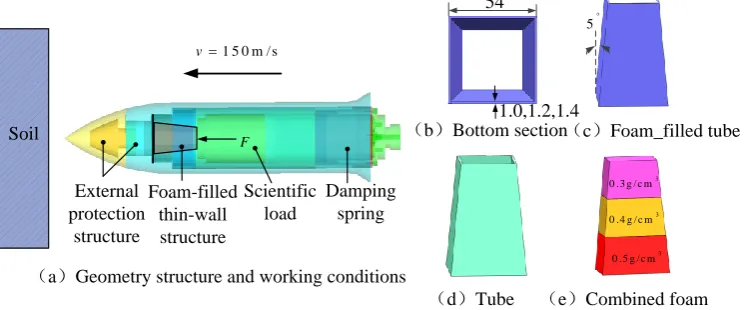
The penetrator consists of an external protective structure (EPS), a foam-filled thin-wall structure (FTS), a scientific load (SL), and a vibration-damping spring. The scientific load includes a detecting device and its power module. The penetrator lands in a free-falling manner with speed of about 150 m/s and collides with the soil. The inertial force of the scientific load acts on the foam-filled thin-wall structure, so the deformation mode and deformation behavior of the thin-wall structure determine the acceleration response of the scientific load. (See figure 1)
F
1 5 0 m / s
v
Soil
Foam-filled thin-wall structure
Scientific load
Damping spring External
protection structure
54
1.0,1.2,1.4
5
(b)Bottom section(c)Foam_filled tube
(d)Tube (e)Combined foam (a)Geometry structure and working conditions
3
0 .3 g / c m
3
0 .4 g / c m
3
[image:2.595.111.485.278.433.2]0 .5 g / c m
Figure 1. Penetrator and thin-wall.
Aluminum Foam
Deshpande and Fleck [9] propose a homogenous constitutive model, and the yield criterion for each uniform foam is defined as:
ˆ y 0
(1)
where y is the yield stress and the equivalent stress ˆ is given as:
2 2 2 2
3
1
[1 ( / 3) ] e m
(2)
where e is the von Mises effective stress and m is the mean stress. Parameter that controls the
shape of the yield surface is a function of the plastic Poisson’s ratio vp given as:
2 9(1 2 )
2(1 )
p
p
v
v
(3)
The hardening criteria in this material model can be described as:
2
ˆ 1
ln[ ]
ˆ
1 ( / )
y p
D D
(4)
where ˆ is equivalent strain, p, 2, , and D are the material parameters and can be related to
2 0 1 0
0
1
( , , , , E ) ( )
ln( )
f K
p p
f
f D
f
C C
(5)
where f is the density of the foam, f0 is the density of the base material, C0, C1 and K are
constants.
Aluminum Alloy 6061-T4
The material of walls is aluminum alloy 6061-T4 [10-11] with the following mechanical properties:
density =2700 kg/m3, Poisson’s ratio = 0.28, Young’s modulus E=70GPa, initial yielding
stresss=110.3Mpa, tangent modulus Et=450Mpa.
Indicators for Energy Absorption
Isolation Efficiency . The isolation efficiency reflects the isolation capability and damping capacity of the thin-walled structure. The larger the isolation efficiency is, the smaller the acceleration transmission efficiency is, and the smaller the acceleration of the scientific load is. Isolation efficiency
is defined as follows:
100%
n m
n
A A
A
(6)Where Amis the peak acceleration of the scientific load and A n is the peak acceleration of the
external protection structure.
Average Acceleration A0 and Acceleration Unevenness . Acceleration unevenness is an
indicator for evaluating the severity of acceleration changes. is defined as follows:
0
m
A A
(7)
Where Am is the peak acceleration of the scientific load and A0 is the average acceleration of the
scientific load.
Energy E. The absorbed energy E [12] is calculated as:
0
d
E
Fdx (8)Where F is the crash force and d is the deformation distance.
Results and Discussion
The foam-filled thin-wall structures are coded: the thin-walled structure, the foams are denoted as S and A, respectively, and the thickness of the thin-walled and the density of the foam are distinguished by numbers. For example, S1.0A0.3 represents a combination of a thin wall of 1.0 mm and a density
of 0.3 g/cm3.
Deformation
During the collision process, the deformation of the empty thin-walls is very large (see Figure 2), indicating that the thin wall is easily deformed and is suitable as an energy absorber.The deformation of the foam-filled thin-walls is more stable, and the amount of deformation is closely related to the foam density. When the thickness of the thin wall is the same, the amount of deformation of the
with foam of 0.5g/cm3 is the smallest, that is, the amount of deformation shows a negative correlation with the density of the foam. At the same time, the thickness of thin-walls also affects the distance of structural deformation. An increase in thickness will improve the stiffness of the energy absorber and inhibit excessive deformation. Therefore, an appropriate combination of foam density and thin-wall thickness can ensure the amount of deformation of the energy absorber.
S1.0 S1.2 S1.4 S1.0A0.3 S1.2A0.3 S1.4A0.3
S1.0A0.4 S1.2A0.4 S1.4A0.4 S1.0A0.5 S1.2A0.5 S1.4A0.5
[image:4.595.177.418.149.294.2]S1.0A0.3~0.5 S1.2A0.3~0.5 S1.4A0.3~0.5
Figure 2. The final densification state of enery absorbers.
Acceleration Response
The EPS is firstly impacted when the penetrator is in contact with the soil. According to the acceleration-time curve obtained from the simulations, the maximum acceleration of the EPS exceeds 10,000 g, and the acceleration rapidly decreases in Figure 3.
[image:4.595.191.406.388.562.2]0 0.002 0.004 0.006 0.008 0.01 -10000 -5000 0 5000 10000 C ru sh in g A c c e le ra ti o n (g ) 15000 Time(s)
Figure 3. Acceleration response curve of EPS.
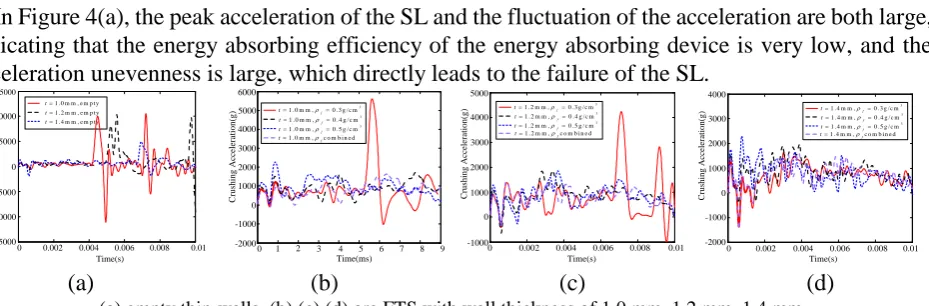
In Figure 4(a), the peak acceleration of the SL and the fluctuation of the acceleration are both large, indicating that the energy absorbing efficiency of the energy absorbing device is very low, and the acceleration unevenness is large, which directly leads to the failure of the SL.
0 0.002 0.004 0.006 0.008 0.01 -15000 -10000 -5000 0 5000 10000 15000 Time(s)
1 .0 m m , e m p t y
t
1 .2 m m , e m p t y
t
1 .4 m m , e m p t y
t C ru sh in g A cc el er at io n (g )
0 1 3 4 5 6 7 8 9
-2000 -1000 0 1000 2000 3000 4000 5000 6000 Time(ms) 2 C ru sh in g A cc el er at io n (g ) 3
1 .0 m m ,f 0 .3 g / c m
t
3 1 .0 m m ,f 0 .4 g / c m
t
3 1 .0 m m ,f 0 .5 g / c m
t
1 .0 m m ,fc o m b i n e d
t
0 0.002 0.004 0.006 0.008 0.01 -1000 0 1000 2000 3000 4000 5000 3 1 .2 m m ,f 0 .3 g / c m
t
3 1 .2 m m ,f 0 .4 g / c m
t
3 1 .2 m m ,f 0 .5 g / c m
t
1 .2 m m ,fc o m b i n e d
t
C ru sh in g A cc el er at io n (g ) Time(s)
0 0.002 0.004 0.006 0.008 0.01 -2000 -1000 0 1000 2000 3000 4000 Time(s) 3 1 .4 m m , f 0 .3 g / c m
t
3 1 .4 m m ,f 0 .4 g / c m
t
3 1 .4 m m , f 0 .5 g / c m
t
1 .4 m m ,fc o m b i n e d
t
C ru sh in g A cc el er at io n (g )
(a) (b) (c) (d)
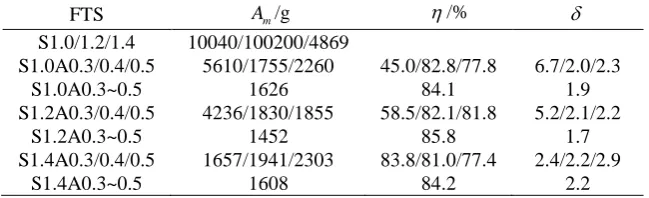
[image:4.595.72.537.590.743.2]The isolation efficiency of FTS with a foam density of 0.3 g/cm3 is very sensitive to wall thickness. Peak acceleration of SL and the unevenness of the acceleration are very large when wall thickness is
small , as shown in Table 1. FTS with a foam density of 0.4 g/cm3 and 0.5 g/cm3 performs well in
[image:5.595.136.461.209.308.2]terms of peak acceleration, acceleration unevenness, and isolation efficiency. The peak acceleration of SL is relatively small, the isolation efficiency is about 80%, the acceleration is relatively stable ,and the unevenness is about 2.2, as shown in Table 1. FTS with combined density has the highest isolation efficiency and the lowest acceleration unevenness, indicating that the combined density performs better than the uniform density.
Table 1. Results of average acceleration, acceleration unevenness, and isolation efficiency.
FTS Am/g /%
S1.0/1.2/1.4 10040/100200/4869
S1.0A0.3/0.4/0.5 5610/1755/2260 45.0/82.8/77.8 6.7/2.0/2.3
S1.0A0.3~0.5 1626 84.1 1.9
S1.2A0.3/0.4/0.5 4236/1830/1855 58.5/82.1/81.8 5.2/2.1/2.2
S1.2A0.3~0.5 1452 85.8 1.7
S1.4A0.3/0.4/0.5 1657/1941/2303 83.8/81.0/77.4 2.4/2.2/2.9
S1.4A0.3~0.5 1608 84.2 2.2
Enery Absorption
S1.0A0.4, S1.2A0.3, and S1.4A0.3 are the best energy absorbers with wall thicknesses of 1.0mm,
1.2mm, and 1.4mm, respectively,which indicates that lower density foams help to increase the energy
absorption of the absorber (Figure 5).
1.0 1.2 1.4 0.3
0.4 0.5 0
200 400 600 800 1000 1200 1400
3
( g / c m )
( m m )
t
E
n
er
g
y
A
b
so
rp
ti
o
n
(
J
)
S1.0 S1.2 S1.4
1.0 0 200 400 600 800 1000 1200 1400 1600
1.2 1.4
E
n
er
g
y
A
b
so
rp
ti
o
n
(
J
)
( m m )
t
[image:5.595.84.516.388.529.2](a) uniform foam-filled square tubes (b) combined foam-filled square tubes Figure 5. Effect of foam density, wall thickness on dynamic absorbed energy.
Conclusions
In this paper, the foam-filled square thin- wall is applied to the high-speed impact penetrator. The research shows that the structure has good energy absorption efficiency and isolation capability under high speed collision. The deformation behaviors of thin-wall, uniform foam-filled thin-wall and combined foam-filled thin-wall are simulated. There are many indicators to evaluate the performance of the energy absorbers, such as isolation efficiency, acceleration unevenness, and the total absorbed energy. The following conclusions can be drawn:
(1) The isolation efficiency and total absorbed energy of the foam-filled thin-walls and are better than that of the thin walls, acceleration of the scientific load are also lower than that of the thin wall, which indicate that the foam is favorable for buffering and energy absorption.
(3) When isolation efficiency, total energy absorption and acceleration unevenness, S1.2A0.3~0.5 is the best design among all the energy absorbers.
Acknowledgement
This research was financially supported by the National Natural Science Foundation of China (Grant No.51505470) and Youth Innovation Promotion Association, CAS and Jiang Xinsong Innovation Fund.
References
[1] Hou S, Li Q, Long S, et al. Crashworthiness design for foam filled thin-wall structures[J]. Materials & Design, 2009, 30(6):2024-2032.
[2] Sun G, Li G, Hou S, et al. Crashworthiness design for functionally graded foam-filled thin-walled structures[J]. Materials Science & Engineering A, 2010, 527(7–8):1911-1919.
[3] Fang J, Gao Y, Sun G, et al. Parametric analysis and multiobjective optimization for functionally graded foam-filled thin-wall tube under lateral impact[J]. Computational Materials Science, 2014, 90(1):265-275.
[4] Duarte I, Vesenjak M, Krstulović-Opara L, et al. Static and dynamic axial crush performance of in-situ, foam-filled tubes[J]. Composite Structures, 2015, 124:128-139.
[5] Dirgantara T, Jusuf A, Kurniati E O, et al. Crashworthiness analysis of foam–filled square column considering strain rate effect of the foam[J]. Thin-Walled Structures, 2018, 129:365-380.
[6] Ebrahimi S, Vahdatazad N, Liaghat G. Crashworthiness efficiency optimisation for two-directional functionally graded foam-filled tubes under axial crushing impacts[J]. International Journal of Crashworthiness, 2017, 22(3):307-321.
[7] Mohammadiha O, Ghariblu H. Crush behavior optimization of multi-tubes filled by functionally graded foam[J]. Thin-Walled Structures, 2016, 98:627-639.
[8] Yanfei Xiang, Min Wang, Tongxi Yu, et al. Key Performance Indicators of Tubes and Foam-Filled Tubes Used as Energy Absorbers[J]. International Journal of Applied Mechanics, 2015, 7(04):155006.
[9] Deshpande V S, Fleck N A. Isotropic constitutive models for metallic foams[J]. Journal of the Mechanics & Physics of Solids, 2000, 48(6–7):1253-1283.
[10] Hou S, Li Q, Long S, et al. Design optimization of regular hexagonal thin-walled columns with crashworthiness criteria[J]. Finite Elements in Analysis & Design, 2007, 43(6-7):555-565.
[11] Çavuşoğlu, O., Leacock, A. G., & Gürün, H. (2016). Forming-limit diagrams and strain-rate-dependent mechanical properties of AA6019-t4 and AA6061-t4 aluminium sheet materials[J]. Materiali in Tehnologije, 2016, 50(6):1005-1010.