© 2016, IRJET | Impact Factor value: 4.45 | ISO 9001:2008 Certified Journal | Page 2024
PAPR Reduction Employing Sub block conversion technique using
Modified SLM Approach
Riddhi Shinde, Dr. B. G. Hogade, Prof Shruti Patil
ME Student, EXTC, Shree L. R. Tiwari College of Engg, Mira Road(E), Thane, Maharashtra, India Professor, EXTC, Terna College of Engg, Nerul (Navi Mumbai), Maharashtra, India
Professor, EXTC, Shree L. R. Tiwari College of Engg, Mira Road(E), Thane, Maharashtra, India
---***---Abstract –
Orthogonal frequency division multiplication(OFDM) is a digital transmission method developed to meet the increasing demand for higher data rates in communications which can be used in both wired and wireless environments. In this system high peak-to-average power ratio (PAPR) is one of the major technical challenges, which brings serious impact on the hardware implementation. In literature, many schemes have been proposed for PAPR reduction, wherein the selective mapping (SLM) scheme is the most popular and widely discussed approach. However, SLM suffers from very high computational complexity because of the requirement of a large number of Inverse Fast Fourier Transformation (IFFT) operations.
A Modified SLM approach based on time domain sub block conversion technique to reduced computational complexity, in this technique frequency domain signal divide multiple sub
blocks the number of the valid conversion matrices can be
increased, and thus more candidate signals are available for PAPR reduction. By applying our scheme, the number of candidate signals can be increased from 12 in the original conversion matrix scheme to 28 and 128 for the two sub block and four-sub block cases, respectively.
Key Words: Orthogonal frequency division multiplication
(OFDM), Peak-to-average power ratio (PAPR),Selective
mapping (SLM), Inverse Fast Fourier Transformation
(IFFT) operations, Time domain sub block conversion
Matrices (TSCM)
1. INTRODUCTION
Orthogonal frequency division multiplexing (OFDM) is a multicarrier modulation technique with bandwidth-efficient signaling schemes for use in high data rate communication systems. This technique received a lot of attention especially in the field of wireless communication because of its robustness to the multi-path fading and it has already been adopted as the standard transmission technique in the wireless LAN systems and the terrestrial digital broadcasting
systems. The WiMAX physical layer (PHY) is based on OFDM modulation. The OFDM system has a high peak-to-average power ratio (PAPR) that can cause unwanted saturation in the power amplifiers, leading to in-band distortion and out-of-band radiation. Peak-to-Average Power Ratio (PAPR) [2] is one of the main drawbacks in OFDM systems. The occurrence of PAPR will make the power amplifier to drive it to non-linearity which causes in-band & out-of-band (OBO) distortions and affects Bit Error Rate (BER) performance. Various methods for PAPR reduction in OFDM systems have been presented to avoid the occurrence of large PAPR. Partial Transmit Sequences (PTS) and Selective Mapping (SLM) [3] are the most effective schemes to reduce large PAPR. Finding the optimum phase sequence requires the exhaustive search over all combinations of the allowed phase factors and the search complexity increases exponentially with the number of sub blocks.
© 2016, IRJET | Impact Factor value: 4.45 | ISO 9001:2008 Certified Journal | Page 2025 also reduce the average complexity of generating a
candidate signal.
1.1 What Is Peak to Average Power Ratio (PAPR)?
Peak to average power ratio is a signal property that is calculated by dividing the peak power amplitude of the waveform by the RMS value of it, a dimensionless quantity which is expressed in decibels (dB). In digital transmission when the waveform is represented as signal samples, the PAPR is defined as
Where S[n] represents the signal samples, max(|S[n]|2) denotes the maximum instantaneous power and E{|S[n]|2} is the average power of the signal, and E{.} is the expected value operation.
1.2 Why We Need to Reduce the PAPR?
Non-linear devices such as high power amplifiers (HPA) and digital to analog converters (DAC) exist in almost all communication links and demand for data transmission over longer ranges. At the same time higher power efficiency of the amplifiers, require the amplifier to operate in a more non-linear region, In general, there is a trade of between linearity and efficiency.
In single-carrier modulation the signal amplitude is somehow deterministic, except for the pulse shaping filter effect, so the operating point in the amplifier can be determined accurately without destructive nonlinear impairments. But in the multi-carrier systems like OFDM, the envelope of the time domain signal will change with different data symbols. Accordingly, the input power amplitude will change with a noticeable variance in specified operating point and the non-linearity effect causes distortion. Distortion acts as noise for the receiver, and also the signal constellation rotates due to phase conversion. Moreover, the out-of-band distortion of subcarriers is the result of non-linearity impairments, which causes cross talk since the subcarriers are not orthogonal any
more [3]. To estimate the distortion which is caused by
non-linearity, it is desired to have a measure of the signal to show its sensitivity to non-linearity. A well-known measure for the multi-carrier signals is peak to average power ratio (PAPR). The higher the PAPR, the more fluctuation in the signal amplitude, so the
operating point in the amplifier needs to be set far enough from saturation point and this input back off 1 reduces the efficiency.
2. EXISTING TECHNIQUE
[image:2.595.313.553.166.344.2]2.1 Slective Mapping
Figure 1. Block diagram of SLM
In the conventional SLM scheme, M statistically independent phase sequences are generated, and then multiplied by the frequency-domain data sequence X to produce the M independent candidate signals. Through IFFT transformations, the candidate signal with the lowest PAPR is selected for transmission, as shown in Fig. 1. Let the frequency-domain candidate signal So=X be the original data vector and the corresponding time-domain signal be
=
= X,where represents the matrix of IFFT.
The time-domain candidate signals are
=
For m = 0, …, M – 1.
In conventional SLM, the transmitter requires performing M IFFT operations in order to generate the
M time-domain candidate signals, leading to a very high computational complexity.
2.2 Modified SLM (MSLM)
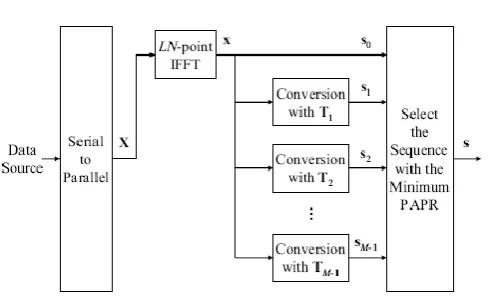
© 2016, IRJET | Impact Factor value: 4.45 | ISO 9001:2008 Certified Journal | Page 2026 Figure2. Block diagram of MSLM
To reduce the computational complexity, it is suggested that some constraints must be satisfied:
The first column vector tm contains only i non-zero elements, where i = 2, 3, or 4.
The real and imaginary parts of each non-zero element in tm must be +1, -1, or 0 (ignoring the constant factor).
All the elements of the corresponding phase rotation vector must be non-zero and have the same magnitude, in order to prevent any distortion on the frequency-domain signals [6].
By computer searching based on the constraints proposed in [6], only 12 candidate signals, i.e., M = 12, are available for PAPR reduction. If the constraint of the same magnitude in a phase rotation vector is relaxed, more candidate signals can be obtained; however, the bit error rate (BER) performance will be significantly degraded.
3. PROPOSED MODEL
3.1 Two Sub block TSCM – SLM
The basic concept of the TSCM-SLM scheme is to divide the frequency-domain data sequence into multiple sub-blocks by using interleaved partition. In other words, each sub-block contains the data symbols upon subcarriers with equally-spaced indices. By this means, the number of valid conversion matrices is greatly increased. For convenience of analysis and explanation, the cases with two sub-blocks and four sub-blocks
[image:3.595.39.284.130.281.2]Fig. 3 shows block diagram of two sub block TSCM SLM. Input data is divided in to two sub block and
Figure 3. Block diagram of two sub block TSCM-SLM length of these sub blocks is N/2. After the over sampling and passing through the LN/2 point IFFT operation, we obtain the time domain signal with length equal to LN/2 and can be extended to length LN easily by applying basic concept of FFT[7]. The resultant time-domain signals are represented as xe
and xo, respectively. Then, xe and xo are respectively multiplied by the conversion matrices Ag and Bh to obtain the partial candidate signals. Sm is obtain by summing the two extended partial candidate signal Se,m and So,m.
By applying this scheme complexity is not higher than MSLM. In order to ensure that no more than three complex vector additions are required for the generation of a candidate signal:
The first column vector tm contains no more than two nonzero elements.
Therefore, the generation of a candidate signal involves no complex multiplications, and there is no degradation in the BER performance.
3.2 Four Sub block TSCM-SLM
Fig. 3 shows block diagram of four sub block TSCM SLM. In this technique we can divide the frequency domain in to four sub block and we get the more candidate signal.
In this approach, the modified constraint to restrain the computational complexity is:
© 2016, IRJET | Impact Factor value: 4.45 | ISO 9001:2008 Certified Journal | Page 2027 Therefore, we need only three complex vector
additions for the generation of a candidate signal.
Figure3. Block diagram of Four sub block TSCM-SLM
[image:4.595.320.570.373.571.2]4. COMPUTATIONAL COMPLEXITY
Table 1 : Comparison of computational complexity
Number of
multiplication Number of additions SLM (LN/2)log2(LN) (LN)log2(LN)
MSL
M (LN/24)log2(LN) (LN/12)log2(LN)+2.75LN Two
block (LN/56)log2(LN) (LN/28)log2(LN)+1.57LN Four
block (LN/256)log2(LN) (LN/128)log2(LN)+2.98LN
As shown in table 1 computational complexity of different scheme with over sampling factor L. In SLM scheme generation of candidate signal requires an LN point IFFT operation
In MSLM only one IFFT operation is require for generation of candidate signal i. e. M=12. In propose scheme, the complexity of block is shown in block diagram as dashed line there is also require LN point IFFT except final summation operation
5. SIMULATION RESULT
The complementary cumulative distribution function (ccdf), defined as the probability that the PAPR
value is smaller than a specific value is used to evaluate the PAPR reduction performance. In the simulations, the number of subcarriers N is set to be 256, 512 or 1024, and the 16-QAM modulation scheme is adopted. The conventional SLM [3] and MSLM [6] are also evaluated for performance comparison with the proposed TSCM-SLM scheme
Fig.4 shows the conventional SLM, Fig.5 MSLM and Fig.6 shows the result for conventional, modified and two sub blocks TSCM-SLM respectively.Fig.7 shows the performance comparison of the proposed TSCM-SLM scheme and the MSLM scheme. Since the number of available candidate signals by applying TSCM- SLM is significantly larger than that obtained by MSLM, the performance of TSCM-SLM is substantially better than that of MSLM. We can find 28 and 128 valid candidate signals for the cases with two sub-blocks and four sub blocks respectively. Applying the proposed scheme can result in not only more valid candidate signals, but also less computational complexity per candidate signal.
[image:4.595.29.297.403.552.2]© 2016, IRJET | Impact Factor value: 4.45 | ISO 9001:2008 Certified Journal | Page 2028 Figur 5. Result of MSLM
Figure 6. Result of two sub block
Figure 7. Result of four sub block
Figure 8. Comparison between SLM, MSLM, Two block and Four Block
We can find 28 and 128 valid candidate signals for the cases with two sub-blocks and four sub blocks respectively. Applying the proposed scheme can result in not only more valid candidate signals, but also less computational complexity per candidate signal.
Table 2: Computational complexity value
6. CONCLUSION
In this paper, we have proposed low-complexity conversions for LN -point IFFT computation in the SLM approach. We have utilized them to replace the IFFT blocks in the conventional SLM approach and proposed two new SLM schemes. By using proposed scheme PAPR reduced and we get less computational complexity as compare to SLM and MSLM scheme. Since the number of candidate is increased by applying, more side information is also needed as compared to MSLM. Again for the same size of side information
[image:5.595.51.278.357.550.2]© 2016, IRJET | Impact Factor value: 4.45 | ISO 9001:2008 Certified Journal | Page 2029 will be divided into more sub blocks. For 256 candidate
signal total 6 numbers of sub blocks are required but it may increases the amount of side information and the computational costs.
7. ACKNOWLEDGEMENT
I am greatly indebted to Prof. B. G, Hogade my guide for her valuable advices at every stage of this work. Without the supervision and many hours of devoted guidance, stimulating and constructive criticism, this paper would never have come out in this form.
8. REFERENCES
[1] A. V. Oppenheim, R. W. Shafer and J. R. Buck, Discrete- Time Signal Processing, 2/e.Prentice Hall, 1999. [2] R. W. Bauml, R. F. H. Fischer and J. B. Huber, “Reducing
the peak-to average power ratio of multicarrier modulation by selective mapping,” Electron. Lett., vol. 32, no. 22, pp. 2056- 2057, Oct. 1996.
[3] A. D. S. Jayalath and C. Tellambura, “Reducing the peak- to- average power ratio of orthogonal frequency division Multiplexing signal through bit or symbol interleaving,” IETEletronics Letters, vol. 36, no. 13, pp.1161-1163, Jun. 2000.
[4] C.-L. Wang, M.-Y.Hsu and Y.Ouyang, “A low Complexity peak-to average power ratio reduction technique For OFDM systems,” in Proc. IEEE GLOBECOM, Dec. 2003, vol. 4, pp.2375–2379.
[5] A. D. S. Jayalath and C. R. N. Athaudage, “On the PAPR reduction of OFDM signals using multiple signal representation,” IEEE Commun. Letters, vol. 8, no. 7, pp. 425-427, July 2004.
[6] C.-L. Wang and Y. Ouyang, “Low-complexity selected mapping schemes for peak-to-average power ratio reduction in OFDM systems,” IEEE Trans. Signal Processing, vol. 53, no. 12, pp. 4652– 4660, Dec. 2005. [7] G. Lu, P. Wu and C. Carlemalm-Logothetis, “Enhanced Interleaved partitioning PTS for peak- to-average Power ratio reduction in OFDM systems,” Electron. Lett., vol. 42, no.17,pp. 983– 984, Aug. 2006
[8] C.-L. Wang and S.-J. Ku, “Novel conversion matrices for Simplifying the IFFT computation of an SLM -based PAPR reduction scheme for OFDM systems,” IEEE Trans Commun., vol.57, no. 7, pp. 1903-1907, July 2009. [9] Dae-Woon Lim, Jong-Seon No, “A New SLM OFDM
Scheme with Low complexity for PAPR Reduction”, Member, IEEE, Chi-Woo Lim, and Habong Chung, Member, IEEE. .