© 2015, IRJET.NET- All Rights Reserved
Page 1644
DYNAMIC ANALYSIS OF SOFT STOREY BUILDING WITH FLAT SLAB
RAVINDRA B N
1, MALLIKARJUN S. BHANDIWAD
21
Student (M.Tech), Department of Civil Engineering, SDMCET, Karnataka, India
2Assistant Professor, Department of Civil Engineering, SDMCET, Karnataka, India
---***---Abstract -
Present study, as per IS code 1893:2002analysis carried out by considering regular and irregular buildings with brick infill and modified building with strong column and shear wall at the corner of the soft storey. For linear and nonlinear analysis 5, 10, and 15 storey buildings modeled by using ETABS software considering Response reduction factor, Importance factor, Zone factor, damping ratio,
loads as per code Lateral displacement, base
shear and hinge reactions were obtained according to code provision
Key Words:
Soft Storey, Flat sab, Pushover Analysis,
Irregular Building, Earthquake Behavior, Stiffness,
Masonry Infill, Tall Building.
1. INTRODUCTION
Earthquake Ground Motion (EQGMs) are the most dangerous natural disaster that cause loss of life and live hood. Frequent courses are damages are collapse of building. Vibrations are not only the Couse of damage it also contain chain link like landslide, flood, fires, Tsunami etc... So that it is very important to design the structure for moderate to severe earthquake based on important and site of construction. If the existing building is not designed to earthquake it should be retrofitted to improve
Now a day flat-slab building are more popular as well as advantages then regular slab-beam-column strictures because of following reasons. It have less time to construct, give good aesthetic view, free design space but flat slab is more flexible to lateral loads due to the absence of shear wall and beams so that it is seismically not more safe as compared to traditional system
In metropolitan cities multi-storey buildings essential requires open first storey for parking of vehicles, for retail shopping, for office meeting room, they required large space. For this preps ground floor has lesser strength and stiffness compared to remaining stories which have masonry infill wall. This phenomena of building create soft and weak storey problem, due to soft storey flexibility in first storey increases as a result excessive deflection, which leads to more force concentration at second story
connection show plastic deformation during earthquake the energy developed is directly acting on column with soft storey. At this level plastic hinges are formed at column ends, which transvers the soft-storey into a mechanism, in that situation collapse of building happens. So that soft storey building required special consideration in designing as well as analyzing
This study aim is to investigate behavior of flat slab building with soft story using nonlinear static analysis by considering regular and irregular buildings with brick infill and modified building with strong column and shear wall at the corner. For linear and nonlinear analysis 5, 10, and 15 storey buildings modeled by using ETABS 9.7.4. Beam and column elements are modeled as nonlinear frame elements with lumped plasticity by defining plastic hinges at both ends of beams and columns. Lateral displacement, base shear and hinge reactions were obtained according to code provision.
2.
MODELING OF THE BUILDING
In which the entire modeling and analysis has will be carried in 3D models using ETABS Nonlinear version. For the present study 5, 10, 15 storey regular and irregular buildings were modeled. Regular building in one in symmetrical plan and elevation is taken. Hear four irregular buildings were taken they are explained below. Buildings dimensions, material taken, section property, loading data, load combination, seismic data all detailed below. The results are organized in order to emphasis the parameters such as base shear, story drift and lateral displacements in linear analysis. In Nonlinear analysis, the identification of plastic hinges at various performance levels, Performance point and capacity of various models were studied
Types of buildings considered for present study are
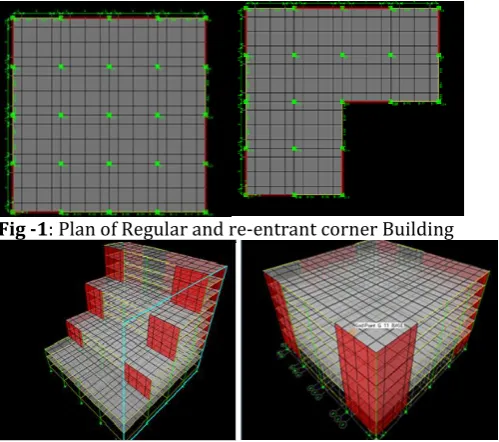
Regular building: it is modeled with symmetrical plan and elevation in three different heights, i.e. 5, 10 and 15 stories, shown in fig 1 below
Re-entrant corner building: one fourth of the grid has been erased in order to make it re-entrant as shown in fig 2, modeled for 5, 10, and 15 stories. Torsion Irregularity buildings: live load is increased more than 200% in 1/4th part of a regular building ,as shown in fig 3, modeled for 5, 10, and 15 stories
© 2015, IRJET.NET- All Rights Reserved
Page 1645
Mass Irregularity building: live load is increased more than 200% that of a regular building in 4thfloor in 9thfloor in 14th floor, as shown in fig 5, modeled for 5, 10, and 15 stories
Building with ground floor stiffness altered: stiffness of the structure is increased by increasing the size of ground Flore column, as shown in fig 5, modeled for 5, 10, and 15 stories
Building with shear wall at the corner of ground Flore:
shear walls are provided at the corners of the buildings, as shown in fig 5, modeled for 5, 10, and 15 stories
Building with shear wall at the corner of ground Flore and ground floor stiffness altered: shear walls are provided at the corners of the buildings and increasing the size of ground Flore column of the structure, as shown in fig 5, modeled for 5, 10, and 15 stories
Fig -1: Plan of Regular and re-entrant corner Building
Fig -2: 3D view of vertical irregular and Building with shear wall at corner of ground floor and ground floor stiffness altered
Table -1: TableInput data of all the building models for equivalent static analysis (IS1893)
Zone V
Zone factor, Z (Table 2) 0.36
Importance factor, I (Table 6) 1
Response reduction factor, R (Table 7) 5
Damping ratio 5% (for RC framed
[image:2.595.302.564.73.665.2]buildings)
Table -2:Input data of all the building models
No. of storey 5, 10,15
Storey height 3.0 m
Seismic zone V
Material Properties
Grade of concrete M25 for slab & drop, column
Grade of steel Fe 415
Density of reinforced concrete 25 kN/m3
Member Properties
5 Storey 10 Storey 15 Storey
Slab 0.2m 0.2m 0.2m
Drop 0.45m 0.45m 0.45m
Column 0.6x0.6m 0.7x0.7m 0.75mx0.75m
Grong storey modified buildings properties
Member Properties
5 Storey 10 Storey 15 Storey
Slab 0.2m 0.2m 0.2m
Drop 0.45m 0.45m 0.45m
Column 0.6x0.6m 0.7x0.7m 0.75mx0.75m
Column for ground Flore
0.75x0.75m 0.85x0.85m 0.95mx0.95m
Shear wall 0.2m 0.2m 0.2m
Live Load Intensities
Roof 1.5 kN/m2
Floor 3.0 kN/m2
SDL
Roof 2.5 kN/m2
Floor 2.0 kN/m2
3. RESULTS AND DISCUSSIONS
[image:2.595.37.287.298.519.2]© 2015, IRJET.NET- All Rights Reserved
Page 1646
result of top displacement, storey drift, base shear andpushover curve were plotted for different building models (five ten fifteen storey’s) for different irregularities.
3.1 Comparing parameters in all type of regular
and irregular buildings
Table -3: Lateral displacement of 5 storey buildings
Storey
Lateral displacement in meter Regula
r
Re-enter
Vertical Torsion mass
5 0.1040 25 0.0977 51 0.0626 34 0.1126 03 0.1086 81 4 0.1013
35 0.0961 33 0.0621 80 0.1100 70 0.1062 69 3 0.0986
44 0.0945 16 0.0615 69 0.1075 36 0.1038 56 2 0.0959
52 0.0928 97 0.0605 82 0.1050 01 0.1014 43 1 0.0932
60 0.0912 80 0.0595 68 0.1024 67 0.0990 30 G F 0.0905
67 0.0896 62 0.0581 31 0.0999 32 0.0966 16
Chart -1: Variation of displacement for regular and irregular 5 storey building
Similarly 10 15 storey buildings of regular plan and four type of irregular buildings Lateral displacement were taken. By observing these results we can easily identified that as storey height increases displacement also increases. In ground floor only least displacement occur for all building type torsional irregular building shows more displacement next mass, regular, re-entrant and vertical irregular building shows least displacement
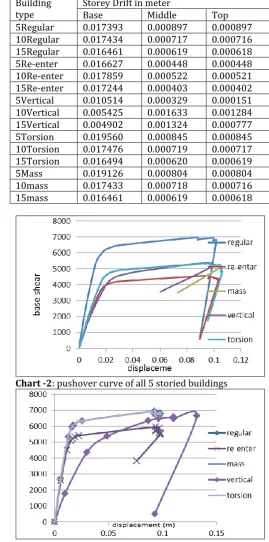
The table-4 contains storey drift for both regular and
irregular 5, 10, 15 storey buildings. It is clearly shows that due to soft storey more drift occur at the base in all regular and irregular buildings.in all type of buildings at the top and middle it shows almost similar drift. As we observe carefully we can find that torsion irregular building shows more drift at base next mass irregularity, [image:3.595.293.563.150.694.2]regular building, re-entrant, finale vertical irregular building shows lees drift.
Table -4: Comparing storey drift of all regular and irregular buildings
Building type
Storey Drift in meter
Base Middle Top
5Regular 0.017393 0.000897 0.000897 10Regular 0.017434 0.000717 0.000716 15Regular 0.016461 0.000619 0.000618 5Re-enter 0.016627 0.000448 0.000448 10Re-enter 0.017859 0.000522 0.000521 15Re-enter 0.017244 0.000403 0.000402 5Vertical 0.010514 0.000329 0.000151 10Vertical 0.005425 0.001633 0.001284 15Vertical 0.004902 0.001324 0.000777 5Torsion 0.019560 0.000845 0.000845 10Torsion 0.017476 0.000719 0.000717 15Torsion 0.016494 0.000620 0.000619 5Mass 0.019126 0.000804 0.000804 10mass 0.017433 0.000718 0.000716 15mass 0.016461 0.000619 0.000618
Chart -2:pushover curve of all 5 storied buildings
Chart -3:pushover curve of all 10 storied buildings
© 2015, IRJET.NET- All Rights Reserved
Page 1647
irregularity, torsion, vertical finally re-entrant cornerbuilding shows less base shear. Almost all buildings were came under life safety and collapse prevention stage. Some of the elements were gone above this boundary. From this date vertical irregular buildings are safer next regular, torsion, mass in re-entrant irregular building more elements were cross the LS-CP rang.
Chart -4:pushover curve of all 15 storied buildings
3.1 Comparing parameters in all modified
buildings
[image:4.595.39.290.185.333.2]By observing the displacement of 5, 10, 15, regular and irregular building. All type of buildings shows excessive displacement which Exide’s code limit. In order to obtain the deflection within limit some modifications are done hear. They are altering the stiffness of the ground storey by increasing the size of the column. Lateral resisting forces is increased by providing concrete shear wall at the corner of the buildings. And another modification is proving stiff column as well as lateral resisting system by increasing size of the column and providing concrete shear wall at corner.
Table -5: Lateral displacement of 5 storey buildings storey Lateral displacement in meter
Regular Modified buildings column Shear
wall
CL wt. SW
Storey5 0.104025 0.091032 0.038869 0.038649 Storey4 0.101335 0.088417 0.035856 0.035615 Storey3 0.098644 0.085802 0.032842 0.032578 Storey2 0.095952 0.083186 0.029827 0.032578 Storey1 0.093260 0.080570 0.026812 0.026504 G F 0.090567 0.077953 0.023800 0.023470
Similarly 10 15 storey buildings of regular plan and three types of modified buildings Lateral displacement were taken. By observing the displacement of 5, 10, 15, mass irregular and modified buildings. Mass irregular buildings shows excessive displacement which Exide’s code limit. In order to obtain the deflection within limit same modifications are done hear. Those modifications are already explained above and hear little bit different results
obtained hear as compared to above results. By observing the displacement of modified buildings we can clearly observe that lateral displacement reduced hear and column modification shows very least displacement which leads to brittle failure of building next column with shear wall finally shear wall providing modification shows small reduction in lateral displacement. These two modifications can be adopted.
Similarly all four irregular buildings were modified and they give some different results
Table -6: Comparing Drift in modified 5 storey Regular buildings
Building type
Storey Drift in meter
Base Middle Top
5Regular 0.017393 0.000897 0.000897 column 0.012638 0.000872 0.000871 Shear wall 0.010373 0.001005 0.001004 CL wt. SW 0.010153 0.001012 0.001011
Similarly 10 15 storey buildings of regular plan and three types of modified buildings Lateral displacement were taken.By observing the drift of 5, 10, and 15, regular and irregular buildings some of the building models shows excessive drift which exudes IS code limit. The code allows limits the drift to 4% of the storey height only. And some are not cross the limit. Although hear all buildings are modified to bring the drift to lower level. They are altering the stiffness of the ground storey by increasing the size of the column. Lateral resisting forces is increased by providing concrete shear wall at the corner of the buildings. By this process all buildings shows least drift for different cases as compared to early stages. Hear we observe that in case of regular buildings it shows least drift for column modification with shear wall next shear wall provision finally for column modification it shows minimum liming of drift. For all irregular buildings re-entrant, vertical geometrical irregular, mass irregular and torsion irregular. Maximum drift can be controlled by providing shear wall at ground storey only. If you increase the stiffness of Colum with shear wall it will not alter anything. By increasing only the column stiffness small amount of drift reduction takes place.
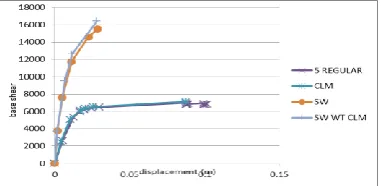
Chart -5: pushover curve of 5 storey regular and modified buildings
[image:4.595.310.501.595.688.2]© 2015, IRJET.NET- All Rights Reserved
Page 1648
Among them column modified buildings shows maximumbase shear next regular building, building with shear wall and column modification, column modification building shows less base shear. Almost all buildings were came under life safety and collapse prevention stage. Nan of the elements were gone above this boundary. In which all buildings were come under A-B region.
4. SUMMARY AND CONCLUSION
4.1
Summary
The present work is an analytical investigation of both regular and irregular soft storey buildings with flat slab are made and nonlinear static method (pushover analysis) are performed 5, 10, 15 storey’s building. All the buildings located in seismic zone-v, analysis is done according to IS-1893-2002 (part-1) to study the parameters like lateral displacement, base shear, storey drift, hinge formation in the structures. And the study also including the modification of the building and strengthening takes place by providing strong column and shear walls at ground storey of the buildings
4.2
The study leads to the following
conclusion
As the storey height increases displacement increases. Torsion irregular buildings shows more displacement next to the mass, regular, re-entrant corner and vertical irregular buildings.
In regular and irregular building it is found that storey drift shows more in ground storey comparing to the upper storeys. Because in upper storey’s infill wall restrict the drift
Regular buildings shows more base shear next to the mass, torsion, vertical re-entrant corner irregular building.
Almost all buildings were comes under life softy and collapse prevention stage. Some of them were gone above this boundary. It leads to modification of buildings.
Modified regular and re-entrant corner building shows less lateral displacement by strong column and shear wall at the ground storey. Whereas vertical, mass, torsion buildings shows less displacement by only strong column.
The modified Regular building shows least drift by only strong column whereas lees drift in irregular buildings by only shear wall provision.
Modified both regular and irregular buildings shows less base shear by only strong column at ground storey.
From the all parameters study it is clear that Soft storey building with flat slab is seismically not safe in order to make building seismically safe provision of shear wall and strong column at the ground storey essential.
comes content here. Paragraph comes content here. Paragraph comes content here. Paragraph comes content here. Paragraph comes content here. Paragraph comes
content here. Paragraph comes content here. Paragraph comes content here. Paragraph comes content here. Paragraph comes content here. Paragraph comes content here. Paragraph comes content here.
ACKNOWLEDGEMENT
I would like to thank my guide, head of department, principal, friends, family and all others who have helped me in the completion of this thesis.
REFERENCES
[1] Dr. Jagadish kori g spoorthi s k “effect of soft storey on tall buildings at various storei pushover analysis ”International Journal of Engineering Research and Applications (IJERA) Vol. 2, Issue 3, Jun 2014, pp.91-98.
[2] Dande P. S., Kodag P. B. “Influence of Providing of Soft Storey in RC Frame Building for Earthquake Resistance Design” (IJERA)Vol. 3, Issue 2, March -April 2013, pp.461-468
[3] Sandesh D.Bothara, Dr.Valsson Varghese “Dynamic Analysis Of Special Moment Resisting Frame Building With Flat Slab And Grid Slab” International Journal of Engineering Research and Applications (IJERA) Vol. 2, Issue 4, July-August 2012, pp.275-280.
[4] Fabio Nardone, Ph.D.; Gerardo Mario Verderame; Andrea Prota; and Gaetano Manfredi4 (2010) “Comparative Analysis on the Seismic Behavior of Combined
RC-Masonry Buildings”. ASCE J. Struct. Eng. 2010.136:1483-1496.
[5] A. E. Hassaballa , M. A. Ismaeil b, A. N. Alzeadc, Fathelrahman M. Adam (2010) “Pushover Analysis of Existing 4 Storey RC Flat Slab Building” International Journal of Sciences :Basic and Applied Research( IJSBAR)(2014) Volume 16, No 2, pp. 242-257
[6] Amit A. Sathawane, R.S. Deotale “Analysis and Design of Flat Slab and Grid Slab and Their Cost Comparison” International Journal of Engineering Research and Applications (IJERA) Vol. 1, Issue 3, pp.837-848
© 2015, IRJET.NET- All Rights Reserved
Page 1649
Pushover Analyses” ASCE J. Struct. Eng.2004.130:1177-1185.