© 2016, IRJET | Impact Factor value: 4.45 | ISO 9001:2008 Certified Journal | Page 103
Performance Evaluation between GA versus PSO
1
Ajay kaushik, 2Hiesh kumar
1M.tech Research scholar, ECE deptt., SGI, Panipat, Haryana, India
2Assistant professor, ECE deptt., SGI, Panipat, Haryana, India
---***---Abstract -
Wireless sensor network is a collectivearrangement of interconnecting tiny sensor nodes. These sensor nodes are deploy into a physical area for various monitoring purpose, battlefield surveillances etc. These sensor nodes are equipped with a limited battery, processing circuit, transceivers etc. When sensor nodes are in operation, performing their task most of their energy is depleted in improper routing, uneven distribution of traffic load and sometime congestion of traffics or data frames. So in this paper we are proposing two metaheuristic based load balancing techniques GA and PSO and have a comparative result analysis in between them.
Key Words: WSN,Genetic algorithm (GA),Particle swarm optimization (PSO), Load balancing, Optimization,
Metaheuristics.
1.INTRODUCTION
Energy of wireless sensor node is an important characteristic for the whole network to be stay long lasting period. As the nodes energy is depleted faster, nodes will dies earlier and network lifetime of WSN system decrease, whole network will shut down. The cause of nodes energy depletion due to several reasons like as improper routing paths, uneven distribution of traffic loads[5], congestion and hardware problem etc. So for the long lasting stay of WSN system we enhance the nodes energy by some optimizing technique by which energy consumption will be fewer and lifetimes of nodes can be increased. In some recent years, some biological metaheuristic swarm intelligence based optimization technique is proposing their algorithms to optimize the energy or lifetime of WSN system. Swarm intelligence is a computational technique which is inspired from social behaviour of bird flocking, fish schooling, nest building and adopt their behaviour into computational and computer graphics. In this paper we are proposing two load balancing metaheuristic techniques[6] GA and PSO which will minimize the load balancing energy cost value and execution time so as to decrease the energy consumption of sensor nodes and enhance the lifetime of WSN system.
Research Objective
In this paper we are finding the impact of increasing number of iteration and percentage of load distribution on WSN nodes.
1. In first case we are going to minimize the load balancing energy cost and execution time of WSN node by proceeding maximize the no. of iterations and load distributions.
2. In second step we are finding the result analysis by which proposed methodology will minimize the load balancing and execution time of sensor nodes and have a comparison in between them.
II. GA (GENETIC ALGORITHM)
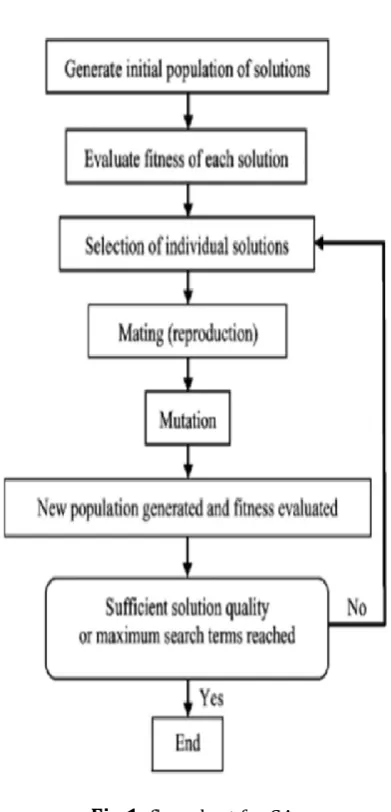
GA is swarm intelligence based metaheuristic technique that minimize the process of natural selection. This technique is used to generate optimal solutions to optimization and search problems. Genetic algorithms belongs to the higher class of evolutionary algorithms (EA), which generate solutions to optimization problems using techniques inspired by natural methods, like inheritance, mutation, selection and crossover.
How GA Works
© 2016, IRJET | Impact Factor value: 4.45 | ISO 9001:2008 Certified Journal | Page 104 population. Once the genetic representation and the
fitness function are defined, GA proceeds to initialize a population of solutions and then to improve the solution through the mutation, crossover, inversion and selection operators.
Flow chart
Fig 1: flow chart for GA
III. PSO (PARTICLE SWARM OPTIMIZATION)
PSO (Particle swarm optimization)[7] was provided by Kennedy and Eberhart in 1995. It has origins in the simulation of communal behaviours retaining instruments and thoughts grabbed from computer graphics and communal psychology research
PSO is inspired by the bird flocking and fish schooling pattern of swarms. These two methods developed
computer software simulations based on birds flocking around food sources, and then later realized how well their algorithms worked on optimization problems.
How PSO Works
In the PSO Algorithm PSO models social behavior of a flock of birds. It consists of a swarm of s candidate solutions called particles, which investigate an n-dimensional hyperspace in search of the global solution (where n shows the number of optimal parameters to be find out). A particle having position and velocity in a search space. Each particle node is determined through an objective function. The fitness value of a particle node is near to the global solution is lower (higher) than that of a particle that is farther. PSO is to minimize or maximize the cost (fitness) value function. In the global best version of PSO the position where the particle i has its lowest cost-fitness value stored as (pbest). Besides gbest, the position of the best particle
node. In every single iteration k, velocity V and position X are evaluated and updated. The update process is iteratively repeated until either a suitable gbest is obtained or a fixed number of iterations kmax is reached.
ADVANTAGE OF PSO OVER GA
1. Genetic algorithm requires some genetic operator like as crossover, mutation, selection etc. but in PSO only few parameter are to adjust, easy to implement.
2. In GA computational cost is very high but PSO minimize this function.
3. PSO is a multicriteria function, check local and global functions but GA checks only present fitness function.
[image:2.595.92.288.206.613.2]© 2016, IRJET | Impact Factor value: 4.45 | ISO 9001:2008 Certified Journal | Page 105 Flow Chart
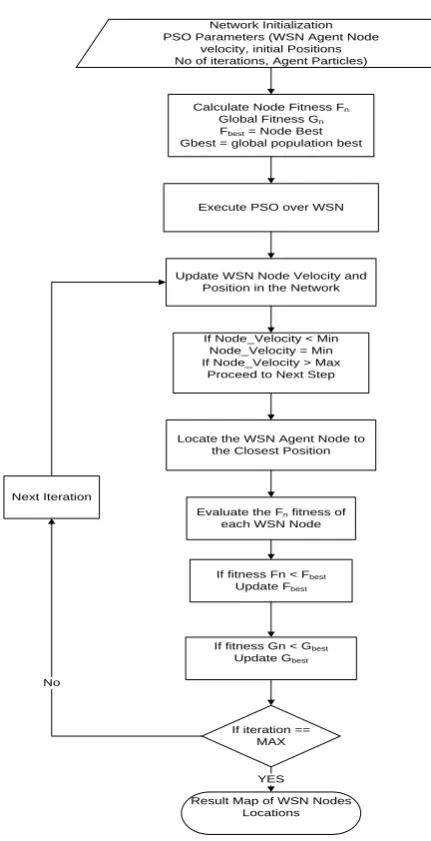
Network Initialization PSO Parameters (WSN Agent Node
velocity, initial Positions No of iterations, Agent Particles)
Calculate Node Fitness Fn Global Fitness Gn Fbest = Node Best Gbest = global population best
Execute PSO over WSN
Update WSN Node Velocity and Position in the Network
If Node_Velocity < Min Node_Velocity = Min If Node_Velocity > Max
Proceed to Next Step
Locate the WSN Agent Node to the Closest Position
Evaluate the Fn fitness of each WSN Node
If fitness Fn < Fbest Update Fbest
If fitness Gn < Gbest Update Gbest
If iteration == MAX Next Iteration
No
Result Map of WSN Nodes Locations
YES
Fig 2: flow chart for PSO
IV. SIMULATION AND RESULT
The results are optimized through proposed load balancing technique using GA and PSO has been simulated with the software MATLAB 2012b.Results are simulated using the parameters load balancing energy cost and execution time of WSN nodes in the following cases:
1. When no. of iterations are changing. 2. When % of load distribution is changing.
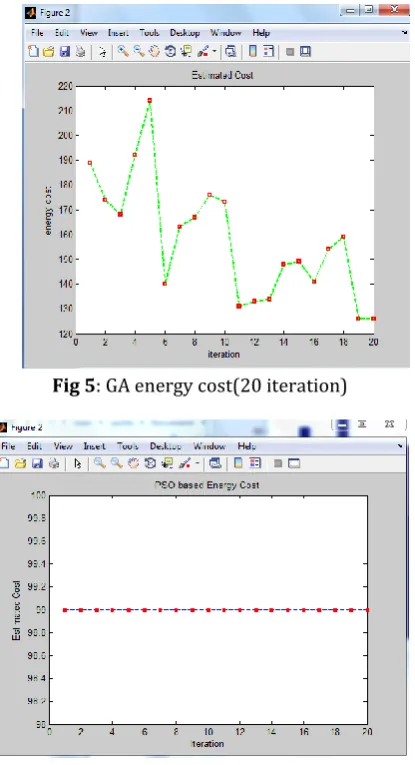
Results are optimized in comparison of these two methodologies which technique will minimize the LB energy cost and execution time of nodes to increase the network lifetime of WSN system.
Case 1: when no. of iteration changing
A. Load balancing energy cost GA/PSO
Fig 3: GA energy cost value( 10 iteration)
[image:3.595.35.251.140.561.2] [image:3.595.344.552.238.439.2] [image:3.595.346.556.471.678.2]© 2016, IRJET | Impact Factor value: 4.45 | ISO 9001:2008 Certified Journal | Page 106
Fig 5: GA energy cost(20 iteration)
Fig 6: PSO energy cost(20 iteration)
Fig 7: GA energy cost (30 iteration)
Fig 8: PSO energy cost(30 iteration)
B. Execution time GA/PSO
Fig 9: GA execution time(i=10)
[image:4.595.61.269.118.501.2] [image:4.595.349.559.124.310.2] [image:4.595.56.269.528.714.2]© 2016, IRJET | Impact Factor value: 4.45 | ISO 9001:2008 Certified Journal | Page 107 Fig11: GA execution time (i=20)
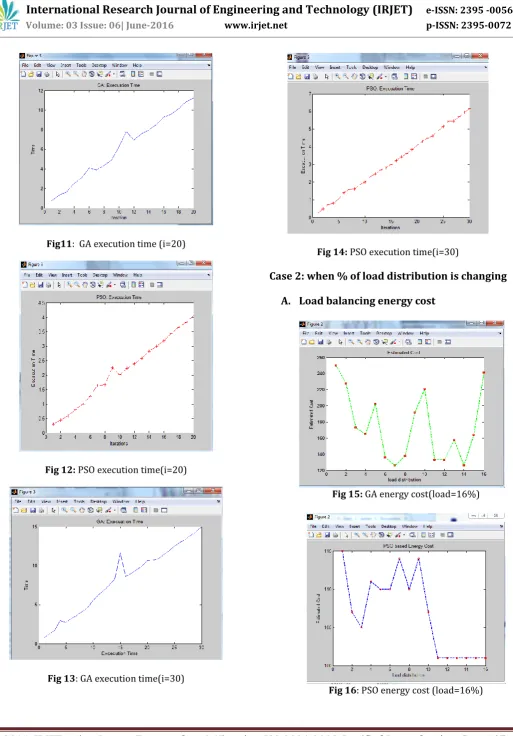
Fig 12: PSO execution time(i=20)
Fig 13: GA execution time(i=30)
Fig 14: PSO execution time(i=30)
Case 2: when % of load distribution is changing
A. Load balancing energy cost
Fig 15: GA energy cost(load=16%)
[image:5.595.45.559.46.783.2] [image:5.595.343.554.361.735.2]© 2016, IRJET | Impact Factor value: 4.45 | ISO 9001:2008 Certified Journal | Page 108
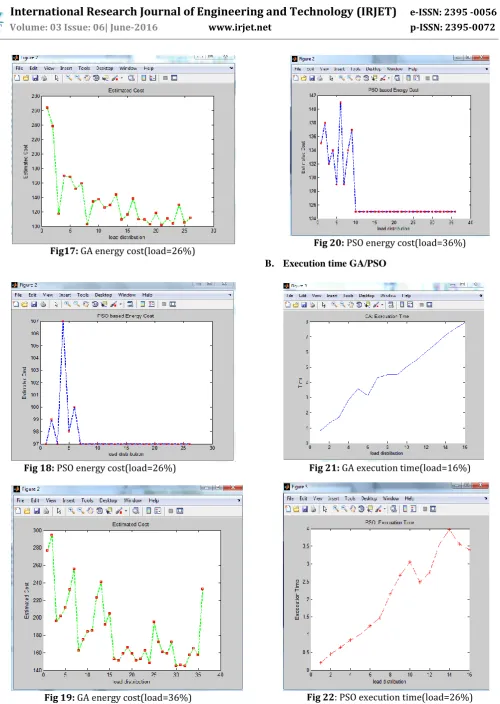
Fig17: GA energy cost(load=26%)
Fig 18: PSO energy cost(load=26%)
[image:6.595.61.562.44.749.2]Fig 19: GA energy cost(load=36%)
Fig 20: PSO energy cost(load=36%)
B. Execution time GA/PSO
Fig 21: GA execution time(load=16%)
[image:6.595.71.295.87.289.2]© 2016, IRJET | Impact Factor value: 4.45 | ISO 9001:2008 Certified Journal | Page 109 Fig 23: GA execution time(load=36%)
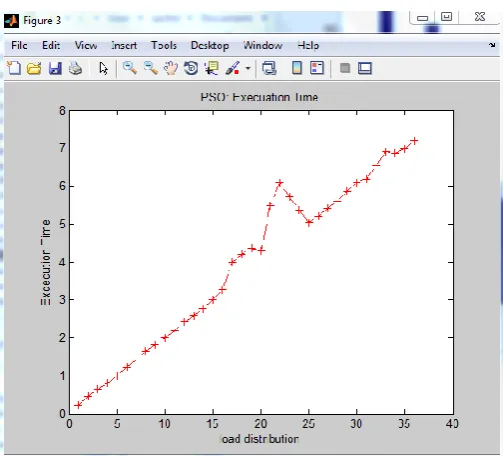
Fig 24: PSO execution time(load =36%)
Case 1 Iteration LB
cost GA
(min.)
LB cost PSO
(min.)
Exec.
time GA
Exec.
time PSO
When iteration changing
10 144 112 2.79 1.095
20 125 99 5.52 2.18
30 125 101 7.16 3.53
Table 1: for case 1 (no. of iteration changing)
Case 2 Load% LB cost
GA min.
LB cost PSO min
Exec. time GA
Exec. time PSO
When % of load change
16 124 101 4.63 2.26
26 100 97 6.11 2.76
[image:7.595.301.581.307.460.2]36 144 125 8.46 3.86
Table 2: case 2(% of load changing)
V.
CONCLUSION
Performance evaluation shows that both the parameters load balancing energy cost and execution time of sensor node are minimized significantly in case of PSO rather than GA. PSO shows best results for increase of no. of iterations and % of load distribution for the WSN nodes.
VI. FUTURE SCOPE
[image:7.595.36.288.327.555.2]© 2016, IRJET | Impact Factor value: 4.45 | ISO 9001:2008 Certified Journal | Page 110 (BFO) established WSN Configurations also we can
additionally examine Managed Diffusion and Burden Aggregation for enhancing energy efficiency.
ACKNOWLEDGMENT
I would like to thank Mr. Vikas Uttereja, head of ECE department for the insightful discussion on Wireless Sensor Network and Metaheuristic techniques.
REFERENCE
[1]. Haidar Safa, Mathieu Moussa, and Hassan Artail. (2014): "An energy efficient Genetic Algorithm based approach for sensor-to-sink binding in multi-sink wireless sensor networks." Wireless networks 20, no. 2, pp.177-196.
[2]. Richa Garg, Saurabh mittal,(2014): "Optimization by genetic algorithm”. "IJARCSSE: international journals of advance research in computer science and software engineering”.
Volume 4, Issue 4, April 2014 ISSN: 2277 128X, pp.587-589
[3]. Arnab Raha, Mrinal Kanti Naskar, Avishek Paul, Arpita Chakraborty, and Anupam Karmakar. (2013): "A Genetic Algorithm Inspired Load Balancing Protocol for Congestion Control in Wireless Sensor Networks using Trust Based Routing Framework (GACCTR)." International Journal of Computer Network and Information Security (IJCNIS) 5, no. 9.pp-9
[4]. Dr. Pradeep Mittal, Swati Sharma, (2013)"Wireless Sensor Networks: Architecture, Protocols" Volume 3, Issue 1, January, ISSN: 2277 128X.
[5]. Ipek Caliskanelli, James Harbin, Leandro Soares Indrusiak, Paul Mitchell, David Chesmore, and Fiona Polack. (2012)"Runtime optimization in WSNs for load balancing using pheromone signaling." In Networked Embedded Systems for Every Application (NESEA), 2012 IEEE 3rd International Conference on, pp. 1-8. IEEE,
[6]. Priyanka G. Gonnade(Kohale), Sonali Bodkhe(2012): "Genetic Algorithm for Task Scheduling in Distributed Heterogeneous System”. "IJARCSSE: international journals of advance research in computer science and software engineering”. Volume 2, Issue 10, October 2012, ISSN: 2277 128X, pp.9-13
[7]. C.Kalpana, U.Karthick Kumar and R.Gogulan,(2012), "Max-Min Particle Swarm Optimization Algorithm with Load Balancing for Distributed Task Scheduling on the Grid Environment”. "IJCSI International Journal of Computer Science Issues, Vol. 9, Issue 3, No 1, May 2012 ISSN (Online): 1694-0814, pp. 365-373
[8]. S. Wijedasa, S. Rizvi, and K. Ferens. (2012) "Load balancing algorithms for wireless sensor networks." In Proc. The 2012 International Conference on Wireless Networks (ICWN'12), Las Vegas, Nevada, USA, pp. 61-67..
[9]. Samina Ehsan and Bechir Hamdaoui. (2012) "A survey on energy-efficient routing techniques with QoS assurances for wireless multimedia sensor networks." Communications Surveys & Tutorials, IEEE 14, no. 2,pp: 265-278.
[10]. Khaled Daabaj, M. W. Dixon, and Terry Koziniec. (2010): "LBR: load balancing routing algorithm for wireless sensor networks." pp 71-85.
BIOGRAPHIES
I Ajay kaushik received my B.tech in ECE from M.D University, Rohtak in 2010. I pursuing my M.tech in ECE presently from KUK, University. I also working as a teaching assistant in SGI college, Panipat.