© 2016, IRJET | Impact Factor value: 4.45 | ISO 9001:2008 Certified Journal
| Page 904
FAnn!!! Search Based Face Annotation
Priyanka Chaudhari
1, Pallavi Nagpure
2, Bansi patel
3, Shital Bhamre
41 Bachelor of Engineering, Department Of Computer Engineering, GESRHSCOE, Nashik, Maharashtra, India
2 Bachelor of Engineering, Department Of Computer Engineering, GESRHSCOE, Nashik, Maharashtra, India
3 Bachelor of Engineering, Department Of Computer Engineering, GESRHSCOE, Nashik, Maharashtra, India
4 Bachelor of Engineering, Department Of Computer Engineering, GESRHSCOE, Nashik, Maharashtra, India
---***---Abstract -
FAnn!!! systemisimplementedto performFace Annotation which means naming the image by the
person’s in the image. In Face annotation system firstdetect face and facial features then perform verification and lastly name the images. Nowadays humans are interested in collecting large number of images, pictures from social networking sites, satellite images etc. Some of these images are tagged but many a times many of them are not tagged properly or correctly, so the auto face annotation is been introduced. Here the system is implemented using Principle Component Analysis (PCA) algorithm to annotate the facial images of personfrom large databases of images which has being the biggest challenging part. Auto face annotation is important technique to assign the human faces with their corresponding and correct human names without any manual efforts using few of the machine learning techniques. This paper focuses on online photo album management or photo record management used in forensics.
Key Words
:
Face Annotation, Web Facial Images, Weakly Labeled Data, Label Refinement, Machine Learning.1.INTRODUCTION
Large numbers of photos/ videos are shared on
social media websites etc. )f a person’s photo is
seen on internet or TV or anywhere else may be
on any social media sites as there are many of
sites nowadays, might be a reason, it is difficult
to recognize that person if next time the same
person appears by his name. This is due to
ignorant or having no knowledge about that
person. Sometimes just see the person’s image,
and forget or many a times avoid reading the
names. )t’s
such a good thing just imagine to get
the person’s name along with his/her photos on
Internet, it becomes so easy to get to know the
person by his name.
FAnn.!!! System is developed to solve the
annotation problem .The system will assign
the proper label to the image which is given
as an input. FAnn.!!! System consists of two
phases given as below:
Training phase
Testing phase
In Training phase, The system will train some images of
different personalities and store it in database. In
testing phase, The system will annotate the image with
its respective label and extract the similar images of
the person and videos of that person.
2. ARCHITECTURAL DESIGN:
© 2016, IRJET | Impact Factor value: 4.45 | ISO 9001:2008 Certified Journal
| Page 905
Search Based Face Annotation consists of the followingsteps:
1. Image Collection
2. Face Detection And Facial Feature Extraction 3. Facial Feature Indexing
4. Learning To Refine Weakly Labeled Images 5. Face Retrieval
6. Face Annotation
First step is data collection i.e. Images of various faces from WWW or Images freely available on Internet or web and the output will be the Facial Images according to the specified name and count by user. But by searching process, the image are sometimes noisy and disturb and it is not always correspond to correct human.
Second step is Pre-processing. In this step , system collect facial information by extracting facial features and the information can be as follows :
1. Face Detection
. Face’s proper alignment
. Face’s region extraction
4. Representation of features
Third step is Indexing. In this, by applying some high dimensional indexing algorithm system will index the images according to the extracted features of specified images and then retrieve the similar images in further steps.
Face annotation takes place at the time of Test phase. First, perform face retrieval process, in which fire a query to search a facial Image for extracting similar images (top N similar Images) from indexed table.
3. LITERATURE SURVEY
Different techniques are used in retrieving facial images based on search query
:
3.1 Classic Model Of Face Annotation
In this model, Y. Tian and et al.[2] used to compare the input Image with the Images available on Internet or their trained Database. This was time consuming and also not used to produce accurate result as per requirement.
This system was challenging because of following factors: 1. Illumination
2. Lighting 3. Camera Quality.
4. Different Alignment of faces etc.
3.2 Repetitive Framework For Face Annotation
The work proposed by Z. Cao et al[3] works recursive manner for face annotation. Here user gives input as Image and the proposed system labels it according to features and stored it in database if it new and next time when sameimages given as input then system will check local database and the matched results are displayed to the user. And the above process continues recursively until we get better results. The System has lot of manual work to be performed.
3.3 Pose Adaptive Face Matching
X.-J. Wang et al[4] worked on system that compares the images to find out identical features based on following factors:
1. Illumination 2. Lighting 3. Camera Quality
4. Different Alignment of faces etc.
This gives efficient way of matching. Hence the results are proper and a wide range Images are available as Labeled Faces on the internet. In this, the face micro pattern encoding is done but the problem with this is pattern sampling sis done manually.
3.4 Graph Based Approach
The system proposed by W. Zhao [5] considered that the nodes and edges as features of the image for considering likeliness of the images. The graph become heavy if the same face of the person occurred frequently and if not the graph becomes sparse. A graph can be represented as G= (V, E), Where, V is the faces,
E is facial features
And weight is according to the similarity. They develop this system to find similar subset of faces with the query of the person’s name. They use greedy algorithm afterwards.
3.5 Retrieval Based Face Annotation
D. Wang et al.[6] proposed a system to assigned label to weakly labeled images available on internet. It is also called as retrieved based face annotation. It labels the images by properly learning all the features of the image. It uses graph-based weak label regularization principle to improve the weak labels of similar kind of faces.
This method has many advantages to improve the quality of labeling:
1. It efficiently retrieves the similar images and annotates them.
2. It increases the performance of the system because it make use optimized algorithm.
3.6 Content Based Image Retrieval
© 2016, IRJET | Impact Factor value: 4.45 | ISO 9001:2008 Certified Journal
| Page 906
SVM is type of supervised learning hence content based
retrieval framework will make use of supervised
learning, which analyze the data and learns different
patterns. This approach having lots of disadvantages ,
for e.g. )f the query is like yellow bag with blue balls
in this yellow and blue are the contents which may be
present on internet and the output of such system may
be incorrect.
4. PCA ALGORITHM:
In the proposed system we are using PCA i.e, Principle Component Analysis algorithm. The main purpose behind using this algorithm is that it analyses patterns in the dataset so as to identify patterns and find patterns in the dataset without losing much information.
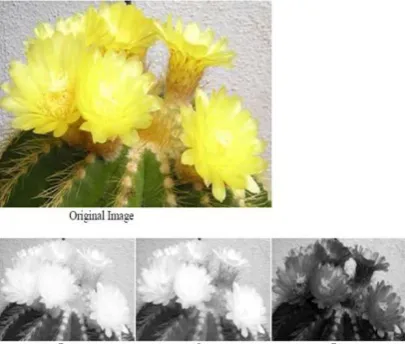
Fig3. Original image and its three color components
Fig 4. PCA of selected image
Fig 5. Comparison of various methods of image color reduction. The gray level image evaluated as weighted sum of R,G,B colors(left) and the gray level image counted on the basis of PCA method (right).
PCA Use for Determination of Object Rotation
PCA can be used object orientation and object rotation. It is uedfo identifying the angle or change in the original object and the one which has been rotated.[image:3.595.73.276.287.459.2]
Fig 6. Image alignment using PCA
Following are the six general steps for performing
PCA:
1. Take the whole dataset consisting m-dimensional samples without considering the class labels.
2. Compute the m-dimensional mean vector.
3. Compute the scatter-matrix(or the covariance matrix) of the whole dataset.
. Compute eigenvectors eg , eg , eg , ….egm and corresponding eigenvalues l ,l ,l ……lm .
5. Sort the eigenvectors in descending fashion and choose e eigenvectors with the largest eigenvalues to form a m*e dimensional matrix WW (where every column represents an eigenvector).
6. Use this m*e matrix to transform the samples onto the new subspace.
This can be summarized using the following mathematical expression:
yy = WTW * xx
where, xx: m*1 dimensional vector representing one sample onto the new subspace.
yy: transformed e*1 dimensional sample in the new subspace.
5.RESULTS :
We have created our local database by collecting images of famous personalities through internet. We have clustered the images according to the personalities and have labeled them. After collecting the images we have converted them into grayscale using PCA algorithm and extracted the facial features.
Near about 30 images of each person have been trained and stored with the respective labels. Number of personalities whose images have been trained are near about 50. Hence our local database consists of approximately 180 images. Consider the graph,
© 2016, IRJET | Impact Factor value: 4.45 | ISO 9001:2008 Certified Journal
| Page 907
010 20 30 40
t1 t2 t3 t4
Total personalities
Total personalities
according to the test results, when we keep n less(n<5) and increase the value of k, our system would be bound to a limit i.e, the system can detect or annotate the faces of only say 5persons. But if we increase the value of n and also the value of k then our systems boosts to a greater extent because we would be increasing the number of personalities as well as their number of images.
5.1 Screenshots :
3. CONCLUSIONS
Through this paper, the system describes a promising search-based face annotation by mining weakly labeled facial images that are freely available on the World Wide Web (WWW). The System focused on tackling the critical problem of enhancing the label quality and proposed a PCA algorithm. We formulate the learning problem as a convex optimization and develop effective optimization algorithms to solve the large-scale learning task efficiently.
ACKNOWLEDGEMENT
This work was under Gokhale Education Society’s R.H.Sapat of engineering, Savitribai Phule Pune University in the academic year 201 5- 2016 and is sponsored by Sumago Infotech, Nashik.
REFERENCES
[1] Dayong Wang, Steven C.(. (oi, Ying (e, and Jianke Zhu,
Mining Weakly Labeled Web Facial Images for Search-Based Face Annotation )EEE Transactions on Knowledge and Data Engineering, vol. 26, no. 1, January 2014 M. Young, The Technical Writer’s Handbook. Mill Valley, CA: University Science, 1989.
[2] Y. Tian, W. Liu, R. Xiao, F. Wen, and X. Tang, A Face
Annotation Framework with Partial Clustering and Interactive Labeling, Proc. )EEE Conf. Computer Vision and Pattern Recognition (CVPR), 2007.
[3] Z. Cao, Q. Yin, X. Tang, and J. Sun, Face Recognition with
Learning-Based Descriptor, )EEE Conf. Computer Vision and Pattern Recognition (CVPR), pp. 2707-2714, 2010. [4] X.-J. Wang, L. Zhang, F. Jing, and W.-Y. Ma, AnnoSearch: Image Auto-Annotation by Search, Proc. IEEE CS Conf. Computer Vision
[5] W. Zhao, R. Chellappa, P.J. Phillips, and A. Rosenfeld, Face Recognition: A Literature Survey, ACM Computing Survey, vol. 35, pp. 399- 458, 2003.
[6] D. Wang, S.C.(. (oi, Y. (e, and J. Zhu, Retrieval-Based
Face Annotation by Weak Label Regularized Local Coordinate Coding, Proc. 9th ACM )nt’l Conf. Multimedia (Multimedia), pp. 353-362, 2011.
[7] A.W.M. Smeulders, M. Worring, S. Santini, A. Gupta, and
R. Jain, Content-Based Image Retrieval at the End of the
© 2016, IRJET | Impact Factor value: 4.45 | ISO 9001:2008 Certified Journal
| Page 908
BIOGRAPHIES
Shital Bhamre is currently a student of GESRHSCOE, Nashik from the University of Savitribai Phule,Pune. Her main research interests include:
a)Web-Mining
b)Object oriented programming c)C#.net
Priyanka Chaudhari is currently a student of GESRHSCOE, Nashik from the University of Savitribai Phule ,Pune. Her main research interests include:
a)Web-Mining b)Data-mining c)Android
Pallavi Nagpure is currently a student of GESRHSCOE, Nashik from the University of Savitribai Phule,Pune. Her main research interests include:
a)Web-Mining b)Android c) Data structures
Bansi Patel is currently a student of GESRHSCOE, Nashik from the University of Savitribai Phule,Pune. Her main research interests include:
a)Web-Mining