© 2016, IRJET | Impact Factor value: 4.45 | ISO 9001:2008 Certified Journal | Page 3136
Implementation Issues and Challenges of Cloud Computing in Mobile
Devices
Reshma Balkrishna Hirve
Department of Master of Computer Application
YMT College of Management, Kharghar
Maharashtra, India
---***---Abstract -
Mobile is very rapidly increasing and influencing aspect of human life. Mobile computing has becomes one of major buzz words in IT industry in last few years. Mobile Cloud computing has given a way for mobile users to use and leverage services and data on the go anytime and anywhere that is not stored on their mobile devices. Mobile cloud computing can be used to address various issues like storage space. We approach different issues faced in mobile technology and how it can be tackled with cloud computing technology. If Cloud computing is used in mobile environment it can prove very useful to tackle issues that are related to the performance, security, etc of mobile devices. This paper gives you information about mobile cloud computing, its issues and challenges ,implementation, applications, security as well as issues that can be faced while implementing Mobile Cloud Computing and some methods to overcome these issues.Key Words:
Cloud Computing, Mobile Cloud Computing,
Issues, Challenges, Security
1. INTRODUCTION
Mobile Devices are rapidly turning to be an essential part of human life day by day as the most effective and convenient communication toll is not bounded. Mobile users gain good experience of various services from mobile applications which run on their devices or on remote servers via wireless networks. The rapid growth of mobile computing becomes a powerful trend in development of IT technology as well as commerce and industry fields. However mobile devices are facing many issues in resources such as storage, bandwidth, battery life etc [1]. Mobile cloud computing has recognized as the next generation of mobile computing infrastructure. Mobile cloud computing offers some advantages to overcome the above issues. Cloud Computing provides us the opportunity to execute out applications on the server rather of running them locally on our device and
allows us to overcome the handsets limitation of limited resources to a great extend. Five essential characteristic of cloud computing listed are:
On-demand self-service Broad network access Resource pooling Rapid elasticity Measure service[3]
1.1 Cloud Computing
Cloud computing has become a highly demanded service due to the high performance, high computing power, scalability, cheap cost of services, accessibility as well as availability. Cloud Computing is termed as device in which resource are made available to the clients and users on demand usually by the means of internet as virtualized services. Cloud services allow users and business to use software or hardware managed by third parties at a remote location.
1.2 Mobile Cloud Computing
© 2016, IRJET | Impact Factor value: 4.45 | ISO 9001:2008 Certified Journal | Page 3137
business opportunities for cloud providers operators aswell as mobile network.
Four types of Resources in Mobile cloud computing are - proximate immobile computing entities, distant immobile clouds, proximate mobile computing entities, and hybrid. As shown in the figure below mobile devices are connected to a network via base stations that create and control the connections and interfaces between networks and devices. Requests from users are transmitted to the central processors which are connected to the servers. After the process is been completed, the subscriber’s requests are been delivered to a cloud through the internet. Cloud request processing is done and then results are provided back to mobile devices.
Fig -1: Mobile cloud computing architecture
1.3 Service Models
[7]
There are 3 service models in cloud computing:
A. Software as a Service (SaaS): It is a capability provided to the consumer to use the provider’s application running on the cloud. The applications can be accessed from various devices through Web Browsers etc. The consumer cannot manage the cloud infrastructure currently using for an application including network of the system along with the servers, the operating systems, storage or even individual application capabilities.
B. Platform as a Service (PaaS): It is a capability provided to the consumer to deploy applications created using programming languages and tools supported by consumer onto the cloud infrastructure. The consumer
cannot manage or control the cloud infrastructure including network of the system along with the servers, the operating systems, storage but has control over the deployed applications.
[image:2.595.315.551.249.483.2]C. Infrastructure as a Service (IaaS): Itis a capability provided to the consumer to provide processing, storage, networks, and other computing resources where the user is able to run software which can include operating systems as well as the applications. The user cannot manage or control the underlying cloud but has control over operating systems, storage, deployed applications [2].
Fig -2: Cloud computing layers accessible within a stack
2. LITERATURE REVIEW
Implementation of Mobile cloud computing has been a boon for all mobile users as it prevents a mobile device to degrade its performance by storing the excess data required for a mobile device to the cloud instead on the device itself. There are many techniques and steps found to implement cloud computing:
Ad-hoc Mobile Cloud: Marinelli[5] introduced Hyrax, a platform derived from Hardtop that supports cloud computing on Android smart phones. Client applications can execute computing jobs on networks of smart phones and helps in connecting networks from device to device that is from phones to servers.
[image:2.595.38.282.298.508.2]© 2016, IRJET | Impact Factor value: 4.45 | ISO 9001:2008 Certified Journal | Page 3138
bandwidths, server speed, available memory, orthe amounts of data exchanged between servers and mobile device are considered to develop algorithms for offloading decisions, to save energy or to improve performance.
Weblets: Weblets are autonomous functional software entities, platform independent and can be accomplished transparently on different computing infrastructures including mobile devices or migrate between different cloud nodes.
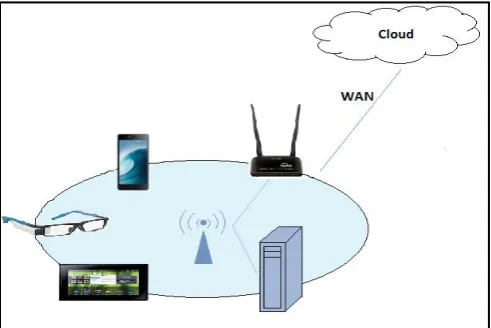
Cloudlets: Costea researched[6] the cloudlet. It can be viewed as a data centre residing nearby the client and cache user data from the cloud to locally access and thereby reducing latency. When finished the user data will be returned to the cloud from where the data was taken. A cloudlet only contains copies of user data or code that is not available elsewhere.
[image:3.595.37.283.463.627.2]Many researchers have found that as the mobile devices have certain resource constraints, there arises a need to get resources from different outside sources. One of the ways to overcome this problem is getting resources from a cloud, but the permission to access to such platforms is not always covenant and is too extravagant. Computing concept in mobile world is all about sending out mobile applications and services in the cloud through cloud service providers and delivers it to end-users (mobile handsets) via internet when required.
Fig -3: Cloudlet as a nearby offload site
2.1 Issues and Challenges
Mobile cloud computing is a stretched-out branch of cloud computing. However, there are some challenges and issues in the implementation of such a Dynamic technology. The Cloud is computationally powerful and mobile devices have restricted resources and therefore there is a need to have balance of both components. Though there are several advantages of mobile cloud
computing. Some ISSUES and CHALLENGES in mobile cloud computing are as follows:
A. Limited resources and resource poverty[4]: The use of cloud computing in mobile devices is difficult because of having limited resources in mobile devices. One of the main issue in mobile cloud computing is limited resources in mobile devices. Mobile devices have less computational power, power battery limitation, storage capacity and poor display as compared to the personal computers. Comparison of personal computers with any mobile device show at what cost the feature of wireless phone is achieved, mobile devices are/have
3 times less processing power 8 times less memory
5 times less storage capacity 10 times less network bandwidth
B. Network related issues[1]:All processing in mobile cloud computing is based on the network. So there are some issues related to network such as bandwidth, availability, latency. For implementing cloud computing the one of the basic requirement is of network. In mobile world there are scenarios with different access technologies like WiMax, WLAN,3G, GPRS, etc each one with their own schemes , policies and hence we need seamless connection handover schemes to void connection failure when we move from one network access point to another.
Bandwidth[2]:It is one of the big issues in mobile cloud computing. Nowadays in mobile phones social media sites are very popular, but they require more bandwidth. As number of clients using these social media increases then demand for a modified high bandwidth website also increases. If the social media fails to increase the bandwidth of the website then gradually the performance of the website in every phone will degrade. So in case of application that require high internet speed like online gaming applications that require high processing speed and minimum network latency mobile cloud computing faces challenges. Mobile internet cannot provide the same speed at every location wherever the user may go. This can make accessing data through cloud more difficult.
Availability[1]: Service availability has become an important issue in mobile cloud computing than in cloud computing with wired networks. Mobile users may not be able to connect to cloud to obtain service due to traffic congestion, network failures.
© 2016, IRJET | Impact Factor value: 4.45 | ISO 9001:2008 Certified Journal | Page 3139
also prove an issue in implementing mobile cloudcomputing.
Interoperability: In an organization many employees are used different phones such as iPhone, Android phones, BlackBerry phones, etc which are generally faces interoperability problems that share the same network. All these phones have different operating systems and hence the common application in the network must be compatible with all mobile devices used by the employees
Cloud Application Flexibility[3]: An application is going to be supported by certain mobile cloud infrastructure or not can easily be judged on the basis of its requirements against the cloud infrastructure characteristics along the device, network bandwidth and latency. Different applications need different cloud infrastructure attributes such as network, bandwidth and latency. For example a low content application like web-search requires less bandwidth and can provide optimal results on a 3G. But if we talk about content rich applications that contents huge images like face recognition will require high bandwidth so that large image content can be transferred quickly to servers that run the face recognition algorithm
Mobile Cloud Convergence[3]: To take full advantage of the mobile cloud computing data distribution is the key issue. Some applications are online some are offline. Offline applications are those that process the presentation and business logic locally on mobile device with data downloaded from backend. Online applications keep their business logic and computation on the cloud away from the mobile as the computing power mobile devices is not as powerful as the main computing platforms. Mobile Cloud Convergence provides performance improvement, longer battery life and a solution to the computation power problem as we partition the application such that the parts that need more computation run on the cloud and the remaining part associated with the user interface run on mobile devices.
D. Security issues in Mobile Cloud: Since cloud computing mostly deals with Data Storage it is very important to keep the stored data safe. Every cloud user wants their data to be more secure as the data can contain some confidential information. Any unauthorized person can do changes in it, to harm the data. Mobile applications that are deployed on the cloud may have some sensitive information about the client if the application is poorly written the information can be hacked and could pose a danger to both the provider and the client.
Privacy [9]: Privacy is the biggest challenge in mobile cloud computing as users data is stored remotely by the cloud computing provider. Third party companies can sell the important data to some government agencies without the users permission. There can be many untrusted and insecure cloud computing provider that can lure you in their schemes in order to steal data.
Malicious Attacks [7]: As network is an integral part of cloud computing and all networks are susceptible to attacks. Nowadays as more and more external websites are been accessed the unauthorized users have more opportunities to access the network and user data. Some attack used by the criminals may include:
- Denial of Service (DoS): Cloud is more susceptible to DoS attacks because more than one client can use the cloud at the same time which can make DoS attacks more damaging.
- Side Channel attacks: In this type of attack a malicious virtual machine is placed close to a target cloud server to compromise the cloud security and then a side channel attack is launched.
-Authentication attacks: Authentication is one of the weak points in case of hosted and virtual services and is generally been targeted. A user can be authenticated in number of ways and these mechanisms and methods which are used to secure the authentication are frequently been targeted by the attackers.
-Man-in-the-middle cryptographic attacks: This attack is taken place when an attacker is himself between two users. When attackers place themselves in the communication path there is the possibility that they can intercept and modify communications.
3. RESEARCH METHODOLOGY
As we have seen various issues in mobile cloud computing various researches have been made to find the solution to this issues and challenges. As mobile cloud computing is a very helpful for every mobile user and future of the mobile devices and their performance, many solutions are taken in to consideration for the betterment of mobile cloud computing and mobile devices.
© 2016, IRJET | Impact Factor value: 4.45 | ISO 9001:2008 Certified Journal | Page 3140
-Using clone clouds to boost performance of smartphones[4]: A number of researchers have popularized the main idea of improving and developing the performance of hardware restricted smart phones by using their clone cloud architecture to be used to boost performance. They have created virtual clones of the number of the smart phones in the cloud environment and transfer the accomplished tasks to those virtual devices. So they conducted offload accomplishment from smart phone to an infrastructure hosting a cloud of smart phone clones. If the smart phone is lost or damaged, the clone can be used as a backup. Another benefit is that hardware restriction of smart phone is coping – the task is transferred to effective and high computation devices in the cloud.
-Moving data processing in cloud instead of mobile device itself[3]: As most of the computing data from the mobile phone is moved to cloud and the processing takes place in the cloud itself the battery needed for processing the application or that earlier can be saved. More execution in cloud means more battery saving but it is not possible to transfer the complete application on to the cloud. For example basic functions like opening of an application, inputting data and displaying result of processing obviously need to run on device. We can partition the application and then decide which functionality can be offloaded and which must be maintained at the mobile device.
-Improving Bandwidth[2]: Applications that contain low quality images and text are relatively small applications and hence require less bandwidth but applications that contain rich text and images will require high bandwidth as more amounts of data will be transferred. The techniques that are used for reducing bandwidth requirements are as following:
compression[11]
logging[11] (making large requests out of several short ones)
prefetching[11] (guessing which files will be needed soon)
difference based updates[10] (using relation between data on both sides of the network to transmit only needed data)
filtering[10] (allows to reduce data sent over the wireless network by performing operation on data and connected host)
-Programming Abstraction[8]: Development on mobile clouds should be simple and at the same time the developer should be able to control behaviour and also able to track location of his application. To take full advantage of modern mobile devices and available cloud computing resources, new programming abstraction tools hiding the complexity of underlying cloud
technologies are needed. The developed software modules should be optimized for running on different mobile device hardware.
3.1 Possible solutions for security issues
A never ending issue will always be security in cloud computing. But as need of mobile cloud computing research have been made to reduce the security issues.
Information Security[3]: Since cloud computing basically deals with data storage and its processing so security is very important. Now a day's various cloud platforms offer robust built-in security measures.
As far as mobile devices are concerned security remains a key concern. As if a device gets stolen or misplaced, crucial data may be compromised. Data misuse from stolen devices can be avoided by wiping of mobile device remotely. This feature is generally provided by most of the mobile manufacturers and wireless carriers.
Easiest way to detect security threats of any mobile device is by installing and running security softwares. However, mobile devices have limited processing power and energy supply to handle security software's hence we can move the threat detection capabilities to clouds.
Even after implementing best measures for safe guarding data and information and having users trained with best safe-surfing techniques, incidents will inescapably occur. Every cloud provider organization must plan and develop some measures that can be implemented as a quick response and recovery from data spill.
Security planning is not even an easy task for an organization. This includes understanding the threat landscape and working to protect the organization against these threats [9].
Promote the culture of security awareness[9]: It is important to note that the careless mistakes of one worker will affect the master plan of primal security officer. That’s why it is very important that every worker must work in a group with security professionals to ensure the safety of enterprise data. Security must be put together on the culture of the organization.
4. CONCLUSION
© 2016, IRJET | Impact Factor value: 4.45 | ISO 9001:2008 Certified Journal | Page 3141
computing has emerged as a great extension to cloudcomputing field. In this paper we present research work done on Mobile Cloud Computing its definitions. Service models of Mobile Cloud Computing such as SaaS, PaaS, and IaaS. We have also discussed how mobile cloud computing has proved to be of great boon to mobile devices, Implementation of mobile cloud computing, Issues and Challenges related to mobile cloud computing and its implementation and also some possible solutions to overcome the issues and challenges. The main idea behind this research is to identify these issues and challenges of mobile cloud computing. This research of mobile cloud computing is particularly useful for mobile service providers so, that they can improve the security technologies and mechanisms used for cloud security to minimize the security issues.
REFERENCES
[1] Dhammapal Tayade; "Mobile Cloud Computing Issues, Security, Advantages, Trends" in DhammapalTayade / (IJCSIT) International Journal of Computer Science and Information Technologies, Vol. 5, 2014
[2] NiteshKaushik, Gaurav, Jitender Kumar; "A Literature Survey on Mobile Cloud Computing: Open Issues and Future Directions" in International Journal of Engineering and Computer Science ISSN: 2319-7242Volume 3 Issue 5 may, 2014 Page No. 6165-6172
[3] Deepti Sahu, Shipra Sharma, Vandana Dubey, Alpika Tripathi; "Cloud Computing in Mobile Applications" in International Journal of Scientific and Research Publications, Volume 2, Issue 8, August 2012
[4] Ahmed DheyaaBasha, IrfanNaufal Umar, and Merza Abbas, Member, IACSIT; "Mobile Applications as Cloud Computing: Implementation and Challenge" in International Journal of Information and Electronics Engineering, Vol. 4, No. 1, January 2014
[5] E. Marinelli, “Hyrax: cloud computing on mobile devices usingMapReduce,” Master thesis, Carnegie Mellon University, 2009
[6] C. Costea; "Applications and Trends in Mobile Cloud Computing" in C. Costea / Carpathian Journal of Electronic and Computer Engineering 5 (2012)
[7] Hyun-Suk Yu, Yvette E. Gelogo, Kyung Jung Kim3;"Securing Data Storage in Cloud Computing" in (Journal of Security Engineering), 2012
[8] Rashmi A.Bajad, Monika Srivastava, Amit Sinha; "SURVEY ON MOBILE CLOUD COMPUTING" in International Journal of Engineering Sciences & Emerging Technologies, Feb 2012
[9] A. Cecil Donald, S. Arul Oli, L. Arockiam; "Mobile Cloud Security Issues and Challenges: A Perspective" in International Journal of Engineering and Innovative Technology (IJEIT) Volume 3, Issue 1, July 2013
[10] Brian Marsh, FredDouglis, Ramon Caceres; "System Issues in Mobile Computing" in Technical report February 1993
[11] Pradeep Loganathan; "The Challenges and