© 2016, IRJET | Impact Factor value: 4.45 | ISO 9001:2008 Certified Journal | Page 2781
Evaluation of Effect of Dust on Polycrystalline Silicon Solar Cell
Santosh N. Dadas
1, Prof. (Dr.) P.S. Patil
2, Prof. N.N. Shinde
3, Prof. M.M. Wagh
41
Research Student, Department of Energy Technology, Department of Technology, Shivaji University, Kolhapur,
Maharashtra, India
2
Professor and coordinator, School of Nano Science and Technology, Shivaji University, Kolhapur, Maharashtra,
India
3
Director, UES Energy Services Private Limited, Kolhapur, Maharashtra, India
4
Professor, Department of Energy Technology, Department of Technology, Shivaji University, Kolhapur,
Maharashtra, India
---***---Abstract -
Rising demand on existing power systemresults in power shortage, so solar PV system is proven best in atmospheric conditions of region like India. Efficiency and Fill factor of solar PV system are degraded due to dust and similar pollutants. The accumulation of dust on the surface of a photovoltaic module decreases the radiation reaching the solar cell and produces losses in the generated power. Dust not only reduces the radiation on the solar cell, but also changes the dependence on the angle of incidence of such radiation. This work presents losses caused by the accumulation of dust on the surface of photovoltaic modules and effect of dust layers on the transmissivity of PV module glass.
Key Words:
Polycrystalline Silicon solar cell, Dust, I-V
Characteristics of solar cell transmissivity of glass, Fill
factor.
1. INTRODUCTION
The sun is probably the most important source of renewable energy available today. Traditionally, the sun has provided energy for practically all living creatures on earth, through the process of photosynthesis, in which plants absorbs solar radiation and convert it into stored energy for growth and development. Scientists and engineers today seek to utilize solar radiation directly by converting it into useful heat or electricity. Two main types of solar energy systems are in use today: photovoltaic and thermal systems. There is a great deal of opportunity for using these systems in the world but the problem is that the deposition of dust on the solar panel. The deposited dust reduces the transmissivity glass which is responsible for low absorption of solar light by PV and hence reduces conversion ability of PV module.
2. OBJECTIVE
To evaluate effect of dust on polycrystalline silicon solar cell and the transmissivity of the glass covered on solar cell.
Effect of Dust accumulation on PV module
Generally solar power plants located on a very arid region that has frequent dust storms and dusty conditions. Deposits of dust on the surface of PV module blocks the solar irradiation from reaching cells through the glass cover. The density of deposited dust, its composition and particle distribution, can have an impact on the power output and current voltage and characteristics of PV modules. During the course of the study, it was observed that there is atmospheric dust that scatters the solar radiation, in addition to dust deposits on PV surface, which also blocks PV module from direct solar radiation. The study concluded that long period of PV module exposure to real outdoor conditions gradually decreases power output if no cleaning is performed to remove the dust.
What is Dust?
Dust is defined as the minute solid particles less than 500 µm in diameter. Minute pollens such as bacteria and fungi, and microfibers separated from clothes, carpets and fabrics are also known as dust when settled on surfaces. Dust deposition is a function of various environmental and weather conditions.
3. Experiment Methodology
In this study Lab level experiment was carried out with polycrystalline PV module connected with Control board (Ecosense) used for obtaining results.
The Specification of PV module is as:
Model: ELDORA 40, Manufacturer: Vikram Solar Pvt Ltd, Kolkata, India- 700001, Electrical Rating:
© 2016, IRJET | Impact Factor value: 4.45 | ISO 9001:2008 Certified Journal | Page 2782 temperature. Simulator (Ecosense) comprises Ammeter,
Voltmeter, and Battery current.
In this research, indoor experiments are conducted to evaluate the effect of dust on PV performance. The PV module is tested using different dust elements. Since the dust effect is considered geographically site dependent, it is directly related to the local air pollution of the place where the PV system is installed. The investigation was conducted for different layers of dust separately. Single element of air pollution is selected to investigate effects on PV module performance based on experimental measurements. Red soil is obtained from playground.
In order to determine the impact of red soil dust on PV-panels performance, an experimental procedure is carried out in order to compare the voltage output of the PV module under different dust deposition conditions say, layer 1, layer 2, layer 3, layer 4, layer 5, layer 6. Layer wise dust deposition also collected on glass slides for the testing of transmissivity of glass. The experimental procedure was carried out indoors and at least 10 measurements were recorded within the time period examined. The experimental analysis is conducted in the Renewable Energy Laboratory located at the campus of the Department of Energy Technology, Department of Technology, Shivaji University, Kolhapur, Maharashtra India.
The dust deposition density “ΔM” is expressed in “g/m2”, via the PV panel area “A”, as ΔM = Δm/A (1) Where “Δm” is the total mass of dust layer on the surface of polluted PV panel.
Experimental Procedure:
[image:2.595.309.555.98.296.2]Playground soil is collected, Screened that soil using 300 microns screen to form the dust size particle, Layer 1 was sprayed by hand and took the I – V readings, Plotted I-V characteristics graph, Power calculated using I-V readings, Same as (3, 4, and 5) Procedure was done for layer 2, layer 3, layer 4, layer 5 and layer 6.
[image:2.595.307.534.514.630.2]Fig. 1 - Clean solar panel and dust deposited solar panel
Fig. 2 - Solar PV module Simulator
Effect of Dust on Transmissivity of Solar PV Module
glass
For checking transmissivity of glass one simple experiment is done with the help of Department of Physics, Shivaji University, Kolhapur, Maharashtra, India. The Slides shown in figure is tested and the results of transmissivity with respect dust layers are tabulated. Transmissivity of glass slides with respect to layer. Here, Glass without dust was considered as a bare substrate or reference glass for finding transmissivity of glass with dust.
Experimental Apparatus
[image:2.595.36.279.530.719.2]One LED Torch (DL 05 B 1U), Radiation meter with sensor and radiation indicator, Bare substrate glass and dust deposited glass slides viz. layer 1 to 6, Stand for fixing the sensor and Glass Slides.
Fig. 3 – Glass slides layer 1-6.
Experimental Procedure:
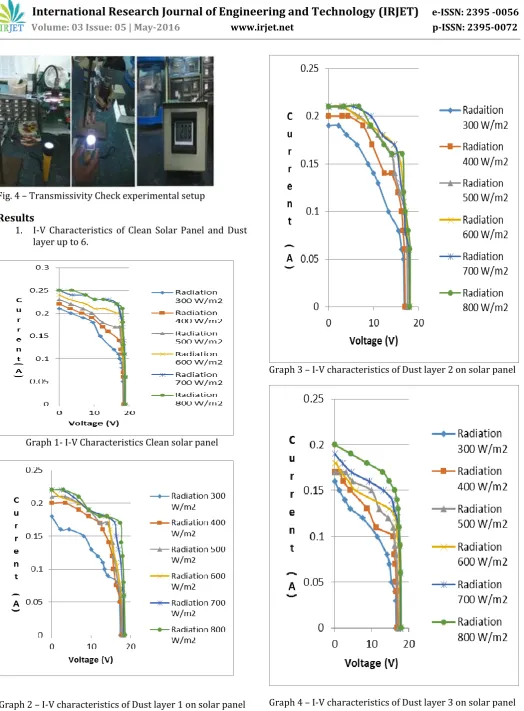
© 2016, IRJET | Impact Factor value: 4.45 | ISO 9001:2008 Certified Journal | Page 2783 Fig. 4 – Transmissivity Check experimental setup
Results
1. I-V Characteristics of Clean Solar Panel and Dust layer up to 6.
Graph 1- I-V Characteristics Clean solar panel
Graph 2 – I-V characteristics of Dust layer 1 on solar panel
Graph 3 – I-V characteristics of Dust layer 2 on solar panel
© 2016, IRJET | Impact Factor value: 4.45 | ISO 9001:2008 Certified Journal | Page 2784 Graph 5 – I-V characteristics of Dust layer 4 on solar panel
Graph 6 – I-V characteristics of Dust layer 5 on solar panel
Graph 7 – I-V characteristics of Dust layer 6 on solar panel
2. Transmissivity glass slides which have same properties of solar panel covered glass.
Graph 7 – Transmissivity v/s dust deposition density g/m2
Conclusion
© 2016, IRJET | Impact Factor value: 4.45 | ISO 9001:2008 Certified Journal | Page 2785
References
[1] Influence of dust deposition on photovoltaic panel performance Abhishek Raoa, Rohit Pillaia, Monto Mania,*, Praveen Ramamurthya aIndian Institute of Science, Bangalore 560012, India
[2] Effect of Dust Accumulation on Performance of Photovoltaic Solar Modules in Sahara Environment Ali Omar Mohamed, Abdulazez Hasan Arab Centre for Research and Development of Saharian Communities - Mourzuq , Libya National Authority for scientific research, Libya
[3] Effects of Dust on the Performance of PV Panels Shaharin A. Sulaiman, Haizatul H. Hussain, Nik Siti H. Nik Leh, and Mohd S. I. Razali
[4] Effect of Dust on the Performance of Solar PV Panel, Dayal Singh Rajput1, K. Sudhakar2 1,2Department of Energy, MANIT, Bhopal, India.
[5] Analysis of dust losses in photovoltaic modules, J. Zorrilla-Casanova*1, M. Piliougine1, J. Carretero1, P. Bernaola1, P. Carpena1, L. Mora-López2, M. Sidrach-de-Cardona11 Dpto. De Física Aplicada II, Universidad de Málaga, 29071 Málaga, Spain 2 Dpto. De Lenguajes y Ciencias de la Computación, Universidad of Málaga, 29071 Málaga, Spain
[6] The effect of dust on solar photovoltaic systems, F. Mejia, J. Kleissl*, J. L. Bosch Center for Renewable Resources and Integration, Department of Mechanical and Aerospace Engineering, University of California, San Diego 9500 Gilman Dr., La Jolla, CA 92093, USA
[7] Preliminary study of environmental solid particles on solar flat surfaces in the UK Dr. Sanaz Ghazi a*, Dr. Kenneth Ipb, Prof. Ali Sayighc an Environmental Engineering Department of Islamic Azad University-Parand branch, Parand , Iran school of Environment and Technology, University of Brighton, Brighton UK world Renewable Energy Network, Brighton, UK.
[8] Impact of dust on solar photovoltaic (PV) performance: research status, challenges and recommendations. Renewable and Sustainable Energy Reviews, Mani M, Pillai R. 2010; 14(9):3124–31.
[9] Simulating the dust effect on the energy performance of photovoltaic generators based on experimental measurements. Kaldellis JK, Kapsali M. Energy 2011; 36(8):5154–61.
[10] Performance of flat-plate solar-heat collectors. Transactions of the American Society of Mechanical Engineers, Hottel H, Woertz B.(USA) 1942:64.
[11] Effects of dust on the performance of thermal and photovoltaic flat plate collectors in Saudi Arabia— preliminary results. In: Veziroglu TN, editor, Nimmo B, Said SAM. Proceedings of the 2nd Miami International Conference on Alternative Energy Sources, Dec. 10–13. 1979. p. 223–5. [12] Dust effect on solar flat surfaces devices in Kuwait. In: Furlan C, Mancini NA, Sayigh AAM, Seraphin BO, editors. Proceedings of the Workshop on the Physics of Non-Conventional Energy Sources and Materials Science for Energy, 1985 Sept. 2 20. 1985. p. 353-367.
[13] Effect of airborne dust concentration on the performance of PV modules, Hassan A, Rahoma U, Elminir H, Fathy A. Journal of the Astronomical Society of Egypt 2005;13(1):24–38.
[14] Effect of dust on the transmittance of low density polyethylene glazing in a tropical climate, Mastekbayeva G, Kumar S. Solar Energy 2000;68(2):135–41.
[15] A new correlation for direct beam solar radiation received by photovoltaic panel with sand dust accumulated on its surface, Al-Hasan AY. Solar Energy 1998; 63(5):323– 33.
[16] Aeolian dust deposition on photovoltaic solar cells: the effects of wind velocity and airborne dust concentration on cell performance, Goossens D, Van Kerschaever E. Solar Energy 1999; 66(4):277–89.
KNOWLEDGEMENT
We are very thankful to Mr. Prathamesh Mayekar, Mr. Ankush Pujari, Mr. Sawankumar Patil and Mr. Pravin J. Awatade for their valuable help.
BIOGRAPHIES
1
Mr. Santosh N. Dadas has completed his B.Tech. In Chemical Tech. and currently he is the research student of Energy technology, at Department of technology, Shivaji University, Kolhapur.
2 Prof. (Dr.) P.S. Patil is
Coordinator of School of Nano Science and Technology, Shivaji University, Kolhapur.
3
Prof. N.N. Shinde has completedhis B.E. in Mechanical Engg., M. Tech. in Heat Transfer. Currently he is Director of UES Energy Services Pvt. Ltd. Kolhapur.
4
Prof. M.M. Wagh has completedhis B.E. in Mechanical Engg, M. Tech. in Energy technology. Currently he is working as
Assistant professor at