Munich Personal RePEc Archive
Conditioning prices on search behaviour
Armstrong, Mark and Zhou, Jidong
University College London (UCL)
January 2010
Conditioning Prices on Search Behaviour
Mark Armstrong
University College London
Jidong Zhou
University College London
January 2010
Abstract
We consider a market in which …rms can partially observe each consumer’s search behavior in the market. In our main model, a …rm knows whether a consumer is visiting it for the …rst time or whether she is returning after a previous visit. Firms have an incentive to o¤er a lower price on a …rst visit than a return visit, so that new consumers are o¤ered a “buy-now” discount. The ability to o¤er such discounts acts to raise all prices in the market. If …rms cannot commit to their buy-later price, in many cases …rms make “exploding” o¤ers, and consumers never return to a previously sampled …rm. Likewise, if …rms must charge the same price to all consumers, regardless of search history, we show that they sometimes have the incentive to make exploding o¤ers. We also consider other ways in which …rms could use information about search behaviour to determine their prices.
Keywords: Consumer search, oligopoly, price discrimination, high-pressure sell-ing, exploding o¤ers, costly recall.
1
Introduction
In a variety of markets in which consumers sequentially search through …rms’ options, sellers know something about their potential customers’ search behaviour. For example, a seller may be able to distinguish visitors who come to the store for the …rst time from those who have returned after a previous visit. Salesmen may try to elicit information from a customer about how many other sellers she has already sampled and how many more she plans to sample. In online markets, sellers may be able to monitor the entire search process of a potential customer.
There are two broad reasons why a …rm may wish to condition its price on a con-sumer’s search behaviour. First, search history may reveal relevantinformation about a consumer’s tastes. For example, a seller may wish to charge a higher price to those consumers who have already investigated other sellers, because their decision to keep searching indicates they are unsatis…ed with previously sampled products when search is costly. (If consumers have heterogenous search costs, it may also reveal that such consumers have relatively low search costs, which may by contrast induce a seller to set a low price.) Second, …rms may have astrategic reason to condition its price on search history, which is to deter a potential consumer from going on to search rival o¤ers. For example, if a …rm can distinguish new visitors from consumers who have previously visited, a …rm can o¤er new customers a relatively low price or force them to buy its product now or not at all, which makes customers more reluctant to investigate rival o¤ers. This paper investigates whether setting prices conditional on search behaviour, if feasible, can emerge as an equilibrium outcome, and, if so, how this practice a¤ects market performance.
Our underlying framework is a duopoly sequential search model with horizontally di¤erentiated products in which consumers search both for price and product …tness. Each …rm has three sources of demand: consumers who sample its product …rst and buy immediately (“fresh consumers”), consumers who sample the …rm …rst, go on to sample the rival’s product, but eventually come back (“returning consumers”), and consumers who sample the rival …rst but go on to buy from the …rm in question (“incoming consumers”). In the standard search model, …rms cannot distinguish between these three groups and so o¤er the same price to all their visitors. In our models, …rms are able to recognize and price discriminate between at least some of these di¤erent consumer groups.
we argue that they are often forced to make “exploding o¤ers”, i.e., new visitors are forced to buy immediately or not at all. In section 3.4, we present a related model in which …rms cannot price discriminate but can arti…cially in‡ate a consumer’s cost of returning. (Thus, only the “strategic e¤ect” mentioned above is relevant.) In this situation, we derive conditions under which …rms choose to make exploding o¤ers.
In section 4, we investigate other ways in which …rms can condition their prices on search behaviour. We …rst suppose that …rms can distinguish all three groups of consumers and so, in principle can set three di¤erent prices. We show that …rms in equilibrium will set the same (high) price to returning and to incoming customers, and o¤er a discount only to fresh customers. Thus, …rms discriminate equally against those customers who have sampled the rival, regardless of whether they are incoming or returning customers. We then consider the case in which each …rm can distinguish consumers who sample it …rst (i.e., fresh and returning consumers) from those who sample its rival …rst (i.e., incoming consumers). Since incoming consumers must be unsatis…ed with the rival’s product, in equilibrium …rms charge them a high price.
There has apparently been little research exploring the question of how …rms might make use of knowledge of consumer search behaviour or search history to re…ne their pricing decisions. Nevertheless, as we discuss next, our paper relates to several strands of the industrial organization literature. In the recent literature on ordered search, consumers sequentially search through options according to some publicly known order, which automatically reveals part of their search history to sellers. Armstrong, Vickers, and Zhou (2009) consider a model where consumers search for both price and product …tness (as in this paper) and where consumers consider one “prominent” …rm …rst. In equilibrium the prominent …rm sets a lower price than the others: …rms further back in the search order know that any customer who reaches them does not particularly value the previous o¤ers made, and so such …rms can exploit their market power by setting a higher price. (This paper is discussed further in section 4 below.) Arbatskaya (2007) analyzes a related model where consumers care only about price but di¤er in their search cost. She obtains the reverse …nding, which is that …rms further back in the search order setlower prices. Intuitively, this is because these …rms are only visited by consumers with relatively low search costs and so face more competition.1
Related e¤ects can be obtained in models of simultaneous, as opposed to sequential, search. For instance, in a di¤erentiated product setting, Gal-Or, Gal-Or, and Dukes (2007) suppose that the buyer can announce from how many sellers she is soliciting quotes, and sellers can condition their price on that information. As is intuitive, in many cases (see their Corollary 1) …rms o¤er a lower price when they know they
1More distantly related is the idea of a “stigma e¤ect” of long-term unemployment. For instance,
must compete against more rivals. Deck and Wilson (2006) conduct an experimental study of a related market. Firms (played by experimental subjects) sell a homogenous product, and consumers (played by price-minimizing robots) are exogenously divided into several groups according to the number of …rms they sample. Each …rm knows how many other …rms a consumer samples and can condition the price on that information. In their experiment, more informed consumers are treated better when sellers can price discriminate relative to when sellers do not observe a consumer’s search behaviour.
In our main model …rms o¤er a “buy-now” discount, and this acts to increase the cost of returning to a previous …rm. As such, our analysis is related to models of search with costly recall. Janssen and Parakhonyak (2008) study the optimal stopping rule when consumers care only about price and must incur a cost to return to a previous …rm. This stopping rule is signi…cantly more complicated than when return is costless. When there are more than two …rms, a consumer’s stopping rule is non-stationary, her reservation surplus level is not independent of her previous o¤ers, and a consumer may end up buying a product which is more expensive than others she has sampled. (This is the pragmatic reason why we focus on a duopoly model, where these complexities are absent.) However, in their model, the supply side is passive and sellers’ prices are randomly drawn from an exogenous distribution. Our paper is also related to models of search with endogenous recall. Daughety and Reinganum (1992) make the point that the extent of consumer recall may be endogenously determined by …rms’ equilibrium strategies. In their model, the instrument that a …rm can use to in‡uence consumer recall is the length of time that it will hold the good for consumers at the quoted price. (In our main model, that instrument is the buy-now discount.) In contrast to our assumption that a consumer can discover a seller’s return cost only after investigating that seller, Daughety and Reinganum suppose that sellers can announce their recall policies to the population of consumers before search begins.
Our paper relates also to situations with high-pressure selling. Broadly speaking, “high-pressure selling” can be classi…ed into at least two types. One type aims to “per-suade” (maybe boundedly rational or socially nervous) consumers to buy unnecessary or over-priced products such as some extended warranties, some payment protection insurance, and so on.2 Another type of high-pressure selling aims to reduce the
con-sumer’s incentive to search further. For example, the seller can commit (or at least claim) that the current price o¤er—or even the availability of the product—will expire if consumers do not buy immediately. Sellers of …nancial products may sometimes at-tempt this sales technique, especially if they are in the home, and the practice is also used in some specialized labour markets.3
2See, for instance, Chu, Gerstner, and Hess (1995) for a model of this type of persuasive
high-pressure selling.
Firms often bene…t from the reduction of consumer search intensity, since this usu-ally softens price competition. In our model, the buy-now discount or the exploding o¤er serves this purpose. Alternatively, Ellison and Wolitzky (2008) present a model in which consumers have convex search costs (i.e., a consumer’s incremental search cost increases with her cumulative search e¤ort). Then if a …rm increases its in-store search cost (say, by making its price harder to comprehend), it will make further search more costly, and thus less likely. Though very di¤erent, the two models lead to a similar result that, even if the exogenous search cost tends to zero, the market may not be frictionless in equilibrium.
De los Santos (2008) presents a rare empirical study of individual consumer search behaviour prior to making a purchase, using data from online book purchases. In this particular market there is no evidence of price discrimination of the kind we study in this paper (as far as we know), but the patterns of search behaviour are nevertheless relevant for our work. In his data, De los Santos (2008, section 4) …nds that three-quarters of consumers search only one retailer before making their purchase, i.e., using our terminology, fresh demand makes up 75% of total demand. Of the remaining consumers who search at least twice, approximately two-thirds buy from the …nal …rm searched (“incoming demand”) and one-third go back to a …rm searched earlier (“returning demand”). De los Santos also …nds that the initial search is non-random (unlike our main model below), and one …rm (Amazon.com) was sampled …rst by about two-thirds of all consumers making a purchase. (We discuss the impact of having one …rm more prominent in section 5 below.)
Our analysis of buy-now discounts is also somewhat related to the emerging lit-erature on auctions with a “buy now” price (see Reynolds and Wooders (2009), for instance). Online auctions such as those run by eBay sometimes o¤er bidders the op-tion to buy the item immediately at a speci…ed price rather than enter an aucop-tion against other bidders. In these situations, a seller has one item to sell to a number of potential bidders, and so a bidder needs to pay ahigh buy-now price in order to induce the seller from going on to “search” for other bidders by running an auction, whereas our model involves sellers o¤ering a low buy-now price so as to induce a buyer from going on to search for other sellers. Common rationales for buy-now prices in auctions are impatience or risk-aversion on the part of bidders, neither of which is needed in our framework with costly search.
Although there is not a great deal of work on conditioning prices on search history,
there is a substantial literature about how …rms can use the information of consumer
purchase history to re…ne their pricing decisions. See, for instance, Hart and Tirole (1988), Chen (1997), Fudenberg and Tirole (2000), and Acquisti and Varian (2005). These models often predict that a …rm will price low to a customer who previously purchased from a rival (or consumed the outside option in the case of monopoly), since such a customer has revealed she has only a weak preference for the …rm’s product. In the current paper, though, we will see that a …rm will price high to a customer who previously searched a rival, since that customer has revealed she has relatively weak preferences for the rival’s product.
2
A Model and Preliminary Results
Our underlying model of consumer choice is based on Wolinsky (1986), simpli…ed to duopoly.4 (See Anderson and Renault (1999) for a further development of Wolinksy’s
model.) There are two …rms i = A; B in the market, each supplying a horizontally di¤erentiated product at zero production cost. A consumer’s valuation of product i,
ui, is a random draw from some common distribution with support [0; umax] and with
cumulative distribution functionF( )and densityf( ). We suppose that the realization of match utility is independent across consumers and products. In particular, there are no systematic quality di¤erences across the products. Each consumer has a unit demand for only one product, and for expositional simplicity the number of consumers is normalized totwo.
Consumers initially have imperfect information about prices and match utilities. But they can gather this information through a sequential search process: by incurring a search costs 0, a consumer can visit a …rm and …nd out its price and match value.5
After sampling the …rst …rm, a consumer can choose to buy at this …rm immediately or continue on to investigate the second …rm. If she continues to search, she can buy from the second …rm or return to buy from the …rst …rm, or neither. If she returns to buy from the …rst …rm, she does not incur a further search cost.6 We focus on symmetric
4Note that if there were in…nitely many …rms, there is no role for conditioning prices on search
history. Even if consumers can costlessly return to a previously sampled product, when consumers have unlimited options it is a standard result in search theory that consumers optimally do not return to previous options, but always prefer to search for a new option. Note also that this duopoly model applies when there are more than two sellers if, for some reason, consumers never consider more than two options.
5If the search cost is zero, we require that consumers nevertheless consider products sequentially.
6Our analysis could straightforwardly extend to situations where consumers have an intrinsic cost
situations in which half the consumers sample …rm A …rst, while the other half …rst sampleB.7 Each …rm has three sources of demand: consumers who sample its product
…rst and buy immediately (“fresh consumers”), consumers who sample its product …rst, go on to investigate the rival …rm, but eventually come back (“returning consumers”), and consumers who sample its rival …rst but go on to buy from the …rm in question (“incoming consumers”).
Firms maximize their pro…ts, and set prices simultaneously based on their expec-tation of consumer behavior. However, their pricing decisions depend on how much information they have about consumers’ search history. If all consumers are indistin-guishable, as in Wolinsky (1986), each …rm must set a uniform price. But if some groups of consumers are distinguishable, …rms may be able to price discriminate. There are a number of di¤erent kinds of price discrimination which could be considered. In our main model, analyzed in section 3, we suppose that …rms can distinguish returning con-sumers from other concon-sumers, but cannot distinguish incoming from fresh concon-sumers. For instance, this might apply when a consumer needs to interact with a seller to discuss speci…c requirements which reveal the consumer’s identity, and it is therefore clear if a consumer has previously consulted the seller. (Examples might include job o¤ers, med-ical insurance, or home improvements.) Likewise, in online markets sellers might place “cookies” on a consumer’s computer which reveal whether the consumer has visited previously. In such cases, it is often the case that a seller does not know whether the consumer has also interacted with rival sellers. In section 4, we consider the alternative situation in which a …rm does observe whether a consumer has visited a rival.
When a …rm sets a higher price to returning customers than to customers on their …rst visit, a customer faces a returning cost if she chooses to leave and then return to the …rm, since the price she has to pay will then rise. Similarly, in our model of high-pressure selling in section 3.4, …rms impose a non-monetary returning cost. As a necessary ingredient for each of these models, we next derive the optimal stopping rule for consumers in a search model with an arbitrary (monetary or non-monetary) returning cost, which may be …rm speci…c and is denoted i.
A consumer’s optimal stopping rule balances the surplus of the …rst sampled product and the expected surplus from searching on. Denote by
V(p)
Z umax
p
(u p)dF (u) s (1)
the expected surplus of sampling the second product if a consumer expects that the second …rm will charge pricepand she surely does not return to buy the …rst product. De…ne
a z + ; (2)
wherez solves
V(z ) : (3)
Note that bothz and a decrease with . Indeed,
da d =
F(z )
1 F(z ) : (4)
As we show next, a determines the consumer’s reservation utility level when she an-ticipates a returning cost if she leaves and then returns to a …rm. That is, if the two …rms charge the same tari¤s, a consumer will investigate the second …rm when the match utility of the …rst product is belowa . In more detail:
Lemma 1 Consider a consumer who encounters …rm i …rst and is o¤ered the price
pi and match utility ui. Suppose the consumer expects that …rm j will charge p with
V(p)>0and expects that she will incur a returning cost i if she returns to …rmi after
sampling …rm j (in addition to …rm i’s price pi).
(i) If i < V(p), she will search on to …rmj if and only if
ui pi < a i p ; (5)
and she will return to …rm i after sampling …rm j if ui pi i > maxf0; uj pjg,
where pj is …rmj’s actual price.
(ii) If i V(p), she will search on to …rmj if and only if
ui pi < V(p) ;
and she will never return to …rm i after sampling …rm j (regardless of …rm j’s actual price pj).
(All omitted proofs can be found in the Appendix.)
Note that when i = V(p), the cut-o¤ surplus levels in cases (i) and (ii) coincide.
Note also that in case (i) some consumers will indeed return to …rmiafter investigating …rmj. Those consumers with match utility just below the threshold in (5) will go on to investigatej, and if j’s match utility is low (below pj say), then the consumer still
obtains positive utility if she returns toi.8
When there is no returning cost ( i = 0), Lemma 1 implies that the consumer will
sample the second …rm wheneverui pi < a0 p.9 This is the stopping rule in the search 8Formally, whenu
i a i+pi pso that (5) is nearly satis…ed, thenui pi i a i i p=z i p, which is positive sinceV( )is a decreasing function and by assumptionV(z i) = i< V(p).
9Notice that the stopping rule also applies for a negative returning cost
i s. (If i < s,
consumers will always sample the second product.) We show later that this does not occur in equilib-rium. In addition, if i<0(which might occur if a …rm’s buy-later pricep^i is lower than its buy-now
pricepi) then a consumer has an incentive to leave …rm iand return, even if she has no intention of
investigating the rival. If this kind of consumer arbitrage behavior—of stepping out the door and then back in again—cannot be prevented, then settingp^i < pi is equivalent to setting a uniform price p^i,
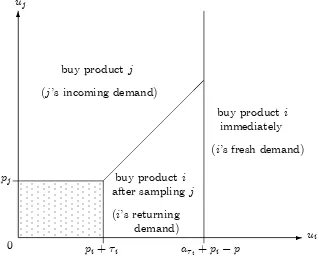
model with costless recall as described in Wolinsky (1986). Sincea decreases with the returning cost , it follows that if the returning cost increases, a consumer becomes less willing to investigate the rival …rm. (The utility from sampling the rival falls with since there are fewer pro…table opportunities to return to the initial …rm.) The case where i < V(p)is illustrated in Figure 1, where the shaded area is the region where the
consumer buys neither product. (Recall thatpis the price which consumers anticipate …rmj will charge, while pj is the price that …rm j actually o¤ers.) When i exceeds
V(p), the returning cost is so great that the consumer never returns to …rmi once she leaves it and returning demand vanishes. Hence, the continuation payo¤ for sampling the second …rm isV(p), and she will sample both products wheneverui pi < V(p).
-6
0 pi+ i a
i +pi p
ui
uj
pj buy producti
after samplingj
(i’s returning demand)
buy producti
immediately
(i’s fresh demand) buy product j
(j’s incoming demand)
[image:10.612.146.465.257.516.2]p p p p p p p p p p p p p p p p p p p p p p p p p p p p p p p p p p p p p p p p p p p p p p p p p p p p p p p p p p p p p p p p p p p p p p p p p p p p p p p p p p p p p p p p p p p p p p p p p p p p p p p p p p p p p p p p p p p p p p p p p p p p p p p p p p p p p p p p p p p p p p p
Figure 1: Pattern of demand for consumers who sample …rm i…rst ( i < V(p))
In the remainder of the paper, an important consideration is whether a higher cost for returning to a …rm acts to boost or reduce that …rm’s total demand. First, it is clear that a …rm’s returning cost i cannot a¤ect its incoming demand, since incoming
consumers buy immediately or not at all. Second, Figure 1 shows that increasing i
boosts a …rm’s fresh demand. Third, the …gure also shows that the …rm’s returning demand contracts with a higher i. Thus, the impact on the …rm’s total demand is
uncleara priori. The next result discusses the net impact in some special cases:
Lemma 2 Suppose that …rm j’s actual incoming price pj is equal to the anticipated
price p. Then an increase in …rm i’s returning cost i will:
(ii) decrease the …rm’s total demand if the density f is decreasing with u; (iii) leave the …rm’s total demand unchanged ifu is uniformly distributed.
The intuition for this result is as follows. A fresh consumer who buys at …rm i
immediately has a higher valuation of the product than a returning consumer. Whenf
is increasing, there are more consumers with higher valuations in the population, and so the e¤ect of a higher recall cost on increasing fresh demand is more signi…cant than its impact on returning consumers. Whenf is decreasing, the opposite is true. When utilities are uniformly distributed, the net impact of the returning cost on total demand is zero, and an increase in i causes demand to be substituted from returning to fresh
demand in a one-for-one manner.
As discussed earlier, a …rm has two broad reasons to condition its o¤er on a con-sumer’s search behaviour: an informational motive based on what it learns about the consumer’s preferences, and a strategic motive to in‡uence the consumer’s decision to engage in further search. The strategic motive is essentially captured by the impact of the return cost on a …rm’s total demand. Thus, if the density is increasing, a …rm has an incentive to make it hard for consumers to return to it, as the resulting gain in fresh demand outweighs the loss of returning customers. As we discuss further in section 3.4, this implies that when the density is increasing, …rms have an incentive to force potential consumers to buy “now or never”.
3
“Buy-Now” Discounts
Consider the situation in which …rms are able to recognize returning consumers and charge them a di¤erent price. Each …rm then potentially sets two prices: pi is …rm i’s
price to those consumers who visit it for the …rst time (comprising both the fresh and incoming consumers), while p^i is its price o¤ered to a consumer when she returns to
the …rm. An interpretation is that each …rm sets a “regular” (or “buy-later”) price p^i
and o¤ers the …rst-time visitors a “buy-now” discount i p^i pi. We assume that a
…rm can commit top^i when it o¤ers new visitors the buy-now pricepi. (We discuss the
impact of more limited commitment later in section 3.3.)
For simplicity, from now on we focus mostly on the case where match utility ui is
uniformly distributed on[0;1], so thatF(u) uand expression (2) becomes
a = 1 + p2(s+ ) :
result that …rms will choose to o¤er a buy-now discount continues to hold for more general distributions for the match utility, provided that the density function for u
does not decrease “too fast”. (See Table 1 below for illustrations of the equilibrium when the distribution of match utility is non-uniform.)
To ensure an active market we assume a relatively small search cost0 s 1 8. (If
s > 1
8 then there is no equilibrium in which consumers sample even one …rm’s o¤er.)
We also focus on symmetric equilibria where both …rms o¤er the same price pair(p;p^).
3.1
Equilibrium prices
For convenience, we analyze the model in terms of the buy-now price p and the total returning cost = ^p p (rather than in terms ofp and p^). Suppose …rm j adopts the equilibrium strategy(p; )and consumers expect that both …rms will o¤er these prices. If …rmi unilaterally deviates to(pi; i), with i V(p), its pro…t is10
piQT + iQR ; (6)
whereQT is …rmi’s total demand and QR is the portion of demand from its returning
customers. (The …rm obtains revenue pi from all its customers, plus the incremental
revenue p^i pi = i from its returning customers.) These demand functions can be
derived by calculating the areas of the various regions in Figure 1 to yield11
QT = 1 (pi+a i p)
| {z }
fresh demand
+ 1
2(a i i)
2 1
2p
2
| {z }
returning demandQR
+ a (1 pi)
1
2(a p )
2
| {z }
incoming demand
: (7)
Note that the …rm’s returning demand does not depend on its buy-now pricepi over
the relevant range. (By examining Figure 1, we see that varying pi simply shifts the
region of returning demand uniformly to the left or right.) Note also that the …rm’s total demandQT does not depend on its buy-now discount i. (This follows from part
(iii) of Lemma 2.) Thus, a …rm’s pro…t in (6) is additively separable in its buy-now pricepi and its buy-now discount i.
In particular, …rm i will choose its returning cost i to maximize iQR( i), the
extra revenue from its returning consumers. We deduce that given the equilibrium buy-now price p, the buy-now discount maximizes the incremental industry pro…t from returning customers, which is
((a )2
p2
) = (z2
p2
) : (8)
10When
i V(p), the returning demand disappears and fresh demand becomes1 [pi+V(p)];and
so the pro…t will be independent of i. Hence, our restriction to i V(p)is without loss of generality.
11To calculate …rm i’s incoming demand use Figure 1 to calculate …rm j’s incoming demand, but
permute the two …rms, i.e., replacepj with pi and replace pi withp. (A consumer who visits …rmj
It is clear (e.g., by using a revealed preference argument) that the value of which maximizes (8) is a decreasing function of p.12 In equilibrium, as we will show, we
have p < a0 = z0 provided that s < 18. Since z is a decreasing function of , it
follows that the pro…t generated from returning consumers in (8) is negative whenever
< 0, and strictly positive for in a neighborhood above 0. We deduce that …rms in equilibrium will choose a strictly positive buy-now discount if s < 1
8. Note that a
…rm has an incentive to o¤er a positive buy-now discount even if its rival does not. Moreover, returning demand falls to zero if V(p), i.e., if z p, and from (8) we can deduce that in equilibriump < z whenever s < 1
8. From Figure 1, it follows that
there is indeed a region of returning demand in equilibrium. That is to say, although …rms could force consumers to buy “now or never” by choosing a very large , it is more pro…table for them to induce at least some consumers to return after sampling the rival’s o¤er and to extract some additional revenue from them.
One can show that (8) is concave in in the (relevant) region 0 1
8 (and is
decreasing in for larger ).13 From (8) and noting that dz =d = 1=(1 z ), the
…rst-order condition for equilibrium given p is
z2 p2 2 z
1 z = 0 : (9)
Turning to the equilibrium choice of buy-now pricep, note that …rmi’s total demand in (7) is linear inpi, and so its pro…t is concave inpi. Therefore, the …rst-order condition
for pi to be optimal is also su¢cient. Each …rm’s equilibrium total demand is QT =
1 p(p+ ). That is, a consumer will leave the market without buying anything if and only if she neither buys at the second …rm nor wants to go back to the …rst one. Using this fact, one can see that the …rst-order condition for the equilibrium buy-now price
p, given , is
1
p p= 1 +z + 2 : (10)
The right-hand side of (10) is at least3 2.
14 Since the left-hand side of (10) is decreasing in p, it follows that the solution to this …rst-order condition satis…esp 1
2. (In particular,
since a0 = z0 12, it follows that p < a0 = z0 as claimed previously.) Moreover,
for 0 1
8 s, which will be the relevant range of , the right-hand side of (10) 12More precisely, the …rm’s optimal choice for
i decreases with its rival’s buy-now price.
13Expression (8) is decreasing in if and only if z2
p2
+ 2 z z0 <0, which is certainly true if
z + 2 z0 <0. But since z0 = 1=(1 z ), this is true if 2 > z (1 z ), which in turn is always
true if > 1
8. Thus, pro…t decreases in for > 1
8. Next, suppose that 1
8. Di¤erentiating the
…rst-order condition once more shows that (8) is concave in if and only if <2z (1 z )2
, i.e., if
=(s+ )<4(1 p2(s+ )). But when s; <1
8 the right-hand side of this is greater than 1, and so
the claim follows.
14Note that z + 2 is a convex function which is minimized by setting =1
8 s, which makes the
right-hand side of (10) equal to 7
4 2s. Sinces 1
is decreasing in , and so the buy-now price p in (10) is an increasing function of . Intuitively, a buy-now discount increases search frictions in the market, which in turn allows …rms to charge a higher price.
As an aside, note that expression (10) reveals the equilibrium price in the alterna-tive situation where …rms choose a uniform price p and consumers have an exogenous
returning cost for returning to a previously-sampled …rm. (In this situation, …rm i’s pro…t is modi…ed from (6) to be piQT, where we set i = in (7). The …rst-order
condition for the equilibrium price is therefore still (10).) As far as we know, this is only example where equilibrium price is derived in an oligopoly model with a returning cost.15
The equilibrium strategy (p; )is then found by solving the pair of nonlinear equa-tions (9)–(10), which can typically be done only numerically. For instance, whens= 0, so that there are no intrinsic search frictions in the market, solving these equations shows that p 0:45 and 0:06 and hence a buy-later price of p^ 0:51 (which is actually slightly above the monopoly price of 0.5). In this example, although the mar-ket has no intrinsic search frictions, …rms in equilibrium impose “tari¤ intermediated” search frictions on consumers via the buy-now discount, which here is about 12% of the buy-later price. By contrast, in a market withs = 1
8, which is the highest intrinsic
search cost which induces consumers to participate, one can check that the (exact) so-lution to this pair of equations isp= 1
2 and = 0, so that there is no buy-now discount.
(When s = 1
8, search costs are so high that consumers will accept the …rst o¤er which
yields them a non-negative surplus. In particular, there are no returning consumers even with costless recall.)
More generally, the equilibrium buy-now discount decreases with the search cost
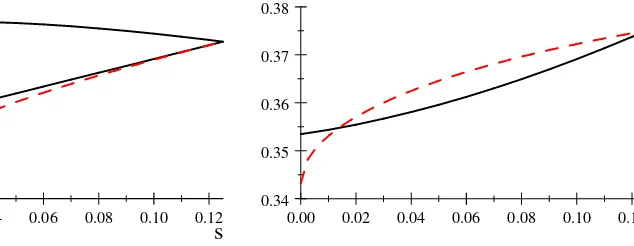
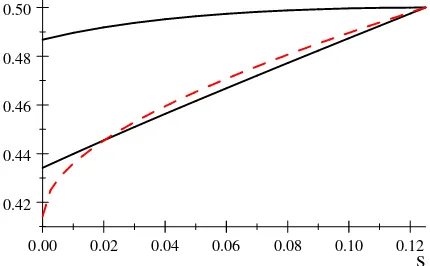
s. That is, the higher is the intrinsic search cost, the less incentive …rms have to deter consumers from searching on. This can be seen from Figure 2A below, which depicts how the buy-later price p^ = p+ (the upper solid curve) and the buy-now price p
(the middle solid curve) vary withs. As is expected, the buy-now price increases with the search cost. Less expected is the observation that the buy-later price depends non-monotonically on s (and is always above the monopoly price).
Further details of the equilibrium are provided in this formal result.16
Proposition 1 Given s 2 [0;1
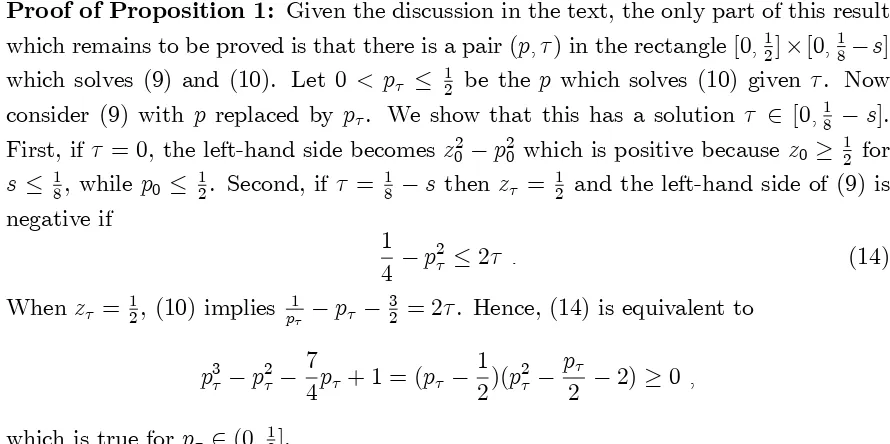
8], the system of (9) and (10) has a solution (p; ) 2
[0;1 2] [0;
1
8 s], and the solution satis…es p z .
15As mentioned in the Introduction, Janssen and Parakhonyak (2008) examine consumer behaviour
in a model where consumers incur a recall cost. Although their model is in other respects more general than ours, they do not model …rms’ price choices.
16As discussed, decreases withpin (8) andpincreases with in the range0 1
8 sin (10),
and so there is auniqueequilibrium with(p; )2[0;1 2] [0;
1
8 s]. Numerical simulations suggest that
in the wider region of(p; )2[0;1]2
This analysis assumes that …rms cannot distinguish fresh from incoming customers and so must charge both groups the same price. In section 4 we suppose instead that …rms can distinguish all three customer groups, in which case it turns out that …rms will o¤er incoming consumers the same price as the returning consumers, a price which is higher than that o¤ered to fresh customers. Thus, if feasible, …rms have an incentive to discriminate against customers who have investigated the rival …rm (i.e., the returning and incoming customers), rather than discriminate between returning customers and those customers who come to the …rm for the …rst time.
3.2
Comparison with uniform pricing
In the more familiar search model where …rms can only charge a uniform price p0,
consumers face no returning cost and so expression (10) implies that the …rst-order condition for the price is
1
p0
p0 = 1 +a0 : (11)
(Unlike the discriminatory prices, this uniform price can be explicitly computed.) Recall that the price which solves (10) increases with the returning cost for 2 [0;1
8 s].
We can therefore deduce the following result immediately:
Proposition 2 Price discrimination over returning consumers leads to higher prices, i.e.,p0 p p^.
That is, even the discounted buy-now price in the discriminatory case is higher than the uniform price, and the ability to o¤er discounts for immediate purchase drives up
both prices.17 The intuition for this comes in two steps. First, a …rm’s total demand
is inelastic with respect to changes in the buy-now discount (perfectly so when match utility is uniformly distributed). Since a …rm makes additional pro…t of i from its
returning customers, it surely wishes to set a positive buy-now discount. Second, the buy-now discount adds to the intrinsic search frictions in the market, and this allows …rms to charge a higher price. (Relative to the uniform-price case, consumers become less willing to search on, and so the …rms’ demand is less price elastic.) Figure 2A depicts the three prices, where from the bottom up the three curves represent p0, p
and p^, respectively. In particular, when s = 1
8 the search cost is so high such that no
consumers want to search beyond the …rst sampled …rm, there is no returning demand in either regime, and so all three prices coincide.
In the discriminatory case, each …rm’s equilibrium demand is1 pp^. This is clearly lower than the counterpart1 p2
0 in the uniform-pricing case sincep;p^ p0. Hence, this 17It is not unusual that the ability to price discriminate in oligopoly leads to falls in all prices, but
form of price discrimination excludes more consumers from the market. In addition, one can show that fresh demand rises, and returning demand falls, when this form of price discrimination is used. This is illustrated in the cases= 0 in Table 2 below.
However, whether price discrimination leads to higher pro…t depends on the mag-nitude of the search cost. In the non-discriminatory case, each …rm’s pro…t is 0 =
p0(1 p20). In the discriminatory case, from (6) each …rm’s pro…t is
=p(1 pp^) + 1 2 (z
2
p2
) :
Figure 2B shows how 0 (the dashed curve) and (the solid curve) vary with the
search cost s. We see that price discrimination leads to higher pro…t (i.e., > 0)
only if the search cost is relatively small. When the search cost is relatively high, price discrimination leads to prices which exclude too many consumers. In these cases, …rms are engaged in a prisoner’s dilemma: when feasible an individual …rm wishes to o¤er a buy-now discount, but when both do so industry pro…ts fall.18
0.00 0.02 0.04 0.06 0.08 0.10 0.12 0.42
0.44 0.46 0.48 0.50 0.52
s
Figure 2A: Prices and search cost
0.00 0.02 0.04 0.06 0.08 0.10 0.12 0.34
0.35 0.36 0.37 0.38
[image:16.612.185.502.341.464.2]s
Figure 2B: Pro…ts and search cost
Finally, we observe that aggregate consumer surplus and total welfare (measured by the sum of consumer surplus and pro…t) fall when …rms discriminate in this man-ner. Consumer surplus falls since both prices rise compared to the non-discriminatory regime. (Even if p^= p, i.e., if …rms charged returning consumers the buy-now price, consumers would obtain lower surplus in the price-discrimination case since p p0.
The buy-later premium 0 only adds to their loss.) As far as total welfare is con-cerned, relative to uniform pricing, price discrimination not only induces suboptimal consumer search (i.e., consumers on average cease their search too early due to the
18This bears some similarities to situations with competitive bundling. There, a …rm often has a
buy-now discount), but also excludes more consumers from the market, both of which harm e¢ciency.19
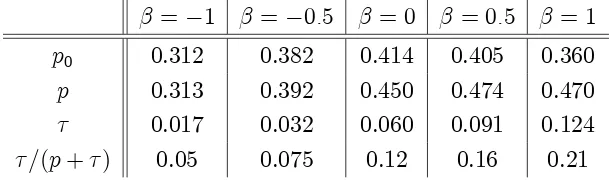
Our analysis of buy-now discounts so far has assumed that the match utility is uni-formly distributed. It is possible to derive equilibrium prices in non-uniform examples by calculating the measure, rather than simply the area, of the regions in Figure 1. As a robustness check on our results, we report numerical calculations for the equilibrium tari¤ in examples where the density function f is linear rather than constant. Speci…-cally, suppose that the density takes the formf(u) = 2 u+ 1 , where 2[ 1;1], so that the density function is a straight line with slope2 passing through the point
(1
2;1). Table 1 reports the equilibrium prices for various values of , assuming that the
search costs is zero.
= 1 = 0:5 = 0 = 0:5 = 1
p0 0.312 0.382 0.414 0.405 0.360
p 0.313 0.392 0.450 0.474 0.470 0.017 0.032 0.060 0.091 0.124
[image:17.612.153.458.256.346.2]=(p+ ) 0.05 0.075 0.12 0.16 0.21
Table 1: Equilibrium prices when utilities are not uniformly distributed (s= 0)
Here, the …rst row reports the equilibrium non-discriminatory price, the second and third rows report the now price and discount, while the …nal row reports the buy-now discount as a fraction of the buy-later price. The central column with = 0 is the uniform case previously discussed. As expected, when the density is increasing, the incentive to set a buy-now discount is reinforced by an additional strategic e¤ect: as shown in Lemma 2, with an increasing density a …rm’s total demand is boosted if it makes it costly to return. Thus, we see that the size of the buy-now discount increases with , both in absolute terms and as a proportion of the buy-later price. Nevertheless, over all linear density functions, the equilibrium buy-now discount remains positive. Notice also that all prices are higher with price discrimination than without discrimi-nation, even when the density is decreasing. In particular, consumers in aggregate are worse o¤ with this form of price discrimination.
3.3
Buy-now discounts without commitment
We discuss next whether buy-now discounts can still emerge as an equilibrium outcome if we relax the assumption that a …rm can commit to its buy-later price when consumers …rst visit. We consider two cases: one with partial commitment in which …rms can commit to a returning purchase price cap (but cannot commit to a speci…c price), and
19The proof of Proposition 3 in Armstrong, Vickers, and Zhou (2009) can be adapted to prove this
the other with no commitment at all. The …rst case may be reasonable in situations where …rms can post a “regular” price. For example, the price printed on the price label in a store usually has this kind of commitment power. The second case may be more relevant in bargaining situations where it is infeasible to sign a contract for the returning purchase price. In both cases, we argue that a buy-now discount can still arise in equilibrium.
Partial Commitment: Here, there is an equilibrium with the same outcome as in the full commitment case. Speci…cally, in this equilibrium, …rms charge a buy-now pricep, commit to a buy-later price cap p^, and actually charge returning consumers p^, where both p and p^ take the same values as the commitment case analyzed in section 3.1. To sustain this equilibrium, we assume that all consumers believe that for any (maybe o¤-equilibrium) committed price capp^i the …rm’s actual buy-later price will bep^i.
To prove this claim, it su¢ces to observe that when consumers hold the above belief, they will return to the …rst sampled …rm, say …rm i, only if ui p^i, where p^i is …rm
i’s buy-later price cap. This implies that …rm i can have no incentive to charge them a price below p^i. (It may have an incentive to raise the price above p^i, but that is
not permitted given that the …rm commits to this cap.) This in turn ful…lls consumer beliefs. Thus, the price cap can be used as a full commitment device.20
No Commitment: We turn next to the case where …rms can make no credible com-mitments about their buy-later prices when consumers …rst visit. Here, and unlike the rest of this paper, it makes an important di¤erence whether or not consumers face an intrinsic returning cost when they come back to a …rm. If consumers face no such cost (as we assumed in the rest of the paper) it is possible to construct equilibria of the con-stant markup form which are qualitively similar to the commitment prices: consumers anticipate that a …rm will set a return pricep^i =pi+ if that …rm o¤ers the buy-now
pricepi, and given these expectations …rms have no incentive to set a di¤erent buy-later
price. (There is a continuum of such which can make up an equilibrium of this form, and which induce some consumers to return to their initial …rm.) There is also an “exploding o¤er” equilibrium: consumers anticipate that …rms o¤er very high prices if they return and so never return, and given this behaviour …rms have no incentive to reduce their return prices.
However, if there is even a small intrinsic returning cost, sayr >0, it turns out that theonly equilibrium involves exploding o¤ers where the returning demand segment is shut down altogether. To see this, suppose in some equilibrium that each consumer forecasts that a …rm’s buy-later price is p^(pi) when its buy-now price is pi, where p^( )
can take any form. Suppose that the buy-now price in this equilibrium is p , say, and
suppose—contrary to the claim—there is some returning demand in this equilibrium. (Formally, from Figure 1 this implies thatr+ ^p(p ) p < V(p ), wherer+ ^p(p ) p is a consumer’s total returning cost.) But if a consumer returns to …rmiafter …rst sampling …rmi and then …rm j, it follows that her match utility satis…es ui p^(p ) +r, since
the consumer must also pay the returning costr >0. Since all its returning customers have match utility at leastp^(p ) +r, the …rm’s optimal price for these customers must be at least p^(p ) +r, which contradicts the assumption that p^(p ) was the correctly anticipated buy-later price.
Thus, when there an intrinsic returning cost, no matter how small, consumers an-ticipate that the buy-later prices will be so high that it is never worthwhile to return to the …rst …rm after leaving it. In e¤ect, …rms are forced to make exploding o¤ers, and consumers have just one chance to buy from any …rm. This result is analogous to Diamond’s (1971) paradox, showing how a small search cost can cause a market to shut down. Diamond’s result relies on consumers knowing their match utility in advance, and one major advantage of Wolinsky’s formulation withex ante unknown match util-ities is that this paradox can be avoided. But even in our Wolinsky-type framework, thereturning consumers know their match utility, and so the returning market fails for the same reason as the primary market failed in Diamond’s framework.
3.4
Non-monetary returning costs and exploding o¤ers
The previous section suggested that exploding o¤ers would often arise when …rms can-not commit to their buy-later prices. In this section we discuss an alternative rationale for exploding o¤ers. In the buy-now discount model, the discount induces a return-ing cost, but it also directly a¤ects …rms’ revenue since …rms gain revenue from the high prices their returning consumers must pay. In other situations it is plausible that …rms must o¤er the same price to all consumers, but can a¤ect the cost of returning with various non-price means.21 The case of exploding o¤ers, where aggressive sellers
force new visitors to buy “now or never”, is represented by the extreme case of a very large returning cost. In these situations when …rms must o¤er the same price to all consumers, the only reason to increase the returning cost is the “strategic” motive to deter a consumers from searching further.
Suppose that each …rm chooses a returning cost i and a uniform pricepi. Suppose
…rms can freely choose and i 0without incurring additional costs. Since the strategic
motive to make it hard to return is paramount in this setting, suppose in this section that the match utilityu comes from a general distribution distribution F rather than the special case of the uniform distribution. (Recall that the strategic motive is absent
21For example, online sellers can ask customers to log on to their accounts or input information
with a uniform distribution.) To calculate the symmetric equilibrium strategy (p; ), suppose that …rmichooses(pi; i)while its rival follows the equilibrium strategy (p; ).
Firmi’s pro…t is justpi multiplied by its total demand. Thus, a …rm’s returning cost i
is chosen simply to maximize its total demand given its own price and its rival’s price and returning cost.
From Lemma 2 we can deduce: (i) if u has an increasing density, …rms will choose a returning cost as high as possible, and in equilibrium there is no returning demand, and (ii) if u has a decreasing density, …rms will choose the lowest possible returning cost i = 0. In case (i) the price p is the equilibrium price in a search model without
the possibility of consumer recall, while in case (ii)pis the equilibrium price in a search model with costless recall. Thus, when the density of the match utility is increasing the equilibrium involves each …rm forcing fresh consumers to buy “now or never”, while when the density decreases …rms allow consumers to return freely if they do not wish to buy immediately.22
In the particular case of the uniform distribution, where f 1, given a particular price p …rms are indi¤erent between all levels of the returning cost, and altering i
merely shifts returning demand to fresh demand in a one-for-one manner. In this case there are multiple equilibria. Consider for simplicity the case of costless search, so that
s= 0. Then when consumers can freely return to their initial …rm (so that = 0), one can check from (10) with =s= 0that the equilibrium price isp=p2 1 0:41. By contrast, if new consumers are forced to buy “now or never” ( V(p)), one can check from (10) with s = 0 and = V(p) that the equilibrium price solves p3
+ 2p 1 = 0
so that p 0:45. Either of these strategies make up a symmetric equilibrium (and there are interior symmetric equilibria as well, where …rms make it costly to return but not prohibitively so). Clearly, consumer surplus is higher in the free-return equilibrium (since consumers have the option of buying “now-or-never” even when they are not forced to). It turns out that industry pro…ts are also a little lower with high-pressure selling: the price is higher than with free return, but signi…cantly fewer consumers then buy either product. In this example then, a laissez-faire market may exhibit high-pressure sales techniques being employed in equilibrium, while both consumers and …rms would be better o¤ if such practices were prohibited.23
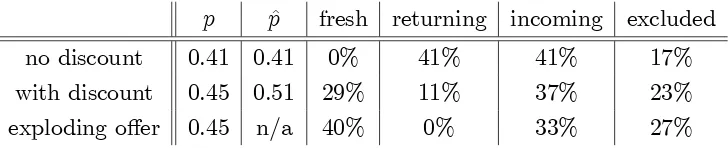
Table 2 summarizes the outcomes withs= 0 and a uniform distribution for match utilities in the three situations we have now encountered. When consumers can freely return to their initial …rm, the equilibrium price (buy-now or buy-later) is 0.41. With
22If the density if non-monotonic, it is possible that …rms will adopt an intermediate returning cost,
which is positive but still induces some consumers to return.
23The use of exploding o¤ers could be prohibited by mandating a “cooling o¤ period”, so that
costless search and return no consumer will ever choose to buy from the …rst …rm immediately, and so fresh demand is zero. In equilibrium, …rms set the same price and so each …rm’s total demand is split equally between returning and incoming consumers. When …rms o¤er a buy-now discount, section 3.1 shows that the buy-now discount is about 12% of the buy-later price, and as a result there is signi…cant fresh demand and less returning demand. Finally, when exploding o¤ers are used, there is no returning demand at all.
[image:21.612.125.489.184.258.2]p p^ fresh returning incoming excluded no discount 0.41 0.41 0% 41% 41% 17% with discount 0.45 0.51 29% 11% 37% 23% exploding o¤er 0.45 n/a 40% 0% 33% 27%
Table 2: The impact on prices and demand of buy-now discounts and exploding o¤ers
4
Other Forms of Search-Based Discrimination
In this section we consider alternative methods of price discrimination in this market. In some situations, …rms may be able to distinguish more …nely between consumers, and can identify fresh from incoming consumers. (For instance, an online …rm may be able to track whether a consumer has previously paid it a visit and whether she has already visited the rival seller.) What are equilibrium prices when …rms can distinguish all three types of consumers? We continue to assume a uniform distribution for match utilities, that the search cost lies in the range s 2 [0;1
8], and that …rms can commit
to their buy-later prices when a consumer visits for the …rst time. Let p, p^, and P
be the corresponding prices for fresh consumers, returning consumers, and incoming consumers, respectively. Then the pattern of demand for those consumers who …rst visit …rmi is just as depicted in Figure 1, except that …rmj’s prices are changed from its buy-now prices (p; pj) to its incoming prices (P; Pj). As the following proposition
shows, in this setting there continues to be an equilibrium with active returning purchase and a buy-now discount, but now the discount applies only to a …rm’sfresh consumers.
Proposition 3 When …rms can distinguish all three groups of consumers, there is a unique equilibrium with 2[0;1
8 s] and P = ^p=p+ 1 2 z .
A little surprisingly, in equilibrium …rms charge exactly the same price to returning consumers and incoming consumers.24 Thus, in equilibrium a …rm discriminates equally
against all consumers who have investigated the rival seller, regardless of whether the consumer …rst sampled it or the rival seller. It is clear that …rms have a motive to
24This result also holds for general distributions, and so it is not driven by the assumption of a
discriminate against consumers who have investigated the rival, since by revealed pref-erence such consumers do not much care for the rival’s product. But it is less clear why a …rm discriminates equally against all such consumers. After all, a returning consumer has also revealed that she does not much care for the …rm’s product either (for otherwise she would have purchased immediately).
Whenever a consumer samples the second product, that consumer makes her choice under complete information and without search frictions: she knows both of her match utilities and both prices, and she needs to incur no further search costs to buy either product. There are two opposing factors a¤ecting the …rst seller’s choice of buy-later price. First, the …rst seller o¤ers a lower match utility on average than its rival, and hence its buy-later price should be lower than the rival’s (incoming) price for these consumers. Second, raising its buy-later price reduces a consumer’s incentive to search further, which therefore allows the …rm compete for fewer consumers in a disadvanta-geous situation. For reasons which are not yet fully clear, these two forces cancel out exactly, and the equilibrium buy-later and incoming prices coincide.
0.00 0.02 0.04 0.06 0.08 0.10 0.12 0.42
0.44 0.46 0.48 0.50
[image:22.612.199.414.347.480.2]s
Figure 3: Prices with full discrimination
Figure 3 describes the relative positions of the fresh demand pricep(the lower solid curve), the returning/incoming demand price p^= P (the upper solid curve), and the uniform price p0 (the dashed curve, already depicted on Figure 2A). Relative to the
uniform price, the price for returning and incoming consumers becomes higher, but the price for fresh consumers may be higher or lower, depending on the magnitude of the search cost. Note also that, in contrast to the case in Figure 2A, here the non-discounted price depends monotonically on the search cost and never exceeds the monopoly level of 0.5. However, numerical simulations suggest that the impacts of price discrimination on pro…t, consumer surplus, and total welfare are similar to our main model.
there is even a small exogenous returning cost, then in equilibrium consumers expect a prohibitively high buy-later price and never return to the …rst sampled seller. Then each …rm acts as a monopolist over its incoming consumers and charges them the monopoly price 1
2. This further implies that a consumer samples the second seller if and only if
the …rst product’s net surplus is belowV(1
2), and so the price o¤ered to fresh consumers
is 1
2[1 V( 1
2)] 0:44if s = 0.
Other forms of price discrimination could also be considered, depending on which consumer groups can be separately identi…ed by …rms. We have seen in Proposition 3 that when …rms can separately identify all three groups, they do not set distinct prices to incoming and returning customers even though they could do so. It follows that in the alternative setting where …rms cannot distinguish these two groups of customers the equilibrium prices are as described in Proposition 3 and Figure 3. (It is not clear, however, how relevant this particular information structure is for real markets.)
A perhaps more relevant situation is where …rms can identify incoming consumers, but cannot distinguish fresh from returning customers. This implies that a …rm sets price p for those consumers who sample it …rst (i.e., for both fresh and returning con-sumers), and priceP for the incoming consumers who have sampled the rival …rst. Since fresh consumers and returning consumers pay the same price, consumers no longer face a returning cost. This case might also apply when a …rm is somehow prevented from o¤ering di¤erent prices to fresh and returning customers.25
This variant essentially replicates the model in Armstrong, Vickers, and Zhou (2009), specialized to duopoly. (In the earlier paper, all consumers visited a prominent …rm …rst, while in the current paper consumers have a random search order. But the assumption that …rms can observe the search order makes the two situations the same.) Armstrong
et al. (2009, Proposition 1) showed that prices were ordered as
p p0 P ;
where p0 is the equilibrium uniform price in (11). In other words, all consumers who
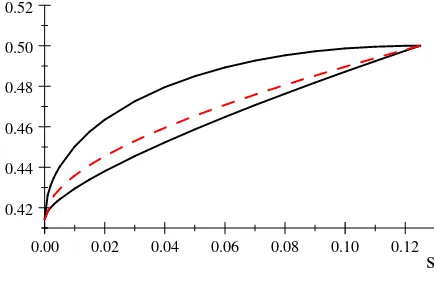
buy the …rst sampled product will pay less than before, while all consumers who buy the second sampled product will pay more than before. This is because the incoming consumers for each …rm must be those consumers who were relatively unsatis…ed with the rival’s product, and so the …rm holds greater market power and can a¤ord to set a high price. Separating these consumers makes the remaining demand more price sensitive, and so the associated price becomes lower. For comparison with our previous …gures, Figure 4 below depicts how these three prices vary with the search cost, where
25For instance, consider a consumer buying an item online. If she …rst investigates …rmi, that …rm
the middle dashed curve isp0(already shown on Figures 2A and 3 above), and the lower
and upper solid curves arep and P, respectively. Unlike previous cases in this paper, the three prices coincide when s = 0. When search and recall is costless, consumers will always sample both products, and so whether or not consumers have …rst seen the rival product reveals no useful information with which to set discriminatory prices.
0.00 0.02 0.04 0.06 0.08 0.10 0.12 0.42
0.44 0.46 0.48 0.50 0.52
[image:24.612.196.413.174.322.2]s
Figure 4: Prices when incoming consumers can be identi…ed
The welfare impacts of price discrimination over incoming consumers are again sim-ilar to our main model: relative to the uniform-pricing case, price discrimination lowers both consumer surplus and total welfare, and (at least in our duopoly setting) it boosts industry pro…ts if and only if the search cost is relatively small.
5
Discussion and Extensions
This paper has explored how …rms could use their knowledge of consumer search be-haviour to re…ne their pricing decisions, and how this practice could a¤ect market per-formance. Our main model studied the case in which a …rm knows whether a consumer is visiting it for the …rst time or whether the consumer is returning after a previous visit. We saw that …rms have an incentive to o¤er a lower price on a …rst visit than a second visit, so that new consumers are o¤ered a “buy-now” discount. The ability to o¤er such discounts acts to raise all prices in the market, which lowers both consumer surplus and total welfare and may even harm …rms themselves when the search cost is relatively high. We also explored …rms’s incentives to use exploding o¤ers, so that a new visitor to a …rm is forced to make her purchase decision immediately, before she has the chance to investigate the rival o¤ering.
The impact of prominence: In many circumstances, one seller is more prominent than others, with the result that more consumers sample it …rst. (Recall that De los Santos (2008) showed how one seller in the online book market attracted a greatly disproportionate share of the initial searches by consumers.) We now discuss how prominence could a¤ect our results in the main model. For instance, will a prominent …rm o¤er a greater or smaller buy-now discount than its rival, or will a prominent …rm have a greater incentive to use exploding o¤ers than its rival? (In the variants presented in section 4, …rms compete for consumers with di¤erent search orders separately, so prominence does not a¤ect prices at all.)
In the non-monetary returning cost model presented in section 3.4, each …rm just chooses its returning cost to maximize the sum of its fresh demand and returning demand (recall that a …rm’s incoming demand is not a¤ected by its returning cost). Given prices, this decision is independent of how many consumers sample the …rm …rst. Hence, at least for monotonic utility density functions (in which cases the choice of returning cost is independent of prices), prominence does not alter …rms’ incentive to choose their returning cost. In particular, if the density for match utility is increasing, a …rm has an incentive to make exploding o¤ers regardless of how prominent it is.
Turning to the buy-now discount model, consider …rst the extreme case where all
consumers …rst visit one of the …rms, say …rm A. Thus, …rm A has only fresh and returning demand, with respective prices p and p^, while …rm B only has incoming demand with priceP. It is then clear that the equilibrium choices for these three prices are exactly as described in Proposition 3 when full discrimination is possible. (When calculating equilibrium prices in the fully discriminating case, the share of consumers who …rst sample one …rm makes no di¤erence to the analysis, since the segments of consumers who …rst sample A and consumers who …rst sample B are treated entirely separately by the …rms.) Hence, when one …rm is prominent, its buy-now price is the lower solid line on Figure 3 and its buy-later price is the higher solid line, which is also the (single) price o¤ered by the less prominent …rm. Since each of the prominent …rm’s prices are (weakly) lower than the its rival’s price, consumers have a strict incentive to investigate the prominent …rm …rst, even if they have a choice over their search order.26
However, this extreme case cannot shed light on the less prominent …rm’s incentive to o¤er buy-now discount (since it has no opportunity to do so when its only demand comes from incoming consumers). In a less extreme setting where1 + (with < 1) consumers sample the prominent …rm …rst, one can show that the prominent …rm’s buy-now discount decreases with while the less prominent …rm’s buy-now discount increases with . That is, the less prominent …rm will actually o¤er a deeper buy-now
26In particular, the buy-now discount model withex ante symmetric …rms also has twoasymmetric
discount than its rival. For example, if s = 0, the prominent …rm’s buy-now discount decreases from0:06to0:053as varies from zero to one, while the less prominent …rm’s buy-now discount increases from0:06to 0:063.27
More ornate schemes:In our buy-now discount model, sellers may be able to extract more surplus from buyers by o¤ering them an additional option—namely, buyers can pay a deposit d for the option to return and buy at a speci…ed price q.28 With this
new option, more consumers may opt to search on, and among the consumers who do search on, those having relatively high valuations of the …rst product will buy the deposit contract while others having relatively low valuations will not since they rarely come back. In the uniform distribution case, one can show numerically that: (i) starting from the equilibrium in our main model, each …rm has a strict incentive to introduce a deposit contract; (ii) the purchase price in the deposit contract is even lower than the buy-now price (i.e., q < p) but the consumers who buy the deposit contract and eventually come back pay more than fresh consumers (i.e.,d+q > p); (iii) with the new instrument …rms earn less in equilibrium. This extension could be extended further, so that …rms o¤er amenu of deposit contracts (a bigger deposit would grant the right to come back and buy at a lower price).
Using search behaviour to infer search cost:When consumers have heterogenous search costs, which plausibly will be private information initially, consumer search be-haviour may be informative of search costs. The consumers who buy the …rst sampled product immediately have (on average) relatively high search costs, which may induce …rms to charge them a high price when they are distinguishable. Meanwhile, those consumers who keep searching have (on average) relatively low search costs, which may induce …rms to charge them a low price.
To illustrate in a stark model, consider the situation in which …rms can distinguish all three groups of consumer (fresh, returning and incoming) and so charge each group a distinct price. Suppose that products are homogeneous, and each consumer is willing to pay up tov for a unit. Suppose there are two possible costs of search: some consumers have costless search (i.e.,s = 0), while the others have extremely high costs of searching the second …rm, and so will immediately buy from the …rst …rm they visit provided that that …rm’s price is below v. Then the equilibrium in this market involves each …rm setting the buy-now price equal to monopoly price v, and the incoming and returning
27This is because, as we pointed out in footnote 12, in equilibrium a …rm’s buy-now discount decreases
with its rival’s buy-now price. When a …rm becomes more prominent, it will charge a lower buy-now price as it has fewer incoming consumers (over whom it has more monopoly power), which in turn induces its rival to o¤er a greater buy-now discount.
28For example, some business schools demand a deposit from applicants who want to keep the
price equal to marginal cost (which is zero).29 Thus, …rms will attempt to exploit the inert consumers with a high buy-now price, but once a consumer reveals she is willing to shop around, she is o¤ered a competitive deal.
Consumers’ incentives to conceal/reveal their search history. Notice that from anex ante perspective, in all our models a consumer will be better o¤ if she can conceal her search history, so that …rms are forced to set the non-discriminatory price.30 Thus, if
it is costless to pretend to be a new visitor (e.g., by deleting cookies on your computer), all consumers will do this, and the market will operate as a standard search market with uniform prices (as in Wolinsky’s framework). But if there are some costs involved in concealing search history, or if some consumers do not think to do so, there will remain an incentive to condition prices on observed search history.
Consumers may also have incentive to (selectively) reveal their search history. For instance, they may want to force the current seller to o¤er a better deal by providing hard information of a previous price o¤er (if this is possible).31 Investigating how such
a possibility could a¤ect price competition and market performance is an interesting topic for future investigation.
APPENDIX
Proof of Lemma 1: We calculate the consumer’s optimal strategy by backward induction. Denote by v(ui) the consumer’s expected continuation payo¤ if she decides
to investigate …rm j when her match utility from …rm i is ui. For convenience, write
^
pi =pi + i for the total expected cost of buying from …rmi if a consumer …rst leaves
and then returns to the …rm. Thus, a returning customer for …rmi expects to pay p^i
and so she will never do this ifui <p^i. Therefore, v(ui) =V(p) when ui <p^i. On the
other hand, if ui p^i then she will return to i after sampling j if ui p^i > uj pj,
wherepj is …rmj’s actual (not expected) price. Since the consumer expectsj to charge
p, her expected payo¤ from investigating j is then
Z p+ui p^i
0
(ui p^i)dF(uj)+
Z umax
p+ui p^i
(uj p)dF(uj) s =V(p)+
Z ui p^i
0
F(p+x)dx ; (12)
29The argument is similar to Armstrong, Vickers and Zhou (2009, section 4).
30This is somewhat related to models of sequential bargaining. If one buyer is negotiating with a
sequence of sellers, then the buyer may gain from keeping the order (and the outcome) of negotiations secret from sellers. Noe and Wang (2004) present such a model, and …nd that when the objects sold are complements for the buyer, then the buyer obtain greater surplus when he randomizes and conceals the order in which he approaches the sellers.
31In the model in Daughety and Reinganum (1992), if a consumer makes contact with two sellers,
where the equality follows after integrating by parts and the de…nition of V in (1). In sum, the consumer’s expected payo¤ if she decides to investigate …rmj is
v(ui) =
8 > < > :
V(p) if ui p^i
V(p) +Rui p^i
0 F(p+x)dx if ui p^i :
Note thatv( ) is a (weakly) increasing function with slope no greater than 1. Clearly, the consumer will decide to investigate …rmj if and only if
ui pi < v(ui) : (13)
Since (13) holds whenui = 0, and the left-hand side has slope 1 while the right-hand
side has slope less than 1, there is at most one point, say u where the curves in (13) cross so thatu pi =v(u ), and (13) holds if and only ifui < u . If the curves never
cross, so that (13) always holds for ui umax, then the price pi is so high that the
consumer will always continue onto the rival no matter how high the match utility from
iis. Otherwise the curves will cross, andu is the reservation utility level for continuing ontoj.
The curves cross at the “‡at” portion ofv( ), i.e.,u <p^i, if and only if i = ^pi pi
V(p). When the three prices satisfy this inequality, the consumer will continue onto j
if and only ifui pi < V(p). Moreover, the consumer will never return toiif she leaves
it, no matter how low isuj or how high the actual (as opposed to the expected) pj is.
(To check this, observe that her payo¤ if she returns toi after leaving it isui p^i, and
since she chooses to continue to j we have ui p^i < V(p) +pi p^i which is negative
given thatp^i pi V(p).) This proves part (ii) of the lemma.
Now suppose i = ^pi pi < V(p), so that the curves cross on the increasing portion
of v( ). In this case, from the expression for the continuation payo¤ on the left-hand side of (12) the threshold utilityu satis…es
u pi = v(u ),
Z umax
p+u p^i
[uj (p+u p^i)]dF(uj) s= i
, V(p+u p^i) = i
, z i =p+u p^i
, u =a i +pi p :
In sum, when i < V(p) the consumer should continue on to investigate the second
product if and only ifui pi < a i p. And if she does continue to j, she should return to i whenever ui p^i > uj pj where pj is …rm j’s actual price. This completes the