Munich Personal RePEc Archive
Microenvironment-specific Effects in the
Application Credit Scoring Model
Khudnitskaya, Alesia S.
Ruhr Graduate School in Economics, Economics and Social
Statistics Institute, Department of Statistics, Universität Dortmund
December 2009
Online at
https://mpra.ub.uni-muenchen.de/23175/
1
Microenvironment-specific Effects in the Application
Credit Scoring Model
Alesia KHUDNITSKAYA
Ruhr Graduate School in Economics, Essen, Germany
Economics and Social Statistics Institute, Department of Statistics, Universität Dortmund1
Abstract:Paper introduces the improved version of a credit scoring model which assesses credit worthiness of applicants for a loan. The scorecard has a two-level multilevel structure which nests applicants for a loan
within microenvironments. Paper discusses several versions of the multilevel scorecards which includes random-intercept, random-coefficients and group-level variables. The primary benefit of the multilevel
scorecard compared to a conventional scoring model is a higher accuracy of the model predictions.
Key words: Credit scoring, Hierarchical clustering, Multilevel model, Random-coefficient, Random-intercept, Monte Carlo Markov chain.
1 Introduction
In retail banking consumer credit scoring plays an important role as a valuable instrument
for a decision-making process. Lenders apply scoring models in order to assess credit worthiness of
applicants for a loan and forecast the probability of default. This paper contributes to the literature
on credit scoring and introduces a new type of a credit scoring model which has a multilevel
2 structure. The multilevel scorecard is an improved alternative to a conventional logistic scoring
model which is regularly applied in retail banking. In addition, paper proposes a new type of
clustering for a hierarchical two-level structure which is more intuitive and efficient in the
application to credit scoring. The structure allows exploring the microenvironment-specific effects
which are viewed as the unobserved determinants of default. Including microenvironment-effects
helps to improve the forecasting accuracy and evaluate the impact of the particular group-level
characteristics on the riskiness of borrowers.
In general, multilevel statistical modelling assumes that the data for the analysis is nested
within groups. In this set up groups represents the higher-level units and observations are the
lower-level units. The structure implies that units within the same group share more similarities
than units within different groups. Multilevel models are frequently applied in the field of social
science (Steele and Durrant (2009)), political science (Gelman and Hill (2007)) and education
(Goldstein and McConell (2007)). In particular, Goldstein (1998) applied a hierarchical structure
where pupils are nested within schools to evaluate school effectiveness and compare pupils’
achievements between and within schools.
The paper is divided into three parts: theoretical, empirical and discussions. The first section
introduces the multilevel structure and explains the motivation for the particular type of a
hierarchical structure. In addition, it provides the summary of the data used in the empirical
analysis and describes the sources of the data collection. I split the sample into two parts (training
and testing samples) in order to compare the out-of-sample performance between the multilevel
scoring models and a conventional scorecard.
The empirical part introduces several versions of the multilevel credit scoring models which
differ by the composition of random-effects and group-level characteristics. I apply a ROC curve
analysis to assess the predictive accuracy of the scorecards and calculate several postestimation
diagnostics which check the goodness-of-fit and help to compare the credit scoring models.
Section 4 evaluates the economic significance of the proposed multilevel structure and
provides a graphical illustration of the fitted model results. In addition, it shows that the quality of
borrowers varies greatly between poor and rich living areas. Applying multilevel modelling allows
3
2 Microenvironment and a multilevel structure
In the multilevel credit scoring the main goal is to define the unobserved characteristics which
influence riskiness of a customer additionally to the observed characteristics on borrowers such as
income, marital status and a credit history. Accordingly, I define a two-level hierarchical structure for a
scoring model which allows including the unobserved determinants of default (random-effects). The
structure nests applicants for a loan within microenvironments. In this case the borrowers are the
level-one units and microenvironments are the second-level groups. Each microenvironment represents a
living area of a borrower with a particular combination of socio-economic and demographic conditions.
There are several reasons why including information on microenvironments in the credit scoring
model is important and advantageous. First, it shows that borrowers from dissimilar living areas have
exposure to the different risk factors which impact their probabilities of default. It is evident that poor
living areas have higher unemployment rates, crime rates, contain a lower share of individuals with a
college degree and have a lower level of housing wealth. In such microenvironments individuals have a
higher chance to experience an adverse event such as damage of a property, an unexpected income cut or
health problems. It is also true that the overall quality of borrowers is lower in low income regions
compared to the richer regions which contain fewer borrowers with a derogatory credit history. In this
case the microenvironment-specific effects are viewed as the random determinants of riskiness which
trigger probability of default. Specifying random-effects and including them in the scoring model
improves a credit worthiness assessment of borrowers.
Second, clustering of borrowers within microenvironments allows exploring the impact of the
microenvironment-level characteristics on default. In section 3 I evaluate and discuss how area income,
real estate wealth and socio-demographic conditions influence the riskiness of individuals within poor
and rich living areas.
I define 61 microenvironments within which all borrowers are clustered. The grouping within
microenvironments is done according to the similarities in the economic and demographic conditions in
the residence areas of borrowers. The economic determinants of grouping are living area income,
unemployment rate, purchasing power index and the percentage of department store sales in the total
retail sales in the market. The socio-demographic determinants are the share of individuals with a
college degree in the living area and share of African-American (Hispanic) residents in the district.
Importantly, the proposed two-level structure where borrowers are nested within
microenvironments differ from a standard geographical grouping where individuals are nested in groups
according to their geographical locations. The main difference is that the former structure clusters
4
residence areas. This implies that a particular combination of economic and demographic conditions
impacts the riskiness of a customer but not a geographical location itself. Accordingly, within one
microenvironment it is possible to have applicants from different areas or cities if their living area
conditions are essentially the same.
2.1 Data and variables
In the empirical analysis I use the data from the American Express credit card database which
was also applied by W.Greene (1992). The sample contains 13 444 records on the credit histories of the
individuals who applied for a loan in the past and for whom the outcome (default or not default) is
observed. In addition, I collect the data on the regional economic accounts provided by the Bureau of
Economic Analysis (BEA) (www.bea.gov). The BEA data includes annual estimates of personal income, full and part-time employment, taxes and gross domestic product by states and counties.
The individual-level data includes personal information, a credit Bureau report and market
descriptive data for the 5-digit area zip-code. I combine the living area descriptive data with the
regional-accounts data (BEA) in order to define the microenvironments and create the group-level characteristics.
.
Full sample Training sample Testing sample
Default 1753 1069 684
Non-default 11691 6997 4694
Observations 13444 8066 5378
Table 1. Data subsamples
To compare the out-of-sample performance between the multilevel scorecards and a logistic
regression I split the sample into two parts. The short summary of the training and testing subsamples is
given in Table 1.
I apply a forward selection approach in order to choose the best performing predictors to
include in a scoring model. The resulting set of explanatory variables consists of 12 individual-level
5
3 Empirical analysis
This section provides an empirical analysis for the multilevel credit scoring models. I introduce
and fit several versions of the credit scorecards which differ by the composition of random-effects and
group-level variables. All scoring models are specified with a two-level structure where borrowers are
the level-one units which are nested within microenvironments, the level-two groups. The two-level
structure allows to recognize the microenvironment-specific effects which are defined by the
random-effects in the models.
3.1 Microenvironment-specific intercept scorecard
The microenvironment-intercept scorecard extends a logistic scoring model by specifying a
varying-intercept at the second-level of the hierarchy. Including a random-intercept in the scorecard
helps to relax the main assumption of the logistic regression of the conditional independence among
responses for the same microenvironment. The two-level credit scorecard with a varying-intercept and
individual-level explanatory variables is presented in (1). The borrower-level explanatory variables are
income ( ), number of dependents in the family ( ), number of current trade credit
accounts ( ), a dummy variable for using bank savings and checking accounts ( ),
number of previous credit enquiries ( , an indicator for the high-skilled professionals
( !), number of derogatory reports ( "), average number of current revolving credits
("#$% ) , an indicator variable for the borrowers who have previous experience with a lender such as personal loan or credit card (& ), total number of 30-day delinquencies in last 12 months ( % $) and a dummy variable for the borrowers who own a real estate property ('( ).
)* + ,-. / 0/12 + 334 5 67890: ;< =7 < => < =?
<33=@ < =A < =B ! < =C "
<=D"#$% <33=E& < =71 % $ < =77'( (1)
33390: ;3+ 33=1< 0/133333 (2)
0/1F./G3333H333I3 JK/ L>MN /333333333 3 O 33P + ,Q QR,
6
Given explanatory variables the random-intercept follows a normal distribution with mean =13 and variance L>. The second-level model for the random-intercept includes a population average intercept =13 and a second-level residual 0/ as given in (2). The residual 0/ models the unobserved determinants of default which show the impact of the microenvironment-specific effects. The
random-intercept accounts for the unobserved heterogeneity in the probabilities of default between borrowers
within different microenvironments.
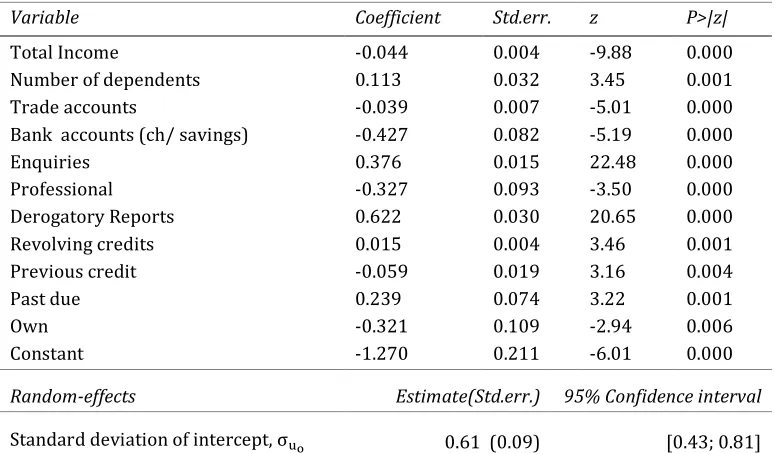
The estimation results for the two-level credit scoring model with microenvironment-specific
intercept are presented in Table 2. I fit the scorecard in Stata by applying maximum likelihood.
It is evident, that the coefficient estimates for the fixed-effect variables confirm that the
probability decreases with higher income, previous experience with a lender, house ownership and if a
customer has both bank checking and savings accounts.
The last row in the table provides the estimate of the standard deviation of the random-intercept.
The standard deviation is large suggesting that there is a considerable variation across area-specific
intercepts among different microenvironments. On the probability scale the varying-intercept explain
changes in the riskiness over and above the population average value by U,VW. Importantly, this variability is not explained in the logistic regression scorecard which does not recognize a multilevel
structure of the data. Given the normality assumption the 95% confidence interval for the
varying-intercept equals :XYQVZ XKQKR;. It shows that 95% of the realizations of the area-specific intercepts are going to lie within this range.
Variable Coefficient Std.err. z P>|z|
Total Income -0.044 0.004 -9.88 0.000
Number of dependents 0.113 0.032 3.45 0.001
Trade accounts -0.039 0.007 -5.01 0.000
Bank accounts (ch/ savings) -0.427 0.082 -5.19 0.000
Enquiries 0.376 0.015 22.48 0.000
Professional -0.327 0.093 -3.50 0.000
Derogatory Reports 0.622 0.030 20.65 0.000
Revolving credits 0.015 0.004 3.46 0.001
Previous credit -0.059 0.019 3.16 0.004
Past due 0.239 0.074 3.22 0.001
Own -0.321 0.109 -2.94 0.006
Constant -1.270 0.211 -6.01 0.000
Random-effects Estimate(Std.err.) 95% Confidence interval
Standard deviation of intercept, E[\ 0.61 (0.09) [0.43; 0.81]
Table 2. Estimation results for the two-level credit scoring model with microenvironment-specific intercept. The random-intercept variance and its 95% confidence interval.
[image:7.595.105.493.462.689.2]7
In order to assess the discriminatory power of the multilevel scoring model with a
random-intercept I apply a receiver operating characteristics curve (ROC) and calculate several accuracy
measures using the curve. In a ROC curve the true positive rate (Sensitivity) is plotted in function of the
false positive rate (100-Specificity) for different cut-off points. Each point on the ROC plot represents a
sensitivity/specificity pair corresponding to a particular decision threshold. A model with the perfect
discrimination has a ROC plot that passes through the upper left corner (100% sensitivity, 100%
specificity). Therefore the closer the ROC plot is to the upper left corner, the higher the overall accuracy
of a model (Zweig & Campbell, 1993).
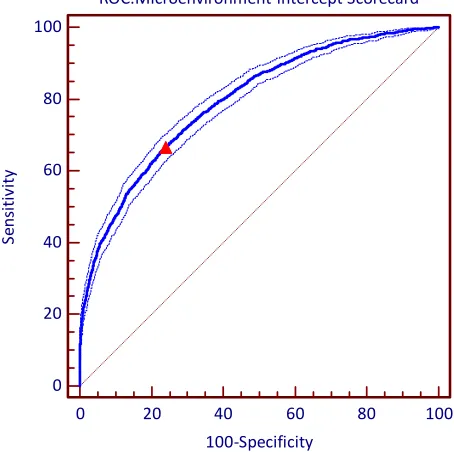
Figure 1 presents the ROC curve plot for the scorecard 2. Following Hilgers (1991), I also display
the 95% confidence bounds for the curve which show the ranges within which the true curve lies. The
red triangle on the graph indicates the optimal cut-off point ( >+ KQ,]^R . This value provides a criterion which yields the highest rate of the correct classifications (minimal false negative plus false
positive rates). Importantly, it is possible to define other cut-off points which are optimal according to a
specified rule or given a budget constraint. I do not discuss these alternatives in the paper because the
decision about an optimal threshold is generally driven by the practical considerations within a bank.
Given a scorecard a lender assesses the costs and benefits associated with different cut-off points and
then decides which one satisfies his budget constraints.
The summary results derived from of the ROC curve and the classification table for the optimal
cut-off point are presented in Table 3.
True Classified
>+ KQ,]^R D ND
Total
Default 472 1253 1566
Non-default 212 3441 3812
Total 684 4694 5378
Correctly classified 73.00%
Sensitivity 69.01%
Specificity 73.31%
Area under the ROC (AUC2) 0.801
Standard error (DeLong) 0.005
95% confidence interval (CI) [0.794;0.808]
Gini coefficient 0.602
[image:8.595.125.472.477.675.2]Accuracy ratio 0.688
8
The area under the ROC curve (AUC2) is 0.8015. This is 0.095 higher than _`&a b + KQ^K^ for the
logistics regression scorecard. The Gini coefficient and the accuracy ratio are also increased 8c a b + KQ]Rd/ _" + KQe,e . The 95% confidence interval for the AUC2 is narrow and does not overlap with the confidence interval for the logistic regression scorecard (&a b + :KQRfd/KQ^,R;). The results confirm that
specifying a microenvironment-specific intercept improves the discriminatory power of the credit
scoring model.
Figure 1. ROC curve for the two-level credit scoring model with microenvironment-specific intercept. The optimal cut-off point is
7+ KQ,]^R.
3.2 Microenvironment-level characteristics in the two-level credit
scorecard
In this section I present the extended version of the credit scoring model which allows
accounting for the living area characteristics. The credit scorecard is presented in (3). It inserts the
microenvironment-level variables in the second-level model for the varying-intercept 90: ;. The varying-intercept model is given in (4) includes the population average varying-intercept 91 , the random term 0/1 and four microenvironment-level variables g0/h , for m=1,..,4. The group-level variables g0/h vary across J=61
ROC:Microenvironment-intercept Scorecard
0 20 40 60 80 100 100
80
60
40
20
0
100-Specificity
S
e
n
si
ti
v
it
[image:9.595.183.410.233.459.2]9
microenvironments but take the same value for all borrowers + ,/ Q Q / 0 within the microenvironment j. Microenvironment-level variables characterize the economic and demographic conditions in the
borrowers’ residence areas. The variables are _ i h$0- average income in the living area j measured in tenth of thousands of dollars, j 0 -percentage of retail, furniture and auto store sales in the total retail sales in the neighborhood, & !! 5 0 - percentage of residents with a college degree in the area and
__#$ %$ M - percentage of African-American and Hispanic residents in the region.
Including group-level characteristics in a scorecard helps to explore the impact of the
microenvironment-level information on the probability of default. It also improves the estimation of the
area-specific intercepts.
)*0+ ,-.0/ 0/12 + 33334 5 67890: ;< =7 < => < =? <3=@
<33=A 3< 33=B ! 3<3=C " 3< 3=D"#$%
<3=E& 71< 3=E& < =71 % $ < =77'( (3)
339033 + 33391< g6k < 3 0/1
333g6k33 + 33k7_ l 0< k>__#$ %$ M< k?j 0< k@& !! 5 0 (4) 3 0/ 3F./G/ g0/h3H333I3 JK/ L>MN
S ) 0/123+33L>T
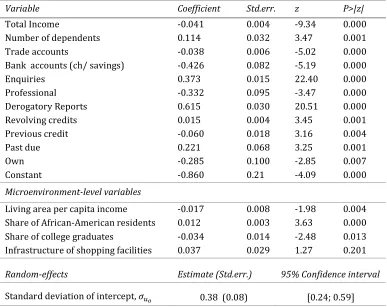
Similarly, to the previous model (scorecard 2) the area-level residual is assumed to follow a
normal distribution with zero mean and variance L>M. The two-level credit scoring model with the microenvironment-level variables is fitted in Stata by using maximum likelihood. Table 4 provides the
estimation results for the fixed-effect estimates at the borrower and microenvironment levels and the
standard deviation for the random-effects.
The estimated coefficients are very similar to the results for the scorecard without the
group-level characteristics. This is reasonable as specifying the microenvironment-specific variables modifies
only the random-intercept model. The standard deviation of the varying-intercept is decreased which
implies that accounting for the second-level characteristics partly explains the variation of the
microenvironment-specific effects.
The estimated coefficients for the second-level variables show the impact of the living area
information on the riskiness of the applicants for a loan. Higher income in the area has a negative effect
on the area-specific intercept. A ten thousands increase in income leads to -0.17 decrease in the
10
probabilities of default. This result is intuitive and shows that the impact of higher education on riskiness
is negative not only at the borrower-level but also at the microenvironment-level. In contrast, the impact
of the variable share of African-American residents on default is significant and positive. Infrastructure
of shopping facilities also positively impacts probability of default. One possible interpretation of this
result is that good access to the various department stores and shopping malls provokes spending and
initiate borrowing.
Variable Coefficient Std.err. z P>|z|
Total Income -0.041 0.004 -9.34 0.000
Number of dependents 0.114 0.032 3.47 0.001
Trade accounts -0.038 0.006 -5.02 0.000
Bank accounts (ch/ savings) -0.426 0.082 -5.19 0.000
Enquiries 0.373 0.015 22.40 0.000
Professional -0.332 0.095 -3.47 0.000
Derogatory Reports 0.615 0.030 20.51 0.000
Revolving credits 0.015 0.004 3.45 0.001
Previous credit -0.060 0.018 3.16 0.004
Past due 0.221 0.068 3.25 0.001
Own -0.285 0.100 -2.85 0.007
Constant -0.860 0.21 -4.09 0.000
Microenvironment-level variables
Living area per capita income -0.017 0.008 -1.98 0.004 Share of African-American residents 0.012 0.003 3.63 0.000
Share of college graduates -0.034 0.014 -2.48 0.013
Infrastructure of shopping facilities 0.037 0.029 1.27 0.201
Random-effects Estimate (Std.err.) 95% Confidence interval
[image:11.595.105.492.248.555.2]Standard deviation of intercept, Lm 0.38 (0.08) [0.24; 0.59]
Table 4. Estimation results for the two-level random-intercept model with microenvironment-level explanatory variables. The random-intercept variance is given in the last row in the table.
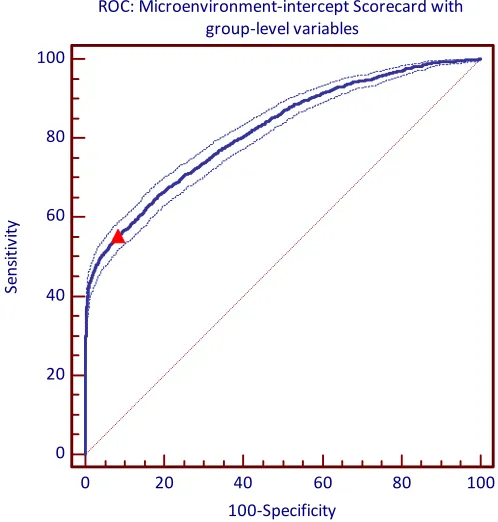
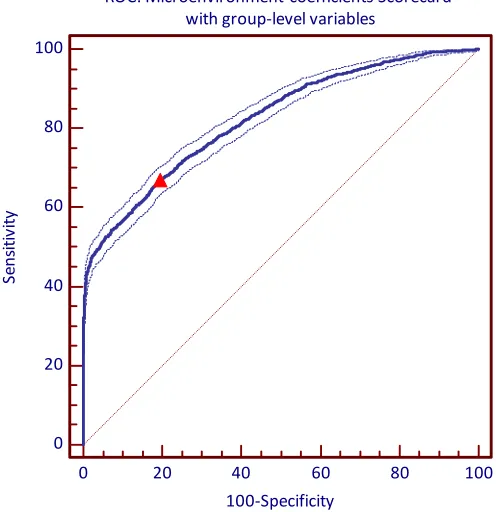
The predictive accuracy of the model is evaluated by applying a ROC curve analysis after the
estimation. The ROC curve for the credit scoring model with group-level variables and a
11 Figure 2. The ROC curve for the two-level credit scoring model with
area-specific intercept and group-level variables. The optimal cut-off point is indicated by the red triangle ( ,+ KQYYRe Q
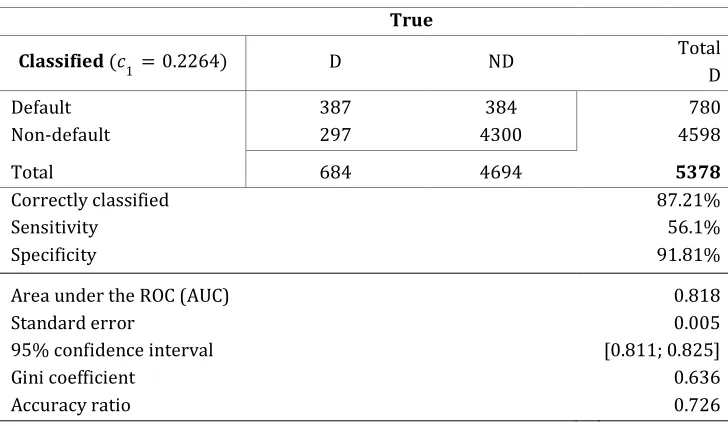
The summary results of the ROC curve analysis, Gini coefficient and a classification table for
the optimal cut-off point are provided in Table 4.8. The area under the ROC curve and Gini
coefficient are increased. The AUC 0.017 is higher than in the case of the credit scoring model
without the microenvironment-level variables. The difference is not large; however, the 95%
confidence intervals for the AUC values do not overlap which implies the areas are significantly
different from each other ([0.811; 0.825 ] versus [0.794;0.808]. The standard error of the AUC value
is small.
Another important improvement of the current version of the credit scoring model over the
scorecard without group-level variables is that the former model has a higher rate of correct
classifications (87% versus 75%). This rate is calculated at the threshold which corresponds to the
maximal sensitivity / specificity pair (n7+ KQYYRe).
ROC: Microenvironment-intercept Scorecard with group-level variables
0 20 40 60 80 100
100
80
60
40
20
0
100-Specificity
S
e
n
si
ti
v
it
12 True
Classified 8 ,+ KQYYRe D ND Total
D
Default 387 384 780
Non-default 297 4300 4598
Total 684 4694 5378
Correctly classified 87.21%
Sensitivity 56.1%
Specificity 91.81%
Area under the ROC (AUC) 0.818
Standard error 0.005
95% confidence interval [0.811; 0.825]
Gini coefficient 0.636
[image:13.595.115.479.101.314.2]Accuracy ratio 0.726
Table 5. The summary results for the ROC curve analysis and the classification table for the optimal cut-off point: 7+ KQYYRe for the microenvironment-intercept scorecard with the group-level variables.
3.3 Microenvironment-specific coefficients in the credit scoring model
The credit scoring models in the previous sections assign fixed-effect coefficients for the
individual-level explanatory variables. This section relaxes the assumption by allowing the coefficients
on the two variables to vary across microenvironments. Specifying microenvironment-level coefficients
makes a scorecard more flexible and improves the estimation. The area-specific coefficients are viewed
as random-effects in a scorecard which show an interaction effect between the borrower and
microenvironment-level characteristics.
I specify random-coefficients for the explanatory variable and l . A
varying-coefficient of explains that the impact of credit enquiries on default differ across
microenvironments with different economic and demographic conditions. Similarly, the random-slope
of the variable l shows that the effect of delinquencies on the credit obligations varies across
residence areas of borrowers.
The credit scoring model with the microenvironment-specific coefficients is presented in (5).
13
coefficient k0$ o333 includes a fixed-effect of credit enquiries (=$ o , a random-term 0/$ o and the microenvironment-level variables g6k. Similarly, model for the varying-slope k0p contains an intercept =p , group-level variables and a random-term 0/p . The second-level random-effects are assumed to follow a normal with zero mean and variance-covariance matrix K[ as shown in (7). Given
the individual-level and microenvironment-level variables random-coefficients are allowed to be
correlated where q is the correlation coefficient.
33 )* + ,-. / g0/ 0/r o/ 0/s 2 + 3334 5 67890: ;< =7 < => < =?
3<333=@ < k0: ;$ o < =B ! <
3<333=C " < =D"#$% M<=E& < k0: ;p % $
3<33=77'( (5)
33g6k3 + 333k7_ l 0< k>__#$ %$ M< k?j 0< k@& !! 50
3333k0$ o33+33333=$ o< g6k < 0/$ o333
333k0p 3+ 3333=p < g6k < 0/p (6)
8 0/$ o3/ 0/s -./G/ g0/h2333H333I3 tK/K[ + u L$ o
> qLs L$ o
qL$ oLs Ls> v3w33 (7)
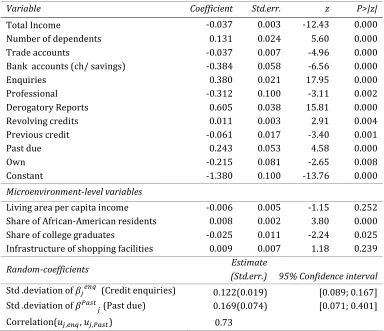
Table 6 provides the estimation results for the two-level credit scorecard with
microenvironment-specific coefficients and group-level variables (Scorecard 4).
The probability of default decreases with higher annual income, number of active trade accounts,
if a borrower has previous experience with a lender and if he owns a real estate property. In particular,
an average relationship borrower has 1.5% smaller probability than a new customer (no experience with
a lender). High-skilled professionals are 8.2% less likely to default. The effect of a house ownership or
use of banking deposit accounts is negative. This makes sense as a real estate property or other assets
indicate the financial stability of a borrower. These borrowers are more reliable and have a higher
incentive not to fall into arrears. In the case of default their property can be repossessed and deposit
accounts can be garnished by a creditor. Compared to the borrowers who rent accommodation, house
owners are 5.1% less risky. Having both checking and saving accounts reduces the probability by 9.53%.
At the same time, a derogatory credit history positively impacts the riskiness of an applicant. Additional
derogatory remark in the borrower’s credit profile increases the probability by 15.1%.
The fixed-effect of the variable is 0.38 on the logit scale which is similar to the
14
The standard deviation of the microenvironment-specific slope k0$ o is 0.122 which implies that the area-specific slopes differ by U]W on the probability scale.
Similarly, the fixed-effect coefficient of % $ is 0.243. The estimated standard deviation of this
coefficient is Lxp yz{ + KQ,Rf on the logit scale. Translating it to the probability scale shows that the area-specific coefficient explains the change in the probability over and above the population average
value by approximately UeQ]W .
Variable Coefficient Std.err. z P>|z|
Total Income -0.037 0.003 -12.43 0.000
Number of dependents 0.131 0.024 5.60 0.000
Trade accounts -0.037 0.007 -4.96 0.000
Bank accounts (ch/ savings) -0.384 0.058 -6.56 0.000
Enquiries 0.380 0.021 17.95 0.000
Professional -0.312 0.100 -3.11 0.002
Derogatory Reports 0.605 0.038 15.81 0.000
Revolving credits 0.011 0.003 2.91 0.004
Previous credit -0.061 0.017 -3.40 0.001
Past due 0.243 0.053 4.58 0.000
Own -0.215 0.081 -2.65 0.008
Constant -1.380 0.100 -13.76 0.000
Microenvironment-level variables
Living area per capita income -0.006 0.005 -1.15 0.252
Share of African-American residents 0.008 0.002 3.80 0.000
Share of college graduates -0.025 0.011 -2.24 0.025
Infrastructure of shopping facilities 0.009 0.007 1.18 0.239
Random-coefficients Estimate
(Std.err.) 95% Confidence interval
Std .deviation of k0$ o (Credit enquiries) Std .deviation of kp 0 (Past due)
0.122(0.019) [0.089; 0.167] 0.169(0.074) [0.071; 0.401] Correlation( 0/$ o, 0/p ) 0.73
Table 6. The estimation results for the two-level microenvironment-specific coefficients credit scoring model: coefficients of the individual and group-level variables, standard deviations with their 95% confidence intervals and the correlation coefficient.
I check the discriminatory power of the credit scoring model with varying-coefficients and
group-level variables by plotting a ROC curve as shown on Figure 3. The optimal threshold which yields the
maximal true positive and true negative rates is @+ KQ1406.
The summary results derived from the ROC curve and the classification table for the optimal
cut-off point are provided in Table 6. The area under the ROC curve is higher than in the case of the model
[image:15.595.106.490.233.564.2]15
[0.817;0.83]. The confidence interval for the microenvironment-coefficients scorecard and the interval
for the microenvironment-intercept scorecard do not overlap. This confirms that the scorecard 4
outperforms the scorecard 2 and 3 by improving the predictive accuracy. The Gini coefficient and the
accuracy ratio are also increased.
I check the discriminatory power of the credit scoring model with varying-coefficients and
group-level variables by applying a ROC curve as shown on Figure 4.5. Following Hilgers (1991) I
also display 95% confidence bounds for the curve. The threshold which yields the maximal true
positive and true negative rates is indicated by the red triangle on the graph.
Figure 3. The ROC curve for the two-level credit scoring model with the area-specific coefficients and microenvironment-level variables. The optimal threshold is ,+ KQ,eKRQ
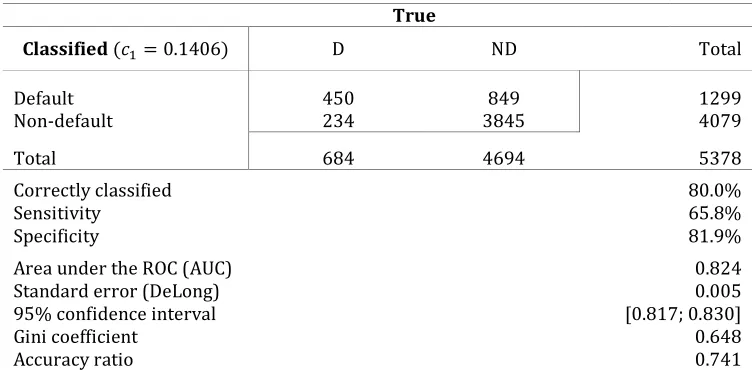
The summary results derived from the ROC curve and the classification table for the optimal
cut-off point ( 7+ KQ1406) are presented in Table 7. The area under the ROC curve is higher than in the case of the model without varying-coefficients. The AUC equals 0.824 and the 95%
confidence interval for this value is [0.817;0.83]. The confidence intervals for the
ROC: Microenvironment-coefficients Scorecard with group-level variables
0 20 40 60 80 100
100
80
60
40
20
0
100-Specificity
S
e
n
si
ti
v
it
16 microenvironment-coefficients model and the intervals for the area-specific intercept scorecard do
not overlap which indicates that the current version of a scorecard improves the predictive
accuracy. The Gini coefficient and the accuracy ratio are also increased.
Given the optimal cut-off point 7+ KQ,eKR the credit scoring model correctly classifies 80% of applicants for a loan. The true negative rate and the true positive rates are 81.9% and 65.8%
correspondingly.
True
Classified 8 7+ KQ,eKR D ND Total
Default 450 849 1299
Non-default 234 3845 4079
Total 684 4694 5378
Correctly classified 80.0%
Sensitivity 65.8%
Specificity 81.9%
Area under the ROC (AUC) 0.824
Standard error (DeLong) 0.005
95% confidence interval [0.817; 0.830]
Gini coefficient 0.648
[image:17.595.109.485.235.420.2]Accuracy ratio 0.741
Table 7. The summary of the ROC curve analysis results and the classification table for the optimal cut-off point: 7+ KQ,eKR.
3.4 Multiple random-coefficients credit scoring model
Section presents a very flexible version of the credit scoring model which includes multiple
random-coefficients, microenvironment-level variables and interacted variables. This model extends the
varying-coefficients scorecard presented in the previous section. Complementary to the previous
structure, I specify two random-coefficients for the individual-level explanatory variables: use of banking
savings and checking accounts ( 0 3and a house ownership indicator ('( 0).
The two-level model with multiple random-effects is presented in (8). The
microenvironment-specific coefficients are modeled by themselves as shown in (9). The interactions between the
17
probability of default. I create three interacted variables which are l } __#$ %$ M: ; - number of
the delinquent credit accounts in the past measured at the borrower-level and the living area share of
African-American residents measured at microenvironment-level ; } j 0: ; - the access to the
various shopping facilities at the area-level and the current credit burden of a borrower; and
3_ } '( ~ •#$ /0: ; - the share of house owners within a microenvironment and the duration (in
months) a borrower stays at his current living address.
)* + ,-. / 0/ g02 + 3334 5 67891< =7 < => < =?
3<333k0€ G < k0$ o < =B ! <33k0•‚ "
3<3=D"#$% < =E& < =71 % $3<33k0ƒ„ '( < …|33 3 (8)
33g6k333 + 333k7_ l 0< k>__#$ %$ M< k?j 0< k@& !! 5 0
|33 + 33|7 % $__#$ %$ M: ;< |> j 0< |?_ '( ~ •#$ /0: ; (9)
333k0r o3+33=$ o< g6k < 0/$ o333
333k0•‚333+ 33=•‚< g6k < 0/•‚333333333
33k0€ G+ 33=€ G< g6k < 0/† G
33k0ƒ„ 33+33=„ < g6k < 0/ „ (10)
3‡ 333 0/$ o333
0/•‚
333 0/€ G
33 0/ƒ„
ˆ. / g0‰333H333ŠSI38K/K[ 33333/ K[3+3‹ L$ o>
K K K
K L•‚>
K K
K K Lp>
K K K K Lƒ„>
Œ33333 (11)
The random-coefficient model of the variable '( in (10) illustrates that the average impact of
having a house on the probability of default is 8=„ < g6k . The microenvironment-level residual 0/ „ explains the change in the probability over and above the population average value. The
varying-coefficient model of the variable is similar. It includes the second-level residual 0/† G ,
group-level variables and intercept =† G .
The variance-covariance matrix for the second-level random-effects is constrained to have an
independent structure as illustrated in (11). I’m primarily interested in estimating standard deviations of
the microenvironment-specific effects and to a lesser extent in measuring the covariances between the
varying-coefficients. Additionally, the independent structure of the variance-covariance matrix helps to
18
variance-covariance matrix specification (such as exchangeable, identity or unstructured ) are not
discussed in the paper.
The estimation of the credit scoring model in (8) can be problematic with maximum likelihood.
The scorecard is complex and contains many of random-effects which should be integrated out in the
likelihood. The approximation of the likelihood function can be obtained by applying numerical methods.
When the number of the area-specific effects is low a numerical integration produces unbiased
estimates. However, the precision decreases as the number of random-effects increases. To solve this
computational issue I apply Bayesian Monte Carlo Markov chain (MCMC) to fit the scorecard in (8). This
approach is more flexible and more intuitive in the case of a random-effects model where the
varying-intercepts and coefficients are viewed as drawn from the population of microenvironment-specific
[image:19.595.111.486.322.704.2]effects.
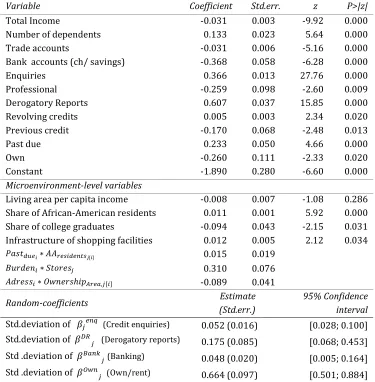
Table 8. The estimation results for the flexible credit scoring model with multiple random-coefficients, microenvironment-level variables and interacted variables. The standard deviations of the random-coefficients are given together with their 95% confidence intervals.
Variable Coefficient Std.err. z P>|z|
Total Income -0.031 0.003 -9.92 0.000
Number of dependents 0.133 0.023 5.64 0.000
Trade accounts -0.031 0.006 -5.16 0.000
Bank accounts (ch/ savings) -0.368 0.058 -6.28 0.000
Enquiries 0.366 0.013 27.76 0.000
Professional -0.259 0.098 -2.60 0.009
Derogatory Reports 0.607 0.037 15.85 0.000
Revolving credits 0.005 0.003 2.34 0.020
Previous credit -0.170 0.068 -2.48 0.013
Past due 0.233 0.050 4.66 0.000
Own -0.260 0.111 -2.33 0.020
Constant -1.890 0.280 -6.60 0.000
Microenvironment-level variables
Living area per capita income -0.008 0.007 -1.08 0.286 Share of African-American residents 0.011 0.001 5.92 0.000
Share of college graduates -0.094 0.043 -2.15 0.031
Infrastructure of shopping facilities 0.012 0.005 2.12 0.034
% $ } __#$ %$ M: ; 0.015 0.019
} j 0 0.310 0.076
_ } '( ~ •#$ /0: ; -0.089 0.041
Random-coefficients Estimate
(Std.err.)
95% Confidence interval
Std.deviation of k0$ o (Credit enquiries) 0.052 (0.016) [0.028; 0.100] Std.deviation of k•‚0 (Derogatory reports) 0.175 (0.085) [0.068; 0.453]
Std .deviation of33k€ G0(Banking) 0.048 (0.020) [0.005; 0.164]
19
The estimation results for the scorecard 5 are provided in Table 8. The standard deviation of the
microenvironment-specific coefficient of credit enquiries equals 0.052 which is more than twice smaller
than in the credit scorecard with only two varying-coefficients. The large variation is found between the
coefficients of the variable '( . This implies that the effect of housing wealth considerably varies
across areas with different economic and demographic conditions.
The fitted model coefficients of the interactions are not precisely estimated which is not
surprising, given I only have 61 level-two groups (microenvironments). The impact of the interaction
} j 0 on default is significant and positive. Similarly, the estimated coefficient of % $ } __#$ %$ M: ; explains that the impact of the credit delinquencies is higher for borrowers whose
living areas contain a higher share of African-American residents. The effect of the interacted variable
_ } '( ~ •#$ /0: ; on the riskiness of a borrower is negative. In the richer living areas with a
higher level of housing wealth (90% of families own a house) the marginal effect of the length of stay at
the address on default is -0.2%.
I evaluate the discriminatory power of the flexible version of the two-level credit scorecard
with microenvironment-specific coefficients, group-level variables and interactions by applying a
ROC curve analysis as illustrated on Figure 4.6. The optimal cutoff-point is indicated by the red
triangle on the ROC curve. The 95% confidence interval for the curve is calculated according to
Hilger (1991).
The classification table given the optimal threshold 7+ KQ,efR , the summary results of the ROC curve analysis, Gini coefficient and the accuracy ratio are presented in Table 9. The area under
the ROC curve is increased. It equals 0.825. The change in the estimated AUC value compared to the
previous model is moderately small and the confidence intervals overlap. This is not surprising
given the data limitations. The testing data sample is not large enough to provide all sufficient
information required for a more precise estimation of a multilevel scorecard with many
microenvironment-specific effects. Observing a larger sample on the credit histories of borrowers
20 Figure 4. The ROC curve for the flexible credit scoring model
with area-specific coefficients, group-level variables and interactions. The optimal cut-off point is 7+ KQ,efRQ
Given the optimal threshold c1=0.1496 the credit scorecard correctly classifies 81% of
applicants for a loan. I have to mention that this cut-off point implies that a lender weights equally
true positive and true negative classifications which may not be the case in retail banking. I discuss
the alternative choices for an optimal threshold in the next chapter where I compare a predictive
performance between different credit scoring models.
True
Classified 8 7+ KQ,efR D ND Total
Default 439 778 1217
Non-default 245 3916 3977
Total 684 4694 5378
Correctly classified 81.00%
Sensitivity 64.12%
Specificity 83.42%
Area under the ROC (AUC) 0.825
Standard error (DeLong) 0.005
95% confidence interval [0.818; 0.831]
Gini coefficient 0.650
Accuracy ratio 0.743
Table 9. The summary of the ROC analysis results, Gini coefficient, accuracy ratio and the classification table for the optimal cut-off point: 7+ KQ,efR.
ROC: Multiple random-coefficients credit Scorecard with group-level variables and interactions
0 20 40 60 80 100
100
80
60
40
20
0
100-Specificity
S
e
n
si
ti
v
it
[image:21.595.162.394.96.326.2] [image:21.595.121.473.524.707.2]21
4 Predicted probabilities and goodness-of-fit check
Section provides several postestimation diagnostic statistics which aim to evaluate the
predictive performance of the multilevel credit scoring models.
In general, there are quiet a few techniques discussed in the literature which can be used in
order to check the goodness-of-fit and assess the discriminatory power of a regression. However,
the number of possibilities decreases when a multilevel modelling is applied (Hox (2002)). The
main complexity in a multilevel model which prevents application of the standard goodness-of-fit
tests (Hosmer and Lemeshow, pseudo "> is that the model includes characteristics measured at different levels. Accordingly, I calculate and report several measures of the goodness-of-fit of an
estimated scoring model which are appropriate for a multilevel model and widely applied in the
econometric literature. Following Farrell (2004) and Zucchini (2000) I calculate Akaike information
criterion (AIC, AICc) in combination with Bayesian information criterion (BIC). AIC and BIC are the
tools for a model selection that combine both the measure of fit and complexity. Given two models
fitted on the same data, the model with the smaller value of the information criterion is considered
to be better. The mathematical details of the calculation of AIC and BIC are provided in Burnham
and Anderson (2002), Akaike (1974) and Schwarz (1978).
Section 4.1 summarizes the results derived from the ROC curves for the four multilevel
credit scoring models and the logistic regression scorecard. It provides a pairwise comparison of the
AUC measures and test the statistical significance of the differences in the AUC values between the
credit scorecards. Additionally, I briefly analyse the application of the ROC curve metrics for the
evaluation of a scorecard performance in retail banking and describe the alternative measures of
the predictive accuracy. In particular, I compute the area under a specific region of the ROC curve (a
partial AUC) and show how to incorporate asymmetric costs in the regular ROC curve analysis.
Section 4.2 provides a comparison of a model fit by applying AIC and BIC criteria. It also
checks the discriminatory power between credit scorecards by calculating Brier score, logarithmic
score and spherical score (Krämer and Güttler (2008)). These scalar measures of accuracy allow to
compare the per observation error of the forecasts produced by the different scoring models. These
techniques are relatively simple but at the same time they provide a transparent measure of the
22 The graphical illustration of the predicted probabilities concludes the presentation of the
fitted model results. It visualizes the microenvironment-specific effects and illustrates the main
advantages of the specification of a two-level structure for a scorecard. In addition, I discuss the
impact of the microenvironment-level characteristics on default within poor and rich living areas. It
is found that economically unstable regions contain a larger share of borrowers with a derogatory
credit history and rich living areas have a higher share of borrowers with a good credit history.
5.1 Summary of the ROC curve analysis
In order to compare the ROC curves and related metrics between the multilevel credit
scoring models and the logistic regression scorecard I provide a summary plot on Figure 5.1. The
plot combines five ROC curves for the credit scoring models which are presented in chapter 4. The
curves are named according to the shortened notation as given in Table 4.12. The logistic
regression scorecard is presented by the dashed line and it is assigned the name "'&7. The "'&> and 3"'&? denote microenvironment-specific intercept scorecards with and without group-level variables. The curves "'&@ and 3"'&A illustrate the performance of the credit scoring models with two random-coefficients and multiple random-coefficients.
It is evident from the graph that the multilevel credit scoring models outperform the
conventional logistic scorecard by showing a higher classification performance. Similarly, the
comparison of the ROC curves between the multilevel models reveals that the scorecards with more
microenvironment-specific effects provide a higher predictive accuracy. The two-level scorecard
with multiple random-coefficients and group-level variables has a ROC curve which lies above the
23 Figure 7.The comparison of the ROC curves for the different
credit scoring models presented in the chapter 4. The ROC1 for
the logistic regression scorecard is illustrated by the dashed curve on the plot.
In order to give the meaningful interpretation to the graphical illustration of the ROC curves
I make a pairwise comparison of the areas under the curves. The results are presented in Table 10. I
use the logistic scorecard as a reference model and calculate the differences in the AUC measures as
following: •_`& + _`&a b X _`&‚ƒŽ, where _`&‚ƒŽ denotes the area under the "'&• for l=2,..,5.
The standard error of this difference given by j ••Ž + ‘)j ••Ž’2>< )j ••Ž“2>X Yqj ••Ž’j ••Ž“ as
reported in the third column in the table (j ••Ž is estimated according to Delong (1988)).
Following Hanley and McNeil (1984), I calculate the z-statistics in order to test if the
differences 8•_`& are statistically significant. The z-statistics tests the null hypothesis that the difference between the two AUC values is zero. The test results and the corresponding p-values are
presented in the fifths and sixth columns in the table. The 95% confidence interval for the
differences in the areas are shown in the forth column in the table.
Comparison of ROC curves for the scoring models
0 20 40 60 80 100
100
80
60
40
20
0
100-Specificity
S
e
n
si
ti
v
it
y ROC 2ROC 5
24
ROC •_`& +_`&
‚ƒŽ X _`&a b
Standard error
95% confidence
interval z-statistics p-value
"'&> 0.094 0.00566 [0.084;0.105] 16.65 p<0.001
"'&? 0.111 0.00623 [0.099;0.123] 17.81 p<0.001
"'&@ 0.117 0.00615 [0.105;0.128] 18.98 p<0.001
"'&A 0.118 0.00623 [0.107;0.130] 19.02 p<0.001
[image:25.595.105.490.105.208.2]Logistic regression scorecard: area under the ROCLogit curve is AUCLogit=0.707
Table 9.A pairwise comparison of the differences between the areas under the "'& and the ROCLogit.
The standard errors of •_`& are calculated according to Delong (1988).
The results of the pairwise comparison of the AUC values confirms the statement made
earlier that the multilevel scorecards show a higher discriminatory power than the conventional
logit model. It is also true that the difference in the AUC measures increases when a scoring model
includes more microenvironment-specific effects.
Next, I discuss the relevance of a ROC curve application to retail banking and list the main
weaknesses of this approach. In general, a ROC curve is currently considered to be a benchmark
approach used to check the predictive quality of a model. It is widely applied in many fields. The
predictive performance of a model is measured by computing the area under the curve. However,
recently some authors begin to criticize the use of AUC as the standard measure of accuracy
(Termansen et al. (2006), Austin (2007), Hosmer and Lemeshow (2000)). They found quiet a few
important drawbacks associated with AUC (ROC) measure which prevents its application in
practice. In the paper I only briefly discuss the main disadvantages of AUC measure when it is
applied in credit scoring and propose the alternative methods.
First, ROC (AUC) ignores the predicted probability values and goodness-of fit of the
estimated model (Ferri (2005)). The continuous forecasts of the probabilities are converted to a
binary default-nondefault variable. This transformation neglects the information on how large is the
difference between the threshold and the prediction. Additionaly, Hosmer and Lemesow (2000)
show that it is possible for a poorly fitted model (which overestimates or underestimates all the
predictions) to have a good discrimination power. They also introduce an example when a
well-fitted model has a low discrimination power.
A second weakness of the ROC curve and AUC is that they summarise a model performance
over the regions of the ROC space in which it is not reasonable to operate (Baker and Pinsky
(2001)). For instance, in retail banking, a lender typically defines a threshold for the accept/reject
25
.0 .2 .4 .6 .8 1.0
.0 .2 .4 .6 .8 1.0
T
P
R
(c
)
FPR(c)
Partial ROC curve
FPR(c2
performance across all possible thresholds as given by a ROC curve (AUC) and related metrics. In
this case the left and central areas are of the ROC curve are valueless.
One solution to the mentioned above weakness would be to compute an area under a portion
of the ROC curve. A partial AUC is an alternative to the regular AUC measure which evaluates the
discriminatory power of a model over the particular region of the ROC curve (Thompson and
Zucchini (1989), Baker and Pinsky (2001) and McClish(1989)). When it is applied in credit scoring,
the partial AUC is simply the area under the partial ROC curve between two cut-off points or given a
specific range for the specificity/sensitivity pairs. Computing a partial AUC is also helpful if a lender
aims to satisfy a budget constrain or fulfil a banking legislation requirement. For instance, a partial
AUC can be estimated over the region of the ROC curve which yields the highest true positive rate
(or false negative rate). The decision about an assessment of a particular region of a ROC curve
should be guided by practical considerations within a commercial bank. I illustrate the application
of the partial AUC to evaluate a scorecard performance over the region of the ROC curve between
two cut-off points.
Figure 8. Partial area under the ROC curve between FPR(c2)
and FPR(c1).
[image:26.595.192.410.426.627.2]26 On a ROC curve plot the performance of a predictive model is visualized by plotting TPR
(true positive rate) versus FPR (false positive rate) over all possible cut-off points c. If the TPR
given a threshold c is "8 + ”•8– — F + j•8 and the corresponding FPR given a threshold c is ˜ "8 + 8– — FI + j™•8 + thenaccording to Pepe (2003) the area under the ROC curve from some point 7 to the point > is defined as following
_`&3 +33 š "'&8
“
’
3+3 š j•Jj™•678 N “
’
3+ 3 3:–•— –™•/ –™•› œj
™•6787 / j™•6781 •;
where –™•3and –• are the continuos variables with survivor functions j™• and j•. In application to credit scoring –™•3and –• would define the classification scores (or probabilities) assigned to the non-defaulted and defaulted customers. Figure 8 provides a graphical illustration of
the partial area under the ROC curve between FPR(c2) and FPR(c2) where the c1 and c2 are the
cut-off points.
On the graph the partial area of the ROC curve is bounded above by the area of the rectangle
that encloses it. This rectangle has sides of length 1 and 8˜ "8 , X ˜ "8 Y which leads to the following partial area
_`&h ž + 3˜ "8 , X ˜ "8 Y
where FPR(c) is the false positive rate at the cut-off point c. This area is the maximum partial
AUC given c1 and c2.
The lower bound for the partial AUC is given by the trapezoid which lies below the 45°
diagonal line on the ROC plot. The area of this trapezoid is
_`&h +88˜ "8 7 < ˜ "8 >
Y 8˜ "8 7 X ˜ "8 >
Accordingly, the partial AUC given two cut-off points c1 and c2 lies between the maximum
and minimum partial areas.
27 The partial areas under the curves are presented in Table 10. I calculate and report partial
areas for the two regions of the ROC space: between cut-off point 7+ KQ,3and >+ KQ] and between 7+ KQ, and >+ KQY. Additionally to the pAUC values, the table provides the maximum
and minimum bounds for the partial areas and the relative value of a partial AUC (s••Žs••ŽŸ ¡).
Cut-off points : [0.1, 0.3] [0.1, 0.2]
_`& _`&h ž _`&¢£¤
_`&
_`&h ž _`& _`&h ž _`&¢£¤ _`&_`&h ž
Scorecard 1 0.1036 0.2738 0.0489 0.394 0.0988 0.2191 0.0451 0.451
Scorecard 2 0.1876 0.3096 0.0705 0.631 0.1609 0.2402 0.0630 0.670
Scorecard 3 0.1335 0.2190 0.0344 0.635 0.1044 0.1629 0.0302 0.641
Scorecard 4 0.1362 0.2200 0.0348 0.645 0.1038 0.1596 0.0300 0.651
Scorecard 5 0.1358 0.2195 0.0350 0.645 0.1054 0.1619 0.0304 0.651
Differences between the relative partial AUC values
Scorecard 1 2 0.237 0.219
Scorecard 1 3 0.241 0.190
Scorecard 1 4 0.251 0.200
[image:28.595.62.534.207.419.2]Scorecard 1 5 0.251 0.200
Table 10. The partial areas under the portion of the ROC curve between the cut-off points c1=0.1 and c2= 0.3 and between
c1=0.1 and c2= 0.2. The differences the relative partial AUC values for the logit scorecard and the multilevel scoring models.
Results in Table 5.3 confirm that the multilevel scoring models outperform the logistic
regression scorecard over the region of the ROC space between two cut-off points
, and Y8 ] 3. Given the thresholds c1 and c2 the scorecard 4 and 5 show similar classification performance. Interesting, given the region of the ROC space between the cut-off point , + KQ, and
Y + KQY3 the scorecard 2 shows the highest predictive accuracy yielding the relative partial area s••Ž
s••ŽŸ ¡=0.67.
The third important drawback of the AUC value that limits its use as a measure of the
predictive accuracy is that it does not account for the asymmetry of costs. The AUC implies that
misclassifying a defaulter has the same consequence as incorrectly classifying a non-defaulter.
However, this is not the case in retail banking where the costs of misclassification errors (false
positive and false negative outcomes) are very asymmetric.
Generally, incorrectly classifying a true defaulter leads to problematic credit debt.
28 incorrectly classifies a true defaulter/non-defaulter the costs associated with a past due credit
account are much higher than the opportunity costs of the foregone profit. This implies that in retail
banking a lender is primarily interested in increasing the true positive rate in order to minimize the
misclassification costs of the incorrectly predicted non-defaulters.
There are several techniques proposed in the literature which aim to incorporate
misclassification costs in the assessment of the predictive accuracy. Metz (1978) proposed to
measure the expected losses (costs) by summing up the probability weighted misclassification costs
and benefits of the correct and false predictions. Given the probability of default 8 and the
probability of non-default 8I the expected losses can be calculated using following formula
33 . 34 3 + 333&8 F ¥ 3 8 ¥ "3 < 3&8I FI 3¥ 3 8I ¥ I" <3 333333333333333&8 FI ¥ 8I ¥ ˜ " < &8I F ¥ 8 ¥ 8, X " 33333333+ 333 " ¥ 8 ¥ )&8 F X &8I F 2 < &8I FI ¥ 8I < 3333333333333333˜ " ¥ 8I ¥ )&8 FI X &8I FI 2 < &8I F ¥ 8
3
where &8I F 3is the cost of a false negative classification, &8 FI is the cost of a false positive classification. The cost of the correct classification of a true defaulter is &8 F and non-defaulter is &8I FI , correspondingly.
Next, I apply the expected loss approach to compare the misclassification costs between
different credit scoring models. For simplicity, I assume that the cost of the correct classification of a
true positive (negative) outcome is zero. The cost of an incorrectly classified defaulter is 10 times
higher than the cost of a misclassified non-defaulter (&8I F + ,KK/ &8 FI + ,K . Table 11 reports the expected losses a scorecard produces given three cut-off points for the accept/reject
[image:29.595.164.432.594.684.2]decision c1=0.1, c2=0.2 and c3=0.3 .
Table 11. The misclassification costs produced by a credit scoring model given three different cut-off points for the accept/reject decision.
Cut-off point 7+ KQ, >+ KQY ?+ KQ]
Scorecard 1 7.97 10.40 11.89
Scorecard 2 6.16 7.28 8.41
Scorecard 3 6.19 6.70 7.06
Scorecard 4 5.97 6.70 7.03
29 Concluding the discussion about the application of a ROC curve and derived from it metrics, I
suggest that the ROC analysis application to retail banking should be used with caution. In order to
evaluate and compare the predictive performance of different scorecards additionaly to the regular
ROC curve metrics other measures of accuracy have to be calculated and reported. In particular, the
partial area under the curve, misclassification rates and the expected losses given a threshold are
the good complements to the regular ROC curve metrics.
5.2 Measures of fit and accuracy scores
In order to compare the goodness-of-fit between the multilevel credit scoring models and
the logistic regression scorecard I calculate and report Akaike Information criterion (AIC) and
Schwarz criterion or Bayesian Information criterion (BIC). AIC and BIC criteria are deviance-based
measures of fit of an estimated model. Generally, they are applied to select the model which
provides the best fit among the range of the fitted models. Table 12 shows the AIC and BIC criteria
for the four multilevel credit scoring models and the logistic regression scorecard. The model with
the smallest values of both AIC and BIC criteria gives the best fit.
Postestimation statistics AIC BIC
Scorecard 1 2991.34 3090.20
Scorecard 2 2957.18 3062.62
Scorecard 3 2927.17 3045.78
Scorecard 4 2909.24 3041.04
Scorecard 5 2884.50 3029.48
Table 12. Postestimation statistics: Akaike information criterion (AIC) and Bayesian information criterion (BIC).
According to the information criteria the multilevel scorecards (scorecard 2-5) outperform
30 multilevel models AIC and BIC values decrease with the degree of the model’s complexity. Credit
scorecards which include more microenvironment-specific effects and group-level characteristics
show better classification performance. A flexible version of a scoring model with multiple
random-coefficients, microenvironment-level variables and interactions (scorecard 5) provides the best fit.
In addition to the goodness-of-fit check I compute several scalar measures which aim to
evaluate the predictive accuracy of the probability forecasts. Following Krämer and Güttler (2008) I
calculate Brier score, logarithmic and spherical scores.
The Brier score is the mean squared difference between the predicted probabilities and
observed binary outcomes (Brier (1950), Murphy (1973), Jolliffe and Stephenson (2003)). It is one
of the oldest and most commonly used techniques for assessing the quality of the probability
forecasts of a binary event (default/non-default).
The formula for the calculation of a Brier score is given in (13). It shows how large is the
average squared deviation of the predicted probabilities §¦ from the actually observed outcomes ¨. Lower values for the score indicate higher accuracy. The estimated Brier scores for the credit
scorecards are reported in the second column in Table 13.
3j +™7© 8¨ X™7 §¦3 >3/ 333(~ 3333¨ + ª3,/3K3/ ! 33333333333333X ! « (12)
The logarithmic score is another measure of the forecasting accuracy of a model. The
calculation of the score is shown in [5.2]. The logarithmic score values are always negative. The
scoring rule imposes that a model with the closest to zero logarithmic score shows the best
performance. The third column in Table 5.6 presents the values of the logarithmic scores for the
credit scoring models.
4 5 ~ 3 + ,¬I © -®38F™¯7 § < ¨ X ,F¦ (13)
A slightly modified version of the logarithmic score is a spherical score which was
introduced by Roby (1965). The calibration of the score is shown in [5.3]. The values of the
spherical scores for the credit scoring models are provided in the last column in Table 5.6.
j ~ !3 +™7© 8 Fs±²³ 67F° ‘sx“²876s±°“ ™
31
Postestimation statistics Brier
score
Logarithmic score
Spherical score
Scorecard 1 0.08090 -0.301 0.910
Scorecard 2 0.06736 -0.235 0.926
Scorecard 3 0.06252 -0.208 0.932
Scorecard 4 0.05663 -0.187 0.938
[image:32.595.73.522.105.197.2]Scorecard 5 0.05652 -0.186 0.939
Table 13.The score measures of the predictive accuracyfor the logistic regression and the multilevel credit scoring models: the Brier scores, logarithmic scores and spherical scores.
The results of the Brier scores confirm that the logistic scoring model produces the crudest
forecasts yielding the highest per observation error. It also true, that among the multilevel
scorecards (scorecard 2-5), models with more microenvironment-specific effects provide a better
calibration of the probabilities of default. The smallest error of the forecasts (0.05652) is produced
by the flexible version of a credit scoring model (scorecard 5) which includes multiple area-specific
coefficients, group-level variables and interactions. Similarly, conclusion is made after comparing
the logarithmic and spherical scores. According to the spherical scoring rule higher values of the
score indicate the model which produces the more accurate forecasts. The spherical scores are
reported in the last column in the table. The best results of the logarithmic and spherical scores are
given by the scorecard 5.
To summarize the results of the predictive accuracy measures and the goodness-of-fit check,
I conclude that the multilevel credit scoring models outperform the conventional logit. The
goodness-of-fit and the accuracy measures also confirm that the main contribution of the paper is
to introduce the multilevel credit scoring model which improves the forecasting quality of a scoring
model. In particular, specifying the two-level structure where borrowers are nested within
microenvironments and applying the structure to the model results in the efficiency gain.
Microenvironment-specific effects vary across groups and show the impact of the economic and
demographic conditions in the living areas on the riskiness of borrowers. These area-specific effects
are the unobserved determinants of default. Accordingly, including them in the scoring model
improves the predictive quality and provides better fit to the data.
Accuracy gain is essential in retail banking where lenders are interested in minimizing the
![Table 3. The summary results for the ROC analysis for the microenvironment-specific intercept model and the classification table for the optimal cut-off point: �7 + KQ,]^R](https://thumb-us.123doks.com/thumbv2/123dok_us/7940731.750689/8.595.125.472.477.675/summary-results-analysis-microenvironment-specific-intercept-classification-optimal.webp)