Institut fur Neutronenphysik und Reaktortechnik
The Long-Time Behaviour of Fast Power Reactors with Pu-Recycling
Als Manuskript vervielfaltigt
FUr diesen Bericht behalten wir uns alle Rechte vor
Oktober 1967
Institut fur Neutronenphysik und Reaktortechnik
KFK 630 SM 101/16 EUR 3674 e
The Long-Time Behaviour of Fast Power Reactors with Pu-Recycling*
A. Jansen
Gesellscha:f't :t'iir Kernforschung mbH., Karlsruhe
30 October - 3 November 1967 Kernforschungszentrum Karlsruhe• Germany
SM 101/16
THE LONG-TIME BEHAVIOUR OF FAST POWER REACTORS WITH PLUTONIUM RECYLING•
A. Jansen
Institut fiir Neutronenphysik und Reaktortechnik Kernforschungszentrum Karlsruhe, Germany
- 2
-1, INTRODUCTION
The long-time behaviour of fast power reactors with plutonium re-cycling generally includes the overall time behaviour caused by the fuel burn-up in the reactor and the internal and external fuel management. It is useful to distinguish between two types of problems:
(a) The behaviour of the reactor between two loading events which refers to the time dependence of neutron flux. reactivity. power distribu-tion• fuel composition etc,; usually it is the object of the conven-tional fuel burn-up studies,
(b) The behaviour of the reactor during many reloading cycles• which re-fers to the time dependence of the isotopic composition of plutonium• the uranium and plutonium content of the fuel. the breeding gain etc,
In this paper we will confine ourselves to the second class of pro-blems only, We consider a fast power reactor in which only fissionable material is consumed which is bred in the same reactor, except for the plutonium amount to start up the reactor and for a certain period a~er-wards, Therefore• we have to consider a closed fuel cycle including the core and the external plants for reprocessing the irradiated fuel and
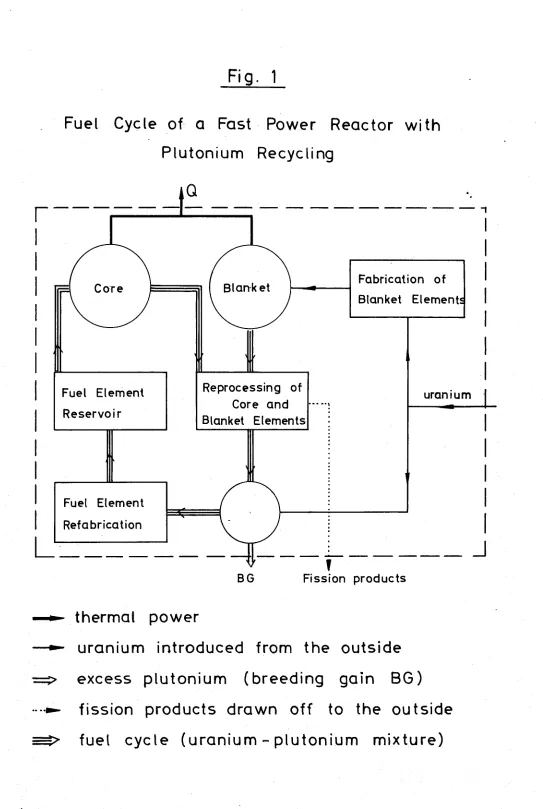
re-fabricating the fuel elements, The blank.et plutonium is introduced into the closed fuel cycle• the breeding gain is drawn off this cycle. The fuel cycle for common reprocessing of the core and blanket elements is shown in Fig, 1,
The time variations of the isotopic composition of the plutonium in the fuel cycle system are caused by the neutron irradiation in the reactor and by the internal and external fuel management•), The composition of the refabricated fuel elements is determined by that uranium-to-plutonium ratio which maintains the reactor critical• assuming the total number of the heavy isotopes in the fuel elements to be constant.
•)
Internal fuel management is always done to improve the burn-up behaviourThe problems which we are going to investigate were studied first in [1] on the basis of an idealized zero-dimensional model without taking into account the internal and external fuel management. Loading and unloading the core and blanket elements were regarded as continuous processes, In this paper we will investigate the long-time behaviour of the plutonium.
composition in the fuel and the physical aspects of the fuel cycle econany under more realistic conditions, Especially loading and unloading the core and blanket elements will be treated as discontinuous processes; the ex-ternal fuel management and the times for reprocessing and refabrication will be taken into account,
As we will not look at the first type of problems of long-time behav-iour, we can make some simplifications which refer essentially to these-condary time variations of neutron flux and spectrum caused by the fuel burn-up. By these simplifications we are able to solve the long-time pro-blems with sufficient accuracy by tolerable numerical efforts. The for-malism developed below is applied to a sodium cooled 1 OOO MW(e) power re-actor
[2].
The main numerical results are given in the last section of this paper,2, THE MATHEMATICAL FORMALISM FOR CALCULATING THE LONG-TIME BEHAVIOUR 2.1. C~n~itions for Reactor Operation
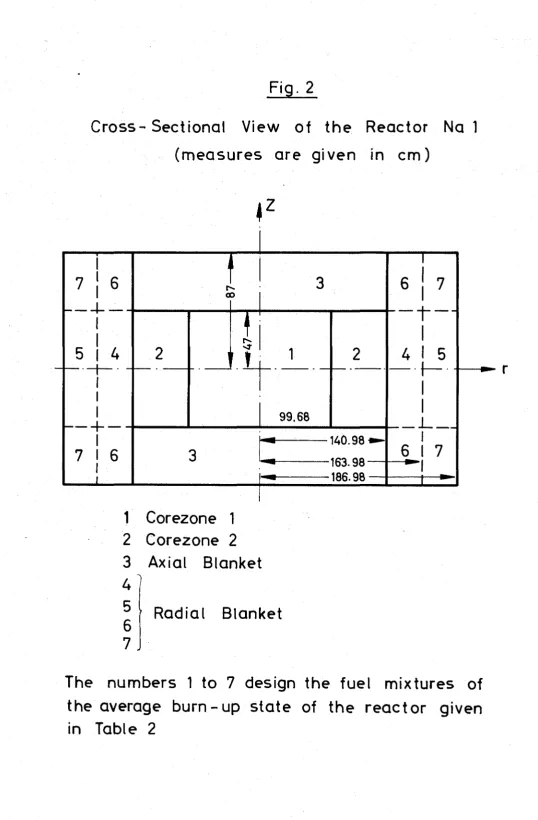
We consider a cylindrical reactor with few core zones, an axial and a radial blanket (Fig. 2), Exchanging the core and blanket elements takes place at each of the discrete time values
( 1 ) t = s • tit •
s C
lltc is a given constant correlated to the thermal reactor power Q and the given maximum burn-up of the fuel elements as shown in equation
(6),
The core elements are loaded and unloaded according to the cyclic
burn-up scheme described in [3], The core is subdivided into radial regions; the elements of the same radial region are combined into groups of n ele-ments (e,g, n=3), At each point of time t
4
-is exchanged for a fresh fuel element, During a period of time rtitc each element of a group is exchanged once and only once. The life time of the core elements is
o
= nAtc• i.e. the total irradiation time of a fuel ele-ment in the core, At each time t only the n-th part of the core elementss
is exchanged for fresh elements. If Ve is the total fuel element volume of the core, the exchanged fuel element volume at t
6 is
(2)
tivc=-v.
1 n CThe operation of the axial and radial blankets must be in agreement with the rhythm given by (1); i.e. loading and unloading the blanket ele-ments must succeed in intervals mtitc • rn may be a positive integer. The ele-ments of the axial blanket are coupled with the core eleele-ments; therefore both are managed jointly. Contrary to this the management of the radial blanket is largely independent of the core management. We assume the re.-dial blanket to be divided into NB rare.-dial zones, which are exchanged as a whole. The life-time of the j-th zone of the radial blanket may be
(3)
the integer m. is related to the maximum burn-up in the j-th zone, J
The a.mount of uranium and plutonium discharged out of the core and the axial and radial blankets is calculated in two steps: a) the calcu-lation of the space dependent uranium and plutonium concentrations of the discharged elements by solving the fuel burn-up equations; b) the calculation of the uranium and plutonium content of these elements by volume integration. The fuel burn-up calculations and the volume inte-gration for the core and blanket elements are discussed in the follow-ing sections.
2. 2. The Fuel Burn-up Equations
,
235
238
.
.
239
240
241
isotopes U and U and the four plutonium isotopes Pu, Pu, Pu, and 242Pu. Therefore• we have to solve a system of six first-orderdiffer-ential equations in time and flux time. respectively. The coefficients of these equations are the one group space dependent neutron flux and micro-scopic cross sections for neutron absorption and capture. which are defined in the multigroup picture as
(4)
~(r1z) =i
,i(r,z) • 1~i(r.z) is the neutron flux in the i-th neutron energy group at r1z; the ,i(r.z) are determined by multigroup calculations, The oi are the micro-scopic cross sections of the heavy nuclei in the fuel for neutron absorp-tion and capture in the i-th energy group.
In general,~ and also the o are time dependent as a consequence of the variation of the fuel composition in the reactor during neutron irra-diation, But it will be possible to calculate the uranium and plutonium concentrations in the irradiated elements at the end of their life time by solving the fuel burn-up equations with sufficient accuracy1 if we take into account time averaged, and o instead of the exact time depen-dent quantities. The latter, in general• would require the simultaneous solution of the burn-up equations and the criticality equation of the reactor, e.g. multigroup-diffusion equations. In our case the time averaged one group quantities are calculated according to equation
(4)
with time averaged neutron spectra, which are determined by multigroup calculations for an average burn-up state of the reactor assuming a homogeneous distribution of the fuel. The one group neutron flux for the average burn-up state is normalized to the given reactor power Q which is regarded as constant,
2.3. The Uranium and Plutonium Output of the Core &n;d the Axial Blanket
We suppose that the core is divided into N radial zones of different fuel compositions. The N. k(s.o) may be the time dependent initial
con-J. 1 )
centrations of the nuclei k s 1,2, ••
,6
in the fuel elements which are6
-loaded into the core zone J = 1.2, •••• N at the time ts' We presume
N. k(s.o}
=
N. k(o.o} for all s<s ; j = 1.2, ••• ,N; k = 1.2 •• , ••6.
J. J. 0
s designates the time ts at which refabricated fuel elements are loaded
0 O
into the core for the first time. i.e. for closing the :fuel cycle. s 0 is determined by the external fuel management as shown below. The N. k(o,o)
Jt
denote the j-th initial composition of the fuel elements at t
0 = 0, For all s>s the N. k(s,o) are to be calculated as functions of s, as shown
- 0 Jt
below.
Now we have to calculate the fuel output of the core at the time ts'
The N.*k(s.t .} may be the concentrations of the heavy nuclei in the J • maxJ
fuel elements unloaded from the j-th zone at t • The corresponding initial
s
concentrations may be given by N.•k(s.o). The N.•k(s,t .} are the
J. J. ma.xJ
solutions of the fuel burn-up equations with these initial values and the space dependent flux times
( 5)
r,z is any point of the core zone j. t . is related to the maximum fuel maxJ
burn-up for the elements of the core zone j in M:WD/tonne, From equation (5) follows the relation between ttc• the maximum burn-up for the inner core zone j = 1 expressed by the corresponding maximum flux time• and the neu-tron flux at the core center ~(o,o):
( 6} = -1 n
Tmax1 ~(o.o)
~(o,o) is proportional to the reactor power Q,
(7)
Obviously, the following relation holds:
•
N. k(s.o) = Jt
for s-n<s • 0 for s-n>s ,
The total number tiN. • k ( s) of the nucleus k which is unloaded from
h . Jl. . . • ( )
t e core zone J at t fol ows by integrating N. k s,t . over the
s J • maxJ
volume of the unloaded fuel elements• We obtain
(8)
H+D
2
Rj+1• ( > = -n
2
1T
I I
6N. k s
J.
H+D R.
- 2
J•
N. k(s,t .)rdrdz, J • maxJ
where the discharged nuclei of the axial blanket are included. H denotes the height of the core, D the total thickness of the axial blanket, R. the
J inner and Rj+
1 the outer radial boundary of the j-th zone, The division by
n is necessary• for only the n-th part of the elements of the zone j is discharged, In the core range we have to take into account the time
de-pendence of the initial. composition of the fuel; in the axial blanket region we take the initial composition of the elements constant.
The total output of the core and the axial blanket expressed as the total number of the discharged nuclei at the time ts• denoted as 6NCk(s), is
(9)
2,4.
The Uranium and Plutonium Output of the Radial BlanketThe uranium and :plutonium content of the radial blanket zone j at the time of discharging, which may be denoted as 6NBj:k • j = 1,2, ••• ,NB, k = 112,., ••
6,
is also calculated by a volume integral in analogy to equation ( 8), But in the case of the radial blanket n is equal to 1 and the initial values of the elements are time independent. The flux time distribution in the j-th zone for solving the burn-up equation isj : ,
.2.
o I O t ~ t8
-For a given value of s only that zone j of the radial blanket is unloaded for which
( 10) an integer.
*
If no value of j exists for a given s, the total output A~k(s). k = 1,2 ... 6 of the radial blanket is zero:
(11a) for all k.
If there are t special values of j for a given s. denoted as
j(t')•
1• = 1,2, ••••t,
for which equation (10) is valid• all the designated zones are unloaded at ts. Thus, the uranium and plutonium output of the radial blanket at t :iss
( 1 lb)
The CoW?osition of the Refabricated Fuel Elements and the Breeding G~in In the case of joint reprocessing of core and blanket elements the
total number of nuclei, which are unloaded from the reactor at t and s which are to be reprocessed• is
the ANB:(s) may vanish for certain values of s as shown before. The total numbers of uranium and plutonium nuclei are
6
(12)
l
A~(s).k=3
using the same symbols for the reduced numbers. The enrichment of the uranium available af'ter reprocessing is
"'
6N 1(s) If, 6Nu(s) (13) r(s) =
and the relative composition of the plutonium mixture available for the refabrication of the fuel elements is given by
(14) ~(s) =
i( 6Nk(s)
•
•
6NPu(s)
The initial uranium and plutonium concentrations of the fuel elements for the j-th core zone• which are refabricated from plutonium of the s-th discharge• i.e. from 6NP• (s)1 may be denoted as n. U(s) and n. Pu(s).
re-u Jt J.
spectively. Then. k(s), k = 1.2 •••••
6
may be the initial concentrationsJt
of the uranium and plutonium isotopes in the refabricated fuel elements. Thus1 the following relations hold:
(15)
Then.
ua
n. Pu and n. k are space independent.Ja J, Ja
The basis for calculating the initial compositions of the refabricated fuel elements are the 2N linear algebraic equations
6
l
c.
k • n. k(s) = K.(o)k=1 J. J. J
(16)
6
j = 1t2t••••Nl
n. k(s) = Z .(o)k=1 Jt J
with the abbreviations
C. = (vc/). k - a~ 1 k = 1.2 ... 6;
J1k Jt J1k
6
(16a) K.(o)=
l
C. kn. k(o). n. k(o)=N. k(o,o)J k=1 Jt Jt Jt Jt
6
z.(o)=
l
n. k(o)• 10
-Th e one group quan ities t . . o. a k an d ( vo f) . k re er to any re erence f f
Jt Jt
point in the j-th zone (e.g. r
=
R •• z=
o). As mentioned above• they are Jcalculated for the average fuel burn-up state of the reactor assuming a homogeneous fuel distribution. The vof are defined by analogy to equation
( 4).
The equations (16) are used to calculate the 2N unknown initial con-centrations n. U and n. Pu with a presupposed uranium enrichment and the
J. J,
isotopic composition of the plutonium given by
(14).
The first equations (16) are given to maintain criticality. By these equations the reactivity worth of the refabricated fuel elements is fixed approximately at a con-stant value for each zone by adjusting the fuel composition to a constant difference between neutrons produced and absorbed in the fresh fuel at a given point of each zone. The constant differences are defined bythe fresh fuel of the initial reactor at t =o.
0
The second equations (16) take the total number of heavy nuclei in the fresh fuel elements for each zone to be constant. The constants are given again by the initial conditions at t =
o.
For simplification we0
assume that the enrichment of the uranium used for fuel element refabri-cation is constant and equal to the initial enrichment
y
at t =o.
Thus•0 we have the relations
If only the plutonium mixture from the s-th discharge of the reactor is used for refabricating• i, e, in the case of positive breeding gain, the concentrations of the plutonium. isotopes are
(18) n. k(s) = Q_ (s) • n. Pu'
J, lt Jt
With the relations (17)and (18) the equations (16) are rearranged to
( 19)
n.
0(s) ,
C. U +n. Pu(s)
c.
Pu(s)
=K.(o)
Jt J, J, Jt J
n.
0(s)
with
( 19a)
c.u=c.
61 y+c. 2 (1-y). c.P(s)= \' c.kct(s)
J • J • J • J • u k~3 J • "'k
If C. p (s); C. Uthe equations are solved by J. u J.
(20)
z.(o)C. Pu(s)-K.(o) () J ,J1 J
n. U s =
-JI
c. Pu(s)-c. u
J. J.
-z.(o)c. u+K.(o) n. (s)= J,
,i•
J ,J ,Pu ( ) •
cj,Pu
s-cj,u
•
For physical reasons n. U(s) and n. P (s) must be positive, If
J. J. u
(21)
cj.u
~o.
i,e.
y
~ 1 /(1-c.
1
/c. 2).
n. Pu(s) is positive. If(21)
is true, theJt Jt Jt
numerator of the first equation (20) I!nlst be positive• i.e.
K .(o)
C. Pu(s) > J • j =
1.2,,.,,N,
J, -Z.(o)
J ( 22)
In the most interesting cases of fast power breeders with natural or depleted uranium as the fertile material the two conditions
(21)
and (22)are always true and the solutions (20) are :positive 2 ). In the following we will restrict ourselves to these cases, But the initial compositions for the refabricated :f'Uel elements are only determined by equation (20)• if the number AN~ ( s) of the available plutonium nuclei is enough for ma-nufacturing the fuel element volume AVc• i.e. in the case of positive breed-ing gain, The total number of plutonium nuclei from the s-th unloadbreed-ing of the reactor which is required for refabricating the fuel element volume
AVC is given by
2
• 12
-1 N
NPu ( s ) =
'ii"
.l
1 fl v . • n . P ( s ) • J= J J, u fl V • isJ the total volume of the fuel elements of the core zone j; thus 1 flV./n is the exchanged fuel element volume. Losses during the fuel element
J
fabrication reduce the number of plutonium nuclei by a factor qPu• there-fore, the number of the required plutonium nuclei is NPu(s)/qPu I instead
of NPu { s) • If
( 23)
the initial compositions of the refabricated fuel elements, are determined by the equations {20).
The breeding gain of the s•th fuel cycle is defined by
(24)
it is positive in accordance with (23),
The Parameter s
0
The time required for the external fuel management is (s
0-1 )fltc with the above definition of s • Thus• the plutonium unloaded fran the reactor
0
at t is reloaded into the core at t = (s+s -1)fltc• Therefore, we
s s+s0-1 o
have the relation
{25) N. k(s+s -1J, 0 10) = n. k(s) J, for all values of k and j,
s
0 is determined by the characteristics of the reprocessing and refabricat-ing plants, The external fuel cycle is characterized essentially by the parameters 6 16 • and 6f1 which are the minimum cooling time and the times
C r
-for reprocessing and refabricating
-
-
1 respectively, These quantities define a new parameter6ex = 6c + 6r + 6f;
furthermore, we define p = [ ~ ] flt •
For simplification we will assume in the following that the refabri-cated fuel element volume AV C of any fuel cycle is loaded into the core as a whole, i.e. it should not be distributed over different loading events. Now, we will express the time for loading the fuel element volume AVe of the s-th fuel cycle into the core in terms of P•
The time at which the first elements of the S•th fuel cycle are
re-fabricated lies between ts + ~te and ts + {p+1)Atc as the case may be, whether or not 6 /Ate is an integer. For economical reasons we assume that
ex
the time a~er which the complete volume AVC is refabricated will not ex-ceed Ate• i.e. the last elements of the s-th cycle may be refabricated not later than ts + {p+2)Atc• This condition avoids unnecessary accumulations of plutonium in the external fuel cycle, In general, three values of s are
0 possible:
s 0 = p+e: • e: = 1,2 or 3, respectively.
e:=1: if 6 ex/Atc=p and if the fuel element volume AVe is managed as only one batch. e:=2: (1) if oex/Atc~P and if the fuel element volume 6Ve is divided into partial batches and the last batch is refabricated not later than ts + {p+1)Ate; (2) if oex/t:,.te>p and if AVC is managed as a whole,e: =3: only if oex/Atc>p and if AVC is divided into partial batches and the last batch is refabricated later than ts + (p+1)6tc
3. NUMERICAL RESULTS
The numerical results refer to the sodium cooled reactor Na1
121.
The availability of the reactor may be 80 per cent; thus, the thennaJ. power is assumed to beQ = 2. OOO M".-l
on the average, Furthennore, we suppose
n = 3,
for the fuel burn-up cycles in the core. The corresponding maximum burn-up in r=o is
86,ooo
MWD/tonne averaged in the z-direction, The ~eometrical dataare given in Fig. 2, The initial COJILI)osition of the core and blank.et elements at t =o is given in TABLE I:
14
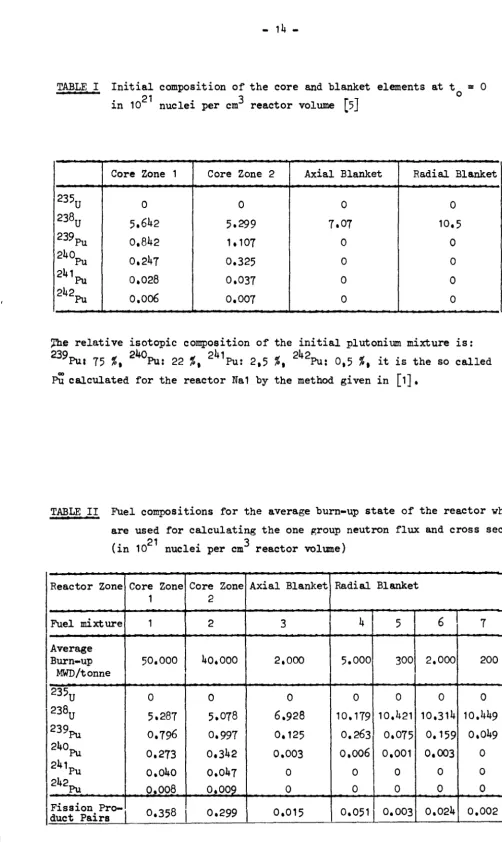
-TABLE I Initial composition of the core and blanket elements at t = 0
0
in 1021 nuclei per cm3 reactor volume (5]
Core Zone 1 Core Zone 2 Axial Blanket Ra.dial Blanket
235u 0 0 0 0
238u 5,642 5,299 7,07 10,5
239Pu o,842 1,107 0 0
240Pu 0,247 0.325 0 0
241Pu 0,028 0,037 0 0
242Pu o.oo6 0,007 0 0
:r'he relative isotopic composition of the initial plutonium mixture is:
239 240 241 242 . .
Put 75
%,
Pu: 22%,
Pu: 215%
1 Pu: 0,5%,
1t 1s the so called~ calculated for the reactor Na1
by
the method given in[1].
TABLE II Fuel compositions for the average burn-up state of the reactor which are used for calculating the one group neutron flux and cross sections (in 1021 nuclei per cm3 reactor volume)
Reactor Zone Core Zone Core Zone Axial Blanket Radial Blanket
1 2
Fuel mixture 1 2 3 4 5 6 7
Average
Burn-up 50.000 40.000 2,000 5.000 300 2,000 200
MWD/tonne
235u 0 0 0 0 0 0 0
238u 5,287 5.078 6.928 10,179 10.421 10,314 10.449 239Pu 0,796 0,997 0, 125 0.263 0,075 0,159 0,049 240Pu
0,273 0,342 0.003 0.006 0,001 0,003 0
241Pu o.o4o 0,047 0 0 0 0 0
242Pu 0.008 0,009 0 0 0 0 0
Fission.Pro-I
[image:18.703.137.639.19.861.2] [image:18.703.165.636.558.829.2]The 26-multigroup calcualtions are carried out for the average burn-up state of the reactor specified in TABLE II. The fuel compositions given in this Table are taken to be constant in the subzones of the reactor de-signated in Fig, 2, The Karlsruhe 26-group set
(4]
is used for the multi-gro'Ul) calculations,The radial blank.et is divided into two radial zones• i,e, NB= 2, The radial boundary between the two zones (Fig, 2) is R = 164 cm, The inner zone is always exchanged a~er the irradiation time 36tc• the outer zone always a~er 126tc• i,e, m
1 = 3, m2 = 12, The maximum burn-up of the radial blanket in the plane z = 0 is 10,000 MWD/tonne in the inner and 9,500 MWD/tonne in the outer zone, The 238
u
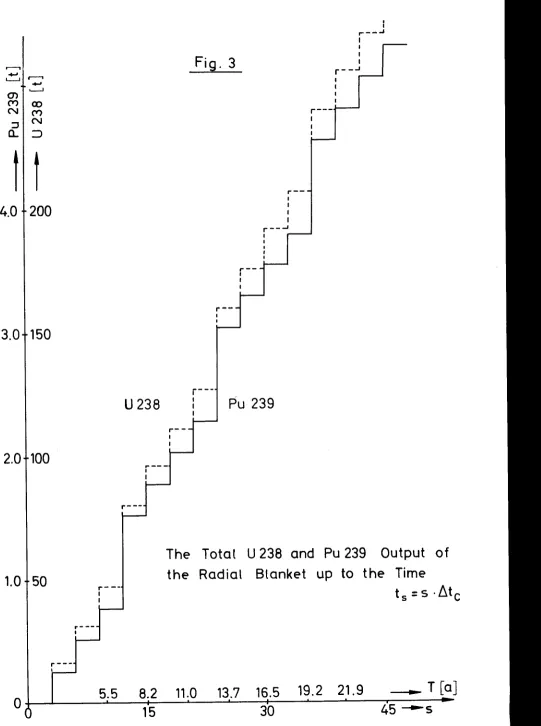
and 239Pu output of the radial blanket as func-tioIEof time are given in Fig, 3, The unloaded plutonium consists of about 97%
239Pu and 4%
240Pu,The para.meters for the external fUel management are oc = 100 days for cooling, or= 30 days for reprocessing, of= 70 days for refabricating. Di-viding the discharged :f\lel element volume 6VC into partial batches, we get
s = 3. Thus, the external fUel inventory, which corresponds to the fuel
0
element volume of (s
0-1)6VC = 26Vc• amounts to 2,020 kg plutonium of the initial composition and 8,460 kg uranitm1,
Fig,
4
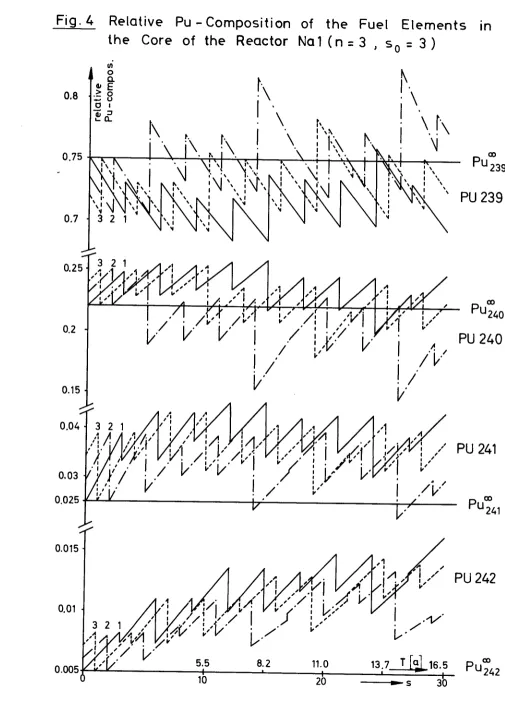
shows the time behaviour of the relative plutonium composition of the fuel elements in the core, As a consequence of the group structure of the fuel elements in the core with n = 3, there are threelines for each plutonium isotope, Ee.eh of these refers to those fuel ele-ments which are loaded and unloaded jointly, The diagram shows the con-tinuous behaviour of the plutonium mixture in the :f\lel during neutron
irradiation (idealized as linear to simplify plotting) and the discontinuous behaviour at the times t caused by exchanging the fUel elements, The initial
s
composition of the plutonium is plotted as~.
16
-The numerical results reveal the dependence of the time behaviour of the plutonium composition in the fuel elements on the fuel burn-up and the
internal and external fllel management, In particular.there is a strong coupling between the radial blanket operation and the closed fuel cycle in the case of joint reprocessing of the core and blanket elements. which increases the variations of the plutonium composition by exchanging the fuel elements as well as during burn-up {Fig,
4),
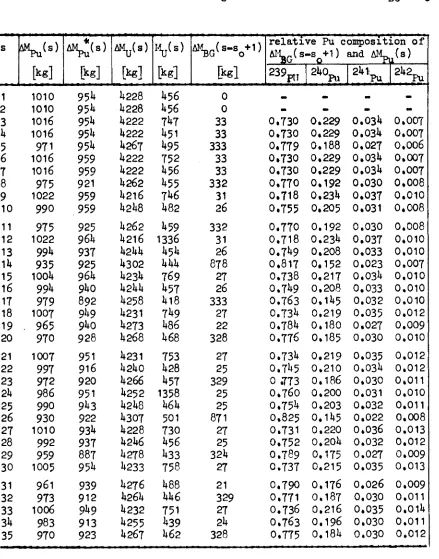
Furthermore, it follows from the numerical results that the fuel cycle economy of the reactor system depends on the time variations of the plutonium composition in the fuel(TABLE III),
TABLE III The most important quantities of the reactor system which are
changed by plutonium recycling as functions of the time parameters plutonium loaded into the core at time t
8: ~(s}
plutonium unloaded from the core at time t s : l:ilv~ ( s )
uranium loaded into the core at the time t
6: l:i~(s) net uraniun introduced into the system from the outside: l\J(s} breeding gain of the (s-s
0+1)-th f'uel cycle: l:i~G(s-s0+1)1 s0=3
s ~(s) ~(s) l1Mu(s) !'11( s) i:iMaG( s-s0 +1) relative Pu composition of t:iI\a ( s-s
n +1) and l1Mp,
1 ( s)
[kg]
[kg]
(kg] [kg]
[kg}
239PlJ 124oPu 1241:Puj
242Pu1 1010 954 4228 456 0
-
-
-
-2 1010 954 4228 456 0
-
-
-
-3 1016 954 4222 747 33 0.730 0.229 0.034 0.007 4 1016 954 4222 451 33 0.730 0.229 0.034
0.001
5 971 954 4267 495 333 0.779 0.188 0.027 0.006 6 1016 959 4222 752 33 0,730 0.229 0.034 0.007
1
1016 959 4222 456 33 0.730 0.229 0.034 0.007 8 975 921 4262 455 3320.110
0.192 0.030 0.008 9 1022 959 4216 746 31 0,718 0,234 0.037 0.01010 990 959 4248 482 26 0.755 0.205 0.031 0.008
11 975 925 4262 459 332 0.770 0.192 0.030 0.008
12 1022 964 4216 1336 31 0.718 0.234 0.037 0.010
13 994 937 4244 454 26 0.749 0.208 0.033 0.010 14 935 925 4302 444 878 o.817 0.152 0.023
0.001
15 1004 964 4234 769 27 0.738 0.211 0.034 0.010 16 994 940 4244 457 26 0.749 0.208 0.033 0.010 17
919
892 4258 418 3330.163
0.145 0.032 0.010 18 1007 949 4231 749 27 0.734 0.219 0.035 0.012 19 965 940 4273 486 22 0.784 0.180 0.027 0.009 20910
928 4268 468 328 0.776 0.185 0.030 0.01021 1007 951 4231 753 27 0.734 0.219 0.035 0.012 22 997 916 4240 428 25 0.745 0.210 0.034 0.012 23 972 920 4266 457 329 O .773 0.186 0.030 0.011 24 986 951 4252 1358 25
0.160
0.200 0.031 0.010 25 990 943 4248 464 25 0.754 0.203 0.032 0.011 26 930 922 4307 501 871 0,825 0.145 0.022 0.00827 1010 934 4228
130
27 0.731 0.220 0.036 0.01328 992 937 4246 456 25 0.752 0.204 0.032 0.012 29 959 887 4278 433 324 0.789 0.175 0.027 0.009 30 1005 954 4233 758 27 0.737 0.215 0,035 0.013
[image:21.688.53.492.217.776.2]18
-REFERENCES
[1
J
K. OTI'• A, JANSEN• Long-time behaviour of fast breeders• Proceedings of the Seminar on the Physics of Fast and Intermediate Reactors• Vienna. SM-18/2 (1962) 213-228,[2] D, SMIDT• A, MULLER et
al,•
Referenzstudie fur den Na-gekillllten schnellen Brutreaktor (Na1)• KFK-299• GfK Karlsruhe• 1964.[3] A, JANSEN• K, Ol'T• K,E, SCHROETER, Zum Abbrandverhalten schneller Reaktoren• PSB-report 121/64,
[4] 26-group set KFK 26-10. Karlsruhe ( 1965) • for first infonnation: K, KtiSTErrn. M, METZENROTH, The innuence of sane important group
constants on integral fast reactor quantities. ANL-7120 (1965) 423-433, [5] K,E, SCHROETER• Zweidimensionale 26-Gruppen-Diff'usions-Rechnungen
Fuel Cycle of- a Fast Power Reactor with
Plutonium Recycling
Q
,----~~~-~-~~~-=~---·--,
Core
Fuel Element
Reservoir
Fuel Element
Refabrication
Blanket t - - - 1
Reprocessing of
Core and Blanket Elements
Fabrication of
Blanket Element
uranium
I
I
I
I
I
L_· - - - -
- - - _J
'
BG Fission products
thermal power
_..,...,_ uranium introduced from the outside
=:>
excess plutonium ( breeding gain BG)
.... .-
fission products drawn off to the outside
[image:23.693.19.562.18.827.2]Fig. 2
Cross- Sectional View of the Reactor Na 1
(measures
are
given in cm)
I
i
~
I
6
l
7
7:6
..,
I
3
I
.--t--1---__.,_~~'.---~-t---l
r-... jI
5
f
4
2
, , .
1
2
41 5
--·1· _.___
·-·1---·-
i
I
--!-
I
99.68_l_ __ _
7 : 6
3
,-
140. 98~
6 : 7
1 ~ 163.98 .
I
I r ,._ 186.98 I
1
Corezone
1
2
Corezone
2
I
3 Axial Blanket
4
5
6
7
Radial Blanket
. r
[image:24.694.132.670.24.843.2]O')
("I') CX)
N ("I')
:::, N
a..
:Jt
t
4.0 200
3.0 150
2.0 100
1.0 50
,.---I0
,.-
--I Ir
-I
5.5
U 238
,---1 I~---
,.---'
IThe
the
Fig. 3
r
-,
I ,---1 I I ,---1 I I Ir--....,
I I i---1I
Pu
239
I
r---1
I
r- _..,
Total U 238 and Pu 239 Output of
Radial Blanket up to the Time
t5 :s,L'.\tc
8.2
11.0
13.7
16.5
19.2 21.9
... T [a]
[image:25.696.57.598.69.795.2]Fig. 4 Relative Pu - Composition of the Fuel Elements
inthe Core of the Reactor Na 1 ( n
=
3 , s
O
=
3 )
0.8 0.7 0.2 0.15 0.04 0.03 0.015 0.01 Ill 0 Q.
CII E -~ 0
-0 u I
-
::,~a..
3 2 1
f\
t·
.\
! \
I \
I ,
.,,
,
/
/
I
~j·
.
,,/~·
/f
II
, •/VI
. ! ,(.'/ ~·
i,'
I
~.
·\
I
.
. \ r\
I ..
\J
,
, "
~,1
I
~/1,/
!;
V
./~/ a> Pu239PU
239
00
Pu240 PU
240
PU
241
00
Pu241
~
,,
l,,,,.
PU242
00
5.5 8.2 11.0 13.7 T [~ 16.5 0.005f---l"--"'---+----..._ _ _ _ -+-_ _ _
....,___'---+-10 20