Exploration of New Phosphors Using a Mineral-Inspired
Approach in Combination with Solution Parallel Synthesis
Masato Kakihana1, Jihae Kim1, Tetsufumi Komukai2, Hideki Kato1, Yasushi Sato1, Makoto Kobayashi1, Yuji Takatsuka2
1
Institute of Multidisciplinary Research for Advanced Materials, Tohoku University, Sendai, Japan
2
Ichikawa Research Laboratories, Sumitomo Metal Mining Co. Ltd., Ichikawa, Japan Email: [email protected]
Received May 29,2013; revised July 7, 2013; accepted August 1, 2013
Copyright © 2013 Masato Kakihana et al. This is an open access article distributed under the Creative Commons Attribution License, which permits unrestricted use, distribution, and reproduction in any medium, provided the original work is properly cited.
ABSTRACT
The concept, as well as the methodology of using a mineral-inspired approach in combination with solution parallel synthesis (SPS) for exploration of new phosphors among Na/Sr(Ba)/Al-silicate and Zr(Ti)-silicate minerals, is reported. By employing the proposed approach, we have discovered new phosphors of NaAlSiO4:Eu2+ and BaZrSi3O9:Eu2+, that
emit green-yellow (553 nm) and blue-green (480 nm) light, respectively, when excited by radiation of 290 to 420 nm.
Keywords: Mineral; Solution Parallel Synthesis; Exploration of New Phosphors; Silicate
1. Introduction
Research aimed at the discovery of new phosphors has been dependent on the knowledge of solid-state physics and crystal chemistry. Generally, the exploration of new phosphors involves the repetition of a sequential process: 1) devising the composition of a chosen candidate sub- stance, 2) its synthesis, 3) characterization of the fluo- rescence of the synthesized material, 4) modification of the original composition, 5) its re-synthesis, and so on. However, it should be noted that the aforementioned process needs to be repeated several times to develop a new phosphor. Therefore, the process of discovering a new phosphor requires an enormous amount of time and effort. As a consequence, the search for new phosphors was confined to a limited composition range.
One of the effective ways of addressing the challenge is to employ generic algorithm-assisted combinatorial chemistry (GACC), which was applied to the develop- ment of heterogeneous catalysts in the recent past [1-3]. GACC has been successfully utilized by Kee-Sun Sohn’s group for the exploration of new phosphors for the use in plasma displays and light-emitting diodes (LEDs) [4-8]. More recently, the same research group employed high- throughput combinatorial chemistry in combination with an advanced computational approach based on particle swarm optimization [9], and executed a so-called particle swarm optimization-assisted combinatorial materials search (PSOCMS) to discover novel phosphors such as
Ce2.6Ca1.4Si12O4.4N16.6:Eu2+ and
La2.544Ca1.456Si12O4.456N16.544:Eu2+ [10]. Considerable
at-tention has been paid to the following in both GACC and PSOCMS: 1) development of computational algorithms to make the high-throughput combinatorial screening efficient and 2) shortening of the time needed for the final identification of promising compositions. On the other hand, lesser attention has been devoted to the me- thod of the material fabrication itself although it is cru- cial to establish the methodology for the reliable syn- thesis of phosphors, as this ensures homogeneity of com- positions and uniform distribution of activators in given host compounds. In most previously reported studies based on GACC/PSOCMS as well as the synthetic stu- dies on phosphors, researchers have primarily relied on the traditional method based on solid-state reactions. As a result, precise control of the compositions of phosphors and achievement of a homogeneous distribution of small amounts of activators in the host compounds were not possible. Therefore, we propose an alternative methodo- logy involving a mineral-inspired approach in combina- tion with the so-called solution parallel synthesis (SPS) method [11].
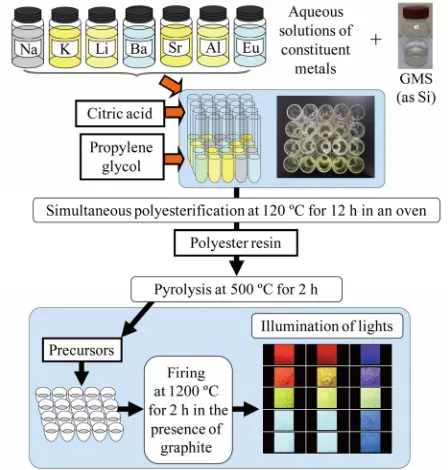
the phosphor candidate substances, which was difficult through conventional techniques. The PC and AMC methods are best suited for homogeneous synthesis of ceramics with complex compositions. The scheme for the SPS method is summarized in Figure 1. We explored new phosphors containing silicon by focusing on silicon of Clarke number 2 and employing the SPS method. There are more than 18,000 inorganic crystalline com- pounds containing silicon, a common element [15]. However, since most of them are found in natural miner- als, their artificial synthesis is difficult. As a result, their application as functional ceramics, e.g., phosphors, is un- common.
[image:2.595.60.284.423.658.2]The obstacle in the artificial syntheses of compounds containing silicon imitating minerals comes from the lack of an appropriate silicon source that is required when an advanced solution technology has to be employed to ob- tain high-quality Si-containing ceramic materials. In fact, the only silicon sources that can be used in a given solu- tion process are “volatile” tetraalkoxysilanes (TAS). However, the use of TAS is not recommended, since TAS evaporates when subjected to repeated heat treat- ment, as a result of which the composition changes greatly from the original. For this reason, the discovery of new phosphors from silicon-containing compounds regarded as cornucopia of functions is challenging. We systematically synthesized silicon-containing phosphors
Figure 1. Scheme of solution parallel synthesis scheme for exploration of new phosphors in AxByAlzSiqOw:Eu2+ (A = Li,
Na, K; B = Sr, Ba) systems. GMS stands for “gly-col-modified silane,” which was used as the silicon source. Visual observation of emission light by illumination with near-UV light is also shown as the image.
[16-22] using nonvolatile and nonflammable glycol-mo- dified silane (GMS) [16], which was uniformly dispersed in water.
The accomplishment of the reliable synthesis of sili- con-containing phosphors from GMS has heralded the development of new silicon-containing phosphors by the SPS method.
In this paper, we report a process for exploring new phosphors by the SPS method based on a mineral-in- spired approach. Specifically, we detail the discovery of new phosphors of silicate minerals, nepheline, i.e., NaAlSiO4:Eu2+ (green-yellow) [21] and benitoite, i.e.,
BaZrSi3O9:Eu2+ (blue-green) [22], by the SPS method
utilizing water-dispersible GMS. We have first described the method for the synthesis of GMS, followed by the importance of the use of GMS in the SPS method.
2. Glycol-Modified Silane (GMS):
Water-Dispersible Silicon Compound
Until now, we reported on the synthesis of silicon-con- taining phosphors [16-22] through the aqueous solution method involving GMS obtained by reacting tetraethox-ysilane (TEOS)—a typical silicon alkoxide—with glycol. For example, silane modified with propylene glycol (PG) (propylene-glycol-modified-silane; PGMS) can be syn- thesized in the presence of hydrochloric acid as a catalyst by reacting TEOS with PG at 80˚C for a couple of min- utes. GMS has a distinct property of reacting with water to form silicon clusters [23], such as Si(OH)4 and
(OH)3-Si-O-Si(OH)3, and of distributing uniformly in
water, unlike other conventional Si compounds such as TEOS. While GMS is important in the synthesis of sili- con-containing phosphor, it is indispensable in the dis- covery of new silicon-containing phosphors by the SPS method.
3. Establishment of a Library of Artificial
Compositions Using Minerals as Models
and Search for New Phosphors
We describe herein the conditions employed for the search of new phosphors by the SPS method. The suc- cess or failure of the search for new substances hinges on the effectiveness of the composition library that is estab- lished. We chose to use “minerals as models” in our arti- ficial composition library. By employing the SPS method, we recently discovered NaAlSiO4:Eu2+ phosphor, which
emits a strong green-yellow light (553 nm) when excited by near ultraviolet radiation of 290 to 420 nm. We first describe the sequence of steps implemented in the dis- covery of the aforementioned phosphor below and, then, introduce BaZrSi3O9:Eu2+ phosphor discovered by the
3.1. NaAlSiO4:Eu2+ Phosphor
Step 1: Establishment of a library of artificial composi- tions using minerals as models.
First, we extracted alkaline aluminum silicate-based substances of mineral origin from the database. Eleven minerals that were specifically chosen are listed in Table 1. Additionally, two more minerals based on alka- line-earth/alkali metals and aluminum silicate, which include banalsite and stronalsite, are listed in Table 1. Of the artificial compositions in Table 1, the standard com- position was created by removing water of crystallization (“•nH2O”) from original mineral compositions. We have
taken into consideration artificial solid solutions of Na and Sr in sodium-aluminum silicates assuming that a certain portion of sodium in a given sodium-aluminum silicate can be replaced by Sr. For instance, in the case of jadeite NaAlSi2O5, (1st column in Table 1), two possible
solid solutions have been created artificially, i.e., Na0.95Sr0.05Al1.05Si1.95O6 and Na0.9Sr0.1Al1.1Si1.9O6. Owing
to the mismatch in the charges between Na+ and Sr2+, the charge neutrality in the artificial composition was main-
tained by adjusting the molar ratio of Al to Si. In the case of banalsite, BaNa2Al4Si4O16, two possible solid solu-
tions, i.e., Ba0.8Sr0.2Na2Al4Si4O16 and
Ba0.6Sr0.4Na2Al4Si4O16, have been artificially created as
shown in the penultimate row in Table 1. Similarly, we have constructed 27 artificial compositions, including the standard compositions. Thus, the list in Table 1 is re- ferred to as a “composition library” inspired by minerals.
Step 2: Preparation of a mixed solution in accordance to the library of compositions.
[image:3.595.58.542.380.732.2]An aqueous solution of each element that appeared in the library was prepared. The concentration of each metal was analytically determined prior to its use. In addition, an aqueous solution of europium was also prepared. The mixed solution with a composition corresponding to that mentioned in the library was prepared in a test tube, and Eu, the activator, was then added to the test tube so that its amount is 1 mol% for Na/Sr or Ba/Sr (when necessary, charge compensation was achieved by adjusting the ra- tios of Al and Si). Finally, citric acid was added as a metal stabilizer and glycol was added as a polymerizing agent.
Table 1. Library of artificial compositions inspired by natural minerals of AxByAlzSiqOw (A = Li, Na, K; B = Sr, Ba) systems.
Artificial compositions inspired by natural minerals
Sr substitutions for Na or Ba No. Name of
Mineral
Original compositions of
minerals Standard compositions
5% for Na and 20% for Ba 10% for Na and 40% for Ba
1 Jadeite NaAlSi2O6 NaAlSi2O6 Na0.95Sr0.05Al1.05Si1.95O6 Na0.9Sr0.1Al1.1Si1.9O6
2 Albite NaAlSi3O8 NaAlSi3O8 Na0.95Sr0.05Al1.05Si2.95O8 Na0.9Sr0.1Al1.1Si2.9O8
3 Nepheline NaAlSiO4 NaAlSiO4 Na0.95Sr0.05Al1.05Si0.95O4 Na0.9Sr0.1Al1.1Si0.9O4
4 Natrolite Na2[Al2Si3O10]·2H2O Na2Al2Si3O10 Na1.9Sr0.1Al2.1Si2.9O10 Na1.8Sr0.2Al2.2Si2.8O10
5 Barrerite Na2[Al2Si7O18]·6H2O Na2Al2Si7O18 Na1.9Sr0.1Al2.1Si6.9O18 Na1.8Sr0.2Al2.2Si6.8O18
6 Gobbinsite Na5[Al5Si11O32]·12H2O Na5Al5Si11O32 Na4.75Sr0.25Al5.25Si10.75O32 Na4.5Sr0.5Al5.5Si10.5O32
7 Orthoclase KAlSi3O8 KAlSi3O8 - -
8 Kalsilite KAlSiO4 KAlSiO4 - -
9 Leucite KAlSi2O6 KAlSi2O6 - -
10 Lithosite K6Al4Si8O25·21H2O K6Al4Si8O25 - -
11 Petalite LiAlSi4O10 LiAlSi4O10 - -
12 Banalsite BaNa2Al4Si4O16 BaNa2Al4Si4O16 Ba0.8Sr0.2Na2Al4Si4O16 Ba0.6Sr0.4Na2Al4Si4O16
Step 3: Parallel, simultaneous chemical processes, such as polyesterification (fabrication of polyester resin).
These test tubes were placed in an oven and heated, and the mixture in them was concentrated at 120˚C for 12 h to promote polyesterification.
Step 4: Heat treatment processes for production of precursors and inducing fluorescence by final heat treat- ment.
The test tube containing polyester resin was heat- treated in a sand bath at 500˚C for 2 h, for degreasing. The degreased substances were transferred to crucibles and fully baked in the electric furnace in the presence of graphite as a reducing agent at 1200˚C for 2 h for simul- taneous synthesis of many kinds of samples.
Step 5: Visual examination of light emission.
The appearance of luminescence of oxides thus ob- tained, through illumination by ultraviolet light (254 nm) or near-ultraviolet lights (365 nm and 400 nm), is shown in Figure 2. The image clearly indicates that many of the Na(K)/Sr(Ba)/Al/Si-oxide systems are hosts for blue-to- yellow luminescence originating from Eu2+.
Step 6: Choice of promising phosphors: Re-synthesis based upon rational inspection.
Phase identification by X-ray diffraction measurement and the evaluation of photoluminescence properties by excitation and emission-spectrum measurement were performed to choose promising phosphors. In the specific case of Eu2+-doped Na(K)/Sr(Ba)/Al/Si-oxide systems, further reduction of a stable trivalent europium (Eu3+) to a less stable divalent europium (Eu2+) was found to be necessary. In order to reduce Eu3+ to Eu2+ completely, additional heat-treatment under a strongly reducing at- mosphere was carried out by passing N2/NH3 (90/10
mol%) gas at 1200˚C for 2 h. As expected, the lumines- cence characteristics were significantly improved due to
the increased amount of available Eu2+. Figure 3 shows images depicting luminescence of some representative samples after reduction by N2/NH3. The nepheline sam-
ple with the nominal composition of NaAlSiO4:Eu2+, the
natrolite sample with the nominal composition of Na2Al2Si3O10:Eu2+, and their Sr-substituted derivatives
emit strong green-to-yellow lights when illumination with UV/near-UV lights between 254 nm and 400 nm. Careful phase identification by X-ray diffraction indi- cated that while NaAlSiO4 was found in the nepheline
sample, the same was not true for the natrolite sample; instead a mixed phase of NaAlSiO4 and SiO2 formed.
These observations led us to the conclusion that it is ne- pheline that emits strong green-to-yellow lights in sam- ples with the nominal compositions of NaAlSiO4:Eu2+
and Na2Al2Si3O10:Eu2+.
The excitation and emission spectra of the
NaAlSiO4:Eu2+ phosphor discovered in the
aforemen-tioned manner are shown in Figure 4. While this phos-phor displays weak emission when excited by visible light, it emits strong green-yellowish light with excitation by near ultraviolet light of 320 nm. In addition, the emis-sion spectrum is comprised of one simple broad compo-nent with a peak maximum at 553 nm.
Our future goal is to achieve a redshift (long-wave- length shift) in an excitation spectrum. In oxynitride, wherein a portion of oxygen was replaced with nitrogen, a redshift in the excitation spectrum was observed along with a slight increase in intensity at 400 nm [21].
3.2. BaZrSi3O9:Eu 2+
Phosphor
Like in the case of NaAlSiO4, we extracted zirconium
[image:4.595.129.467.525.696.2](titanium) silicate-based substances of mineral origin from the database. Of the elements present in original mineral compositions, we replaced those that were un-
Figure 3. Appearance of luminescence in some representative samples upon illumination of the samples with ultraviolet light (254 nm) or near-ultraviolet light (365 nm and 400 nm) before and after reduction by N2/NH3. Figures on each image indicate
the wavelength (nm) used for excitation.
400 600 800
200
Intens
it
y /
P
46(
YA
G
:Ce)
0.2 0.4 0.6 0.8 1.0 1.2
0
Excitation Emission
320 nm 553 nm
Wavelength / nm
(excited by 365 nm-light)
Figure 4. Excitation and emission spectra of the nepheline- origin NaAlSiO4:Eu2+ (1 mol% for Na) discovered by
em-ploying the SPS method.
suitable for phosphors. For instance, Fe and Ti were re- placed with elements having similar ionic radii such as Mg and Zr, respectively. We replaced the removed artifi- cial composition for water of crystallization (“•nH2O”).
In addition, we took into consideration the solid solutions comprising alkaline earth metals Ca, Sr and Ba and alkali metals Li, Na, and K. Thus, as depicted in Table 1, 49 artificial compositions were established using each min- eral as a model, and a part of the artificial composition library established in this way is shown in Table 2. As in the case of NaAlSiO4, we employed Eu2+ as an activator
for all the 49 artificial compositions (typically 3 mol% Eu2+ for Na or Ba).
After careful inspection of the result obtained by the SPS experiment, the BaZrSi3O9:Eu2+ phosphor, emitting
blue-green light (480 nm), was found. Its emission inten- sity was comparable to the maximum intensity of a commercially available BAM (BaMgAl10O17:Eu2+) pho-
sphor. The light emission when irradiated with 405 nm of near ultraviolet light is shown in Figure 5, and the exci-tation and emission spectra of the same sample are shown in Figure 6 in comparison with that of BAM. It is worthwhile to note that in contrast to BAM, a flat excita- tion spectrum was observed for BaZrSi3O9:Eu2+ over the
range of 290 nm to 420 nm. The intensity of lumines- cence due to excitation with 405 nm was more than twice that of BAM. In conclusion, BaZrSi3O9:Eu2+ is consid-
ered to be useful as a blue-green phosphor for use in near-ultraviolet LEDs [22,24].
4. Concluding Remarks
[image:5.595.61.267.325.475.2]Table 2. Library of artificial compositions inspired by natural minerals of zirconium (titanium) silicate systems.
Artificial compositions inspired by natural minerals No. Name of Mineral Original compositions of
Standard compositions Solid solutions minerals
1 Armstrongite CaZrSi6O15·2.5H2O CaZrSi6O15 (Ca,Sr)ZrSi6O15
2 Benitoite BaZrSi3O9 BaZrSi3O9 (Ba,Sr)ZrSi3O9
3 Calciohilairite CaZrSi3O9·H2O CaZrSi3O9 (Ca,Sr)ZrSi3O9
4 Cataplelite Na2ZrSi3O9·2H2O Na2ZrSi3O9 (Na,Li)2ZrSi3O9
5 Elpidite Na2ZrSi6O15·3H2O Na2ZrSi6O15 (Na,K)2ZrSi6O15
6 Parakeldyshite Na2ZrSi2O7 Na2ZrSi2O7 (Na,K)2ZrSi2O7
7 Terskite Na4ZrSi6O16·2H2O Na4ZrSi6O16 (Na,Li)4ZrSi6O16
8 Aenigmatite Na2Fe5TiSi6O20 Na2Mg5ZriSi6O20 (Na,Li)2Mg5ZriSi6O20
9 Titanite CaTiSiO5 CaZrSiO5 (Ca,Sr)ZrSiO5
10 Natisaite Na2TiSiO5 Na2ZrSiO5 (Na,K)2ZrSiO5
405
nm-Near UV green emissionStrong
[image:6.595.53.544.102.503.2]blue-(a) (b)
Figure 5. Appeara ZrSi3O9:Eu2+ (a)
esis, unearthing new phosphors prepared from silicates,
in- vo
nce of the powder of Ba and its emission by illumination of 400 nm light (b).
th
expected to have wide-ranging functions, is doubtful. In this paper, we described the process parameters lved in the exploration of new phosphors using the SPS method based on a mineral-inspired approach. We would like to reiterate the importance of glycol-modified silane (GMS) in the implementation of the SPS method for preparing new phosphors from silicates. Using this method, we recently found Eu2+-activated oxide phos- phor that emitted red-orange light (625 nm) when excited with blue light [25]. Moreover, we are currently devel- oping new phosphorus-containing phosphors using new phosphate compounds applicable to the SPS method [26]. It is expected that the SPS method will become popular in the near future and this will inject new vigor into the field of phosphor exploration.
0 0 .5 1 1 .5 2 2 .5 3
:C
e
)
2 0 0 3 0 0 4 0 0 5 0 0 6 0 0
w ave le ngth / nm
In
te
n
s
it
y
/
P
46(
Y
A
G
B A M
Ba0 .9 7ZrSi3O9:0 .0 3 Eu 4 8 0 nm
e)
Intens
it
y /
P
46
(Y
A
G:
C
Wavelength / nm 4 0 5 nm4 5 5 nm
Figure 6. Excitation and emission spectra of the benitoite- origin BaZrSi3O9:Eu2+ (3 mol% for Ba) discovered by
m-ts
ted by the Ministry of Edu-Technology, Japan through
NCES
[1] O. V. Buyevs . Kondratenko and D. Wolf and M and Combinatorial
e ploying the SPS method.
5. Acknowledgemen
This work was partly suppor cation, Culture, Sports and
Grant-in-Aids for Scientific Research on Innovative Ar-eas of “Fusion Materials” (No. 2206) and on Scientific Research A (No. 22246081).
REFERE
kaya, A. Bruckner, E. V . Baerns, “Fundamental
Approaches in the Search for and Optomization of Cata-lytic Materials for the Ozidative Dehydrogenation of Propane to Propene,” Catalysis Today, Vol. 67, No. 4, 2001, pp. 369-378.
[2] D. Wolf, O. V. Buyevskaya and M. Baerns, “An Evolu-tionary Approach in
Opromization of Catalytic Materials,” Applied Ca the Combinatorial Selection and
talysis A, Vol. 200, No. 1-2, 2000, pp. 63-77.
http://dx.doi.org/10.1016/S0926-860X(00)00643-8
[3] J. S. Paul, R. Janssens, J. F. M. Denayer, G. V. Baron and P. A. Jacobs, “Optimization of MoVSb O
Partial Oxidation of Isobutane by Combinatoria xide Catalyst for
l Ap-proaches,” Journal of Combinatorial Chemistry, Vol. 7, No. 3, 2005, pp. 407-413.
http://dx.doi.org/10.1021/cc0500046
[4] K. S. Sohn, D. H. Park, S. H. Cho, J. S. Kwak and J. S. Kim, “Computational Evolution
Phosphor for Use in Tri-Color White
ary Optimization of LEDs,” Chemistry
Red of Materials, Vol. 18, No. 7, 2006, pp. 1768-1772. http://dx.doi.org/10.1021/cm052179o
[5] K. S. Sohn, D. H. Park, S. H. Cho, B. I. Kim and S. I. Woo, “Generic Algorithn-Assisted Combinatorial S for a New Green Phosphor for Use
earch in Tricolor White LEDs,” Journal of Combinatorial Chemistry, Vol. 8, No. 1, 2006, pp. 44-49.
http://dx.doi.org/10.1021/cc050101z
[6] K. S. Sohn, J. M. Lee and N. Shin, “A Search for New Red Phosphors Using
timization Process,” Advanced Mater
a Computational Evolutionary Op-ials, Vol. 15, No. 24,
cy at Soft Ultraviolet Excitation 2003, pp. 2081-2084.
[7] K. S. Sohn, B. I. Kim and N. Shin, “Generic Algo-rithm-Assisted Combinatorial Search for New Red Phos-phors of High Efficien ,” J. Electrochem. Soc., Vol. 151, No. 12, 2004, H243-H248. http://dx.doi.org/10.1149/1.1808592
[8] Y. S. Jung, C. Kulshreshtha, J. S. Kim, N. Shin and K. S. Sohn, “Generic Algorithm-Assisted Combinatorial Search for New Blue Phosphors in a (Ca,Sr,Ba,Mg,Eu)xBy zP O d
System,” Chemistry of Materials, Vol. 19, No. 22, 2007, pp. 5309-5318. http://dx.doi.org/10.1021/cm070976b [9] J. Kennedy and R. Eberhart, “Particle Swarm
Optimiza-tion,” IEEE International Conference on Neural Net-works, Perth, Vol. 4, 27 November-1 December1995, pp. 1942-1948. http://dx.doi.org/10.1109/ICNN.1995.488968 [10] W. B. Park, Y. S. Jeong, S. P. Singh and K. S. Sohn, “A
Yellow-Emitting Oxynitride Phosphor:
Ce4-xCaxSi12O3+xN18-x:Eu2+,” ECS Journal of Solid State
Science and Technology, Vol. 2, No. 2, 2013, pp. R3100- R3106. http://dx.doi.org/10.1149/2.013302jss
[11] Y. Suzuki and M. Kakihana, “Parallel Solution-Based Synthesis Approach for Search of Lanthanoid-Activated Ca2SnO4 Phosphor Materials,” Journal of the American
Ceramic Society, Vol. 92, Suppl. s1, 2009, pp. S168-S171. http://dx.doi.org/10.1111/j.1551-2916.2008.02706.x
[12] M. Kakihana, “Synthesis of High-Performance Ceramics Based on Polymerizable Complex Method,” Journal of the Ceramic Society of Japan, Vol. 117, No. 8, 2009, pp. 857-862. http://dx.doi.org/10.2109/jcersj2.117.857 [13] M. Kakihana and M. Yoshimura, “Synthesis and
Charac-teristics of Complex Multicomponent Oxides Prepared by Polymer Complex Method,” Bulletin of the Chemical So-ciety of Japan, Vol. 72, No. 7, 1999, pp. 1427-1443. http://dx.doi.org/10.1246/bcsj.72.1427
[14] M. Kakihana, “Sol-Gel Preparation of High Temperature Superconducting Oxides,” Journal of Sol-Gel Science and Technology, Vol. 6, No. 1, 1996, pp. 7-55.
[15] Inorganic Crystal Structure Database (ICSD), compiled
2.
, 2009, pp. by Das Fachinformationszentrum (FIZ) Karlsruhe (in Germany) and National Institute of Standard and Tech-nology (in United States of America) in 201
[16] Y. Suzuki and M. Kakihana, “Preparation of Water Solu-ble Silicon Compound and its Application for Synthesis of (Y, Ce, Gd)2SiO5 Blue Emission Phosphor,” Journal of
the Ceramic Society of Japan, Vol. 117, No. 3 330-334. http://dx.doi.org/10.2109/jcersj2.117.330 [17] Y. Suzuki and M. Kakihana, “New Water Soluble and
Handy Silicon Precursor for Synthesis of (Y, Ce, Gd)2SiO5 Phosphor,” IOP Conference Series: Materials
Science and Engineering, Vol.1, No. 1, 2009, p. 012012. http://dx.doi.org/10.1088/1757-8981/1/1/012012
[18] N. Takahashi, Y. Suzuki and M. Kakihana, “Synthesis of Zn2SiO4: Mn2+ Green Emission Phosphor by
Hydrother-mal Gelation Method Using a Novel Water Soluble Sili-con Compound,” Journal of the Ceramic Society of Japan, Vol. 117, No. 3, 2009, pp. 313-315.
http://dx.doi.org/10.2109/jcersj2.117.313
[19] K. Yoshizawa, H. Kato, M. Kakihana, “Synthesis of Zn2SiO4:Mn
2+
by Homogeneous Precipitation Using Pro- pylene Glycol-Modified Silane,” Journal o
Chemistry, Vol. 22, No. 33, 2012, pp. 1727
f Materials 2-17277. http://dx.doi.org/10.1039/c2jm33056c
[20] C. Yasushita, H. Kato and M. Kakihana, “Synthesis of an Oxynitride-Based Green Phosphor Ba3Si6O12N2:Eu
2+
via an Aqueous Solution Process Using Propylene Glyc Modified Silane,” Journal of the Socie
ol- ty for Information Display, Vol. 13, No. 3, 2012, pp. 107-111.
http://dx.doi.org/10.1080/15980316.2012.692725 [21] J. Kim, H. Kato and M. Kakihana, “Control of
NaAl-SiO4:Eu2+ Photoluminescence Properties by Charge-Com-
pensated Aliovalent Element Substitutions,” the Society for Information Display, Vol. 13, No. 3
Journal of , 2012, 97-100. http://dx.doi.org/10.1080/15980316.2012.691079 [22] T. Komukai, Y. Takatsuka, K. Yoshizawa, S. Tezuka, H.
Kato and M. Kakihana, “Synthesis and Luminescence Properties of BaZrSi3O9:Eu by Aqueous Solution Method
Using Water-Soluble Silicon Compounds,” The Electro-chemical Society of Japan, Vol. 338, 2011, pp. 19-23. [23] D. Yoshihara, M. Kobayashi, H. Kato and M. Kakihana,
“Development and Characterization of Novel Water-So- luble Silicon Compounds,” Proceedings for the 29th In- ternational Korea-Japan Seminar on Ceramics (KJ
Ce-1, No. 29, 201Ce-1, ramics 29), Poster No. PS02-8, 2012.
[24] D-Y. Wang, C.-H. Huang, Y.-C. Wu and T.-M. Chen, “BaZrSi3O9:Eu2+: A Cyan-Emitting Phosphor with High
Quantum Efficiency for White Light-Emitting Diodes,” Journal of Materials Chemistry, Vol. 2
pp. 10818-10822. http://dx.doi.org/10.1039/c1jm00080b [25] S. Tezuka, Y. Sato, T. Komukai, Y. Takatsuka, H. Kato
and M. Kakihana, “Eu2+-Activated CaSrSiO4: A New
http://dx.doi.org/10.7567/APEX.6.072101
[26] M. Kim, M. Kobayashi, H. Kato and M. Kakihana, “En- hancement of Luminescence Properties of a KSrPO4:
Eu2+ Phosphor Prepared Using a Solution Method with a