6
II
February 2018
Performance Evaluation of Air Conditioning
Systems Using Air Pre-Cooler
Rahul D. Gorle1, Pratik R. Chandurkar2, Smitesh.R.Bobde3, Mayuri.M.Wandhare4 1.
Assistant Professor, Department of Mechanical Engineering, DBACER, Nagpur, Maharashtra, India 2.
M-Tech Scholar, Heat Power Engineering, DBACER, Nagpur, Maharashtra, India. 3.
Assistant Professor, Department of Mechanical Engineering, DBACER, Nagpur, Maharashtra, India 4.
Assistant Professor, Department of Mechanical Engineering, PBCOE, Nagpur, Maharashtra, India
Abstract: Air conditioning systems contribute to the largest share of energy consumption in building sector. Increasing the coefficient of performance of air conditioner with air-cooled condenser is a challenging problem especially in area with very hot weather conditions. The aim of this study is to minimize the energy consumption and improve the performance of air conditioning systems utilizing condensate & water. Experimental investigation has been carried out to improve the performance of an air-cooled vapour compression system by pre-cooling air entering the condenser using condensate and water. A pre-cooler is incorporated on a 1.5 ton-cooling capacity window type air conditioning system to lower the air temperature entering the condenser sensibly. Performances of the air conditioning system with and without air pre-cooling are compared and recorded in the results.
Keywords: Air conditioning systems, Coefficient of performance, pre-cooler, Condenser.
I. INTRODUCTION
Power consumption is a major concern in vapour compression cycle especially those which are using air-cooled condensers instead of water cooled condenser. The concern is increased much more if the air-cooled condensers work in very hot weather conditions. Temperature of air-cooled condenser is directly depended on the ambient air temperature, therefore, in the area with very hot weather temperature in summer; the condenser temperature and pressure are increased considerably which consequently increases the power consumption of the air conditioner due to the increase in the pressure ratio. In some cases the pressure increase is so much that pressure control system in the air conditioners shut down the compressor. increasing condenser temperature also decreases cooling capacity of the cycle due to the reduction of liquid content in the evaporator. These two effects decrease performance of air conditioner considerably (Dossat, 1991). In order to increase the performance of air conditioner in this situation, one of the best solutions is decreasing the condenser temperature. Reducing the condenser temperature reduces the pressure ratio across the compressor which results power consumption reduction. It also decreases the refrigerant quality after the capillary tube and more
liquid refrigerant would be available in the evaporator; therefore mass flow rate of refrigerant and the cooling capacity of the
refrigerant are increased. To reduce the condenser temperature, one of the easiest ways is the application of direct evaporative cooler in front of the condenser to cool down the air temperature before it passes over the condenser. Using evaporative cooler in front of
the air condenser can be considered as energy efficient, environment friendly and cost-effective method to enhance the performance
of air conditioners. Since huge numbers of air conditioners are used in the residential sector, therefore, any considerable improvement in the performance of the cycle will have huge effect on the power consumption of the whole network. Air condenser is generally used in small size residential air conditioners like window or split type, for heat rejection process in the cycle. The reason is to make the system as simple as possible without any need to the water connection line and other equipment’s. This idea
seems reasonable as far as the air temperature in summer is moderate and not too high (about 40 o C). But when the air temperature
increases and approach 50 o C or higher, as it happens in many Middle East countries, the performance of the air condenser drops
down and the air conditioner works improperly since the temperature and the pressure of the condenser increase and the compressor is forced to work under the greater pressure ratio, which results in more power consumption. Another problem which was reported with application of air condenser in hot weather area is related to the high stories buildings. Sometimes, the increase in the air temperature is so high that the air conditioner trip down. In order to prevent this problem, the hot air is required to be cool down
before passing over the condenser. [2]Evaporative cooling is an environmentally friendly and energy efficient method for cooling
used for cooling buildings in traditional architecture. All of these methods have been worked based on natural ventilation. [3]The need to reduce peak power, as well as save energy, requires new approaches to the design and research of evaporative cooling system. Some dry-surface installations had second stages of refrigeration or direct evaporative cooling. In rare humid weather, when the regenerative dry-surface system was inadequate, the refrigerate stage supplemented it. The evaporative coil followed the main cooling coil in the air stream and performed both sensible and latent cooling. In general, the indirect stages handled the air’s sensible heat, usually estimated as 70% of total, and the refrigerated coils removed mostly the 30% of latent heat. Even quite small refrigerated stages gave satisfactory results [4]. A possible solution to meeting the extremely high demand of electrical power consumption during summertime is to pre-cool the air entering the condenser, resulting in higher performance of air-conditioning units, and hence, lower the power required for cooling. Improving air-conditioning performance has always been an issue in this
part of the world, where the outside temperature may reach 55oC during the summer in the shade. The performance of the unit
depends directly on the ambient temperature and is known to decrease with the increase in ambient temperature. More than 20%
decrease in A/C performance can be noticed when the ambient temperature increases from 35 to 50oC.
II. REVIEWOFLITERATURE
This chapter deals with literature available on Experimental investigation has been carried out to improve the performance of an air-cooled vapour compression system by pre-cooling air entering the condenser using condensate and water. The following is a review of the research that has been completed especially on performance of an air-cooled vapour compression system by pre-cooling air.
A. R. Sawan, K. Ghali & M. Al-Hindi[1],Use of condensate drain to pre-cool the inlet air to the condensers: A technique to
improve the performance of split air conditioning units, In hot ambient conditions, split air-conditioning (AC) systems experience a drop in their coefficient of performance and an increase in power consumption due to the direct relationship between the condensation temperature of the unit and the prevailing ambient temperature. In this work, the enhancement in the COP and the reduction in power consumption for a split AC unit are evaluated when a direct water spray evaporative cooling system is used. The study focuses on minimizing the amount of water needed to cool the condenser by utilizing the wasted water from the condensate drain, synchronizing the water injection with ON–OFF compressor operation, and determining the optimal hourly periods for the injection system to achieve a reduction in energy consumption. The objectives of this work are threefold. The simulation results have shown that the drain water would be sufficient in October only, resulting in 5.3% energy saving throughout the whole day. On the other hand, the synchronized spray of water is found to last for six operating hours in a June day and eight hours in August; this results in a total daily reduction in the consumed energy of 5% in June and 4.5% in August.
B. Ebrahim Hajidavalloo[2], studied Application of evaporative cooling on the condenser of window-air-conditioner. The research
programs in order to improve the performance of window-air-conditioners by enhancing heat transfer rate in the condenser. A new design with high commercialization potential for incorporating of evaporative cooling in the condenser of window air conditioner is introduced and experimentally investigated. A real air conditioner is used to test the innovation by putting two cooling pads in both sides of the air conditioner and injecting water on them in order to cool down the air before it is passing over the condenser. The experimental results show that thermodynamic characteristics of new system are considerably improved, and power consumption decreases by about 16% and the coefficient of performance increases by about 55%.
C. E. Hajidavalloo, H. Eghtedari[3], studied Performance improvement of air-cooled refrigeration system by using evaporative
cooled air condenser. Application of evaporatively cooled air condenser instead of air-cooled condenser is proposed in this paper as an efficient way to solve the problem. An evaporative cooler was built and coupled to the existing air-cooled condenser of a split-air-conditioner in order to measure its effect on the cycle performance under various ambient air temperatures up to 49C. Experimental results show that application of evaporative cooled air condenser has significant effect on the performance improvement of the cycle and the rate of improvement is increased as ambient air temperature increases. It is also found that by using evaporative cooled air condenser in hot weather conditions, the power consumption can be reduced up to 20% and the coefficient of performance can be improved around 50%. More improvements can be expected if a more efficient evaporative cooler is used
D. Shahram Delfani, Jafar Esmaeelian, Hadi Pasdarshahri, Maryam Karami[4], studied Energy saving potential of an indirect
The results indicate IEC can reduce cooling load up to 75% during cooling seasons. Also, 55%reduction in electrical energy consumption of PUA can be obtained
E. May Waly, Walid Chakroun and Nawaf K. Al-Mutawa[5], Studied the Effect of pre-cooling of inlet air to condensers of
air-conditioning units. This paper experiments three different methods of pre-cooling the condenser air; the cooling pad (CP) setup, the cooling mesh (CM) setup and the shading setup. The CP and CM setups are two different methods of evaporatively cooling the air. The three methods have been applied to three identical, 2.8 tons, split air-conditioning units during the peak summer time period in Kuwait, under ambient temperatures ranging from 39 to 48C. The results yielded a drop in the power consumption ranging from 8.1 to 20.5% and an increase in the cooling load ranging from 6.4 to 7.8% by using the CP and CM setups, which, in turn, resulted in an increase in the coefficient of performance (COP) of the units by 36–59%
F. A.E. Kabeel, Mohamed Abdelgaied, Ravishankar Sathyamurthy, T. Arunkumar[6], Performance improvement of a hybrid air
conditioning system using the indirect evaporative cooler with internal baffles as a pre-cooling unit, In the present paper, the effects of the indirect evaporative cooler with internal baffle on the performance of the hybrid air conditioning system are numerically investigated. The hybrid air conditioning system contains two indirect evaporative coolers with internal baffle, one is utilized to pre-cool the air inlet to the desiccant wheel and the other is utilized to pre-cool the supply air inlet to the room. The effects of the inlet conditions of the process and reactivation air and working air ratio on the thermal performance of the hybrid air conditioning system have been analysed. The results of this study show that in the hybrid air conditioning system for using the indirect evaporative cooler with internal baffle as a pre-cooling unit, the supply air temperature reduced by 21% and the coefficient of performance improved by 71% as compared to previous designs of the hybrid air conditioning system at the same inlet conditions.
G. D. Y. Goswami, G. D. Mathur, S. M. Kulkarni[7], Experimental investigation of Performance of a Residential Air Conditioning
System with an Evaporatively Cooled Condenser, This paper presents an experimental investigation of the use of indirect evaporative cooling process to increase the performance of an air-to-air vapor compression refrigeration system. The condenser of an existing 2.5 ton (8.8 kW) air conditioning system at the University of Florida's Energy Park in Gainesville was retrofitted with a media pad type evaporative cooler, a water source, and a pump. The system performance was monitored without and with the evaporative cooler on the condenser. The data show that electric energy savings of 20 percent can be achieved by using an evaporative cooled air condenser. The energy savings can pay for the cost associated with retrofitting the condenser in as little as two years.
H. Kolin J. Loveless & Aamir Farooq & Noreddine Ghaffour[8], Collection of Condensate Water: Global Potential and Water
Quality Impacts ,Water is a valuable resource throughout the world, especially in hot, dry climates and regions experiencing significant population growth. Supplies of fresh water are complicated by the economic and political conditions in many of these regions. Technologies that can supply fresh water at a reduced cost are therefore becoming increasingly important and the impact of such technologies can be substantial. This paper considers the collection of condensate water from large air conditioning units as a possible method to alleviate water scarcity issues. Using the results of a climate model that tested data collected from 2000 to2010, we have identified areas in the world with the greatest collection potential. We gave special consideration to areas with known water scarcities, including the coastal regions of the Arabian Peninsula, Sub-Saharan Africa and South Asia. We found that the quality of the collected water is an important criterion in determining the potential uses for this water. Condensate water samples were collected from a few locations in Saudi Arabia and detailed characterizations were conducted to determine the quality of this water. We found that the quality of condensate water collected from various locations
and types of air conditioners was very high with conductivities reaching as low as 18 μS/cm and turgidities of 0.041 NTU. The
quality of the collected condensate was close to that of distilled water and, with low-cost polishing treatments, such as ion exchange resins and electrochemical processes, the condensate quality could easily reach that of potable water
I. Madhu Jhariya, P.K. Jhinge and R.C. Gupta[9], Experimental study on performance of condenser of two different types used in
J. Aditya P. Sawant, Neeraj Agrawal and Prasant Nanda[10], Performance assessment of an evaporative cooling-assisted window air conditioner, Substantial growth in refrigeration and air-conditioning industry has made a significant impact on net energy consumption. Condenser pressure is one of the critical parameters in the energy-efficient operation of refrigeration and air-conditioning systems. A novel system is developed to use the condensate, available at the cooling coil, for condenser cooling of a window air-conditioner unit by employing evaporative cooling. Performance testing of the system has shown 13% savings in energy and up to 18% enhancement in coefficient of performance. The maximum benefit of the evaporative cooling cycle over the basic cycle was found to be in the region of moderate climatic conditions
K. Vahid Vakiloroaya, Bijan Samali, Kambiz Pishghadam[11], A comparative study on the effect of different strategies for energy
saving of air-cooled vapor compression air conditioning systems, This paper investigates and compares the energy saving potential of air-cooled vapor compression air conditioning systems by using liquid pressure amplification (LPA), evaporative-cooled condenser (ECC)and combined LPA and ECC strategies. The applicability, limitation and energy performance of these strategies are discussed. The integrated simulation tool was validated by comparing predicted and measured power consumption
of the rooftop package. Comparing between LPA and ECC methods shows that for the ambient temperatures less than 27◦C the
LPA is more effective method while for ambient temperature greater than 27◦C the ECC system is more efficient. Our results
also demonstrate average energy savings of 25.3%, 18.3% and 44.2%, respectively for LPA, ECC and combined LPA and ECC methods
L. Nasiru I. Ibrahim, Abdulghani A. Al-Farayedhi, P. Gandhidasan[12], Studied investigation of a vapor compression system with
condenser air pre-cooling by condensate experimentally. Experimental investigation has been carried out to improve the performance of an air-cooled vapor compression system by cooling air entering the con-denser using condensate. A pre-cooler is incorporated on a 1.5 ton-cooling capacity split-type air conditioning system to lower the air temperature entering the condenser sensibly. Performances of the air conditioning system with and without air pre-cooling are compared and reported in this paper. The results show that pre-cooling the air by about 4°C before entering the condenser lowers the compressor discharge pressure. The decrease in the discharge pressure resulted in the decrease in compressor power consumption by 6.1% and the cooling effect of the system is enhanced. The combined effect of the increase in the cooling effect and decrease in compressor power resulted in an increase in the coefficient of performance (COP) and second law efficiency of the system by about 21.4 and 20.5%, respectively.
III.REVIEWOFLITERATURE
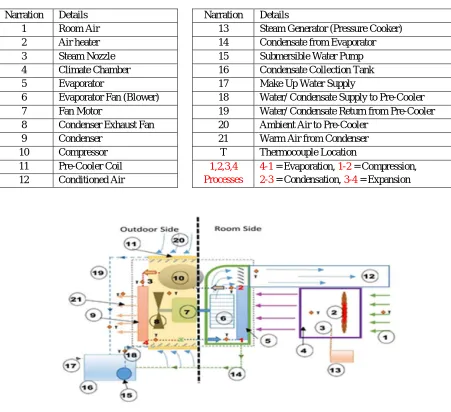
The aim of the present work is to investigate experimentally; the details of the experimental set- up are as follows:
Table 1: Details of Experimental Set-up
Narration Details Narration Details
1 Room Air 13 Steam Generator (Pressure Cooker)
2 Air heater 14 Condensate from Evaporator
3 Steam Nozzle 15 Submersible Water Pump
4 Climate Chamber 16 Condensate Collection Tank
5 Evaporator 17 Make Up Water Supply
6 Evaporator Fan (Blower) 18 Water/ Condensate Supply to Pre-Cooler
7 Fan Motor 19 Water/ Condensate Return from Pre-Cooler
8 Condenser Exhaust Fan 20 Ambient Air to Pre-Cooler
9 Condenser 21 Warm Air from Condenser
10 Compressor T Thermocouple Location
11 Pre-Cooler Coil 1,2,3,4
Processes
4-1 = Evaporation, 1-2 = Compression, 2-3 = Condensation, 3-4 = Expansion
12 Conditioned Air
Fig.2: Construction view of experimental setup
A. Operating Procedure
Experiments are conducted in Nagpur, Maharashtra, India during high ambient temperatures (40–46 oC). Condensate was collected
from the air conditioning system and stored in the storage tank before the start of the experiment. The first experiment is conducted
without operating the pre-cooler while the second with the pre-cooler under the same conditions for comparison. The experimental conditions, which are based on standard conditions for a forced-circulation air cooling coil are given in Table 3.1. Experimental data are recorded at every minute interval. Temperatures of air, refrigerant and that of the condensate circulating through the pre-cooler are measured using type-T thermocouples in Fig. 3.1 and various locations shown in Figs. 3.1. The refrigerant suction and discharge pressures are measured using pressure Gauge. The compressor power consumption is measured by the use of Energy Meter.
Wet bulb temperature of the air is measured using Hygrometer. The mass flow rate of condensate circulating through the pre-cooler
is measured using Rotameter of 10 LPM Capacity. The Rotameter displays the measured flow rate analogically.
IV.RESULTSANDDISCUSSIONS
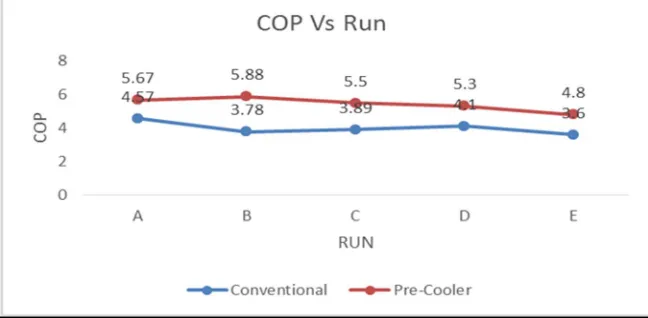
[image:7.612.149.473.148.307.2]The results of calculation for power consumption, mass flow rate, cooling capacity, refrigeration effect and COP for run B are shown in Table. The results show power consumption decrease about 12.26 % and cooling capacity increase about 20.24 %. Mass flow rate increase 8.9% and refrigerant effect increase 36.56%. The COP which is the most important parameter increase about 55.55%. This indicates that by employing Pre-cooler not only power consumption decreases but also cooling capacity also increases.
Fig.3: Run vs. COP Chart
Table 2: Run vs. COP Chart
Run COP
Conventional Pre-Cooler
A 4.57 5.67
B 3.78 5.88
C 3.89 5.5
D 4.1 5.3
E 3.6 4.8
V. CONCLUSIONS
Performance evaluation of a vapour compression air conditioning system utilizing condensate to pre-cool the air entering the condenser is presented in this report. It is found that the compressor power consumption is decreased by 10 % on average as a result of the decrease in discharge pressure when the air temperature entering the condenser is lowered by circulating the condensate through a pre-cooler. The coefficient of performance (COP) is increased by 40 %. The temperature of the circulating condensate or water was effective for air pre-cooling until about 5.5 h when the air temperatures at the pre-cooler inlet and exit became equal. This is a clear indication that the pre-cooling technique can be used to improve the system performance, particularly for large capacity cooling systems which produces reasonable amount of condensate. The technical advantage of the decrease in the discharge pressure in addition to lower compressor power consumption is the tendency of the compressor to have better life expectancy due to reduced thermal stresses on the compressor parts.
REFERENCES
[1] E. Hajidavalloo, H. Eghtedari, Performance improvement of air-cooled refrigeration system by using evaporatively cooled air condenser, Int. J. Refrig 33 (2010) 982–988, http://dx.doi.org/10.1016/j.ijrefrig.2010.02.001.
[2] E. Hajidavalloo, Application of evaporative cooling on the condenser of window-air-conditioner, Appl. Therm. Eng. 27 (2007) 1937–1943, http://dx. doi.org/10.1016/j.applthermaleng.2006.12.014.
[3] G. Heidarinejad, M. Bozorgmehr, S. Delfani, J. Esmaeelian, Experimental investigation of two-stage indirect/direct evaporative cooling system in various climatic conditions, Building and Environment 44 (2009) 2073–2079.
[4] J.R. Watt, W.K. Brown, Evaporative Air Conditioning Handbook, Fairmont Press,1997.
[6] M. Waly, W. Chakroun, N.K. Al-Mutawa, Effect of pre-cooling of inlet air to condensers of air-conditioning units, Int. J. Energy Res. 29 (2005) 781–794. [7] Yi CHEN*, Yimo LUO and Hongxing YANG “Fresh air pre-cooling and energy recovery by using indirect evaporative cooling in hot and humid region”,
International Conference on Applied Energy – ICAE2014
[8] Smith, S. T., Hanby, V. I., & Harpham, C. (2011). A probabilistic analysis of the future potential of evaporative cooling systems in a temperate climate. Energy and Buildings, 43(2), 507-516.
[9] Delfani, S., Esmaeelian, J., Pasdarshahri, H., & Karami, M. (2010). Energy saving potential of an indirect evaporative cooler as a pre-cooling unit for mechanical cooling systems in Iran. Energy and Buildings, 42(11), 2169-2176.
[10] Jain, V., Mullick, S. C., & Kandpal, T. C. (2012). A financial feasibility evaluation of using evaporative cooling with air conditioning (in hybrid mode) in commercial buildings in India.
[11] P.J. Martínez, J. Ruiz, C.G. Cutillas, P.J. Martínez, A.S. Kaiser, M. Lucas, Experimental study on energy performance of a split air-conditioner by using variable thickness evaporative cooling pads coupled to the condenser, Appl. Therm. Eng. 105 (2015) 1041–1050.