64
Chapter
8
Reaction Kinetics of Acetic Acid and Ethanol Esterification Catalyzed by
ZSM-5 Catalyst
Simparmin Br. Ginting1,a, Vastina B. Khairat2,a, Nina Febriantina3,a, Hens Saputra4,a
1
Chemical Engineering Departement, Universitas Lampung, 35145 Lampung, Indonesia 2
Process Industrial Technology Center–TIRBR, Agency for the Assessment and Application of Technology–BPPT, Tangerang Selatan, Indonesia a
[email protected] ,[email protected],[email protected], d
Abstract. Kinetics of esterification of acetic acid and ethanol use solid catalyst ZSM-5 has been studied in this
research. Experiments were carried out in a batch reactor, reactant ratio of sulfuric acid and ethanol 1:2, stirring at 1000 rpm, reaction time in 150 minutes and catalyst concentration 6 g/L. Variable varied is reaction temperature of 308oK to 348oK. Reaction kinetics data obtained use Matlab 7.8 software. From the experimental results, the greatest conversion is obtained at temperatures of 348oK is 70.16%. Activation energy obtained from the calculation was 28,566.8 J/mol.The experimental data were compared with data from the calculation of Matlab is used to see the approach of the model used. It can be concluded that the modeling approach used in accordance with the experimental data.
Keywords: acetic acid, ethanol, esterification, reaction kinetics, ZSM-5 catalyst
I.
Introduction
On the industrial scale, ethyl acetate produced from the esterification reaction between acetic acid (CH3COOH) and ethanol (C2H5OH) using sulfuric acid catalyst (H2SO4). Ethyl acetate is a compound resulting from the exchange of the hydroxyl group in acetic acid with a hydrocarbon group in ethanol. Ethyl acetate on an industrial scale is widely used as a solvent in industrial paints, thinner, material for plastics, adhesives, cosmetics, pharmaceutical and organic chemical industry. The overall reaction between acetic acid and ethyl alcohol over a catalytically ZSM-5 catalyst is as follows:
CH3COOH + C2H5OH C2H5COOCH3 + H2O...(1)
One example of an esterification reaction using sulfuric acid catalyst is esterification of free fatty acids and alcohol [1]. The highest conversion was obtained by 96% at a temperature of 3280K with a ratio alcohol / free fatty acids was 6.13 and the concentration of catalyst 2.2% by mass. But the use of sulfuric acid as a catalyst has several weaknesses such the difficulty of separation of the product with the catalyst so that the waste treatment plant has a greater load in the presence of sulfuric acid inseparable in refining and high levels of corrosion in equipment.
65
been carried out using acid catalyst Amberlyst-15 resin from Rohm and Haas [3]. The highest conversion was obtained by 75% at a temperature of 3530K with a mole ratio of acetic acid: ethanol is 1: 2 and a catalyst concentration of 5.4 gram per 100 grams of acetic acid. The kinetics of the reaction rate obtained from the study are:Kinetics of esterification reaction between acetic acid and methanol was studied using a catalyst and not using the catalyst [4]. The results obtained showed that the esterification reaction by using a catalyst is faster and give conversion 54% compared to the reaction that does not use a catalyst with a conversion of 14% within 180 minutes. The highest conversion using a catalyst obtained by 54% at a temperature of 3280K with a mole ratio of acetic acid and methanol is 1: 3 as well as the weight of the catalyst at 10% by weight of acetic acid. In this research, used a stirrer speed of 1,000 rpm. In previous research has been learned about the resistance of the external mass that is by varying the stirring speed of 800 rpm to 1,200 rpm [4], because the stirring speed in excess of 800 rpm can eliminate external diffusion, internal diffusion ignored during the esterification reaction conditions. The result, for the reaction with stirring speeds above 1,000 rpm did not experience significant changes in the rate of reaction. So the esterification reaction was carried out with stirring speed of 1,000 rpm. The activation energy reactions using the catalyst obtained is 37,626 kJ / mol.
II. Materials and Methods
A. Chemical
Acetic acid and ethyl alcohol were supplied by Merck AG. Acetic acid of 99.5% (w/w) purity (Merck) and ethanol aqueous solution with a content of 96% w/w ethanol (Merck) were used as supplied.
B. Catalyst
The catalyst used is a catalyst ZSM-5, which has been synthesized from lignite bottom ash and rice husk. The synthesis of ZSM-5 performed in an autoclave at temperature of 1800C with an autogenous pressure, the mole ratio parameter Na +/ SiO20.2 mol / mol, mole ratio H2O / SiO230 mol / mol, mole ratio TPABr / SiO20.05 mol / mol , the mole ratio of SiO2 / Al2O3 50 mol / mol and crystallization time of 48 hours using a template TPABr. Percent crystallinity of ZSM-5 product obtained by 86.95%. ZSM-5 catalyst concentration used adalam 6 g / L.
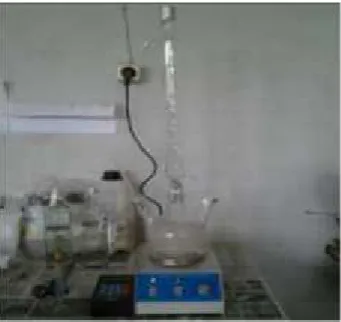
C. Reaktor Batch
66
Fig. 1. Research EquipmentD. Procedure
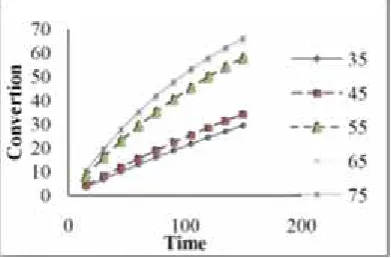
Acetic acid and ethanol was added into the reactor with a mix volume of 0.5 L, then the stirrer is moved so that the system is mixed. Samples were taken for analysis of the initial concentration of acetic acid, then the catalyst ZSM-5 was added and the reactor was shut down (reactor equipped with a thermometer). Hot plate turned on and the stirrer set at 1,000 rpm. The heater is adjusted to the desired temperature is reached which is 350C then 10 mL samples are taken every 15 minutes during 150 minutes. The experiment was repeated by varying the reaction temperature 450C, 550C, 650C and 750C. Each sample taken is analyzed to determine the conversion.
E. Result Analysis
The analysis of concentration acetic acid is done by using the titration method. Samples were taken and put in erlenmeyer, then add 3 drops of indicator PP. Furthermore, the sample is titrated with 0.1 N NaOH solution until the color changes from clear to pink. Be noted the volume of titrant, repeat the experiment two times and calculated initial concentration acetic acid using the formula:
M1x V1= M2x V2with :
V1 = volume of titrant solution (NaOH)
V2 = the volume of titrated solution (CH3COOH) M1 = concentration the titrant solution (NaOH)
M2 = concentration of the solution being titrated (CH3COOH)
Conversion calculation based on the results of the reduction reaction between the initial acetic acid concentration of acetic acid reduced residual divided by the initial acetic acid.
with :
Ao = initial concentration acetic acid
At = concentration residual acetic acid every 15 minutes
F. Derivation of A Catalytic Rate Equation
67
2. The reaction at the catalyst surface3. Desorption products of the surface of the catalyst
From equation (2), (3) and (4) obtained rate equation :
WhereK = k1k2k3 , K
k−1k−2k−3 W is the adsorption equilibrium constant of water. In this research KW = 0. For initial rates (CECW/K=0), so that the equation (5) becomes :
The reaction irreversible mechanism can be written as follows [5] :
1. Transfer of the reactant mass of fluid to the surface of the catalyst
2. The reaction on the surface of the catalyst
Because ethanol is given excess, then the reaction to the left is assumed to be very small and can be ignored, so equation (9) into:
3. Transfer of product mass of liquid to the catalyst surface
68
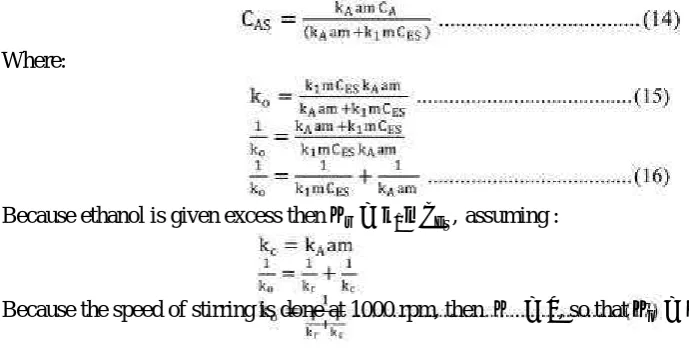
Where:Because ethanol is given excess thenKr = k1mCES, assuming :
Because the speed of stirring is done at 1000 rpm, then K = 0, so thatKo = Kr
The equation to find the reaction kinetics of reversible and irreversible mechanism which is obtained of a decrease in the formula is the same, that is equation (6) and (19). Kr value can be searched by means of minimizing the sum of square of errors (SSE) using Matlab program of conversion of acetic acid acetic acid calculated and conversion data.
III. Results and Discussions
[image:5.595.92.437.49.223.2]From the experiments obtained acetic acid conversion data as in Fig. 2.
Fig. 2. Conversion Data Acetic Acid vs. Reaction Time Temperature Variation In each reaction
69
5 4 3
[image:6.595.204.400.83.212.2]between acetic acid and ethanol.
Fig. 3. Conversion Acetic Acid Reaction Time Calculate vs. Temperature Variation In each reaction
As seen in Fig. 3, the model used is good enough to describe the process that occurs during the reaction process. It can be seen from the results that calculate conversion value has a similarity with data conversion. So that the kr value obtained from the calculation at each temperature variation can be used to calculate the activation energy of the reaction.
7 6
y = 3436.x- 5.097 2 R² = 0.900 1
0
kr Linear (kr)
0.0028 0.003 0.0032 0.0034
1/T
Fig. 4. Curve Relationship Between -Ln K and 1 / T
From the results linearized kr value at each temperature in Fig. 4, the reaction kinetics equation:
Activation energy obtained in this study is 28,566.8 J / mol. Activation energy obtained in this study is smaller when compared to the activation energy is obtained by using a catalyst Amberlyst 15 [3] is 104, 129 J / mol.
.
IV. Conclusions
From the research that has been done can be concluded that:
1. The catalyst ZSM-5 can be used as a catalyst at esterification of acetic acid and ethanol with the highest conversion is obtained at a temperature of 750C is 70.16%.
[image:6.595.201.403.349.481.2]70
SYMBOLA = the surface area of the catalyst rA, rE, rEAS, rWS = Mass transfer speed
m = catalyst mass per volume of solution CA, CE = concentration acetic acid and ethanol
CAS, CES, CEAS, CWS = concentration a the surface of the catalyst for the acetic acid, ethanol, ethyl acetate and water
rAX = acetic acid reaction speed
rEX = ethano reaction speed
kA, kE, kEA, KW = mass transfer coefficient acetic acid, ethanol, ethyl acetate and water
ke = equilibrium constants
CAo = initial acetic acid concentration
XA = conversion reaction
Ko = constant overall
Kr, k = the reaction rate constants Kc = mass transfer coefficient
t = time
CE = concentration ethyl acetate
CW = the concentration of water
CC = catalyst concentration
CAH, CEH = concentration acetic acid and ethanol on the surface of the catalyst k1, k2, k3 = forward reaction rate constants
k-1, k-2, k-3 = backward reaction rate constants
K = equilibrium constants
kw = constant water absorption
References
[1]. Marchetti J. M. dan Errazu A. F. 2008. Esterification of free fatty acid using sulfuric acid as
catalyst in the present of triglycerides. Biomass and Energy 32. 892-895.
[2]. Nuryoto. 2008. Studi Kinerja Lewatit Monoplus-100 pada Reaksi Esterifikasi Antara Etanol Dan Asam Asetat. Jurusan Teknik Kimia Universitas Sultan Ageng Tirtayasa. Cilegon.
[3]. Kirbaslar, S. I., Baykal, Z. B., and Dramur, U. 2000. Esterification of Acetic Acid with Etanol
Catalysed by an Acidic Ion-Exchange Resin. Turk. J. Engg Environmental Science. 25, 569-577.
[4]. Mandake, M. B., Anekar, S. V., Walke, S. M. 2013. Kinetic Study of Catalyzed and Uncatalyzed
Esterification Reaction of Acetic Acid with Methanol. India.