INTRODUCTION
Commission Regulation (EC) 2073:2005 (1) considers the factors which can support or inhibit the growth of L.monocytogenes in ready-to-eat foods, such as water activity (aw) and pH. According to ICMSF (8) raw cured shelf-stable meats are some low-acid dry sausages and high-acid fermented sausages in which low aw or a combination of low pH and reduced aw provides microbial stability. EFSA opinion (6) reported that all products, except
UDC: 637.524.065:579.869.1
Original Scienti
fi
c Article
ABSTRACT
Available online at www.macvetrev.mk
STUDY ON FACTORS (pH, WATER ACTIVITY, SALT CONTENT)
AFFECTING THE GROWTH OF LISTERIA MONOCYTOGENES
IN RAW DRIED CURED SAUSAGES
Daskalov Hristo
1, Fejzullah Fejzulla
2, Stoyahchev Todor
31National Diagnostic and Research Veterinary Institute, BFSA, 1606 Sofi a, Bulgaria 2StateUniversity of Tetovo, 1200 Tetovo, Macedonia
3Faculty of Veterinary Medicine, Trakia University, 6000 Stara Zagora, Bulagaria
Received 30 June 2013; Received in revised form 29 July 2013; Accepted 22 August 2013
Commission Regulation (EC) 2073:2005 considers the factors which can support or inhibit the growth of Listeria monocytogenes
in ready-to-eat foods. The aim of the experiments was to examine the values of pH, water activity (aw), salt content and level
of contamination with Listeria monocytogenes of some popular in Bulgaria raw dried cured vacuum packed sausages, produced from June 2006 till May 2008. 81 vacuum-packed samples were taken from 5 different meat producing plants during the period of study. Average water activity level of the tested sausages was 0,87 ± 0,035; pH level - 5,61 ± 0,59 and salt content - 4,12 ± 1,11%. Four specimens contained Listeria spp. (two samples L.monocytogenes, one L.welshimeri and one L.innocua). All contaminated raw dried cured sausages had aw bellow ≤ 0,92 and pH ≥ 4,4 or pH ≥ 5. After 3 months of storage of the same contaminated samples at 40C, in three of them Listeriaspp. (two L.monocitogenes and L.welshimeri) survived and was
detected. Salt content of the samples varied from 2,46 to 6,28% and was not able to affect the growth of L.monocytogenes. Data showed that the detected levels of aw could support the growth of L.monocytogenes in only 6 (7,4%) of the tested
samples. pH values lower than 5 were presented in three samples and only the combination with low aw was able to inhibit the growth of L.monocytogenes. The detected levels of salt content did not affect the presence and growth of L.monocytogenes. Microbiological criterion’ set in Commission Regulation (EC) No 2073/2005 for ready-to-eat foods unable to support the growth of L. monocytogenes can be applied to 75 (92,6%) of the tested sausages.
Key words: L.monocytogenes, raw dried cured sausage, water activity, pH, salt
Corresponding author: Daskalov Hristo, DVM
E-mail address: [email protected];
Present address: National Diagnostic and Research Veterinary Institute, BFSA, Pencho Slaveykov 15, 1606, Sofi a, Bulgaria
tel: ++00359 2 9523903 ext 359
Copyright: © 2013 Daskalov H. This is an open-access article published under the terms of the Creative Commons Attribution License which permits unrestricted use, distribution, and reproduction in any medium, provided the original author and source are credited.
Competing Interests: The authors have declared that no competing interests exist.
of Listeria monocytogenes in relation to these factors. Two equations were developed, both equations were based upon the Ratkowsky equation for temperature and growth rate. McMeekin et al. (10) considered factors such as low pH tolerance and low water activity tolerance when describing quantitative microbiology and predictable modeling in food microbiology.
The aim of the experiments was to examine the values of pH, water activity (aw), salt content and level of contamination with Listeria monocytogenes of some popular in Bulgaria raw dried cured vacuum packed sausages, produced from June 2006 till May 2008.
MATERIALS AND METHODS
Sampling
81 different kinds of raw cured dried meat sausages were studied. All of them were vacuum-packed in meat factories and prepared for sale without any other treatments. All samples were taken from 5 different food business operators during all seasons included in the period of study (June 2006 – May 2008). Tested specimens were kept at storage temperature from 0 to 40C. The samples were transported and received at the laboratory up to 72 hours after processing.
Microbiological analysis
The samples were analyzed according to the USDA method for meat foods, described by Ryser
and Donelly (11). Five of all typical on PALCAM agar (Merck) colonies were taken and reinoculated on TSAYE agar (Merck, Darmstadt). Further examination comprised Gram staining, motility at 20-250C, growth at 350C, catalase activity (Hydrogen peroxide, Merck, Darmstadt), oxidase reaction (Oxidase reagent, bioMerieux) and -hemolysis on blood agar (Merck, Darmstadt). Additionally, biochemical identifi cation with API Listeria ID strip (bioMerieux, Inc., Hazelwood, Mo.) was done to all Listeria spp. isolates.
Physicochemical testing
Water activity (aw) was estimated by HygroLab 3 rotronic AG instrument. Sample mass was cut to small pieces (3-5 mm) and put into a sample cup. The cup was fi lled to the upper edge. The probe was immediately put into the sample cup. The result was read as soon as the humidity and temperature values became stable.
pH was measured by Professional pH Meter Sartorius PP-15, according to interlaboratory procedure for testing, based on Bulgarian State Standard 1323 (2).
Salt content was determined according to AOAC Offi cial method 935.47 Salt in Meat (Volumetric Method) (3).
RESULTS
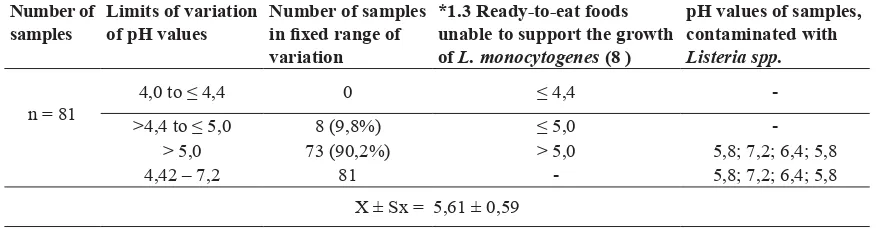
Results showing the pH values of the tested raw cured dried meat products are presented in Table 1.
Number of samples
Limits of variation of pH values
Number of samples in fi xed range of variation
*1.3 Ready-to-eat foods unable to support the growth of L. monocytogenes (8 )
pH values of samples, contaminated with
Listeriaspp.
n = 81
4,0 to ≤ 4,4 0 ≤ 4,4
->4,4 to ≤ 5,0 8 (9,8%) ≤ 5,0
-> 5,0 73 (90,2%) > 5,0 5,8; 7,2; 6,4; 5,8
4,42 – 7,2 81 - 5,8; 7,2; 6,4; 5,8
X ± Sx = 5,61 ± 0,59
Table 1. Data of pH values of raw cured dried sausages, tested for presence of Listeriaspp.
*COMMISSION REGULATION (EC) No 2073/2005, Chapter 1. Food safety criteria, (8) Products with pH ≤ 4,4 or
Most of the specimens (90,2 %) had pH higher than 5 and only in 9,8% pH varied from 4,4 to 5 and could infl uence the growth of L.monocytogenes. Four samples were contaminated with Listeriaspp. and all of them showed high pH values (>5).
Data for water activity of the tested specimens are reported in Table 2.
Number of samples
Limits of variation of water activity (aw) values
Number of samples in fi xed range of variation
*1.3 Ready-to-eat foods unable to support
the growth of
L. monocytogenes, (8)
aw values of samples, contaminated with
Listeriaspp.
n = 81 0,70 to ≤ 0,92 75 (92,6 %) ≤ 0,92 0,906; 0,88; 0,88; 0,84
>0,92 to ≤ 0,94 6 (7,4 %) ≤ 0,94
-> 0,94 0 > 0,94
-0,74 – 0,94 81 - 0,906; 0,88; 0,88; 0,84
X ± Sx = 0,87 ± 0,035
Great number of samples showed variation of aw below 0,92 (92,6%). All contaminated with Listeria spp. samples belonged to the group of raw cured dried products with low aw. Only 6 samples (7,4%) showed variation of aw from 0,92 up to 0,94. None of the specimens had aw higher than 0,94.
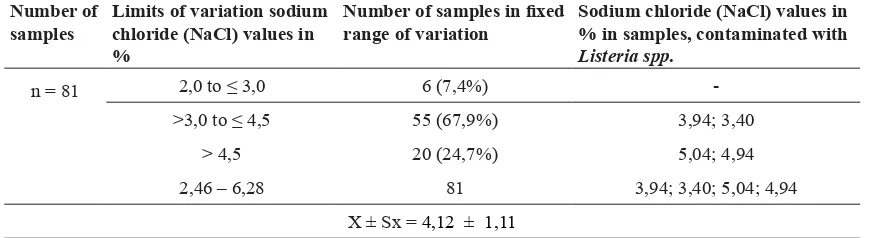
Results presenting the sodium chloride values of the tested samples are shown in Table 3. Most of the samples (67,9%) had salt content between 3 and 4,5%. Two of them were contaminated with Listeria spp. Other 20 samples (24,7%) showed higher salt content values (≥ 4,5%) and also two of them contained Listeriaspp.
Average water activity level of the tested sau-sages was 0,87 ± 0,035; pH level - 5,61 ± 0,59 and salt content - 4,12 ± 1,11%. Four specimens
Table 2. Data of water activity (aw) values of raw cured dried sausages, tested for presence of Listeria spp.
*COMMISSION REGULATION (EC) No 2073/2005, Chapter 1. Food safety criteria, (8 ) Products with pH ≤ 4,4 or
aw.≤ 0,92, products with pH ≤ 5,0 and aw.≤ 0,94, products with a shelf-life of less than fi ve days shall be automatically considered to belong to this category. Other categories of products can also belong to this category, subject to scientifi c justifi cation.
contained Listeria spp. (two samples L.monocytogenes, one L.welshimeri and one L.innocua). All contaminated raw dried cured sausages had aw bel-low ≤ 0,92 and pH ≥ 4,4 or pH ≥ 5. After 3 months of storage of the same contaminated samples at 40C, in three of them Listeriaspp. (two L.monocitogenes and L.welshimeri) survived and was detected. Salt content of the samples varied from 2,46% to 6,28% and was not able to affect the growth of L.monocytogenes.
Number of samples
Limits of variation sodium chloride (NaCl) values in %
Number of samples in fi xed range of variation
Sodium chloride (NaCl) values in % in samples, contaminated with
Listeriaspp.
n = 81 2,0 to ≤ 3,0 6 (7,4%)
->3,0 to ≤ 4,5 55 (67,9%) 3,94; 3,40
> 4,5 20 (24,7%) 5,04; 4,94
2,46 – 6,28 81 3,94; 3,40; 5,04; 4,94
X ± Sx = 4,12 ± 1,11
Table 3. Data of sodium chloride (NaCl) values in % of raw cured dried sausages, tested for presence of
DISCUSSION
Our data illustrated the status of some popular in Bulgaria raw cured dried sausages, typical for the taste of Balkan region countries. Factors as pH, aw and salt content, affecting the growth of Listeria spp., especially L.monocytogenes showed values, infl uencing in different ways the survival and growth of Listeria spp. and L.monocytogenes. On average, salt content in the group of tested products (raw cured dried meat foods) was low. The main reason for this is the consumer demand in Bulgaria. The evaluated pH level of the examined samples was up to 5, despite the adding of starter culture in the process of preparation of raw cured dried products. Consumers in Bulgaria do not prefer a too acidulous taste of these kinds of products. Drying and related to it decrease in water activity level is the hurdle that stops the growth of Listeriaspp. In our case all positive for Listeria spp. samples belonged to the category of ready-to-eat raw cured dried meat foods unable to support the growth of L.monocytogenes, according to Regulation (EC) 2073:2005(1). After 3 month of storage in refrigerator (≤40C) one of the samples contaminated with Listeria spp. was found to be free from the pathogen. EFSA (7) reported that there was infl uence of pH and water activity on the prevalence of L.monocytogenes in ready-to-eat foods (fi sh products) and concluded that data showed very slow growth in the period of storage. Coelho (4) concluded that fermented under variable temperatures (mostly between 25-30°C) salami (also raw cured dried sausages) which were not heat treated, had fi nal pH between 4.8 and 5.2, and water activity around 0.85-0.90. In our raw cured dried sausages fermentation process, if carried out, did not decrease pH to such low levels. Lahti et al. (9) studied sausages, which were manufactured (fermented and dried) in a smoke chamber at 17–23°C for 15 days and further stored at 15–17°C for 34 days. L. monocytogenes counts decreased more rapidly in the high-inoculum sausages produced with starter A (P<0.0001) but no signifi cant difference was detected between the starters in the medium-inoculum sausages. L. monocytogenes was eliminated from the medium-inoculum sausages after 49 days. Daskalov et al. (5) proved in experiment the fate of L.monocytogenes during process of drying and storing of already dried product.
CONCLUSIONS
Data showed that the detected levels of aw could support the growth of L.monocytogenes in only 6 (7,4%) of the tested samples. pH values lower than 5 were presented in three samples and only the combination with low aw was able to inhibit the growth of L.monocytogenes. The detected levels of salt content did not affect the presence and growth of L.monocytogenes. ‘Microbiological criterion’ set in Commission Regulation (EC) No 2073/2005 for ready-to-eat foods unable to support the growth of L. monocytogenes can be applied to 75 (92,6%) of the tested sausages.
ACKNOWLEDGEMENT
To the Faculty of Veterinary Medicine, Trakia University, Stara Zagora, Bulgaria for sponsoring of Project 17/2006 and food processors for the help to carry out the research activities.
REFERENCES
1. EU Regulation 2073/2005 of 15 November 2005 on microbiological criteria for foodstuffs. Offi cial Journal of the European Union, 338 (2005), 1–29
2. Anonymous. (1975). Bulgarian State Standard - 1323. Meat. Methods for testing. Bulgarian Institute for Standardization, Sofi a, pp. 12. 3. AOAC Offi cial Method 935.47 Salt (Chlorine
as Sodium Chloride) in Meat Volumetric Method First Action 1935 Final Action 1987. (1999). In Patricia Gunniff (Edt), Offi cial methods of analysis 16-nth Edition, 5th Revision, Publ. by AOAC International (Volume II, 39 Meat and meat products), pp.4. 4. Coelho, C.P. (1997). Efeito dos fatores presentes
em embutidos fermentados e de culturas láticas sobre Listeria spp. .in vitro. UFV-Impr.Univ., Viçosa. 79p. Tese de Mestrado
6. EFSA Panel on Biological Hazards (BIOHAZ) (2012). Scientifi c Opinion on a review on the European Union Summary reports on trends and sources zoonoses, zoonotic agents and food-borne outbreaks in 2009 and 2010 – specifi cally for the data on Salmonella, Campylobacter, verotoxigenic Escherichia coli, Listeria monocytogenes and foodborne outbreaks. EFSA Journal, 10 (6): 2726 [25 pp.], www.efsa.europa.eu/efsajournal
7. European Food Safety Authority (2013). Analysis of the baseline survey on the prevalence of Listeria monocytogenes in certain ready-to-eat (RTE) foods in the EU, 2010-2011 Part A: Listeria monocytogenes prevalence estimates. EFSA Journal, 11(6): 3241, 75.
8. ICMSF (International Commission on Microbiological Specifications for Foods) (2000). Microorganisms in foods 6. Microbial ecology of food commodities. Aspen Publishers, Inc. Gaithersburg, Maryland
Please cite this article as: Daskalov Hristo, Fejzullah Fejzulla, Stoyahchev Todor. Study on factors (pH, water activity, salt content) affecting the growth of Listeria monocytogenes in raw dried cured sausages. Mac Vet Rev 2013; 36 (2): 91-95.
9. Lahti, E, Johansson T., Honkanen-Buzalski, T., Hill, P., Nurmi, E. (2001). Survival and detection of Escherichia coli O157:H7 and Listeria monocytogenes during the manufacture of dry sausage using two different starter cultures. Food Microbiology, 18, 1, 75-85.
10. McMeekin, T. A., Brown, J., Krist, K,. Miles, D., Neumeyer, K., Nichols, D.S., Olley, J., Presser, K., Ratkowsky, D. A., Ross, T., Salter, M., Soontranon, S. (1997). Quantitative Microbiology: A Basis for Food Safety. Emerging Infectious Diseases, 3(4): 541-546. 11. Ryser, E.T., Donnelly, C.W. (2001). Listeria. In
F.P. Downes and K. Ito (Eds.) Compendium of Methods for the Microbiological Examination of Foods. Fourth Edition, (pp. 343-357). APHA 12. Wijtes, T., McClure, P.J., Zwietering, M.H.,