Teachers’ and Students’ Perceptions on
the Problems of Effective Teaching and
Learning of Science and Technology in
Junior Secondary Schools
Gimba, R. W.[1], Hassan, A. M. [2], Yaki, A. A.[3], Chado, A. M.[4]
[1]
[email protected] Science Education Department, FEDERAL UNIVERSITY OF TECNOLOGY MINNA
[2] [email protected] Science Education Department, FEDERAL UNIVERSITY OF TECNOLOGY MINNA
[3] Science Education Department, FEDERAL UNIVERSITY OF
TECNOLOGY MINNA
[4] [email protected] Industrial And Technology Education Department, FEDERAL UNIVERSITY OF TECNOLOGY MINNA
ABSTRACT
It has been observed that students shy away from the study of Science and Technology even though Science and Technology occupies a central position in the development of the nation. This shows the negative attitude and poor performance of students in Science and Technology. This has prompted the research into teachers and students’ perceptions of the problems of effective teaching and learning of Science and Technology in junior secondary schools. The study aimed at identifying the problems and proffering solution to them. Consequently, two research questions were raised. Some factors which revolved around physical facilities, quality and quantity of teaching investigated. Data were collected by means of two different questionnaires administered to (350) students and (35) Science and Technology teachers drawn from seven (7) secondary schools in Bosso Local Government of Niger State. Four-points Likert rating scale was used in administering it and it was analysed using percentage. Some of the findings that emerged are: the foundation of most Science and Technology teachers in Science and Technology is poor. Based on the findings, it was recommended that: The State government should as a matter of urgency send Science and Technology teachers for training and seminars for effective teaching and learning.
Keywords: Perception, Effective Teaching, Science and Technology
INTRODUCTION
Science and Technology occupy a central position in the school curriculum. They are important subjects from primary through junior secondary to senior secondary school levels of educational system (Hassan, Gimba & Chado, 2016). The important position occupied these subjects in the school curricula is role out of Science and Technology in scientific and technological development, as a necessary condition or requirement in national building. However, the teaching of these relevant subjects is surrounded by problems; such as the problem of inadequate and substandard learning materials, poor reading habit, class size, culture/belief, Science and Technology anxiety, and general attitudes of students (Hassan, 2016).
The major problem that Nigerian secondary education is facing is the student’s poor performance in core subjects, especially English Language and Science and Technology. Researches of Kurumeh & Imoko (2008) revealed low academic achievement of students in Science and Technology at all levels of education in Nigeria from primary school (Basic education) to secondary school. Also, pupils and secondary school students complained about Science and Technology as being difficult. This entails that Science and Technology foundation in primary school level is very weak and is carried forward to Junior and Senior
www.moj-es.net
Secondary School levels which has contributed a lot to poor academic achievements of students in Senior School Certificate Examination (SSCE). Science and Technology is not a single subject at any level of education. A student cannot be admitted into most science and technology courses at institutions of higher level in Nigeria, since Nigerians aiming of technological advancement and economic emancipation is being undermined by the continued poor Science and Technology achievement of secondary school students in both external and internal examinations.
It is common knowledge that the economies of the industrialized nations are driven by science and technology. Hence, Nigeria’s vision to be among the top 20 world largest economies by the year 2020 (Vision 2020) justifies the emphasis placed on “science, technical and vocational education” (FRN, 2004, p23). For the fact that students in Nigeria are advised to offer science subjects, and one subject that cuts across all the sciences is Science and Technology. Presently, Science and Technology strategies are applied in most areas of human activities and as such they play a fundamental and major part in the development of the economy in any country. For Nigeria to meet-up with the predicted technological improvement, it needs better Science and Technology achievement for students at all levels of Education.
The position of Science and Technology on any individual’s life in every country cannot be undermined because it occupies central position in the improvement of a country. In the study of (Betiku 2001) Science and Technology have been widely identified as the instrument for measuring the geo-political and socio-economic development of every nation. According to the (NPE 2004), Science and Technology is one of the essential subjects which must be offered by every learner in all levels of Primary and Secondary Education in Nigeria. We can then conclude that the knowledge of Science and Technology is important and necessary to every individual because of the mandatory nature of the subjects. If any country or nation is to train or produce engineers, technologists and scientists, the monitoring and accountability of these subjects must be of priority to them. Obodo (2000) lamented that the causes of ineffectiveness in teaching and learning of Science and Technology in Nigeria is from various sources. It is therefore very sad that the performance of students’ Science and Technology in both the internal and external examination has continued to be deteriorating yearly despite the importance of the subjects. Amazigo (2000) stated that Science and Technology educators have been trying to pinpoint the main factors militating against the effectiveness of teaching and learning of Science and Technology in Nigeria.
Science and Technology plays a significance role in the life of every student, they are fulcrum that hold every other subject in the field of science and technology offered at every educational level in the country. The teachers’ needs to adopt a teaching strategy that challenge students/learners to learn and this must be tested to ensure that it enhances teaching and learning of the subjects.
The effectiveness of Science and Technology teaching and learning is strongly depend on perceptions of the teacher towards his/her teaching and the teacher teaching strategies according to (Ahmed and Aziz 2009) also believed that teachers perceptions reinforces teacher’s decision making. Teaching cannot be transformed until teachers have positive perceptions about the teaching and learning of Science and Technology (Ernest 1989).
A lot of literatures have been documented on Science and Technology teachers’ perceptions because recommendable attentions have been given to the perceptions they hold about their teaching. Ahmed and Aziz (2009) stated that data collections Science and Technology teachers teaching from students/leaners provide a valuable result since their opinions are “highlighted by demanding and exciting skill that allow them to perceive learning and teaching manners more than their Science and Technology teachers”. Ahmed and Aziz (2009) explained that the students perceptions towards the Science and Technology teachers teaching influence the effectiveness of teaching and learning of Science and Technology positively and it provides a meaningful and fruitful suggestion for the improvement of their Science and Technology teachers practice. Ahmed and Aziz (2009) further stated that the learners’ will developed a clear insight of the idea that is being offered by their Science and Technology teachers if they perceive the teacher classroom condition to be cooperative rather than competitive. Rawnsley (1997) also argued that if the students perceived their Science and Technology teachers to be highly supportive and pave way for them to plays an essential part in teaching and learning activity of Science and Technology, they will established more positive attitude towards the teaching.
www.moj-es.net
Purpose of the Study
The purposes of this research are:
1. To determine the perceptions of teachers on the problem of effective teaching and learning of Science and Technology in junior secondary school.
2. To determine the perceptions of students on the problem of effective teaching and learning of Science and Technology in junior secondary school.
3. To recognize the factors that partakes in the problem of teaching and learning of Science and Technology in junior secondary school.
4. To suggest the approaches that could cure the difficulty in the teaching and Learning of Science and Technology in junior secondary school.
Research Questions
1. What are the perceptions of teachers on the problem of teaching and learning of Science and Technology?
2. What are the perceptions of students on the problem of teaching and learning of Science and Technology?
RESEARCH METHODOLOGY Research Design
The study employed a survey method in investigating into teachers’ and students’ perceptions on the problem of effective teaching and learning of Science and Technology in senior secondary schools. The design was suitable for the study since the data was collected through questionnaire. The target population for the study was the senior Secondary Schools in Bosso Local Government Area of Niger State and the study sample was drawn from some selected senior Secondary Schools in Bosso Local Government Area of Niger State.
Population of the Study
The target population consisted of 14,916 students and 254 teachers in all the twenty-four (24) senior secondary schools in Bosso Local Government Area of Niger State. This information was retrieved from Niger State (2013) annual school census report.
Sample and Sampling Techniques
The sample for the study consisted of two three hundred and fifty (350) SSSII and SSSIII students and from each of the two schools and thirty-five (35) teachers selected from seven senior Secondary Schools in Bosso Local Government Area using simple random sampling techniques.
Research Instrument
The instrument used for the collection of data was a semi-structured questionnaire designed for eliciting information on teachers and students’ perception on the problem of effective teaching and learning of Science and Technology in junior secondary school. Questions were dignified making used of four-point scale response format (SA = Strongly Agree, A = Agree, D = Disagree and SD = Strongly Disagree). There were two questionnaires and the first contained fifteen questions assessing students’ perceptions regarding the problems of teaching and learning Science and Technology in their respective classrooms. The second Questionnaire also contained fifteen questions that assessed teachers’ teaching experiences as well as to examine the teachers’ perceptions regarding the problems of teaching and learning Science and Technology in their respective classrooms.
Validity of the Instruments
The questionnaires were validated by two senior lecturers in the Departments of Science Education and Educational Technology in Federal University of Technology, Minna, who examined the instruments and subjected them to removing, adding and restructuring of some questions and the suitability of the research questions so that the instruments will be more valid.
Reliability of the Instruments
Test-retest method was used to test the reliability of the instruments. The questionnaires were administered to a sample of 30 students and 6 teachers within the population but outside the sample of the students to collect their responses and after two weeks the same test was administered on them again and their responses were correlated with the previous one and a reliability coefficient of 0.78 was obtained using Spearman Brown’s formula.
www.moj-es.net
Method of Data Collection
At the various schools, the researcher introduced himself to the principals, the classroom teachers and the students and then briefed the school managements and the subjects about the purpose of his visit.
The researcher then randomly selected the number of students and teachers needed for the study, gave them the questionnaire and brief explanations regarding how they were to respond to each question. The respondent were also encourage to ensure that responses were called and analysed.
Method of Data Analysis
The data collected from the students and the teachers were analysed using Statistical Package for Social Science (SPSS), frequency distribution analysis and percentage of the students and the teachers responses to each item was calculated and tabulated to provide answers to the research questions.
RESULTS AND DISCUSSION
Research Question 1
What are the perceptions of teachers on the problem of teaching and learning of Science and Technology?
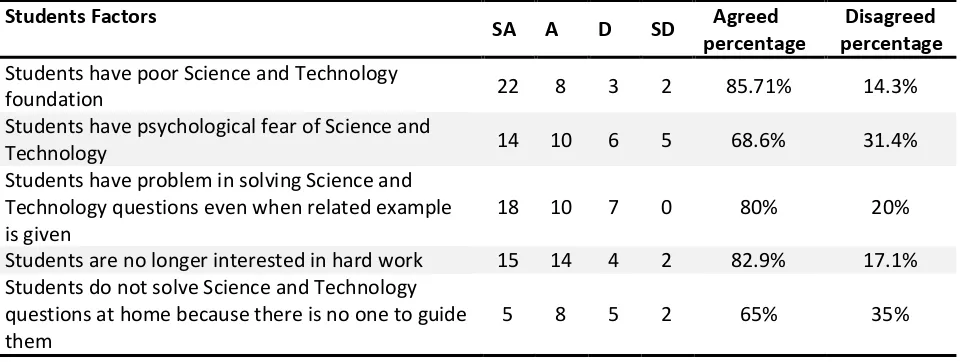
Table 4.1 Students Factors
Students Factors SA A D SD Agreed
percentage Disagreed percentage Students have poor Science and Technology
foundation 22 8 3 2 85.71% 14.3%
Students have psychological fear of Science and
Technology 14 10 6 5 68.6% 31.4%
Students have problem in solving Science and Technology questions even when related example
is given 18 10 7 0 80% 20%
Students are no longer interested in hard work 15 14 4 2 82.9% 17.1% Students do not solve Science and Technology
questions at home because there is no one to guide
them 5 8 5 2 65% 35%
Table 1 above reveals that the factors affecting effective teaching and learning of Science and Technology are; (1) students poor Science and Technology foundation as agreed by 85% of the respondents against the disagreed respondents percentage score of 15%, (2) students psychological fear of Science and Technology as agreed by 75% of the respondents as against the 25% that disagreed, (3) students have problem in solving Science and Technology questions even when related examples are given as agreed by 90 percentage of the respondents as against the 10% that disagreed. (4) students are no longer interesting in hard work as agreed by 75% of the respondents against the 25% that disagreed, and (5) students do not solve Science and Technology questions at home because there is no one to guide them also have an agreed respondents’ percentage score of 65% against the disagreed respondents percentage score of 35%. From these, it was observed that all the problems itemized are problems effective teaching and learning of Science and Technology as perceived by Science and Technology teachers.
www.moj-es.net
Table 2 Teachers Factors
Teachers Factors SA A D SD Agreed percentage Disagreed percentage Science and Technology teachers do not relate
topics in Science and Technology to real life
situations 10 17 6 2 77.1% 22.9%
Teachers do not entertain questions from
students 9 16 6 4 71.4% 28.6%
There are insufficient Science and Technology
teachers in schools both in number and quality 13 14 6 2 77.1% 22.9% Poor teaching methods are used by science and
technology teachers 2 3 10 20 14.3% 85.7%
Teachers do not plan moderately for the Science and Technology class as a result of much work
load 6 13 8 8 54.3% 45.7 %
Table 2 above shows that the teachers’ perceptions on teachers factors responsible for problems of teaching and learning of Science and Technology are; (6) Science and Technology teachers do not relate topics in Science and Technology to real life situations has an agreed respondents percentage score of 65% as against the disagreed respondents percentage score of 35%, (7) teachers do not entertain questions from students has an agreed respondents percentage score of 65% as against the disagreed respondents percentage score of 35%, (8) there are insufficient Science and Technology teachers in schools both in number and quality has an agreed respondents percentage score of 85% as against the disagreed respondents percentage score of 15%, (9) teachers teaching methods are poor has an agreed percentage respondents score of 15% against the disagreed respondents percentage score of 75% and (10) they also agreed with percentage scores of 60% that teachers do not plan moderately for the Science and Technology class as a result of much work load as against the disagreed respondents percentage score of 40%. From these finding, it was observed that all the problems itemized are problems affecting effective teaching and learning of Science and Technology except number nine (9) i.e. poor teaching method used by Science and Technology teachers, as perceived by science and technology teacher.
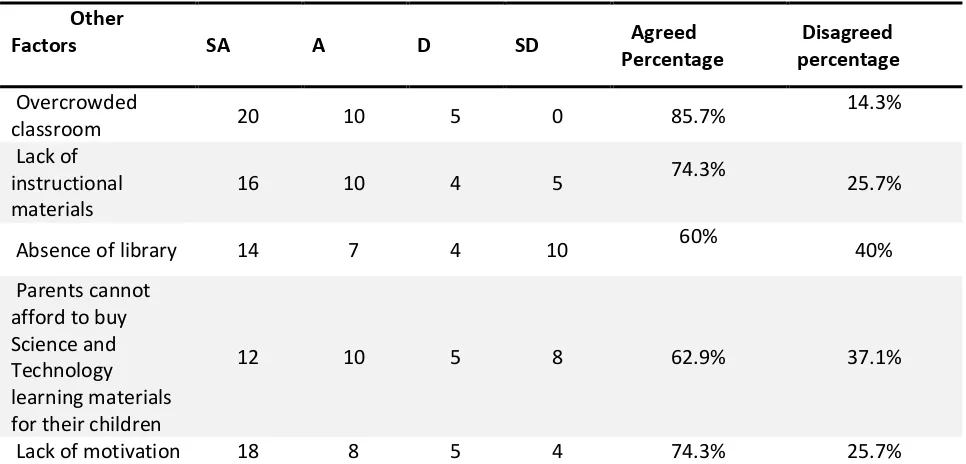
Table 3 Other Factors
Other
Factors SA A D SD Agreed Percentage Disagreed percentage
Overcrowded
classroom 20 10 5 0 85.7% 14.3%
Lack of instructional
materials 16 10 4 5
74.3% 25.7%
Absence of library 14 7 4 10 60% 40%
Parents cannot afford to buy Science and Technology learning materials for their children
12 10 5 8 62.9% 37.1%
Lack of motivation 18 8 5 4 74.3% 25.7%
Table 3 reveals other factors affecting teaching and learning of Science and Technology in junior secondary schools such as (11) overcrowded classrooms has an agreed respondents percentage score of 95%
www.moj-es.net
as against the disagreed respondents percentage score of 5%, (12) lack of instructional materials has an agreed respondents score of 70% as against the disagreed respondents percentage score of 30%, (13) absence of library have an agreed respondents percentage score of 55% as against the disagreed respondents percentage score of 45%, (14) parents cannot afford to buy Science and Technology learning materials for their children has an agreed respondents percentage score of 60% as against the disagreed respondents percentage score of 40% and (15) lack of motivation has an agreed respondents percentage score of 80% as against the disagreed respondents percentage score of 20%. From these findings, it was also observed that all the problems itemized are problems affecting effective teaching and learning of Science and Technology as perceived by Science and Technology teachers.
Research Question 2
What are the perceptions of students’ on the problem of teaching and learning of Science and Technology?
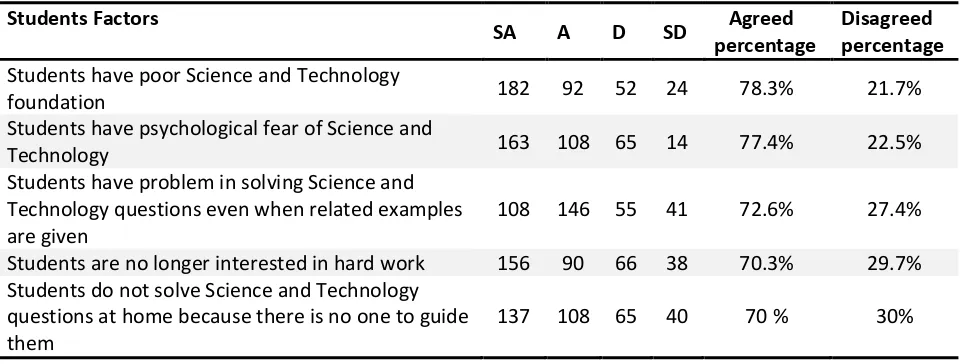
Table 4 Students Factors
Students Factors SA A D SD Agreed
percentage Disagreed percentage Students have poor Science and Technology
foundation 182 92 52 24 78.3% 21.7%
Students have psychological fear of Science and
Technology 163 108 65 14 77.4% 22.5%
Students have problem in solving Science and Technology questions even when related examples
are given 108 146 55 41 72.6% 27.4%
Students are no longer interested in hard work 156 90 66 38 70.3% 29.7% Students do not solve Science and Technology
questions at home because there is no one to guide
them 137 108 65 40 70 % 30%
Table 4 above revealed that the factors affecting effective teaching and learning of Science and Technology are; (1) students have poor Science and Technology foundation has an agreed respondents percentage score of 86.5% as against the disagreed respondents percentage score of 13.5%, (2) students have psychological fear of Science and Technology has an agreed respondents percentage score of 70.5% as against the disagreed respondents percentage score of 29.5%, (3) students have problem in solving Science and Technology questions even when related examples are given to them has an agreed respondents percentage score of 77% as against the disagreed respondents percentage score of 23%, (4) students are no longer interested in hard work has an agreed respondents percentage score of 62% as against the disagreed respondents percentage score of 38% and (5) students do not solve Science and Technology questions at home because there is no one to guide them also has an agreed respondents score of 62.5% as against the disagreed respondents percentage score of 37.5%. From these findings, it was observed that all the problems itemized are problems affecting effective teaching and learning of Science and Technology as perceived by students.
www.moj-es.net
Table 5 Teachers Factors
Teachers Factors SA A D SD Agreed percentage Disagreed percentage Science and Technology teacher do not relate
topics in Science and Technology to real life
situations 116 154 70 10 77.1% 22.9%
Teachers do not entertain questions from
students 143 80 102 25 63.7% 36.3%
There are inadequate Science and Technology
teachers in terms of number and quality 48 202 69 31 71.4% 28.6%
Poor teaching method 105 119 73 53 64% 36%
Teachers do not plan moderately which result
into much work load 172 99 62 17 77.4% 22.6%
Table 5 above reveals that students’ perceptions on teachers’ factors responsible for problems of teaching and learning of Science and Technology are; (6) Science and Technology teacher do not relate topics in Science and Technology to real life situations has an agreed respondents percentage score of 85% as against the disagreed respondents percentage score of 15%, (7) teachers do not entertain questions from students has an agreed respondents percentage score of 60% as against the disagreed respondents percentage score of 40%, (8) there is insufficient Science and Technology teachers in schools both in number and quality has an agreed respondents percentage score of 70% as against the disagreed respondents percentage score of 30%, (9) poor teaching method has an agreed respondents percentage score of 76% as against the disagreed respondents percentage score of 24% and (10) teachers do not plan moderately for the Science and Technology class as a result of much work load has an agreed respondents percentage score of 77% as against the disagreed respondents percentage score of 23%. From these findings, it was observed that all the problems itemized are problems affecting effective teaching and learning of Science and Technology as perceived by students.
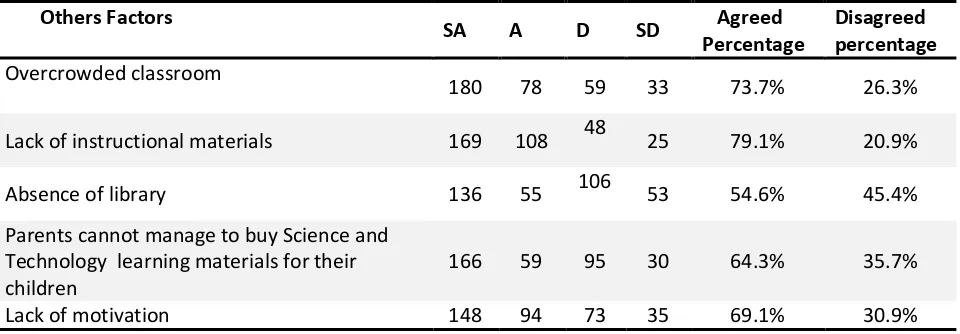
Table 6 Others Factors
Others Factors SA A D SD Agreed
Percentage Disagreed percentage
Overcrowded classroom 180 78 59 33 73.7% 26.3%
Lack of instructional materials 169 108 48 25 79.1% 20.9%
Absence of library 136 55 106 53 54.6% 45.4%
Parents cannot manage to buy Science and Technology learning materials for their
children 166 59 95 30 64.3% 35.7%
Lack of motivation 148 94 73 35 69.1% 30.9%
Table 6 above reveals other factors affecting teaching and learning of Science and Technology in junior secondary schools in Bosso Local Government, Niger State. such factor include (11) overcrowded classrooms with an agreed respondents percentage score of 79% as against the disagreed respondents percentage score of 21%, (12) lack of instructional materials with an agreed respondents percentage score of 82.5% as against the disagreed respondents percentage score of 17.5%, (13) absence of library has an agreed respondents percentage score of 50.5% as against the disagreed respondents percentage score of 49,5%, (14) parents cannot afford to buy Science and Technology learning materials for their children has an agreed percentage score of 62.5% as against the disagreed respondents percentage score of 37.5%, and (15) lack of motivation has an agreed respondents score of 72% as against the disagreed respondents percentage
www.moj-es.net
score of 28%. From these findings, it was also observed that all the problems itemized are problems affecting the effective teaching and learning of Science and Technology as perceived by the students.
CONCLUSION
The results from the study revealed that; the students have poor foundation in Science and Technology from their primary School, lack the commitment and willingness to learn, teaching and learning environment are not conducive, most Science and Technology teachers have poor teaching foundation, several Science and Technology teachers do not plan moderately for the Science and Technology class as a result of much work load. Therefore, Science and Technology teachers need regular training to make them competent in preparing the 21st century students to face global contest in their chosen fields. If the needed effort is put in place, these problems will become history.
RECOMMENDATIONS
From the findings of this research, some recommendations are suggested, they are;
The government should sponsor Science and Technology teachers for training for improvement in Science and Technology teaching in junior secondary schools.
Science and Technology teachers should strive to relate their Science and Technology teaching to real life situation so as to limit the abstract nature of the subject.
The government should make available the needed equipment and facilities in order to encourage Science and Technology teaching and learning.
The government should endeavour to motivate and reward hardworking teachers and students with honorary packages.
The government should also employ more qualified Science and Technology teachers so as to reduce their work load.
The parents should endeavour to employ home lesson Science and Technology teachers for their children and ensure proper monitoring.
The responsible bodies for the supervision of teachers and students should be made to live up to
expectations.
REFEREN
c
ES
Ahmad, F., and Aziz J. (2009) Students’ perception of their teachers’ Teaching of literature communicating and understanding through the eyes of the audience. European Journal of Social Science, 7(3)17-26.
Amazigo, J.C. (2000). Science and Technology phobia diagnosis and Prescription. National Science and Technology centre first annual Lecture, Abuja, July.
Betiku, O. F. (2001). Causes of mass failure in Science and Technology Examinations among students. A commissioned paper presented at Government Secondary school, Karu, Abuja Science day, 1st March.
Ernest, P. (1989). The Impact of Beliefs on the Teaching of Science and Technology. 6th International Congress
of Science and Technology Education. pp. 249-254. Falmer Press
Federal Republic of Nigeria (2013). National Policy on Education NERDC, Abuja.
www.moj-es.net
Hassan, A. M. (2016). Functional Science and Technology Education Tool for National Economic Empowerment and Development. A Journal of Science, Technology and Mathematics Education (JOSTMED) 1 (1) 46-51
Hassan, A. M., Gimba, R. W. & Chado, M. A. (2016). Effect of Information and Communication Technology (ICT) on gender and Achievement of Students in Basic Science and Technology at Junior Secondary School Level. Computer Education Research Journal (CERJ) 3(1) 111-126.
Kurumeh, M.S & Imoke B. I (2008). Universal Education: A way forward for the Development of primary school pupils in Science and Technology Education. ABACUS, 33(1) p49-56.
Obodo, G. C. (2000). Principles and practice of Science and Technology education In Nigeria. Enugu: General studies division, University of Science And Technology pub.
Rawnsley, D. G. (1997). Associations between classroom learnin Environments, teacher interpersonal behaviours and student Outcomes in secondary Science and Technology classrooms. Unpublished Doctoral thesis,Curtin University of technology, perth, Western Australia.
www.moj-es.net