http://www.sciencepublishinggroup.com/j/ijssam doi: 10.11648/j.ijssam.20170205.14
ISSN: 2575-5838 (Print); ISSN: 2575-5803 (Online)
One-Dimensional Cutting Stock Problem with Cartesian
Coordinate Points
Niluka Rodrigo
*, Sium Shashikala
Department of Mathematics, University of Peradeniya, Peradeniya, Sri Lanka
Email address:
[email protected] (N. Rodrigo), [email protected] (S. Shashikala) *
Corresponding author
To cite this article:
Niluka Rodrigo, Sium Shashikala. One-Dimensional Cutting Stock Problem with Cartesian Coordinate Points. International Journal of Systems Science and Applied Mathematics. Vol. 2, No. 5, 2017, pp. 99-104. doi: 10.11648/j.ijssam.20170205.14
Received: September 29, 2016; Accepted: December 22, 2016; Published: October 24, 2017
Abstract:
The cutting stock problem is used in many industrial processes and recently has been considered as one of the most important research topics. It is basically describes in two ways, One –dimensional and Two-dimensional Cutting Stock Problems (CSP). An optimum cutting stock problem can be defined as cutting a main sheet into smaller pieces while minimizing the total wastage of the raw material or maximizing overall profit obtained by cutting smaller pieces from the main sheet. In this study, One-dimensional CSP is discussed. Modified Brach and Bound algorithm for One-dimensional cutting stock problem is coded and programmed in the Matlab programming environment to generate feasible cutting patterns. At the same time, Cartesian coordinate points are derived from the developed algorithm. In our approach, the case study is pertained to the real data used at L.H. Chandrasekara & Brothers (Pvt Ltd) in Sri Lanka for its production.Keywords:
One-Dimensional CSP, Brach and Bound Algorithm, Matlab Software, Cartesian Coordinate Points1. Introduction
Efficiency of the production process has become a key factor of the success in today’s competitive manufacturing environment in industries. Productivity can be improved by minimizing wastage, lead time and hence reducing the cost of production. Throughout the process of production, wastage can occur in many ways at any stage of the production process. Cutting stock problem can be defined as optimizing the raw material wastage. Therefore, techniques in Operations Research play a major role in minimizing wastage of raw material or maximizing usage of the raw material. In early days, in order to achieve the goal of (1D-CSP), researchers used different methodologies. The linear programming based procedure was the first approach which may be traced back to the column generation procedure proposed by Gilmore and Gomary (1961, 1963). Moreover, Sequence Heuristic Procedure (SHP) described by Haesseler (1971) and then Hybrid Solution Procedure which is a combination of the LP based procedure and SHP or some other procedures (Haesseler et al., 1991). Basically CSP is describes in two ways, One-dimensional and
has made an approach for one-dimensional cutting stock problem as an extended of early study and cutting stock problem has been described as a NP-hard problem1. Gilmore [2] has described a new and faster Knapsack method, and mathematical formulation changes. The following formulation changes have been discussed; limitation on the number of cutting knives available, balancing of multiple machine usage when orders are being filled from more than one machine, and introduce a tolerance in the customers’ orders. Gilmore has explained the procedure of Knapsack Method using a test problem2.
Addition to that, Morbito [3] has reported the problem of cutting rectangular plates into smaller ones in Brazilian hardboard industry. The problem was determine the best patterns to be cut by an automated machine composed of a set of circular saws, device to move and hold the plates and loading and unloading stations. A particular two-phase column generation procedure was described for the cutting stock formulation of hardboard industry. Each phase of the procedure was modeled as an integer program and solved by two alternative methods. The first was based on dynamic programming and the second was a simple extension of the algorithm presented in Gilmore [2]. Also, Saad M. A. Suliman [4] has developed a simple pattern generating procedure for solving the auxiliary problem which solves the one-dimensional CSP to minimize the trim loss or minimize the total amount of stock material. Branch and Bound Algorithm has been modified to find feasible cutting patterns for one-dimensional CSP and a search tree is used to develop the pattern generation method. Modified Branch and Bound Algorithm is illustrated using a case study, where standard steel coil which is 130 cm in length is cut into four different lengths of coils with similar width of main coil4. The one-dimensional Cutting Stock Problem becomes more difficult when there are a large number of objects of different sizes available. A similar problem is addressed by Belov [5], and a method based on combination of some enumerative methods is proposed. In this work the more general case was studied where different stock types with supply bounds are available. The total material cost minimization has been modeled as an integer linear optimization problem5. Puchinger [6] has described a combined genetic algorithm/branch & bound approach for solving a real world glass-cutting problem. The Genetic Algorithm uses an order-based representation, which is decoded using a greedy heuristic. The Branch & Bound algorithm was applied with a certain probability enhancing the decoding phase by generating locally optimal sub-patterns. Reported results indicate that the approach of occasionally solving sub patterns to optimality may increase the overall solution quality6. Fernandez [7] has presented a method to find Integer Solutions to One-dimensional CSP to minimize the trim loss or to minimize the number of master rolls needed to satisfy the orders. Two Integer linear programming models for the One-dimension CSP with different objective cost functions have been considered. Fernandez has studied an approach based on the classical column-generation procedure by Gilmore and Gomary for
solving the linear programming (LP) relaxations. Also to obtain an integer solution, a final integer CSP after using an extra column-generation procedure has been solved7.
In addition to above studies, Rodrigo [8] has presented modified Branch and Bound Algorithm and a computer program using Matlab software package to generate feasible cutting patterns. As a case study, 1200 cm long steel bars are considered to be cut into eight types (different lengths) of pieces according to the customer requirements. Optimum cutting schedule has been presented by solving the integer linear programming problem which is given in the paper8. Rodrigo [9] has proposed a method to discover the feasible cutting patterns for One-Dimensional Cutting Stock Problem with varying dimensions. Pattern Generation Technique has been used to nest the pieces of cutting items within the main sheet by minimizing the raw material wastage. Computer program using Matlab software package has presented to generate feasible patterns. In the case study, three different paper rolls of widths 1000mm, 500mm and 800mm are used as raw materials to cut different sizes of paper items according to the given specifications9. In addition to that Rodigo [10] has developed an algorithm based on Modified Branch And Bound
to generate the cutting patterns for two-dimensional triangular shaped cutting items. As a case study, four different sizes of triangular shaped items with their demands are selected to cut from a raw material with known dimensions 10.
2. Materials and Methods
2.1. One-Dimensional (1D) Cutting Stock Problem
In most industries, the cost of the materials consists of a high percent of total price (More than 80%). The CSP is one of the most famous operation research problems which are defined to improve the quality of using materials. This CSP can be described as follow; there is a collection of rectangular shaped stock materials with different widths (but with the same length L) that we are going to divide them into smaller pieces of desired widths (with the same length L). First, the desired widths has been arranged in descending order ( , , … ..) and then divide the original sheets into small pieces having the width- as much as possible. After then if there is a loss raw material, we go to the next required width- and divide that loss into small pieces having the width- . By continuing the same procedure up to the smallest required width we can generate all the cutting patterns and finally calculate the minimum trim loss.
2.2. Mathematical Model (Gilmore and Gomary, 1961)
(
)
(
)
h 1 1 h m 1 1Minimize Total Cutloss
Subject to
for all 1, 2,..., Demand Constraints , 0 and integer for all , ,
m
k j k j
k j
i k j k j i
k j
k j i k j
z c x
a x d
i n
x a i j k
= = = = = ≥ = ≥
∑ ∑
∑ ∑
Whereh=Number of raw materials with different sizes,
n= Number of items,
m= Number of patterns,
i k j
a
= The number of occurrences of the ith item of the kth
sheet in the
th
j
pattern,
k j
c
= Cut loss of the kth sheet in the
th
j
pattern,
i
d
= Demand of the ith item,
k j
x
= The number of main sheets being cut from the kth
sheet according to the
th
j
pattern.
2.3. Modified Branch and Bound Algorithm (in Step-Wise Form)
Step1: Arrange the required widths of raw materials,
, = 1, 2, … , ℎin decreasing order.
(i.e. > > ⋯ > where h is the number of main sheets with different widths)
Step 2: Arrange the required widths, , = 1, 2, … , in decreasing order.
(i.e. > > ⋯ > where n is the number of items with different widths)
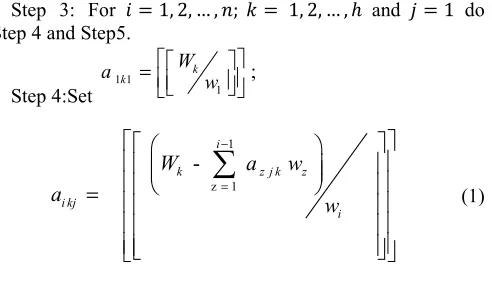
Step 3: For = 1, 2, … , ; = 1, 2, … , ℎ and = 1 do Step 4 and Step5.
Step 4:Set 1 1 1 ; k k W a w = 1 z 1
-ik z j k z
i kj
i
W
a
w
a
w
− =
=
∑
(1)Where Wk is the length of the k th
main sheet. Here, aijk is the
number of pieces of the ith item in the
th
j
pattern along the
width of the kth main sheet and
[ ]
y is the greatest integer less than or equal to y.Step 5: = − ∑ . (2)
find the cut loss resulting from cut pattern 1.
Step 6: Set the level index i to n-1 (i.e. set = − 1) While t>0 do Step7.
Step 7: While > 0
Set = + 1 and do Step8.
Step 8: Generate a new pattern according to the following conditions;
For " = 1, 2, … , − 1
Set # = # $ % &;
For " =
Set # = # $ % &− 1;
For " = + 1, … , Calculate # using (1). Step 9:Set = − 1. Step 10: Stop.
2.4. Case Study
Modified branch and bound algorithm is tested to determine feasible and optimal cutting patterns.
A paper company (Chandrasekara Group Of Companies in Sri Lanka) uses Bank papers of widths 80cm and 60cm with same length (90cm) as raw materials to cut different sizes paper items according to the given specifications. The company has received an order for papers with the following specifications:
Table 1. Required cutting item dimensions and demands.
Order Number (i) 1 2 3 4 5
Name of the Item A2 B4 A4 B5 Legal
Required width (cm) 42 26 21 18 8.5
Demand 1000 2000 4000 5000 6000
Bank Papers are produced by the company in two standard widths; 60cm and 80cm that are slit to the sizes specified by the orders.
3. Results and Discussion
Modified Branch and Bound Algorithm is used to the above example to generate feasible cutting patterns as given below;
Step 1: For = 1, 2 widths of rawmaterials = 80cm and 60 cm.
Step 2: For = 1, 2, 3, 4, 5 widths of items = 42cm, 26cm, 21cm, 18cm, 8.5cm.
Step 3: For i= 1, 2, …,5 and k=1, 2 and j=1, do Step 4 and Step 5.
Step 4: Allocating cutting items for cutting pattern 1, Item 1 is selected and nested along the width of the raw material.
Following equation states the maximum number of pieces that can be allocated for Item 1.
= *+ , -.
Residual width of the raw material calculated by the formula bellow:
Residual width =W1 −
(
w a1 111)
.If w2 ≤ W1 −
(
w a1 111)
,where w2 is the width of the Item 2. Then Item 2is nested
Nesting of Item 2 is as follows:
= /+[ − $ &], -2
This process continues till the last cutting item (Item 5) while calculating residual width of the raw material.
Set = *+ , -. = 1;
= /+[ − $ &], -2 = 1;
3 = /*[ − $ & − $ &], .2 = 03 ;
4 = /*[ − $ & − $ & − $ 3 3 &], .2 = 04 ;
5 = /*[ − $ & − $ & − $ 3 3 & − $ 4 4 &], .2 = 15 .
Nested cutting items in Step 2 is defined as first cutting pattern
Set pattern1
1 1 0 0 1
=
Step 5: Total cut loss
Cutloss is calculated as follows:
(
) (
) (
)
(
) (
)
1 111 2 211 3 311 1
4 411 5 511 Cutloss
3.5 cm
w a w a w a
W
w a w a
+ + +
= −
+
=
Step 6: At the end of each pattern, Seti= n-1 (> 0).
Set i = 4.
Step 7: Value of aikj is checked. If aikj = 0, setting i = i-1
and again value of aikj is checked. When aikj> 0, set j = j+1
and determine the number of pieces of each cutting item along the length of the raw material.
411 0, set .
a = j= j
3 = 0
> 0
Set = + 1
Step 8: Generate a new pattern according to the following conditions:
Set = = 1;
Set = − 1 = 0;
3 = /*[ − $ & − $ &], .2 = 13 ;
4 = /*[ − $ & − $ & − $ 3 3 &], .2 = 04 ;
5 = /*[ − $ & − $ & − $ 3 3 & − $ 4 4 &], .2 = 25 .
Nested cutting items of pattern 2 as follows:
Set Pattern 2
1
0 1 0 2
=
.
Step 5: Total cut loss
= 6 − 7
5
8 = 0 9
Repeat the procedure until i = 5 (n).
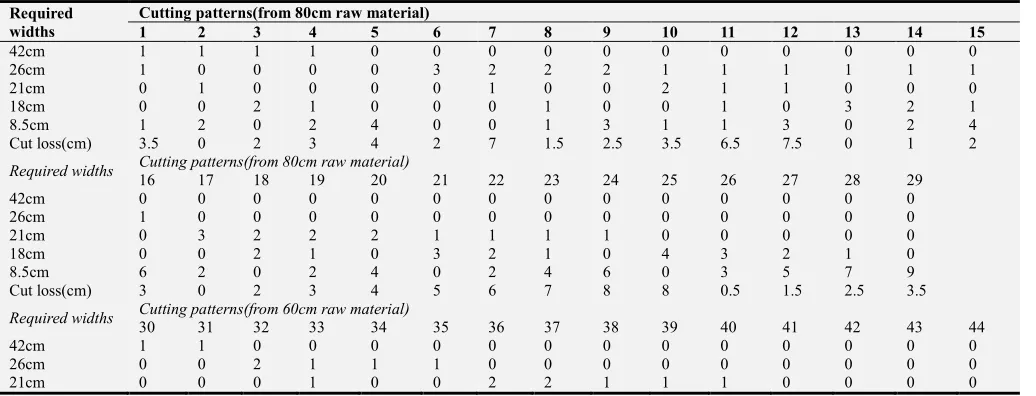
This process ends up with 44 different cutting patterns to allocate 5 items which is exhibited in the Table 2.
Table 2. Generated Cutting Patterns.
Required widths
Cutting patterns(from 80cm raw material)
1 2 3 4 5 6 7 8 9 10 11 12 13 14 15
42cm 1 1 1 1 0 0 0 0 0 0 0 0 0 0 0
26cm 1 0 0 0 0 3 2 2 2 1 1 1 1 1 1
21cm 0 1 0 0 0 0 1 0 0 2 1 1 0 0 0
18cm 0 0 2 1 0 0 0 1 0 0 1 0 3 2 1
8.5cm 1 2 0 2 4 0 0 1 3 1 1 3 0 2 4
Cut loss(cm) 3.5 0 2 3 4 2 7 1.5 2.5 3.5 6.5 7.5 0 1 2
Required widths Cutting patterns(from 80cm raw material) 16 17 18 19 20 21 22 23 24 25 26 27 28 29
42cm 0 0 0 0 0 0 0 0 0 0 0 0 0 0
26cm 1 0 0 0 0 0 0 0 0 0 0 0 0 0
21cm 0 3 2 2 2 1 1 1 1 0 0 0 0 0
18cm 0 0 2 1 0 3 2 1 0 4 3 2 1 0
8.5cm 6 2 0 2 4 0 2 4 6 0 3 5 7 9
Cut loss(cm) 3 0 2 3 4 5 6 7 8 8 0.5 1.5 2.5 3.5
Required widths Cutting patterns(from 60cm raw material)
30 31 32 33 34 35 36 37 38 39 40 41 42 43 44
42cm 1 1 0 0 0 0 0 0 0 0 0 0 0 0 0
26cm 0 0 2 1 1 1 0 0 0 0 0 0 0 0 0
Required widths
Cutting patterns(from 80cm raw material)
1 2 3 4 5 6 7 8 9 10 11 12 13 14 15
18cm 1 0 0 0 1 0 1 0 2 1 0 3 2 1 0
8.5cm 0 2 0 1 1 4 0 2 0 2 4 0 2 4 7
Cut loss(cm) 0 1 8 4.5 7.5 0 0 1 3 4 5 6 7 8 0.5
There are 44 feasible cutting patterns available to cut raw materials with the dimensions 80cm and 60cm into required items. By considering the standard lengths of the main sheets (length of the main sheets are same (90cm)) and the other items;
Table 3. Length-wise allocation.
Item Standard length No. of items* (cuts are made length-wise)
A3 59.4cm 1
B4 36.5cm 2
A4 29.7cm 3
B5 26cm 3
Legal 14cm 6
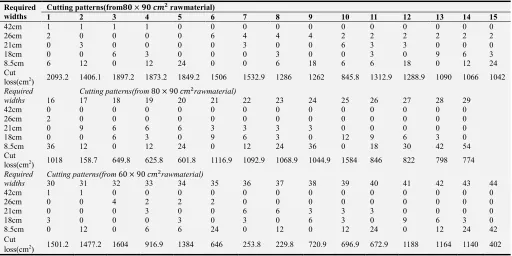
(No. of items* - number of items that can be cut from the relevant strip after cutting the main sheet width-wise). Then the total number of cutting patterns can be listed as follows:
Table 4. Feasible cutting patterns.
Required widths
Cutting patterns(from:; × =; >?@ rawmaterial)
1 2 3 4 5 6 7 8 9 10 11 12 13 14 15
42cm 1 1 1 1 0 0 0 0 0 0 0 0 0 0 0
26cm 2 0 0 0 0 6 4 4 4 2 2 2 2 2 2
21cm 0 3 0 0 0 0 3 0 0 6 3 3 0 0 0
18cm 0 0 6 3 0 0 0 3 0 0 3 0 9 6 3
8.5cm 6 12 0 12 24 0 0 6 18 6 6 18 0 12 24
Cut
loss(cm2) 2093.2 1406.1 1897.2 1873.2 1849.2 1506 1532.9 1286 1262 845.8 1312.9 1288.9 1090 1066 1042 Required
widths
Cutting patterns(from 80 × 90 9rawmaterial)
16 17 18 19 20 21 22 23 24 25 26 27 28 29
42cm 0 0 0 0 0 0 0 0 0 0 0 0 0 0
26cm 2 0 0 0 0 0 0 0 0 0 0 0 0 0
21cm 0 9 6 6 6 3 3 3 3 0 0 0 0 0
18cm 0 0 6 3 0 9 6 3 0 12 9 6 3 0
8.5cm 36 12 0 12 24 0 12 24 36 0 18 30 42 54
Cut
loss(cm2) 1018 158.7 649.8 625.8 601.8 1116.9 1092.9 1068.9 1044.9 1584 846 822 798 774 Required
widths
Cutting patterns(from 60 × 90 9rawmaterial)
30 31 32 33 34 35 36 37 38 39 40 41 42 43 44
42cm 1 1 0 0 0 0 0 0 0 0 0 0 0 0 0
26cm 0 0 4 2 2 2 0 0 0 0 0 0 0 0 0
21cm 0 0 0 3 0 0 6 6 3 3 3 0 0 0 0
18cm 3 0 0 0 3 0 3 0 6 3 0 9 6 3 0
8.5cm 0 12 0 6 6 24 0 12 0 12 24 0 12 24 42
Cut
loss(cm2) 1501.2 1477.2 1604 916.9 1384 646 253.8 229.8 720.9 696.9 672.9 1188 1164 1140 402
There are 44 feasible cutting patterns available to cut rawmaterials with the dimensions 80 × 90cm and 60 ×
90cm into required items. The mathematical model is solved as an integer programming model using EXCEL to design generated cutting patterns so that the trim loss will be minimized and optimum solution to the model is given in Table 5.
Table 5. Optimum cutting schedule.
Item Patterns Demand
6 30 35 36
A2 0 1 0 0 1000
B4 6 0 2 0 2000
A4 0 0 0 6 4000
B5 0 3 0 3 5000
Legal 0 0 24 0 6000
Cut loss(cm2) 1506 1501.2 646 253.8
Total Cutloss 2208484.6 No. of sheets(DEF& 250 1000 250 667
4. Conclusion
In this study, a cutting stock problem is formulated as a mathematical model based on the concept of cutting patterns. As shown in the Table 2, forty four feasible cutting patterns were generated and after solving the model, only four patterns were selected as given in Table 5 to cut the main sheets according to the requirements. In this case study, the plant assumes that all extra pieces from each item were stocked for the next production. Since the company cuts only one item from one main sheet, they need minimum 500 main sheets from 80 × 90cm2 and 1642 main sheets from 80 ×
Table 6. Number of sheets required to satisfy the demand according to the company process.
Item Length (cm) Width (cm) No. of items (that can be cut from one sheet) Demand No. of sheets required No. of the main sheet
A2 59.4 42 2 1000 500 1
B4 36.5 26 6 2000 500 2
A4 29.7 21 8 4000 500 2
B5 26 18 10 5000 500 2
Legal 14 8.5 42 6000 142 2
The total cutloss of the company= 2525200cm2
Rate of utilized area (of the company)= 79.77% Total cutloss (obtained from our model) = 2208484.6cm2
Rate of utilized area=81.83% (obtained from our model)
Clearly we can see that the optimum solution we obtained through our process is more profitable than the existing one.
References
[1] P. C. Gilmore and R. E. Gomary, “A Linear Programming Approach to the Cutting Stock Problem”, Operations Research, Vol. 9, No. 2 (1961), 849-859.
[2] P. C. Gilmore and R. E. Gomary, “A Linear Programming Approach to the Cutting Stock Problem – Part II”, Operations Research, Vol. 11, No. 6 (1963), 863-888.
[3] R. Morbito and V. Garcia, “A Cutting Stock Problemin Hardboard Industry- Case Study”, Computer Operations Research, Vol. 25, No. 6 (1997), 469-485.
[4] Saad M. A. Suliman, “Pattern Generating Procedure for the Cutting Stock Problem”, International Journal of Production Economics 74(2001) 293-301.
[5] G. Belov and G. Scheithauer, “A cutting plane algorithm for the one-dimensional cutting stock problem with multiple stock
lengths”, European Journal of Operational Research 141 (2002) 274–29.
[6] JakobPuchinger, Gunther R. Raidl and Gabriele Koller, “Solving a Real-World Glass Cutting Problem”.
[7] L. Fern´andez, L. A. Fern´andez, C. Pola, “Integer Solutions to Cutting Stock Problems”, 2nd International Conference on Engineering Optimization, Sep 6-9, 2010.
[8] W. N. P Rodrigo, W. B Daundasekera and A. A. I Perera, “Pattern Generation for One-dimensional Cutting Stock Problem”, Peradeniya University Research Session (PURSE), 2011.
[9] W. N. P. Rodrigo, W. B. Daundasekera and A. A. I. Perera, “Modified Method for One-dimensional Cutting Stock Problem”, Science Publishing Group 2015;3(3); 12-17.