Waffles: A Machine Learning Toolkit
Mike Gashler [email protected]
Department of Computer Science Brigham Young University Provo, UT 84602, USA
Editor: Soeren Sonnenburg
Abstract
We present a breadth-oriented collection of cross-platform command-line tools for researchers in machine learning called Waffles. The Waffles tools are designed to offer a broad spectrum of func-tionality in a manner that is friendly for scripted automation. All funcfunc-tionality is also available in a C++ class library. Waffles is available under the GNU Lesser General Public License.
Keywords: machine learning, toolkits, data mining, C++, open source
1. Introduction
Although several open source machine learning toolkits already exist (Sonnenburg et al., 2007), many of them implicitly impose requirements regarding how they can be used. For example, some toolkits require a certain platform, language, or virtual machine. Others are designed such that tools can only be connected together with a specific plug-in, filter, or signal/slot architecture. Un-fortunately, these interface differences create difficulty for those who have become familiar with a different methodology, and for those who seek to use tools from multiple tookits together. Toolkits that use a graphical interface may be convenient for performing common experiments, but become cumbersome when the user wishes to use a tool in a manner that was not foreseen by the interface designer, or to automate common and repetitive tasks.
Waffles is a collection of tools that seek to provide a wide diversity of useful operations in
machine learning and related fields without imposing unnecessary process or interface restrictions on the user. This is done by providing simple command-line interface (CLI) tools that perform basic tasks. The CLI is ideal for this purpose because it is well-established, it is available on most common operating systems, and it is accessible through most common programming languages. Since these tools perform operations at a fairly granular level, they can be used in ways not foreseen by the interface designer.
As an example, consider an experiment involving the following seven steps:
1. Use cross-validation to evaluate the accuracy of a bagging ensemble of one-hundred decision trees for classifying the lymph data set (available athttp://MLData.org).
2. Separate this data set into a matrix of input-features and a matrix of output-labels.
3. Convert input-features to real-valued vectors by representing each nominal attribute as a cat-egorical distribution over possible values.
5. Use cross-validation to evaluate the accuracy of the same model on the data with reduced features.
6. Train the model using all of the reduced-dimensional data. 7. Visualize the model-space represented by the ensemble.
These seven operations can be performed with Waffles tools using the following CLI commands:
1. waffles learn crossvalidate lymph.arff bag 100 decisiontree end
2. waffles transform dropcolumns lymph.arff 18 > features.arff
waffles transform dropcolumns lymph.arff 0-17 > labels.arff
3. waffles transform nominaltocat features.arff > f real.arff 4. waffles dimred pca f real.arff 2 > f reduced.arff
5. waffles transform mergehoriz f reduced.arff labels.arff > all.arff
waffles learn crossvalidate all.arff bag 100 decisiontree end
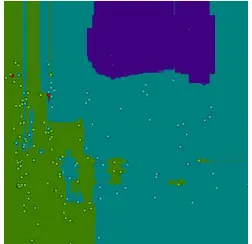
6. waffles learn train all.arff bag 100 decisiontree end > ensemble.model 7. waffles plot model ensemble.model all.arff 0 1
The cross-validation performed in step 1 returns a predictive accuracy score of 0.781. Step 5 returns a predictive accuracy score of 0.705. The plot generated by step 7 is shown in Figure 1.
It is certainly conceivable that a graphical interface could be developed that would make it easy to perform an experiment like this one. Such an interface might even provide some mechanism to automatically perform the same experiment over an array of data sets, and using an array of differ-ent models. If, however, the user needs to vary a parameter specific to the experimdiffer-ent, such as the number of principal components, or a model-specific parameter, such as the number of trees in the ensemble, the benefits of a graphical interface are quickly overcome by additional complexity. By contrast, a simple script that calls CLI commands to perform machine learning operations can be directly modified to vary any of the parameters. Additionally, the scripting method can incorporate tools from other toolkits, or even custom-developed tools. Because nearly all programming lan-guages can target CLI applications, there are few barriers to adding custom operations. Graphical tools are unlikely to offer such flexibility.
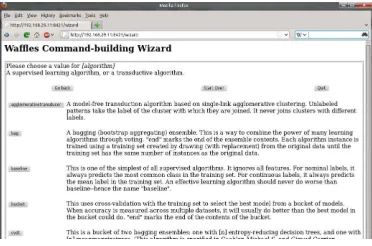
Figure 2: A partial screen shot of the Waffles Wizard tool displayed in a web browser.
2. Wizard
One significant reason many people prefer to use tools unified within a graphical interface over scriptable CLI tools is that it can be cumbersome to remember which options are available with CLI tools, and to remember how to construct a syntactically-correct command. We solve this problem by providing a “Wizard” tool that guides the user through a series of forms to construct a command that will perform the desired task. A screen shot of this tool (displayed in a web browser) is shown in Figure 2.
Rather than execute the selected operation directly, as most GUI tools do, the Waffles Wizard tool merely displays the CLI command that will perform the operation. The user may paste it directly into a command shell to perform the operation immediately, or the user may choose to incorporate it into a script. This gives the user the benefits of a GUI, without the undesirable tendency to lock the user into an interface that is inflexible for scripted automation.
3. Capabilities
In order to hilight the capabilities of Waffles, we compare its functionality with that found in Weka (Hall et al., 2009), which at the time of this writing is the most popular machine learning toolkit by a significant margin. Our intent is not to persuade the reader to choose Waffles instead of Weka, but rather to show that many useful capabilities can be gained by using Waffles in conjunction with Weka, and other toolkits that offer a CLI.
One notable strength of Waffles is in unsupervised algorithms, particularly dimensionality re-duction techniques. Waffles tools implement principal component analysis (PCA), isomap (Tenen-baum et al., 2000), locally linear embedding (Roweis and Saul, 2000), manifold sculpting (Gashler et al., 2011a), breadth-first unfolding, neuro-PCA, cycle-cut (Gashler et al., 2011b), unsupervised backpropagation and temporal nonlinear dimensionality reduction (Gashler et al., 2011c). Of these, only PCA is found in Weka. Waffles contains clustering techniques including k-means, k-medoids, agglomerative clustering, and related transduction algorithms including agglomerative transduction, and max-flow/min-cut transduction (Blum and Chawla, 2001).
algo-rithms is much smaller than that of Weka, which implements more than 50 classification algoalgo-rithms. Waffles, however, provides an interface that offers several advantages in many situations. For ex-ample, Weka requires the user to set up filters that convert data to types that each algorithm can handle. Waffles automatically handles type conversion when an algorithm receives a type that it is not implicitly designed to handle, while still permitting advanced users to specify custom filters. The Waffles algorithms also implicitly handle multi-dimensional labels. As some algorithm-specific examples, the Waffles implementation of multi-layer perceptron provides the ability to use a diver-sity of activation functions, and also supplies methods for training recurrent networks. The k-nearest neighbor algorithm automatically supports acceleration structures and sparse training data, so it is suitable for use with problems that require high scalability, such as document classification.
As was demonstrated in the first example in this paper, Waffles features a particularly convenient mechanism for creating bagging ensembles. It also provides a diversity of collaborative filtering algorithms and optimization techniques that are not found in Weka. Waffles also provides tools to perform linear-algebraic operations, and various data-mining tools, including attribute selection and several methods for visualization.
4. Architecture
The Waffles tools are organized into several executable applications. These include:
1. waffles wizard, a graphical command-building assistant,
2. waffles learn, a collection of supervised learning techniques and algorithms, 3. waffles transform, a collection of unsupervised data transformations, 4. waffles plot, tools related to visualization,
5. waffles dimred, tools for dimensionality reduction and attribute selection, 6. waffles cluster, tools for clustering data,
7. waffles generate, tools for sampling distributions, manifolds, etc., 8. waffles recommend, tools related to collaborative filtering, and 9. waffles sparse, tools for learning with sparse matrices.
References
A. Blum and S. Chawla. Learning from labeled and unlabeled data using graph mincuts. In
Pro-ceedings of the Eighteenth International Conference on Machine Learning, pages 19–26. Morgan
Kaufmann Publishers Inc., 2001. ISBN 1558607781.
M. Gashler, C. Giraud-Carrier, and T. Martinez. Decision tree ensemble: Small heterogeneous is better than large homogeneous. In Seventh International Conference on Machine Learning and
Applications, 2008. ICMLA ’08., pages 900–905. Dec. 2008. doi: 10.1109/ICMLA.2008.154.
M. Gashler, D. Ventura, and T. Martinez. Manifold learning by graduated optimization. Systems,
Man, and Cybernetics, Part B: Cybernetics, IEEE Transactions on, PP(99):1 –13, 2011a. ISSN
1083-4419. doi: 10.1109/TSMCB.2011.2151187.
M. Gashler, D. Ventura, and T. Martinez. Tangent space guided intelligent neighbor finding. In The
2011 International Joint Conference on Neural Networks (IJCNN), July 2011b.
M. Gashler, D. Ventura, and T. Martinez. Temporal nonlinear dimensionality reduction. In The
2011 International Joint Conference on Neural Networks (IJCNN), July 2011c.
M. Hall, E. Frank, G. Holmes, B. Pfahringer, P. Reutemann, and I. Witten. The WEKA data mining software: an update. SIGKDD Explor. Newsl., 11(1):10–18, 2009. ISSN 1931-0145. doi: 10. 1145/1656274.1656278.
S. Roweis and L. Saul. Nonlinear dimensionality reduction by locally linear embedding. Science, 290:2323–2326, 2000.
S. Sonnenburg, M.L. Braun, C.S. Ong, S. Bengio, L. Bottou, G. Holmes, Y. LeCun, K.R. M¨uller, F. Pereira, C.E. Rasmussen, et al. The need for open source software in machine learning. Journal
of Machine Learning Research, 8:2443–2466, 2007.