The Journal of Public Space 2016 | Vol. 1, n. 1
https://www.journalpublicspace.org
Founding Editors
Luisa Bravo, City Space Architecture, Italy
Mirko Guaralda, Queensland University of Technology, Australia
Scientific Board
Davisi Boontharm, Sophia University, Japan
Simone Brott, Queensland University of Technology, Australia Julie-Anne Carroll, Queensland University of Technology, Australia Margaret Crawford, University of California Berkeley, United States Philip Crowther, Queensland University of Technology, Australia Simone Garagnani, University of Bologna, Italy
Pietro Garau, University of Rome “La Sapienza”, Italy
Carl Grodach, Queensland University of Technology, Australia Miquel Marti, Universitat Politècnica de Catalunya, Spain Darko Radovic, Keio University, Japan
Estanislau Roca, Universitat Politècnica de Catalunya, Spain Joaquin Sabate, Universitat Politècnica de Catalunya, Spain Robert Saliba, American University of Beirut, Lebanon Claudio Sgarbi, Carleton University, Canada
Hendrik Tieben, The Chinese University of Hong Kong, Hong Kong
Editorial Board
Glenda Caldwell, Queensland University of Technology, Australia Linda Carroli, Queensland University of Technology, Australia Debra Cushing, Queensland University of Technology, Australia Severine Mayere, Queensland University of Technology, Australia
Editorial Support
Paul Donehue, Queensland University of Technology, Australia Michael Marriott, Queensland University of Technology, Australia Marisha McAuliffe, Queensland University of Technology, Australia
Journal Manager
Luisa Bravo, City Space Architecture, Italy
Correspondents
Konstantinos Ioannidis, Aristotle University of Thessaloniki, Greece Massimo Santanicchia, Iceland Academy of the Arts, Iceland
Lakshmi Priya Rajendran, Lancaster University, United Kingdom Matthew D. Lamb, The Pennsylvania State University, USA
Editorial offices
Queensland University of Technology 2 George Street, Brisbane
QLD 4000, AUSTRALIA [email protected]
City Space Architecture
Via Paolo Giovanni Martini 26/d 40134 Bologna, ITALY
Publication Ethics Statement
The Journal of Public Space aligns itself with the Committee on Publication Ethics (COPE) best practice guidelines for dealing with ethical issues in journal publishing.
THE JOURNA
The Journal of Public Space 2016 | Vol. 1, n. 1
https://www.journalpublicspace.org
TABLE OF CONTENTS
EDITORIALAn open access forum for the discussion and advancement
of research about public space 1-4
Luisa Bravo & Mirko Guaralda, Queensland University of Technology, Brisbane, Australia
Public Space and the New Urban Agenda 5-10
Cecilia Andersson, UN Habitat
OVERVIEW
Public Space Update. Report from the United States 11-16
Margaret Crawford, University of California Berkeley, USA
Measuring the Magic of Public Space 17-24
Pietro Garau, “La Sapienza” University in Rome, Italy
Public Space Trends in Hong Kong. A view from the New Territories 25-34 Hendrik Tieben, The Chinese University of Hong Kong, Hong Kong
Learning, Thinking and Living Tokyo. 35-42
About doing urban research in cultures radically different to that of our own Darko Radovic, Keio University, Tokyo, Japan
Mapping the lived experiences of Bangkok’s soi 43-52
Davisi Boontharm, Sophia University,Tokyo,Japan
SPACE
Urban morphology and the post-industrial city: commercial space in Manchester 53-62 Eamonn Canniffe, Manchester School of Architecture, UK
Temporary Public Spaces: A Technological Paradigm 63-74
Philip Crowther, Queensland University of Technology, Brisbane, Australia
SOCIETY
The Social Life of Gas Stations 75-94
Giulio Giovannoni, University of Florence, Italy
Guerilla East and Bicycle Espresso. 95-112
The Changing Contemporary Food Culture of Urban Helsinki Mika Savela, Canadian Centre for Architecture, Canada
Public Space for Street-Scape Theatrics. Guerrilla Spatial Tactics 113-128 and Methods of Urban Hacking in Brisbane, Australia
Christopher Cox, Mirko Guaralda, Queensland University of Technology, Brisbane, Australia
SYSTEMS
Private control and public openness. 129-146
The development of London’s public spaces since the Mayor’s 2009 manifesto Camilo Vladimir de Lima Amaral, University of East London, UK
VIEWPOINT
This is My City 147-150
Leonardo Parra-Agudelo, Queensland University of Technology, Australia
Magic Carpet. Re-envisioning Community Space in Hong Kong 151-154 Hendrik Tieben, The Chinese University of Hong Kong, Hong Kong
THE JOURNA
The Journal of Public Space 2016 | Vol. 1, n. 1
https://www.journalpublicspace.org
EDITORIAL
An open access forum for the discussion
and advancement of research about public space
Luisa Bravo & Mirko Guaralda
Queensland University of Technology Creative Industries Faculty, School of Design [email protected] | [email protected]Human beings are social beings and public spaces have always been the stage of
interaction, socialization and representation of a society as well as of a culture (Carmona, Heath, Oc, & Tiesdell, 2010). The role of public space has changed throughout history; the profound changes our cities have undergone during the industrial and technological revolution have modified the way people access and engage in the public domains (Gehl, 2010). The introduction of motorized vehicles and mass consumption commercial centres challenged the traditional view of publics and new types of public spaces in time have emerged. More recently, at the outset of the digital revolution, some analysts predicted that information technology would have sanctioned the death of public place, but the introduction of mobile technologies is instead fostering a renaissance of social public spaces (Foth, 2011). The way citizens relate to the public dominion has also deeply changed in recent decades with more and more bottom-up, pop-up and temporary interventions taking place in the public realms (Caldwell & Guaralda, 2016).
Public space is still the centre of the contemporary social life; its forms and types have evolved in time and today we are facing with a variety, complexity and richness in public spaces rarely experienced in the past. The traditional role of the square as gathering and social place has evolved in a multitude of location, uses and interactions. Streets, parks, commercial centres, cultural precincts, techno-parks, libraries, but also infrastructures, stations or parking lot today accommodate publics in different ways. What in the 1990s was labelled as a ‘non-place’ (Auge, 1995) today has resulted in a ‘new-place’.
The discourse about public spaces is generally dominated by exempla coming mainly from Europe and North America, where in the 1960s and 1970s main theories about use and navigation of the built environment have been developed (Arefi, 2004). If on one side cases from these cultural areas are more accessible, on the other side interesting and relevant experiences are today developed all over the world, starting with the innovative and highly socially relevant intervention in South American cities. New types of public spaces are also emerging in the Asia-Pacific region, due to the digital revolution, or in Africa, in consideration of the massive urbanisation this continent is undergoing.
THE JOURNA
Editorial
Whilst there are several dedicated publications to cities, urban morphologies, urban dynamics and urban design, a forum where to discuss and share research, experiences and projects about public space so far was not provided in a structured and clear way.
The Journal of Public Space aims to be the first international, open access journal, integrally dedicated to the discussion of public space in all its different forms and incantations. The objective is to provide a platform where academics and practitioners can share ideas and debate publics breaking traditional disciplinary boundaries. We are willing to engage also artists, to provide a different point of view.
The Journal of Public Space, as a true public space, is meant to be an inclusive forum where people from different backgrounds can present their work and access other people’s experiences. This is possible through the use of an open access platform (Open Journal System), where authors publish their work and readers can download articles without the payment of any fees. The open access platform could be also used to comment articles and to send requests to authors and editors. Nowadays academic knowledge is often not easily accessible; most of the leading journals require a
subscription fee to access contents. Universities, institutions or individual researchers have often to deal with the substantial cost of knowledge in the form of fees to publishers, not only to be able to read contents, but in some cases even to have one’s research reviewed and published. Publish or perish, they say, but how? A recent on line petition “The Cost of Knowledge”, signed by more than 15.000 researchers, is discussing the way knowledge is produced and disseminate in academia. Some illegal actions - like Sci-Hub, the first pirate website in the world to provide mass and public access to tens of millions of research papers - are standing against commercial enterprises. We promote a different approach to academic knowledge. We want a journal different from most of the leading journals that are currently available. Knowledge is a common good, in the same way public space in cities is a common good.
As a project, The Journal of Public Space was born as a collaboration between the nonprofit cultural association ‘City Space Architecture’, based in Bologna, Italy1, and the
Queensland University of Technology, Brisbane, Australia2 . Discussions about the need of
a new journal started after the first ‘Past Present and Future of Public Space’ International conference on Art, Architecture and Urban Design organised by ‘City Space Architecture’ that took place in Bologna on June 25-27, 20143. After two years of brainstorming,
discussion and planning, The Journal of Public Space commences now its journey, paying tribute to the international conference that has fostered its conception. The partnership with UN Habitat, the United Nations Agency for Cities and Human Settlements is a promising wish that the journal will be able to attract attention and interest not only of the academic environment but also of global institutions involved in the process of create, transform and manage public space all around the world. The Journal is committed to foster international collaboration and knowledge transfer from academia into industry and society and to facilitate better practice in the design and management of public spaces through access to knowledge and international exempla.
In this first issue, the variety and richness of public space is discussed presenting some of the papers initially presented in 2014, revised, on a double blind peer review process, and expanded to suit the broad audience the journal aims to reach.
Luisa Bravo & Mirko Guaralda
the discourse on public space. Margaret Crawford, Pietro Garau, Hendrik Tieben, Darko Radovic and Davisi Boontharm provide their view from different geographical and cultural perspectives. The journal is then organised in three sections covering Space, Society and Systems: six different papers discuss topics in design, such as urban form and temporary spaces; social dynamics, for example urban hacking or the emergence of new places; and complex topics related to publicness and openness. The viewpoint section closes the first issue providing an artist’s point of view on his city, Bogota, a report on an on-going research project in Hong Kong and a report of a photography research project on instant urbanity initiated in Bologna.
Overall, this first issue gives voice to experiences across five different continents and provide points of view from different disciplines and cultural positions. As a first issue, the tone and structure of the Journal is still developing, but its vision as a public inclusive forum is clear.
After the 2014 conference in Bologna, City Space Architecture and the Queensland University of Technology are currently establishing the ‘Past Present and Future of Public Space’ research group, intended to engage academic scholars from multidisciplinary fields in the advancement of knowledge and understanding of the complexity and relevance of public space in our cities. The Journal of Public Space was presented on September 23, 2016, in Venice, Italy, during an international seminar, in the frame of Biennale Sessions, a special educational project of La Biennale di Venezia. This symposium was the first
meeting of the ‘Past Present and Future of Public Space’ research group.
The Journal of Public Space will be officially launched at the Habitat III conference, the United Nations Conference and Sustainable Urban Development, that will take place in Quito, Ecuador, on October 17-20, 20164. City Space Architecture, the Queensland
University of Technology and UN Habitat will held a talk at the Urban Library on October 19, 5.00-5.45pm at the main venue of the conference, Casa de la Cultura Ecuatoriana ‘Benjamín Carrión’. This talk is included in the main programme of the conference.
Habitat III is a major global summit that takes place every twenty years5, to decide the
future of cities. More than 45.000 participants already registered. We hope to provide a valuable contribution.
Bologna/Brisbane, October 13, 2016
Acknowledgments
The Editors would like to thank the Queensland University of Technology, QUT Library and QUT - Creative Industries Faculty for the support to this editorial project. We would like also to acknowledge the support of QUT eJournal Community of Practice for their input in finalising this first issue. Finally we wish to thank every one who has collaborated to this first number; the Scientific and Editorial Boards our Correspondants and
Editorial
Notes
(1) http://www.cityspacearchitecture.org (2) http://www.qut.edu.au
(3) The ‘Past Present and Future of Public Space’ International Conference on Art, Architecture and Urban Design (2014) was organised by City Space Architecture under the patronage of the Municipality of Bologna, the Department of Architecture of the University of Bologna, the Italian Institute of Urban Planners (INU), the Institute of Cultural Heritage of the Emilia-Romagna Region, the Academy of Fine Arts in Bologna, the Professional Association of Architects and Engineers in Bologna, the Italian Council of Architectural Libraries and the International Society of Biourbanism, with the collaboration of several relevant Italian Institutions. Conference details are available here: http://www.cityspacearchitecture.org/?p=past-present-future-of-public-space (4) Official website of the conference: https://habitat3.org/. More details on the conference are available here: http://citiscope.org/habitatIII/explainer/what-habitat-iii
(5) The first one was in Vancouver in 1976, the second one was in Istanbul in 1996.
Bibliography
Arefi, M. (2004). The pedagogy of the American city: revisiting the concepts of place, non-place, and placelessness. Urban Design Int, 9(1), 103 - 117.
Auge, M. (1995). Non-places: Introduction to an anthropology of supermodernity. (J. Howe, Trans.). London: Verso.
Caldwell, G. A., & Guaralda, M. (2016). Blurring the physical boundaries of the city: Media architecture and urban informatics for community engagement. In G. A. Caldwell, C. H. Smith, E. M. Clift & G. Cairns (Eds.), Digital Futures and the City of Today New Technologies and Physical Spaces (pp. 235-250). Bristol, UK: Intellect.
Carmona, M., Heath, T., Oc, T., & Tiesdell, S. (2010). Public Places Urban Spaces: The Dimensions of Urban Design. New York: Taylor & Francis Ltd.
Foth, M. (2011). From social butterfly to engaged citizen: urban informatics, social media, ubiquitous computing, and mobile technology to support citizen engagement. Cambridge, Mass: MIT Press. Gehl, J. (2010). Cities for People. Washington DC: Island Press.
To cite this Editorial:
Bravo, L. & Guaralda, M. (2016), An open access forum for the discussion and advancement of research about public space, The Journal of Public Space, 1(1), 1-4, DOI: 10.5204/jps.v1i1.3
Please see the Editorial Policies under the ‘About’ section of the journal website for further information.
The Journal of Public Space 2016 | Vol. 1, n. 1
https://www.journalpublicspace.org
EDITORIAL
Public Space and the New Urban Agenda
(*)Cecilia Andersson
UN Habitat | United Nations Human Settlements Programme Programme on Public Space. Urban Planning & Design Branch [email protected]
Public Space led urban development
Cities that improve the quality of life for their citizens experience higher levels of prosperity; they are also likely to find themselves more advanced in terms of
sustainability. Such cities strive towards social equity and gender equality by increasing access to the urban commons and public good, preventing private appropriation and expanding the scope for improved quality of life for all. Cities that have a strong notion of the ‘public’ demonstrate a commitment to an improved quality of life for their citizens by providing adequate street space, green areas, parks, recreation facilities and other public spaces.
Public spaces are a vital ingredient of successful cities. They help build a sense of community, civic identity and culture. Public spaces facilitate social capital, economic development and community revitalisation. The liveliness and continuous use of public space as a public good leads to urban environments that are well maintained, healthy and safe, making the city an attractive place in which to live and work. It is important for local governments to invest in public space:
• Public space = quality of life
• Public space supports the economy
• Public Space contributes to a sense of civic cohesion and citizenship • Public space fosters social and cultural interaction
• Public space enhances safety
• Public space improves health and well-being • Public space increases mobility
• Public space improves the environment
Public space can lead urban development by ensuring that building will only be permitted if public space has been organized prior to development. The link between public space and urban development needs to be understood in each context and legal framework in order to prevent the creation of unmanaged and/or public space deficiencies common to many cities. Particularly in recent decades, many cities have put public space at the core of urban development, for example Bogota in Colombia.
Ensuring city-wide distribution of public spaces is a way for governments to reduce inequalities and reallocate benefits. The benefit of preparing a city-wide strategy/policy is
THE JOURNA
Editorial
and strategies should ensure planning, design and management of public spaces at different scales. Without a clear strategy/policy, it is difficult for local governments to prioritise, spend and plan resources and to show how much public space is valued, and to mitigate the negative impacts of site specific interventions (e.g. gentrification).
The Relevance of Public Space and global mandate
Globally, the growing attention to public space informed the 23rd Session of the
Governing Council of The United Nations Human Settlements Programme (UN-Habitat) in 2011, where member states mandated UN-Habitat to consolidate agency-wide work on public space, to develop and promote public space policy, coordination, disseminate knowledge and directly assist cities in public space initiatives1. In addition, UN-Habitat
established in 2012, a Global Programme on Public Space now working in 30 cities. In 2013-15, the Future of Places (FoP) initiative also significantly contributed to raising awareness around the public space agenda on a global level. A multi-stakeholder initiative which was established by Ax:son Johnson Foundation, UN-Habitat and Project for Public Spaces (PPS) brought together a large and diverse network of stakeholders around the issues of public space through a series of annual conferences. The Future of Places gathered global thinkers, academia, decision-makers, practitioners, UN Agencies, media, communities and private sector that subscribe to the transformative power that good quality public spaces can have in a city. The initiative has shown the commitment of a wide range of actors with a stake in public space, as well as highlighted the global importance of this theme.
The opportunity: the global SDG and the New Urban Agenda
Another great milestone is the adoption of the 2016-2030 Sustainable Development Goals which adopted a Goal 11 ‘Build cities and human settlements inclusive, safe, resilient and sustainable.’ One of the proposed targets set out is “by 2030, provide universal access to safe, inclusive and accessible, green and public spaces, particularly for women and children, older persons and persons with disabilities”. Support for SDG 11, and in particular public space Target 11.7, is important to ensure adequate means of implementation and a sound monitoring framework that will be necessary to catalyse action on public space as a contribution to sustainable cities and human settlements. The adoption of SDG 11.7 and the elaboration of the New Urban Agenda provide significant recognition of the importance of public space to sustainable development and whilst it is a critical first step, on its own it will have little impact without an appropriate follow up mechanism. Therefore, there is a need for supporting local and national governments in developing legislation, policy, norms and practices, which support governments in adopting a holistic and integrated approach to the planning, design
Cecilia Andersson
Towards Habitat III: the road from Vancouver to Quito
In 1976, the United Nations General Assembly convened the first United Nations Conference on Human Settlements (Habitat I) in Vancouver, Canada. Governments had just begun to recognize the consequences of rapid urbanization driven by rural poverty, growing urban economies, reduced infant mortality and longer life spans. Along with this shift came unplanned urbanization and in some cities urban slums and evictions became commonplace, whilst others struggled with urban sprawl and decaying inner cities. While Habitat I was notable for bringing urban issues to an international stage for the first time, the Second United Nations Conference on Human Settlements (Habitat II) which took place in Istanbul, Turkey in 1996 was notable for being the first UN conference to invite NGOs and civil society organizations to provide input and participate in drafting
recommendations. The result of the conference was the Habitat Agenda containing 600 recommendations organized around five central objectives meant to guide UN policy regarding cities: (1) adequate shelter for all, (2) security of tenure, (3) support for vulnerable groups and women, (4) adequate and equitable access to services, and (5) promotion of decentralization and good urban governance. Despite the success of bringing urban issues to the global stage and the inclusion of a broad range of stakeholders, Habitat II was criticized for failing to produce a lasting and meaningful impact on urban policy.
In the period since Habitat II, cities have become centres of unprecedented wealth and prosperity. As Habitat III approaches, the New Urban Agenda (NUA) is being articulated. The NUA is guided by the following interlinked principles: (a) Leave no one behind, (b) Sustainable and inclusive urban economies, and (c) Environmental sustainability as well as reflecting the Sustainable Development Goal 11. Promoting socially inclusive, integrated, connected, accessible, gender-responsive, environmentally sustainable and safe public spaces is key in achieving the New Urban Agenda. Good quality public space provides connectivity and access, protection from crime, shelter from climate, seclusion from traffic and the opportunity to rest, work and meet. Through its multifunctional and multi-disciplinary nature, public space offers a holistic view of the city, such as social inclusion, gender equality, the benefits of nature and green spaces, governance, health, safety, education, climate change, transport, energy and the local urban economy. Therefore, in the spirit of the new urban agenda, cities and local governments should take a trans-disciplinary approach by working in partnership with a range of stakeholders and organizations, which should include civil society (taking into consideration indigenous people, women’s and grass roots women’s organizations), academia and the private sector to ensure inclusive, safe and accessible public spaces for all.
Editorial
public space can lead the implementation of the new urban agenda and urban growth. This link between public space and urban development is critical and needs to be understood in each context and legal framework in order to prevent the creation of unmanaged and unimproved open spaces and/or public space deficiencies common to many cities.
Public space offers an integrated and holistic approach to sustainable urban development. Building on the interlinked principles of the New Urban Agenda:
a) public space lends itself well to participatory, gender and age -responsive
approaches, and to landscape planning that catalyzes on the benefits of ecosystems to health and quality of life, providing equal access and making sure to leave no one behind. Adequately planned and designed public space raise issues regarding the right of people to freedom of artistic expression, political assembly and civic empowerment, to enjoy, engage and exchange with each.
b) public space creation, protection, management and enjoyment are ideal opportunities for the involvement of all citizens, ensuring that individual and
differentiated interests are transformed into collaborative practices. The commons provides the space for participation of urban stakeholders from different classes of the society to advance sustainable and inclusive urban economies. Investments in streets and public space infrastructure improve urban productivity, livelihoods and allows better access to markets, jobs and public services, especially in developing countries where over half of the urban workforce is informal.
c) Public space is critical for environmental sustainability. Adequately planned and designed public spaces play a critical role in mitigation and adaptation strategies to climate change. Green open spaces can minimise carbon emissions by absorbing carbon from the atmosphere. Green spaces can act as sustainable drainage system, solar temperature moderator, source of cooling corridors, wind shelter and wildlife habitat.
Key drivers for action: implementation of the New Urban Agenda
Some of the key driver that have been distilled from the issue paper on public space and the dialogues leading up to the adoption of the New Urban Agenda include:
1. At regional and city level, city-wide strategies need to focus not only on places and spaces but on the form, function and connectivity of the city as a whole.
2. Local authorities should be able to design the network of public space as part of their development plans.
3. At neighbourhood level, urban design should work with communities to foster social inclusion, gender equality, celebrate multiculturalism and biodiversity, and enable urban livelihoods, thus creating rich, vibrant spaces in the urban commons. 4. Laws and regulations need to be reviewed, to establish enabling systems to create,
revitalise, manage, and maintain public space, including participatory processes to define their use and manage access to public spaces.
5. Land value sharing and land readjustment tools to be widely adopted and
Cecilia Andersson
6. Investing in public space needs to be harnessed as a driver for economic and social development, as well as for gender equality, taking into consideration urban-rural linkages.
7. As cities expand, the necessary land for streets and public spaces as well as public infrastructure networks must be secured. Urban projects need to ensure adequate public space in planned city extensions, planned city infills and participatory slum upgrading projects. Instruments to enable the creation of public space from private owned land are of critical importance.
8. Debate on targets, indictors and principles on measuring the distribution, quantity, quality and accessibility of public space.
Note
(1) UN-Habitat Resolution 23/4 on Sustainable Urban Development through Access to Public Spaces.
(*) Some contents of this paper are a summary of articles and documents already published
on line, available at: www.habitat3.org; www.unhabitat.org; www.futureofplaces.com.
To cite this Editorial:
Andersson, C. (2016), Public Space and the New Urban Agenda, The Journal of Public Space, 1(1), 5-10, DOI: 10.5204/jps.v1i1.4
Please see the Editorial Policies under the ‘About’ section of the journal website for further information.
Editorial
View the agreed draft of the New Urban Agenda - 10 September 2016
http://habitat3.org/the-new-urban-agenda
The Habitat III Conference has, as its mission, the adoption of a New Urban Agenda - an action-oriented document which will set global standards of achievement in sustainable urban development, rethinking the way we build, manage, and live in cities through
drawing together cooperation with committed partners, relevant stakeholders, and urban actors at all levels of government as well as the private sector.
After the release of the Surabaya Draft of the New Urban Agenda at the third session of the Preparatory Committee for the Habitat III Conference in Surabaya, Indonesia in July 2016, the New Urban Agenda has been agreed on at the Habitat III Informal
Intergovernmental Meeting which took place at the United Nations Headquarters in New York from 7 to 10 September 2016, and it will be adopted in Quito, Ecuador, in October 2016.
View also the Habitat III Issue Paper on Public Space (Area 3. Spatial Development, issue paper n. 11):
The Journal of Public Space 2016 | Vol. 1, n. 1
https://www.journalpublicspace.org
Public Space Update.
Report from the United States
Margaret Crawford
University of California Berkeley, USA College of Environmental Design [email protected]
Abstract
Like everything else in this large and disparate country, public space, as a movement and as a collection of physical places is highly varied and unequally distributed. Even so, over the last decade public space in both senses has moved to the forefront of American urbanism. In terms of academic debates, the narratives of decline that dominated discussions of public space since the 1990s have been replaced with expanded definitions of public space. The number of actual new public spaces, public events and support for them has grown exponentially over the last decade. These spaces continue to attract large numbers of people. For design professionals, this has meant new opportunities to connect their practices with the larger public realm. At the same time, however, critics have raised important questions about their inclusivity and ability to promote genuine social interaction.
Keywords: Public Space; United States; New Urbanism; Occupy Movement; Black Lives Matter.
THE JOURNA
L OF PUBLIC SPACE
To cite this article:
Crawford, M. (2016). Public Space Update. Report from the United States. The Journal of Public Space, 1(1), 11-16, DOI: 10.5204/jps.v1i1.5
This article has been peer-reviewed and accepted for publication in The Journal of Public Space. Please see the Editorial Policies under the ‘About’ section of the journal website for further information.
Public Space Update. Report from the United States
Introduction
Like everything else in this large and disparate country, public space, as a movement and as a collection of physical places is highly varied and unequally distributed. Even so, over the last decade public space in both senses has moved to the forefront of American urbanism. In terms of academic debates, the narratives of decline that dominated
discussions of public space since the 1990s have been replaced with expanded definitions of public space. The number of actual new public spaces, public events and support for them has grown exponentially over the last decade. These spaces continue to attract large numbers of people. For design professionals, this has meant new opportunities to connect their practices with the larger public realm. At the same time, however, critics have raised important questions about their inclusivity and ability to promote genuine social interaction.
In order to understand both the conceptual and the physical dimensions of public space, we need to clarify what public space is. Until recently, theorists held to a very pure notion of public space. Drawing a firm line between public and private, they argued that only spaces that were open to everyone and collectively owned (usually through the state) were “true” public spaces1. Current definitions of public space have become more
expansive and nuanced, recognizing their multiplicity and complexity. This acknowledges public spaces where public and private are blurred, such as “quasi-public” spaces such as shopping malls, or semi-public spaces such as POPS (privately owned public spaces) which are usually corporately sponsored plazas, the best known of which is Zuccotti Park in Lower Manhattan, where the Occupy Movement began. There are also publically owned, but privately managed (usually by non-profit organizations) spaces such as Central Park, funded and supervised by the Central Park Conservancy.
The migration of much political debate on-line to virtual public spaces has helped clarify the differences between the public sphere of civic engagement (an arena of debate and discussion) and physical spaces whose civic benefits are still being debated. In a nation without a long tradition of the commons and spaces historically associated with collective use, no universal model of public space has emerged. Continuous influxes of immigrants from around the globe, whose experiences of public space vary widely, insure that the meanings of public space will remain in flux, as new uses and demands continue to reshape society and space.
New Landscapes of Public Space
In spite of these complications, we can identify a broad array of organizations, people, activities, events, times and places that have recently come together to create and constitute contemporary public spaces in the U.S. Although the General Services Administration, which manages federal properties, issued a guide urging “great federal public spaces”, and the National Endowment for the Arts funds Creative Placemaking, individual cities have taken the lead in supporting, producing and maintaining public spaces2. Their efforts vary widely according to city size budget and, most importantly, the
Margaret Crawford
public space3. Burden was instrumental in producing not only highly designed places such
as the High Line and Brooklyn Bridge Park, but also the lower Manhattan and Brooklyn waterfronts, as well as upgrading smaller urban plazas such as Madison Square Park and Union Square. Similarly, Bloomberg’s Transportation Commissioner, Janette Sadik-Khan, implemented a dramatic pedestrianization of city streets, converting streets, disused traffic triangles, parking lots and other under-utilized sites across the five boroughs into more than 300 new plazas and squares. To speed up their transformation, she began by designating the plazas with traffic cones, paint, and hauling in lawn chairs. Once the places became populated, potted trees, chairs, tables, and Wi-Fi were installed.
The best known of these projects was the series of new plazas along Broadway, taking advantage of the triangular spaces produced by the street’s diagonal path. Making Times Square, one of the most heavily trafficked areas in the world, into a pedestrian mall was the program’s main event. Along a 5-block area, from 42nd to 47th streets, the DOT designated multiple plazas. Their popularity with both locals and tourists improved pedestrian and driver safety, and higher commercial rents in the area prompted the city to hire the well-known Norwegian architectural firm Snoetta to redesign them as permanent spaces4. Since then, not all of these plazas have been well maintained or
supported by City Hall. But the most successful made immediate differences in reducing crime, boosting local commerce, and improving street life. Bloomberg’s commitment to public space was exceptional, however. Few American cities have high enough density or budgets to justify such large investments in public life.
As a result, numerous non-profits and other advocacy groups have stepped into this breach. In many cases, their concepts and proposals have filtered upwards to inform and shape city governments and planners’ policy recommendations. Organizations such as the Project for Public Spaces, the Design Trust for Public Space, the Canadian Foundation for Indoor Public Spaces, and others across the country conduct research, sponsor design competitions, and publish books and websites to raise awareness and interest about public space among government officials, urban planners, and the general public. They can be seen as benevolent lobbyists for public spaces, often commissioning surveys and generating designs that cash-strapped city governments typically can’t afford. Public space also plays an important role in larger organizations whose goal it is to transform the American built environment. The Congress for the New Urbanism, Making Cities Livable and Smart Growth America have each crafted their own versions of public space
advocacy. Pedestrian spaces and public squares and plazas, often following traditional models are central elements in the CNU design principles, while Smart Growth America sponsors the Complete Streets program, which encourages municipalities to redesign streets to better accommodate pedestrians and bicyclists. Supplying municipal
governments with detailed engineering and planning manuals makes it easy for cities to adopt their recommendations. They claim that these changes improve not only safety but also health, livability, and community cohesion5.
Another growing but very different approach to public space comes from artists and art organizations. Public art, public performances, social practice art, and “creative
Public Space Update. Report from the United States
has emerged to support this approach. A well-funded non-profit, Creative Time sponsored artist Paul Chan’s community-centered production of Waiting for Godot, performed in the middle of an intersection in New Orleans’ flood devastated Ninth Ward. Another important work was feminist artist Suzanne Lacy’s Between the Door and the Street. Lacy asked 400 people, mostly women, to sit on the stoops of a single block in Brooklyn and discuss gender issues for an afternoon. Thousands of people showed up to walk down the street and listen to their conversations6.
Smaller, less expensive and more concerned with the built environment are DIY (Do It Yourself) urban projects known as tactical urbanism or temporary urbanism. They also cover a vast range of activities, temporalities, and scale. The American pavilion at the 2012 Venice Biennale, Spontaneous Intervention: Design Actions for the Common Good7,
cataloged 126 of these small, pop-up temporary and mobile interventions into urban public life, ranging from guerrilla gardening and yarn bombing, to free mini-libraries in phone booths and, most famously, Park(ing) Day, which encouraged anyone to turn a parking space into a temporary park. In many cases, ordinary people rather than designers or artists undertook these projects8.
Finally, designers have been enormous beneficiaries of all of these efforts. Although quick and inexpensive projects have received a lot of attention, more permanent public spaces require professional expertise. The increasing number of commissions for public parks, plazas, and other communal places has prompted many architects, urban designers and landscape architects to add public space design to their portfolios. These new
opportunities also attracted European designers experienced in working on public projects. The Danish architect, Jan Gehl, whose firm specializes in urban public spaces, and who has written several books on the subject, recently opened offices in New York and San Francisco. The French landscape firm Agence Ter, working with local partners, just won an important competition to redesign Los Angeles’ historic Pershing Square. All of these activities, ranging from amateur efforts such as yarn bombing to sophisticated professional park designs, have led public space advocates to assert that we live in a golden age of public space. Bicycle lanes, upgraded public plazas designed for human comfort, farmers markets and pedestrianized streets all demonstrate growing investments in high-quality urban spaces. Furthermore, new planning policies encourage sidewalk cafes, festivals and street performers, and more and more cities adopt “complete streets” programs. While not all of these advocates agree on every point, they all assert that “vibrant” public spaces are fundamental in humanizing contemporary cities, and cite the increasing number of people enjoying these spaces as evidence of their success.
Underlying the broad array of practices described above is an assumption that the goal of creating public spaces is to bring “everyone” together in safe and pleasant places. This, they argue, fosters social unity and supports democracy9. Important exceptions to this
approach are critical artists such as Chan and Lacey. Their work is intended to do the opposite: to focus on specific social groups, such as African-Americans or women and to unsettle rather than comfort the users of public space.
Questions about Pubic Space
Margaret Crawford
arguing that these spaces have clear limits. This is particularly visible when we examine them in the American context. Focusing on central cities, they neglect the suburbs, where more than 50% of Americans live. Emphasizing pedestrians and bicyclists over cars, they privilege the young and able-bodied. Assuming that highly diverse populations are a single universal group of “users” without significant differences, they fail to consider and even mask the troubling social, racial and spatial inequalities that have long characterized the United States. Scholars have pointed out that there is no single “public” but a myriad of publics, each with differing identities and interests. Some publics, such as white men, claim powerful rights to urban space, while the claims of others, such as African-Americans and the homeless are far weaker10. Public spaces invariably reflect these
differences. Bloomberg’s celebrated public spaces, for example have been criticized as primarily benefitting tourists and wealthy Manhattan residents. There are racial
implications to approaches that assume a generic public, disregarding the fact that many whites automatically link the presence of blacks with danger and criminality. Studies have shown that sharing public spaces with more than a limited percentage of non-whites makes white people uncomfortable11.
A more serious accusation is the contradiction between New York’s new public plazas and squares and another signature Bloomberg public space initiative: “Stop and Frisk.” Highly controversial, this policy allowed the New York Police Department to stop, question and search any “suspicious” pedestrian. In 2011 alone, police stopped nearly 700,000 people, nearly all African-American or Latino males, essentially depriving them of equal rights to be in public12. Most of these stops occurred in neighborhoods far from
those with newly improved public spaces. Across the country, the “Black Lives Matter” movement has demonstrated that African-American men are not safe in public, risking death from police or other members of the public as they conduct their daily lives. The fatal shooting of Travon Martin, a black teenager on the way to his mother’s house, by a white neighbor who was acquitted of any crime was only one example of racially
restricted access to space13.
Even the apparently benign complete streets movement can be seen as dangerously “incomplete”, imposing privileged, usually white, narratives that drown out the voices of low-income and minority communities. Street vending, a largely immigrant economic activity, or Chicano low riding and other car-centered public activities are completely absent from their concept of street life. This bias has led African-American communities to organize against bike lanes in their neighborhoods, identifying hipster bikers as the first wave of gentrification14.
These critiques are important, and, as the Black Lives Matter movement shows, the stakes are high. By focusing on the popularity and “vibrancy” of a limited number of designated spaces, public space advocates and designers avoid very real issues of access, use and identity present in other kinds of public spaces. Often influenced by European examples, they ignore America’s continuing problems of segregation and racial violence, assuming a spatial equality that in fact does not exist. In order for American public spaces to become truly public, both discourse and design need to confront their actual social content. This means acknowledging inequality and exclusion, conflict, and contestation. A more expansive view of public space would include protests such as the Occupy
Public Space Update. Report from the United States
take place in public, on city streets. This definition of public space would be far more challenging than current versions, but ultimately more productive in connecting public spaces with real issues of democracy and citizenship.
Notes
(1) See, for example: Don Mitchell (2003), The Right to the City: Social Justice and the Fight for Public Space, New York: Routledge.
(2) See: http://www.gsa.gov/graphics/pbs/pmg_part1_intro.pdf, Accessed 7/28/16. And https://www.arts.gov/partnerships/creative-placemaking, accessed 7/28/16.
(3) William H. Whyte’s book (1980) and film, The Social Life of Small Urban Spaces is a classic of public space design.
(4) http://www.pps.org/reference/broadway-boulevard-transforming-manhattans-most-famous-street-to-improve-mobility-increase-safety-and-enhance-economic-vitality/. Accessed 11/5/14. (5) http://www.smartgrowthamerica.org/complete-streets. Accessed 7/28/16.
(6) http://creativetime.org. Accessed 7/28/16.
(7) http://www.spontaneousinterventions.org/interventions
(8) www.architectmagazine.com/Design/spontaneous-interventions. Accessed 4/20/16 (9) http://gehlarchitects.com. Accessed 10/20/15.
(10) Nancy Fraser (1990), “Rethinking the Public Sphere: A Contribution to the Critique of Actually Existing Democracy”, Social Text, No. 25/26, pp. 56-80.
(11) See, for example: Dovidio, John F.; Gaertner, Samuel E.; Kawakami, Kerry; Hodson, Gordon (2002), “Why can't we just get along? Interpersonal biases and interracial distrust,”, Cultural Diversity and Ethnic Minority Psychology, Vol 8(2), May, pp. 88-102.
(12) http://www.nytimes.com/interactive/2014/09/19/nyregion/stop-and-frisk-is-all-but-gone-from-new-york.html?_r=0. Accessed 11/15/14. On August 11, 2013, Federal judge Shira Scheindlin declared that Bloomberg’s “stop and frisk” policy was unconstitutional.
http://www.nytimes.com/2013/08/13/nyregion/stop-and-frisk-practice-violated-rights-judge-rules.html?pagewanted=all&_r=0. Accessed Nov. 11, 2014.
(32) http://www.nytimes.com/interactive/2012/04/02/us/the-events-leading-to-the-shooting-of-trayvon-martin.html?_r=0,Accessed 7/28/16.
The Journal of Public Space 2016 | Vol. 1, n. 1
https://www.journalpublicspace.org
Measuring the Magic of Public Space.
Le Piazze di Roma
Pietro Garau
University of Rome “La Sapienza”, Italy INU – Italian Institute of Urban Planners [email protected]
Abstract
The concept of public space, and particularly of civic public space, is certainly a constitutive element of Italy’s urban culture. The design and spatial configuration of public spaces have always been a synthesis between deeply rooted models and political functions (the piazza,
the palazzo, the church, the civic buildings), and of local circumstances and design
inspiration. Hence the fascination of the piazza: while all piazze perform similar functions, they take very different spatial and architectural characteristics, thus adding to the variety and the “magic”, as it were, of public space experience.
The main purpose of this article is to celebrate the piazza as the core symbol of public space magic. In doing so, I set a modest linguistic goal: to discourage non-Italian speaking piazza fans from using the plural “piazzas” and to impose the Italian “piazze”. As to the success of this endeavour, only future will tell.
Keywords: public space; Italy; Roma; piazze; urban magic.
THE JOURNA
L OF PUBLIC SPACE
To cite this article:
Garau, P. (2016). Measuring the Magic of Public Space. Le Piazze di Roma. The Journal of Public Space, 1(1), 17-24, DOI: 10.5204/jps.v1i1.6
This article has been peer-reviewed and accepted for publication in The Journal of Public Space. Please see the Editorial Policies under the ‘About’ section of the journal website for further information.
This work is licensed under a Creative Commons Attribution - Non Commercial 4.0 International License.
Measuring the Magic of Public Space. Le Piazze di Roma
Introduction
The concept of public space, and particularly of civic public space, is certainly a constitutive element of Italy’s urban culture. The design and spatial configuration of public spaces have always been a synthesis between deeply rooted models and political functions (the piazza,
the palazzo, the church, the civic buildings), and of local circumstances and design inspiration. Hence the fascination of the piazza: while all piazze (the Italian plural of “piazza”)perform similar functions, they take very different spatial and architectural characteristics, thus adding to the variety and the “magic”, as it were, of public space experience.
Needless to say, no pre-determined norms or standards ever applied to the design of the piazza as the centrepiece of Italian urbanism. Only less than a century ago was public space mentioned in the first piece of comprehensive national legislation on urbanism: the Legge Urbanistica Statale 17 agosto 1942, n. 1150. This law prescribed that all master plans had to indicate, in addition to transportation networks, expansion and redevelopment zones, and sites for community services, all areas designed to “form spaces for public use”: basically, gardens, parks and piazze.
However, with the notable exception of comprehensive public housing projects, public spaces were almost totally neglected during the rapid, speculative and disorderly expansion process of urban areas in post-world war II Italy. Hence, the national decree of 1968 (Decreto Ministeriale 1444/1968) imposed for all new developments, a minimum of 18 square meters per inhabitant for “public spaces or spaces reserved for communal activities, public green spaces or parking spaces excluding spaces reserved for roads and streets”. Of these, 9 square meters per inhabitant had to be provided for “public spaces equipped for play and sports, not counting green spaces alongside road infrastructure”.
Despite the fact that it might have been relatively simple to impose on developers, the implementation of this decree encountered many difficulties, such as the alienation of the required public spaces in exchange for permission to build.
Therefore, the full implementation of the decree became the exception, rather than the rule. Later on, plans and planning legislation became a responsibility of regional
governments, and in turn municipalities acquired greater powers in drawing and adopting municipal master plans. This became, however, a case of decentralization without
Pietro Garau
As always, there is a renowned national talent for coping, intervened by introducing
practices, often successful, of “active citizenry” initiatives in improving or maintaining public spaces at the neighbourhood level1. However, the fragile, small-scale and remedial nature
of these practices cannot be ignored. Until the country can again count on financially viable local governments, there will be little hope for a proper supply, distribution and quality of public spaces.
On the positive side, there is a notably increasing interest in public space in Italy. Whilst summer schools and master courses have been devoted to the subject, seminars and meetings on public space, also of an international nature, have multiplied in recent years. Most notably, Architect Mario Spada’s intuition to organize under the INU2 flag a “Biennial
of Public Space” starting from 2011 has led to an increasingly popular, and increasingly international, event which is nothing but a virtual piazza – a place where people can meet, listen, and intervene to discuss ideas, experiences, and plans. The Biennial, with its Charter of Public Space adopted in 2013, also contributed to filling a gap in the understanding, definition, and guiding principles of successful public spaces.
Going back to the lamentable current conditions and prospects for public space in Italy, we have to underscore the increasing asymmetry between the supply, quality and distribution of public spaces in newly developed urban areas compared to those in the “historic city”. This leads to the bittersweet task of celebrating the financially viable, reasonably well maintained and eminently enjoyable public spaces one can still find everywhere in the country: the historic piazze.
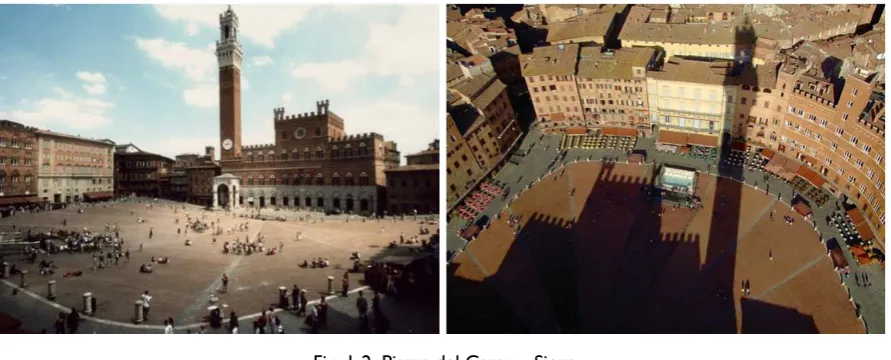
Why piazza is more than “square”
The Italian piazza is not simply the translation of the term “square”, in itself a brutish approximation of the spatial variety of public spaces that for so many years, and in so many different cultures, have symbolized and embodied public life.
Fig. 1-2. Piazza del Campo, Siena.
Sources: on the left https://villaroseto.files.wordpress.com/2013/03/siena3.jpg and on the right https://it.wikipedia.org/wiki/Piazza_del_Campo
Measuring the Magic of Public Space. Le Piazze di Roma
commercial. Luigi Piccinato remarks that at the beginning piazze were spaces devoted specifically to one of the above three functions (piazza della chiesa, piazza del comune, piazza del mercato). With reference to its civic function, it is important to note that the piazza became the place where citizens congregated to affirm their newly conquered independence embodied in the comune (a term still in use in Itay to denote municipalities, and which simply means “shared”,”commonly held”).
The Italian piazza is loaded with a rich array of historic and architectural meanings pointing to it as the “public space par excellence”. Here are some:
- piazza as testimony of historical events;
- piazza d’armi; piazza del mercato; piazza del duomo; - piazza as a political container (rallies, speeches); - piazze as places of elocution and execution; - piazza as a marketplace;
- piazza as an architectural background (e.g. Navona, Piazza San Marco) - piazze as architecture (e.g. San Pietro)
- piazza as the quintessence of “public”.
The piazza is also an inspirer of commonly used Italian idioms such as: “Mettere in piazza” meaning to “make known something that it might be better to maintain private”;
“Scendere in piazza” which means taking action to seize political advantage; “La pubblica piazza” which means a place where any action or activity could not possibly be more manifest; “Spiazzato” which refers to losing one’s point of reference and “Fare una piazzata” meaning coming out with an unexpected action, often accompanied by strong expressions, of an unwelcome vigour.
An exploratory sample: le piazze di Roma
Of all Italian cities, Rome possibly presents the greatest variety of piazza; its piazze storiche” (historic piazze) presents an extreme example of the public-space asymmetry remarked above. Further, Rome’s piazze storiche mark a sharp contrast with their epigones in newly developed peripheral areas because they are points of attraction for the whole city and, of course, for all visitors, national and international.
Measuring the Magic of Rome’s piazze storiche
Whilst in its plainest sense, the piazza is simply a paved urban surface, surrounded by buildings, and connected to the city’s street network; it is also a quaint, respectable and valuable urban space. Therefore, it is inevitable that the piazza’s “urban value” be connected to a number of measurable parameters.
Five of them were selected for the purpose of this brief review. They are: 1) Absence, or severe limitation, of motorized traffic;
2) Functional variety, i.e. the ability of the urban space to perform different functions, either at the same time or during different times of the day;
Pietro Garau
4) Locational value - an admittedly more vague indicator signifying the synergy the piazza has with functions and uses in its adjacency;
5) Historic interest – an aspect indicating the unfair advantage that “old” piazze enjoy over “new” piazze3.
These five parameters are the result of the analysis of a few Roman examples sketched below. Many others could, and perhaps, should have been added such as safety,, or intensity of use. Most of them, in fact, are linked to the “software” of public space (users) as opposed to its hardware (the built environment). But for the time being, these five might suffice.
Fig. 3-4 . Piazza San Giovanni, Rome. Pictures by: Eugenio Monti
Piazza San Giovanni: snails and rallies Free of
motorized traffic Functional variety Architectural value Locational value Historic interest
✔ ✔
While of less than astonishing architectural appeal, Piazza san Giovanni is the largest enclosed public open space in Rome. At the centre of a popular working class
neighbourhood, San Giovanni was famous both for hosting its Saint’s Summer Day and rallies of the PCI, the Italian Communist Party (the saint remains, but the party does not). With the demise of the PCI and the decline of popular political participation, the piazza became a challenge to those who dared repeating the mass gatherings of the past. The last time the piazza hosted a party rally was in 2013, when the populist ”Movimento Cinque Stelle” managed to fill the square in a gesture of defiance that meant to celebrate the end of the established political parties’ political domination. The heirs of the communist party decided instead to give up San Giovanni for their closing event and to hold it in a former vaudeville theatre.
The irony was not missed by the voters. Today, the piazza continues to owe its prestige to its size and the basilica it hosts more than to any degree of pleasantness, plagued as it is to this day by hosting more motorized traffic than it should.
A harmonious redesign of the eighteenth century, Piazza del Popolo achieved new
significance in recent times. As a result of a comprehensive 18th century design to create a
Measuring the Magic of Public Space. Le Piazze di Roma
has also become a passage for all visitors exiting the nearby subway stop and flocking to the via del Corso’s elegant shopping district. For a while, its appeal attracted semi-permanent exhibition infrastructure, a habit thankfully discontinued in recent times. To this day, the piazza (see photograph) also hosts a variety of spontaneous street happenings and events.
Fig. 5-6. Piazza del Popolo, Rome. On the left, source:
https://it.wikipedia.org/wiki/Piazza_del_Popolo_(Roma)#/media/File:Roma_Piazza_del_Popolo_BW_1.JPG On the right, picture by: Eugenio Monti
Piazza del Popolo: from parking lot to urban oasis Free of motorized
traffic
Functional variety
Architectural value
Locational value Historic interest
✔ ✔ ✔ ✔
Marking the eastern boundary of the tiny Vatican state, Piazza San Pietro is one of the few squares of the world reserved exclusively for religious events. While it can be negotiated on foot during weekdays, it is often partitioned to a point where visitors cannot even stand on the foci of the Bernini ellipsed portico to savour a joy of the past - seeing the columns as one. In addition, the northern portico has become a corral for the queues of the faithful waiting to be admitted into the basilica, while access can be granted only at the end of an exhausting security check.
The magnificent Bernini enclosure designed to provide a spectacular spatial introduction to the church, literally exploding from the dense mass of popular tenements immediately preceding it, is in stark contrast with the stubborn clumsiness of the via della Conciliazione, the avenue created in the middle of the twentieth century to provide a grand motorized access to St. Peter’s. To this day, the avenue feeds the temptation to consider everything that is old -worthy of respect, and everything that is new - largely worthless.
Pietro Garau
Fig. 7-8. Piazza San Pietro, Rome. Pictures by: Eugenio Monti
Piazza San Pietro: an imposing public space not quite so public Free of motorized
traffic Functional variety Architectural value Locational value Historic interest
✔ ✔ ✔
One of the Rome piazzas taking its name from a patrician family, Piazza Farnese is strongly characterized by the renaissance façade of the palazzo, now hosting the French Embassy. It is perhaps too solemn and too square (literally and figuratively) for Romans and visitors alike, who tend to prefer the contiguous Campo de Fiori.
Fig. 9-10. On the left: Piazza Farnese, Rome. Source:
https://it.wikipedia.org/wiki/Piazza_Farnese#/media/File:Piazza_Farnese_Rome.jpg
On the right: Piazza Campo de' Fiori, Rome. Source: http://www.prolocoroma.it/piazza-campo-de-fiori/
Piazza Farnese: order and beauty, but little magic Free of
motorized traffic Functional variety Architectural value Locational value Historic interest
✔ ✔ ✔
Measuring the Magic of Public Space. Le Piazze di Roma
uses (vegetable market in the morning, eating and gathering place in the afternoon, favourite spot of the young drinking classes in the evening) and its unique historical
significance, with its statue of the reformist cleric Giordano Bruno on the very spot where he was burned at the stake half a millennium ago.
Another reason of the Campo de Fiori prevalence over Piazza Farnese is its closeness to some of the most popular retail shops in the city as opposed to the patrician upper crust of the Piazza Farnese streets, notably the sanitized, elegant and fairly lifeless via Giulia.
Campo de’ Fiori: a popular favourite Free of
motorized traffic Functional variety Architectural value Locational value Historic interest
✔ ✔ ✔ ✔ ✔
Conclusions
This brings us to the end of our cursory and culpably limited review. We omitted
important examples like Piazza Venezia, the traffic exchange at the opposite end of Piazza del Popolo, former location of the rallies of the infamous fascist regime, and surrounded by a host of architectural horrors; and Piazza del Pantheon, a gem that can be only enjoyed in the week hours of the morning due to the fact that it is now strangled by huge numbers of tourists, vendors, space-gobbling restaurateurs, and many others.
So, we come back to our initial question: in what way can the piazza embody the “urban magic”?
The question is as baffling as its subject. But we have found that there is no single element that makes a great piazza. Getting rid of motorized traffic is important, but not decisive, as in the case of Piazza Farnese. Architectural props and heroics are important as well, but not decisive either, as in the cases of Saint Peter’s and San Giovanni. Certainly, what is important is the harmony of space and use, as in Campo de’ Fiori. Whenever we manage to have a pleasant urban space enriched by variety and life, we can be confident in its success.
Unfortunately, this apparently simple combination is hard to create in outer urban areas, where the frequently combined lack of history, care and good design militate against that important success factor for public space sustainability – attractiveness.
Notes
(1) Many of them are described in the archive section of the Biennial of Public Space’s web site. (2) INU is the acronym of “Istituto Nazionale di Urbanistica”. Of late this non-profit institute,
born in 1930 to cultivate and disseminate the culture of urbanism, has internationalized its mandate through the dissemination of the Charter of Public Space, the preparation of UN-HABITAT’s “Global Public Space Toolkit” and the coordination, in partnership with the China Society of Urban Planners, of the Habitat III Policy Paper on Urban Spatial Strategies.
(3) “Vetustas”, a powerful magnifier of architectural glory that would merit becoming a
The Journal of Public Space 2016 | Vol. 1, n. 1
https://www.journalpublicspace.org
Public Space Trends in Hong Kong.
A view from the New Territories
Hendrik Tieben
The Chinese University of Hong Kong, Hong Kong School of Architecture
Abstract
Hong Kong’s vertical urban landscape, bustling street markets, and multi-layered urban spaces have attracted a range of scholars (Cuthbert and McKinnell, 1997; Smith, 2005; Frampton [et al.], 2010; Shelton [et al.], 2011). Therefore, this paper focuses on aspects of Hong Kong’s public spaces1, which so far have caught less attention, but affect the majority of its residents today. The paper starts with the following observations: (1) More than half of Hong Kong’s population (52,2%) lives today in the New Territories, an area usually outside of international attention (Census 2011)2; (2) Here, most people live in public and private housing estates, constructed over the last 40 years; (3) Individual estates can reach a population size of entire European towns and their “public spaces” – if one can name them as such – follow strict rules and have their own spatial conditions; (4) The street patterns, which connect these estates with their surrounding are fundamentally different from those of the older urban areas on Hong Kong Island and the Kowloon Peninsula. Basically, in these new developments we don’t find the bustling street markets or the complex multi-layered spatial conditions anymore, which have caught most international attention (e.g. Frampton [et al.], 2010); and, (5) through urban renewal and redevelopment these new spatial conditions are introduced also to the older urban areas. As a response, there have been a growing number of initiatives by civil society groups to recapture the original role of streets as public spaces to offer more opportunities for economic and social activities, and re-enable expressions different cultural identities, life styles, and political views3.
Keywords: Public Space; Hong Kong; Streets; New Territories.
THE JOURNA
L OF PUBLIC SPACE
To cite this article:
Tieben, H. (2016). Public Space Trends in Hong Kong. A view from the New Territories. The Journal of Public Space, 1(1), 25-34, DOI: 10.5204/jps.v1i1.7
This article has been peer-reviewed and accepted for publication in The Journal of Public Space. Please see the Editorial Policies under the ‘About’ section of the journal website for further information.
Public Space Trends in Hong Kong. A view from the New Territories
Background
In 2013 UN-Habitat published the report Streets as Public Spaces and Drivers of Urban Prosperity, in which Hong Kong ranked highest among all studied cities in Africa, Asia and Latin America and the Caribbean, in regards to the amount of land allocated to streets and
density of street intersections (UN Habitat, 2013, 72 & 77). In the preface of the report, Joan Clos, Under-Secretary-General and Executive Director of UN-Habitat, highlighted the fundamental importance of street patterns for five dimensions of prosperity: Productivity, infrastructure development, environmental sustainability, quality of life, and equity/social inclusion
(UN-Habitat, 2013, IV). The exceptional high ranking of Hong Kong’s core areas, seems to be supported by other data regarding its economic performance4, and by the urban
experience of bustling street spaces, short walking distances and numerous businesses and activities in the older urban areas on Hong Kong Island and Kowloon Peninsula.
Fig. 1. Intersection Density in Cities Africa, Asia, Latin America & The Caribbean (UN Habitat, 2013, 77).