RESEARCH
Type IIs restriction based combinatory
modulation technique for metabolic pathway
optimization
Lijun Ye
1,2, Ping He
1,2,3, Qingyan Li
1,2, Xueli Zhang
1,2*and Changhao Bi
1,2*Abstract
Background: One of the most important research subjects of metabolic engineering is pursuing a balanced metabolic pathway, which is the basis of an efficient cell factory. In this work, we dedicated to develop a simple and efficient technique to modulate expression of multiple genes simultaneously, and select for the optimal regulation pattern.
Results: A Type IIs restriction based combinatory modulation (TRCM) technique was designed and established in the research. With this technique, a plasmid library containing variably regulated mvaE, mvaS, mvaK1, mvaD and mvaK2 of the mevalonate (MVA) pathway were obtained and transformed into E. coli DXS37-IDI46 to obtain a β-carotene producer library. The ratio of successfully assembled plasmids was determined to be 35%, which was increased to 100% when color based pre-screening was applied. Representative strains were sequenced to contain diverse RBSs as designed to regulate expression of MVA pathway genes. A relatively balanced MVA pathway was achieved in E. coli cell factory to increase the β-carotene yield by two fold. Furthermore, the approximate regulation pattern of this optimal MVA pathway was illustrated.
Conclusions: A TRCM technique for metabolic pathway optimization was designed and established in this research, which can be applied to various applications in terms of metabolic pathway regulation and optimization.
Keywords: Metabolic pathway optimization, Type IIs restriction, β-carotene, MVA pathway, Terpene
© The Author(s) 2017. This article is distributed under the terms of the Creative Commons Attribution 4.0 International License
(http://creativecommons.org/licenses/by/4.0/), which permits unrestricted use, distribution, and reproduction in any medium,
provided you give appropriate credit to the original author(s) and the source, provide a link to the Creative Commons license, and indicate if changes were made. The Creative Commons Public Domain Dedication waiver (http://creativecommons.org/
publicdomain/zero/1.0/) applies to the data made available in this article, unless otherwise stated.
Background
As the development of Synthetic Biology and Meta-bolic Engineering, various microbial cell factories have been developed for producing value-added chemical compounds. However, engineering of cell metabolism often disturbs the metabolic network,triggers energetic and objective inefficiency inside the cell, and impedes
cell metabolism [1]. Hence, one of the most important
research subjects of metabolic engineering is pursuing the balanced metabolic network and pathways. Tech-niques have been developed to analyze metabolic
path-ways, including genome-scale models and C13-metabolic
flux analysis. And there have been strategies developed to relieve the metabolic burden, such as enhancing res-piration, co-utilizing nutrient resources, decoupling cell growth with production phases, and dynamic
regula-tory systems [1]. As for a specific metabolic pathway,
gene expression level is the key effector of the
path-way efficiency [2]. Lower expression of genes decreases
metabolic pathway flux, while overexpressed genes may over-consume building blocks and cause cells metabolic
burden [3]. Furthermore, imbalanced pathway may cause
accumulation of pathway intermediates, some of which
may even be toxic and jeopardize cell growth [4].
Due to the complexity of metabolic network in organ-isms and difficulty to precisely control expression of certain gene, it is almost impossible to rationally design and construct an optimized metabolic pathway. In most metabolic engineering projects, one common way was to
Open Access
modulate gene expression one by one [5]. With this strat-egy, the possibility to achieve an optimized regulation pattern is very low. A better solution was to analyze all possible expression levels of pathway genes in a combi-natorial fashion. With this strategy, Yin et al. constructed a plasmid library containing the possible combinations
of gene regulation patterns [6]. A similar strategy was
employed by Xu et al. to optimize fatty acid pathway. Plas-mids of various copy numbers were used to carry expres-sion genes for the first round of optimization, which was followed by fine tuning expression with four RBS
ele-ments [7]. However, in their work, regulatory parts were
limited and the plasmids were exhaustively constructed one by one, which limited the experiment outcome and made the process laborious. The same group also estab-lished a BioBrick based method with specially designed restriction adapters. Genes with regulatory elements could be iteratively integrated into the ePathBrick vectors
to create a diversified expression library [8]. Similarly,
Zelcbuch et al. created a plasmid library construction method to “span high-dimensional expression space”
[9]. In their methods, the libraries were constructed with
multiple rounds of plasmid construction, which made the practice very time consuming. In the work of Lee et al., a combinatorial library was established by Gibson
assem-bly based method in one reaction [10, 11]. However, only
five regulatory parts were employed, which decreased the diversity of the combinatorial library. Based on the extensive researches and great progress achieved by fel-low researchers in this subject, we were able to develop a convenient method for constructing complex combinato-rial expression library, which was aimed for optimizing a metabolic pathway with maximal outcome and minimal lab hours.
β-carotene, one kind of isoprenoids, is one of the
strongest antioxidant in nature [12], and has tremendous
potential in healthcare and pharmaceutical industries
[13, 14]. Isoprenoids are all derived from two
five-car-bon building blocks, isopentenyl diphosphate (IPP) and dimethylallyl diphosphate (DMAPP), which are syn-thesized either by the mevalonate (MVA) pathway in eukaryotes, archaea, and some bacteria or 2-C-methyl-d-erythritol-4-phosphate (MEP) pathway in other
prokar-yotes and plastids in plants (Fig. 1) [13–15]. In MVA
pathway, two acetyl-CoA are condensed into one atetoa-cetyl-CoA, which is then reduced into 3-hydroxy-3-me-thyl-glutaryl-coenzyme A (HMG-CoA). The CoA group is released from HMG-CoA to form MVA, which is phosphorylated into mevalonate-5-phosphate, and then mevalonate-5-diphosphate. This compound is coverted
into IPP, the common precusor of isoprenoids (Fig. 1).
The heterologous MVA pathways have been introduced
into E. coli to improve precursor supply of IPP and
DMAPP [16–20]. Isoprenoid production was improved
by employment of the bottom portion of MVA pathway
derived from Streptococcus pneumoniae and
supplemen-tation of MVA in culture [18, 20]. Lycopene production
of E. coli with only native MEP pathway was increased twofold with introduction of the whole MVA
path-way from Streptomyces sp. CL190 [19]. However,
over-expression of mevalonate pathway genes was reported to inhibit cell growth. Pitera et al. found that accumula-tion of MVA pathway intermediate HMG-CoA inhibited
cell growth, which was caused by overexpression of atoB,
mvaS and hmg1 [4]. Mevalonate kinase (MK), encoded
by erg12, was identified as another rate-limiting enzyme when MVA pathway was adopted for amorphadiene
pro-duction in E. coli [21]. Thus, the MVA pathway has to be
expressed in an optimized and balanced status to benefit isoprenoid cell factories, otherwise an unbalanced MVA pathway would impede the growth and production. In this work, an MVA pathway optimized by combinatorial expression library technique was to be introduced into
MEP pathway dependent E. coli cell factory for
improv-ing β-carotene production (Fig. 2).
Methods
Strains, medium and growth conditions
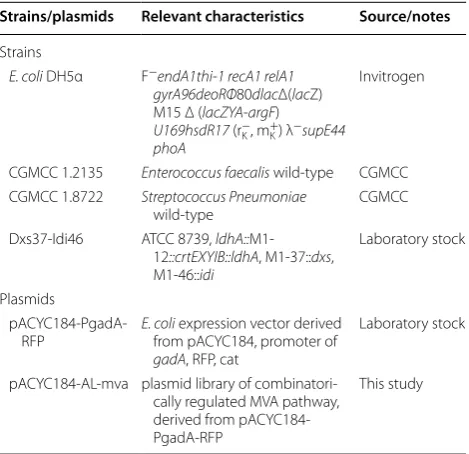
Strains used in this study are listed in Table 1. During
strain construction, cultures were grown aerobically at 30 or 37 °C in Luria broth (per liter: 10 g Difco tryptone, 5 g Difco yeast extract and 5 g NaCl) and fermentation medium (per liter: 10 g Difco yeast extract, 15 g glycerol,
10.5 g K2HPO4.3H2O, 6 g (NH4)2HPO4, 5 g MgSO4·7H2O,
1.84 g citric acid monohydrate and 10 mL microele-ments solution; Microelemicroele-ments solution per liter: 10 g
FeSO4·7H2O, 5.25 g ZnSO4·7H2O, 3.0 g CuSO4·5H2O,
0.5 g MnSO4·4H2O, 0.23 g Na2B4O7·10H2O, 2.0 g CaCl2
and 0.1 g (NH4)6Mo7O24). For β-carotene production,
single colonies were picked from LB plate and
inocu-lated into 15 × 100 mm tubes containing 4 mL LB with
or without 34 mg/L chloramphenicol, and grown at 30 °C and 250 rpm overnight. Seed culture was subsequently inoculated into 100 ml flask containing 10 mL
fermen-tation medium at an initial OD600 of 0.05, with or
with-out 34 mg/L chloramphenicol, and grown at 30 °C and 250 rpm. After growth for 24 h, cells were collected for measurement of β-carotene production.
Genes, vector and primers
MVA pathway genes mvaE, mvaS, mvaK1, mvaD, and
mvaK2 were amplified from genomic DNA of
Enterococ-cus faecalis CGMCC No.1.2135 using primer set Ga2-R1-EfmvaE-F/Ga2-R1-EfmvaE-R, Ga3-R1-EfmvaS-F/
Ga3-R1-EfmvaS-R, and from genomic DNA of
set Ga46-R1-SpmvaK1-F/Ga46-R1-SpmvaK1-R, Ga7-R1-SpmvaD-F/Ga7-R1-SpmvaD-R, and Ga8-R1-Spm-vaK2-F/Ga8-R1-SpmvaK2-R respectively (Additional
file 1: Table S1). The DNA fragments used for
assem-bly were gel purified and designated as Ga2-mvaE, Ga3-mvaS, Ga46-mvaK1, Ga7-mvaD and Ga8-mvaK2
(Fig. 1b). Vector Fragment Ga91-184A was amplified
from pACYC184-PgadA-RFP, and subjected to DpnI
digestion (10 U, 16 h, 37 °C) and gel purification. PCR
was performed with PrimeSTAR® HS DNA
Polymer-ase (Takara) with primers purchPolymer-ased from GENEWIZ (Suzhou, China). All assembly primers were designed with optimized linkers for Type IIs restriction enzyme based assembly, in which forward primers for
amplifica-tion of genes were embedded with an RBS library at 5′
ends. Primers used in this study are summarized in
Addi-tional file 1: Table S1.
Construction of mva operon variants using TRCM
DNA fragments were assembled by Golden Gate DNA
assembly method [22, 23]. 100 nanogram vector fragment
Ga91-184A and equimolar amount of PCR amplified genes Ga2-mvaE, Ga3-mvaS, Ga46-mvaK1, Ga7-mvaD and Ga8-mvaK2 were mixed in 20 μL Golden Gate
reac-tion solureac-tion with 1 μL BsaI-HF, 1 μL T4 ligase (New
Eng-land Biolabs, Ipswich, MA) and 1× T4 ligase buffer. The reaction was carried out in a thermocycler using the fol-lowing program: 37 °C for 5 min, 37 °C for 5 min (step 2), 16 °C for 10 min (step 3), step 2 and 3 for 20 cycles, 16 °C for 20 min, 37 °C for 30 min, 75 °C for 6 min, and 4 °C for hold. After PCR, 0.5 μL plasmid-safe nuclease (Epicenter), and 1 μL of 25 mM ATP was added to the reaction, which was incubated at 37 °C for 15 min. 1.5 μL of the resultant reaction solution were transformed into 80 μL competent
DXS37-IDI46 cells to obtain the library [24].
DXP
MEP
CDP-ME
CDP-MEP
MEC
dxrispF
ispG ispE ispD NADPH
CTP PPi
ATP ADP
CMP NADP+
HMBPP
DMAPP
IPP
idi NADPHNADP+
G-3P
dxs CO2
Pyruvate
Oxidized ferridoxin Reduced ferridoxin
ispH
MEP Pathway
2 acetyl-CoA
Acetoacetyl-CoA
HMG-CoA
MVA
MVA-5-P
MVA-5-PP
mvaE
mvaS
mvaK
2mvaD
mvaK
1mvaE
CoA
NADPH
2NADPH
2NADP
ATP ADP
ADP
ADP CO2
p ATP
ATP 2NADP
MVA Pathway
FPP
GGPP
crtE
Phytoene
crtB
Lycopene
crtI
IPP PPi 2PPi 2GGPP
ispA
β-carotene
crtY
β-carotene synthesis pathway
Fig. 1 Illustration of β-carotene synthesis pathway in E. coli DXS37-IDI46 (pACYC184-AL-mva). This route involved β-carotene synthesis module, MEP module and MVA module. MVA Genes modulated with TRCM were underlined. G-3-P glyceraldehyde-3-phosphate, DXP 1-deoxy-d
-xylulose-5-phosphate, MEP 2C-methyl-d-erythritol-4-phosphate, CDP-ME 4-diphospho-cytidyl-2C-methyl-d-erythritol, CDP-MEP
4-diphosphocytidyl-2C-methyl-d-erythritol-2-phosphate, MEC 2C-methyl-d-erythritol-2,4-cyclodiphosphate, HMBPP 1-hydroxy-2-methyl-2-(E)-butenyl-4-diphosphate, HMG-CoA 3-hydroxy-3-methyl-glutaryl-coenzyme A, MVA mevalonate, MVA-5-P mevalonate-5-phosphate, MVA-5-PP mevalonate-5-diphosphate, IPP
In order to determine whether the MVA pathway genes were successfully incorporated into vector backbone, recombinant clones were subjected to colony PCR anal-ysis. PCR primers were designed to amplify the region
from mvaE (the first gene on plasmid) to mvaK2 (the last
gene on plasmid) by primers fE-JF and pK2-JR
(Addi-tional file 1: Table S1), which had a product size of 3.8
Kbp. A master mix with 1× Es Taq MasterMix (CWBio, Peking, China) and 0.4 μM forward and reverse primer
(Additional file 1: Table S1) was prepared, and 20 μL
master mix was dispensed into each PCR tubes. Colonies were directly transferred from LB agar plates into the PCR tubes with sterile toothpicks. The PCR cycling was started with an initial denaturation temperature at 94 °C for 10 min, followed by 30 cycles (94 °C, 30 s; 61 °C, 30 s; and 72 °C, 2 min) and one fill-up cycle (72 °C, 2 min). The PCR products were analyzed on agarose–TAE gels.
Measurement of β‑carotene titer
Production of β-carotene was quantified by measuring absorption of acetone-extracted β-carotene at 453 nm as
previously reported [24]. A standard curve was obtained
by measuring OD453 of β-carotene standard samples (Cat.
No. C4582, Sigma, USA) with varied concentrations using a Shimadzu UV-2550 spectrophotometer (Shimadzu, Kyoto, Japan). The results represented the mean ± stand-ard deviation (S.D.) of three independent experiments. Dry cell weight (DCW) was calculated based on optical
density at 600 nm (1 OD600 = 323 mg DCW).
Calculation of MVA pathway genes RBS strength of strains from TRCM libraries
RBS sequences of mvaE, mvaS, mvaK1, mvaD, and mvaK2
in representative strains were obtained by PCR and DNA sequencing. Their theoretical RBS strength characterized
Fig. 2 Modulation and optimization of MVA pathway with TRCM technique. a Primer design for obtaining assembly parts containing degener-ate RBS sequences. Primers for amplification of MVA genes were embedded with BsaI recognition site, optimized four bp linkers, and random RBS sequence AGGAGRNNNNNN. b TRCM DNA parts for assembly. One ready-made vector part was used to assemble with five library parts. c Combina-tory expression library of MVA pathway. The plasmid library contained all five genes regulated with degenerate RBSs in various combinations
Table 1 Strains and plasmids in this study
Strains/plasmids Relevant characteristics Source/notes
Strains
E. coli DH5α F−endA1thi-1 recA1 relA1
gyrA96deoRΦ80dlacΔ(lacZ)
M15 Δ (lacZYA-argF)
U169hsdR17 (rK−, m
K
+) λ−supE44
phoA
Invitrogen
CGMCC 1.2135 Enterococcus faecalis wild-type CGMCC CGMCC 1.8722 Streptococcus Pneumoniae
wild-type CGMCC Dxs37-Idi46 ATCC 8739, ldhA::
M1-12::crtEXYIB::ldhA, M1-37::dxs,
M1-46::idi
Laboratory stock
Plasmids
pACYC184-PgadA-RFP
E. coli expression vector derived
from pACYC184, promoter of
gadA, RFP, cat
Laboratory stock
pACYC184-AL-mva plasmid library of combinatori-cally regulated MVA pathway, derived from pACYC184-PgadA-RFP
by the value of translation initiation rate was calculated
with the RBS Calculator [25, 26]. The RBS sequence
diversity of the combinatory library was analyzed with
the Weblogo software [27].
Results and discussions
Design of a Type IIs restriction based combinatory modulation technique (TRCM) for metabolic pathway optimization
With the purpose of developing a simple technique to modulate and optimize expression of multiple genes simultaneously, we designed a Type IIs restriction based combinatory modulation technique (TRCM) for
meta-bolic pathway optimization as illustrated in Fig. 2. Variably
regulated genes were obtained by PCR amplification with extended primers, in which degenerate RBS nucleotides
were embedded at the 5′ ends. Specifically designed
link-ers for Type IIs restriction enzymes were also imbedded in the primers to ensure the assembly pattern and efficiency.
Type IIs restriction based Golden Gate [23] was
employed as DNA assembly method in this work, which has several advantages. First, there is no PCR reaction involved in the assembling process, which reduces the possibility of mutation compared with other PCR based
assembly methods such as Gibson and CPEC [10];
sec-ond, the ligase facilitated irreversible ligation greatly improves assembly efficiency compared with
homolo-gous arm based method [23]. With this method, gene
parts of a pathway were assembled with a vector part to form an expression plasmid. Since each gene part was constructed to carry a collection of regulatory parts, a combinatory plasmid library with variably regulated pathway genes was created, which was subsequently transformed into dedicated host to be screened and selected for strains carrying optimized pathways.
This technique was designed with the modularized strategy to be as simple as possible. The vector part was ready-made for all reactions, providing a stable plasmid backbone. By incorporation of fixed linkers and regula-tory elements in primers for amplification of genes, the only variable parts of this method were the actual PCR
primer sequences of pathway genes (Fig. 2a).
Development and application of TRCM for MVA pathway optimization
Our lab has constructed a few E. coli β-carotene
produc-ers, such as DXS37-IDI46 and CAR001, by modulating several key genes of the MEP pathway module, the pen-tose phosphate pathway (PPP) module, the ATP module
and the tricarboxylic acid cycle (TCA) module [24]. In
this work, a heterologous MVA pathway optimized with TRCM technique was introduced into DXS37-IDI46 for
further improving its β-carotene production (Fig. 2).
Since MVA pathway upstream genes mvaS, mvaE from
Enterococcus faecalis and downstream genes mvaK1,
mvaK2, mvaD from Streptococcus pneumoniae were
reported to be successfully expressed in E. coli, they were
selected to be used in this research [17]. As designed with
the TRCM technique, primers for PCR amplification of
vector and MVA genes were embedded with BsaI
rec-ognition sites GGTCTC and specific four bp linkers, in order to be assembled in sequence. These linkers were rationally designed and experimentally tested to enable efficient assembly of DNA parts regardless of condition
change (Fig. 2a).
To create a library of differently regulated genes, the RBS sequences of each gene were degenerated. For this purpose, forward primers of MVA genes Ga2-R1-Efm-vaE-F, Ga3-R1-EfmvaS-F, Ga46-R1-SpmvaK1-F, Ga7-R1-SpmvaD-F and Ga8-R1-SpmvaK2-F were embedded with the random RBS sequence AGGAGRNNNNNN behind the 4 bp linkers. The starting code ATG of each gene was located behind the six Ns, which was also the
starting point of actual PCR primers (Fig. 1a).
Gene parts, which carried front and back linkers for assembly in sequence, were obtained with PCR amplifi-cation. In Golden Gate assembly reaction, PCR amplified
mvaS, mvaE, mvaK1, mvaK2 and mvaD parts were mixed
with the ready-made vector part Ga91–184A (Fig. 1b).
After reaction, a plasmid library was created, which had differentially regulated MVA genes in various combina-tions. Theoretically, all patterns of differently expressed MVA pathway could be obtained in such a library
(Fig. 1c). With this simple method, we achieved the goal
of spanning high-dimensional expression space [9].
β‑carotene production was improved with TRCM optimized MVA pathway
To select for the optimally expressed MVA pathways, Golden Gate reaction solution containing plasmid library was transformed into the β-carotene producer
strain DXS37–IDI46 (Table 1). After electroporation,
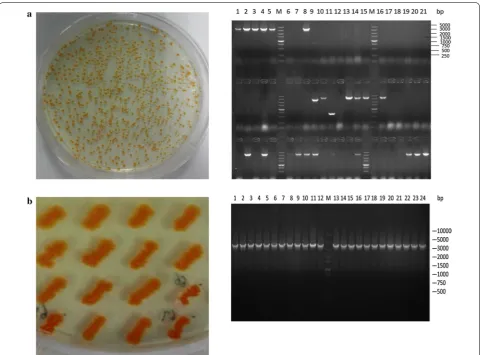
transformed cells were plated on solid LB with 34 mg/L chloramphenicol to select for plasmid bearing trans-formants. Orange colored colonies with various inten-sity appeared on the plates as expected after incubation
overnight (Fig. 3a), which indicated their different
capac-ity of β-carotene production. Colonies were randomly picked and analyzed by colony PCR to determine the ratio of successful assembly, for which PCR primers were
designed to amplify the region from mvaE to mvaK2 with
primers fE-JF and pK2-JR (Additional file 1: Table S1),
with an expected product size of 3.8 Kbp. As illustrated in
Fig. 3a of TAE gel electrophoresis, 22 of 63 screened
determine this ratio of strains with increased β-carotene production, transformants were picked and evenly re-streaked on fresh chloramphenicol LB plates, which was to improve the reliability of color based β-carotene
pro-duction screening (Fig. 3b). Colonies with deeper orange
color were selected for PCR analysis. The gel
electropho-resis (Fig. 3b) indicated a positive ratio of 100%, since all
24 strains gave the correct PCR products. The results indicated a decent assembly ratio of 35% was achieved by TRCM technique with modulation of five genes simulta-neously, and a higher successful ratio could be achieved with a simple color based pre-screening process.
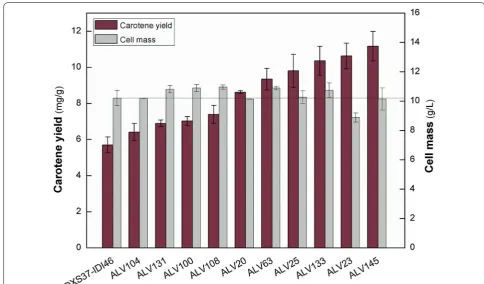
To select strains with significantly improved β-carotene producing capacity, colonies with deeper color were cul-tured aerobically, and the β-carotene titer was measured. Ten representative strains ALV104, ALV131, ALV100, ALV108, ALV20, ALV63, ALV25, ALV133, ALV23, and
ALV145 were determined to have improved β-carotene production to various extent in comparison with
DXS37-IDI46, as illustrated in Fig. 4. Strain ALV145 had the
highest yield of 11.17 ± 0.82 mg/g, which was a 96.0%
increase compared with the parent strain DXS37-IDI46. The significant improvement indicated that an efficient cell factory with optimized metabolic pathway could be obtained by the simple TRCM technique.
A combinatorial expression library with five genes regulated by diverse RBSs was obtained with TRCM technique
To analyze the degenerated RBS sequences regulating MVA gene, PCR was used to amplify regions containing the RBS sequences of MVA operon genes in representa-tive strains. The PCR products were sequenced subse-quently to obtain the RBS sequence information, which
Fig. 3 Determination of successfully assembled combinatory expression library pACYC184-AL-mva in host DXS37-IDI46. A 35% successful assembly ratio was determined by PCR analysis of randomly selected colonies, and a 100% assembly ratio was achieved with a color based pre-screening process. a DXS37-IDI46 transformed with TRCM assembly reaction solution after overnight incubation on LB plate. Colonies were randomly picked and analyzed by colony PCR to determine ratio of successfully assembled pACYC184-AL-mva. M marker, 1–21 colonies picked from LB plate.
b Colonies from original plates were picked and evenly re-streaked on fresh chloramphenicol LB plates, then were validated by colony PCR. M
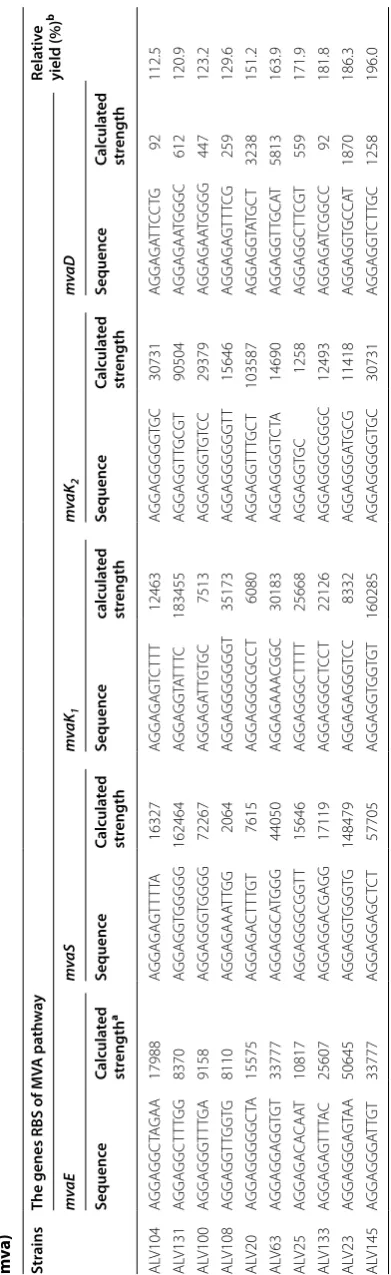
was summarized in Table 2. As designed, a combinato-rial expression library with the five MVA genes regu-lated by diverse RBSs was obtained. For each strain, RBSs of the five genes were all different; and for each gene, all ten RBSs were not same either. Diversity of the degener-ate RBS sequence RNNNNNN from combinatory library
was further analyzed with the Weblogo software [27]. A
good but not great diversity was obtained for each of the five MVA genes, probably due to the low sample num-ber, which was only ten for one gene. However, when all fifty RBS sequences were subjected to calculation, a logo
with very high diversity was achieved (Additional file 2:
Figure S1). In addition, among the fifty sequenced RBSs, ratio of the highest calculated RBS strength to the
low-est was 183,455/92 [25, 26], which indicated an
expres-sion dynamic range of about 2000-fold. The results proved that TRCM technique process did not create significant bias, and were able to generate quite diverse combinatory expression library.
An approximate expression pattern of optimal MVA pathway was illustrated
To illustrate a general and approximate expression
pat-tern of an efficient MVA pathway in E. coli cell factories,
RBS strength of the MVA genes was analyzed with the
RBS Calculator [25, 26]. Calculated RBS strength was
represented by the translation initiation rate as listed in
Table 2. The calculated RBS strength was by no means
a very accurate measurement of the expression status of
mvaE, mvaS, mvaK1, mvaD and mvaK2, however, could
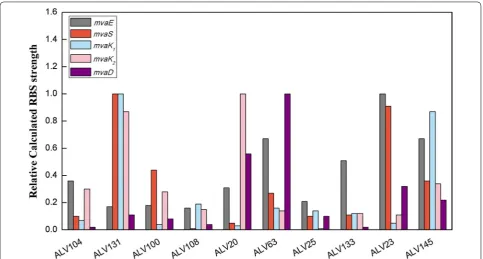
give a good estimation of a general trend of the optimized expression status of MVA pathway. For better illustration, the highest RBS strength for each gene was defined as 1, and a relative RBS strength of the ten strains for this gene
was calculated accordingly (Fig. 5). The ten strains are
lined up along the X axis according to their β-carotene yield. MVA gene expression pattern of ALV145 strain with the highest yield was obvious, that all genes were regulated to a medium level. In contrast, some of the inefficient strains had one or more MVA genes fell to very low expression level, or one or more genes reached the highest level. It was reported that some MVA path-way intermediates were toxic, for example HMG-CoA, accumulation of which affected cell growth and pathway
efficiency [4]. Besides, Mevalonate kinase (MK), encoded
by mvaK1, was identified as a rate-limiting enzyme [21].
Thus in an optimized MVA pathway, mvaE should be
coordinately expressed with mvaS to avoid HMG-CoA
Table
2
MV
A gene RBS sequenc
es with their c alcula ted str ength of repr esen ta tiv e str ains fr om the c ombina tor y e xpr ession libr ar y D XS37-IDI46 (pA CY C184-AL -mv a)
a C
alcula ted S tr ength w as r epr esen ted b
y the tr
ansla tion initia tion r at e calcula ted b
y RBS Libr
ar y C alcula tor [ 9 , 17 ]
b R
ela
tiv
e yield c
ompar
ed with their par
en t str ain D XS37-IDI46 Str ains
The genes RBS of MV
accumulation, and a higher expression of mvaK1 is
desired. It was found by the expression analysis, except ALV131, most of the inefficient strains did not follow these two rules.
Analysis of the representative strains indicated that an efficient MVA pathway contained genes expressed at a
medium level, among which mvaE coordinately expresses
with mvaS to avoid HMG-CoA accumulation, and a
higher expression level of mvaK1 is beneficial.
Conclusion
A TRCM technique was designed and established in the research, which could be easily applied to various applications in terms of metabolic pathway regula-tion and optimizaregula-tion. An optimized MVA pathway was constructed with TRCM to increase β-carotene
yield of E. coli cell factory by twofold, and the optimal
regulation pattern of MVA pathway was analyzed and illustrated.
Additional files
Additional file 1: Table S1. Oligonucleotides used in this study.
Additional file 2: Figure S1. The sequence logo diagrams of the
degen-erate nucleotides in RBSs. Plasmid maps and DNA sequences.
Abbreviations
LB: lysogeny broth; RBS: ribosome-binding site; DCW: dry cell weight; ATP: adenosine triphosphate.
Authors’ contributions
YL and HP planned and performed experiments, analyzed and interpreted the data. LQ, BC and ZX supervised the study, designed experiments and inter-preted the results. YL wrote the manuscript. All authors read and approved the final manuscript.
Author details
1 Tianjin Institute of Industrial Biotechnology, Chinese Academy of Sciences, Tianjin 300308, People’s Republic of China. 2 Key Laboratory of Systems Micro-bial Biotechnology, Chinese Academy of Sciences, Tianjin 300308, People’s Republic of China. 3 School of Pharmacy, East China University of Science and Technology, Shanghai 200237, People’s Republic of China.
Acknowledgements
We would like to thank the two great reviewers this manuscript is lucky to have, who took a lot of time and made tremendous efforts to give very precise criticism and very constructive suggestions to help make this manuscript better.
Competing interests
The authors declare that they have no competing interests.
Availability of data and materials
All supporting data is present in the article and the supplemental material documents. Specifically, plasmid maps and DNA sequence data are repent in Additional file 2.
Consent for publication
I hereby give the Journal of Microbial Cell Factories the right and permission to publish this article.
• We accept pre-submission inquiries
• Our selector tool helps you to find the most relevant journal • We provide round the clock customer support
• Convenient online submission • Thorough peer review
• Inclusion in PubMed and all major indexing services • Maximum visibility for your research
Submit your manuscript at www.biomedcentral.com/submit
Submit your next manuscript to BioMed Central
and we will help you at every step:
Funding
This research was supported by grants from National High Technology Research and Development Program of China (2015AA020202), Tianjin Key Technology RD program of Tianjin Municipal Science and Technology Commission (Y5M2121111), National Natural Science Foundation of China (31522002), Natural Science Foundation of Tianjin (15JCYBJC49400), and Chi-nese Academy of Sciences (NN-CAS) Research Fund (NNCAS-2015-2).
Received: 6 December 2016 Accepted: 8 March 2017
References
1. Wu G, Yan Q, Jones JA, Tang YJ, Fong SS, Koffas MA. Metabolic burden: cornerstones in synthetic biology and metabolic engineering applica-tions. Trends Biotechnol. 2016;34:652–64.
2. Scott M, Gunderson CW, Mateescu EM, Zhang Z, Hwa T. Interdependence of cell growth and gene expression: origins and consequences. Science. 2010;330:1099–102.
3. Glick BR. Metabolic load and heterologous gene expression. Biotechnol Adv. 1995;13:247–61.
4. Pitera DJ, Paddon CJ, Newman JD, Keasling JD. Balancing a heterologous mevalonate pathway for improved isoprenoid production in Escherichia coli. Metab Eng. 2007;9:193–207.
5. Lu J, Tang J, Liu Y, Zhu X, Zhang T, Zhang X. Combinatorial modulation of galP and glk gene expression for improved alternative glucose utilization. Appl Microbiol Biotechnol. 2011;93:2455–62.
6. Yin L, Zhao J, Chen C, Hu X, Wang X. Enhancing the carbon flux and NADPH supply to increase l-isoleucine production in Corynebacterium glutamicum. Biotechnol Bioprocess Eng. 2014;19:132–42.
7. Xu P, Gu Q, Wang W, Wong L, Bower AG, Collins CH, Koffas MA. Modular optimization of multi-gene pathways for fatty acids production in E. coli. Nat Commun. 2013;4:1409.
8. Xu P, Vansiri A, Bhan N, Koffas MA. ePathBrick: a synthetic biology platform for engineering metabolic pathways in E. coli. ACS Synth Biol. 2012;1:256–66.
9. Zelcbuch L, Antonovsky N, Bar-Even A, Levin-Karp A, Barenholz U, Dayagi M, Liebermeister W, Flamholz A, Noor E, Amram S, et al. Spanning high-dimensional expression space using ribosome-binding site combinato-rics. Nucleic Acids Res. 2013;41:e98.
10. Gibson DG, Young L, Chuang R-Y, Venter JC, Hutchison CA, Smith HO. Enzymatic assembly of DNA molecules up to several hundred kilobases. Nat Methods. 2009;6:343–5.
11. Lee ME, Aswani A, Han AS, Tomlin CJ, Dueber JE. Expression-level optimi-zation of a multi-enzyme pathway in the absence of a high-throughput assay. Nucleic Acids Res. 2013;41:10668–78.
12. Ajikumar PK, Tyo K, Carlsen S, Mucha O, Phon TH, Stephanopoulos G. Terpenoids: opportunities for biosynthesis of natural product drugs using engineered microorganisms. Mol Pharm. 2008;5:167–90.
13. Das A, Yoon SH, Lee SH, Kim JY, Oh DK, Kim SW. An update on microbial carotenoid production: application of recent metabolic engineering tools. Appl Microbiol Biotechnol. 2007;77:505–12.
14. Lee PC, Schmidt-Dannert C. Metabolic engineering towards biotech-nological production of carotenoids in microorganisms. Appl Microbiol Biotechnol. 2002;60:1–11.
15. Yadav VG, De Mey M, Giaw Lim C, Kumaran Ajikumar P, Stephanopoulos G. The future of metabolic engineering and synthetic biology: towards a systematic practice. Metab Eng. 2012;14:233–41.
16. Martin VJ, Pitera DJ, Withers ST, Newman JD, Keasling JD. Engineering a mevalonate pathway in Escherichia coli for production of terpenoids. Nat Biotechnol. 2003;21:796–802.
17. Yoon SH, Lee SH, Das A, Ryu HK, Jang HJ, Kim JY, Oh DK, Keasling JD, Kim SW. Combinatorial expression of bacterial whole mevalonate pathway for the production of beta-carotene in E. coli. J Biotechnol. 2009;140:218–26. 18. Yoon SH, Lee YM, Kim JE, Lee SH, Lee JH, Kim JY, Jung KH, Shin YC,
Keasling JD, Kim SW. Enhanced lycopene production in Escherichia coli engineered to synthesize isopentenyl diphosphate and dimethylallyl diphosphate from mevalonate. Biotechnol Bioeng. 2006;94:1025–32. 19. Vadali RV, Fu Y, Bennett GN, San KY. Enhanced lycopene productivity by
manipulation of carbon flow to isopentenyl diphosphate in Escherichia coli. Biotechnol Prog. 2005;21:1558–61.
20. Yoon S-H, Park H-M, Kim JE, Lee SH, Choi MS, Kim JY, Oh DK, Keasling JD, Kim SW. Increased β-carotene production in recombinant Escherichia coli harboring an engineered isoprenoid precursor pathway with mevalonate addition. Biotechnol Prog. 2007;23:599–605.
21. Anthony JR, Anthony LC, Nowroozi F, Kwon G, Newman JD, Keasling JD. Optimization of the mevalonate-based isoprenoid biosynthetic pathway in Escherichia coli for production of the anti-malarial drug precursor amorpha-4,11-diene. Metab Eng. 2009;11:13.
22. Liang J, Chao R, Abil Z, Bao Z, Zhao H. FairyTALE: a high-throughput TAL effector synthesis platform. ACS Synth Biol. 2014;3:67–73.
23. Engler C, Marillonnet S. Generation of families of construct variants using golden gate shuffling. Methods Mol Biol. 2011;729:167–81.
24. Zhao J, Li Q, Sun T, Zhu X, Xu H, Tang J, Zhang X, Ma Y. Engineering central metabolic modules of Escherichia coli for improving beta-carotene pro-duction. Metab Eng. 2013;17:42–50.
25. Salis HM, Mirsky EA, Voigt CA. Automated design of synthetic ribo-some binding sites to control protein expression. Nat Biotechnol. 2009;27:946–50.
26. Espah Borujeni A, Channarasappa AS, Salis HM. Translation rate is controlled by coupled trade-offs between site accessibility, selective RNA unfolding and sliding at upstream standby sites. Nucleic Acids Res. 2014;42:2646–59.