RESEARCH
Exploiting members of the BAHD
acyltransferase family to synthesize multiple
hydroxycinnamate and benzoate conjugates
in yeast
Aymerick Eudes
1,2, Maxence Mouille
1,2, David S. Robinson
3, Veronica T. Benites
1,2,4, George Wang
1,2,
Lucien Roux
1,2,5, Yi‑Lin Tsai
1,2, Edward E. K. Baidoo
1,2, Tsan‑Yu Chiu
1,2, Joshua L. Heazlewood
1,2,6,
Henrik V. Scheller
1,2, Aindrila Mukhopadhyay
1,2, Jay D. Keasling
1,2,7,8, Samuel Deutsch
3and Dominique Loqué
1,2,9*Abstract
Background: BAHD acyltransferases, named after the first four biochemically characterized enzymes of the group, are plant‑specific enzymes that catalyze the transfer of coenzyme A‑activated donors onto various acceptor mol‑ ecules. They are responsible for the synthesis in plants of a myriad of secondary metabolites, some of which are ben‑ eficial for humans either as therapeutics or as specialty chemicals such as flavors and fragrances. The production of pharmaceutical, nutraceutical and commodity chemicals using engineered microbes is an alternative, green route to energy‑intensive chemical syntheses that consume petroleum‑based precursors. However, identification of appropri‑ ate enzymes and validation of their functional expression in heterologous hosts is a prerequisite for the design and implementation of metabolic pathways in microbes for the synthesis of such target chemicals.
Results: For the synthesis of valuable metabolites in the yeast Saccharomyces cerevisiae, we selected BAHD acyltrans‑ ferases based on their preferred donor and acceptor substrates. In particular, BAHDs that use hydroxycinnamoyl‑CoAs and/or benzoyl‑CoA as donors were targeted because a large number of molecules beneficial to humans belong to this family of hydroxycinnamate and benzoate conjugates. The selected BAHD coding sequences were synthe‑ sized and cloned individually on a vector containing the Arabidopsis gene At4CL5, which encodes a promiscuous 4‑coumarate:CoA ligase active on hydroxycinnamates and benzoates. The various S. cerevisiae strains obtained for co‑expression of At4CL5 with the different BAHDs effectively produced a wide array of valuable hydroxycinnamate and benzoate conjugates upon addition of adequate combinations of donors and acceptor molecules. In particular, we report here for the first time the production in yeast of rosmarinic acid and its derivatives, quinate hydroxycinna‑ mate esters such as chlorogenic acid, and glycerol hydroxycinnamate esters. Similarly, we achieved for the first time the microbial production of polyamine hydroxycinnamate amides; monolignol, malate and fatty alcohol hydroxycin‑ namate esters; tropane alkaloids; and benzoate/caffeate alcohol esters. In some instances, the additional expression of Flavobacterium johnsoniae tyrosine ammonia‑lyase (FjTAL) allowed the synthesis of p‑coumarate conjugates and eliminated the need to supplement the culture media with 4‑hydroxycinnamate.
© The Author(s) 2016. This article is distributed under the terms of the Creative Commons Attribution 4.0 International License (http://creativecommons.org/licenses/by/4.0/), which permits unrestricted use, distribution, and reproduction in any medium, provided you give appropriate credit to the original author(s) and the source, provide a link to the Creative Commons license, and indicate if changes were made. The Creative Commons Public Domain Dedication waiver (http://creativecommons.org/ publicdomain/zero/1.0/) applies to the data made available in this article, unless otherwise stated.
Open Access
*Correspondence: [email protected]
2 Biological Systems & Engineering Division, Lawrence Berkeley National Laboratory, 1 Cyclotron Road, Berkeley, CA 94720, USA
Background
Chemical synthesis from non-renewable resources is the route most employed for production of chemicals used in both the pharmaceutical and flavor and fragrance indus-tries. Several alternatives have emerged to limit the use of petroleum-based chemicals and to develop environmen-tally friendly methods through decreasing solvent utiliza-tion and reducing the carbon footprint of manufacturing processes. An example of such an alternative is biologi-cal synthesis via the use of engineered microbes for the production of fine and specialty chemicals. Because these processes consume renewable lignocellulosic biomass as a carbon source, they have reduced need for toxic chemi-cals and also offers consistent quality, scalability, simple extraction procedures and the potential for higher syn-thesis efficiency [1, 2]. In addition, biological synthesis could expand the chemical diversity of natural products, the structural complexity of which is sometimes chal-lenging to achieve using multistep chemical synthesis [3]. In this area, the industrial microorganism S. cerevisiae
is a powerful host platform for the biosynthesis of plant secondary metabolites such as beta-carotene, amorpha-diene, valencene, casbene, cubebol, linalool, patchoulol, resveratrol and vanillin. This is due to its food-grade sta-tus, its advantages in the expression of complex meta-bolic pathways, extensive knowledge regarding its use in large-scale production, the availability of genetic tools, and its biodiversity [4].
BAHD acyltransferases are plant enzymes that cata-lyze the transfer of coenzyme A-activated donors—
which include acetyl-CoA, β-phenylalanine-CoA,
malonyl-CoA, tiglyl-CoA, anthraniloyl-CoA, benzoyl-CoA and (hydroxy)cinnamoyl-benzoyl-CoA—onto several types of acceptor molecules [5]. BAHDs catalyze O- or
N-acylation of acceptors by acylating their hydroxyl (OH) or amine (NH2) groups, respectively, with CoA
donors (Fig. 1). In plants, these enzymes participate in the synthesis of a wide range of polymers and second-ary metabolites such as cutin, suberin, lignin, volatiles, pigments and defense compounds [5]. Furthermore, several BAHD acyltransferases catalyze the forma-tion of metabolites beneficial for human health, which has prompted their use as biocatalysts in engineered microbes. For example, engineered Escherichia coli
strains have been developed to express BAHDs such as hydroxycinnamoyl-CoA:quinate transferases (HQT) for the synthesis of the antioxidant chlorogenic acid [6,
7]; hydroxycinnamoyl-CoA:hydroxyphenyllactate trans-ferases for the production of rosmarinic acid [8–10]; hydroxycinnamoyl-CoA:glycerol transferase for the synthesis of the water-soluble antioxidants hydroxy-cinnamate glycerol esters [11] and hydroxycinnamoyl/ benzoyl-CoA:anthranilate transferase (HCBT) for the production of therapeutic benzoyl and hydroxycinnamoyl anthranilates [12]. To our knowledge, the use of yeast strains engineered for the expression of BAHD acyltrans-ferases has not been reported, except for the synthesis of hydroxycinnamoyl anthranilates using either HCBT or promiscuous hydroxycinnamoyl-CoA:shikimate trans-ferases [13–16].
Hydroxycinnamic acids such as p-coumaric acid, caf-feic acid, ferulic acid and sinapic acid possess antioxi-dant properties, antimicrobial activities and have been implicated in the prevention of cardiovascular diseases and cancer [17]. Importantly, the pharmacokinetics and bioavailability of hydroxycinnamic acids, as well as their antimicrobial activity, are highly dependent on their chemical structures and the types of molecules to which they are conjugated [17, 18]. Moreover, certain benzo-ate conjugbenzo-ates are also used for their health benefits and therapeutic effects [19, 20], whereas benzoate alcohol esters are widely used as flavoring agents in the food and cosmetic industries [21, 22].
In this study, we investigated the potential of 10 mem-bers of the BAHD acyltransferase family for the pro-duction of diverse hydroxycinnamate and benzoate conjugates in S. cerevisiae after feeding with compatible acceptor molecules. These enzymes were selected based on their capacity to use hydroxycinnamoyl-CoAs and/ or benzoyl-CoAs as donor molecules and their affinity for structurally divergent acceptors. We have previously
Conclusion: We demonstrate in this study the effectiveness of expressing members of the plant BAHD acyltrans‑ ferase family in yeast for the synthesis of numerous valuable hydroxycinnamate and benzoate conjugates. Keywords: Yeast, BAHD, Antioxidant, Therapeutics, Flavors and fragrances, CAPE
BAHD
CoA-activated
acyl donors Acyl acceptors
Ester bond
Amide bond
reported on a two-gene strategy for co-expression in
S. cerevisiae of Arabidopsis (Arabidopsis thaliana) 4-coumarate:CoA ligase 5 (4CL5) and HCBT for the syn-thesis of hydroxycinnamoyl anthranilates upon feeding with hydroxycinnamates and anthranilate [13]. We also recently showed evidence that 4CL5 can accept benzoic acid as a substrate, which enabled the production of ben-zoyl anthranilates when co-expressed with HCBT [14]. Here, taking advantage of 4CL5 substrate’s promiscuity, several BAHD acyltransferases were selected and co-expressed with 4CL5 in an attempt to synthesize in yeast novel hydroxycinnamate and benzoate esters and amides. Furthermore, although the yields of product formation were typically two to fivefold lower compared to those achieved with p-coumarate feedings, additional expres-sion of tyrosine ammonia-lyase from Flavobacterium johnsoniae (FjTAL), which converts tyrosine into p -cou-marate [23], enabled the synthesis of p-coumarate esters and amides directly from the endogenous tyrosine pool.
Results and discussion
Synthesis of rosmarinic acid and analogues
Rosmarinic acid (RA), a caffeate ester of 3,4-dihydroxy-phenyllactate, and its analogues, are strong antioxidants with several beneficial properties for human health [24]. The RA synthase LaAT1 from lavender ( Lavan-dula angustifolia), a member of the BAHD family, was selected for expression in yeast because of its substrate promiscuity towards various donors and acceptors [25]. A S. cerevisiae strain co-expressing 4CL5 and LaAT1 was generated. Growing this strain in the presence of 4-hydroxyphenyllactate (LaAT1’s preferred acceptor),
p-coumarate, caffeate and ferulate resulted in the pro-duction of p-coumaroyl 4′-hydroxyphenyllactate, caffeoyl 4′-hydroxyphenyllactate (isorinic acid) and feruloyl 4′-hydroxyphenyllactate, respectively (Fig. 2a–c). Simi-larly, feeding the strain with 3,4-dihydroxyphenyllactate as the acceptor and p-coumarate, caffeate and ferulate as donors resulted in the production of p-coumaroyl 3′,4′-dihydroxyphenyllactate, caffeoyl 3′,4′ -dihydroxy-phenyllactate (RA) and feruloyl 3′,4′ -dihydroxyphenyllac-tate, respectively (Fig. 2d–f). Quantification of RA using an authentic standard showed that the culture medium contained 429 ± 81 µM (or 154 mg/L) (Fig. 2g). None of these products were observed in the culture medium of a control strain expressing 4CL5 alone and fed with the same precursors (data not shown). To our knowl-edge, this is the first report of RA biosynthesis in yeast. Moreover, considering the substrate promiscuity of LaAT1 [25], additional RA analogues would likely be produced by supplying the culture medium with alter-native donors and acceptors. Such substrate flexibility has been explored for RA synthase from Coleus blumei
and allowed biosynthesis of 13 RA analogues in E. coli
[10]. Heterelogous pathways for the synthesis of the two acceptors, 4-hydroxyphenyllactate and 3,4-dihydroxy-phenyllactate, from an inexpensive renewable carbon source has already been demonstrated in E. coli [8, 9] and could be implemented in yeast for sustainable and economical biosynthesis. We also demonstrated that expression of tyrosine ammonia-lyase (FjTAL) in addi-tion to 4CL5 and LaAT1 results in the producaddi-tion of
p-coumaroyl 4′-hydroxyphenyllactate when the FjTAL-4CL5-LaAT1 strain is fed with only 4-hydroxyphenyl-lactate (Additional file 1: Figure S1A). This result shows a potential in yeast for producing hydroxycinnamates more sustainably and directly by using endogenous tyrosine as a precursor pool.
Synthesis of chlorogenic acid
Caffeoyl quinate (chlorogenic acid) and its derivatives have several beneficial properties for human health [6, 7, 26]. NtHQT, a BAHD enzyme from tobacco (Nicotiana tabacum), was selected for the synthesis of coumaroyl quinate and chlorogenic acid in S. cerevisiae because it uses both p-coumaroyl-CoA and caffeoyl-CoA as donors and quinate as its acceptor [27]. We confirmed that feed-ing a strain expressfeed-ing 4CL5 and NtHQT with quinate and p-coumarate or caffeate resulted in the production of the two target metabolites, namely coumaroyl quinate and chlorogenic acid (Additional file 1: Figure S2). The subsequent quantification of chlorogenic acid using an authentic standard showed that the culture medium con-tained 1.43 ± 0.21 µM (or 506 µg/L). To our knowledge, this is the first example of chlorogenic acid biosynthesis in yeast. Because of the conservation of the shikimate pathway between bacteria and yeast, engineering strate-gies for accumulation of quinate described in E. coli [28] could be easily transferred to our 4CL5-NtHQT yeast strain to achieve chlorogenic acid synthesis without feed-ing quinate.
Synthesis of glycerol hydroxycinnamates
x105
0 0.2 0.4 0.6 0.8 1 1.2 1.4 1.6
Time (min)
1 2 3 4 5 6 7 8 9 10 11 12 13 14 15 9.79 min
327.0875 [M-H]
-328.0910 329.0937
x105
0 0.5
1 1.5
2 2.5
1 2 3 4 5 6 7 8 9 10 11 12 13 14 15 8.60 min
Time (min)
343.0826 [M-H]
-344.0857 345.0874
x105
0 0.25
0.5 0.75 1 1.25
1.5 1.75 2
1 2 3 4 5 6 7 8 9 10 11 12 13 14 15
10.08 min
Time (min)
357.0980 [M-H]
-358.1014 359.1046
a
b
c
d
e
f
g
x1060 0.5
1 1.5
2 2.5
3 3.5
1 2 3 4 5 6 7 8 9 10 11 12 13 14 15
7.08 min
Time (min)
359.0772 [M-H]
-360.0817 361.0883
x106
0 0.1 0.2 0.3 0.4 0.5 0.6 0.7 0.8 0.91 1.1
1 2 3 4 5 6 7 8 9 10 11 12 13 14 15 8.44 min
Time (min)
343.0825 [M-H]
-344.0851 345.0900
x105
0 1 2 3 4 5 6
1 2 3 4 5 6 7 8 9 10 11 12 13 14 15 8.75 min
7
Time (min)
373.0929 [M-H]
-374.0957 375.1076
x105
0 0.51 1.52
2.53
3.54
4.55
5.56
1 2 3 4 5 6 7 8 9 10 11 12 13 14 15
7.08 min
Time (min)
360.0785 361.0845 359.0772 [M-H]
-Intensit
y
Intensit
y
Intensity Intensit
y
Intensit
y
Intensit
y
Intensit
y
caffeoyl glycerol, respectively (Fig. 3a–c). Interestingly, and only in the case of caffeate feeding, a compound with a m/z value matching that of trisubstituted glycerol (i.e., 1,2,3-tricaffeoyl glycerol) was also detected (Fig. 3d). None of these products were observed in the culture medium of a strain expressing 4CL5 alone and fed with the same precursors (data not shown). These experi-ments are the first example of synthesis of hydroxycin-namate glycerol conjugates in yeast. Finally, using its endogenous glycerol pool, a strain expressing FjTAL, 4CL5 and OsHCT4 produced p-coumaroyl glycerol with-out the addition of any precursors to the culture medium (Additional file 1: Figure S1B).
Synthesis of polyamine hydroxycinnamates
Multiple studies have reported on the beneficial prop-erties of hydroxycinnamate amides of polyamines. For example, spermidine hydroxycinnamate conjugates have antioxidant [31, 32], antibacterial [33], antiviral [34], insecticidal [35] and antiparasitic [36] activities. Other studies have demonstrated the inhibitory activ-ity of polysubstituted p-coumaroyl polyamines on brain transporters for which a genetic polymorphism is associated with psychological disorders [37, 38]. For
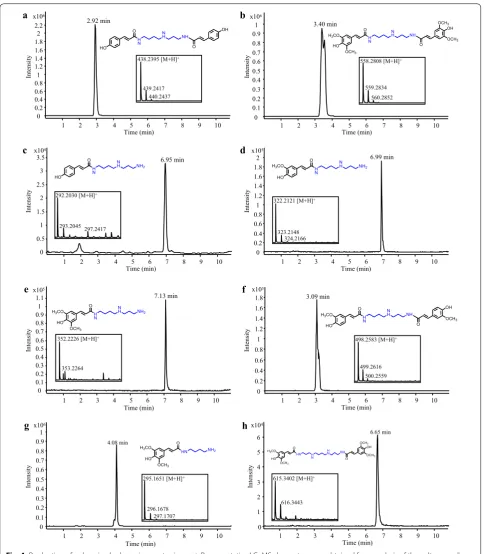
this experiment, we selected the BAHDs p -coumaroyl-CoA:spermidine (AtSCT) and sinapoyl--coumaroyl-CoA:spermidine (AtSDT) transferases from Arabidopsis [39], and p -cou-maroyl-CoA:agmatine transferase (HvACT) from barley (Hordeum vulgare) [40]. Consistent with the properties of both AtSCT and AtSDT to catalyze the transfer of two hydroxycinnamate moieties onto spermidine [39], feed-ing with spermidine and p-coumarate or sinapate strains co-expressing 4CL5 with AtSCT or AtSDT resulted in the synthesis of dicoumaroyl and disinapoyl spermidine conjugates, respectively (Fig. 4a, b). In particular, a sin-gle new liquid chromatography-mass spectrometry (LC– MS) peak with a m/z value corresponding to 438.2395 [M + H]+ was detected in the medium of the
4CL5-AtSCT strain (Fig. 4a), suggesting the presence of N1,N8
-dicoumaroyl spermidine as previously observed in vitro [39]. In the case of the 4CL5-AtSDT strain, LC–MS anal-ysis of the culture medium showed a double LC–MS peak with a m/z value corresponding to 558.2808 [M + H]+
(Fig. 4b), suggesting the presence of another disinapoyl spermidine isomer (i.e. N1,N4-disinapoyl spermidine or
N4,N8-disinapoyl spermidine) in addition to the
previ-ously characterized AtSDT product, N1,N8-disinapoyl
spermidine [39]. The presence of a monosubstituted
x107
0.2 0.4 0.6 0.81 1.2 1.4 1.6 1.82 2.2
1 2 3 4 5 6 7 8 9 10 11 12 13 14 15
10.71 min
0
Time (min) 237.0772 [M-H]
-238.0807 239.0821
x107
0 0.25 0.5 0.751 1.25 1.5 1.752 2.252.5 2.75
1 2 3 4 5 6 7 8 9 10 11 12 13 14 15
11.14 min
Time (min)
267.0879 [M-H]
-268.0915 269.0928
1 2 3 4 5 6 7 8 9 10 11 12 13 14 15
x107
0 0.2 0.4 0.6 0.8 1 1.2 1.4
1.6 9.46 min
Time (min)
253.0716 [M-H]
-255.0879 254.0744
256.0910
1 2 3 4 5 6 7 8 9 10 11 12 13 14 15
x105
0 0.2 0.4 0.6 0.81 1.2 1.4 1.6
1.8 5.11 min
Time (min)
577.1335 [M-H]
-a
b
c
d
Intensit
y
Intensit
y
Intensit
y
Intensit
y
x104
0 0.5 1 1.5 2 2.5 3 3.5
1 2 3 4 5 6 7 8 9 10
6.95 min
Time (min)
292.2030 [M+H]+
293.2045 297.2417
x106
0 0.2 0.4 0.6 0.81 1.2 1.4 1.6 1.82 2.2
1 2 3 4 5 6 7 8 9 10
2.92 min
438.2395 [M+H]+
439.2417 440.2437
x105
0 0.2 0.4 0.6 0.8 1 1.2 1.4 1.6 1.8 2
1 2 3 4 5 6 7 8 9 10
6.99 min
Time (min)
322.2121 [M+H]+
323.2148 324.2166
x105
0 0.2 0.4 0.6 0.8 1 1.2 1.4 1.6 1.8
1 2 3 4 5 6 7 8 9 10
3.09 min
Time (min)
498.2583 [M+H]+
499.2616 500.2559
x105
0 0.1 0.2 0.3 0.4 0.5 0.6 0.7 0.8 0.91 1.1
1 2 3 4 5 6 7 8 9 10
7.13 min
Time (min)
352.2226 [M+H]+
353.2264
Time (min)
c
e f
Time (min) 3.40 min
x106
0.1 0.2 0.3 0.4 0.5 0.6 0.7 0.8 0.9 1
1 2 3 4 5 6 7 8 9 10
0
558.2808 [M+H]+
559.2834 560.2852
a b
x104
0 1 2 3 4 5 6
Time (min)
1 2 3 4 5 6 7 8 9 10
6.65 min
615.3402 [M+H]+
616.3443 d
x106
0 0.1 0.2 0.3 0.4 0.5 0.6 0.7 0.8 0.9 1
1 2 3 4 5 6 7 8 9 10
4.08 min
Time (min)
295.1651 [M+H]+
296.1678 297.1707
g h
Intensity Intensity
Intensity Intensity
Intensit
y
Intensit
y
Intensit
y
Intensit
y
Fig. 4 Production of polyamine hydroxycinnamates in yeast. Representative LC–MS chromatograms obtained from analysis of the culture medium of S. cerevisiae strains expressing 4CL5 and AtSCT (a, c–f) or 4CL5 and AtSDT (b, g, h) are shown. The 4CL5‑AtSCT strain was fed with spermidine and
spermidine (i.e., p-coumaroyl spermidine) was also observed in the culture medium of the 4CL5-AtSCT strain but not in that of the 4CL5-AtSDT strain (Fig. 4c). Experiments exploring the substrate promiscuity of AtSDT and AtSCT were conducted to produce additional polyamine hydroxycinnamates. Feeding the 4CL5-AtSCT strain with spermidine and ferulate or sinapate success-fully enabled the biosynthesis of feruloyl spermidine and sinapoyl spermidine, respectively (Fig. 4d, e). Moreover, a double LC–MS peak with a m/z value matching that of diferuloyl spermidine was detected when ferulate was supplied (Fig. 4f), but the exact identities of the two iso-mers was not determined. Next, feeding the 4CL5-AtSDT strain with sinapate and putrescine or spermine resulted in the synthesis of sinapoyl putrescine and disinapoyl spermine, respectively (Fig. 4g, h). These results show that the substrate flexibility of the two enzymes toward both donors and acceptors can be exploited for the syn-thesis of diverse polyamine hydroxycinnamates. This is the first report of biological synthesis of polyamine hydroxycinnamates in microbes, and our results show the potential for the production of disubstituted polyamine conjugates. We also demonstrated that co-expression of FjTAL with 4CL5 and AtSCT resulted in the production of N1,N8-dicoumaroyl spermidine without the addition of
any precursors to the culture medium (Additional file 1: Figure S1C), providing a potential route to sustainable synthesis of such compounds. This indicates that sper-midine pools in S. cerevisiae are sufficient for such bio-synthetic approaches. In that respect, recently developed engineering strategies for enhancing spermidine content in yeast could be applied to our strain [41]. Lastly, our list of microbially produced polyamine hydroxycinnamates was extended after a strain co-expressing FjTAL, 4CL5 and HvACT and fed with agmatine was able to produce
p-coumaroyl agmatine (Additional file 1: Figure S1D).
Synthesis of monolignol hydroxycinnamates
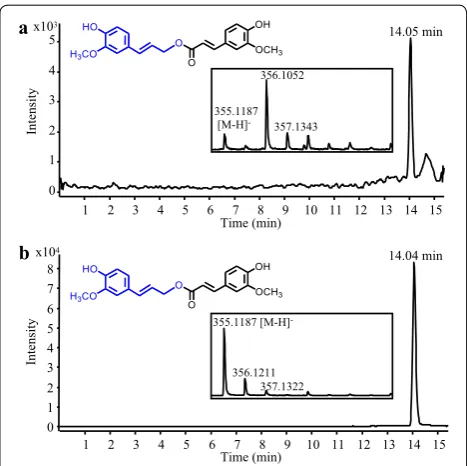
Monolignol hydroxycinnamates belong to another class of hydroxycinnamate ester conjugates with beneficial pharmacological properties. For example, coniferyl fer-ulate has antibacterial activity, antioxidant and anti-Alzheimer properties, and it was also shown to have a potential role in reversing multidrug resistance mech-anisms acquired by tumor cells [42–44]. Feruloyl-CoA:monolignol transferase (AsFMT) from Chinese angelica (Angelica sinensis) is a BAHD enzyme involved in the synthesis of coniferyl ferulate by coupling feruloyl-CoA to the monolignol coniferyl alcohol [45]. A S. cer-evisiae strain that co-expressed 4CL5 with AsFMT was generated and grown in the presence of ferulate and coniferyl alcohol for the synthesis of coniferyl ferulate. Interestingly, using LC–MS analysis and an authentic
standard for comparison, we observed that coniferyl ferulate was effectively produced by the yeast strain (Fig. 5a–b) but remained exclusively intracellular. This is the first successful attempt at producing coniferyl feru-late in microbes. To facilitate its purification and reduce production costs, it would be useful to evaluate other hosts for their capability to synthesize and excrete this valuable product. In this respect, several strains of E. coli
have been engineered for the production of p-coumaryl alcohol via p-coumaroyl-CoA and could become suitable hosts [46, 47].
Synthesis of malate hydroxycinnamates
Malate hydroxycinnamates are another group of hydrox-ycinnamate esters with potential beneficial properties for human health, as exemplified by caffeoyl malate (phaselic acid), which possesses anti-inflammatory activities [48]. Hydroxycinnamoyl-CoA:malate transferase from red clo-ver (Trifolium pratense) (TpHCT2) was selected for the production of malate hydroxycinnamates in yeast [49]. A S. cerevisiae strain co-expressing 4CL5 and TpHCT2 was fed with malate and p-coumarate or caffeate. LC–MS analysis of the culture medium showed the presence of peaks corresponding to p-coumaroyl malate and phaselic acid, respectively (Fig. 6a, b). These LC–MS peaks were absent from control cultures of a strain expressing 4CL5
a
x104
0 1 2 3 4 5 6 7 8
1 2 3 4 5 6 7 8 9 10 11 12 13 14 15
b
Time (min)
355.1187 [M-H]
-356.1211 357.1322
14.04 min x103
0 1 2 3 4 5
1 2 3 4 5 6 7 8 9 10 11 12 13 14 15
356.1052
357.1343 355.1187
[M-H]
-14.05 min
Time (min)
Intensit
y
Intensit
y
alone and fed with the same precursors (data not shown). This is the first example of the production of malate hydroxycinnamates in microbes, and such synthesis could theoretically be achieved sustainably considering existing engineering methods used to obtain high titers of malate in yeast [50]. Concerning the de novo synthesis of hydroxycinnamate moieties, we also show that expres-sion of FjTAL in the 4CL5-TpHCT2 strain can sustain the synthesis of p-coumaroyl malate without an external sup-ply of p-coumarate (Additional file 1: Figure S1E).
Synthesis of alkyl hydroxycinnamates
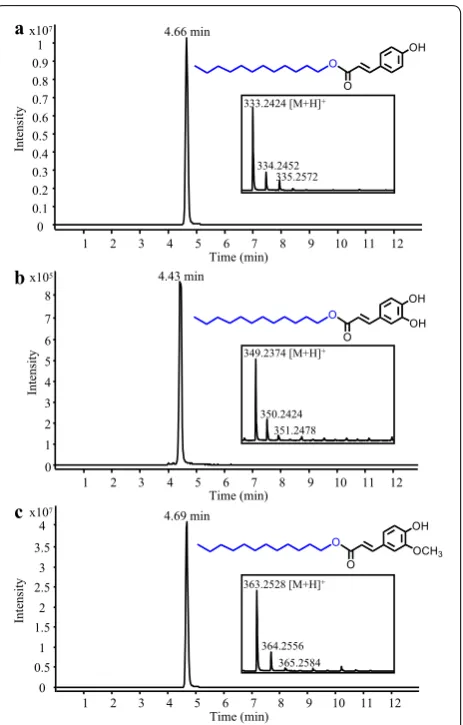
Alkyl hydroxycinnamates such as hydroxycinnamate esters of fatty alcohols are lipophilic antioxidants that can efficiently inhibit the growth of tumor cells [51, 52]. Hydroxycinnamoyl-CoA:fatty alcohol transferase from Arabidopsis (AtHHT3), which accepts various medium chain fatty alcohols as substrates, was selected for the synthesis of dodecyl hydroxycinnamates [53]. In par-ticular, a S. cerevisiae strain co-expressing 4CL5 with AtHHT3 and fed with 1-dodecanol and p-coumarate, caffeate or ferulate produced the potent antioxidants dodecyl p-coumarate, dodecyl caffetae and dodecyl feru-late, respectively (Fig. 7a–c). These alkyl hydroxycinna-mates were not detected in cultures of a control strain
expressing 4CL5 alone and fed with hydroxycinnamates and 1-dodecanol (data not shown). The microbial synthe-sis of alkyl hydroxycinnamates has never been reported and engineering strategies used for the production of fatty alcohols could be leveraged for their de novo syn-thesis [54, 55]. Moreover, using a strain that co-express FjTAL with 4CL5 and AtHHT3, we achieved the produc-tion of dodecyl p-coumarate by supplying only 1-dode-canol to the culture medium (Additional file 1: Fig. S1F).
Synthesis of cinnamoyl and benzoyl tropane analogues
Tropane alkaloids, such as cinnamate and benzoate esters of tropane skeletons, are of considerable interest due to their wide range of biological activities, and some are commonly employed in the pharmaceutical industry [56, 57]. Cocaine synthase (EcCS) from coca (Erythroxylum
281.0672 280.0594 x10⁴
0 1 2 3 4 5 6 7 8
1 2 3 4 5 6 7 8 9 10 11 12 13 14 15
5.85 min
Time (min) 279.0532[M-H]
-x104
0 0.51 1.52 2.53 3.54 4.55
1 2 3 4 5 6 7 8 9 10 11 12 13 14 15 5.83 min
295.0458 [M-H]
-297.0620 296.0502 a
b
Time (min)
Intensit
y
Intensit
y
Fig. 6 Production of malate hydroxycinnamates in yeast. Representa‑ tive LC–MS chromatograms obtained from analysis of the culture medium of a S. cerevisiae strain expressing 4CL5 and TpHCT2 are shown. The strain was fed with malate and p‑coumarate or caffeate for the synthesis of p‑coumaroyl malate (a) and phaselic acid (b), respectively
x107
0 0.1 0.2 0.3 0.4 0.5 0.6 0.7 0.8 0.9 1
Time (min)
1 2 3 4 5 6 7 8 9 10 11 12
4.66 min
333.2424 [M+H]+
334.2452 335.2572
a
x105
0 1 2 3 4 5 6 7
1 2 3 4 5 6 7 8 9 10 11 12
4.43 min 8
Time (min)
b
349.2374 [M+H]+
350.2424 351.2478
x107
0 0.5
1 1.5
2 2.5
3 3.5
1 2 3 4 5 6 7 8 9 10 11 12 4.69 min
4
c
Time (min)
363.2528 [M+H]+
364.2556 365.2584
Intensit
y
Intensity
Intensit
y
coca) catalyzes the transfer of both cinnamoyl-CoA and benzoyl-CoA onto 2-carbomethoxy-3β-tropine for the synthesis of the tropane alkaloids cinnamoylcocaine and cocaine, respectively [58]. Because we previously demon-strated the activity of 4CL5 towards cinnamate and ben-zoate in yeast [14], and considering that EcCS was also shown to use 3β-tropine as an acceptor in vitro [58], we generated a S. cerevisiae strain that co-express 4CL5 and EcCS for the synthesis of the tropane alkaloids cinnamoyl 3β-tropine and benzoyl 3β-tropine (tropacocaine). By comparison with an authentic standard, LC–MS analy-sis identified cinnamoyl 3β-tropine (9.58 ± 1.06 µM or 2.6 mg/L) in the culture medium of the 4CL5-EcCS strain grown in the presence of cinnamate and 3β-tropine (Fig. 8a, b). Similarly, benzoyl 3β-tropine was detected in the culture medium of the 4CL5-EcCS strain cultivated with the precursors benzoate and 3β-tropine (Fig. 8c).
None of these products were detected in control cultures of a strain expressing 4CL5 alone and fed with the same precursors (data not shown). Nevertheless, further inves-tigation will be needed since the detection of double LC– MS peaks strongly suggests the presence of two isomers for each product, possibly due to the isomerization of 3β-tropine in the culture medium. To our knowledge, this is the first report on the synthesis of tropane alkaloids in microbes, and it would be interesting to investigate the substrate flexibility of EcCS for the synthesis of phar-macologically valuable cinnamoyl and benzoyl tropane analogues [20]. As future work, the plant β-oxidative pathway of benzoic acid biosynthesis could be imported into yeast for the synthesis of benzoyl-CoA from pheny-lalanine [59], as well as the metabolic engineering strate-gies already established in hairy root culture systems for the synthesis of tropane moieties from arginine [60].
Synthesis of benzoate alcohol esters and caffeate phenethyl ester (CAPE)
Benzoate alcohol esters are widely used as flavoring agents in foods and cosmetics as well as in hygiene and pharmaceutical products [21, 22]. Benzoyl-CoA:benzyl alcohol/phenylethanol benzoyltransferase (BPBT), a BAHD enzyme from petunia (Petunia x hybrida), uses benzoyl-CoA as a donor and various alcohols as accep-tors for the formation of benzoate alcohol esters [61]. A
S. cerevisiae strain was generated for the co-expression of 4CL5 and BPBT. Based on the substrate preference of BPBT observed in vitro [61], our 4CL5-BPBT strain was fed with benzoic acid in combination with ethanol, butanol, isopentanol or 2-phenylethanol. By comparison with the elution of authentic standards, LC–MS analy-sis of the culture media showed the presence of ethyl benzoate (1.39 ± 0.40 µM or 209 µg/L), butyl benzo-ate (2.65 ± 0.69 µM or 471 µg/L), isopentyl benzoate (2.50 ± 0.50 µM or 481 µg/L) and phenethyl benzoate (7.80 ± 1.73 µM or 1763 µg/L), respectively (Fig. 9a–h). Moreover, caffeate phenethyl ester (CAPE) is a bioac-tive compound that possesses antimicrobial, antioxidant, anti-inflammatory and cytotoxic properties [62, 63]. Therefore, the capacity of BPBT to accept 2-phenyle-thanol as a substrate is of particular interest toward the biological synthesis of CAPE and its derivatives, espe-cially because its production using chemical synthesis or its purification from natural sources (e.g., honeybee hives) are low-yielding procedures [64]. Feeding our 4CL5-BPBT strain with caffeate and 2-phenylethanol resulted in successful synthesis of CAPE (1.61 ± 0.23 nM or 457 ng/L), which was identified by LC-MS analysis of the culture medium (Fig. 9i–j). Although several BAHDs acyltransferases similar to BPBT have been shown to transfer benzoyl-CoA onto 2-phenylethanol [65, 66], the x107
0 0.5 1 1.5 2
1 2 3 4 5 6 7 8 9 10
3.30 min
Time (min)
272.1643 [M+H]+
273.1668 274.1699
x105
0 0.51 1.52 2.53 3.54
1 2 3 4 5 6 7 8 9 10
3.35 min
Time (min)
3.67 min
246.1486 [M+H]+
247.1520 248.1553
x106
0 0.5 1 1.5 2 2.5 3 3.5
1 2 3 4 5 6 7 8 9 10
4
272.1646 [M+H]+
274.1795 273.1676
275.1824
a
b
c
Time (min)
Intensit
y
Intensity
Intensity
pRS423 vector was used for the expression of FjTAL under the control of the constitutive promoter PTDH3.
The S. cerevisiae pad1 knockout (MATa his3∆1 leu2∆0 met15∆0 ura3∆0 ∆pad1, ATCC 4005833) [69] was transformed using the Frozen-EZ Yeast Transformation II Kit™ (Zymo Research Corporation, Irvine, CA) and selected on solid medium containing yeast nitrogen base (YNB) without amino acids (Difco 291940; Difco, Detroit, MI) supplemented with 3% glucose and 1X dropout-ura-cil (CSM-ura) or 1X dropout-uradropout-ura-cil-histidine (CSM-ura-his) (Sunrise Science Products, San Diego, CA).
Construction of plasmids
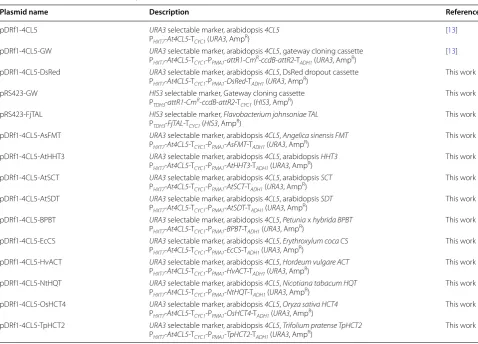
A description of the plasmids used in this study is pro-vided in Table 1. For the construction of the pDRf1-4CL5-DsRed vector, a red fluorescent protein (pDRf1-4CL5-DsRed) dropout cassette sequence (kindly provided by Chris Ander-son’s lab, UC Berkeley) was synthesized with flanking sequences (Genescript, Piscataway, NJ; Additional file 1: Data S1). It contains at the 5′-end the 18-bp sequence located upstream of the EcoRI site in pDRf1-4CL5-GW [13], followed by an EcoRI restriction site, the Gateway recombination site attB1 and a PmlI restriction site. At the 3′-end, it contains a PmlI restriction site, followed by the Gateway recombination site attB2, a PstI restric-tion site and the 15-bp sequence located upstream of the
PstI site in pDRf1-4CL5-GW. This sequence was ampli-fied by PCR using the oligonucleotides DsRed-dropout-fw and DsRed-dropout-rv (Additional file 1: Table S2) and inserted by In-Fusion cloning (Clonetech, Mountain View, CA) into a pDRf1-4CL5-GW vector digested with
EcoRI and PstI to remove the Gateway cassette and yield the pDRf1-4CL5-DsRed vector. BAHD acyltransferase nucleotide sequences were codon-optimized for expres-sion in S. cerevisiae using an empirically derived codon usage table. Codon optimization, including restriction site removal, and oligo design (150 mers) were performed using GeneDesign [70]. Oligonucleotides were pooled for synthesis using acoustic deposition (Labcyte Echo 550), and synthesis was performed at the Joint Genome Insti-tute using a two-step polymerase chain assembly (PCA) approach in 2 μL final volume as previously described [71]. PCA products were purified by gel excision and cloned into a PmlI-digested pDRf1-4CL5-DsRed vec-tor using Gibson assembly to generate the pDRf1-4CL5-BAHDs vectors. Plating and picking were performed
(See figure on next page.)
Fig. 9 Production of benzoate alcohol esters and CAPE in yeast. Representative LC–MS chromatograms of hexane extracts of culture media of a S. cerevisiae strain expressing 4CL5 and BPBT are shown. The strain was fed with benzoate and ethanol, butanol, isopentanol or 2‑phenylethanol for the synthesis of ethyl benzoate (a), butyl benzoate (c), isopentyl benzoate (e) and phenethyl benzoate (g), respectively. Identification of the different benzoate alcohol esters was made by comparison with the LC–MS profiles of authentic standards (b, d, f, h). Similarly, feeding the strain with caffeate and 2‑phenylethanol allowed the synthesis of CAPE (i) by comparison with the LC–MS profile of an authentic CAPE standard (j)
use of hydoxycinnamoyl-CoA donors (e.g., caffeoyl-CoA) by these enzymes has never been reported and could enable the biological synthesis of valuable hydroxycinna-mate phenethyl esters. Taking advantage of existing engi-neering strategies that yield high titers of alcohols and 2-phenylethanol should enable the economical synthesis of benzoate alcohol esters and CAPE in yeast [67, 68].
Conclusions
This study illustrates the potential of using BAHD acyl-transferases from plants and S. cerevisiae as an expression host for the biological synthesis of valuable molecules that are usually produced from petrochemicals or found at very low concentration in plant extracts. In particular, expression of BAHD acyltransferases that use hydoxycin-namoyl-CoA and benzoyl-CoA allowed the synthesis of more than 30 different compounds which have applica-tions across diverse sectors such as human health prod-ucts and the flavor and fragrance industry. Exploring the substrate promiscuity of these BAHDs could consider-ably expand the number of molecules produced. Moreo-ver, the use of BAHDs activity on alternate donors such as acetyl-CoA or malonyl-CoA should be explored for the biosynthesis of additional beneficial products.
Methods
Chemicals
The chemicals used for the S. cerevisiae feeding are listed in Additional file 1: Table S1. Rosmarinic acid was obtained from Spectrum Chemical Mfg. Corp. (New Brunswick, NJ), chlorogenic acid from Alfa Aesar (Haverhill, MA), ethyl benzoate, butyl benzoate, isopen-tyl benzoate and caffeate pheneisopen-tyl ester from TCI Amer-ica (Portland, OR), cinnamoyl 3β-tropine and phenethyl benzoate from Sigma-Aldrich (St. Louis, MO), and coniferyl ferulate from Biorbyt LLC (Berkeley, CA).
Strains, plasmids and media
The vectors pDRf1-4CL5-AtSDT, pDRf1-4CL5-AtSCT, 4CL5-HvACT, 4CL5-OsHCT4, AsFMT, EcCS, pDRf1-4CL5-TpHCT2, pDRf1-4CL5-LaAT1, pDRf1-4CL5-NtHQT, pDRf1-4CL5-AtHHT3, and pDRf1-4CL5-BPBT were used for co-expression of 4CL5 with the different BAHDs under the control of the constitutive promoters PHXT7
x104
0 1 2 3 4 5
1 2 3 4 5 6 7 8 9 10 11
4.43 min
179.1058 [M+H]+
180.106075
x104
0 0.5 1 1.5 2 2.5 3
1 2 3 4 5 6 7 8 9 10 11
2.10 min
Time (min)
153.0574 151.0748 [M+H]+
152.0704 154.0457
x104
0 0.2 0.4 0.6 0.8 1 1.2 1.4
1 2 3 4 5 6 7 8 9 10 11
2.10 min
Time (min)
153.0561 151.0747 [M+H]+
155.1184
4.43 min x105
0 0.2 0.4 0.6 0.81 1.2 1.4 1.6
1 2 3 4 5 6 7 8 9 10 11
1.7
x106
0 0.25
0.5 0.75 1 1.25
1.5 1.75 2
1 2 3 4 5 6 7 8 9 10 11
5.28 min
193.1216 [M+H]+
195.0978
Time (min)
Time (min) x104
0 1 2 3 4 5
1 2 3 4 5 6 7 8 9 10 11
5.27 min
Time (min)
193.1219 [M+H]+
194.1211 195.1209
4.73 min x103
1 1.5
2 2.5
3 3.5
4 4.5
1 2 3 4 5 6 7 8 9 10 11
0 5
227.1063 [M+H]+
232.1768 229.2117
x105
0 0.5
1 1.5
2 2.5
3 3.5
4
1 2 3 4 5 6 7 8 9 10 11
4.72 min
227.1066 [M+H]+
228.1095 229.2061
a
b
c
d
Time (min)
e
f
g
h
i
j
Time (min) Time (min)
179.1067 [M+H]+
180.0923
x105
0 1 2 3 4 5
1 2 3 4 5 6 7 8
4.29 min
Time (min)
283.0973 [M-H] -285.1108
x106
0 0.5 1 1.5 2
1 2 3 4 5 6 7 8
4.32 min
Time (min)
283.0953 [M-H]
-284.0973
Intensity Intensity
Intensity Intensity
Intensit
y
Intensity
Intensity Intensity
Intensit
y
Intensit
using a QPix 400 system (Molecular Devices, Sunnyvale, CA). Eight colonies per construct were sequence-verified using PACBIO RSII system (Pacific Biosciences, Menlo Park, CA). Synthesized BAHD sequences and protein accession numbers are listed in Additional file 1: Data S1.
For the construct of the pRS423-GW vector, two DNA fragments covering the full backbone including PTDH3
and TCYC1 sequences while excluding XKS1 encoding
sequence of the pRS423.XI vector were amplified by PCR using the oligonucleotide pairs pRS423-fw1/pRS423-rv1 and pRS423-fw2/pRS423-rv2 (Additional file 1: Table S2) and the pRS423.XI vector as a template [72]. A third fragment corresponding to the Gateway cassette was amplified using the oligonucleotides GW-fw/GW-rv (Additional file 1: Table S2) and the pDRf1-4CL5-GW vector as a template [13]. The pRS423-GW vector was constructed by assembling the three PCR fragments via In-Fusion cloning (Clonetech, Mountain View, CA). For the construct of the pRS423-FjTAL vector, a nucleotide sequence encoding FjTAL (GenBank accession number AKE50827.1) flanked with the attB1 (5′-end) and attB2 (3′-end) Gateway recombination sites was synthesized for
expression in S. cerevisiae (Genescript, Piscataway, NJ) and cloned into the Gateway pDONR221 entry vector by BP recombination (Life technologies, Foster City, CA). An entry clone was LR recombined with the pRS423-GW vector to generate the pRS423-FjTAL construct. Plasmids are available upon request through the JBEI-ICE registry (http://public-registry.jbei.org) [73].
Production of hydroxycinnamate and benzoate conjugates
Overnight cultures from single colonies of recombinant S. cerevisiae harboring the 4CL5-BAHDs and pDRf1-4CL5 [13] constructs were grown using 2X YNB medium without amino acids, supplemented with 6% glucose and 2X CSM-ura. These cultures were used to inoculated 4 mL of fresh minimal medium at an OD600 = 0.15 and shaken at
200 rpm at 30 °C. Precursors were added 5 h post inocula-tion at the concentrainocula-tions indicated in Addiinocula-tional file 1: Table S1. These concentrations were selected to be below toxicity levels and avoid growth inhibition. The cultures were shaken at 200 rpm at 30 °C for 24 h in the presence of the precursors for the production of hydrocinnamate and benzoate con-jugates. Yeast colonies harboring the pDRf1-4CL5 control
Table 1 Plasmids used in this study
Plasmid name Description Reference
pDRf1‑4CL5 URA3 selectable marker, arabidopsis 4CL5
PHXT7‑At4CL5‑TCYC1 (URA3, AmpR)
[13]
pDRf1‑4CL5‑GW URA3 selectable marker, arabidopsis 4CL5, gateway cloning cassette PHXT7‑At4CL5‑TCYC1‑PPMA1‑attR1‑CmR‑ccdB‑attR2‑TADH1 (URA3, AmpR)
[13]
pDRf1‑4CL5‑DsRed URA3 selectable marker, arabidopsis 4CL5, DsRed dropout cassette PHXT7‑At4CL5‑TCYC1‑PPMA1‑DsRed‑TADH1 (URA3, AmpR)
This work
pRS423‑GW HIS3 selectable marker, Gateway cloning cassette PTDH3‑attR1‑CmR‑ccdB‑attR2‑TCYC1 (HIS3, AmpR)
This work
pRS423‑FjTAL HIS3 selectable marker, Flavobacterium johnsoniae TAL
PTDH3‑FjTAL‑TCYC1 (HIS3, AmpR)
This work
pDRf1‑4CL5‑AsFMT URA3 selectable marker, arabidopsis 4CL5, Angelica sinensis FMT
PHXT7‑At4CL5‑TCYC1‑PPMA1‑AsFMT‑TADH1 (URA3, AmpR)
This work
pDRf1‑4CL5‑AtHHT3 URA3 selectable marker, arabidopsis 4CL5, arabidopsis HHT3
PHXT7‑At4CL5‑TCYC1‑PPMA1‑AtHHT3‑TADH1 (URA3, AmpR)
This work
pDRf1‑4CL5‑AtSCT URA3 selectable marker, arabidopsis 4CL5, arabidopsis SCT
PHXT7‑At4CL5‑TCYC1‑PPMA1‑AtSCT‑TADH1 (URA3, AmpR)
This work
pDRf1‑4CL5‑AtSDT URA3 selectable marker, arabidopsis 4CL5, arabidopsis SDT
PHXT7‑At4CL5‑TCYC1‑PPMA1‑AtSDT‑TADH1 (URA3, AmpR)
This work
pDRf1‑4CL5‑BPBT URA3 selectable marker, arabidopsis 4CL5, Petunia x hybrida BPBT
PHXT7‑At4CL5‑TCYC1‑PPMA1‑BPBT‑TADH1 (URA3, AmpR)
This work
pDRf1‑4CL5‑EcCS URA3 selectable marker, arabidopsis 4CL5, Erythroxylum coca CS
PHXT7‑At4CL5‑TCYC1‑PPMA1‑EcCS‑TADH1 (URA3, AmpR)
This work
pDRf1‑4CL5‑HvACT URA3 selectable marker, arabidopsis 4CL5, Hordeum vulgare ACT
PHXT7‑At4CL5‑TCYC1‑PPMA1‑HvACT‑TADH1 (URA3, AmpR)
This work
pDRf1‑4CL5‑NtHQT URA3 selectable marker, arabidopsis 4CL5, Nicotiana tabacum HQT
PHXT7‑At4CL5‑TCYC1‑PPMA1‑NtHQT‑TADH1 (URA3, AmpR)
This work
pDRf1‑4CL5‑OsHCT4 URA3 selectable marker, arabidopsis 4CL5, Oryza sativa HCT4
PHXT7‑At4CL5‑TCYC1‑PPMA1‑OsHCT4‑TADH1 (URA3, AmpR)
This work
pDRf1‑4CL5‑TpHCT2 URA3 selectable marker, arabidopsis 4CL5, Trifolium pratense TpHCT2
PHXT7‑At4CL5‑TCYC1‑PPMA1‑TpHCT2‑TADH1 (URA3, AmpR)
vector were grown under similar conditions. Yeast colonies co-transformed with the pRS423-FjTAL plasmid and the LaAT1, OsHCT4, pDRf1-4CL5-AtSCT, pDRf1-4CL5-HvACT, pDRf1-4CL5-TpHCT2, or pDRf1-4CL5-AtHHT3 vector were grown under similar conditions except that the medium was supplemented with 2X CSM-ura-his. For the detection of metabolites, an ali-quot of the culture medium was collected and cleared by centrifugation (21,000×g for 5 min at 4 °C), mixed with an equal volume of cold methanol:water (1:1, v/v), and filtered using Amicon Ultra centrifugal filters (3000 Da MW cutoff regenerated cellulose membrane; Millipore, Billerica, MA) prior to analysis using high-performance liquid chromatog-raphy (HPLC), electrospray ionization (ESI), and time-of-flight (TOF) mass spectrometry (MS). Alternatively, for the detection of dodecyl hydroxycinnamates, caffeate phenethyl ester and benzoate alcohol esters, the culture medium was cleared by centrifugation and mixed with 2 mL of hexane for extraction with vortexing. The hexane phase was collected after centrifugation and concentrated under a nitrogen stream prior to HPLC-TOF-MS analysis. For the detection of coniferyl ferulate, yeast cells were harvested by centrifu-gation, washed and resuspended with 1 mL of HPLC grade water, and mixed with 2 mL of hexane for extraction with vortexing. The hexane phase was collected after centrifu-gation and concentrated under a nitrogen stream prior to HPLC-ESI-TOF-MS analysis.
LC–MS analysis of hydroxycinnamate and benzoate conjugates
Standard solutions of chlorogenic acid, rosmarinic acid, coniferyl ferulate and cinnamoyl 3β-tropine were pre-pared in methanol and water (1:1, v/v) and those of caffeate phenethyl ester and benzoate alcohol esters were prepared in hexane. All metabolites were separated via an Agilent 1200 Series Rapid Resolution high perfor-mance liquid chromatography (HPLC) system. The sys-tems autosampler tray was set to 6 °C. The HPLC system was coupled to an Agilent Technologies 6210 LC/TOF mass spectrometer (MS) via either electrospray ioniza-tion (ESI) or atmospheric pressure chemical ionizaioniza-tion (APCI), which was used for MS detection and metabolite identification. Drying gas temperature, drying gas pres-sure, nebulizing gas pressure and capillary voltage were set to 330 °C, 10 or 11 L/min, 25 lb/in2, and 3500 V (in
positive or negative ion modes), respectively, unless stated otherwise. For APCI, the vaporizer and corona were set to 350 °C and 4 µA, respectively, unless stated otherwise.
A HPLC-ESI-TOF-MS method previously described in [12] was used for the separation and detection of ros-marinic acid and its derivatives, coumaroyl quinate and malate hydroxycinnamate esters. The same method was used for coniferyl ferulate except that the drying gas
temperature was set at 200 °C. A similar method was used for glycerol hydroxycinnamate esters with the following modifications: The mobile phase was composed of water (solvent A) and methanol (solvent B), and metabolites were separated via gradient elution under the following mobile phase compositions: % B was linearly increased from 30% B to 98% B in 12 min, held at 98% B for 0.6 min, decreased from 98% B to 30% B in 0.2 min and held at 30% B for a further 2.8 min. The total run time was 15.6 min. A drying gas temperature of 200 °C was used throughout. A HPLC-ESI-TOF-MS method previously described in [74] was used for the separation and detection of polyamine hydroxycinnamates amides and tropane alkaloids.
Separation of benzoate alcohol esters was conducted on a Phenomenex Kinetex XB-C18 column (100 mm length, 2.1 mm internal diameter, and 2.6 µm particle size; Phenomenex, Torrance, CA). The mobile phase was composed of water (solvent A) and methanol (solvent B). The elution gradient was as follows: % B was linearly increased from 60% B to 100% B in 5.0 min, held at 100% B for 2.0 min, decreased from 100% B to 60% B in 0.2 min and held at 60% B for a further 4.5 min. A flow rate of 0.3 mL/min was used until 7.0 min, increased from 0.3 to 0.45 mL/min in 0.2 min and held at 0.45 mL/min for 4.5 min. The total run time was 11.7 min. The column compartment was set to 55 °C. A sample injection volume of 2 µL was used throughout. APCI was conducted using in the positive ion mode for the detection of [M + H]+
ions. The same HPLC column and column compartment temperature were used for the separation of CAPE. The mobile phase was composed of water (solvent A) and acetonitrile (solvent B) and the elution gradient was as follows: % B was increased linearly from 25% B to 100% B in 3.0 min, held at 100% B for 1.0 min, decreased from 100% B to 25% B in 0.2 min and held at 25% B for a fur-ther 4.0 min. A flow rate of 0.3 mL/min was used until 4.0 min, increased from 0.3 to 0.45 mL/min in 0.2 min and held at 0.45 mL/min for the remaining 4.0 min. The total run time was 8.2 min. A sample injection volume of 0.5 µL was used throughout. ESI was conducted in the negative ion mode for the detection of [M–H]− ions.
0.33 min and held at 0.65 mL/min for 2.0 min. The total run time was 13.0 min. APCI was conducted in the pos-itive ion mode for the detection of [M + H]+ ions. The
corona and capillary voltage were set to 15 µA and 3000 V, respectively. A nebulizing gas pressure of 30 lb/in2 and a
drying gas temperature of 200 °C were used throughout. A HPLC-ESI TOF-MS method was used to detect chlorogenic acid. The chromatography was done using a Phenomenex Kinetex XB-C18 column (100 mm length, 3 mm internal diameter and 2.6 µm particle size) using the aforementioned HPLC system. A sample injection volume of 5 μL was used throughout. The mobile phase was composed of 0.1% formic acid in water (solvent A) and in methanol (solvent B). The elution gradient was as follows: % B was increased linearly from 25 to 77.5% B in 3.0 min, then increased from 77.5 to 97.1% B in 0.3 min, held at 97.1% B for 1.0 min, decreased from 97.1 to 25% B in 0.4 min and held at 25% B for a further 2 min. A flow rate of 0.42 mL/min was used until 4.3 min, then increased from 0.42 to 0.65 mL/min in 0.4 min and held at 0.65 mL/min for 2 min. The total run time was 6.7 min. The column compartment and sample tray were set to 50 °C and 6 °C, respectively. A sample injection volume of 3 µL was used throughout. ESI was conducted in the negative ion mode for the detection of [M–H]− ions. The
nebulizing gas pressure was set to 30 lb/in2.
Data acquisition and processing were performed by the MassHunter software package (Agilent Technologies Inc., Santa Clara, CA). For each compound detected, the measured masses agreed with the expected theoretical masses within less than 5 ppm mass error.
Abbreviations
AsFMT: Angelica sinensis feruloyl‑CoA:monolignol transferase; AtHHT3:
Arabidopsis thaliana caffeoyl‑CoA:fatty alcohol transferase; AtSCT: Arabidop-sis thaliana p‑coumaroyl‑CoA:spermidine transferase; AtSDT: Arabidopsis thaliana sinapoyl‑CoA:spermidine transferase; At4CL5: Arabidopsis thaliana
4‑coumarate:CoA ligase 5; BAHD: BEAT (benzoyl alcohol O‑acetyltransferase), AHCT (anthocyanin O‑hydroxycinnamoyl transferase), HCBT (anthranilate N‑hydroxycinnamoyl/benzoyl transferase), and DAT (deacetyl vindoline 4‑O‑acetyltransferase); BPBT: benzoyl‑CoA:benzyl alcohol/phenylethanol benzoyltransferase; CAPE: caffeate phenethyl ester; CoA: coenzyme A; EcCS: Erythroxylum coca cocaine synthase; FjTAL: Flavobacterium johnsoniae
tyrosine ammonia‑lyase; HCBT: hydroxycinnamoyl/benzoyl‑CoA:anthranilate transferase; HvACT: Hordeum vulgare p‑coumaroyl‑CoA:agmatine transferase; LC–MS: liquid chromatography‑mass spectrometry; NtHQT: Nicotiana tabacum
hydroxycinnamoyl‑CoA:quinate transferase; OsHCT4: Oryza sativa hydroxy‑ cinnamoyl‑CoA:shikimate transferase 4; RA: rosmarinic acid; TpHCT2: Trifolium pratense hydroxycinnamoyl‑CoA:shikimate transferase 2.
Authors’ contributions
AE wrote the manuscript. DL edited the document. AE, LR, MM, VTB and Y‑LT performed the experiments. T‑YC generated the p423‑GW yeast vector. EEKB and GW conducted the LC–MS analyses. DR and SD synthesized the genes and assembled them in the yeast expression vector. AE, AM, HVS, JDK, SD and DL supervised the research. AM, DL, HVS, JDK, JLH and SD provided chemicals and financial support. All authors read and approved the final manuscript.
Author details
1 Joint BioEnergy Institute, EmeryStation East, 5885 Hollis St., 4th Floor, Emery‑ ville, CA 94608, USA. 2 Biological Systems & Engineering Division, Lawrence Berkeley National Laboratory, 1 Cyclotron Road, Berkeley, CA 94720, USA. 3 Joint Genome Institute, Walnut Creek, CA 94598, USA. 4 Graduate Program, San Francisco State University, San Francisco, CA 94132, USA. 5 Master Pro‑ gram, Ecole Polytechnique Fédérale de Lausanne, 1015 Lausanne, Switzerland. 6 School of BioSciences, The University of Melbourne, Melbourne, VIC 3010, Australia. 7 Department of Chemical & Biomolecular Engineering and Depart‑ ment of Bioengineering, University of California, Berkeley, CA 94720, USA. 8 Novo Nordisk Foundation Center for Biosustainability, Technical University of Denmark, Kogle Alle´, 2970 Hørsholm, Denmark. 9 CNRS, UMR5240, Micro‑ biologie, Adaptation et Pathogénie, Université Claude Bernard Lyon 1, INSA de Lyon, 10 rue Raphaël Dubois, 69622 Villeurbanne, France.
Acknowledgements
We thank Sabin Russell for editing this manuscript.
Competing interests
JDK has financial conflicts of interest in Amyris and Lygos. DL and HVS have financial conflicts of interest in Afingen Inc.
Availability of data and materials
All data generated or analyzed during this study are included in this published article and its supplementary information files. Plasmids are available upon request through the JBEI‑ICE registry (http://public‑registry.jbei.org).
Funding
This work was part of the DOE Joint BioEnergy Institute (http://www.jbei. org) supported by the US Department of Energy, Office of Science, Office of Biological and Environmental Research and the US Department of Energy Joint Genome Institute, a DOE Office of Science User Facility, through contract DE‑AC02‑05CH11231 between Lawrence Berkeley National Laboratory and the US Department of Energy. The United States Government retains and the publisher, by accepting the article for publication, acknowledges that the United States Government retains a non‑exclusive, paid‑up, irrevocable, world‑ wide license to publish or reproduce the published form of this manuscript, or allow others to do so, for United States Government purposes.
Received: 31 August 2016 Accepted: 6 November 2016
Additional file
Additional file 1: Figure S1. Synthesis of p‑coumarate esters and amides from tyrosine in yeast. S. cerevisiae strains co‑expressing tyrosine ammonia‑lyase FjTAL and 4CL5 with LaAT1 (A), OsHCT4 (B), AtSCT (C), HvACT (D), TpHCT2 (E) or AtHHT3 (F) were fed with 4‑hydroxyphenyl‑ lactate (A), nothing (B, C), agmatine (D), malate (E) or 1‑dodecanol (F) for the synthesis of p‑coumaroyl 4’‑hydroxyphenyllactate (A), p‑coumaroyl glycerol (B), N1,N8‑disinapoyl spermidine (C), p‑coumaroyl agmatine (D), p‑coumaroyl malate (E) and dodecyl p‑coumarate (F), respectively. Figure S2. Synthesis of quinate hydroxycinnamates in yeast. Representa‑ tive LC‑MS chromatograms obtained from analysis of the culture medium of a S. cerevisiae strain expressing 4CL5 and NtHQT are shown. The strain was fed with quinate and p‑coumarate or caffeate for the synthesis of
References
1. Keasling JD. Manufacturing molecules through metabolic engineering. Science. 2010;330:1355–8.
2. Nielsen J, Keasling JD. Engineering cellular metabolism. Cell. 2016;164:1185–97.
3. Sun H, Liu Z, Zhao H, Ang EL. Recent advances in combinatorial biosyn‑ thesis for drug discovery. Drug Des Devel Ther. 2015;12:823–33. 4. Hong KK, Nielsen J. Metabolic engineering of Saccharomyces cerevisiae:
a key cell factory platform for future biorefineries. Cell Mol Life Sci. 2012;69:2671–90.
5. D’Auria JC. Acyltransferases in plants: a good time to be BAHD. Curr Opin Plant Biol. 2006;9:331–40.
6. Kim BG, Jung WD, Mok H, Ahn JH. Production of hydroxycinnamoyl‑shiki‑ mates and chlorogenic acid in Escherichia coli: production of hydroxycin‑ namic acid conjugates. Microb Cell Fact. 2013;12:15.
7. Cha MN, Kim HJ, Kim BG, Ahn JH. Synthesis of chlorogenic acid and p‑coumaroyl shikimates from glucose using engineered Escherichia coli. J Microbiol Biotechnol. 2014;24:1109–17.
8. Bloch SE, Schmidt‑Dannert C. Construction of a chimeric biosynthetic pathway for the de novo biosynthesis of rosmarinic acid in Escherichia coli. ChemBioChem. 2014;15:2393–401.
9. Jiang J, Bi H, Zhuang Y, Liu S, Liu T, Ma Y. Engineered synthesis of ros‑ marinic acid in Escherichia coli resulting production of a new intermedi‑ ate, caffeoyl‑phenyllactate. Biotechnol Lett. 2016;38:81–8.
10. Zhuang Y, Jiang J, Bi H, Yin H, Liu S, Liu T. Synthesis of rosmarinic acid analogues in Escherichia coli. Biotechnol Lett. 2016;38:619–27. 11. Kim IA, Kim BG, Kim M, Ahn JH. Characterization of hydroxycinnamoyl‑
transferase from rice and its application for biological synthesis of hydroxycinnamoyl glycerols. Phytochemistry. 2012;76:25–31. 12. Eudes A, Juminaga D, Baidoo EE, Collins FW, Keasling JD, Loqué D. Pro‑
duction of hydroxycinnamoyl anthranilates from glucose in Escherichia coli. Microb Cell Fact. 2013;12:62.
13. Eudes A, Baidoo EE, Yang F, Burd H, Hadi MZ, Collins FW, Keasling JD, Loqué D. Production of tranilast [N‑(3′,4′‑dimethoxycinnamoyl)‑ anthranilic acid] and its analogs in yeast Saccharomyces cerevisiae. Appl Microbiol Biotechnol. 2011;89:989–1000.
14. Eudes A, Teixeira Benites V, Wang G, Baidoo EE, Lee TS, Keasling JD, Loqué D. Precursor‑directed combinatorial biosynthesis of cinnamoyl, dihydrocinnamoyl, and benzoyl anthranilates in Saccharomyces cerevisiae. PLoS ONE. 2015;10:e0138972.
15. Eudes A, Pereira JH, Yogiswara S, Wang G, Teixeira Benites V, Baidoo EE, Lee TS, Adams PD, Keasling JD, Loqué D. Exploiting the substrate promis‑ cuity of hydroxycinnamoyl‑CoA: shikimate hydroxycinnamoyl transferase to reduce lignin. Plant Cell Physiol. 2016;57:568–79.
16. Moglia A, Goitre L, Gianoglio S, Baldini E, Trapani E, Genre A, Scattina A, Dondo G, Trabalzini L, Beekwilder J, Retta SF. Evaluation of the bioactive properties of avenanthramide analogs produced in recombinant yeast. BioFactors. 2015;41:15–27.
17. El‑Seedi HR, El‑Said AM, Khalifa SA, Göransson U, Bohlin L, Borg‑Karlson AK, Verpoorte R. Biosynthesis, natural sources, dietary intake, pharma‑ cokinetic properties, and biological activities of hydroxycinnamic acids. J Agric Food Chem. 2012;60:10877–95.
18. Guzman JD. Natural cinnamic acids, synthetic derivatives and hybrids with antimicrobial activity. Molecules. 2014;19:19292–349.
19. Mo H, Tatman D, Jung M, Elson CE. Farnesyl anthranilate suppresses the growth, in vitro and in vivo, of murine B16 melanomas. Cancer Lett. 2000;157:145–53.
20. Singh S. Chemistry, design, and structure‑activity relationship of cocaine antagonists. Chem Rev. 2000;100:925–1024.
21. Adams TB, Cohen SM, Doull J, Feron VJ, Goodman JI, Marnett LJ, Munro IC, Portoghese PS, Smith RL, Waddell WJ, Wagner BM. Expert panel of the flavor and extract manufacturers association: the FEMA GRAS assess‑ ment of benzyl derivatives used as flavor ingredients. Food Chem Toxicol. 2005;43:1207–40.
22. Del Olmo A, Calzada J, Nuñez M. Benzoic acid and its derivatives as natu‑ rally occurring compounds in foods and as additives: uses, exposure and controversy. Crit Rev Food Sci Nutr. 2015. doi:10.1080/10408398.2015.108 7964.
23. Jendresen CB, Stahlhut SG, Li M, Gaspar P, Siedler S, Förster J, Maury J, Borodina I, Nielsen AT. Highly active and specific tyrosine ammonia‑ lyases from diverse origins enable enhanced production of aromatic
compounds in bacteria and saccharomyces cerevisiae. Appl Environ Microbiol. 2015;81:4458–76.
24. Kim GD, Park YS, Jin YH, Park CS. Production and applications of rosmarinic acid and structurally related compounds. Appl Microbiol Biotechnol. 2015;99:2083–92.
25. Landmann C, Hücherig S, Fink B, Hoffmann T, Dittlein D, Coiner HA, Schwab W. Substrate promiscuity of a rosmarinic acid synthase from lavender (Lavandula angustifolia L.). Planta. 2011;234:305–20. 26. Ma CM, Kawahata T, Hattori M, Otake T, Wang L, Daneshtalab M. Synthe‑
sis, anti‑HIV and anti‑oxidant activities of caffeoyl 5,6‑anhydroquinic acid derivatives. Bioorg Med Chem. 2010;18:863–9.
27. Niggeweg R, Michael AJ, Martin C. Engineering plants with increased lev‑ els of the antioxidant chlorogenic acid. Nat Biotechnol. 2004;22:746–54. 28. Juminaga D, Baidoo EE, Redding‑Johanson AM, Batth TS, Burd H, Muk‑
hopadhyay A, Petzold CJ, Keasling JD. Modular engineering of l‑tyrosine production in Escherichia coli. Appl Environ Microbiol. 2012;78:89–98. 29. Kikugawa M, Tsutsuki H, Ida T, Nakajima H, Ihara H, Sakamoto T. Water‑
soluble ferulic acid derivatives improve amyloid‑β‑induced neuronal cell death and dysmnesia through inhibition of amyloid‑β aggregation. Biosci Biotechnol Biochem. 2016;80:547–53.
30. Evans KO, Compton DL, Laszlo JA, Appell M. Feruloyl glycerol and 1,3‑diferuloyl glycerol antioxidant behavior in phospholipid vesicles. Chem Phys Lipids. 2016;195:1–11.
31. Ohta S, Fujimaki T, Uy MM, Yanai M, Yukiyoshi A, Hirata T. Antioxidant hydroxycinnamic acid derivatives isolated from Brazilian bee pollen. Nat Prod Res. 2007;21:726–32.
32. Hadjipavlou‑Litina D, Garnelis T, Athanassopoulos CM, Papaioannou D. Kukoamine A analogs with lipoxygenase inhibitory activity. J Enzyme Inhib Med Chem. 2009;24:1188–93.
33. Yingyongnarongkul BE, Apiratikul N, Aroonrerk N, Suksamrarn A. Synthesis of bis, tris and tetra(dihydrocaffeoyl) polyamine conjugates as antibacterial agents against VRSA. Arch Pharm Res. 2008;31:698–704. 34. Ma CM, Nakamura N, Hattori M. Inhibitory effects on HIV‑1 protease of
tri‑p‑coumaroylspermidine from Artemisia caruifolia and related amides. Chem Pharm Bull. 2001;49:915–7.
35. Fixon‑Owoo S, Levasseur F, Williams K, Sabado TN, Lowe M, Klose M, Joffre Mercier A, Fields P, Atkinson J. Preparation and biological assess‑ ment of hydroxycinnamic acid amides of polyamines. Phytochemistry. 2003;63:315–34.
36. Li Z, Fennie MW, Ganem B, Hancock MT, Kobaslija M, Rattendi D, Bacchi CJ, O’Sullivan MC. Polyamines with N‑(3‑phenylpropyl) substituents are effective competitive inhibitors of trypanothione reductase and trypano‑ cidal agents. Bioorg Med Chem Lett. 2001;11:251–4.
37. Yamamoto A, Nakamura K, Furukawa K, Konishi Y, Ogino T, Higashiura K, Yago H, Okamoto K, Otsuka M. A new nonpeptide tachykinin NK1 recep‑ tor antagonist isolated from the plants of Compositae. Chem Pharm Bull. 2002;50:47–52.
38. Zhao G, Qin GW, Gai Y, Guo LH. Structural identification of a new tri‑ p‑coumaroylspermidine with serotonin transporter inhibition from safflower. Chem Pharm Bull. 2010;58:950–2.
39. Luo J, Fuell C, Parr A, Hill L, Bailey P, Elliott K, Fairhurst SA, Martin C, Michael AJ. A novel polyamine acyltransferase responsible for the accumulation of spermidine conjugates in Arabidopsis seed. Plant Cell. 2009;21:318–33. 40. Burhenne K, Kristensen BK, Rasmussen SK. A new class of N‑hydrox‑
ycinnamoyltransferases. Purification, cloning, and expression of a barley agmatine coumaroyltransferase (EC 2.3.1.64). J Biol Chem. 2003;278:13919–27.
41. Kim SK, Jin YS, Choi IG, Park YC, Seo JH. Enhanced tolerance of Saccha-romyces cerevisiae to multiple lignocellulose‑derived inhibitors through modulation of spermidine contents. Metab Eng. 2015;29:46–55. 42. Chou SC, Everngam MC, Sturtz G, Beck JJ. Antibacterial activity of compo‑
nents from Lomatium californicum. Phytother Res. 2006;20:153–6. 43. Ho CC, Kumaran A, Hwang LS. Bio‑assay guided isolation and identifi‑
cation of anti‑Alzheimer active compounds from the root of Angelica sinensis. Food Chem. 2009;114:246–52.
44. Chen C, Wu C, Lu X, Yan Z, Gao J, Zhao H, Li S. Coniferyl ferulate, a strong inhibitor of glutathione S‑transferase isolated from radix Angelicae sinen-sis, reverses multidrug resistance and downregulates P‑glycoprotein. Evid Based Complement Alternat Med. 2013;2013:639083.