
SYSTEMATIC MAP PROTOCOL
What specific plant traits support
ecosystem services such as pollination,
bio-control and water quality protection
in temperate climates? A systematic map
protocol
Claire J. Blowers
1*, Heidi M. Cunningham
2, Andrew Wilcox
1and Nicola P. Randall
1Abstract
Background: Agricultural intensification has increased diffuse source pollution within water catchments, reduced heterogeneity within the landscape and caused major declines in farmland wildlife, including birds, mammals, inver-tebrates and wildflowers. This increase in pollution and wildlife decline, has effected three vital ecosystem services, pollination, biological pest control and water quality protection. The morphological traits of plant species, such as floral display size and leaf area, provide support to these services and vegetative strips can be established with plants that have these desirable traits. Vegetative strips are widely used across Europe and integrated into government environmental schemes such as The Common Agricultural Policy and The Water Framework Directive. However, issues of land availability and food security require a sustainable intensification of current agricultural practices. One component of this process is to sow vegetative strips that are designed to support multiple ecosystem services. To do this, combinations of plant species that will support specific ecosystem services, have been designed. However, to enable a fully-informed design process, evidence must be collated on which specific plant traits provide the sup-port to the target ecosystem services. We propose to systematically map all evidence on which specific plant traits provide support for three of the most vital ecosystem services, pollination, bio-control and water quality protection. Information from this map could inform future decisions on which plant species are suitable for inclusion within a multifunctional vegetative strip that aims to provide the target ecosystem services. The aim of this systematic map is to create a searchable database of studies that demonstrate evidence of plant traits and how they support the named ecosystem services.
Methods: Seven bibliographic databases, 25 organisational websites and 2 search engines, will be systematically searched with predefined and tested key search terms. All searches will be undertaken in English and only those undertaken in a temperate climate zone will be considered. Studies found will be screened at title, abstract and full text levels, recording the number of excluded articles. Following full text assessment, the meta-data of included stud-ies will be incorporated into a systematic map database in Microsoft Access. A report will summarise the evidence, highlight any knowledge gaps, and provide recommendations for future research.
Keywords: Pollinator, Beneficial invertebrate, Natural enemy, Buffer strip, Agri-environment scheme, Biodiversity, Multifunctional field margin, Vegetative strip
© The Author(s) 2017. This article is distributed under the terms of the Creative Commons Attribution 4.0 International License (http://creativecommons.org/licenses/by/4.0/), which permits unrestricted use, distribution, and reproduction in any medium, provided you give appropriate credit to the original author(s) and the source, provide a link to the Creative Commons license, and indicate if changes were made. The Creative Commons Public Domain Dedication waiver (http://creativecommons.org/ publicdomain/zero/1.0/) applies to the data made available in this article, unless otherwise stated.
Open Access
*Correspondence: [email protected]
1 Harper Adams University, Newport, Shropshire TF10 8NB, UK
Background
Around the globe, farming practices have intensified over the past 60 years, with an increase in the application of pesticides and fertilisers and the removal of off-crop habitat such as hedgerows and vegetative strips [1, 2]. This has increased diffuse pollution within entire water catchments, reduced heterogeneity within the landscape and caused major declines in farmland wildlife, includ-ing birds, mammals, invertebrates and wildflowers [3–6]. This increase in pollution and decline in wildlife, directly affects the services that a farmland ecosystem provides to the land-owner. For example, in 2007, 35% of global agri-cultural crops were animal-pollinated [7], but declines in wild pollinator numbers and their associated plants [8], have led to pollination deficits [9–11]. In contrast, wide-spread use of pesticides has led to increased resistance in over 500 species of crop pests [12] and this number is still rising. A recent review by Bass et al. [13], col-lated evidence on the global rise in insect resistance to the widely used neonicotinoid insecticides. Within this review, using data extracted from Michigan University’s Arthropod Pesticide Resistance database [14], resistance was shown to be already present in over twenty insect pest species including some significant crop pests such as Bemisia tabaci, Myzus persicae, Aphis gossypii and Nilaparvata lugens. This, combined with recent calls for sustainable intensification [15], drives the need to control pests using other means, such as predation by their natu-ral enemies (biological pest control) [16]. However, sup-portive habitat that provides shelter, overwintering sites, alternate hosts or prey and pollen and nectar [17], has been widely removed [18]. These off-crop habitats within agricultural land offer other benefits too. Riparian buffer strips, for example, provide a valuable barrier to pollu-tion, protecting water quality [19]. Without them, pollut-ants such as pesticides, nitrates and phosphates start to increase water toxicity and cause eutrophication [20–22].
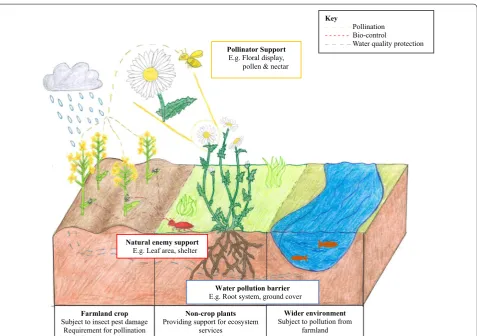
The services that an ecosystem provides are numer-ous, but the three outlined above, (pollination, biological pest control (bio-control) and water quality protection) are some of the most vital when making agriculture more environmentally sustainable [23]. The morphologi-cal traits of different plant species, such as floral display size, nectar content and leaf area, can provide support to these services [24]. For example, Kudo et al. [25] found that Bombus hypocrita subsp. Sapproensis, were more attracted to a larger floral display size, Bianchi and Wack-ers [26] found that a plant with a higher nectar content attracted more parasitoids, and Burylo et al. [27] found that a plant’s ability to trap sediment was positively cor-related with leaf area. An illustration of how plant traits may support these three different ecosystem services can be seen in Fig. 1.
Non-crop habitats, such as vegetative strips, can be established with plant species that have desirable traits, to try and return support for these vital ecosystem ser-vices [28], and support may even be made available through legislation and incentives. In Europe, for exam-ple, specified habitats, plants and animals are protected through the Habitats Directive [29], and water quality through the Water Framework Directive and the Nitrates Directive. The latter specifically addresses water pollu-tion by leaching of nitrates from agriculture into farm-land watercourses [30]. Also, funding for the preservation of habitat biodiversity, water quantity and quality and the protection of soil from erosion is provided via the Com-mon Agricultural Policy (CAP) [31–34].
Though these policies are effective, future availabil-ity of land is likely to be restricted due to food pro-duction requirements, which have increased with consumption growth, and issues of food security such as, competition for land, climate change and other land use pressures, caused by the continued exponen-tial increase of the human population [35, 36]. This has created a need to sustainably intensify agriculture, which involves increasing food production from exist-ing agricultural land whilst minimisexist-ing pressure on the environment [15].
In order to support this sustainable intensification, it may be necessary to increase the ecosystem service value of off-crop habitats by designing vegetative strips that aim to support multiple ecosystem services [28, 37] rather than prioritising one over the others. Combina-tions of plant species to support specific ecosystem ser-vices, are already utilised in parts of Europe (e.g. [38, 39]). However, to enable the maximum functionality of measures such as vegetative strips, it may be valuable to consider which specific plant traits provide support to the target ecosystem services. Therefore, we propose to systematically map all evidence on specific plant traits that provide support for three of the most vital ecosys-tem services, pollination, bio-control and water quality protection.
Objective of the systematic map
Primary question
Which plant traits provide the following ecosystem ser-vices, within temperate climates:
Pollinator support
Crop pest natural enemy support Water quality protection
Elements of the primary question Population
Water quality, pollinator species and natural enemies of insect crop pests, within temperate climates. A temperate zone has a temperature range of −3 to +18 °C, shown as ‘C’ in the Köppen-Geiger world map on climate classifi-cation Kottek et al. [40].
Exposure
Specific plant traits, for example floral display size, leaf area etc.
Comparator
Lack of traits or alternative traits, for example no floral display.
Outcome
Outcomes of each study will be stated as they are found within the relevant articles included and details will be coded into the map accordingly.
Methods
The methods used in the development of the systematic map database will be adapted from the Collaboration for Environmental Evidence (CEE) Systematic Review Guidelines [41] and from an existing systematic map report, Randall and James [42].
Searches
A comprehensive search will be undertaken using multi-ple information sources to capture an un-biased sammulti-ple Pollinator Support
E.g. Floral display, pollen & nectar
Farmland crop
Subject to insect pest damage Requirement for pollination
Non-crop plants
Providing support for ecosystem services
Wider environment
Subject to pollution from farmland
Water pollution barrier
E.g. Root system, ground cover
Natural enemy support
E.g. Leaf area, shelter
Key
– – – –Pollination
- - - -Bio-control
– – – –Water quality protection
of literature. The search strategy was developed to iden-tify both published and grey literature.
Key search terms
An initial scoping search was performed to validate the methodology and used to provide a preliminary indica-tion of the volume of relevant literature. Search terms were tested between November 2014 and March 2015 for specificity and sensitivity using the Harper Adams Uni-versity library electronic database, ‘Findit@Harper’, and used to indicate the volume of relevant literature. The search terms, number of articles found and general qual-ity of the search results were recorded in Microsoft Excel (Additional file 1).
The following Boolean search operators will be used. A wildcard (*) will be used where accepted by a database or search engine to pick up multiple word endings, for exam-ple plant* would pick up plant, plants, etc. A keyword may be made more restrictive by the addition of a qualifier e.g. (plant*) AND (trait*) AND (beneficial) AND (inverte-brate*). The combination of qualifiers and keywords will vary for each ecosystem service, based on the results of the scoping search. The exact keyword and qualifier combina-tions to be used are listed in Table 1 in Additional file 2.
Plant traits identified by the systematic map will then be used as keywords for further searches linking them with the specific target ecosystem services, e.g. (flo-ral display*) AND (pollinat*). This will ensure that the searches are as comprehensive as possible.
Sources of publications
Several online sources will be searched in the English lan-guage to identify relevant literature and a record of each search will be made to enable a re-run of the search if needed. Data that will be recorded include: date search conducted, database name, search term, number of hits and any other notes.
The following online sources will be searched:
1. Bibliographic electronic databases:
1.1. Harper Adams University Library Database (‘Findit@Harper’) which includes the following relevant sources (all other sources included in this database can be found in Additional file 3): 1.2. ISI Web of Science involving the following
prod-ucts: ISI Web of Science; ISI Proceedings 1.3. Index to Theses Online
1.4. Agricola (United States department of Agricul-ture National Agricultural Library) NAL cata-logue
1.5. Copac
1.6. Directory of Open Access Journals (DOAJ)
2. Grey literature for specialist searching
2.1 Organisational websites
Where possible, Boolean search terms will be used in these databases. However if the tech-nical infrastructure of a database does not support this search method, simplified subsets of the key search terms will be used.
2.1.1. Defra (https://www.gov.uk/government/organi sations/department-for-environment-food-rural-affairs)
2.1.2. UK Environment Agency (https://www.gov. uk/government/organisations/environment-agency)
2.1.3. UK Forestry Commission/Forestry Research (http://www.forestry.gov.uk/)
2.1.4. The Woodland Trust, UK ( https://www.wood-landtrust.org.uk/)
2.1.5. Natural England ( https://www.gov.uk/govern-ment/organisations/natural-england)
2.1.6. Natural Resources Wales ( https://naturalre-sources.wales/)
2.1.7. Scottish Natural Heritage (http://www.snh. gov.uk/)
2.1.8. Scottish Environment Protection Agency (https://www.sepa.org.uk/)
2.1.9. Northern Ireland Environment Agency (https://www.doeni.gov.uk/)
2.1.10. European Environment Agency (http://www. eea.europa.eu/)
2.1.11. European Commission Joint Research Centre (https://ec.europa.eu/jrc/en)
2.1.12. Ministry of Agriculture and Forestry (Finland) (http://mmm.fi/en/frontpage)
2.1.13. Swedish Environmental Protection Agency (http://www.swedishepa.se/)
2.1.14. Danish Environmental Protection Agency (http://eng.mst.dk/)
2.1.15. Ministry of Environment and Food of Den-mark (http://en.mfvm.dk/the-ministry/) 2.1.16. Government Norway Portal (https://www.
regjeringen.no/en/)
2.1.17. Flemish Environment Agency (http://en.vmm. be/)
2.1.18. Federal Environment Agency (Germany) (http://www.bmub.bund.de/en)
2.1.19. Federal Ministry of Food, Agriculture (Ger-many) (http://www.bmel.de)
2.1.20. Netherlands Environmental Assessment Agency (http://www.pbl.nl/en)
Transport, Energy and Communication (Swit-zerland) (http://www.uvek.admin.ch/) 2.1.22. Federal Office for Agriculture (Switzerland)
(http://www.blw.admin.ch)
2.1.23. Food and Agriculture Organization of the United Nations (http://www.fao.org) 2.1.24. Ecologic Institute (http://www.ecologic.eu) 2.1.25. EU Cost (European Cooperation in Science
and Technology) (http://www.cost.eu)
3. Search engines
Scirus (www.Scirus) and Google Scholar (scholar. google.com). The first 25 hits (.doc,.txt,.xls and.pdf documents where this can be separated) from each data source will be examined for appropriate data. No further links from the captured website will be followed unless to a document/pdf file
4. Other literature searches
Other specific/specialised databases will be searched where identified or recommended by experts within the field.
5. Key studies through stakeholder consultation
Bibliographies of articles viewed at full text will be searched for relevant articles missed by previ-ous searches. Recognised experts, practitioners and authors will be contacted for further recommenda-tions and to provide relevant unpublished material or missing data.
Article screening and study inclusion criteria Screening process
The results of each search term on each database will be imported into a separate EndNote X7 library file. All the database libraries will be incorporated into one library, recording the number of references captured. Using the automatic function in the EndNote X7 software, any duplicates will be removed.
The inclusion criteria will be applied by one reviewer to all potential articles at the title and abstract level. Where there is insufficient information to make an informed decision regarding an article’s inclusion, relevance to full text assessment will be assumed. A second reviewer will examine a random subset of at least 10% of the refer-ence list to assess repeatability of the selection criteria. A
kappa analysis will be performed to determine agreement between reviewers, with a score of 0.6 or above indicating substantial agreement. Disagreement between reviewers will be discussed and resolved by consensus. This same method will be used to assess the quality assessment and data extraction methods.
A full list of articles excluded at full text with reasons for exclusion will be provided.
Inclusion criteria
All retrieved studies will be assessed for relevance using the following inclusion criteria:
Relevant subject(s) Studies that investigate some aspect of plant traits and how they provide support for the tar-get ecosystem services will be considered for inclusion into the systematic map.
Relevant climate zone Studies that have been under-taken in a region with a temperate climate, i.e. those clas-sified as ‘C’ in Kottek et al. [40].
Language All languages will be included in ini-tial searches. Only studies published in English will be included in full text assessment. This is due to limited resources and the languages known by the study reviewers.
Date No date restrictions will be applied.
Relevant ecosystem service provided The following sup-port for ecosystem services provided by plant traits will be included: support for pollinators and crop pest natural enemies and water quality protection.
Relevant Population Water quality, pollinator species and natural enemies of insect crop pests.
Relevant exposure Specific plant traits, for example flo-ral display size, leaf area, root length, plant height.
Relevant comparator Lack of traits or alternative traits, for example no floral display.
Relevant outcome Outcomes of each study will be stated as they are found within the relevant articles included and details will be coded into the map accordingly.
Examples of outcomes may include:
• Effects on pollinator abundance and diversity, visita-tion rates and attractiveness.
• Effects on natural enemy abundance and diversity or predation rates
Table 1 Study quality assessment categories. Modified from Haddaway et al. [45]
Quality assessment term applied Replication Sample selection Other sources of bias
Yes Well-replicated (>10 samples per group) Random or blocked or exhaustive None evident Partially Moderate level of replication (4–10 samples
per group) Not stated but clearly random or blocked Potential confounder Not at all Poorly-replicated or not stated (1–3 samples
• Effects on water quality protection including inhibit-ing pollution from nitrogen, phosphorus, pesticides and sediment levels.
Relevant study design: Any primary research study that collects experimental or quasi-experimental data to investigate the effect of specific plant traits on provision of the named ecosystem services.
Potential sources of bias
Due to limitations on resources, only English language articles will be included in full text assessment. This does limit the number of articles discovered. Further funding to translate relevant articles or employ a reviewer that can understand multiple languages, could help increase the geographical scale of this systematic map.
Study quality assessment
This quality assessment method has been informed by the systematic review guidelines’ hierarchy of evidence used in medicine and public health [43] and conser-vation [44]. A generic list of variables used for qual-ity assessment developed by Haddaway et al. [45] will be modified and combined with topic-specific qual-ity measures. These may include an assessment of the sampling methodology used (e.g. number, frequency and period of sampling, quality of measure, stand-ards adhered to etc.). An example of a good quality of measure could refer to the sampling technique, such as ensuring the ground is flush with a pitfall when set-ting the trap. Standards adhered to refers to any known standards for that method of sampling, for example, observations of pollinators such as bees should be undertaken between 10 a.m. and 4 p.m. Terms includ-ing ‘yes’, ‘partially’ or ‘not at all’ will be applied to each study for these methodological factors during the crea-tion of the systematic map database. Studies will be assessed on three categories, degree of replication, sample selection methods and other sources of bias, as shown in Table 1.
For example, a replicated, randomised control trial with no obvious bias would be categorised with the term ‘yes’ in all cases. No articles will be excluded from the data-base data-based on study quality.
Data coding strategy
Studies that pass the inclusion criteria will be imported into a database. Generic and topic specific keywords were discussed with experts to assess their suitability. Each article will be coded and categorised according to these terms, which are as follows:
• Author
• Title
• Publication date
• Reference type
• Target system (e.g. a specific plant species)
• Plant trait
• Target organism (e.g. specific pollinator species)
• Outcome
• Target Ecosystem service
• Study country
• Study region/state
• Study site (e.g. greenhouse, pine forest etc.)
• Study timing (specific date(s) that the study took place)
• Study length
• Study type
• Linked study (ID numbers from the article(s) in which the linked study took place will be cross-ref-erenced here)
The following potential effect modifiers have been compiled following discussion with subject experts and will also be coded in the map:
• Country of origin
• Climate (e.g. annual average rainfall values), only studies undertaken in temperate regions are to be included
• Soil properties (e.g. free or poor draining/nutrient levels)
• Time of planting
• Sampling method
• Species of crop pest natural enemy
• Species of pollinator
Data regarding the study characteristics, quality of design and results will be recorded. A notes section will identify any other interesting results such as other eco-system services provided (e.g. nutrient or carbon cycling or carbon sequestration), but will not be included in fur-ther analysis. Where fur-there is more than one article found for a study, each article will be recorded and cross refer-enced in the database. Also, where there is more than one study within an article, information about each study will be included in the database.
from the systematic map. Pivot tables will be generated in order to identify trends in the research.
Where information regarding the reasons for heteroge-neity is presented in the studies, it will be recorded e.g. species of pollinator, time of sampling etc. Where neces-sary and feasible, authors will be contacted for missing/ suitable data.
Subject experts will review the completed systematic map database to ensure that all relevant categories have been defined.
Study mapping and presentation
The systematic map will be presented in an Access data-base, accompanied by a report describing the nature and character of the evidence. Summary graphs and tables of the study characteristics and quality will be presented. Possible knowledge gaps will also be identified, and rec-ommendations will be made for future research based on the findings of the map.
Authors’ contributions
CJB: Design, drafting and revision of protocol. NPR: Conception of project and design of protocol, involved in drafting and revision of protocol, final approval of version. HMC: Participated in the drafting and revision of the manuscript. AW: Participated in the drafting and revision of the manuscript. All authors read and approved the final manuscript.
Author details
1 Harper Adams University, Newport, Shropshire TF10 8NB, UK. 2 Jealott’s Hill
International Research Centre, Syngenta UK Ltd, Bracknell, Berkshire RG42 6EY, UK.
Acknowledgements
The authors wish to thank those who commented on a previous draft of the manuscript. Harper Adams University provided access to the library databases.
Competing interests
The authors declare that they have no competing interests. Any reviewers involved in this review that are also authors of relevant articles will not be included in the decisions connected to the inclusion and critical appraisal of the articles.
Availability of data and materials
All data generated or analysed during this study are included in this published article and information files.
Funding
This systematic map is funded through a Ph.D. Studentship provided by the Biotechnology and Biological Sciences Research Council and Syngenta Ltd.
Received: 12 August 2016 Accepted: 3 January 2017
Additional files
Additional file 1. Scoping search for plant traits and ecosystem services. Additional file 2. Keywords and qualifiers to be used in the literature search.
Additional file 3. Sources searched by Harper Adams University Library Database.
References
1. Robinson RA, Sutherland WJ. Post-war changes in arable farming and biodiversity in Great Britain. Appl Ecol. 2002;39:157–76.
2. Ehrlich PR, Ehrlich AH. Can a collapse of global civilization be avoided? Proc R Soc B. 2013;280:20122845.
3. Benton TG, Vickery JA, Wilson JD. Farmland biodiversity: Is habitat hetero-geneity the key?. Trends Ecol Evol. 2003;18:182–88.
4. Donald PF, Green RF, Heath MF. Agricultural intensification and the col-lapse of Europe’s farmland bird populations. Proc R Soc B. 2001;268:25–9. 5. Flowerdew JR. Mammal biodiversity in agricultural habitats. In: Kirkwood RC, editor. Biodiversity and conservation in agriculture: proceedings of an international symposium organised by the British Crop Protection Council. 1997. p. 25–40.
6. Sotherton NW, Self MJ. Changes in plant and arthropod diversity on lowland farmland: an overview. In: Aebischer NJ, Evans AD, Grice PV, Vickery JA, editors. The ecology and conservation of lowland farmland birds. British Ornitholo-gist’s Union; 2000. p. 26–35.
7. Klein AM, Vaissiere BE, Cane JH, Steffan-Dewenter I, Cunningham SA, Kre-men C, Tscharntke T. Importance of pollinators in changing landscapes for world crops. Proc R Soc B. 2007;274:303–13.
8. Biesmeijer JC, Roberts SPM, Reemer M, Ohlemüller R, Edwards M, Peeters T, Schaffers AP, Potts SG, Kleukers R, Thomas CD, Settele J. Parallel declines in pollinators and insect-pollinated plants in Britain and the Netherlands. Science. 2006;313:351–4.
9. Kevan PG, Phillips TP. The economic impacts of pollinator declines: an approach to assessing the consequences. Conserv Ecol. 2001;5:8. 10. Kremen C, Williams NM, Thorp RW. Crop pollination from native
bees at risk from agricultural intensification. Proc Natl Acad Sci USA. 2002;99:16812–6.
11. Garratt MP, Truslove CL, Coston DJ, Evans RL, Moss ED, Dodson C, Jenner N, Biesmeijer JC, Potts SG. Pollination deficits in UK apple orchards. J Pol-linat Ecol. 2014;12:9–14.
12. Green MB, LeBaron HM, Moberg WK. Managing resistance to agrochemi-cals. From fundamental research to practical strategies. Washington: American Chemical Society; 1990.
13. Bass C, Denholm I, Williamson MS, Nauen R. The global status of insect resist-ance to neonicotinoid insecticides. Pest Biochem Physiol. 2015;121:78–87. 14. Arthropod pesticide resistance database. Michigan State University. 2014.
http://www.pesticideresistance.com. Accessed 23 Nov 2016. 15. Garnett T, Godfray C. Sustainable intensification in agriculture.
Navigat-ing a course through competNavigat-ing food system priorities. Food Climate Research Network and the Oxford Martin Programme on the Future of Food. 2012. http://futureoffood.ox.ac.uk/sites/futureoffood.ox.ac.uk/files/ SI%20report%20-%20final.pdf. Accessed 29 Nov 2016.
16. Fiedler AK, Landis DA, Wratten SD. Maximizing ecosystem services from conservation biological control: the role of habitat management. Biol Control. 2008;45:254–71.
17. Gurr G, Wratten S, Barbosa P. Success in conservation biological control of arthropods. In: Gurr G, Wratten S, editors. Biological control: measures of success. Berlin: Springer; 2010. p. 105–32.
18. Rusch A, Chaplin-Kramer R, Gardiner MM, Hawro V, Holland J, Landis D, Thies C, Tscharntke T, Weisser WW, Winqvist C, Woltz M. Agricultural land-scape simplification reduces natural pest control: a quantitative synthesis. Agric Ecosyst Environ. 2016;221:198–204.
19. Reichenberger S, Bach M, Skitschak A, Frede H-G. Mitigation strategies to reduce pesticide inputs into ground- and surface water and their effectiveness: a review. Sci Total Environ. 2007;384:1–35.
20. Kuivila KM, Foe CG. Concentrations, transport and biological effects of dormant spray pesticides in the San Francisco Estuary, California. Environ Toxicol Chem. 1995;14:1141–50.
21. Thorburn PJ, Biggs JS, Weier KL, Keating BA. Nitrate in ground waters of intensive agricultural areas in coastal Northeastern Australia. Agric Ecosyst Environ. 2003;94:49–58.
22. Gevao B, Semple KT, Jones KC. Bound pesticide residues in soils: a review. Environ Pollut. 2000;108:3–14.
23. Bommarco R, Kleijn D, Potts SG. Ecological intensification: harnessing ecosystem services for food security. Trends Ecol Evolut. 2013;28:230–8. 24. Kattge J, Diaz S, Lavorel S, Prentice I, Leadley P, Bönisch G, Garnier E,
• We accept pre-submission inquiries
• Our selector tool helps you to find the most relevant journal • We provide round the clock customer support
• Convenient online submission • Thorough peer review
• Inclusion in PubMed and all major indexing services • Maximum visibility for your research
Submit your manuscript at www.biomedcentral.com/submit
Submit your next manuscript to BioMed Central
and we will help you at every step:
25. Kudo G, Ishii HS, Hirabayashi Y, Ida TY. A test of the effect of floral color change on pollination effectiveness using artificial inflorescences visited by bumblebees. Oecologia. 2007;154:119–28.
26. Bianchi F, Wackers FL. Effects of flower attractiveness and nectar avail-ability in field margins on biological control by parasitoids. Biol Control. 2008;46:400–8.
27. Burylo M., Dutoit T, Rey F. Species traits as practical tools for ecological restoration of marly eroded lands. Restoration Ecol. 2014;22:633–40. 28. Hackett M, Lawrence A. Multifunctional role of field margins in arable
farming. European Crop Protection Association, Cambridge Environmen-tal Assessments, ADAS UK Ltd. http://www.ecpa.eu/files/attachments/ Field%20Margins%20Arable%20Farming_V02.pdf (2014). Accessed 23 Feb 2015.
29. European commission: Environment. The Habitats Directive http:// ec.europa.eu/environment/nature/legislation/habitatsdirective/index_ en.htm (2016). Accessed 29 March 2016.
30. European commission: Environment. Introduction to the new EU Water Framework Directive http://ec.europa.eu/environment/water/water-framework/info/intro_en.htm (2016). Accessed 29 Mar 2016.
31. European commission: Agriculture and biodiversity. http://ec.europa.eu/ agriculture/envir/biodiv/index_en.htm (2016). Accessed 29 Mar 2016. 32. European commission: Agriculture and Water. http://ec.europa.eu/
agriculture/envir/water/index_en.htm (2016). Accessed 29 Mar 2016. 33. European commission: Agriculture and Pesticides. http://ec.europa.eu/
agriculture/envir/pesticides/index_en.htm (2016). Accessed 29 Mar 2016. 34. European commission: Soil and agriculture
http://ec.europa.eu/agricul-ture/envir/pesticides/index_en.htm (2016). Accessed 29 Mar 2016. 35. United Nations, Department of Economic and Social Affairs, Population
Division: World population prospects, the 2015 Revision. http://esa. un.org/unpd/wpp/DataQuery/ (2015). Accessed 31 Mar 2016.
36. Godfray HC, Beddington JR, Crute IR, Haddad L, Lawrence D, Muir JF, Pretty J, Robinson S, Thomas SM, Toulmin C. Food security: the challenge of feeding 9 billion people. Science. 2010;327:812–8.
37. Stutter MI, Chardon WJ, Kronvang B. Riparian buffer strips as a multi-functional management tool in agricultural landscapes. J Environ Qual. 2012;41:297–303.
38. Syngenta UK Ltd. Grower’s guidelines. Operation pollinator: multifunc-tional landscapes. Cambridge: Syngenta UK Ltd; 2014.
39. Ecostac. Optimising Ecosystem Services in Terms of Agronomy and Con-servation. http://www.lancaster.ac.uk/lec/sites/ecostac/seed_selection. php (2009). Accessed 4 Nov 2016.
40. Kottek M, Grieser J, Beck C, Rudolf B, Rubel F. World map of the Köppen-Geiger climate classification updated. Meteorol Z. 2006;15:259–63. 41. Collaboration for Environmental Evidence: Guidelines for Systematic
Review in Environmental Management. Version 4.0. http.//www.environ-mentalevidence.org/Authors.htm (2010). Accessed 23 Feb 2015. 42. Randall NP, James KL. The effectiveness of integrated farm management,
organic farming and agri-environment schemes for conserving biodiver-sity in temperate Europe: a systematic map. Environ. Evid.. 2012;1:4. 43. Stevens A, Milne R. The effectiveness revolution and public health. In:
Scalley G, editor. Progress in Public Health. London: Royal Society for Medicine Press; 1997. p. 197–225.
44. Pullin AS, Knight, TM. Effectiveness in conservation practice: pointers from medicine and public health. Conserv Biol. 2001;15:50–4. 45. Haddaway NR, Styles D, Pullin AS. Evidence on the environmental
![Table 1 Study quality assessment categories. Modified from Haddaway et al. [45]](https://thumb-us.123doks.com/thumbv2/123dok_us/9127363.1905910/5.595.56.537.640.719/table-study-quality-assessment-categories-modified-haddaway-et.webp)
