International Journal of Science Technology
Management and Research
Available online at: www.ijstmr.com
IJSTMR
©
2018 | All Rights Reserved 13QR based Smart Cart
Komal K. Sancheti
Department of Information Technology
MET’s Bhujbal Knowledge City
Institute of Engineering Nashik, India
Vaishnavi P. Patil
Department of Information Technology MET’s Bhujbal Knowledge City Institute of Engineering Nashik, India
Pradnya G. Bhor
Department of Information Technology
MET’s Bhujbal Knowledge City
Institute of Engineering Nashik, India
Abstract-: An innovative product with user acceptance providing with comfort, convenience and efficiency in everyday life. Shopping at malls is becoming daily activity most of cities. Malls are getting almost crowded now days, most of people do shopping from mall. People purchase different items and put them in trolley. After purchasing, one needs to go to billing counter for payments. At billing counter the cashier prepare the bill using QR Code Reader which is very time consuming process and results in long queue at billing counter.
Keywords: Smart Trolley, QR Code, Smart Shopping.
I. INTRODUCTION
The idea for the project is to optimize this process of shopping at a retail store, by enabling the customer to handle the check-out process. The approach to automated shopping and billing until now has been more hardware-centric. A number of attempts have been made to design Smart Shopping Carts with various different functionalities. After negotiating busy supermarket aisles, you often have to pick the queue you think will move fastest to stand a chance of getting your shopping home before the ice cream melts. Now days purchasing and shopping at big malls is becoming a daily activity in metro cities. We can see huge rush at malls on holidays and weekends. The rush is even more when there are special offers and discount. People purchase different items and put them in trolley. After total purchase one needs to go to billing counter for payments. At the billing counter the cashier prepare the bill using bar code reader which is a time consuming process and results in long queues at billing counters. But this tedious ritual may become a thing of the past thanks to sensors embedded into the wheel of trolleys. Our aim is to develop a system that can be used in shopping malls to solve the above mentioned challenge. The system will be placed in all the trolleys. It will consist of a QRCode reader. All the products in the mall will be equipped with QR-Codes. When a person puts any products in the trolley, its code will be detected and the price of those products will be stored. Thus the billing will be done in the trolley itself. Item name and its cost will be displayed on local display.
In the modern world, every supermarket employ shopping baskets and shopping trolleys in order to aid customers to select and store the products which they intend to purchase. The customers have to drop every product which they wish to purchase into the shopping cart and then proceed to checkout at the billing counter. The billing process is quite highly time consuming. We propose to do this by using a smart phone application that allows the user to scan the products he or she wishes to purchase, generate the bill for all the products selected, and make the payment. Instead of using traditional bar codes, we propose to use Quick Response (QR) codes to identify each product. The application includes an option to search where a product is located in the store. The entire process of bill generation is automatically carried out, and is displayed on the interface as the user continues shopping. Once all the items are scanned and the user confirms the purchase order, the final bill is generated and the user is be redirected to payment options. The customer has the option to sign up for a custom wallet that can be used for faster payment.
II. LITERATURE SURVEY
IJSTMR
©
2018 | All Rights Reserved 14storage, bar codes can hold less data, mostly numeric, and take up greater space as they are one dimensional. Also, if a bar code is damaged or dirty, they are not capable of reading any data and they cannot be properly scanned.
We believe that the entire system can be changed to provide a better shopping experience for the customer, as well as for the store management, through digital solutions.
While doing survey we found that most of the people prefer to leave the shopping mall instead of waiting in long queues to buy a few products. People find it difficult to locate the product they wanted to buy, after selecting product they need to stand in a long queue for billing and payment. To try to solve the problems previously identified, recent years have seen the appearance of several technological solutions for hypermarket assistance. All such solutions share the same objectives: save consumer’s time and money, help the retailers to win loyal clients.
One system is designed i.e. the Web shopping cart system as a typical client-server application on the Web. Then they clarified several problems on the implementation of the Web shopping cart system, which are peculiar to the Web. In order to solve the problems, proposed a new mechanism that can manage user sessions with high reliability and safety. It is compared the Web shopping cart system implemented using the proposed mechanism with the one developed by the conventional methods.
One more system is proposed, an automatic embedded software generation framework that can create and evolve Zigbee applications. The framework consists of two major modules, pattern extraction and code generation. Pattern extraction and development are designed to provide Zigbee application with model reuse and modification. SysML serves as a medium between pattern development and code generation. A smart shopping cart application has been implemented using this pattern based software framework.
III. PROPOSED SYSTEM
Fig. 1: Architecture Diagram of the System
The smart trolley system integrates a Shopping cart (trolley) with 2 sets of QR code scanners placed at 2 different checkpoints – the entry and exit points respectively. It facilitates the user to self-scan the QR code of the purchased products which he intends to purchase. Wrongful entries can be corrected by making use of a keypad that changes the functionality of the machine from addition of products to removal of products and activates the other QR code scanner at the opposite end.
A wireless smart-device makes note of all the scanned commodities of the particular trolley (with allotment number) ; and is linked with the Supermarket's backend database which contains details of the products such as Cost Price, Available Stock. The scanned products are automatically billed in the wireless smart device for their purchases, thereby significantly reducing turnaround time and reducing and transmitted to the Shop's central Billing program. System will generate a bill.
Then user will pay the bill and take out all their products and place them into carry bags during the checkout process.The smart phone application is one that provides a User Interface (UI) to interact with the products, by means of adding, viewing or removing it to a personalized cart.
IJSTMR
©
2018 | All Rights Reserved 15IV. SNAPSHOTS
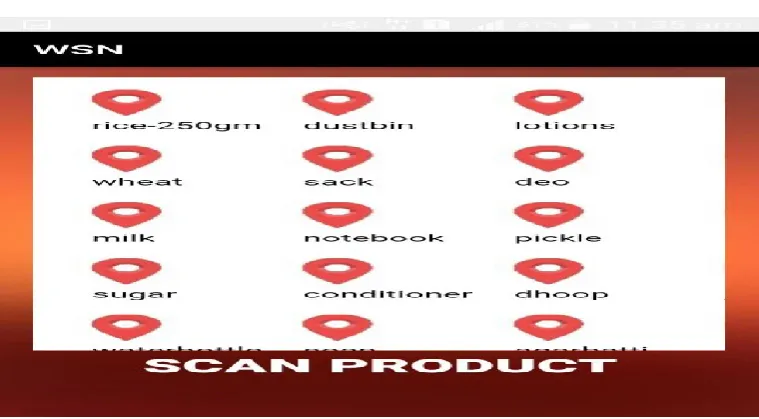
Fig. 3: Start cart application
Fig. 4: List of items for shopping
IJSTMR
©
2018 | All Rights Reserved 16Fig. 6: Bill generation system
IJSTMR
©
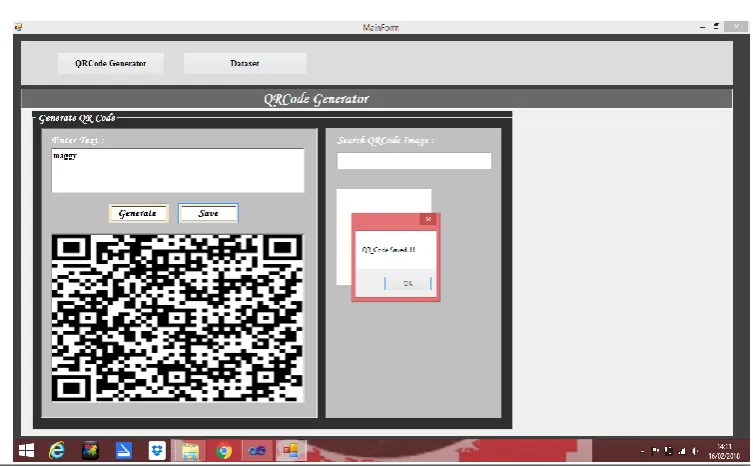
2018 | All Rights Reserved 17Fig. 8: Add record
CONCLUSION
We believe that this process of shopping can revolutionize the existing shopping system, as it isn’t a very high cost investment for the store management. Almost everybody owns a smart-phone with a camera which is all that is required to perform the software automation that we propose. In exchange, the speed of shopping and the convenience that the customer gets is immense. This leads to a win-win situation where the customer is happy to come back for the convenience that this system provides, and the management is happy with the customer retention they get.
REFERENCE
1. Raju Kumar, K. Gopalakrishna, K. Ramesha on “Intelligent Shopping Cart” in International Journal of Engineering Science and Innovative Technology (IJESIT)
Volume 2, Issue 4, July 2013
2. Kindiling And Perception Of Qr-Images Using Raspberry-PI 1P.V.Vinod Kumar, 2K.Dhanunjaya- International Journal Of Engineering And Computer Science
ISSN:2319-7242 Volume 4 Issue 7 July 2015, Page No. 13082-13085
3. International Journal of Computer Applications (0975 – 8887) International Conference on Communication, Computing and Information Technology
(ICCCMIT-2014)
4. A QR Code-Based on-Street Parking Fee Payment Mechanism, IEEE 2014
5. S. Vakulenko, O. Müller, and J. v. Brocke, “Enriching iTunes app store categories via topic modeling,” The 35th International Conference on Information
Systems, 2014.
6. An Unhackable QR Code to Fight Bogus Chips, IEEE 2013
7. Indias Largest Malls - 2010, asipac, Mar 2010, [Research Studies On Malls in India].
8. Ankit Anil Agarwal, Saurabh Kumar Sultania, Gourav Jaiswal and Prateek Jain on RFID Based Automatic Shopping Cart in Control Theory and Informatics;
ISSN 2224-5774 (print) ISSN 2225-0492 (online),Vol 1, No.1, 2011
9. J.Awati and S.Awati, Smart Trolley in Mega Mall, in International Journalof Emerging Tech- nology and Advanced EngineeringWebsite: www.ijetae.com
(ISSN 2250-2459, Volume 2, Issue 3, March 2012)
10. Raju Kumar, K. Gopalakrishna, K. Ramesha on Intelligent Shopping Cart in International Journal of Engineering Science and Innovative Technology (IJESIT)
Volume 2, Issue 4, July 2013
11. L. Yew, L. Fang, C. Guancheng, C. Jianing, and L. Hangzhi, RFID: Smart Shopping for the future, Singapore Management University, Tech. Rep.
12. 1Arbaaz Khan, 2Aadil Siddiqui” Smart Trolley Using QR Code”
13. J.Awati and S.Awati, "Smart Trolley in Mega Mall," vol.2, Mar 2012.
14. L. Yew, L. Fang, C. Guancheng, C. Jianing, and L. Hangzhi, “RFID: Smart Shopping for the future,” Singapore Management University, Tech. Rep.
15. Udita Gangwal, Sanchita Roy, Jyotsna Bapat, “Smart Shopping Cart for Automated Billing Purpose using Wireless Sensor Networks”, SENSORCOMM 2013
16. “Zebra Crossing (Zxing) Bar Code Scanner Project for Android “https://github.com/zxing/zxing
17. Shivani Titarmare , Monali Thakre , Rasika Shingote, Sakshi Shukla, Vikram Deshmukh, “RFID Based Smart Shopping Trolley with IR Sensor”, 2017 IJSRST
, Volume 3 ,Issue 2 ,Print ISSN: 2395-6011