International Journal of Science Technology
Management and Research
Available online at: www.ijstmr.com
IJSTMR
©
2016 | All Rights Reserved 1Comparative Study of Flexural Strength of
Behavior of RC Slab Using Armid Fiber& Carbon
Fiber
Patil Dattatray R. P.G. Student, Civil Engineering Department, Late G.N. Sapkal College of Engineering,
Maharashtra, India
Dr. R S Talikotti Associate Professor Civil Engineering Department
Late G.N. Sapkal College of Engineering, Maharashtra, India
Abstract: Aramid Fiber and Carbon Fiber as an external reinforcement is used extensively to deal with the strength requirements related to flexure in structural systems. In the present work, the behavior and performance of rectangular reinforced concrete slab strengthened with externally bonded Aramid Fiber and Carbon Fiber subjected to flexure is studied experimentally. Rectangular RC slab externally bonded with Aramid Fiber and Carbon Fiber. Each panel is subjected to equal static loading during the experiment. Total eighteen RC slab will be cast and tested for the study. In that nine panels will be design for one way and same for two way. six panels will be use as a control panel and six slab panels were strengthened using different configurations and different types of Aramid Fiber and Carbon Fiber . The study is restricted to continuously wrapped Aramid Fiber and Carbon Fiber wrapped with strip of Aramid Fiber and Carbon Fiber. The effect of different types and configuration of Aramid Fiber and Carbon Fiber on first crack load, ultimate load carrying capacity and failure mode of the slab were investigated. The experimental results have been validated with finite element analysis by using ANSYS software and found to be in good agreement with analytical values. The results also indicate that the most effective configuration is the full-wrap of Aramid Fiber and Carbon Fiber.
Key Words: Aramid Fiber, Carbon Fiber , Flexural Strength , Strengthening.
1. INTRODUCTION
Strengthening of existing structures has become a major part of construction activity in our country. Many civil structures are no longer safe due to increased load specifications in the design codes. Such structure must be strengthened in order to maintain their serviceability. Strengthening refers to the reconstruction or renewal of any part of an existing building to provide better structural capacity like higher strength and ductility than the original building. The various strengthening techniques include steel plate bonding, polymer injection followed by concrete jacketing, use of advanced composite materials like aramid fiber reinforced polymer (AFRP), carbon fiber reinforced polymer (CFRP), and ferrocement etc. the choice of a particular strengthening method depends upon the type, nature and cause of distress to be repaired. Nowadays, strengthening using CFRP, AFRP etc. is gaining popularity due to their high strength-to-weight ratio and corresponding fatigue resistance. In RC buildings, slab are subjected to large forces during severe ground shaking and its behavior has a significance influence on the response of the structure. Hence slab is the crucial zone in a reinforced concrete moment resisting frame. The revisions of Indian code provisions have necessitated strengthening of several existing structure in country. The exposed joints in those structures such as frames of industrial buildings, water tanks, bridges and other structure can be strengthened by giving adequate lateral confinement using ferrocement or fiber reinforced polymer (FRP) composites.
IJSTMR
©
2016 | All Rights Reserved 2 materials such as CFRP, AFRP on the performance RC slab under static as well as cyclic loading. A significant improvement in themoment carrying capacity, energy absorption, etc. was observed for all the strengthened specimens.2. METHODOLOGY
Flexural Strengthening of RC slab: Early efforts for understanding the response of plain concrete subjected to pure torsion revealed that the material fails in flexural rather than shear. Structural members curved in plan, members of a space frame, ultimate loaded slab, curved box girders in bridges, spandrel beams in buildings, and spiral stair-cases are typical examples of the structural elements subjected to Flexural moments cannot be neglected while designing such members. Structural members subjected to flexural are of different shapes such as one way, two way slab sections. These different configurations make the understanding of flexural in RC members a complex task. In addition, torsion is usually associated with bending moments and shearing forces, and the interaction among these forces is important. Thus, the behavior of concrete elements in flexural is primarily governed by the tensile response of the material, particularly its tensile cracking characteristics. Spandrel beams, located at the perimeter of buildings, carry loads from slabs. This loading mechanism generates flexural forces in the slab. Reinforced concrete (RC) slab has been found to be deficient in flexural capacity and in need of strengthening. These deficiencies occur for several reasons, such as insufficient stirrups resulting from construction errors or inadequate design, reduction in the effective steel area due to corrosion, or increased demand due to a change in occupancy. Similar to the flexure and shear strengthening, the aramid fiber is bonded to the flexural surface of the RC members for flexural strengthening. In the case of flexural, all sides of the member are subjected to diagonal tension and therefore the FRP sheets should be applied to all the faces of the member cross section. However, it is not always possible to provide external reinforcement for all the surfaces of the member cross section. In cases of inaccessible sides of the cross section, additional means of strengthening has to be provided to establish the adequate mechanism required to resist the torsion Aramid fiber: Aramid Fiber is a composite material made by combining two or more materials to give a new combination of properties. However, aramid fiber is different from other composites in that its constituent materials are different at the molecular level and are mechanically separable. The mechanical and physical properties of aramid fiber are controlled by its constituent properties and by structural configurations at micro level. Therefore, the design and analysis of any aramid fiber structural member requires a good knowledge of the material properties, which are dependent on the manufacturing process and the properties of constituent materials. Aramid fiber composite is a two phased material, hence its anisotropic properties. It is composed of fiber and matrix, which are bonded at interface. Each of these different phases has to perform its required function based on mechanical properties, so that the composite system performs satisfactorily as a whole.
Carbon Fiber: Carbon fibers are produce by bonding carbon atoms together in a crystals that are aligned parallel to the axis of fiber. Carbon fibers have been manufactured with petroleum and coal pitch with 5-10 micrometer in diameter with specific gravity near about 1.9. The crystal alignment gives the fiber high strength to volume ratio and the modulus of elasticity is higher than steel and it is twice or thrice stronger than steel. They have high stiffness , high chemical resistance , high temperature tolerance and low thermal expansion.
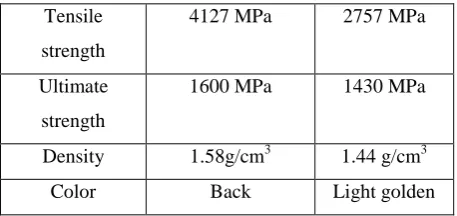
Properties of CFRP & AFRP
Name Carbon Fiber Aramid
Fiber Modulus of
elasticity
IJSTMR
©
2016 | All Rights Reserved 3 Tensilestrength
4127 MPa 2757 MPa
Ultimate strength
1600 MPa 1430 MPa
Density 1.58g/cm3 1.44 g/cm3
Color Back Light golden
Table 1.1 Properties of CFRP & AFRP
3. EXPERIMENTAL RESULTS:
One Way Slab Controlled Panel:-
Table 3.1: One Way Slab Controlled Panel
One Way Panel Wrapped with Carbon Fibre:-
Sr.
No.
Load (kg)
Deflection
(mm)
1
250
0.64
2
300
0.9
3
350
1.1
4
400
1.21
5
450
1.4
6
500
1.52
7
550
1.85
8
600
2.75
9
650
3.24
10
700
3.5
11
750
4.0
12
800
4.55
13
850
5.0
Sr.
No.
Load (kg)
Deflection (mm)
1
250
2.0
2
300
2.8
3
400
3.1
4
450
3.37
5
500
3.55
6
550
3.78
7
600
4.3
8
650
5.0
9
700
5.83
10
750
6.75
11
800
7.93
12
850
8.12
13
900
8.3
14
950
8.65
15
1000
9.05
16
1050
9.5
IJSTMR
©
2016 | All Rights Reserved 414
900
5.75
15
950
6.35
16
1000
7.09
17
1050
7.6
18
1100
8.15
19
1150
8.85
20
1200
9.45
21
1250
10
Table 3.2:One Way Panel Wrapped with Carbon Fibre
One Way Panel Wrapped with Aramid Fibre:-
Sr.
No.
Load (kg)
Deflection (mm)
1
250
0.75
2
300
0.86
3
350
0.91
4
400
0.95
5
450
0.98
6
500
1.03
7
550
1.23
8
600
1.34
9
650
1.70
10
700
2.35
11
750
2.49
12
800
2.59
13
850
2.76
14
900
3.30
15
950
3.60
16
1000
4.30
17
1050
4.60
18
1100
4.95
19
1150
5.64
20
1200
6.21
21
1250
6.95
22
1300
7.34
23
1350
7.59
24
1400
7.85
25
1450
8.24
26
1500
8.70
Two Way Slab:-Two Way Controlled Panel:-
Sr.
No.
Load (kg)
Deflection (mm)
1
250
1.20
2
300
1.35
3
350
1.45
4
400
1.6
5
450
1.81
6
500
2.2
7
550
2.7
8
600
2.85
IJSTMR
©
2016 | All Rights Reserved 510
700
3.09
11
750
3.15
12
800
3.50
13
850
3.87
14
900
4.10
15
950
4.30
16
1000
5.20
17
1050
5.50
18
1100
6.00
19
1150
6.70
20
1200
7.85
21
1250
8.00
22
1300
8.30
23
1350
8.70
24
1400
9.00
25
1450
9.85
26
1500
10.00
Two Way Panel Wrapped with Carbon Fibre:- Sr.
No.
Load (kg) Deflection (mm)
1 250 0.9
2 300 0.9
3 350 1.18
4 400 1.31
5 450 1.41
6 500 1.59
7 550 1.72
8 600 1.81
9 650 1.92
10 700 2.21
11 750 2.50
12 800 2.80
13 850 2.95
14 900 3.20
15 950 3.60
16 1000 3.85
17 1050 4.45
18 1100 4.85
19 1150 5.00
20 1200 5.31
21 1250 6.00
22 1300 6.28
23 1350 6.80
24 1400 7.32
25 1450 7.65
IJSTMR
©
2016 | All Rights Reserved 6 Two Way Panel Wrapped with Aramid Fibre:-Sr. No.
Load (kg) Deflection (mm)
1 250 0.60
2 300 0.90
3 350 1.00
4 400 1.05
5 450 1.17
6 500 1.28
7 550 1.39
8 600 1.50
9 650 1.72
10 700 2.00
11 750 2.35
12 800 2.55
13 850 2.90
14 900 3.30
15 950 3.70
16 1000 4.00
17 1050 4.50
18 1100 4.85
19 1150 5.20
20 1200 5.50
21 1250 5.90
22 1300 6.40
23 1350 7.05
24 1400 7.53
25 1450 8.13
26 1500 8.59
IJSTMR
©
2016 | All Rights Reserved 7 Graph No. 02:- Load Vs. Deflection for Two Way SlabCONCLUSION
According to the present study it is expected that there will be remarkable increment in strength of RC slab. Strengthening refers to the reconstruction or renewal of any part of an existing building to provide better structural capacity like higher strength and ductility than the original building. Using carbon fiber and aramid fiber the strength will be increase and it is economical as compare to reconstruction of existing building.
1) Ductility increase 2) Deflection reduces 3) Crack reduces 4) Aspectic view
5) No change in geometry.
REFERENCES
1. A. Deifalla and A. Ghobarah “Strengthening RC T-beams subjected to combined torsion and shear using FRP fabrics: Experimental study” Journal of Composites for Construction, ASCE, Vol. 10 ( 2014 ), 301-311.
2. A. Deifalla and Ghobarah “Behavior and analysis of inverted T-shaped RC beams under shear and torsion” Engineering Structures Vol.68, (2014) 57–70.
3. Ramesh kumar U More, D. B. Kulkarni “Flexural behavioral study on RC beam with externally bonded aramid fiber reinforced polymer” International Journal of Research in Engineering and Technology, Vol. 03 ( 2014 ), 316 – 321.
4. Vishnu H. Jariwalaa*, Paresh V. Patel, Sharadkumar P. Purohit “Strengthening of RC beams subjected to combined torsion and bending with GFRP composites” Procedia Engineering, Vol. 51 ( 2013 ), 282 – 289.
5. A.R. Zojaji, M.Z. Kabir “Analytical approach for predicting full torsional behavior of reinforced concrete beams strengthened with FRP materials” Scientia Iranica, Transactions A: Civil Engineering, Vol. 19 (2012) 51–63.
6. A. Deifalla and A. Ghobarah, “Full torsional behavior of RC beams wrapped with FRP: Analytical Model”, Journal of Composites for Construction, ASCE, Vol.14, 2007, pp. 289–300.
7. Mehran Ameli; Hamid R. Ronagh; and Peter F. Dux, “Behavior of FRP strengthened reinforced concrete seams under torsion”, Journal of Composites for Construction, ASCE, Vol.11, 2007, pp. 192–200.
8. Constantin E. Chalioris, “Analytical model for the torsional behaviour of reinforced concrete beams retrofitted with FRP materials”, Engineering Structures, Vol.29, 2007, pp. 3263–3276
9. R.Santhakumar, R.Dhanaraj & E.Chandrasekaran “Behaviour of retrofitted reinforced concrete beams under combined bending and torsion: A numerical study” Electronic Journal of Structural Engineering, Vol.7, 2007, pp 1-7.