journal homepage: http://farplss.org
Volume 27, Number 3, 2018
15
The archetypal ability of the psyche to transcode the ideal realities
into the materialized
T. Yatsenko
Cherkasy Bohdan Khmelnytskyi National University, Cherkasy, Ukraine
L. Galushko
Central Ukrainian Volodymyr Vynnychenko State Pedagogical University, Kropivnitsky, Ukraine
Article info
Received 25.02.2018 Accepted 29.06.2018 Cherkasy Bohdan Khmelnytskyi National University, Cherkasy, Ukraine
Central Ukrainian Volodymyr Vynnychenko State
Pedagogical University, Kropivnitsky, Ukraine
[email protected] [email protected]
Yatsenko, T., Galushko, L. (2018). The archetypal ability of the psyche to transcode the ideal realities into the materialized.Fundamental and applied researches in practice of leading scientific schools, 27 (3), 15–32.
The preparation of a psychologist, in a psychoanalytic paradigm, involves getting acquainted with archetypal ability of the subject's psyche to be transcoded into visualized representatives with the preservation of information equivalents. Such visualized representatives may be different means of objectification, which include an archetypal intentionality (emotional non-indifference), in particular, a modeling, a psycho drawing "my tattoo", author's thematic drawings, reproductions of artistic canvases (offered to choose), etc. It is accentuated that unconscions simultanuously curtained contents are implicitly typical of materialized representants. The process of deep knowledge involves the emotional "revival" of the representant in a dialogical interaction with the respondent. The transcendentnis of information equivalents provides the independence of deep cognition from the peculiarities of metaforic simbolizing of psyche into visualized forms in connection with the invariance of their information equivalents, which should be taken into account by the psychologist in his practical work.
The article provides a fragment of psychoanalysis using reproductions of artistic canvases.
Keywords: conscious; unconscious; psychological defence; representant; information equivalent; archetype.
Introduction
For a long time psychology has not paid any attention to people whose mental health is considered as a norm. This issue arose in relation to the introduction of training methods (since 80s), for the professionally oriented people. These are the following scientists: Y. M. Emelianov (Leninhrad), L. A. Petrovska, H. O. Kovalev (Moscow), T. S. Yatsenko (Cherkasy). This reorientation took place in the framework of humanistic paradigm which focuses on optimizing psyche of mentally healthy people in order to intensify their personal growth and self-actualization of their abilities. The method of active social and psychological cognition (hereafter cited as ASPC) has been recently used in higher educational institutions (according to the current Field Standards (Yatsenko, 2005)) which helps to identify internal, stabilized contradictions, and their solution allows
future psychologists to reduce the risks of self-deprivation and self-obstruction of their personal potential. Therefore, the work in ASPC groups allows future psychologists to develop both their personalities and professional skills.
The purpose of the article is to reveal the role of archetypal mental ability to recode an objectivized and visually perceptible ideal (mental) reality which is indirectly able to provide backgrounds for objectivizing deep factors of subjectivity as a characteristic of the consciousness.
Objectives:
Volume 27, Number 3, 2018
16
Research Methods
The category of «deep cognition» has been actively developed and grounded theoretically and methodologically by Academician of the NAPS of Ukraine T. Yatsenko’s scientific school for more than forty years. The method of active social psychological cognition (ASPC) she developed (and tested by her students) is based on psychodynamic methodology, which enables to outline professional diagnose-targeted activity dynamics of an ASPC psychologist who is trying to find out a respondent’s personal problem (internal contradiction) in the dialogic interaction with him, which causes motivational impulses in his activity.
Its effectiveness depends on probability prediction implemented in the dialogic interaction «Psychologist – Respondent» (hereinafter P↔R). A dialogic interaction in its regulative and cognitive nature takes into account scientific achievements of Academician of NAPS of Ukraine O. Chebykin (Sudakov, 2002), which increase the ASPC presenter’s attention to the emotional component of the process of the psyche’s deep cognition in its integrity.
Psychodynamic-oriented studies are rapidly developing in Ukraine – there are over forty defended theses that
thematically prove their focus on the improvement of both theory and practice for training practical psychologists. The attention is given to the integrity of the psyche in undivided unity of conscious and unconscious areas requiring methodological basis for instrumental and methodological parameters of deep cognition. The methodology «is a system of principles, methods and ways of organizing and constructing theoretical and practical activity» (1983). The use of ASPC means of cognition reflects E. Husserl’s statement that «pure (transcendental) consciousness is rooted in the «living world», in a universal field to reflective structures which are the atmosphere and foundation for both theoretical and practical activities» (1983, p. 719]). The methodology of this study is designed by the academician of NAPS of Ukraine T. S. Yatsenko and presented in the work (Yatsenko, Gluzman, 2015).
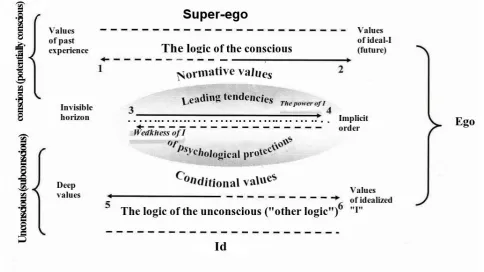
One of the central issues in psychodynamic theory is to find out the nature of integrated psyche, by clarifying the structure of the psyche, introduced by Z. Freud (Super-Ego, Id, Ego) that reflects the «Internal Dynamics Model of the Psyche» (hereafter cited as Model).
Fig. 1. Internal Dynamics Model of the Psyche Horizontal interdependences of substructures in the
psyche show multidirectional flows in psychic energy, but they do not negate each other. On the contrary, they dynamically coexist in the plane of «horizon». Freud’s antagonism towards relationships, according to the «vertical» (Id↔Super-Ego), is supplemented by interdependence antinomy according to the «horizon». Thus, we conclude that the functional nature of the psyche involves a crossing between «vertical» and «horizontal». This is what, in our opinion, has prospects of studying the
psyche’s functional parameters as psychological defences are systematically arranged. T. S. Yatsenko classify them as basic (horizontal) and peripherally situational (vertical).
(multi-Volume 27, Number 3, 2018
17
directionality) – see arrows 1-2 and 5-6 (See Model). Defences are considered to be an important substructure in the psyche. They comprise both conscious and unconscious spheres (See «ellipse» on the model). The psychodynamic paradigm argues that psychological defence cannot be limited to one-action conduct but it is an integrative system with a multi-level, dispositional structure (cognitive, emotional and behavioural levels). It is important to understand that the defensive system, regardless of its structural vastness (and varieties), is only regulated by the general mechanism – «from weakness to strength».
We cannot continue reviewing other methodological positions for the research; they are presented in the following literature (Yatsenko, Gluzman, 2015). It is noteworthy, though, that the methodological basis of research discipline its organizational and instrumental aspects. At the same time, they leave some space to adequately construct instrumental and methodological aspects of ASPC according to every individual’s personal and unique psychological traits. The research process (within ASPC) aims to gain positive practical results; the conclusions are based on the analysis of transcripts (See the fragment of empirics at the end of the article). This allows
ASPC participants (future psychologists) not to fall into the category of experimental subjects.
Presentation and Discussion of Research Results
Psychodynamic approach to the psyche study (K. Levin (Levin, 2001) M. Klain (2010) T. Yatsenko (1996; 2006; Yatsenko, Gluzman, 2015) et al.) develops historically significant method of orthodox psychoanalysis (free associations). It focuses on both language of the conscious (the word) and language of the unconscious (image and symbol) which is facilitated by instinctive and archetypal capacity of the individual’s psyche to be visualized as its own self-representant. A famous Ukrainian psychologist P. Symonenko’s works (2005), particularly her doctoral thesis on strategic and semantic approach to the psychology of visual thinking, are of great practical value for this study. Other noteworthy works include psychological analysis of imagery and symbolic practices with the use of: drama-symbol (catathymic images by H. Leuner (1987)); spontaneous drawing using psychedelics (holotropic breath work by S. Grof, 2009), art therapeutic techniques etc.
Psychodynamic approach gives all reasons to distinguish it from other research areas as they have not intended to examine subject’s psyche in its integrity and have not used a dialogue. Although unconscious study oriented projective methods used visualized means, their conclusions are based on test methods, which are:
a) subject processed (sphere of conscious); b) conclusions are based on quantitative data;
c) one specific sphere cannot be explored one of the areas, violating the principle of «inseparability between conscious and unconscious» (introduced by T. S. Yatsenko).
Long term experience of running ASPC groups shows that the psyche incarnates archetypally (carries in itself) the ability to recode its own psychical realities into material forms maintaining «information equivalents» (Sudakov, 2002).
D. Hume (1711-1776) in «A Treatise of Human Nature» underlines the importance of perception for psychological self-sentiment: «I cannot catch my inner Self as something that exists out of perception» (Jum, 1965, p. 366). Studies in the psychic and dynamic framework show that involuntary, spontaneous mutual transition of implicative and explicative characteristics of the psyche are of great importance. In this context another important idea belongs to P. K. Anokhin who states that: «The way the process of reflection develops, makes an external object gain its form, through a continuous row of physical and physiology processes, according to the information transfer theory» (Anohin, 1969, p. 111). P. Anokhin’s theory opens up prospects for psyche objectivity understanding in particular, decoding the transition process of «material physical processes into subjective image, into consciousness» [ibid.]. Despite the fact that there is a vast number of «steps» in dialogical co-operation between a psychologist and a respondent, empirical facts confirm the relevance of P. K. Anokhin’s claim, that «there must be an exact and adequate information equivalence between the initial and final link of information transference» (Anohin, 1969, p. 112).
A psychodynamic paradigm, taking into account two-dimensional (binary) nature of psychical nature, requires a principle of complementarity in its two varieties: a principle that conscious and unconscious are inseparable, and a principle of «from other» which has some special requirements for the psychologist’s professional skills in his ability to provide accurate diagnostics. This requires formulating questions the way they can actualize the unconscious features of the psyche (Yatsenko). Therefore, question formulation is a key component for psychologist’s professionalism. This is based on the semantic parameters of respondent’s behavioural material which generates (in a respondent) a power impulse (motive). It is the latter that generates an internal activity of the psychic, an impulse of motivation. The psychodynamic paradigm has recently focused on fact verification (and cognition) of implicit order in the psyche which catalyzes the individually unique ordering of subject’s representative activity.
In practice of diagnostic and corrective ASPC process, a psychologist initiates a metaphorical and imaginative representation of an individual by suggesting choosing artistic realization from a set of selected themes (a thematic set of pictures), or through the choice of reproductions (Yatsenko, 1996; Yatsenko, 2006). The psycho-analysis of pictures can be combined with the use of toys, stone models, clay modelling of self-presentant, and work with sand.
Volume 27, Number 3, 2018
18
to others, to the outer world, and «vision of himself in his professional activity».
ASPC groups focus on the problem of psyche internal contradiction which objectively sets disintegration processes with participation defences in their distortional possibilities of subject’s social-perceptual sensitivity. The latter objectify psyche by retreats from reality and distort information reflections in order to please «Idealized Self». The psyche’s protective system deteriorates information processing by disguising the sense of underestimation and idealizing self-esteem. This indicates certain oppression of behaviour biological expedience due to a conflict with pro-social ideals. We are convinced that main reason for the disfunction of psychological defence system results from the illusion of the I subject idealization that they create (Yatsenko, Ivanenko, Avramchenko, Yevtushenko, Serhiyenko, Kalashnyk, 2008; Yatsenko, 2006).
An important basis for solving the issue of psyche’s archetypal abilities in its visualization is the discovery in the framework of the psychodynamic paradigm, –psyche laws are universal (Yatsenko, Gluzman, 2015). The understanding of psyche universality does not reduce possibility to provide perception in ASPC and its individual uniqueness. This is a fundamental postulate in psychodynamic methodology of deep cognition (Yatsenko, Gluzman, 2015).
The psychical comprises both the conscious, which is functionally in tune with laws of the observed world, and, at the same time, unconsciousness which corresponds to the Universe functioning laws following such features as: simultaneity of processes, integration of time and space, – beyond any gender; system and structural and matrix (holographic) peculiarities of unconscious functions; logical psyche ordering and, at the same time, asymmetries in functional organization of conscious and unconscious spheres.
On the basis of holistic (integrity) psychical, in unity of laws based on the spiritual and material worlds, our research and practical study is still invariably oriented to the line of complicity of spheres («conscious – irresponsible»), which outlines an «invisible horizon» (See Model Pic. 1). Internal, implicit order of psych objectifies in the continuity of impulses of an individual’s behavioural «steps» which stimulates motivated activities and conduct. The latter can be quite clearly seen in a subject’s ability to rank quickly and without any considerations according to importance – author’s pictures or reproductions that he selected. Diagnostic and corrective process finds out the unrealized cognitive knowledge of psyche, which a professional-psychologist leans against (ASPC presenter).
Psychologist’s professionalism is in his ability to predict unconscious energetic potential specified by the repressed tracks of Id impulses providing that their activity orients to be manifested «outside». Deep cognitive process becomes wavy that does not eliminate, but on the contrary, integrates with a super-ability of implicit kind. It is interesting that this kind of waviness in metaphysics is interpreted as a «reference wave» alongside with an «object wave». The latter agrees with the position of psychodynamic theory in finding out psychological defence varieties – basal (meta-experience) and peripheral (situational and objective). The act of mental objectification is always associated with the «points» of horizontal (basal defence) and vertical (situational
protection) intersection. Dialogic varieties of interactions between the psychologist and the respondent gives wavy prospects for studying of the psyche and defining a deep level of the conscious through finding constant parameters (iterativity, invariantness) in individual’s behavioural patterns.
A profound study of the individual’s psyche as a research objective coincides with the objectives of providing him with some practical help, with the aim to restore areas of affected relationships between spheres of the conscious and unconscious that are masked by protectors through deviations from reality and information its deformities. This is what absorbs energy and damages the psyche.
Psychologist’s professionalism should provide deep objectification factors underlying mental destruction during conversion psychic realities in objective forms that symbolically express the integrity of conscious and unconscious spheres. Further dialogic interaction involves decoding the meanings based on the fact that «the psyche knows everything» (it is only conscious the I that does not). Dialogic interaction with the respondent contributes to the transfer of «explicit knowledge» in the subject’s psyche that he recognizes on his own spontaneous behavioural material. This diagnostic and corrective process assists the psyche reintegration through the dialogic interaction process that positively disintegrates it [psyche] with the prospect of subsequent integration at a higher level of the subject’s harmonious development.
Research attention to the visualized representation is caused by the importance of prelingual, perinatal period in the individual’s psyche development. Trace fixations of that period lack verbalization opportunities, but they can be objectively represented with the further verbal and dialogic analysis of their semantic loads (in the interaction «P↔R»). This diagnostic and correctional dialogue goes beyond the hermeneutical features because recognizable meanings are not a text, they do not exist as a finished product, they cannot be directly observed, but they are only given by the subject’s previous experience and can be objectified provided that there is a well-grounded diagnostically and ramified in time dialogic interaction. This is where a practicing psychologist’s professionalism comes out.
Thus, deep cognition is only possible in a specific context mediated by means used. Dialogic interaction can be considered as a necessary pre-condition of behavioural material accumulation with its further interpretation and generalization. In every dialogical «step» between P and R we have both diagnostics and correction in their integrity, portioning and multiple levels provided by partial positive disintegrations in combination with partial integrations causing the secondary integration of the psyche at much higher level of its development.
Volume 27, Number 3, 2018
19
which immanently has senses (information equivalents). A dialogic interaction makes it necessary to have intermediate interpretations on different levels of diagnostics and correction process and – general interpretation (explanation) based on general results of dialogically accumulated behavioural material.
Making disintegration processes positive is the problem of great importance for a successful ASPC procedure. This is achieved through weakening subject’s illusory ideas. It is the positive mental disintegration that catalyzes secondary integration at a higher level of subject’s development. Disintegration positivity has the following features – illusory aspects weakening in the psyche (generated by automatic defences) which is made in portions, on a multi-level basis with the expansion of self-awareness and gaining auto psycho-correction skills. Psycho-correction effect results from the reduction of social and perceptual information deformations by moving to a higher level of the subject’s cognitive structure integration. This is related to automatic defence forms weakening, the origin of which roots in the oedipal dependence (Oedipus complex).
Malfunctions in cognitive processes are beyond the control of consciousness as they are disguised by the system of psychological defences which deform (distort) social and perceptual information at the level of perception, internal processing and external explication.
There is a question: what do defences hide by means of informative retreats and deformations? Our long-term practice proves the oedipal origins of such informational deformations which are hidden behind transference, substitution, projection, introjection, identification etc. In the Oedipal period (from 2 to 5 years) a child consciousness meets the law of «The Incest Taboo». This fact is not legally-organized and controlled though. From ancient times it is related to the domestic «acquaintance» i.e. «impossibility (prohibition) of sensual association with a close relative (primary libido objects)».
In any case, conditions of sensitive and emotional attraction towards parents results in the effect of incomplete action, incomplete need for unity through «The Incest Taboo» which has influence on the energetic activity of motivational dominant –«to complete unfinished». The last one is scientifically grounded in K. Levin’s works. A quantity and variety of parental symbols in psycho-pictures (See Pic. 2-4) and selected reproductions of artists (Pic. 5-7) prove that powerful energetic factors are formed in parental period influencing an individual’s further life. In other words, they are found throughout the whole life of an individual and, beyond his will, – bring him back to traumas experienced in the past, block his pro-social activity. This creates the phenomenon of «wrong circle» as well as a tendency known as «forced reiteration». Many years of our experience proves that there is a need to introduce an «oedipal perfection» category into the scientific usage (Yatsenko, Gluzman, 2015). «Oedipal perfection» shows a fixation of incest fact in the psyche as well as a drama (inevitability) of parting with «mother’s bosom» (9 months). In general, Oedipal dependence has such consequence effects on an individual as feelings of guilt, being guilty without guilt, ambivalent feelings for beloved people. It is important to keep in mind such destructive consequences as a tendency to «forced reiteration», «going round in circles» and so on. If one can
avoid Oedipus complex (through different forms of «fall from grace»), the problem of parting with mother’s bosom (birth) is an inevitable separation. This may explain why children have such high sensitivity to harmony (or hatred) in parents’ family relationships, and in case of «breakup drama» such tendencies as «returning into womb» and «psychological death» become more predominant. In this case it is defences that are of great help. The introjection, substitution and projection they contain are invisible for a subject but they make his personal problems follow him throughout his life. Usually this is a tendency of transference on other (beyond family) relationships (See empirical part). There may be more acceptable, pro-social and compensational form of defence. It is a sublimation of unrealized energy and its reflection on different pro-social areas: science, art, sport, creativity etc.
In «A Philosophy of Nature» F. Shelling states that mythology is a source for any piece of art work; only within the world of the mythology «there can be persistent and certain images through which eternal concepts can be expressed» (Schelling, 1966, p. 105). One of the myths is a myth about Oedipus: Sophocles’ drama «Oedipus the King» (429 – 426 BC), the tragedy «Oedipus» by Seneca, the satiric drama «Oedipus Tyranus» (1820) by P. B. Shelli, the play «Oedipus the King» (1937) by J. Cocteau, the play «Oedipus» (1715 – 1726) by Voltaire, the play «Oedipus» (1659) by P. Corneille.
Sophocles’ drama became literary basis for the similarly named opera-oratorio by I. Stravinsky (1927). Sophocles’ character Oedipus appears in J. Cocteau’s film «The Testament of Orpheus» with J. Marais in the leading part (1960). The main entrance to The Chernivtsi Drama Theater is decorated with a sculptural composition reproducing the scene from the tragedy «Oedipus the King» by ancient Greek playwright Sophocles. The canvas paintings «The Plague of Thebes: Oedipus and Antigone» (19th century) by C. Jalabert, «Oedipus and the Sphinx» (1864) by G. Moreau and «Oedipus and the Sphinx» (1827) by J. Ingres, the sculpture «Shepherd Phorbas finds the infant Oedipus» (1801) by A. Chaudet and his students etc. (See Pic. 8, 9). The above mentioned demonstrates vitality and effectiveness of Oedipal complex, easily recognised motives of «Oedipus» motives at the everyday level of the psyche and understanding of ancient stories in different periods of human development, which depends on the invariability of psychological laws related to sensual attraction of Oedipal origins which are born in «the unity of two» (See Pic. 8, 9).
Volume 27, Number 3, 2018
20
restraining factor (taboo on incest) in her stepfather. The empirical material illustrates how such act of a child's seduction generates the destruction of his psyche, on the
physical level (self-repression), and psychological - the formation of a tendency toward psychological death.
Diagnostical psychocorrectional work with the respondent N., with use of art paintings replicas,stones and a respondent’s own picture
N. is a first year student of Bohdan Khmelnytsky National University of Cherkasy (2016). It is a group session according to the ASPC method.
P: Choose the pictures emotionally appealing to you. Lay out the pictures (one by one) according to their importance to you, please. Choose the picture we will start to work with. (To the audience): we rely on the fact, that the human psyche is aware of everything, but the conscious is not aware of that. You need to make efforts for that knowledge to become acquired by the consciousness in its personal growth. Let’s
proceed to the discussion of the picture. Tell me what you see in picture 10.
N: I see a desert... A man with the cross on his back... Broken chess pieces... Clouds in the sky...
P: What is the most important for you from all you’ve mentioned?
N: The man with the cross is the central figure for me. P: Is there, in this man figure, anything you have experienced before?
N: Yes, there is. Should I tell you what my experience was?
Pic. 6. M. Parkes «The Wonderful World»
Pic. 5. Sammie Chernine «The Sea Inside»
Pic. 2. Author’s thematic drawing «The Map of the
Inner World»
Pic. 7. D. Ho «Love» Pic. 3. Author’s thematic drawing «The
perception of close people and relatives of each other»
Volume 27, Number 3, 2018
21
P: It is important to clarify what this man has in common with you.
N: Probably, it is the ability to carry the cross on, as it is quite difficult.
P: Thus, do you understand the metaphorical symbol, the cross? Is it filled with the certain personal unique contents for you? If I were you, I would obviously choose an animate figure among of those chess pieces, too. But, as for this "cross", does it embody your emotions, feelings? Do the broken chess figures mean anything?
N: I do not know. I think the picture is a kind of gloomy. It is close to my mood, but I do not like it in general. Simply, the first thing that strokes my eye was an animate figure with the cross. So, I could not help taking it.
P: It is noteworthy that among of all pictures, you, N., have chosen exactly this one (Fig. 10), and lay it first for the analysis. So, is it significant? Does it reflect certain troubles? Look, we have the broken chess figures, the cross, which is carried by the man, the desert, the absence of others people, and the obviously threatening sky that can break out with rain or a storm. Is there anything from your experience that has left a similar trace? Are you still bearing it inside?
N: Certainly. It is and always will be inside me. It is a definite and hard to bear trace.
Fig. 10. S. Zademack «Exiled» P: Is it of some sort of a personal loss or difficult
relationships? N: Relationships.
P: Relationships and breaking up? N: No, just bad relationships.
P: You say bad relationships. Were they beyond the family or within the family?
N: Within the family.
P: Are they your own relationships? Or are you worried about the family relationships (for example, "mother – father" relationships), which make your life complicated?
N: Both of them, my own and a family one, - relationships that are hard for me.
Pic. 8. G. Moreau «Oedipus and the Sphinx»
Pic. 9. J. Ingres «Oedipus and the Sphinx»,
Volume 27, Number 3, 2018
22
P: Here we have the double difficulty. That is why; there are broken figures (pointing to the chess on Fig. 10). Did you have any loss, failure, disappointment?
N: There was much failure. The cases are impossible to count.
P: How does it influence your life now? Your choice was far from being random. Do you realise that it makes your life oppressed in general?
N: I think it is so. I find it very hard to trust people and to let them in. I am mostly alone.
P: You have experienced some disappointment. Was the person who disappointed you the one you trusted? Did you rely on him or her?
N: Yep.
P: Imagine that the situation does not exist anymore. And you are surrounded by other people. They belong to the environment of your current student life. They have to make you compensate those troubles in the relationships you have experienced in the past.
N: It is hard to move over the previous experience, to get rid of it, since it pursues me.
P: Is it difficult to get rid of the previous experience? Could you address it and say something. Please, give it a try! N: Probably, I would not say anything, as I am tired of it.
The psychologist's comment: This means that you would like everything to disappear, to have no emotional
links to this cross (pointing to the cross, Fig. 10), and not to experience troubles, frustration. Thus, you want to forget everything. It is reasonable! Here we come up to the fact that our diagnostic-correctional process works in unison with your psyche’s desires. Psychocorrectional process is directed towards the cognition of the consequential effects, which are very strong, and often stronger than the existing reality. The material has allowed us to spot that you cannot see dignity of the people around you, and that you perceive the relationship with them as dull and unpromising only because there have been difficulties with some beloved people in your previous experience. Here we distinguish the imperative character of the past fixations manifestation that causes destructive energy losses. You have told us that you notice certain repetitions, transference of the previous experience or people from the past onto present-day life or people not aware of and involved in the experienced troubles. S. Freud identified this tendency of forced repetition. Later, in other real situations, experiences, disappointments, and emotional burden influence the modelling of relationships, by unwanted emotional tones, you, N., obviously, would like to say goodbye to. So, we have come up to the inner contradiction of the psyche. We will put this picture aside. We might get back to it.
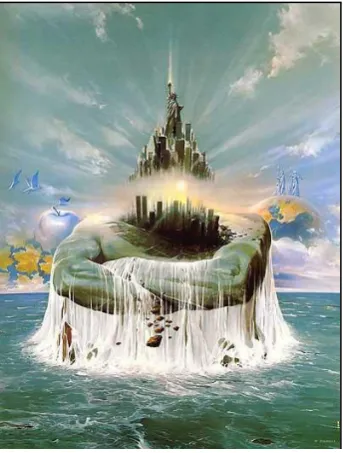
Fig. 11. W. Siudmak "The strongest"
P: The following picture is a replica of "The strongest" (Fig. 11). When I look at this picture, I feel as if I see an act of self-birth. Do you wish to experience self-birth: to throw off the cross you are bearing (Fig. 10), and to feel at ease?
N: I do not know. When I saw that picture, I had a feeling that those crossed arms were a symbol of power. And for me, power is mental, as it is in the mind, because the emphasis is placed exactly on a head (pointing to the light below the Statue of Liberty). Apple (on the left) is associated with the Garden of Eden, with something nice. The Earth (the globe) (on the right) symbolises a global scale, the earth wholeness to me. The Statue of Liberty stands for intelligence, power, will, freedom!
P: Freedom, intelligence, Earth ... Are they a scale of self-realisation, lack of restrictions in self-identification, freedom to act? Are these your values?
N: Yes, they are.
Volume 27, Number 3, 2018
23
N: May be so. Perhaps, picture 1 is a shadow of picture 11. I just started to think about it, as I have not ever been at such sessions.
P: What are the objects on the previous picture (Fig. 10) you would like to bid farewell in your act of "self reborn" (Fig. 11)?
N: To the cross.
P: Thus, the cross seems to express the difficulties of your previous life in a synthesised way. Tell me, what this "cross" is associated with. It is not the loss of someone beloved, is it? Has no one passed away?
N: No, it is a different thing. This is a burden of my stuck feelings that cannot leave me.
P: No one has passed away and all are safe and sound. But do you still have problems? So, does the cross originate from them? What part of this cross you would like to get rid of the by act of self-birth (Fig. 11) would have fallen off? Are they, perhaps, feelings of repentance, guilt or anything cannot forgive yourself?
N: Probably, I would let go hatred, offence, aggression, moral rather than physical, non-acceptance of myself and much more I would like to pull out and cognise by the process of making them definite and specific.
P: Is this process a difficult experience for you? (Addressing the group) As we can see, our N. articulates the desire for change, indicates the unconstructive effects of destructive energy of mortido, in its inhibiting influence on libido, which is creative, life-giving energy. (Addressing N.) Would it be easier for you then?
N: Yes, I really want this! I want freedom from myself.
Psychologist's comment: Here are the sources of motivation strength of psychocorrectional sessions we are conduct. We move in unison with what the respondent's psyche wants. To do so, we need to pave the route to the initial causes of personal problems, which do not disappear with time. We do not have to be limited to the conversation. We should offer a specific diagnostic-corrective work based on the visualised material that proves the presence of problems in N. It is difficult to say in advance whether other pictures will be of any help to us. Let us try to continue our analysis of picture 2. Is this figure emerging out of the water a male or a female?
N: A male.
P: Looking at picture 11, does it seem that you have your own ideal in life?
N: An ideal of what exactly?
P: Just a person. A person striving to achieve, to gain significance and strength. Do you have a similar example in your family? Is it possibly determined by your father?
N: I do not have anyone in my family to be an ideal to follow.
P: You have a collective ideal. But is it of the male power or not?
N: No, I do not focus on the "male power". I am looking at the arms. And this (pointing to the crossed arms), somewhere in-between male and female, is a symbol of power!
P: It is of both female and male nature, isn’t it? Your words are so true. In regards to the archetypal symbols, the crossed arms symbolise a circle filled with water that is the archetype of the womb. You can notice that something is emerging from the centre as if "germinating" (the statue).
This is already of feminine nature. Indeed, in picture 11, there are both the feminine and the masculine. Have you ever had similar experience? Have you tried to throw off the burden of the past, to unbend and "to germinate" as a new one with the virtues desired?
N: I have tried, have made some attempts, but the cross (Fig. 10) impedes the progress. It does not go away, with all my efforts proved futile, it is always with me. So, my efforts are nullified.
P: You’d like to say that in your progressive undertakings of self-formation, the cross has been an obstacle absorbing your strength and energy?
N: Exactly.
P: What element in the picture (Fig. 10) is associated with you in the desired transformations?
N: This one (pointing to the light in the center of Fig. 11, under the Statue of Liberty).
P: Is this parallel to an act of birth, like "child has seen the light"? Does the Statue of Liberty denote anything definite for you?
N: Freedom and opportunity to be myself. Just myself!
Psychologist's comment: It is very interesting. You speak out the values, achievements, which are promoted by the method of Active Social-Psychological Cognition (ASPC). However, we endeavour to set the dynamics of progressive improvements for a person to get closer and become the real self. The self, which is not a "performer" of the programs developed under the influence of residual emotional fixations set by the past, but experienced already, and which, nevertheless, retains a tendency to return to them and set the tendency of a vicious circle. These emotionally difficult aspects of experience create destructive programs and absorb forces. They overlap with noise life-asserting effects in situations of existing relationships. All these factors diminish prosocial performance of your action and do not allow the mind and experience to work for their benefits in order to optimise ways of fulfilling desires and getting satisfaction from success!
N: I understand and agree to you.
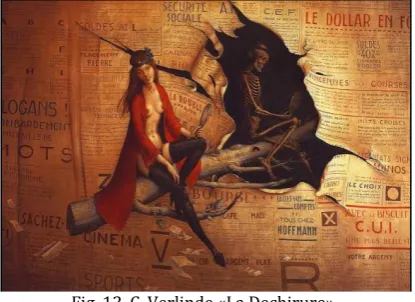
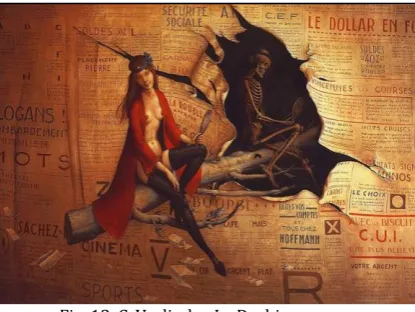
P: Let's go to the next picture (Fig. 12). You see whether the hypothesis is true (the hypothesis concerning self-birth), then, in this picture we have an evidence, in particular, a hole, an archetypal symbol of womb, where only a skeleton is seen. Tell me, how you perceive the picture, regarding the facts clarified earlier today. Could you explain anything?
N: My choice of the picture is due to the contradiction in it. On one side, there is a living person, but on the other side, there is the skeleton (Fig. 12). I feel a contradiction within myself...
P: But you have been striving for changes so much. You have aready mentioned that there is no desire to carry the cross any longer (Fig. 10).
N: Yes, you are right. I wanted it then and I still want it! P: Do you think this cross is emotionally alive for you? N: Yes, it is alive. It is a symbol of stable experiences of my soul.
P: Then this being (pointing to the skeleton, Fig. 12) is also alive similar to the cross? Comment on this, please!
Volume 27, Number 3, 2018
24
Fig. 12. С. Verlinde «La Dechirure» P: Pain, suffering, pangs of remorse. Is that the same as of
the "emotionally alive" nature of the cross? And here, we have the skeleton, which expresses the consequent essence of feelings enumerated by you. Is it from the past? Or is this skeleton a newborn? Skeleton exists beneath this living girl and does not leave her in her life. Is it her shadow?
N: Without a doubt, they (the girl and the skeleton) are always together. They cannot exist separately!
P: This statement contrudicts to your desire to say goodbye to pangs of remorse, suffering, to everything that is associated with the too heavy cross for you wanted to get rid of? So, do you feel that even if you give yourself a reborn as was mentioned in the analysis of picture 11, the "skeleton" will still be your shadow then?
N: Yes, That’s true. I have such feeling that it will not go anywhere, as this is already my fundamental nature! This is my reality. It does not make me happy, but it still exists.
P: If so, then, everything you have experienced is linked to the significant and valued people, as the cross is inseparable from you.
N: It is linked with me! It is linked with people as well, but largely, everything I have experienced are directed at me, not at the other people.
P: But there was psychological influence on you from someone close, wasn’t there?
N: Yes, there was both physical and psychological influence!
P: Even physical? I should specify this. Do you mean that there (pointing at the skeleton) you reject yourself not only psychologically, but also physically, as well as the people involved in the physical and psychological influences on you?
N: Yes, I am overwhelmed with feelings of their alienation and rejection.
P: Do you want to forget them as well? If it is so, why do you revive these feelings in relationships with other people not related to the experienced aspects?
N: I cannot explain. Everything comes to life unintentionally, without any of my efforts and, even more, my desires.
P: It seems that you seek or revive the "skeleton" while communicating with every person. However, it is obviously alive by itself. This can lead to the large problem in relationships with other people. Does this inner, invisible interest in "vitality of the skeleton" stabilise "the feeling of the cross on your shoulders"?
N: That's right. There are such feelings.
P: Hypothetically, there might be a sense of guilt combined with the tendency to self-punishment behind this. A sense of guilt is one of the most invisible for man, but the most difficult feelings.
N: It is familiar to me.
P: It is a very interesting picture (Fig. 12). We have discussed this part linked to the symbol of womb (the skeleton). And what about its black backdround, as a symbol of energy of mortido? Does it indicate complicated relationships with mother? Energy of libido is constructive, loving, and creative energy, but mortido is archetypally expressed by dark, not live-giving, suffering energy. (P. addresses to N.) Speak a little about the girl. She is sitting like this, very seductive, as if waiting for a prince.... Look at her.
N: I have chosen this picture, because there has been an opposed character to her (the girl). I mean this skeleton on the right. This seems to create a contradiction! I paid more attention to the skeleton, than to the girl. I somehow did not seem to see.
P: It turns out that you pay more attention to the "shadows" than to such seductive, life-affirming aspects of life. To my surprise, you place this exactly psychological emphasis at such a young age (the first year of University studying). What would you say to this girl and to her opposition, the skeleton (Fig. 12)? Are they interrelated somehow? Moreover, these figures are sitting on the same tree. Is there any correlation?
N: I would rather remove the girl, and would keep the tree and the skeleton.
P: What do you think this figure in picture 11 (a symbol of freedom, strength, and intelligence) would say on what you have just said? What would she say to you, when listening to you and realising that you ignored a beautiful, young, seductive girl and decided to keep something similar to your own cross – the skeleton?
N: She would ask, "Why do you destroy yourself?" P: It seems that you realise that you destroy yourself. Do you not forgive yourself something from the past? What could you do at such a young age that you do not forgive yourself? Is it artificial and later habituated? Now it sets the subsequent self-perception.
N: No, it's not artificial. I really feel it. I have experienced it...
P: Did you transform anyone into a skeleton? N: No. I bear it alone. Actually, it’s my symbol.
Volume 27, Number 3, 2018
25
N: I feel bad about my mother and myself.
P: Mother? That is why; the womb as a clue symbol of something maternal appears. While working with picture 11, we have come up to the womb symbol. There is something like been broken (pointing to the rods, Fig. 11) inside the receptacle (made by closed arms). How do you explain your feelings of guilt about mother? Did you try to break off her (your mother) also?
N: She tried to break me off. It was not I who did that. That is why; there are no branches on the tree (Fig. 12).
P: Why do you have such a guilty that you are ready to punish yourself so much, if you are already like "punished"? Whether did mother inspire such behaviour?
N: Fifty-fifty. It was done by both my mother and me, with my share being larger.
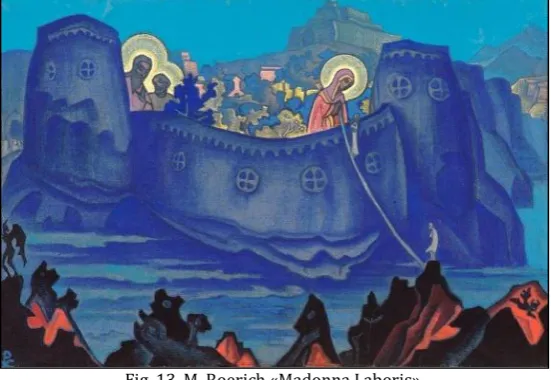
P: It is necessary to think about the importance of that sense of guilt. We have one more picture left (Fig. 13). It shows Hell and Heaven. There we have Madonna depicted when throwing her scarf down into Hell, so that the souls, who ask forgiveness, could climb onto it to Heaven. Where do you feel you are?
Fig. 13. M. Roerich «Madonna Laboris»
N: I see myself in Hell. I have not even approached this cord (scarf) to climb to Heaven. I am somewhere here (pointing to the rock of tongues of fire near the scarf).
P: Do you think you are not ready to go to Heaven? N: Yes, I am not ready to go there as my sense of guilty is still growing up in me.
P: So, are you driving yourself to that Hell? Or are you just stuck in the sense of hell?
N: Apparently, yes. But I cannot do this other way. The psychologist explained that N. should have some rest. Thus, she offered to meet after a one-day break.
Continuation of the diagnostical-psychocorrectional work with the respondent N.
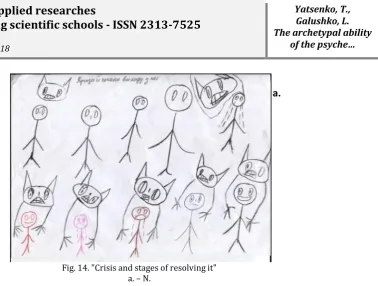
N: I propose to take look at my picture "The crisis and stages of resolving it". You can see me at the top right corner (Fig. 14 (a)). I have depicted dynamics of self-perception.
P: Do you feel grief (tears), discomfort? What else? N: But I feel comfort as well.
P: Do you feel comfort because there is no other way? Have you adapted yourself to escape from discomfort and hide in comfort? Then, it is "protective comfort", isn’t it?
N: Both yes and no. But it is rather the way you say. P: Does it mean that comfort is a rescue? So, you had to deviate from something inside you in that "comfort", hadn’t you? What did you deviate from in order to acquire such comfort?
N: From moral principles, from some societal norms. I have involved myself in things I should not have at all.
P: Did you ignore principles?
N: At first, in childhood, I did not understand whether they existed or not, and whether everything happening to me was a norm or not.
P: But there are those who monitor the adherence to the norms. I mean our parents. Did they somehow try to make improvements?
N: My mother wasn’t aware of this side of my life. P: Did you do anything covertly?
N: Yes, only covertly.
Volume 27, Number 3, 2018
26
Fig. 14. "Crisis and stages of resolving it" a. – N.
N: Yes, that’s right. When I eventually began to realise "what it was", the cross came out (Fig. 10).
P: That "what it was" came to you retroactively. The picture, as a representant, reproduces something that happened from the point of view of your perception. When did you recognise everything? When did the cross appear on your shoulders?
N: So, when I was about thirteen or fourteen my inner self-perception became complicated that way.
P: Is this cross on your shoulders unchanging?
N: It has changed in size. In particular, it tends to increase, to grow.
P: Did it grow and become heavier?
N: Yes, sometimes, it was unbearable. It’s hard to describe.
P: You cannot forgive yourself for something, can you? N: Yes, I can’t.
P: Do you have a sense of guilt? N: Yes, a big one.
P: What parent do you feel bad about? N: Mother.
The psychologist suggested to make a model from stones (see Photo 1) and to place a "guilt stone".
P: Why did you put guilt near mother? N: I feel so.
Fig. 10. S. Zademack «Exiled»
Volume 27, Number 3, 2018
27
Photo 1.
"Mother, I and a sense of guilt" Marking:
1 – protagonist N. (a pearl), 2 – mother
3 – N.’s sense of guilt 4 – werewolf (stepfather).
P: It was your hand that put it there. If you put it near her so mother is somehow involved in that sense of guilt in you. If it weren’t for your mother, there would not be such a big, heavy stone (see 3 on Photo 1).
N: Most likely it would be. Even if weren’t for my mother. She did not know anything about it, but I feel guilty. She might slightly know, but superficial, not completely.
P: If to take into account only what you mother knows, what stone would be associated with your guilt?
N: It would be blacker, not gray.
P: And how does your mother perceive your guilt? N: As a small pearl (see fragment 1, Photo 1).
P: That means that your mother treats you good enough, doesn’t she? Can you still form bonds and attachments with her?
N: No, there can’t be any bonds and attachments with her (I am a skeleton there).
P: It cannot be... There is only a bead, as a part of a necklace, which archetypally symbolises the umbilical cord. So, here we have a discrepancy between the following: your mother thinks that your guilt looks like a bead, and you, obviously, are careful not to let your mother know the true chain of your deeds, to know everything you are aware of yourself. What is bigger? Is this a sense of guilt or feeling of fear that your mother won’t know about reality and your attitude towards yourself in the context of your covert actions?
N: I think I am afraid, because she will accuse me, not another person, of everything. It is easier for me to accuse myself, than to have her blaming me.
P: Everything you say is significant. Sometimes, we exaggerate the guilt, blaming ourselves, in order to prevent accusations made by others. As punishment imposed by others will be less significant than punishment meted out personally.
N: Yes, that's true.
P: But is there a reason for the psyche to load you so hard? What is this interest in the "cross of guilt"? Is that
linked to someone important to you? If it is possible, put another stone near your stone of guilt (fragment 3). It will point to the person, who is related to that large guilt.
N: I have chosen a black stone (fragment 4, Photo 1 (a werewolf)).
P: Here we can see a very black stone, though it is smaller than the stone of N.’s guilt. Is it someone, who has very hard, unforgivable psychological marking for you? Am I right?
N: Yes, this is my soul's stumbling-stone. P: Is it a stranger or a family member?
N: It is a stranger and a family member at the same time. P: As a stranger, it has such colour?
N: No, the colour is an assessment of his actions. He is part of the family, but according to my feelings, he is a stranger. It is my stepfather.
P: What metaphorical descriptions would you give to the person? For example, is it a mouse, a cat or what?
N: A werewolf!
P: If being a werewolf, he did seduce you, didn’t he? What stone would it be to symbolise you looking in his direction?
N: It would be a light transparent stone.
P: Would you put it far from the "stone of guilt"? When did such "seduction" emerge?
N: Since eight years old. His real intentions were evident at once, but if you are 8 years old, you cannot identify them.
P: Did you see both sides of that man later? N: Yes, I did.
P: So, what do you punish yourself for, then? For following the light? You were innocent in your children naivety!
N: I punish myself for having been a participant of actions that should not have been at all.
P: Did those actions concern only two of you? Or was someone else involved?
N: Only two of us.
P: When you were eight years old, you were a child and could neither resist nor understand the real meaning of the situation clearly? So, perhaps, it is not necessary to grow that heavy cross on own shoulders.
1
2
3
Volume 27, Number 3, 2018
28
N: Although I could not understand then... Later I understood everything happened to me. And the burden fell on my soul.
P: But why are you blaming yourself, if you are pure, innocent and beautiful, a child in the past and the girl at this moment? It is typical to everyone not to be "wrongfully accused"! Moreover, here, it turns out that you transform your own innocence into a serious guilt personally and let it crush down you.
N: Because, at the same time, I understood and I did not understand... to a certain extent I felt that something was going wrong, but I was powerless...
P: What is your age difference? N: About thirty years.
P: What would you say to the light side of this man and to his dark side?
N: Probably, I would say nothing. There is the only thing in him, the blackness, which takes over. He is a werewolf, so the darkness absorbs the light side!
P: Have you ever had a chance to tell that person everything you think?
N: I just do not want to say again the whole thing I have already told him. There is no reason anyway.
P: So, it has been already said. But you do not approve of it, do you?
N: Do not approve too much, because I need to be stronger.
P: Has the person ever demonstrated ligh or lifi-affirming nature? Or that dark stone has already existed then, hasn’t it?
N: The dark stone dominates in all places. As for my perception at the moment, it's hopeless.
P: If your mother happen to be here on this "session", should she gain more understanding of what's going on?
N: Yes, of course. She’ll understand more.
P: What would she say to you then?
N: O, God! How could that be! When? Where? What? She would pretend to look in this direction for the first time.
P: But she could make your anxiety even worse, couldn’t she?
N: Maybe. However, I am overwhelmed with anxiety even without this!
P: Could this pearl become covered by the blackness in those past situations?
N: It could, no doubt. It could be covered because of guilt and shame.
P: So, this is the reasone you make secrets of all of this from your mother. What would you tell yourself about this?
N: OK, now, in the past or future? P: As you like. You can do all.
N: In the past – become thoughtful, do not keep silence, do anything! Now ... (thinking for a long time)
P (helps suggesting): Now, obviously – it is good to have come to the psychocorrection session, to acquire something new, more than you already know. What would you said to yourself in the future?
N: Grow up, make progress, move, live!
P: Grow psychologically and intellectually, right? N: Yes, without a doubt, I'm glad to have come to the correction, to have clarified much for myself, to feel as my mind becomes stronger.
Psychologist's comment: On the model with stones, the difference between mother and the protagonist (photo 1, figures 1, 2) is quite obvious. It is remarkable that the colour with dark shades has already become characteristic of such a pretty, young girl. We do not mean the situation that has been somewhen and has gone by now. We can see that the darkness of situation throws the "shadow" onto N.’s future life and follows her.
Fig. 11. W. Siudmak "Thestrongest"
Volume 27, Number 3, 2018
29
N: I’ve chosen it then, placing on an emphasis on the "head", ie the development of intelligence. As everything starts and comes from the head (pointing to the light near the statue).
P: So, you focus on your own mind, don’t you?
N: Maybe. However, I need to weaken the "darkness" of the soul to make be the mind light.
P: How do you perceive the hypothesis of self-birth now? N: I rather accept, because I feel the need for this. P: Thus, self-birth means to evolve intellectually through reconsideration of your life experience, to understand the destruction you cause yourself now, doesn’t it?
N: Yes, undoubtedly, because this holds me in some internal inactivity, emptiness. I resembles a stop in the darkness of my own soul’s desert.
P: You have good self-progression. I hope you will get free from the darkness we are talking about. We cannot give birth to ourselves biologically, but we can help ourselves in reconsidering past experienced situations and in clarifying their consequences. Let's turn to the next picture from the previous session (Fig. 12). Tell me, what have you learnt from the analysis of this picture? What aspects has it helped recognise?
N: It's the role of the "skeleton" in my life most of all. P: This skeleton is not just merely a symbol; it’s a part of you, isn’t it?
N: Yes, no doubts, this is my self-perception. It embodies alienation of my own flesh, the female entity. The skeleton itself has no gender identity. Now I have realised why I have been ignoring the girl in picture 12 all that time. It has been the defence: I do not belong to any gender, so it is easier to me to live.
P: Your rejection of this sensual, beautiful girl was really a mystery for me.
N: I did not pay attention to her at all. She did not exist for me then. And now the same thing – I cannot look at her seductive look.
P: This is strange. You are young, beautiful. You have your whole life ahead. You could associate yourself with a girl rather than with a skeleton, because you are young, gentle and beautiful, aren’t you? Last time I offered you to speak to the girl; you said that she did not exist to you. Maybe, when time has passed, you can address the "girl" and the "skeleton" with particular words.
N: No, I can’t, it's hard. Especially addressing the girl... The skeleton is a accustomed remainder of my mental sufferings.
P: Consequently, you reject your beauty, your harmonious nature existing externally, don’t you? I mean femininity and attractiveness.
N: Yes, I do reject. And I have a feeling that it is beyond my strength to change this.
Fig. 12. С. Verlinde «La Dechirure»
P: Then, obviously, it is not easy for boys to deal with you, isn’t it? They feel resistance, don’t they?
N: It is easy for a computer to deal with me.
P: Do you take your intimate relationships out? Or do you express them indirectly by the use of a computer? Or do you think of boys in terms of the category of mechanics? Tell me.
N: I just do not communicate with them. It is better for me to be alone. It is much quieter, more comfortable. I do not cling to the people and do not impose myself. So, I would like to get similar attitude from them.
P: But are they allowed to show their interest in you, because you are a beautiful girl?
N: My "Goodbye!" is a ready shield for all occasions! If I am not interested or I do not like anything, that is it! There is nothing else.
P: But you claim a priori that you "do not like" a person. You're not ready to meet the person, to know the person. It
is understandable when it comes for boys. But why do reject this girl in picture 3?
N: I do not know what to say... I think it is because I reject myself. I do not accept own female nature, which seems to me to be unwanted worries.
P: Tell me about the difficulties you feel, when you have to address her, the girl in picture 3. Perhaps, she will help you somehow.
N: I just do not have anything to say to this girl. She seems not to exist.
P: How can it be that she doesn’t exist for you? N: Yes, she really does not exist for me.
P: So, there is only the skeleton for you in this picture? N: Yes, I can see only it.
P: Don't you think it's weird?
Volume 27, Number 3, 2018
30
P: When you have been selecting the picture, have you noticed only this skeleton at once?
N: I think I have chosen it because of its general emotional impact on me. It seemed to be emotive. And the details were left for analysis later on.
P: Could you have also surprised yourself before? Or only now?
N: Yes, certainly, I realise that I can surprise someone. P: And how was it manifested?
N: In the way I do things, I look at people, and the whole world. And I can see I differ from people around!
P: So, the past events of your life have dramatically changed your worldview, attitude towards people, your attributions, points of views, and even your contrast to others, haven’t they?
N: Yes, I see it. But I can’t do anything to put this in order. P: Your experienced events have influenced all areas of your life, including perception of family relationships, haven’t they?
N: Yes, they are not just a particular isolated experience. They determine my nature.
P: And who notices this in your family? Do you have a brother or a sister?
N: Brother.
P: Does brother know that you look at things in life in a different way, not the same way he does?
N: No, I try to hide this carefully. P: And who is aware of it?
N: No one. It’s only me, who knows how I perceive the world. The main task for me is to hide!
P: Thus, you have to split, don’t you?
N: Yes. My thoughts and views remain with me. I also remain myself. I would like to thank you for letting me be sincere during our ASPC session. It's not typical of me.
P: Then you have learned to be a good actress in life, haven’t you?
N: Yes, I have. I have been given no other choice. P: Since you have used to be an actress, try talk to this girl this way. For her not to realise your attitude towards her.
N: I would tell her to get dressed. Nothing more.
P: Your words reveals sensitive attitude to intimacy. Her nakedness hints at this. You’ve confirmed your desire to avoid any topic concerning intimacy.
N: Probably, yes, I avoid it. But I make no efforts. Because the topic is being avoided involuntarily.
P: You do it effortlessly! You have blocked any manifestations of your own sensuality. Do you want to live your life simply as N., and not be loved, sexually significant, happy, and feminine? I have just made an assumption. I hope you will correct me. You’re welcome.
N: Okay. I want to live my life in full. I want to achieve social self-actualisation. But together with this, I also want have my own family as all people do.
Interpretive generalisation of the psychologist: It turns out that this inner split is not painless to you. Deviations from your nature are forced, because they do not correspond to your desire "to be happy in the family". This desire is surpressed there, in the family, by the previously experienced problems. You want to have children, a loving and beloved husband. Why were you picky when I was speaking about a beloved and loving husband?
N: Because that is another story, which is moved away, set aside by me towards the periphery of my desires.
P: You showed an interesting reaction. Probably, I was not correct while rephrasing or specifying your desires. You are welcome to make corrections.
Fig. 13. N. Roerich «Madonna Laboris»
N: I will not correct the expressed prognosis of my desires, because they are very close to the truth, but I haven’t accepted it.
P: As we are clarifying, summarising and considering the pictures from our last session, we have only one image (Fig. 13) left. Do you remember where you have placed yourself? Can you recap so that we have the entire picture of the previous work?
N: I said that I was not even on my way out of Hell. I haven’t started ascending toward Heaven. There, in the
picture, I am standing in Hell even lower than that mournful figure is.
P: This means that you not only live through the experience "presented" by that black stone (a werewolf), but also you keep yourself sitting in that blackness like the skeleton in the black hole.