Available Online at www.ijpret.com 35
INTERNATIONAL JOURNAL OF PURE AND
APPLIED RESEARCH IN ENGINEERING AND
TECHNOLOGY
A PATH FOR HORIZING YOUR INNOVATIVE WORK
A THEORETICAL ANALYSIS OF MAGNETO ELECTRODYNAMICS OF
SUPERCONDUCTING AND ANTIFERROMAGNETIC STATE OF LOW T
CSUPERCONDUCTOR
VERMA PK2, MISHRA LK1 1. Department of Physics, Magadh University, Bodh-Gaya-824234 (Bihar)
2. Principal, A. N. College, Patna (Bihar)
Accepted Date: 12/08/2014; Published Date: 01/10/2014
\
Abstract: Using theoretical formalism of M. L. Kulic etal (Physica C (1995)) and T. Ishiguo etal.(J. Supercond. (1994)) we have theoretically analyzed the high frequency magneto electrodynamics behavior of low Tc superconductor DyNi2B2C in the superconducting and
antiferromagnetic state over wide range of temperature T and magnetic field H. We have analyzed the T dependence of surface impedance ZS and penetration depth λ. The
establishment of antiferromagnetic order at TN =10.3K result in a marked decrease in the
scattering of charge carriers which lead to sharp decrease of surface resistance RS and
surface reactance XS. Our theoretical analyzed results are in good agreement with the
experimental data.
Keywords: Magneto electrodynamics, antiferromagnetism, superconducting state,
Quaternary borocarbides, Spin-flop field, complex surface Impedance, Complex electromagnetic penetration depth, Meta-magnetic transitions, Temperature dependent complex permeability, Effective conductivity.
Corresponding Author: MR. P. K. VERMA
Access Online On:
www.ijpret.com
How to Cite This Article:
Verma PK, Mishra LK; IJPRET, 2014; Volume 3 (2): 35-49
Available Online at www.ijpret.com 36
INTRODUCTION
The discovery of superconductivity in the quaternary borocarbides has led to a family of materials with intriguing properties1,2. These are the only known superconductors containing an appreciable amount of nickel that have transition temperatures in excess 10K. The general composition of RNi2B2C where R is a rare-earth element Yttrium or lutetium has been
extensively investigated. Most members of the family that exhibit superconductivity have coexisting3,4 antiferromagnetic order except YNi2B2C and LuNi2B2C.This system is very useful in
studying the interplay between magnetism and superconductivity. Superconductivity was reported in DyNi2B2C (TC=6.2K) below an antiferromagnetic transition5-7 at TN=10.2K. This
material is one of the select few materials where superconductivity appears in the presence of long-range magnetic order. Other systems8,9 are Ho(IrxRh1-x)4B4, Tb2Mo3Si4 and heavy fermion
superconductors10.
Metallic and superconducting antiferromagnets afford the possibility to study the influence of local moments on electronic properties. In the metallic state the interesting effects are the transition properties like conductivity. In the superconducting state, magnetism can lead to noval effects on the superconducting order parameter. This is because of the low energy and magnetic field scales in the system. Spin-flop field scale arises from the magnetic state and vortex-related fields due to superconductivity. High frequency measurements such as surface impedance ZS gives unique information which is not available in other techniques. In the
metallic state it gives information regarding the dynamics of the electrons and electronic moments. In the superconducting state, the order parameter can be probed in terms of the penetration depth.
MATERIALS AND METHODS
The penetration in the cavity due to charge in the superconducting properties of the sample is reflected as the change of response frequency f and bandwidth δf of the cavity. This is related to the change in the complex surface impedance ZS given by
ZS = RS +I XS (1)
Where RS is the surface resistance and XS is the surface reactance. RS is given by
0
1 1
[ ]
( ) ( )
S
s R
Q T Q T
Available Online at www.ijpret.com 37
0 0 0
0 2
2 ( )[ ( ) ( )]
S s
X f f T f T
f
(3)
Where Г is a geometrical factor relating to the cavity and the sample dimensions. QS and Q0 are
the loaded and unloaded quality factor ( f Q
f
). fS and f0 are the loaded and unloaded
resonance frequencies respectively. One measures the absolute value of RS but only the relative
change in XS. An absolute value is imposed by XS by assuming that Xs=RS at high temperature
(T>>TC, TN) where any effect of superconductivity or magnetism would be negligible.
The real part of the complex electromagnetic penetration depth is given by
1 2
[ i ]
at radio frequency. In the normal state n is the normal conductivity and is purely real. In this case
1 1
[1 i]
(4) Where 1 2 2 [ ] n (5)In the superconducting state, σ has to be replaced with an effective complex conductivity σS=σ1-iσ2 where real and imaginary part are proportional to the quasi particle scattering and
super fluid density respectively. In the limit σ2>>σS which typically holds for T<TC
1 2 2 1 [ ] L (6)
where λL is the London penetration depth. In order to study relaxation phenomena in the
antifrromagnetic state, one uses Drude type conductivity relation
0
( )
(i )
(7)
where σ0 is dc conductivity. Dissipation because of the magnetic relaxation effects, one has
Available Online at www.ijpret.com 38 1 2 0
0
(1 )
i i
(8)
1 0, 2 0
(9)
Now dynamic permeability μ (T) can be of the form
0 2
( )T (1 i )
(10)
Surface Impedance is given by
1 1 2 2 0 2 [ ] ( ) ( ) s i
Z i
(11)
Temperature dependence of μ2(T) is given by
2 2
2
[ ]
( ) , 21
2
s s
c s s
x R
T T T T
x R (12) 0 0 0 2
1 x Rs s
(13)
For T> TN (Neel temperature) μ2 =0. In the AFM (antiferromagnetic state) for T<TN , μ2 increases
with decreasing T
, 1, 2, ( 1 2) /(1 0.092)
s eff eff i eff i
(14)
Where σ1,eff and σ2,eff are the temperature dependent conductivity in the superconducting state
for that σ2,eff =0 for T> TC.
RESULTS AND DISCUSSIONS
In this paper, we have theoretically analyzed the magneto-hydrodynamics at high frequencies in the antiferromagnetic and superconducting states of low Tc superconductor DyNi2B2C
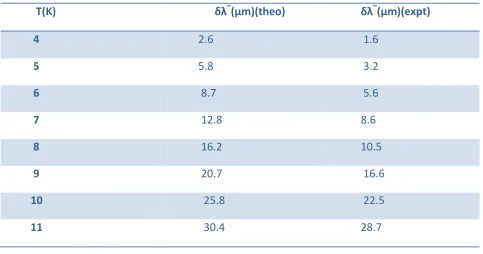
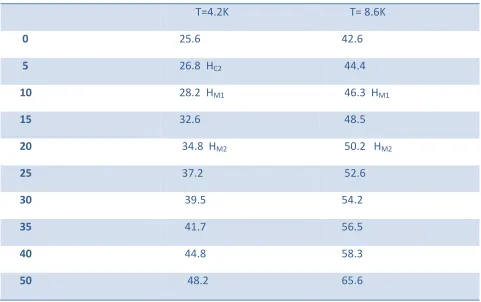
Available Online at www.ijpret.com 39 temperature dependence of λ shows a clear signature of the onset of the magnetic order at 10.6K which has been also observed by other techniques. At the onset of superconducting transition there is a decrease of magnetic penetration. In Table T2, we have presented the theoretically analyzed result of screening length (μm) as a function of applied field (Koe) for two temperatures T=4.2K and T= 8.6K for low Tc superconductor DyNi2B2C. From our analyzed
results, it appears that magnetic state shows two sharp jumps of the screening length both below and above Tc. It originates from meta-magnetic transitions in the sample. The response of the material at very high field (>20Koe) shows positive magneto resistance at all temperatures which is characteristic of its metallic behavior. The screening length is characterized by field scales in addition to well known scales of HC2. We have two field scales
corresponding to meta-magnetic transition called HM1(=10Koe) and HM2 respectively. In table
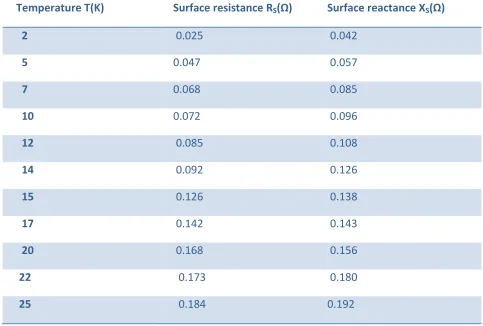
T3, we have shown the analyzed result of surface impedance ZS at 10GHz as a function of
temperature. Actually, we have analyzed the real and imaginary part of the surface impedance (ZS =RS+iXS) for superconductor DyNi2B2C as a function of temperature. Our analyzed results
show that both RS and XS increases with T up to 12K and then it saturates. Both RS and XS differ
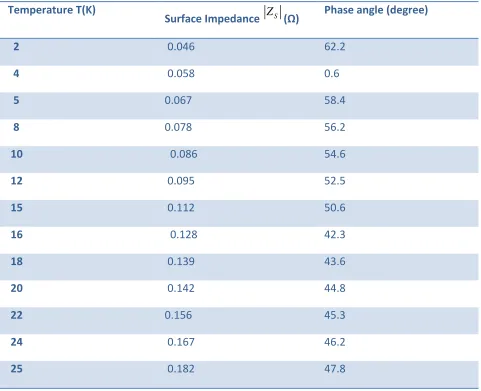
from each other even in the AFM state below TN. In table T4, we have presented the analyzed
result of the magnitude and angle of microwave surface impedance Zs ( ) and phase angle
(degree)[
1 2 2 2
( ) [ ]
s s s
Z T R X
and phase angle
1
( ) tan ( s )
s R T
X
]. For a conventional superconductor, the phase angle is expected to change sharply from 450 in the normal state tending towards 900 as T 0 below the superconducting transition temperature. Such type of transition temperatures have been observed for most type of superconductors. In case of DyNi2B2C the phase angle starts to increase sharply at the onset of the antiferromagnetic
transitions. It continues to increase below TN and it becomes flat when superconducting
transitions sets in. The deviation of from 450 is because of the relaxation effects. Below the
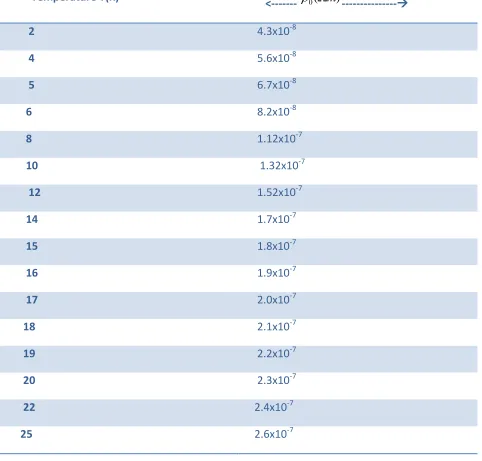
superconducting transition temperature Tc, rises as T is decreased as is expected for superconductor. In table T5, we have reported the analyzed result of temperature dependent of expected dc conductivity of superconductor DyNi2B2C. Dc conductivity ρ0 (Ωm) increases with
T and becomes flat for high values of T (T>13K). The scattering of the conduction electrons by spin waves in the AFM state can give rise to conductivity relaxation observed in DyNi2B2C
superconductor. Conductivity relaxation is also observed in other cases such as spin density wave system and heavy fermion metals. In table T6, we have shown the analyzed result of temperature dependence of imaginary part of μ2 i.e μ2 (T). For this evaluation, we have used
Available Online at www.ijpret.com 40 temperature independent for TN>T>TC. In table T7, we have presented the analyzed results of
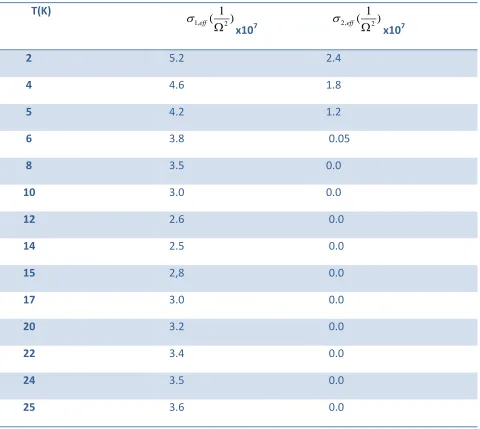
effective values of conductivities σ1 and σ2 as a function of temperature for low Tc
superconductor DyNi2B2C. The real part of the conductivity σ1 takes into account the total
dissipation in the system from all possible mechanisms, one of which can be effect of spin relaxation. Similarly the imaginary part of the effective conductivity σ2 includes all mechanisms
of dissipation free current flow in the system. One is renormalizing the frequency dependent conductivity in the superconducting state. From our analyzed results shown in table T7, σ2,eff =0
for T>Tc which indicates that the quantity is the correct measure of the super fluid density in the system. In the superconducting state, the temperature dependence of σ2,eff is anomalously
broad and possibly arises out of strong pair breaking effects25. This is evident from the fact that σ2,eff continues to rise even for T<TC/2. This type of behavior has been observed in conventional
superconductors. A broad normal to superconducting transition is observed in rf penetration depth and dc resistivity measurements26,27. It appears that although antiferromagnetism does not inhibit the formation of superconducting state, but it has strong effect on the electrodynamics properties. Some of the recent works28-35 also reveal the same facts.
Table T1
An analyzed result of electromagnetic screening depth δλ~ as a function of temperature Analyzed results were compared with the expt. data.
T(K) δλ~(μm)(theo) δλ~(μm)(expt)
4 2.6 1.6
5 5.8 3.2
6 8.7 5.6
7 12.8 8.6
8 16.2 10.5
9 20.7 16.6
10 25.8 22.5
Available Online at www.ijpret.com 41 12 34.3 30.6
13 38.5 32.8
14 40.6 34.5
15 42.8 35.6
Table T2
An analyzed results of screening length (μm) as a function of applied field (Koe) for two fixed temperature T=4.2K and T=8.6K for low Tc superconductor DyNi2B2C
Applied Field (Koe) <---Screening length (μm)---
T=4.2K T= 8.6K
0 25.6 42.6
5 26.8 HC2 44.4
10 28.2 HM1 46.3 HM1
15 32.6 48.5
20 34.8 HM2 50.2 HM2
25 37.2 52.6
30 39.5 54.2
35 41.7 56.5
40 44.8 58.3
50 48.2 65.6
Available Online at www.ijpret.com 42
Table T3
An analyzed results of real and imaginary parts of microwave surface impedance (surface resistance RS(Ω) and surface reactance XS(Ω) as a function of temperature for low Tc
superconductor DyNi2B2C
Temperature T(K) Surface resistance RS(Ω) Surface reactance XS(Ω)
2 0.025 0.042
5 0.047 0.057
7 0.068 0.085
10 0.072 0.096
12 0.085 0.108
14 0.092 0.126
15 0.126 0.138
17 0.142 0.143
20 0.168 0.156
22 0.173 0.180
Available Online at www.ijpret.com 43
Table T4
An analyzed result of the magnitude and phase angle of microwave surface impedance as a function of temperature for low Tc superconductor DyNi2B2C
Temperature T(K)
Surface Impedance ZS (Ω) Phase angle (degree)
2 0.046 62.2
4 0.058 0.6
5 0.067 58.4
8 0.078 56.2
10 0.086 54.6
12 0.095 52.5
15 0.112 50.6
16 0.128 42.3
18 0.139 43.6
20 0.142 44.8
22 0.156 45.3
24 0.167 46.2
25 0.182 47.8
Available Online at www.ijpret.com 44
Table T5
An analyzed result of temperature dependence of extracted dc resistivity of low Tc superconductor DyNi2B2C
Temperature T(K)
<--- 0(m)---
2 4.3x10⁻⁸
4 5.6x10⁻⁸
5 6.7x10⁻⁸
6 8.2x10⁻⁸
8 1.12x10⁻⁷
10 1.32x10⁻⁷
12 1.52x10⁻⁷
14 1.7x10⁻⁷
15 1.8x10⁻⁷
16 1.9x10⁻⁷
17 2.0x10⁻⁷
18 2.1x10⁻⁷
19 2.2x10⁻⁷
20 2.3x10⁻⁷
22 2.4x10⁻⁷
Available Online at www.ijpret.com 45
TableT6
An analyzes result of the imaginary part of the permeability 2as a function of temperature
T(K) for low Tc superconductor DyNi2B2C
Temperature T(K)
<---2---
2 0.092
4 0.067
6 0.054
8 0.038
10 0.029
12 0.005
14 0.006
15 0.008
16 0.010
18 0.012
20 0.014
22 0.016
24 0.018
25 0.021
Available Online at www.ijpret.com 46
Table T7
An analyzed result of effective values of σ1 and σ2 as a function of temperature T(K) for low Tc
superconductor DyNi2B2C
T(K)
1, 2 1
( )
eff
x107
2, 2 1
( )
eff
x107
2 5.2 2.4
4 4.6 1.8
5 4.2 1.2
6 3.8 0.05
8 3.5 0.0
10 3.0 0.0
12 2.6 0.0
14 2.5 0.0
15 2,8 0.0
17 3.0 0.0
20 3.2 0.0
22 3.4 0.0
24 3.5 0.0
Available Online at www.ijpret.com 47
CONCLUSION
From our theoretical analysis, we came across the following conclusion:
In the AFM state, establishment of long-range magnetic order leads to a strong reduction in scattering. An antiferromagnetic order gives rise to anomalous increase of electron scattering time. It makes real and imaginary part of complex microwave surface Impedance differs from each other. This behavior is interpreted in terms of relaxation effects related to either charge transport or spin dynamics in the AFM state.
REFERENCE
1. R. Nagaranjan, C. Mazumdar, Zakir Hossian, S. K. Dhar and R. Vijayaraghvan, Phys. Rev. Lett. (PRL)72, 274(1994)
2. R. J. Cava, H. Takagi, B. Battlog, R. E. Feedel etal. Nature (London) 367, 146 (1994)
3. R. J. Cava, H. Takagi, B. Battlog, R. E. Feedel etal. Nature (London) 367,252 (1994)
4. H. Eisaki, H. Takagi, R. J. Cava, J. O. Lee, S. Uchido and W. F. Peck Jr. Phys. Rev. B50, 647(1994)
5. B. K. Cho, P. C. Canfield and D. C.Johnston, Phys. Rev. B52, R3844 (1995)
6. M. C. Massalami, S. L. Budko, B. Giordameger and E. M. Baggio-Saitoviteh, Physica C244,41 (1995)
7. C. V. Tomy, G. Balakrishnan and D. M. Paul, Physica C248, 349(1995)
8. H. C. Kee, F. Acker and B. T. Matthias, Phys. Lett. 76A, 399 (1980)
9. F. G. Aliev, Yu. K. Gorelenka, V. V. Pryadun, S. Vieira and J. Paredes, Physica B194-196, 171(1994)
10.G. Aeppli, E. Bucher, C. Broholess, J. K. Kjems and UJ. Hufnag, Phys. Rev. Lett.(PRL) 60, 615 (1988)
Available Online at www.ijpret.com 48 12.J. F. Annett, Physica C 317/318, 1-8(1999)
13.M. Aprili, E. Badica and L. H. Greens, Phys. Rev. Lett. (PRL) 83, 4630 (1999)
14.T. Arai, K. Ichimura, K. Normura, S. Takasaki, J. Yamada and H. Anzai, Phys. Rev. B63, 104518 (2001)
15.A. I. Buzdin, Rev. Mod. Phys. 77, 935 (2005)
16.J. W. A. Robinson, S. Piano, G. Burnull, C. Bell and M. G. Blamir, Phys. Rev. Lett. (PRL) 97, 177003 (2006)
17.H. Hilgenkaup, Superconductor Science and Technology 21, 034011(2008)
18.A. A. Bannuykh, J. Pfiffer, V. S. Stolyarov, I. E. Batov and M. Weides, Phys. Rev. B79, 054501(2009)
19.D. P. Choudhury, H. Srikanth, S. Sridhar and P. C. Canfield, Phys. Rev. B58, 14490 (1998)
20.M. L. Kulei, A. I. Lichenstein, E. Goreatchkovski and M. Mehring, Physica C244, 185 (1999)
21.T. Ishiguro, Y. V. Sushko, H. Ito and G. Saito, J. Supercond. 7, 657 (1994)
22.S. M. Frolov, D. J. Van Harlingee and V. V. Ryazanov, Phys. Rev. B70, 144505 (2004)
23.H. H. S. Jarachi, S. Sridhar, G. Gruner, Long Chiang and F. Wudh, Phys. Rev. Lett. (PRL) 55, 1216 (1985)
24.S. Donovan, A. Schwartz and G. Gruner, Phys. Rev. Lett. (PRL) 79, 1401 (1997)
25.B. K. Cho, P. C. Canfield and D. C. Johnston, Phys. Rev. Lett. (PRL) 77, 163 (1996)
26.C. V. Tomy, M. R. Lees, L. Afalfiz, G. Balakrishnan and D. M. Paul, Phys. Rev B52, 9186 (1995)
27.E. A. Demler, G. B. Arnold and M. R. Beasley, Phys. Rev B55, 15174 (1997)
28.M. S. Anwar, F. Czesehsha, H. Henselberth, M. Porek and J. Aarts, Phys. Rev. B82, 100501 (2010)
Available Online at www.ijpret.com 49 30.T. S. Khaire, M. A. Khasawuch, W. P. Pratt jr and N. O. Birge, Phys. Rev. Lett. (PRL) 104, 137002 (2011)
31.G. Koster, L. Klein, W. Siemons, G. Rijuders, J. S. Dodgei, C. B. Eom and M. R. Beasley, Rev. Mod. Phys. 84, 253 (2012)
32.J. H. Kim, I. Vrejoiu, Y. Khaydukiv, T. Keller, J. Stahn and B. Kimer, Phys. Rev B86, 180402R (2012)
33.X. Ke, L. J. Belenky, V. Lauter, H. Ambayl, C. W. Bark, C. B. Eom and M. S. Rzchowshi, Phys. Rev. Lett. (PRL) 110, 237201(2013)
34.G. A. Ovsyammikov, A. E. Sheyerman, A. V. Shadrin, Y. V. Kislimsky and A. Kalabunox, JETP Lett. 97, 145 (2013)
35.C. Richard, M. Houzet, J. S. Meyer, Phys. Rev. Lett. (PRL) 110, 217004 (2013)