Monetary Policy and Economic Growth: Empirical Evidence from Nigeria
1Iroegbu, Ferdinand N., 2Onyeka, Virginia Nnenna 1, 2 Department of Accountancy
Faculty of Management Sciences
Enugu State University of Science and Technology
1. INTRODUCTION:
Sustainable economic growth and development are the most challenging issues inworld economies today. The crux of the matter is how to overcome poverty and unemployment the world over but with emphasis on developing countries of which Nigeria is one. Economic growth and development should impart positively on a people by improving their standard of living which is largely measured by reduction in poverty and unemployment. This is the end point of every economic policy.
Papademos (2003) said that fostering economic growth requires both an accurate diagnosis of the factors determining or constraining growth performance and an appropriate policy prescription regarding the macroeconomic policies and structural reforms needed to achieve higher and sustainable growth. Again, Ajide (2014) believes that one of the most fundamental issues in economics that has received extensive attention centres on the causes of economic growth. According to him, the following questions are frequently asked: What causes economic growth? Why do countries grow faster than the other? What are the causes of disproportionate rates of growth across countries? Various reasons ranging from economic, political, social, cultural, institutional and government policies are fostered.
In line with the above, Bassanini and Scarpetta (2001) believe that the accumulation of physical and human capital is the main driver of economic growth. Again, Bassanini, Scarpetta and Hemmings (2001) were of the view that research and development, a sound macro-economic environment, trade openness and well-developed financial markets and institutions also contribute to sustainable economic growth and development. Some of these factors not only affect economic growth directly but also indirectly through mobilization of resources for investment. The last global economic crisis aroused a lot of interest and questions on the effect of macroeconomic policies and decisions on world economies.
The unimpressive growth rate of the Nigerian economy over the past years has led to the search for the factors that can best speed up and sustain her economic growth. Ezeoha and Uche (2010) observed that the failure of government fiscal policies rather than the failure of monetary policies is the main reason why most of the past developmental programmes undertaken by the Government of Nigeria have failed. Hence, there is need to further evaluate the impact of monetary policies on economic growth in Nigeria. The focus of this paper, therefore, is on how monetary variables affect economic growth in Nigeria.
According to Central Bank of Nigeria (CBN, 2011), the primary objective of monetary management is to ensure a stable macroeconomic environment which is the basis for promoting sustainable economic growth and development. CBN (2017) says that her mission is to be proactive in providing a stable framework for the economic development of Nigeria through the effective, efficient and transparent implementation of monetary exchange rate policy and management of the financial sector. Monetary policy in the United States comprises the Federal Reserve’s actions and communications to promote maximum employment, stable prices and moderate long-term interest rates (Federal Reserve System, 2018). The Bank of England (2018) says that the target rate of inflation is the main objective of monetary policy. However, it goes on to say that its secondary monetary policy objective is to support government’s economic objectives which include those for growth and employment. Bassanini and Scarpetta (2001) defined monetary policy as the process by which the monetary authority of a country controls the supply of money
Abstract: This study examined the impact of monetary policy on economic growth in Nigeria for the period 1981 to 2016. The results from our findings revealed that money supply (measured by M2), open market operation (measured by Treasury bill rate) and monetary policy rate had positive and significant impact on economic growth. The study therefore concluded that monetary policy contributes to economic growth by maintaining price stability. Thus, monetary policy has emerged as one of the most critical government responsibilities and is seen as a powerful instrument for achieving medium-term stabilization objectives. The study recommended amongst others that Government should examine its monetary policy especially money supply to make them more relevant to economic development. If they are not effective, new policies which will be more relevant for economic growth and development should be established.
often targeting a rate of interest for the purpose of promoting economic growth and stability. So, in general, the official goals of monetary policy include maintenance of relatively stable prices and low unemployment, and stable economic growth. Monetary policy is either expansionary or contractionary and uses various tools or instruments. An instrument is expansionary when it is used to increase the money supply and contractionary when it reduces money supply.
Today, monetary policies is commonly accorded prominent roles in the pursuit of macroeconomic stabilization in developing countries, but the relative importance of these policies has generated serious debates. Notwithstanding, the inextricable link between fiscal and monetary policies are in macro-economic management; developments in one sector directly affect developments in the other. Monetarists believe that monetary policy exerts greater impact on economic activity. Undoubtedly, monetary policy is central to the health of any economy, as government’s power determine the quantum of fund available in the economy (Abata, Kehinde and Bolarinwa, 2012). However, monetary policies have been recognized as policies that exert influence on economic activities. Monetary policies appear not to have been sufficiently or adequately used in Nigeria. This may be as a result of inconclusive and conflicting outcomes of previous studies on this subject matter, thus necessitating further empirical investigation.
Monetarists strongly believe that monetary policy exerts greater impact on economic activities while Keynesians are as expected strongly in favour of fiscal policy. In fact, the monetarists argue that the increase in government spending would crowd out the private sector and such can outweigh any short term benefits of an expansionary fiscal policy. The Keynesians, however, recommend fiscal policy with the argument that it stimulates aggregate demand which, in turn, arouses increases in production and production activities thereby curtailing unemployment. They believe that it is also used to control inflation. This controversy has formed the basis of a number of research works as would be seen in the literature review.
However the bulk of empirical research has not reached a conclusion concerning the relative and sole effectiveness of the monetary policies with some specific country studies concluding that monetary policy has a negative effect on economic growth. The findings give contradicting results hence limiting generalization of the results across other countries. Interestingly, the controversy on results is much attributed to variable choice and methodology approach employed in analysis (Senbet, 2011).
In Nigeria’s case, due to the unstable socio-political environment in the country as well as the associated problems of implementation of fiscal policies, some of us believe that paying more attention to monetary policies might pave the way for a sustainable economic growth. We believe this is the reason for the empirical works that have been going on, in recent times, on the impact of monetary policy on the Nigerian economy.However, the volume of work is not yet sufficient to arrive at definite conclusions on the effect of monetary policy on the economic growth of Nigeria. This research work will, therefore, boost the empirical studies in this area. Also, as will be observed in the literature review, much of the work in this area has not paid sufficient attention to the effect of open market operations of the Central Bank of Nigeria, as a monetary policy tool, on economic growth in Nigeria. These are the gaps that our study seeks to fill.
2. THEORETICAL REVIEW:
Generally theories are postulated and advanced after very rigorous tests of hypotheses. In the field of monetary and fiscal policies, many well tested theories abound that have implications on economic growth. Three well known theories are central to the topic of this study and provide the major fulcrum underpinning this work.
Classical Economic Theory
The classical theory of economic growth was a combination of economic work done by Adam Smith, David Ricardo and Robert Malthus in the eighteenth and nineteenth centuries. The theory states that every economy has a steady state GDP and any deviation from that steady state is temporary and will eventually return.
Classical economic theory argues among other things that the transmission mechanism of fiscal policy is ineffective in its efforts to stabilise the economy. According to classical economic theory, the main objective of the government is to ensure a balanced budget (De Long, 1995). This assertion of fiscal policy is known as the “Treasury view”, claiming that an increase in government spending has no effect on economic activity (Mencinger, 2016)
This is predicated on the assumption that an increase in government spending is completely offset by a reduction in private consumption of the same amount. Such a perception is associated with a fundamental assumption of the classical economic theory which states that the invisible hand repeatedly or continuously adjusts the economy to the state of full employment. Therefore, we may conclude that government intervention through the fiscal transmission mechanism is entirely unnecessary or can even be harmful. In the classical theoretical framework, recessions, if they occur at all, are only transitory because economic activity without any deliberate intervention by the government will always return to full employment.
view that regardless of allowing for the potential effectiveness of the transmission mechanism of fiscal policy as a stabilisation tool; advised against the use of fiscal policy in recessions, arguing that in some sense recessions are beneficial. Namely, they presented a necessary and also positive correction response of the economy regarding the excessive investment or overinvestment in the period before a crisis (De Long, 1995).
On one side, Keynes disagreed with such a perspective and even described it as quite ridiculous: “I do not understand how universal bankruptcy can do any good or bring us nearer to prosperity” while, in contrast, other economists interpreted this process as a “crime and punishment” perspective of business cycles (De Long, 1995). Even Friedman and Schwartz (1963) in their monumental work empirically showed that the monetary policy before the Great Depression was neither too loose nor unexpectedly expansionary and thus indirectly rejected this view.
Keynesianism
The General Theory of Employment, Interest and Money published by J. M. Keynes in 1936 not only signifies the start of modern macroeconomics (Blanchard, Dell'Ariccia and Mauro, 2010), but also a turning point in the fiscal revolution. Thus, in the next three decades fiscal policy played a central role in stabilising the economy as a whole (Blinder, 2004). Before Keynes’ publication, under the influence of then ongoing Great Depression, Keynes formally rejected the classical assumption that the economy naturally tends towards a state of full employment and defended the postulate that the government should actively intervene to ensure that the economy realises its potential output. In Keynes’ view, Say’s law of market does not always apply in the short run because at a time of recession the economy faces a substantial drop in confidence by consumers and businesses, which then curtails effective demand.
According to Keynes, the confidence component in the economy is unstable and subject to animal spirit , which in turn means that the investment decisions of individuals or other subjects not only depend on a probability analysis regarding costs and benefits, but also on some psychological factors that lie completely outside the field of economic analysis. In particular, an event like a serious recession can acutely undermine the confidence of consumers and businesses, which may lead to a substantial reduction in both private investment due to worse profit expectations, and consumption due to an upsurge in precautionary savings. This then leads to a substantial increase in the volume of savings in the economy because economic agents cannot find any productive use for spare resources. Due to the induced uncertainty and pessimistic expectations, individuals are reluctant to make investments, but are more prone to save their assets in other liquid forms, including e.g. cash or bank deposits (liquidity preference).
Moreover, Keynes explained that the interest rate may be defined as a “reward for parting with liquidity for a specified period of time” and for an intertemporal choice of consumption, as is suggested in the time preference theory (see Cate, 2013). Arguing further, existence of the nominal rigidity of wages, especially downwards, prevents the automatic tendency of the economy to establish a renewed state of balance or general equilibrium.
As a follow up, Keynes adopted the idea of Fisher that an increase in downwards wage flexibility would not remove the problem of recessions or depressions caused by a vicious cycle whereby households and businesses due to negative inflationary expectations will continue to decrease their spending, which in turn will increase the debt burden in real terms. In the situation where the economy due to very large surpluses of savings reaches a zero or near-zero interest rate threshold bound, a country should prevent the drop in effective demand and increase in unemployment with fiscal stimulus accompanied with an increase in the deficit. Namely, it is simply impossible to stimulate the private sector by lowering interest rates through monetary policy. This situation whereby monetary policy is almost entirely unable to stimulate the economy is known in Keynesian theory as the liquidity trap.
Monetarist Theory
The Monetarist view is a development of the Classical Theory. Monetarists assert that variations in the money supply have major influences on national output in the short run and on price levels over longer periods. The Monetarist position is intermediate between the Classical and the Keynesian theories. Its main tenet is that inflation is primarily a monetary phenomenon. Contrary to the Keynesian view, monetarists claim that a restrictive fiscal policy without a reduction in the rate of monetary expansion cannot reduce the rate of inflation (Stein, 1981).
3. EMPIRICAL REVIEW:
revenue to be neutral to growth as predicted by economic theory. However, contrary to expectations, productive expenditure has strong adverse effect on growth whilst there was no evidence of distortionary effects on growth of distortionary taxes. On the other hand, government investment was found to be beneficial to growth in the long run.
Adefeso and Mobaji (2010) charted new grounds by examining the relative importance of Monetary and fiscal policy in Nigeria by using annual data from 1970 to 2007. Error correction Mechanism and Co-integration techniques were used in the analyses which showed that monetary policy yielded better results than fiscal policy in terms of impact on the economy. Senbet (2011) used the Vector Autoregressive Approach(VAR) and the Granger causality test on monetary and fiscal variables. He used the Federal funds rate and non-borrowed reserves as a measure of monetary policy, and actual government expenditure as the measure of fiscal policy. In addition, he represented economic activity by nominal as well as real output. His results showed that monetary policy is relatively better than fiscal policy in affecting the real output. Meanwhile, fiscal measure failed to have significant impact on real output.
Alcidi and Thirion (2016) present an overview of developments in the economic literature, looking into the combination of fiscal and monetary policy accompanied by a narrative of the actual policy mix in the US, the euro area and the UK between 2000 and 2015. The study starts from the changes that occurred in the medium-term approach during the 1980s and 1990s, and the emergence of the separation between fiscal and monetary policy, and then the dominance of rules over fine-tuning. This approach became part of the mainstream macroeconomic literature until late 2000s. The paper shows that the global financial crisis represents a watershed in the policy mix debate in many respects and that after several years of a synchronised expansionary mix, monetary policy has been the most aggressive tool across countries. This has also been the effect of financial stability becoming a new objective in the mix. In a historical perspective, a key lesson is that the balance between policies in the mix cannot be set independently of the state of the economy.
Ismal (2011) attempted to analyze the economic development and fiscal policy in Indonesia. Especially, the paper investigates whether Wagner and/or Keynes law(s) of economic development apply in the country and what variables determine the economic growth and fiscal policies. Technically, the paper uses econometric model called Autoregressive Distributed Lag model and Vector Auto Regression model to analyze both short and long run periods. The main finding is that both Wagner and Keynes law(s) occur in the Indonesian economy. Particularly, economic growth is influenced by government expenditure variables, namely employment expenditures, good expenditures and non- tax income. Meanwhile, government expenditures are determined by exports of oil, imports and payment of debts. As such, the paper suggests that policy makers use employment expenditures as the fiscal policy variable while imports and exports of oil are the aggregate economy policy variables.
Ahokpossi, Garcia-Martinez, and Kemoe (2016) estimate the latent factors that underlie the dynamics of the sovereign bond yield curve in Morocco during 2004–14 based on the Dynamic Nelson-Siegel model. On this basis, they explore the interaction between macroeconomic variables and the yield curve, which is of direct relevance to macroeconomic policy-making. In Morocco’s context, the paper finds that tighter monetary policy increases short-end maturities, and that the impact is small and short-lived. Economic activity is also briefly but significantly impacted, suggesting that even under a pegged exchange rate, monetary policy autonomy and effectiveness can be increased through greater central bank independence. Fiscal improvements significantly lower yield levels. Policy conclusions are that improvement in the fiscal and monetary policy frameworks, as well as greater financial sector development and inclusion, could benefit Morocco and strengthen the transmission mechanisms and effectiveness of macroeconomic policies.
Chuku (2009) used quarterly data to explore the monetary and fiscal policy interactions in Nigeria between 1970 and 2008. As a preliminary exercise, the paper examines the nature of fiscal policies in Nigeria using a vector auto regression (VAR) model. The simulated generalized impulse response graphs generated from the VAR estimation provides evidence of a non-Ricardian fiscal policy in Nigeria. Further, the paper analyzes the interactions between monetary and fiscal policies by applying a State-space model with Markov-switching to estimate the time-varying parameters of the relationship. The evidence indicates that monetary and fiscal policies
in Nigeria have interacted in
a counteractive manner for most of the sample period (1980-1994). At other periods, we do not observe any
systematic pattern of interaction between the two policy variables, although, between 1998 and 2008, some
form of accommodativeness can be inferred. Overall, the results suggest that the two policy regimes
(counteractive and accommodative) have been weak strategic substitutes during the post 1970(Civil War)
period. For the policy maker, our results imply the existence of fiscal dominance in the interactions between
monetary and fiscal policies in Nigeria, implying that inflation, predominantly results from fiscal problems,
and not from lack of monetary control.
Sahar (2016) was of the view that coordination is defined as the necessary arrangements that assure that the decisions taken by monetary and fiscal authorities are not contradictory. The need for effective coordination of policies becomes pressing with the increasing independence of both authorities to implement their objectives. In a quest to empirically verify this claim, Abdel-Haleim (2016) investigated the extent of coordination between monetary and fiscal policies in Egypt over the period 1974-2015. Quantifying the extent of coordination depends on the appropriate policy mix that responds effectively to different shocks. The results confirm that coordination of policies was absent or weak during most of the period under study, while it has slightly improved since 2003. However, there is still room to improve coordination between policies, particularly after the issuance of the CBE law No. 80of 2003 which renders monetary policy to be effective to accomplish its primary objective. Hence, the need for proper coordination of policies materialized with the issuance of the CBE law which guarantees independence to the central bank in conducting monetary policy with the aim of maintaining price stability. The study evaluated the current institutional arrangements that characterize the coordination between monetary and fiscal policies in Egypt. This is followed by critical recommendations of the required institutional arrangements towards enhancing better coordination of both policies
Enu and Havi (2014) examined the relative importance of monetary policy and fiscal policy on economic growth in Ghana and then determine which of these two policies is more powerful in promoting economic growth in Ghana. The study period was from 1980 to 2012. The method of Ordinary Least Squares estimation technique was used in this study. The results obtained from the three multiple regressions were spurious free. The study revealed that monetary policy impacts on the Ghanaian economy positively. Also, the study found that fiscal policy affected the Ghanaian economy positively. Finally, the study revealed that monetary policy is more powerful in promoting economic growth in Ghana. The study recommends that monetary policies implemented by the Bank of Ghana should promote favorable investment atmosphere through appropriate stabilization of interest rates, lending rates, inflationary rates, and exchange rates to promote and ensure economic growth, economic stability, economic sustainability and economic development in Ghana.
Falade and Folurusho (2015) examined the relative effectiveness of fiscal and monetary policy instruments on economic growth sustainability in Nigeria in order to determine the appropriate mix of both policies. The paper employed error correction mechanism whereby the time series properties of fiscal and monetary variables were first examined using Augmented Dickey-Fuller and Philip Perron unit root tests, followed by Johansen co-integration test among the series using annual data for the period 1970-2013. Data were sourced mainly from Statistical Bulletin published by the Central Bank Nigeria. The unit root test results revealed that all fiscal and monetary policy variables are non-stationary and attained stationarity at first difference. The result also showed that all the fiscal and monetary variables of interest co-integrated with the economic growth series in the country. This suggests that there is a long run relationship among fiscal and monetary variables and economic growth. The paper, however, found that the current level of exchange rate and its immediate past level, domestic interest rate, current level of government revenue and current level of money supply are the appropriate policy instrument mix in promoting economic growth both in the short and long run. The paper concluded that fiscal and monetary policies are still complementary.
whereas monetary expansion has not showed a clear effect. The macroeconomic policy mix with a discretionary fiscal expansion and a neutral monetary policy are likely to mitigate output cost during the financial crisis in developing and emerging countries.
Srithilat and Sun (2017) worked on the impact of monetary policy on the economic development of Lao by using annual time series data from 1999 to 2016. They applied Unit Root test of stationarity, Johansen Co-integration and error correction models to analyse the association between variables. The study showed that money supply, interest rate and inflation rate negatively affected real GDP per capita in the long run, whereas only the real exchange rate had a positive impact in the long run. The error correction model showed the existence of short-run causality between money supply, exchange rate and real GDP per capita.
Ajayi (1974) using the OLS technique had earlier concluded that monetary influences are much larger and more predictable than fiscal influences. He said that greater reliance should be placed on monetary than fiscal actions. Folorunsho and Abiola (2000) found out from their study on the long-run determinants of inflation in Nigeria that exchange rate, money supply , income and fiscal balance determine the inflation spiral in Nigeria.
Abata, Kehinde and Bolarinwa (2012) assessed how fiscal and monetary policies influence economic growth and development in Nigeria. Their study showed that the effect of monetary policy on economic growth in Nigeria is much stronger than that of fiscal policy. Okoro (2013) examined the impact of monetary policy on Nigeria’s economic growth by testing the influence of interest rates, exchange rates, inflation, money supply and credit on GDP. The results show the existence of long-run equilibrium relationship between monetary policy instruments and economic growth.
Finally, Ebiringa, Onuorah and Obi (2014) established that interest rate, inflation and money supply had negative effects on Nigeria’s economic growth in the short run; while in the long run, exchange rate had significant positive effects. Owolabi and Adegbite (2014) examined the impact of monetary policy on industrial growth in Nigerian economy using multiple regression analysis. They found that manufacturing output, treasury bills, deposit and lending, and rediscount rates had significant effects on industrial growth.
4. MODEL SPECIFICATION:
Following a detailed review of previous studies by Falade and Folorunsho (2015) and Srithilat and Sun (2017) monetary and fiscal policies were expressed as a function of economic growth in Nigeria, and a set of control variables and this is expressed by the equation below as;
GDP = β0 + β1MP + β2FPi + Wi +µ……………… (i)
where
GDP = Gross Domestic Product MP = Monetary Polices FP = Fiscal Polices Wi = Control variables µ = Error Term
Based on the above, we modify equation (i) as:
RGDP = β0 + β1MSt + β2TBR + β3MPRt + β4EXRt + β5INFRt+ µ……(ii) where:
RGDP = Real Gross Domestic Product growth rate MSt = Money Supply
TBR = Treasury bill rate MPRt = Monetary Policy Rate
EXRt = Exchange rate
INFRt = Inflation Rate µ = Error Term
Dependent Variable
The study seeks to assess the effect of monetary policies on the economic growth of Nigeria. Accordingly, the dependent variable is economic growth, measured as the Real Gross Domestic Product (GDP).
In line with the work of Srithilat and Sun ( 2017) , Akujuobi (2012) and Okoro (2013), monetary policy variables (MP), and control variables (X) are the independent variables. The monetary policy variables employed in the work are Broad money supply (MS), Treasurybill rate (TBR) andMonetary policy rate (MPR).
Control Variables
A control variable is a variable used to moderate the effects of the main independent variable on the dependent variable so that it will not crowd out the effect being investigated.As a result of clear evidence from prior studies, exchange rate (EXR) and inflation rate (INF) affect economic growth and are thus included as control variables.
Inflation rate: It is defined as the percentage rate of change of a price index over time. It is represented as follows: INFR Rate = Inflation rate……… (iii)
Foreign exchange rate: It is defined as a rate at which one currency will exchange for another. It is also regarded as the value of one country’s currency in terms of another currency. The a prior expectation is that when exchange rate is high, interest rate will be high which increases credit risks
EXR = Nominal exchange rate……….. (iv)
All annual series were measured in natural logarithmic form with the exception of exchange rate, interest rate and inflation rates and gathered mainly from Statistical Bulletin of the Central Bank of Nigeria from 1981 to 2016.
5. ANALYSIS/RESULTS:
Descriptive Statistics
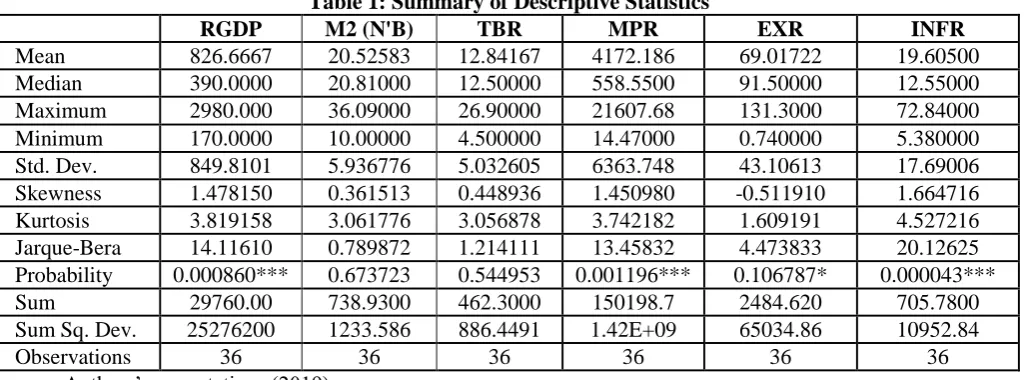
Table 1 below shows the summary descriptive statistics analysis results in terms of the mean scores, median, maximum and minimum values, standard deviation, skewness, Kurtosis and Jarque-Bera statistics. These were computed from the descriptive statistics tab in the main econometric software (EViews version 9.0) used in the analysis. The reported statistics are for the proxies used to measure economic growth namely Real Gross domestic product and as well as the test variables of money supply (MS), Open market operations (TBR) and Monetary policy rate (MPR) while the control variables namely (Exchange rate (EXR) and Inflation rate (INFR), were all transformed to logarithms to achieve linearity The transformation of these variables were deemed appropriate following the outcome of diagnostic tests conducted and reported in chapter three. Summarily, the transformed variables yielded optimum results in terms of the adjusted coefficient of multiple determination, F- ratio, and t-tests).
Table 1: Summary of Descriptive Statistics
RGDP M2 (N'B) TBR MPR EXR INFR
Mean 826.6667 20.52583 12.84167 4172.186 69.01722 19.60500 Median 390.0000 20.81000 12.50000 558.5500 91.50000 12.55000 Maximum 2980.000 36.09000 26.90000 21607.68 131.3000 72.84000 Minimum 170.0000 10.00000 4.500000 14.47000 0.740000 5.380000 Std. Dev. 849.8101 5.936776 5.032605 6363.748 43.10613 17.69006 Skewness 1.478150 0.361513 0.448936 1.450980 -0.511910 1.664716 Kurtosis 3.819158 3.061776 3.056878 3.742182 1.609191 4.527216 Jarque-Bera 14.11610 0.789872 1.214111 13.45832 4.473833 20.12625 Probability 0.000860*** 0.673723 0.544953 0.001196*** 0.106787* 0.000043*** Sum 29760.00 738.9300 462.3000 150198.7 2484.620 705.7800 Sum Sq. Dev. 25276200 1233.586 886.4491 1.42E+09 65034.86 10952.84
Observations 36 36 36 36 36 36
Source: Authors’ computations (2019)
Note: *** indicates 5 per cent significance levels
product and Money supply with standard deviation values of 849.8101 and 6363.748 respectively. As expected, money supply significantly varied from year to year during the study period. This view is supported by the equally significant values of the measures of skewness and kurtosis which reported high values beyond the normal range.
Also, the series were normally distributed except for data on treasury bills and interest rate as revealed by the probability values of the Jarque-Bera statistic with specified levels of significance. These were not considered sufficiently detrimental as to vitiate the outcome of the study as further evidenced by other diagnostic tests.
Table 2: Correlation results
RGDP M2 TBR MPR EXR INFR
RGDP 1.000000
M2 0.970421 1.000000
TBR 0.118278 0.137751 1.000000
MPR -0.158452 -0.066096 0.815816 1.000000
EXR 0.493997 0.442364 -0.403378 -0.526611 1.000000
INFR -0.340261 -0.304920 0.300946 0.368336 -0.609430 1.000000
Source: Authors’ computations (2019)
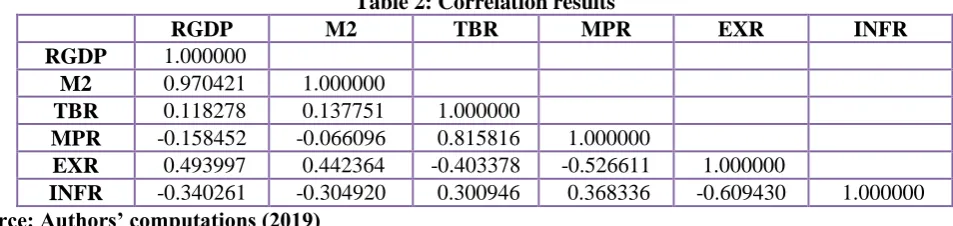
Table 2 reports the correlation among the proxy for economic growth (RGDP), Money supply (M2), Treasury Bill Rate (TBR), Monetary Policy Rate (MPR), Exchange rate (EXR) and Inflation (INFR).The results show that the correlation between RGDP and M2, TBR and EXR is positive at 0.97, 0.11 and 0.49 respectively which confirms the expectation that open market operation when properly used should positively affect the economy. In other words the discretionary use of treasury bills as a monetary policy tool should be encouraged. The correlation between the proxy for economic growth (RGDP) and the proxy for open market operation, Treasury Bill Rate (TBR) is at 0.11. Thus, the correlation coefficient seems to support the postulation that growth is positively related to Money supply.
The correlation coefficient of -0.15 between RGDP and Monetary policy rate suggests a negative relationship between the two variables. The import of this is that an increase in Monetary policy rate increases interest rates which results to a decrease in economic development and vice versa. A generally held explanation for this phenomenon is that is the fact that high lending rate occasioned by increasing MPR discourages borrowing, and when borrowing is discouraged, aggregate investments could diminish. This will stall production and overall national productivity while population continues to increase. The ensuing disequilibrium would exacerbate the standard of living and overall economic development.. The opposite holds true when interest rate is reducing.
With respect to the relationship between economic growth (RGDP) and one of the control variables (INFR) is negative (0.34). This is interestingly true as robustly corroborated by the negative relationship also disclosed between RGDP and MPR.
Unit Root Test
Table 3 presents the results of the augmented Dickey-Fuller (ADF) unit root test, proposed in Dickey and Fuller (1979), for the individual variables as diagnostic tests to evaluate the stationarity properties of the variables. Unit root test is particularly important to ensure that the series are stationary, as estimate obtained from nonstationary series are not reliable. It is clear from Table 4.4 that the base level of some of the series contain unit root at conventional confidence level (i.e., LRt ~ I(1)). At first differences, however, all series do not contain unit root (i.e., Rt ~ I(0)).
Table 3: Augmented Dickey-Fuller Unit Root Test Results 0-Level First Difference
Variables: critical value 5% computed value critical value 5% computed value RGDP -2.948404 3.715245 -2.951125 -1.958445
MPR -2.948404 -3.060357 -2.951125 -8.121518
MS -2.948404 4.744653 -2.951125 -2.243461
TBR -2.948404 -2.936937 -2.951125 -6.725125
INTR -2.948404 -3.031968 -2.951125 -6.148980
INFR -2.948404 -2.816573 -2.951125 -6.033097
Table 4: REGRESSION RESULT
Dependent Variable: RGDP Method: Least Squares Sample: 1981 2016 Included observations: 36
Variable Coefficient Std. Error t-Statistic Prob.
M2 0.778539 0.147297 5.285490 0.0000*** TBR 0.156792 0.023785 6.591908 0.0000*** MPR 0.179280 0.022372 8.013538 0.0000*** MPR 0.179280 0.022372 8.013538 0.0000*** INFR 0.049044 0.008768 5.593398 0.0000***
R-squared 76.956480 Mean dependent var 4.438056 Adjusted R-squared 73.044752 S.D. dependent var 0.232868 S.E. of regression 1.016243 Akaike info criterion 2.949758 Sum squared resid 34.08075 Schwarz criterion 3.081717 Log likelihood 50.09564 Hannan-Quinn criter. 2.995815 Durbin-Watson stat 0.629568
Source: Author’s computations (2018)
Note: *** indicates 5 per cent significance levels
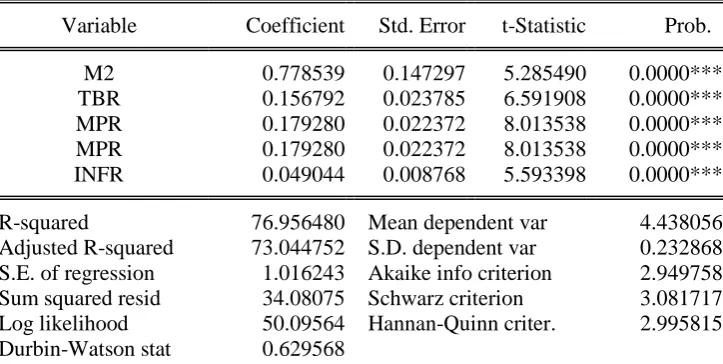
Table 4 below captures the effect of Money supply (M2) as a proxy for monetary policy on economic growth measured by log of real gross domestic product growth rate. The result also shows the result of the control variable as measured by EXR and INFR. The result shows that money supply had positive and significant impact on economic growth in Nigeria (α = 0.77, p-value = 0.00 < 0.05). The result showed that Treasury bill rate had positive and significant impact on economic growth in Nigeria (α = 0.15, p-value = 0.00 < 0.05). The result shows that monetary policy rate had positive and significant impact on economic growth in Nigeria (α = 0.17, p-value = 0.00 < 0.05). Also, the result showed that EXR and INFR had positive and significant impact of RGDP in Nigeria within the period of the study. The estimates indicate clearly that all the model variants estimated are statistically significant, as confirmed by the F-statistics. In the same vein the coefficient of multiple determination, adjusted for degrees of freedom (Adjusted R2) is quite high at 73% which suggests that only 27% of the variations in the dependent variable is not accounted for by the explanatory variables.
5. CONCLUSION/RECOMMENDATION:
This study examined the impact of monetary policy on economic growth in Nigeria for the period 1981 to 2016. The study was able to look into the operation of the monetary policy with various instruments such as money supply (measured by M2), open market operations (measured Treasury bill rate) and minimum rediscount rate or monetary policy rate. It was found that all three measures had positive impact on economic growth (measured by real gross domestic product).
All the variables are statistically significant. Also, changes in monetary policy affect the exchange value of the dollar on currency markets as well inflation which was adopted as control variables. The findings revealed that the relationship between money supply, Treasury bill rate, monetary policy rate, exchange rate and inflation is significant at the level of 5%. Monetary policy and inflation are closely related, such that monetary policy is viewed as the only policy available for the control of inflation, and that in the long run the inflation rate is the only macroeconomic variable that monetary policy can affect This presumed that money supply impacts strongly upon exchange rate and inflation rate.
From the forgoing therefore, monetary policy contributes to sustainable growth by maintaining price stability. In conclusion, Monetary policy has emerged as one of the most critical government responsibilities; monetary policy is seen as providing a flexible and powerful instrument for achieving medium-term stabilization objectives, in that it can be adjusted quickly in response to macroeconomic developments. Based on the findings of this study and conclusion, the study therefore makes the following recommendation
ii. To promote growth, government should ensure that the use of open market operations tools such as treasury bill and bonds should be deepened so as to encourage the provision of funds for capital expenditure. With this, capital expenditure on productive activities and infrastructure will contribute positively to industrial growth which will invariably enhance economic growth.
iii. Also, In order to keep inflation as well as inflation expectations low and stable, government should put more efforts to improve monetary policy coordination through emphasis on single digit monetary policy rate. This will enhance borrowing by deficit earners from surplus earners especially for small and medium scale enterprises
REFERENCES:
1. Abata, M.A., Kehinde, J.S. & Bolarinwa, S.A. (2012). Fiscal/Monetary Policy and Economic Growth in Nigeria: A Theoretical Exploration. International Journal of Academic Research in Economics and Management Sciences, 1(5),75 – 88.
2. Adefeso, H.A. &Mobolaji, H.I. (2010). The fiscal –monetary policy and economic growth in Nigeria: Further empirical evidence. Pakistan Journal of Social Sciences 7, 137-142.
3. Ahokpossi, C., Garcia-Martinez, P. and Kemoe, L. (2016).Monetary and Fiscal Policies and the Dynamics of the Yield Curve in Morocco.IMF Working Paper WP/16/103.
4. Ajayi, S.I. (1974). An econometric case study of the relative importance of monetary and fiscal policy in Nigeria. The Bangladesh Economic Review 2(2), 559-576.
5. Ajide, K.B. (2014). Determinants of Economic Growth in Nigeria.CBN Journal of Applied Statistics 5(2),147-170.
6. Akujuobi, L. E. (2012). Monetary Policy and Nigeria’s Economic Development. African Research Review, 4(4), 153-161.
7. Alcidi, C. and Thirion, G. (2016).The interaction between fiscal and monetary policy – before and after the financial crisis. FIRSTRUN – Fiscal Rules and Strategies under Externalities and Uncertainties Funded by the Horizon 2020 Framework Programme of the European Union Project ID 649261.
8. Baldacci, E., Gupta, S. and Mulas-Granados, S. (2009). How Effective is Fiscal Policy Response in Systemic Banking Crises? IMF Working Paper WP/09/160.
9. Bank of England (2018).Monetary policy.https://www.bankofengland.co.uk/monetary-policy.
10. Bassanini, A. &Scarpetta, S. (2001). Does human capital matter for growth in OECD countries?: Evidence from pooled mean-group estimates. OECD Economics Department Working Papers, No. 282, OECD Publishing, Paris. http://dx.doi.org/10.1787/424300244276
11. Bassanini, A., Scarpetta, S. &Hemmings, P. (2001). Economic growth: The role of policies and institutions: Panel data evidence from OECD countries. OECD Economics Department Working Papers, No. 283, OECD Publishing, Paris. http://dx.doi.org/10.1787/722675213381
12. Blanchard, O. J. and Dell'Ariccia, G. and Mauro, P. (2010).Rethinking Macroeconomic Policy.https://ssrn.com/abstract=1555117 or http://dx.doi.org/10.2139/ssrn.1555117.
13. Blinder, A.S. (2004).The case against the case against discretionary fiscal policy. CEPS Working Paper No. 100, Princeton University, USA.
14. Cate, T. (2012) ed., Keynes's general theory seventy‐five years later. Cheltenham: Edward Elgar Publishing. 15. Central Bank of Nigeria (2006).Monetary policy
decisions.https://www.cbn.gov.ng/monetaryPolicy/decisions/2006.asp.
16. Central Bank of Nigeria (2011a).What is monetary policy?Understanding Monetary Policy Series No. 1. CBN, Abuja, Nigeria
17. Central Bank of Nigeria (2011b).Central Bank of Nigeria moentary policy framework. Understanding Monetary Policy Series No. 3. CBN, Abuja, Nigeria
18. Central Bank of Nigeria (2017).Annual Statistical bulletin.CBN, Abuja, Nigeria.
19. Chigbu, E.E., &Njoku, M. (2013). The impact of monetary and fiscal policies on Nigeria Economic Growth 1990-2010, European Journal of Business and Management, 5(2), 13-24.
20. Chuku, C. A. (2009). Measuring the effects of monetary policy innovations in Nigeria. African Journal of Accounting, Economics, Finance and Banking Research5(5).141-153
21. De Long, J.B. (1995). Keynesianism, Pennsylvania Avenue Style: Some Economic Consequences of the Employment Act of 1946. Journal of Economic Perspectives 10(3), 41-53.
23. Ezeoha, A &Uche, C. U. (2010).Rethinking Monetary and Fiscal Policies in Nigeria. https://www.researchgate.net/profile/Abel_Ezeoha/publication/237382650_Rethinking_Monetary_and_Fiscal _Policies_in_Nigeria/links/551db5690cf213ef063e92e5.pdf
24. Falade, O. &Folorunsho, B. (2015).Fiscal and monetary policy instruments and economic growth sustainability in Nigeria.American Journal of Economics5(6), 587-594.
25. Fetai, B. (2013). Assessing monetary and fiscal policy interaction in a small open economy: The case of Republic of Macedonia.Transition Studies Review 20(1), 89-104,
26.Folorunso, B.A and Abiola, A.G. (2000): The Long – run determinants of inflation in Nigeria (1970 - 1998). The Nigerian Journal of Economic and Social Studies, 42(1): 37 - 52.
27. Friedman, M., &Schwartz, A.J. (1963).A Monetary History of the United States, 1867–1960. Princeton, NJ: Princeton University Press.
28. Hutchison, M.M., Noy, I. & Wang, L. (2010).Fiscal and monetary policies and the cost of sudden stops.Journal of International Money and Finance 29, 973–987
29. Ismal, R. (2011).Islamic banking in Indonesia: New perspectives on Monetary and Financial Issues. Wiley Financial Series. Singapore: John Wiley and Sons Pte.
30. Laeven, L. and Valencia, F, (2008), Systemic Banking Crises: A New Database, IMF Working Paper No. 08/224.
31. Laeven, L. and Valencia, F. (2010), “Resolution of Banking Crises: The Good, the Bad, and the Ugly,” IMF Working Paper No. 10/44.
32. Li, J. &Tang, L. (2010).The Effectiveness of Fiscal and Monetary Policy Responses to 33. Twin Crises.sf.cufe.edu.cn/docs/2011-12/20111202104243562218.pdf
34. M’Amanja, D. & Morrissey, O. (2005).Fiscal Policy and Economic Growth in Kenya.Credit Research Paper, No. 05/06.
35. Mencinger, J. (2016). The impact of the fiscal policy transmission mechanism on economic activity. Doctoral Dissertation, Faculty of Economics, University of Ljubljana. 208 pp.
36. Okoro, A. S. (2013). Impact of monetary policy on Nigeria economic growth. Prime Journal of Social Sciences2(2), 195-199.
37. Owolabi, A. U. &Adegbite, T. A. (2014).Impact of monetary policy on industrial growth in Nigeria.International Journal of Academic Research in Business and Social Sciences4(1), 18-31.
38. Papademos, L. (2003). Contribution of Monetary Policy to Economic Growth. Paper presented at the 31st Economics Conference, Vienna, 12 June. The European Central Bank.
39. Sahar, M.A. (2016). Coordination of monetary and fiscal policies: The case of Egypt. International Review of Research in Emerging Markets and the Global Economy 2(4), 933 – 954.
40. Senbet, D. (2011). The relative impact of fiscal versus monetary actions on output: A vector autoregressive (VAR) approach. Business and Economics Journal 25:1-11.
41. Srithilat, K.& Sun, G. (2017).The Impact of Monetary Policy on Economic Development: Evidence from Lao PDR. Global Journal of Human-Social Science: E-Economics 17(2), 10-15.