Available Online At www.ijpret.com
INTERNATIONAL JOURNAL OF PURE AND
APPLIED RESEARCH IN ENGINEERING AND
TECHNOLOGY
A PATH FOR HORIZING YOUR INNOVATIVE WORK
A GUIDE TO WATER CONSERVATION AND ITS NEED IN PRESENT SCENARIO
MOHD. GULFAM PATHAN1, VEENA PATHAN 2
1. Faculty in Asst. Prof, Civil Engineering Dept. J.L. Chaturvedi College of Engineering Nagpur, India
2. Faculty in Asst. Prof, Civil Engineering Dept. Priyadarshini College of Engineering Nagpur, India
Accepted Date:
27/02/2013
Publish Date:
01/02/2013
Keywords
Greywater,
Equalization,
Treatment,
Conservation,
Wetland
Corresponding Author Mr. Mohd. Gulfam Pathan
Abstract
With less than one percent of Earth’s water available for human use, the
Federal Government is leading by example with water efficiency and
conservation efforts. Federal laws and regulations require agencies to
implement water efficiency efforts and reduce water consumption,
making water an integral part of every comprehensive resource
management program. Conservation or water conservation helps to
recharge ground water by reducing consumption and using alternative
source of water. This method includes rainwater harvesting,
groundwater recharge, reuse of Greywater and recycling wastewater.
This paper guides the way for optimizing utilization of site water
resources, minimizing site wastewater outflows. This work explains a
treatment system for grey water consisting of natural processes involving
equalization, filter bed of sand & aggregates, coal & charcoal, surface
wetland and sub-surface wetland. The treatment is economically viable,
scientifically feasible and treated water can be used for irrigation,
Available Online At www.ijpret.com
INTRODUCTION
India has one of the fastest growing
construction sectors in the world. This rapid
growth in India’s building sector no doubt
presents opportunities for improving the
living conditions and livelihoods of millions
of people. However, in order to be
sustainable the environmental pressures of
increased demand for resources coupled
with a rapidly changing climate must be
addressed [15].
Much emphasis has been placed on green
buildings over the past two decades. Most
of the focus to date has been on green
buildings which may feature energy
conservation in construction and operation,
recycled or native/natural/low tech
materials used in construction or even use
of high tech concepts to reduce energy and
water consumption. The Government is
currently developing a code for sustainable
buildings. The code is a voluntary initiative
to actively promote the transformation of
the building industry towards more
sustainable practices by requiring buildings
that make more efficient use of energy
resources, water resources, material
resources and practices and materials
designed to safeguard occupants' health
and wellbeing.
Most Indian cities rely heavily on
ground-water for use in buildings. However,
ground-water levels in India are projected
to have dropped from 1901 m3/ person/yr
in 2001 to 1401 m3/person/year by 2030
which is well below the international
benchmark for water stress of 1700
m3/person/year. Rainwater harvesting and
large scale water recycling are not widely
implemented in urban areas despite
demand for water often outstripping
supply. An added drain on urban water
supply is the approximately 30% of water
wasted each year due to leaking
infra-structure.
Less than one-fifth of one percent of our
planet’s water is accessible fresh water, and
only about 30 percent of that is potable.
Over 80 percent of municipally supplied
water is used in buildings. There's a reason
that water has become a national priority. A
recent government survey showed at least
36 states are anticipating local, regional, or
Available Online At www.ijpret.com EPA). By using water more efficiently, we
can help preserve water supplies for future
generations, save money, protect the
environment. Many countries and indeed
some states in the United States face
shortages in potable water supply. Several
opportunities exist to use household water
more efficiently without reducing services.
Implementing water efficient practices can
also lead to substantial savings on the cost
of septic tanks, leach fields, and wastewater
treatment infrastructure [10]. These
measures combined will not only benefit
the environment and the community, they
can also create economic savings.
Increasing water efficiency can reduce
water-supply and wastewater-treatment
needs and their related costs. Because
water suitable for reuse is often a
by-product of existing secondary and tertiary
wastewater treatment processes, this type
of water recycling is a low-energy source of
water supply.
The sustainable use of water can fall into
two categories
• Conserve water within and around the
building; and
• Conserve water on the site [11].
A water management plan includes clear
information on how a Federal facility uses
water from the point of access or
generation to its ultimate disposal or reuse.
The water cycle for Federal buildings begins
at the water utility and continues beyond
the building. Covering the entire water
distribution cycle ensures that Federal sites
make appropriate water management
decisions [12].
Methods of water management can be
classified as Conservation, Allocation,
retrofit program and Behavioral practices.
This paper explains Conservation of water
and provides guidance for reuse of
greywater. Based on the comparisons
made, water reclamation and reuse should
be components of any long term water
resources management strategy.
IMPORTANT METHODS IN WATER MANAGEMENT
Conservation
Conservation or water conservation helps
to recharge ground water by reducing
Available Online At www.ijpret.com of water. This method includes rainwater
harvesting, groundwater recharge, reuse of
Greywater and recycling wastewater.
Rainwater Harvesting System: Rainwater
harvesting is the practice of collecting
rainwater off roof surfaces and storing that
water for later use. While collected water
can be filtered and treated for potable uses,
such systems are fairly complex. Using
collected rainwater for landscape irrigation
is more easily accomplished. It is important
that homes become increasingly self reliant
in collecting their own rainwater for grey
water recycling for non-potable domestic
use. At the simplest level, rainwater can be
collected in a water butt for garden use.
More advanced rainwater harvesting
systems can provide water supply for all
non-potable consumption such as for WCs,
washing machines, the garden and car
washing. Rainwater harvesting can save
around 50% on mains water consumption,
depending on roof areas of dwellings and
annual rainfall.
Groundwater recharge: Groundwater
recharge is a hydrologic process where
water moves downward from surface water
to groundwater. Recharge occurs both
naturally and artificially. In natural
groundwater recharge, groundwater is
recharged naturally by rain and snow melt
and to a smaller extent by surface water
such as rivers and lakes. Artificial
groundwater recharge is a successful
method in order to purify surface water and
to improve the water management.
Artificial groundwater recharge is the
infiltration of surface water into shallow
aquifers to increase the quantity of
groundwater. The volume-rate abstracted
from an aquifer in the long term should be
less than or equal to the volume-rate that is
recharged.
Greywater System: Greywater is
wastewater from non-toilet plumbing
systems such as hand basins, washing
machines, showers and baths. Most
Greywater is easier to treat and recycle
than blackwater, because of lower levels of
contaminants. The method and standard of
treatment in a Greywater system will vary
with the size of the system. Pipes and
supply points on the Greywater system
must be clearly labeled in order to avoid
Available Online At www.ijpret.com Greywater systems can help you save 35%
to 40% on your annual water bill.
Recycling wastewater system: Recycling
wastewater
is easier to treat and recycle than
blackwater. Blackwater contains bacteria
that can cause disease. That’s why
communities build wastewater treatment
plants and enforce laws against the release
of raw sewage into the environment.
Sewage Treatment plant system are used to
recycle blackwater. In recent years, there
has been growing interest in waste-water
reuse as a major component of water
demand management.
GREY WATER
Grey water is the ‘waste’ water that is
generated in homes and commercial
buildings through the use of water for
laundry, dishes, or for bathing.
In recent years not only the threats of
improper greywater management have
been recognized, there is an increasing
international recognition that grey water
reuse, if properly done, has a great potential
as alternative water source for purposes
such as irrigation, toilet flushing and others.
The main barrier for wider and faster
dissemination of suitable greywater
management system on household level is
the lack of knowledge and experience in
that field, especially in developing countries.
Recycled water is either reclaimed
wastewater or untreated grey water, two
other possible sources for irrigation water.
Reclaimed wastewater is water from a
wastewater treatment plant that has been
treated and can be used for nonpotable
uses such as landscape irrigation, cooling
towers, industrial processes, toilet flushing,
and fire-protection [13].
As per WichmanK, Otterpohl R. The
combination of aerobic biological process
with physical filtration and disinfection is
considered to be the most economical and
feasible solution for grey water recycling.
Weissenbacher, Mullegge showed that the
Conventional system was capable to fulfill
the physicochemical requirements suggest
by different guidelines but could not ensure
the hygienic quality for all operating
conditions. In comparison to a conventional
Available Online At www.ijpret.com reduce the fresh water demand by more
than 60%.
Greywater generated due to cloth washing
can have fecal contamination with the
associated pathogens and parasites such as
bacteria. Kitchen Grey water is
contaminated with food particles, oils, fats
and other wastes. It readily promotes and
supports the growth of micro-organisms.
Kitchen Grey water also contains chemical
pollutants such as detergents and cleaning
agents which are alkaline in nature and
contain various chemicals.
It is important to recognize that greywater is
not always pathogen-free. Numerous
pathogenic organisms and microbial
indicators have been found in grey water.
These include coliform bacteria, fecal
coliform and virus. Treatment of greywater
is important because, there are number of
problems related to the reuse of untreated
grey wastewater. The risk of spreading of
diseases, due to exposure to
micro-organisms in the water, will be a crucial
point if the water is to be reused for toilet
flushing or irrigation. The risk for pollution
of soil and receiving water due to the
content of different pollutants is another
question that has been raised concerning
infiltration and irrigation with grey water.
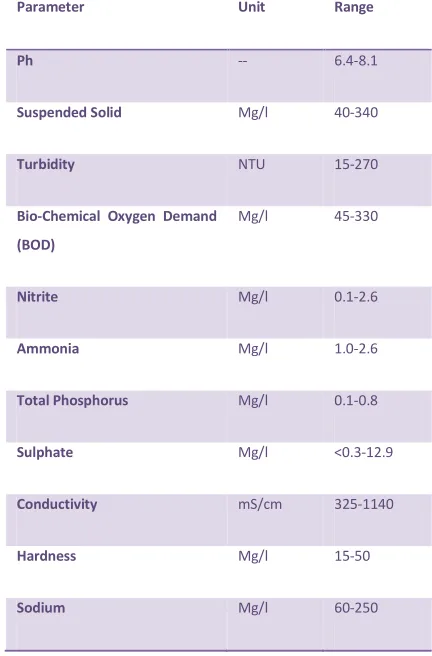
Table I gives the different chemical
characteristics of typical grey water.
TABLE I. PARAMETERS OF GREY WATER
Parameter Unit Range
Ph -- 6.4-8.1
Suspended Solid Mg/l 40-340
Turbidity NTU 15-270
Bio-Chemical Oxygen Demand
(BOD)
Mg/l 45-330
Nitrite Mg/l 0.1-2.6
Ammonia Mg/l 1.0-2.6
Total Phosphorus Mg/l 0.1-0.8
Sulphate Mg/l <0.3-12.9
Conductivity mS/cm 325-1140
Hardness Mg/l 15-50
Sodium Mg/l 60-250
TREATMENT PROCESS OF GREY WATER
Fig. 1 shows the Schematic diagram of
treatment process which is recommended
for recycling.
Screening Cum Equalization
Available Online At www.ijpret.com Fig.1 Flow diagram of treatment process
The treatment comprises of following steps:
• Screening: is the very first method
involved in the treatment of grey water.
It helps to remove large debris such as
sticks, leaves, rubbish and other large
particles which may interfere with
subsequent treatment steps.
• Equalization: After screening, grey water
is equalized by mixing it thoroughly in
the tank so that foul smell, odor, etc can
be minimized and the water get mixed
properly so that the strength of water is
same everywhere.
• Settling: When grey water gets
equalized, it is allowed to settle for 4-6
hours. The solids and heavy particles get
settle down at the bottom of tank by
gravity and light particles floats on
water.
• Filtration: In this unit, grey water passes
through different media of filter i.e.
aggregate, sand, coal and charcoal. Sand
and gravel are usually used for filter bed
but charcoal and coal have also
properties to purify water. Water passes
quickly through the sand and small
particles are removed. The internal pore
characteristics are very important
properties of aggregates. Absorption
relates to the particles ability to take in
liquid and purify. Smelling chlorine and
other unpleasant odors is eliminated by
the absorption power of the charcoal.
Also microorganisms living in the many
pores of the charcoal break down
unhealthy organic matters. Coal is an
adsorbent used to take tiny sediment
out of water making it cleaner.
• Surface Wetland: Constructed Wetland
(CW) Treatment system is a typical
natural, engineered treatment system
designed and developed to utilize the
natural processes involving wetland Surface Wetland
Available Online At www.ijpret.com vegetation, some filter bed consisting
sand or gravel or such material and their
associated microbial assemblage in
order to treat wastewater. The use of
CW can be a cost effective treatment
alternative. After filtration, the water is
allowed to flow in the tank containing
water lily plants. The plants float on
water surface and hence it is known as
surface wetland. These plants use their
roots to purify water as they take up
oxygen in their roots and allow
micro-organisms to grow which decomposes
the organic matter present in water.
Mats of floating plants in wetland may
serve, to a limited extent, as sediment
traps, but their primary role in
suspended solid removal is to limit
resuspension of settled particulate
matter.
• Sub-Surface Wetland: After 3 days, water from surface wetland is allowed
to flow in the sub-surface wetland in
which Typha Latifolia plants are placed
with the support of sand and gravel.
Typha Latifolia acts as a bioremediater
to treat polluted water. Greywater is
discharged into the subsurface
constructed wetland where the water
will be filtered by biological processes.
The main compartment consists of
gravel and sand, with the vegetation
growing on the top portion of mulch or
rich soil. The greywater flows through
the system beneath the soil surface,
which eliminates the risk for standing
pools and mosquito breeding. Biological
removal is perhaps the most important
pathway for contaminant removal in
wetland. Contaminants that are also
forma of essential plant nutrients, such
as nitrate, ammonium, and phosphate,
are readily taken up by the wetland
plants. However, many wetland plant
species are also capable of uptake and
even significant accumulation of, certain
toxic metals such as cadmium and lead.
The rate of contaminant removal by
plants varies widely, depending on plant
growth rate and concentration of the
contaminant in plant tissue. Woody,
plants trees and shrubs, provide
relatively long-term storage of
contaminants, compared with
Available Online At www.ijpret.com
EXPERIMENTAL SETUP
1. Raw grey water is to be collected from
different sources of a residential or
commercial building.
2. The very first tank, equalization cum
settling tank, has screen on the top. The
grey water is put in the tank and it gets
screened.
3. After that, the water is mixed thoroughly
to make it equalized. It is then allowed
to settle for 4-6 hours.
4. The heavy matter gets settled at the
bottom of the tank and the water is
allowed to flow in filtration tank. The
water passes through each filter media
i.e. sand, aggregate, coal and charcoal. It
is a down flow process.
5. After the water is filtered, it flows into
surface wetland in which water lily are
planted. Water is kept for three days in
surface wetland and then it is allowed to
flow in the sub-surface wetland.
6. In sub-surface wetland, Typha Latifolia is
planted and three samples are collected
after every 3 days.
7. The samples of raw grey water, water
after equalization, settling, filtration,
surface wetland and sub-surface
wetland are collected and various tests
are carried out in laboratory like Ph,
Dissolved Oxygen (DO), Turbidity, Total
Solids, BOD, Chemical Oxygen Demand
(COD), Hardness etc.
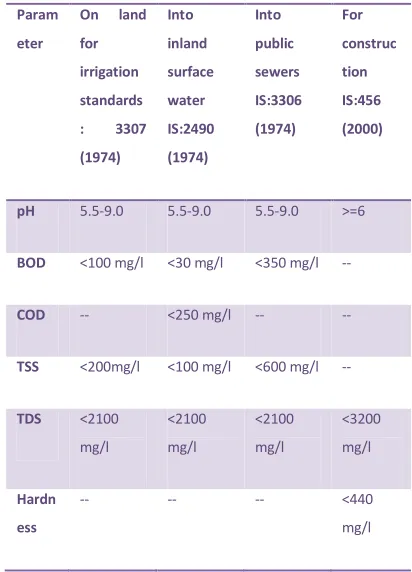
Table II gives the Disposal Standard by
Central Pollution Control Board (CPCB)
for quality of treated grey water.
TABLE II. EFFLUENT STANDARD TABLE
Param
eter
On land
for
irrigation
standards
: 3307
(1974)
Into
inland
surface
water
IS:2490
(1974)
Into
public
sewers
IS:3306
(1974)
For
construc
tion
IS:456
(2000)
pH 5.5-9.0 5.5-9.0 5.5-9.0 >=6
BOD <100 mg/l <30 mg/l <350 mg/l --
COD -- <250 mg/l -- --
TSS <200mg/l <100 mg/l <600 mg/l --
TDS <2100
mg/l
<2100
mg/l
<2100
mg/l
<3200
mg/l
Hardn
ess
-- -- -- <440
Available Online At www.ijpret.com Hence, we can reuse grey water after
treatment which includes screening,
equalization, settling, filtration and
wetlands. It is a suitable and effective
method of treatment of grey water as
compared to the conventional method so it
can be implemented at small scale basis at
homes, schools, colleges, commercial
buildings, etc.
CONCLUSION
• This method of treatment of grey water
is economically viable and scientifically
feasible and the treated water can be
used effectively for irrigation, gardening,
flushing, street washing and
construction purpose.
• The multimedia filter is effective for the
removal of turbidity also, the organic
matter is lesser.
• Constructed wetland is very useful for removal of suspended solids.
• DO is increased after filtration process while there is no effect on hardness of
water.
• BOD and COD values decrease after treatment.
• Vegetation growth increases rapidly.
Water demand should be reduced as much
as possible and water reuse systems, such
as rainwater harvesting or grey water
recycling, should be installed.
REFERENCES
1. “Evaluating water utilization in primary
schools”, C.L. Cheng and Y.T. Hong, 2nd April
2004, www.sciencedirect.com
2. “Green roof energy and water related
performance in the Mediterranean
climate”, R. Fioretti, A. Palla, L.G. Lanza and
P. Principi, 6th March 2010,
www.sciencedirect.com
3. “Towards sustainable-energy buildings”,
Dorota Chwieduk, 22nd July 2003,
www.sciencedirect.com
4. “Potential for potable water savings by
using rainwater in the residential sector of
Brazil”, Enedir Ghisi, 12th July 2005,
Available Online At www.ijpret.com 5. “Regional rainfall level zoning for
rainwater harvesting systems in northern
Taiwan”, C.L. Cheng and M.C. Liao,
April 2009, www.sciencedirect.com
6. “Environmental implications of water
efficient microcomponents in residential
buildings”, A. Fidar, F.A. Memon and D.
Butler, 9th September 2010,
www.sciencedirect.com
7. “Review of the
approaches for grey water treatment and
reuses”, Fangyue Li, Knut Wichmann and
Ralf Otterpohl, 28th February 2009,
www.sciencedirect.com
8. “Performance of UV disinfection and the
microbial quality of greywater effluent
along a reuse system for toilet flushing”,
9. Eran Friedler and Yael Gilboa,
February 2010, www.sciencedirect.com
10. “Lifecycle assessment for sustainable
design options of a commercial building
Shanghai”, Nannan Wang, Yen
Chang and Chris Nunn, 16th December 2009,
www.sciencedirect.com
Available Online At www.ijpret.com “Regional rainfall level zoning for
rainwater harvesting systems in northern
Taiwan”, C.L. Cheng and M.C. Liao, 29th
www.sciencedirect.com
“Environmental implications of water
efficient microcomponents in residential
buildings”, A. Fidar, F.A. Memon and D.
September 2010,
“Review of the technological
treatment and
reuses”, Fangyue Li, Knut Wichmann and
February 2009,
“Performance of UV disinfection and the
microbial quality of greywater effluent
system for toilet flushing”,
Eran Friedler and Yael Gilboa, 20th
www.sciencedirect.com
“Lifecycle assessment for sustainable
design options of a commercial building in
Shanghai”, Nannan Wang, Yen-Chiang
December 2009,
11. Sustainable Development: Design
Guidelines for the Town of Scott
Green Bay Joint Planning Area.
12. Design guide for sustainable buildings,
the WaterSense program,
http://www.epa.gov/watersense
13. The U.S. Department of En
Federal Energy Management Program
(FEMP),
www.femp.energy.gov/program/watereffici
ency.html
14. Los Alamos National Laboratory
Sustainable Design Guide, Landscape Design
and Management.
15. Background paper for Sustainable
Buildings and Construction for India:
Policies, Practices and Performance, UNE Sustainable Development: Design
Guidelines for the Town of Scott - City of
Green Bay Joint Planning Area.
Design guide for sustainable buildings,
the WaterSense program,
http://www.epa.gov/watersense
The U.S. Department of Energy’s (DOE)
Federal Energy Management Program
www.femp.energy.gov/program/watereffici
Los Alamos National Laboratory
Sustainable Design Guide, Landscape Design
Background paper for Sustainable
Buildings and Construction for India: