The Status of Food Industry and Associated
Socio-Economic Implications in Lesotho:
Challenges and Opportunities
Mosotho J. George
1
1Department of Chemistry and Chemical Technology, National University of Lesotho, P.O. Roma 180, Lesotho
– Southern Africa
Corresponding author: [email protected] or [email protected]
Abstract: Food processing is a vital industrial process since it can prolong the longevity of food,
preserve freshness and can convert foods into different forms, increasing the palatability, portability and versatility of food products. The food industry is one of the ‘low risk industries’ since food is a necessity, rather than a luxury good. This paper first assesses the status quo of the food industry in Lesotho, and highlights the impacts of the absence of a developed food industry, including low employment, loss of spill-‐over companies, brain-‐drain, and poor economy in general. The paper next highlights the opportunities for the creation of new processing industries mainly for indigenous people. In particular, the considerable opportunities for the appropriately trained graduates are highlighted. The paper concludes with several recommendations in order to take advantage of these opportunities. These include the implementation of science and technology policy, as well as transformation of the industrial policy to focus on manufacturing and cooperatives rather than the labour-‐based industries as is currently the case. Partnerships between several governmental agencies and academia are also discussed as a potential key to successful economic transformation of food industry.
I. Introduction
Food security is regarded as a basic human rights issue globally. However, developing countries such as Lesotho struggle to supply sufficient food security for their citizens. Nearly 68% of the Lesotho’s population of 2 million lives below the national poverty line [WFP, 2011]. Despite a reported 62% of the population being engaged in some form of agriculture [CBL, 2009], there is persistent food insecurity. The Food Insecurity and Vulnerability Monitoring System (FIVMS) reported three factors that shape food security: the performance of the food economy, care practices, and health and sanitation [Turner, 2009]. Additionally, food security has been related to climatic conditions [Gregory, Ingram & Brklacich, 2005], that have caused prolonged droughts -‐-‐ and heavy rains when rain does occur -‐-‐-‐ leading to poor economic conditions that confront a majority of the citizenry [IRIN, 2012]. There has been a 75% decline in grain production from just under 300,000 metric tons in 1978 to about 75,000 in 2007 [Turner, 2009;
FFSSA, n.d.].
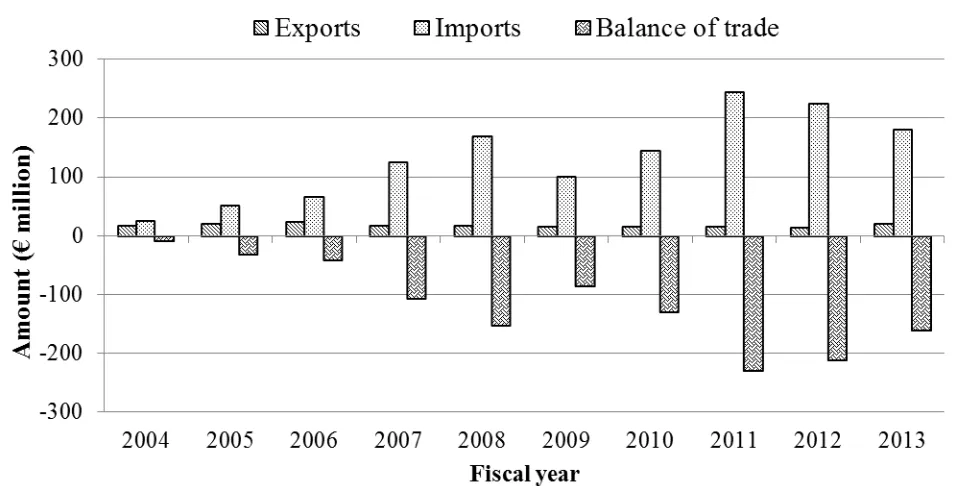
As can be seen, Lesotho has been experiencing a continuous systemic trade deficit, clearly demonstrated in Figure 1, due to import high dependency on almost all commodities including the vital commodities: energy and food. The main exports are: clothing (40%), diamonds (22%), water and wool/mohair [Trading Economics, 2014].
2
Figure 1. The balance of trade for Lesotho (2004 – 2013).
scientists are never invited, which shows some establishes a forum for economic development, scientists are never invited, which shows somedegree of obliviousness or wilful ignorance of the role of science and technology in economic development.
Faced with the heavy reliance on imports, the government of Lesotho established two corporations to promote industry in the country: the Lesotho National Development Corporation (LDNC) in 1967 and the Basotho Enterprise Development Corporation (BEDCO) established in 1975 as a subsidiary of the LNDC [LNDC, n.d.; AfroSAI-‐E, 2002]. BEDCO is charged with the establishment and development of Basotho (the indigenous people of Lesotho)-‐owned business enterprise, with particular emphasis on the promotion of indigenous entrepreneurial skills while the LDNC is charged with the implementation of the country’s industrial development policies and hence attract foreign direct investment.
However, despite these decades-‐old efforts to promote industrial development, science-‐based industry is still lacking in Lesotho and there is little hope for its establishment any time soon. The LNDC has only been successful in attracting the non-‐skilled textile industry, which is the largest private sector employer in Lesotho [CBL, 2009]. The food industry is no exception, and, consequently, the country imports all of its processed foods such as bottled
milk and canned fruits and vegetables from South Africa. The only food related industries in Lesotho include two milling companies, a brewing company, a dairy products company, a cannery, and retailing outlets such as butcheries. Figure 3 shows the distribution of the different industrial sectors to the market. Thus, from an industrial policy perspective, food processing industries have not been successful in alleviating food insecurity and the reliance on imports.
This lack of science-‐based industries in Lesotho is typical of the African continent [Chataway, Smith & Wield, 2005] and it is generally attributed to poor levels of scientific understanding, technical training, and appreciation of the role of science in industry in general [Irwin & Wynne, 1996; Pouris & Pouris, 2009].
Figure 2. Evaluation of different industrial sectors and their contribution to the economy.
This is not helped by vague and inconsistent policies in the universities, typified by constant surprises and reversals, and general corruption, all of which lead to lower investor confidence, resulting resulting in a downward spiral of poor investment and poor overall economic growth [Brunetti, Kisunko & Weder, 1998; Lehmann, et al., 2012]. As a consequence, those who are in a best position to help assist in the development of a food industry are marginalized from participation within the economy. There are a number of academic programmes offered at the university level locally that are relevant to respond to these challenges. Programmes such as agriculture, biotechnology, chemical technology, food and nutrition, economics, etc. can easily transform the status quo. If such programmes are present, then a number of questions come to mind: why has there been no change or any movement towards exploiting this opportunity? Alternatively, is this really an opportunity? Could it be the poor or irrelevant training? Are policies in place to harness this opportunity? The question of relevance of higher education in response to prevailing circumstances has been a very contentious issue. This issue is however quite complex as it could imply many things: ability of the graduates to be immediately absorbed by the markets, ability of the graduates to be responsive to the country’s needs, and the innate capacity development in the graduates themselves.
The universities are usually blamed in media and public debates for not offering relevant programmes while on the other hand the universities blame the private sector for lack of market absorptivity of the graduates. This perpetuates a vicious blame cycle between the private sector and academia [Pillay, 2010].
Despite all of these challenges, there are some reasons for a positive outlook. There is a high market possibility for new businesses to be established, as it will be shown in the proceeding sections. The absence of established industries itself creates an opportunity in that new companies face do not face much competition. The abundance of clean water with minimal to no pollution is a positive potential input into the industry. This resource is already being tapped through the Lesotho Highlands Water Project, where clean water is already being pumped to South Africa. The abundance of wild vegetables and berries that grow naturally is also another positive resource that can be exploited to international markets, where the water and soils are polluted with different types of chemicals including agro-‐chemicals. The graduates of Lesotho’s university programmes have a great deal to take advantage of, if they could be made aware of the potential opportunities.
Journal of Science Policy & Governance Technology Assessment: Lesotho Food Industry
development. Firstly, a layout of the present circumstances regarding food industry is put forth. Secondly, I present a series of impacts that the current lack of industry have for the economy and for society in Lesotho. The losses are beyond that of revenue to imports, but also compromises lost employment opportunities, and lost control over what goes to consumers. Before rounding the paper with the discussion of the opportunities for development, a brief assessment of the existing strengths to support a food industry is presented. For example, the existence of the national science and technology policy could be leveraged to enable the realisation of the proposed opportunities. Finally, I make a series of recommendations for improving the state of the food industry in Lesotho. II. A Review of the Status Quo of Food Industry in Lesotho
Before analysing the potential opportunities for an expanded and improved domestic food industry that could overcome the series of challenges it currently faces, I present a brief review of the current food industry in the country. As has been observed (Figure 2), the food industry, just like manufacturing, is a relatively small component of the nation’s economy. This section discusses a few examples of what that status quo food industry looks like for grain, dairy, fruits/vegetables, and the beverage industries. These are a handful of the food industries that exist in Lesotho currently, although not at the level that could make a meaningful impact to the economy.
A. Grain industry
Lesotho has two flour mills both of which are owned by South African companies, which seldom buy locally-‐produced grains for production. When grain is sourced locally, they purportedly offer lower prices compared relative the production costs, which are relatively more expensive than in neighbouring South Africa. This makes farmers in Lesotho very reluctant to sell to the flour mills in the country, as they opt to sell wherever prices are a bit higher [Makenete, Ortmann & Darroch, 1997; FAO, 2007]. Additionally, these companies do not engage in product improvement other than the fortification of some products in accordance with policy requirements. Hence they offer only limited employment opportunities for researchers and
scientists who could develop better and healthier products.
B. Milk production industry
The only dairy company in Lesotho, Lesotho Dairy Products, was established by a joint effort between the Lesotho government and the Canadian International Development Agency (CIDA) in 1987. In response to the continued losses of the dairy corporation, the Lesotho Government opted to privatize the institution; hence it is currently owned by a private investor with about 200 smallholder farmers holding very few shares. As a way of regulating the dairy industry, the government created the National Dairy Board in 1991 whose mandate was to prescribe standards of production, storage, packaging, processing and distribution of dairy products; issue permits to companies that produce, process and distribute dairy products. However, despite the privatization to reverse the losses to the government, the company has recently been making negative news headlines [Lesotho Times, 2011 (a, b)]. It continues to run at a loss with farmers, some of whom are shareholders, citing excessive corruption and lack of good governance. One farmer lamented that investing his money in this company equated to “throwing one’s money into a bottomless hole” [Lesotho Times, 2011 (c)]. Recently this company has stopped actually processing milk, but rather serves simply as a depot for a South African company – further eroding the already meagre financial resources in Lesotho.
C. Fruit/vegetables cannery industry
peaches and ± 6 tons of baked beans per day [LNDC, n.d]. In the past, this corporation has been closed because of lack of profits, despite the potential overseas and local market. This industry employs mostly non-‐skilled manpower hence also excludes the skilled manpower.
D. Beverage bottling industry
Lesotho is a high alcohol consuming society with the alcohol consumption of 401,000 hectolitres (4.01 × 10⁸ litres) which translates to 17 litres consumption per capita annually [SAB Miller, 2013]. To provide for this demand, there is only one domestic brewery that was founded in 1980, and operates as a subsidiary of LNDC. However, a large percentage of alcohol is not produced through a large-‐scale commercial operation. Throughout the country, there are other indigenous people that brew and sell alcohol informally, and alcohol sale in rural areas is one of the reliable sources of income in most African States [Dancause, Akol & Gray, 2010].
In addition to alcohol, Lesotho is endowed with an abundance of clean water resources leading to a term ‘white gold’ [World Report, n.d.; Tafirenyika, 2011]. Recently there has a boom of bottling water in Lesotho with a potential for export of fresh water to countries that do not have sufficient clean water. Lesotho has about 137 documented springs, with an approximated maximum yield of 8.5 litres of drinking water per second. The natural springs have low concentrations of harmful micro-‐organisms and chemical pollutants [LNDC, n.d.]. Although this is the not food industry per se, in some areas of the world, access to clean water is very limited, and this turns water into a precious commodity. There are reports that by 2025 the world could face wars about water instead of oil [Morrisette & Boerer, 2004]. Currently, no large scale commercial operation exists for taking advantage of this resource in Lesotho.
III. The impacts of the absence of a food industry in Lesotho
As described above, Lesotho lacks a developed food industry. This absence has many, and multifarious impacts for the country’s economy, including its dependence on food imports, the lost opportunities for local employment, absence of related or secondary industries, food wastage, and poor support for indigenous academic and scientific development. I know review these impacts one by one.
A. Loss of revenue and dependence on imports
The most obvious impact of the absence of food industry is the loss of revenue to the country and its total dependence on international imports. In the fiscal year 2004-‐2005, the most recent year available, just over 64,000 tons of meat and 5 million liters of milk were imported into Lesotho with a population of almost 1.8 million [Sephoko, n.d.]. This clearly involved a significant loss of potential revenue. The dependence on food imports also reduces control on what is received; sometimes the dependence on imports leaves the country vulnerable to the effects of regulations elsewhere, as was the case with GMOs in some countries in the Southern Africa where some countries decided to boycott GMOs, affecting the food supply in Lesotho [Zerbe, 2004]. Of course, without regulation, some products may reach the market with no proper documentation and labels to reveal the contents, but the lack of a Lesotho food industry removes these choices from being made locally.
B. Lack of employment opportunities locally – brain drain
The National University of Lesotho offers four programmes in three faculties whose graduates could easily be absorbed by and contribute to the food industry: a BSc in Nutrition (Faculty of Health Sciences), a BSc in Consumer Sciences (Faculty of Agriculture) and a BSc in Biotechnology and Chemical Technology (Faculty of Science). The absence of the relevant industries therefore puts a lot of strain on the abilities of these graduates to find employment locally. This is worsened by the fact that these students are sponsored by the government, which makes the loss in investment since they cannot return the investment made towards their training by working in their country. Most of these graduates end up migrating to neighbouring South Africa to either further their studies or take up employment, leading to a “brain drain.” Exclusion of these skilled human resources from the economy leads to loss in the secondary benefits that could accrue from their employment.
6
industry in Lesotho frustrates these important training programmes that require industrial attachment or learnerships for improved relevance. There are views by some staff and indeed the author for the universities to perhaps rethink their strategy of attachment programmes to better respond to the current circumstances and work towards improving them in the long run.
C. Loss of secondary/spill-over industries
The presence of one type of industry frequently leads to emergence of other secondary or spill over industries and their concomitant job opportunities [UNCTAD, 2003]. For example, currently in Lesotho, there is a high degree of water pollution around the capital city, Maseru, due to the textile industries [Tanor et al, 2014], this creates, albeit unfortunately, an opportunity for waste management companies. The absence of the food industry in Lesotho would prevent the development of other business ventures in sectors such as environmental management, crop and animal husbandry. For example, the treatment and conversion of the waste from such industries to some beneficial materials such as bio-‐fuels could result in formation of spill-‐over industry [COE, 2009]. Other than this, governmental regulatory bodies would also find a lot of work to do thus contribute to infrastructure and capacity building in the country and consequently open up other employment opportunities.
D. Considerable amount of food wastage during periods of good harvests
One impact of the lack of a food industry that is often ignored is the impact of food spoilage to the general food shortage in the country. Most households that can afford to buy food end up throwing away a considerable fraction of that food in the form of waste because it is not processed for storage. Rates of wastage and loss are high across Africa. Post-‐harvest loss in Rwanda has been reported to be between 25 and 50% [Kalibata, n.d.]. The presence of food industry would contribute to reducing these losses and maintaining food security since food maybe available for much longer time if processed industrially.
IV. The Opportunities for a Food Industry in Lesotho
Before exploring the opportunities for the development of a food industry in Lesotho, it is prudent to review the strengths that exist in the
country, geographically and politically, to enable and support these opportunities. Being at a higher altitude, Lesotho is less susceptible to pollution. There are plenty of wild vegetables and berries that are highly medicinal that could be used to fight not only food insecurity but nutrient security as well. The abundance of clean water makes it an ideal place for industrial activities. The degree of literacy as well is sufficiently high (76%) to meet the demands of skill-‐based economy [UNICEF, 2013]. In short, Lesotho is in a position to take advantage of a food-‐industry. Below are outlined three ways in which Lesotho is primed for the development of a food industry.
A. National Institutions
First, the institutional infrastructure to promote a food industry is already present in Lesotho. All that is required is coordination among agencies. Upon the realisation of the need for skill-‐based economy the Government of Lesotho established the Appropriate Technology Section (ATS) in 1979 with the mandate to develop, adopt and distribute appropriate technology widely in the country [Mhlanga, 2004]. However, this Department is not sufficiently supported both in terms of human resources (8 engineers, mostly mechanical) and fiscal resources (at about $0.27 million) making it difficult to carry out the expected mandate. Sadly, this department had collaborations with external universities in the neighbouring South Africa in areas including food technology (drying of fruits and vegetables) although the success was not forthcoming. The presence of this Department together with the two trade corporations, BEDCO and LNDC, is a positive step towards localisation and growth of industry. However there is too much disengagement between these three valuable organizations.
B. Opportunities to start own/local entrepreneurship and industries
Secondly, the general lack of industry opens up substantial opportunities for skilled personnel to form partnerships to combine financial resources and start up small-‐scale enterprises. Cooperatives have historically been part of Basotho – the term for the citizens of Lesotho – culture, in the form of collective work called “matsema” [Silici, 2010]. These formations could then seek some professional advice and support from the academia. While some argue that cooperatives cannot sustain the economy [Shale & Majara, 2014], the author disagrees. The current trend of the absence of foreign direct investment and establishment of big industries cannot be left to transform itself; cooperatives can still add value to the economy. Such cooperatives are sometimes viewed at viewed as a form of "bottom-‐ up" private-‐party response to market imperfections and are deemed to be very important in rural areas where they can provide services such as basic banking [University of Wisconsin, n.d.]. A study in the USA on the impact of cooperatives on the economy revealed that cooperatives earned total aggregate revenue of $201bn with 425,505 jobs [Deller, Hoyt, Hueth & Sundaram-‐Stukel, 2009]. Besides cooperatives have more buying power than few rich individuals, since each person contributes a small fraction in the inception. The effect of the risk associated with the venture is also reduced in proportion to the number of partners. Thus, the social and cultural traditions necessary to support small-‐scale entrepreneurship and cooperative management are present. A good example of a particular sector in which an opportunity exists is the beverage bottling sector. With about 65% of beer drinkers taking traditional home-‐made beer [WHO, 2004], this could offer an entrepreneurship opportunity in bottling and distribution of this commodity. However this would require some studies towards consistent processing and packaging since there are many different ways of producing these beers.
C. Applied research and establishment of entrepreneurships in academic institutions
Finally, there is a tremendous opportunity for collaboration between universities and industry development. Most African universities rank very low in the global ranking due to poor research output especially in science and technology areas
that are consequences of a number of factors which include poor funding and lack of functional infrastructure [Jansen-‐van Vuuren, Buchanan & McKenzie, 2013]. The role of higher education has recently shifted from pure human resource development for graduate markets to that of more globally-‐integrated institution in the economy where processes of learning and knowledge generation are widely recognised as central pillars presenting a competitive advantage over institutions that only offer teaching as prime activity [Aranguren, Larren & Wilson, 2009]. The current absence of food industries could be a catalyst towards development of interdisciplinary curricula, and important concept to learning in order to respond to wide ranging challenges associated with growing an industry from its infancy [Ray, 2003]. In cases such as these there is far less influence on academia from the industry towards academic bias and impinging on academic freedom as well as other risks associated with cooperation with big industries that can perceive the universities as tools to advance their research and development owing to their financial investment [Encyclopaedia Britannica, n.d.].
V. Recommendations and Conclusion.
The state of food industry in Lesotho is very poor with far-‐reaching impacts on the country’s economy. Yet there are opportunities for development of such an industry. So how should Lesotho take advantage of these opportunities and realize its potential?
8
university as a centre of knowledge creation and transfer.
Furthermore, the institutions we already have should re-‐orient towards creating a more sustainable and profitable set of industries. The LNDC investment policy should change and rather focus more on manufacturing than the current inclination towards non-‐skilled industry such as textiles. The same is true for BEDCO, it should also focus more on skills generation taking advantage of the desire by some university departments to develop and transfer skills in some basic manufacturing as has been demonstrated recently where the Department of Chemistry and Chemical Technology has been assisting some cooperatives with chemical analysis [Koloti, Moiloa, Lesemane & George, 2014]. This is a trend globally where public universities are used and empowered as centers of excellence.
Stronger partnerships between the related ministries: Agriculture and Food Security, Trade, Health and academia in Lesotho are also encouraged. The partnerships concept has received considerable interest since it is believed to serve as a solid policy tool to foster the translation of basic science into the final applied product [Alpert, 2009; Chai & Shih, 2013]. The involvement of academia in this partnership could result in the birth of manufacturing firms as the basic research is translated into new products and processes [Mansfiled, 1991]. A closely knitted partnership could generate what are termed “hybrid organisations” that link partnerships between university-‐industry as well as the university– government into a tripartite unit proposed by
Etzkowitz termed Triple Helix Model [Etzkowitz, 2011; Dooley & Kirk, 2007]. This ideally merges all the stakeholders into a more coherent and integrated unit for the benefit of all members of the partnership and the community at large [Leydesdorff, 2012]. As such academia, ATS and other policy institutions should integrate more for the meaningful transformation of the status quo regarding not only food industry, but all other industrial sectors.
Finally, education campaigns must be intensified to remove the reported bias towards the production of “staple and exotic foods” [Lephole, Khaketla & Monoto, 2006] at the expense of indigenous and highly nutritious foods. Wild vegetables and berries provide a lot of nutrition and pharmaceutical benefits to a normal diet. However, these important components of diet have not received much attention in the food security policy [Lephole, Khaketla & Monoto, 2006]. These vegetables are receiving a lot of attention as “functional therapeutic foods” in academic researches only although they seem to hardly feature in the FIVMS. Local people should be encouraged to not only let these vegetables grow naturally but rather grow them in their gardens. Another aspect is to remove the stigma of the consumption of these foods as foods for the poor; rather these foods should be recommended for increased production that relying on their natural growth.
In conclusion, I have presented a summary of the state of food industry in Lesotho. The suggested measures and policy recommendations are believed to hold a key to unlock this tremendous potential in the country, given the abundance of water resources.
References
AfroSAI-‐E (African Organisation of English-‐speaking Supreme Audit Institutions). (2002): avail. 31 Jul 2014 from http://afrosai-‐e.org.za/sites/afrosai-‐ e.org.za/files/reports/Creation_0.pdf
Alpert, C.L. (2009): Broadening and Deepening the Impact: A theoretical framework for partnership between science museums and STEM research Centres. Social Epistemology: A Journal of Knowledge, Culture and Policy, 23(3-‐4), 267-‐281
Amigun, B., Sigamoney, R. & von Blottnitz, H. (2008): Commercialisation of biofuel industry in Africa: A
review. Renewable and Sustainable Energy Reviews. 12, 690–711
Aranguren, M.J., Larrea, M. & Wilson, J.R. (2009): Academia and Public Policy: Towards the co-‐ generation of knowledge and learning processes.
Orkestra Working Paper Series in Territorial Competitiveness No. 2009-‐03 (EN)
Brunetti, A., Kisunko, G. & Weder, B. (1998): Credibility of Rules and Economic Growth: Evidence from a Worldwide Survey of the Private Sector.
CBL (Central Bank of Lesotho). (2009): Labour market developments in Lesotho, Economic Review, 113, Access. 13 June 2014 www.centralbank.org.ls/publications
Chai, S. & Shih, W. (2013): Fostering Translational Research: Using Academic-‐Industry Partnerships to Improve Firm Survival, and Innovative Performance. 1-‐33
Chataway J., Smith J., Wield, D. (2005): Partnerships for Building Science and Technology Capacity in Africa: Canadian and UK Experience, Africa–Canada– UK Exploration: Building Science and Technology Capacity with African Partners. London. Canada House.
COE (Centre of Energy). (2009): Going bananas for biofuel…peeling away at sustainability, Available on 31 Jul, 14 from http://www.centreflow.ca/2009/07/02/going-‐ bananas-‐for-‐biofuel%E2%80%A6peeling-‐away-‐at-‐ sustainability/#sthash.e6P92yRu.dpuf
Dancause, K.N, Akol, H.A. & Gray, S.J. (2010): Beer is the cattle of women: Sorghum beer commercialization and dietary intake of agropastoral families in Karamoja, Uganda, Social Science & Medicine, 70(8), 1123–1130
Deller, S., Hoyt, A., Hueth, H. and Sundaram-‐Stukel, R. (2009): Research on the Economic Impact of Cooperatives, University of Wisconsin Center for Cooperatives, Madison, USA.
Dooley, L. & Kirk, D. (2007): University-‐industry collaboration -‐ Grafting entrepreneurial paradigm onto academic structures. European Journal of Innovation Management. 10(3), 316-‐332
Elmuti, D., Abebe M. & Nicolosi, M. (2005): An overview of strategic alliances between universities and Corporations. The Journal of Workplace Learning. 17, 115-‐129
Encyclopedia Britannica , Academic Freedom, Access. March 20, 2013 from http://www.britannica.com/EBchecked/topic/2591 /academic-‐freedom).
Etzkowitz, H. (2011): Normative change in science and the birth of the Triple Helix. Social Science Information. 50(3-‐4), 549-‐568
FAO/WFP (Food and Agricultural Organisation/World Food Programme). (2007).
Special Report FAO/WFP Crop and Food Supply Assessment Mission to Lesotho, FAO Corporate Document Repository, available on 31 Jul 14 from ftp://ftp.fao.org/docrep/fao/010/ah865e/ah865e0 0.pdf
FFSSA (Forum for Food Security in Southern Africa). (n.d.): LESOTHO Food Security Issues Paper, access. 14 Jun. 2014 from http://www.odi.org.uk/sites/odi.org.uk/files/odi-‐ assets/publications-‐opinion-‐files/5615.pdf
Gregory P.J., Ingram, J.S.I. and Brklacich, M. (2005): Climate change and food security, Phil. Trans. R. Soc. B, 360(1463), 2139-‐2148
IRIN (Integrated Regional Information Networks). (2012): LESOTHO: Food security goes from bad to worse, access. 14 Jun. 2014 from http://www.irinnews.org/report/95735
Irwin, A., Wynne, B. (1996): Misunderstanding Science?: The Public Reconstruction of Science and Technology. Cambridge University Press.
Jansen-‐van Vuuren, R.D., Buchanan, M. & McKenzie, R.H. (2013): Connecting Resources for Tertiary Chemical Education with Scientists and Students in Developing Countries, Journal of Chemical Education, 90, 1325-‐1332
Kalibata, A.M. (n.d.): Agriculture -‐ the backbone to economic transformation in Africa, Frontier Market Network. Access. on 18 Sept., 2013 from http://www.frontiermarketnetwork.com/article/25 20-‐agriculture-‐the-‐backbone-‐to-‐economic-‐
transformation-‐in-‐africa
Koloti L., Lesemane, P., Moiloa, L.V. and George, M.J. (2014): Physico-‐chemical analysis of beverages produced by Sekhutlong Farmers Association, A report to Sekhutlong Farmers Association, Maseru, Lesotho.
Lehmann, L.S. Kaufman, D.J., Sharp, R. R., Moreno, T.A., Mountain, J.L., Roberts, J.S. & Green, R.C. (2012): Navigating a research partnership between academia and industry to assess the impact of personalized genetic testing. Genetics in Medicine, 14(2), 268-‐273
10
Lesotho Times. (2011). Dairy farmers protest,
Lesotho Times Newspaper, Sept. 29, 2011, Access. 11 June, 2014 from http://lestimes.com/?p=7225 Lesotho Times. (2011). Dairy farmers to sue firm over payment, Lesotho Times Newspaper July 27, 2011, Access. 12 June 2014, from http://lestimes.com/?p=6728#sthash.eNK3kfMC.dp uf
Lesotho Times. (2011), Dairy farmers to sue firm over payment, Lesotho Times Newspaper, July 27, 2011, Access. 11 June 2014 from http://lestimes.com/?p=6728
Leydesdorff, L. (2012): The Triple Helix of University-‐Industry-‐Government Relations, University of Amsterdam, Amsterdam School of Communication Research (ASCoR), Kloveniersburgwal, Amsterdam, The Netherlands. LNDC (Lesotho National Development Corporation). (n.d): Food Processing and Beverages, Access. 13
June 2014 from
http://www.lndc.org.ls/opportunities/food.php LNDC (Lesotho National Development Corporation). (2013): LNDC/OBTALA Resources Ltd./LDF Partnership to Boost Production at Basotho Fruits and Vegetable Canners, LNDC Press Release, 29 Nov., 2013 Available on 31 July 2014 from http://www.lndc.org.ls/news/LNDC-‐LDF-‐
Obtala.php
LNDC (Lesotho National Development Corporation). (n.d.): Available on 31 July 2014 from http://www.lndc.org.ls/home/
LNSTP (Lesotho National Science and Technology Policy). (2006): Division of Science Policy and Sustainable Development – UNESCO. France.
Makenete, A.L., Ortmann, G.F. and Darroch, M.A.G. (1997): Maize marketing and pricing in Lesotho: Implications for Policy Reform, Agrekon, 36(1), 9-‐26 Mhlanga M.L. (2004). Adaptation to climate change: Technology needs in Lesotho, Energy and Land Use Change and Forestry, Lesotho Meteorological Services, Ministry of Natural Resources, Maseru, Lesotho
Mpaki, B. (2013): Cannery expects increased production after army deal, Public Eye Newspaper, Published on May 24, 2013 Access. from http://publiceye.co.ls/?p=2415
Pillay, P. (2010): Linking higher education and economic development -‐ Implications for Africa from three successful systems. Centre for Higher Education Transformation.
Pouris, A. & Pouris, A. (2009): Scientometrics, 79(2), 297-‐309
Ray, J.L. (2003): Industry-‐academic partnerships for successful capstone projects, Frontiers in Education, 3, 24-‐29
SAB Miller. (n.d.) Access. June 01 2014 from http://www.sabmiller.com/index.asp?pageid=1158 Sephoko, N. (n.d.): Agriculture and Food Security Statistics, Bureau of Statistics 2004/5 Access. 31 June
2014 from
http://www.bos.gov.ls/Agric/Agric_livestock_produ cts.htm
Shale, S. and Majara, A. (2014): Seboping Radio Programme, Radio Lesotho, Maseru, Lesotho
Silici, L. (2010): Conservation Agriculture and Sustainable Crop Intensification in Lesotho Integrated Crop Management, Vol. 10-‐2010, Food and Agriculture Organisation of the United Nations, Rome, Italy
Tafirenyika, M. (2011): Lesotho’s economy catches flu -‐ from big brother’s sneeze, Africa Renewal, Access. 29 May 2014 from http://www.un.org/africarenewal/magazine/decem ber-‐2011/lesotho’s-‐economy-‐catches-‐flu
Tanor, E.B., Ts’enoli, S. & George, M.J. (2014): Physico-‐chemical Assessment of Pollution in the Caledon River around Maseru City, Lesotho, Eur. Chem. Bull., 3(8), 776-‐782
Tibbits, C. (2013): Lesotho: Its Sustainable Food Future. The FOOD Museum, Access. 18 Sept 2013, from
http://foodmuseum.jigsy.com/foodissues/sustainab leagriculture/organic-‐agriculture-‐in-‐africa
Trading Economics, (2014): Lesotho Balance of Trade, Available on 01 August from http://www.tradingeconomics.com/lesotho/balanc e-‐of-‐trade
2014 from http://www.mokoro.co.uk/files/13/publication/ UNCTAD (United Nations Conference on Trade and Development). (2003): Investment Policy Review Lesotho, UNCTAD/ITE/IPC/2003/4
UNICEF. (2013): Lesotho Statistics, available on 03 August 2014 from http://www.unicef.org/infobycountry/lesotho_stati stics.html#117
University of Wisconsin. (n.d.): Research on the Economic Impact of Cooperatives, University of Wisconsin Center for Cooperatives, available on 02 August 2014 at http://reic.uwcc.wisc.edu/
WFP (World Food Programme). (2011). Lesotho Food Security Monitoring System Quarterly Bulletin,
Access. 17 Sept. 2014 from http://documents.wfp.org/stellent/groups/public/d ocuments/ena/wfp240315.pdf
WHO (World Health Organization). (2004): Global Status Report on Alcohol 2004, Access. 14 June 2014, from
http://www.who.int/substance_abuse/publications /en/lesotho.pdf
World Report. (n.d): White gold powers economic cooperation, Access. 01 June 2014 from http://www.worldreport-‐
ind.com/lesotho/natural.htm
Zerbe, N. (2004): Feeding the famine? American food aid and the GMO debate in Southern Africa, Food Policy. 29, 593-‐608
Mosotho J. George
Dr. Mosotho J. George completed his undergraduate education at the National University of Lesotho where he graduated a BSc Honours in Chemistry following which he was employed in the Department of Chemistry and Chemical Technology. He subsequently pursued his post graduate studies and completed a PhD in Analytical Chemistry at the University of Johannesburg South Africa. Besides his academic and professional training, he has keen interest in interfacing natural science with science and technology policy and entrepreneurship for emancipation of the poor