Received on: 22-02-2014 Accepted on: 06-03-2014 Published on: 22-03-2014
Manik Wankhede
Dr Bhutekar Rd, Satana (Dist- Nashik) Maharasgtra, 423301. Email: [email protected]
QR Code for Mobile users
Training Effectiveness: An Evaluation
Manik Wankhede, Dr Rajashree Gujarathi,University of pune
ABSTRACT
This study attempted to identify and seek to measure the training effectiveness among the persons working in local administration. The important issue of this research is to know how the local administration looks upon training as an instrument for developing the potential sets of their functional department personnel’s. The effectiveness of training has been evaluated under four phases in this paper viz, training need analysis, pre training preparations, the involvement of trainer and trainee and the e post training scenario based on the information collected from the concerned personnel undergoing training.
Liker five point scaling technique has been used for opinion collection and structured questionnaire was used for collecting the primary data. By using scientific tools an analysis has been done. Result of the analysis stated that training need analysis instant process for identifying trainings for personnel’s, pre training preparations essential for increasing participation level, there is no gender bias incurred in selecting the personnel for training and it is purely done on requirement bases. Training is required for managers to enable them work towards taking the organization to its expected destinations. It is against the backdrop of relative importance of managerial training in relation to organizational effectiveness that this paper addressed.
Keywords:Training Effectiveness, Evaluation
Cite this article as:
Manik Wankhede, Dr Rajashree Gujarathi
Training Effectiveness: An Evaluation.
Asian Journal of Management Sciences 02 (02); 2014; 01-07.
2
1. INTRODUCTION
Training has become the most important for an organization. The effectiveness with which organization manage, develop, motivate, involve and engage the willing contribution of those who work in them is a key determinant of how well these organizations perform( Dhar, S.1998)organizations help their people learn new skills so as to be able to perform well. It has been confirmed that organization with more progressive people – oriented policies have excelled, leaving the competition behind. This is mainly because when organization invests in people, in their training, what they get in return is higher skill and greater competence that helps improves morale and productivity. As people’s growth is linked with the organization’s growth, in view of long term profitability, organizations need to invest in their people. As quoted by Kuan Chongtzu, a great man of china: If you wish to plan for year sow seeds. If you wish to plan for ten years plant trees. If you wish to plan for life time development. Jawaharlal Nehru once quoted: “It is good to have goodwill; it is good to have enthusiasm. But it is essential to have training”( Singh,V. and Saldhana, R 2002). The 21st century will belong to those organizations, which learn faster than their competitors. The organizational structure of the future is a learning organization focusing at creating and gaining knowledge for improved performance and building a competitive age. The truly successful organizations of the future will discover how to tap people’s commitment and capacity to learn at all levels.
Education and training are great levelers in a world where differentials and inequalities exist. Researchers have at numerous for a stressed the ‘economic value of education and training’. However, the need for an integrated program, which visualizes changes in the formal training system, also cannot be overlooked. In the words of Douglas McGregor, “the average human being learns under proper conditions, not only to accept but to seek responsibility”
1.1 Review of Literature:
Isyaku(2000) postulated that the process of training and development is continuous one. It is an avenue to acquire more and new knowledge and develop further the skills and techniques to function effectively.
The primary goal of any training programme is to impart to employees a new set of knowledge, skills, abilities, behavior or attitude. Training effectiveness refers to the extent to which the training objectives are achieved (Tai, 2003). In general, training effectiveness is evaluated by measuring a number of training and transfer outcomes. Kirkpatrick (1976) suggested that reaction, learning, behavior and results are four measures that are relevant for the evaluation of training outcomes ( Tai, 2003). In Kirkpatrick’s model, reactions refer to the extent to which trainees like and how they feel about training. Learning refers to the knowledge and skills acquired by the trainees. Behavior refers to the knowledge and skills transferred to the work situation by trainees. Result refer to the attainment of organizational objectives such as a reduction in absenteeism and personnel turnover, productivity gains and cost reduction( Liao et.al.,2006)Arthur(2003) argued that within the frame work of Kirkpatrick’s model, questions about the effectiveness of training or instruction programmers are usually followed by asking, “effective in terms of what? Reactions, learning, behavior or results?” Bedinghan(2003) pointed out that the only criteria that makes sense are those which are related to on th ejob behavior change. Alleger Tannenbaum, & Bennett(1995) stated that it is application to the job that, in most cases, defines training success. Mathieu et.al.(1993) and Tannenbaum et.el.(1991) argued that explicate training effectiveness, it is crucial to identify and measure the impact of individual and organizational constructs on training outcomes including learning and transfer. Hence, it is logical to state that training effectiveness is how trainees are playing what they learned in training on the job or behavior that is retained and applied in the workplace (training transfer)
3
A continuous learning culture is an environmental factor that has an impact on the effectiveness of training. A continuous learning culture is defined as an organization wide concern, value or belief and expectations that general knowledge acquisition and application is important (Tracy et.al., 1995). Such shared meanings involve individual, task and organizational characteristics. In consequence, employees working in a continuous learning environment share the perceptions and expectancies that learning is essential to the demand associated with their work. According to the empirical study, a continuous learning culture was directly related to post – training behaviors (Cheng and Ho, 1998). The more employees perceive that the organization supports continuous learning, the more the value is salient to them, thus raising their motivation to participate in development activities such as learning( London and Mone, 1999).
Supervisor –support is one of the key organizational factors that influence training effectiveness. Supervisory support is clearly a multidimensional construct, which could include encouragement to attend, goal setting activities, reinforcement activities and modeling of behavior (Baumgartel et.al.,1984;Eddy et .al.,1967;Huczynski & Lewis, 1980; Madox, 1987). Employees look to their supervisor for important information regarding how to work successfully within the social environment of the organsiation. As Huczynski & Lewis, 1980 state, employee we perceive that a training program is important to the supervisor will be more motivated to attend, learn and transfer trained skills to the job. Facteau et al., (1995) have observed that the immediate supervisor plays a significant role in their subordinates training motivation. Managerial support( For example, encouraging trainees to use new skills and tolerating mistakes when they are practicing)has been identified as a key environmental variable affecting transfer( Ford et al.,1992 Huczynski & Lewis, 1980)and is likely to be of central importance in creating a “transfer friendly” climate. However, where mangers are highly supportive, individuals are likely to feel more comfortable performing trained skills ( Ford et al.,1992).It is highly likely that immediate supervisors cue the implications of training participation to employees through performance evaluations at the end of the year, and through discussions during the performance period( Chiaburu and Tekleab, 2005)
1.2 Statement of Problem :
In local administration, the pace of service to be provided to citizens as in industry is severely limited by the lack of adequately trained personnel. Where the administration has developed in spite of this constraint, the quality of service provided to citizen has frequently been casualty. Inordinate delays at service at point as basic services are daily need of citizens, lack of proper approach to human resources planning and development. India represent an excellent example of manpower environment where numbers are plentiful but where skills are in shortage. The nature of employment in the tourism industry and the absence of an established training culture do little to facilitate those already in work. The local administration training sectors are all too engaged with paper work and other ancillary preoccupations and hence their involvement in the cause for training is generally half hearted and often negligible. Apart from this, bureaucratic functional interference generally hinders the healthy progress of these centers in several respects vis-a vis arbitrary deputation of officers, ill balanced fund allocation for training, improper investment policies, irrational and unstable priorities and the like.
1.3 Research Gap :
The clarion call is therefore, for training in order to create a workforce which is both appropriately literate and in possession of the required service skills. Substantial investment in training facilities should be required. The outsourcing of services is growing trend in Indias local administration but training for the existing supervisors to organize the proper work and outcomes must to achieve success. Hence local administration in Maharashtra has been chosen for training facilities in the Local Govt, ongoing efforts and future prospects.
1.4 Scope of the study:
4
1.5 Objective of the Study:
The objective of the study are to understand the organization and management of the local administration and to perceive the role of training in the total system, to examine the training programmes that have been held in the light of viability, effectiveness, limitations and grey areas, to develop an understanding of the role of training in the context of organizational development, to critically assess the ongoing training scenario and efforts, to develop acquaintance with new methods of training, to review local administrations performance in terms of employee productivity, determining training needs and suggesting strategies for improving training activities in the local administration and to analyze the benefits and burdens of employee training.
1.6 Hypotheses of the study:
Hypotheses of the study are as follows
1. H1-The null hypothesis assumes that training and development programme at Local administration in Maharashtra is not focused in providing need based training to the different categories of its employees. Failing to accept null hypothesis will lead to acceptance of the alternatives hypothesis.
2. H2-Local administration in Maharashtra is not following and structured training program for its employees. The specific regulations, rules, guidelines are not in place leading to lack of stimulation and motivation among the different categories of employees for undergoing training programmes. Failing to accept the null hypothesis it is presumed that local administration in Maharashtra is having a structured training programme for its employees in different categories.
1.7 Methodology of the study:
An endeavor has been made in this study to call up relevant data and statistics from primary and secondary sources both. The objectives have been set to analyze the benefits of effective and relative training programmes of local administration. The researcher has made an analytical study through the use of significant statistical tools. The data have been collected through the personnel observations, discussions, and interviews with different categories of employees of local administration. The study further based on the structured questionnaire served to the different categories of employees of local administration to know varied dimensions of training programme that have been conducted by the local self Govt being organization. Various statically tools have been used according to the requirement and suitability. The statically tools used for Mean, Standard Deviation, Co-efficient from various books on the relevant subjects matter. Journals and periodicals have been throughly scanned to collect material especially on training and education of employees. Annual reports of the concerned ministries and directorate have been consulted. Some unpublished theses and dissertations have also been studies. The article, write –ups and abstracts of the prominent reports on local Governance appearing in periodicals published by the Yashada and AIILSG have also been consulted. The various informative websites, broachers of various organizations have also been referred.
1.8 Local Administration in Maharashtra:
Local Administration in Urban area has been managed by the Municipal Corporation in Cities and Municipal Councils with three types in Major, small and Medium Towns. These units are managed by the elected representative s from the voters in respective municipal area and monitored by the Govt through the District Magistrates and Director of municipal Administration at State level. Regular execution of Govt policy has been monitored by Govt appointed officer in Charge. The main objectives of the local administration is to provide basic services to citizens of the cities like, water supply, Electricity, Transport, Sewerage system, Sanitation and Hygiene, Hospitals and Schools. Etc.
1.9 Training Efforts at Local Administration:
5
training and development programmes, as structured questionnaire was endeared to the employees of the Municipal administration who have been divided into four categories which are as follows:
Class I – Chief Officers, District Project Officers
Class II- Chief Officers with grade II, Municipal Engineers with grade II, Other Municipal Officers having Grade II Class III – Executive Assistants, State Cadre Officers, Accountant, Auditors, Supervisors.etc.
Class IV- Drivers, Fireman, valve man, Pump Operators, Gardeners, Cleaners etc.
Table 1.1 Presents responses of the various categories of employees of local administration regarding Service Career Training Programme. Total employee from various local bodies have been classified in to four categories namely class I, II, III & IV. It is discernible from the table that none of the class-I employees have attended any training programme, In case of class II employees however it appears that almost all the employees selected for the study have undergone at least one training programme. Out of 130 class III employees, a sample of 39 employees has been taken for the study. It is indicated from the table that 30 employees have been put under one training programme and remaining employees have not attended any training programme. The employees who have attended purported programme constitute about 77 percent of the total respondents.
Table further gives an account of class IV employees regarding participation in the service career Training Programme. Out of the total 330 class IV employees of Local bodies, a sample of 99 employees has been selected for the study. It is found that30 employee have attended one training programme while remaining 69 employees have not attended any training programme.It is discernible that major chunk of the employees under class IV have been either non-chalant to the training programme of the local bodies itself did not send for them for the training.
Categories of
employees Total No fo respondents served with questionnaire.
Number of respondents under gone one Training programme
Number of respondents under gone twoTraining programme
Number of respondents under gone three
Training programme
Number of respondents under gone four Training programme
Number of respondents who have not attended any Training programme
Class I 2 0 0 0 0 0
Class2 11 11 0 0 0 0
Class 3 39 30 0 0 0 9
ClassIV 99 30 0 0 0 69
Table 1 Training and development programme of Urban Local Bodies: An Analysis
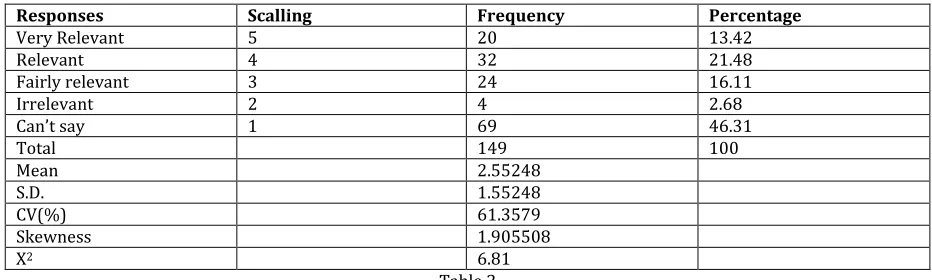
The hypotheses have been tested with the use of relevant statistical tools to arrive at the findings of the study. Skewness has been made good use of to test the formulated hypothesis that whether the response in question is symmetrical or asymmetrical in nature. This will help in determining the opinion of the purported employees on different aspects of the Training and Development programmes of Urban local bodies. The chi-square test has been used to test the statistical significance of responses.
Responses Scalling Frequency Percentage
Very Relevant 5 20 13.42
Relevant 4 32 21.48
Fairly relevant 3 24 16.11
Irrelevant 2 4 2.68
Can’t say 1 69 46.31
Total 149 100
Mean 2.55248
S.D. 1.55248 CV(%) 61.3579
Skewness 1.905508
X2 6.81
Table 2
6
of training programmes. Remaining 46.31 % employee are indifferent about the Relevance of the Training programme, which perhaps indicates that information and Relevance of Training Program has not been rightly explained to the employees. Statistical measures in terms of standard Deviation(1.55248); co-variation(61.3579) and Skewness(1.9055) are also indicating that training programme of Urban Local Bodies is not of much use for the employee to enhance their competence. The calculated value of chi-square is less than the table value at 1% and 5% level of significance, which indicates that null hypothesis should be accepted.
Hence, in order to elevate the performance of Urban Local bodies in terms of higher growth and to make it more competitive sound, comprehensive and logically designed Training programmes are needed.
Responses Scalling Frequency Percentage
Very Relevant 5 13 25.50336
Relevant 4 38 14.09396
Fairly relevant 3 21 8.724832
Irrelevant 2 4 2.684564
Can’t say 1 73 48.99329
Total 149 100
Mean 2.4228
S.D. 1.5024
CV(%) 62.0104
Skewness 2.019677
X2 5.01
Table 3
Analysis of effectiveness of training programme is being given in Table 2. It is observed that only 8.72% respondents of class II, III and IV category have express their satisfaction and responded that training programme is very effective, where as 25.50% employees responded that Training programme is effective, 14.09% respondents indicated that training is fairly effective and 2.68% employees given their negative responses. 48.99% employees are indifferent about the effectiveness of Training programme. It is found that mean score of the responses is higher than the standard Score; Co-variation is indicative that there is considerable variation in the responses of the respondents. Skewness shows that responses are skewed towards the lower grade. Effectiveness of Training programme is being measured with the help of enlisting the responses of employee in table 2. Chi-square is used to test the hypothesis .It is observed from the chi-square value that the null hypothesis should be accepted at 1%level of significance and 5%level of significance. The calculated value (5.01) of chi-square is less than the table value (@5%9.49@1%13.3). From the above, it may be inferred that the training programme of Urban Local Bodies is not suitable designed and tailor made according to the job profile of the employees.
It can further conclude that the pre-training counseling and motivation of employees is not part and parcel of the training programme. As a result employees are not enthusiastic about the training porgramme. It is important that employees should get proper training but it is preponderant that they should well aware about the Relevance and effectiveness of Training programme which will consequently enhance employee efficiency and productivity, then only employee suitable motivated. Knowledge should be tactful, so that he may be able to generate required amount of interest among the employees besides he should possess the art of training employees in a systematic and logical manner. It can be deduced that the job Profile and Training Programme is also not in place. Hence the training programmes of Urban Local Bodeis served no purpose. It failed to deliver the goods. The Urban Local Bodies in future should make an endeavor to frame suitable policy guidelines, conducive and congenial training environment within the organization so that employees can derive more benefits from the Training programme. Training program should be more focused upon the need based learning and it should be cogently matched with the job profile of the employees. Statistical analysis has provide enough evidence that there is an urgent need to enrich and could training programmes according to job specification of the employees.
2. RESULTS:
7
The Hypothesis H2- that Urban Local Bodies is not following any structured training programme for its different categories of employees is also accepted as has been proved through the responses of the purported employees and their analysis. The Urban Local bodies do not set any structured training programs, as has been the consensus among all categories of employees under reference. It is clear that there is little statistical evidence, which support the alternative hypothesis. Most noticeable fact, which is apparent from the overall discussion, is that there is no set structure of training Program available within Urban Local Bodies. Moreover, employees from all categories have had the consensus that training program is not of much use and relevance to their job profile.
2.1 Findings of the study:
ssThe study makes it evident that the training programmes are very rare in the Municipal Local Bodies. Those that have been organized by the urban Local bodies are not well conceived and there is absence of any uniform training policy, which is a major deterrent in the development of human resources in the Urban Local Bodies. The Urban Local Bodies should view training as a process, which will add value to the business by ensuring that best opportunities are provided to maximize the talent of employees to optimize their contribution towards achievement of corporate goals. As the economic progress of an organization is directly proportional to the quantum of technically trained manpower, to put the organization on the fast track to development, Urban Local Bodies abysmally low ration of technical manpower has to rise significantly to fulfill the aspirations of the Urban Local Bodies were not well conceived and objectives were also unclear in the absence of a uniform training policy and training cell/ division. Training programs organized by various organizations for training failed to create an impact due to many reason.
1. Lack of Initiative by Local Management 2. Absence of Training cell/ division.
3. Absence of Training Policy/rules/guidelines.
4. Irrelevant and Outdated training plans and methods. 5. Insufficiency of planning budgets for Training/ programs. 6. Incompetence Trainers.
7. Lack of Trainers Interest
8. Minimum use of communication aids. 9. Inadequate feedback.
The above reasons made training performance fruitless and unsuccessful to quite an extent. However to bring the situation under control, certain measures to be taken for effective implementation of training program.
3. REFERENCES:
1. Administrative Report ( Several Years) : Urban Development Ministry, GOM.
2. Centre for Social Research document (1993)”The Constitution(Seventy-Fourth Amendment) Act 1992”.
3. Sheeba.H(2011)” A Study of Effectiveness of Training and Development Programmes “, South Asian Journal of Tourism and Heritage(2011), Vol.4, No.1 4. India Infrastructure Report (2012)
5. Mehta, Dinesh, “Urban Governance : Lesson from Best Practices in Asia, December 1998.