DEMOGRAPHIC RESEARCH
VOLUME 32, ARTICLE 1, PAGES 1
28
PUBLISHED 6 JANUARY 2015
http://www.demographic-research.org/Volumes/Vol32/1/ DOI: 10.4054/DemRes.2015.32.1
Research Article
Is Buddhism the low fertility religion of Asia?
Vegard Skirbekk
Marcin Stonawski
Setsuya Fukuda
Thomas Spoorenberg
Conrad Hackett
Raya Muttarak
©2015 Vegard Skirbekk et al.
This open-access work is published under the terms of the Creative Commons Attribution NonCommercial License 2.0 Germany, which permits use, reproduction & distribution in any medium for non-commercial purposes, provided the original author(s) and source are given credit.
1 Introduction 2
2 Buddhist religion and childbearing 4
3 Data and methods 7
4 Descriptive overview of Buddhist fertility in Asia 8
5 Case studies of fertility and Buddhism in Mongolia, Thailand, and Japan
9
5.1 Mongolia 10
5.2 Thailand 12
5.3 Japan 15
6 Discussion and conclusions 18
7 Acknowledgements 21
Is Buddhism the low fertility religion of Asia?
Vegard Skirbekk1,2
Setsuya Fukuda3
Conrad Hackett5
Marcin Stonawski2,6,7
Thomas Spoorenberg4
Raya Muttarak2,8
Abstract
BACKGROUND
The influence of religion on demographic behaviors has been extensively studied mainly for Abrahamic religions. Although Buddhism is the world´s fourth largest religion and is dominant in several Asian nations experiencing very low fertility, the impact of Buddhism on childbearing has received comparatively little research attention.
OBJECTIVE
This paper draws upon a variety of data sources in different countries in Asia in order to test our hypothesis that Buddhism is related to low fertility.
METHODS
Religious differentials in terms of period fertility in three nations (India, Cambodia and Nepal) and cohort fertility in three case studies (Mongolia, Thailand and Japan) are analyzed. The analyses are divided into two parts: descriptive and multivariate analyses.
RESULTS
Our results suggest that Buddhist affiliation tends to be negatively or not associated with childbearing outcomes, controlling for education, region of residence, age and marital status. Although the results vary between the highly diverse contextual and
1 Columbia Aging Centre, Columbia University, U.S.A., E-Mail: [email protected]. 2 Wittgenstein Centre (IIASA, VID/ÖAW, WU), International Institute for Applied Systems Analysis,
Austria.
3 Department of Population Dynamics Research, National Institute of Population and Social Security
Research, Japan.
4 Demographic Statistics Section, Statistics Division, Department of Economic and Social Affairs, United
Nations. The views expressed in this paper are those of the author and do not necessarily reflect the views of the United Nations.
5 Pew Research Center, U.S.A.
6 Centre for Economic Demography, Lund University, Sweden. 7
Cracow University of Economics, Poland.
institutional settings investigated, we find evidence that Buddhist affiliation or devotion is not related to elevated fertility across these very different cultural settings.
CONCLUSIONS
Across the highly diverse cultural and developmental contexts under which the different strains of Buddhism dominate, the effect of Buddhism is consistently negatively or insignificantly related to fertility. These findings stand in contrast to studies of Abrahamic religions that tend to identify a positive link between religiosity and fertility.
1. Introduction
A broad range of human behavior is influenced by religion and associated institutions including gender roles, work divisions, family formation, mortality and ageing. Religious differences in demographic behavior in respect to family issues are well documented. The high fertility of Catholic populations and low fertility of Jews in the United States were first documented in the 1960s (Burch 1966; Goldscheider 1967; Zimmer and Goldscheider 1966). More recent research has shown that Catholics have significantly lower rates of divorce than Protestants (Teachman 2002), while conservative Protestants and Mormons are more likely to enter their first marriage earlier than Jews and Catholics (Lehrer 2004). Meanwhile, while there has been significant fertility decline in some Muslim-majority countries e.g., Algeria, Morocco, Tunisia, Libya, Kuwait, Iran, and Oman, (Courbage and Todd 2007; Eberstadt and Shah 2012; Sajoux and Chahoua 2012), fertility rates of the most Muslim-majority countries remain above the world average of 2.4 children (Roudi-Fahimi, May, and Lynch 2013). Moreover, at the individual level, Muslims were generally found to have more children and more likely to want another child than members of other religious groups (Morgan et al. 2002). Such evidence from many societies shows that religion plays a key role in family behavior.
to economic opportunities outside the home leads to female dependency on male family members. The family-oriented value of these faiths may encourage women to bear many children. This shows that the role of religion on childbearing extends beyond explicit teachings on fertility.
In addition to a clear set of rules, religious values can further influence demographic behaviors when religious institutions have mechanisms to communicate their teachings, promote compliance and punish nonconformity (McQuillan 2004). The teachings and practices of a religious denomination that have an impact on fertility frequently differ according to local conditions. A comparative study of the role of religion on fertility behaviors shows that, while Christian denominations in the Netherlands (especially Calvinist and Catholic) effectively enforced norms and doctrinal rules regarding fertility related matters, this was not the case in Taiwan (Schoonheim and Hülsken 2011). Likewise, despite the absence of an explicit prohibition on contraceptive use in the Quran, in countries with nationalist pronatalism such as Afghanistan and Pakistan, birth control has been viewed as a western plot against Islam, serving as a tool to reduce the number of Muslims and diminish their power (Karim 2005; Roudi-Fahimi 2004). Fertility patterns thus are also subject to the political environment as well as the interaction of religious institutions and the state.
Not all religions, however, have implicit or explicit pronatalism or proscriptions on behavior related to the proximate determinants of fertility. While “the religions of the book” such as Judaism, Christianity and Islam have some specific teachings regarding the use of contraception and abortion (McQuillan 2004), there are no such scriptural injunctions or formal codes of conduct on contraception in religions such as Buddhism and Hinduism (Knodel, Chamratrithirong, and Debavalya 1987). Consequently, family planning is left to individual choice due to the lack of a central religious authority, which can offer scriptural interpretation on issues related to childbearing and fertility.
al. 2012). This makes comparisons with Abrahamic religions an interesting point of investigation.
Given the absence of pronatalism and the established influence of religion on demographic behaviors in Buddhism, in this study we examine whether Buddhist followers exhibit lower fertility rates than devotees of other faiths by analyzing patterns of childbearing among Buddhists in various countries of South, East and Southeast Asia. We compare Buddhist and non-Buddhist fertility outcomes, taking into account background characteristics such as educational attainment and religious commitment when data permits.
The rest of the paper is organized as follows. We first discuss Buddhist teaching and practices related to childbearing with the intention of addressing how Buddhist women´s fertility differs from the fertility of women from other religious backgrounds. We then describe the data and methods used for the analysis. The next section presents descriptive comparisons of fertility by religious denominations in three Asian countries: Cambodia, India and Nepal. Subsequently, we present the multivariate results estimating religious difference in fertility controlling for relevant socioeconomic characteristics including age, education, union status and urbanization based on the data from three countries dominated by three different Buddhist traditions: Mongolia, Thailand and Japan. We are able to measure both religious commitment and childbearing in Japan, where degree of devotion is considered as an additional dimension of religious practice.
2. Buddhist religion and childbearing
In the present day, Theravada Buddhism is widely practiced in Cambodia, Laos, Myanmar, Thailand and Sri Lanka. For the latter three countries, Theravada Buddhism was closely associated with a national identity and was established as an official religion several hundred years ago (Gellner 2001). Similarly, Vajrayana Buddhism (also termed Tibetan Buddhism) has a close connection with Tibetan nationalism. Apart from Tibet, Vajrayana Buddhism is also predominant in other Himalayan nations including Nepal, Bhutan and Mongolia. Meanwhile, Mahayana Buddhism (Chinese scripture) is frequently practiced in Japan, China, South Korea and Vietnam. It is considered to be the largest religion in Japan.
Although Buddhism constitutes a variety of scriptures and teachings that are practiced differently among various groups, as we discuss below, several beliefs relevant to family formation and childbearing are largely shared among followers.
Its founder, Siddharta (6th and 5th century BC) chose to abstain from earthly desires in order to attain spiritual enlightenment free from want, ignorance or hatred. In achieving this more peaceful and pure existence he acquired the title Buddha (the enlightened or awakened one). This process led him to go away from his wife (a wealthy princess) and his only child (a son), and thereafter to abstain from further sexual relations and childbearing. Indeed, one of the Buddha‟s core teachings, dukkha (the “Truth of Suffering”), shared among the three Buddhist doctrines, refers to life as generally imperfect and infused with dissatisfaction and discontent (Thathong 2012). Accordingly, many Buddhists perceive that life is suffering, caused by desire and illusions as well as accumulated karmic tendencies. While the Buddhist aim varies according to the school, the general goal is to break the Karmic circle of reincarnations through enlightenment or attaining Nirvana, a liberating state of mind, with no further rebirths (Hosaka and Nagayasu 1993; Gombrich 2006). Note, however, that some see procreation as necessary for those who still have some bad karma to be reincarnated and reduce this debt in their next rebirth (Faure 2003; Learman 2005).
education, possibly since these issues are not related to a „sin‟ component in Buddhism (Falk 1989; Schak 2008).
Not only are there no scriptural injunctions against the use of contraception, but Buddhist doctrine is also not particularly pronatalist. In the case of Thailand, the role of the individual in seeking spiritual liberation in Buddhism coincides with Thai culture, which stresses individualism and freedom of action (Mole 1973:65–68). Given the view that individuals are deemed responsible for their own fate together with the lack of proscriptions on contraceptive practices in Buddhism, family planning could be implemented freely in the interest of couples (Knodel, Chamratrithirong, and Debavalya 1987:169). In contrast, opposition to birth control as an act against God‟s will was repeatedly mentioned in focus-group sessions conducted with southern Muslims in Thailand (Knodel, Chamratrithirong, and Debavalya 1987:164). Likewise, Schoonheim and Hülsken (2011) show that Buddhists in Taiwan were more favorable to family planning than other groups, even if they are traditional on other issues (e.g., being more opposed to religious intermarriage than those from other religious denominations).
With respect to abortion, even though it is not approved on the ground of a violation of the precept against taking life, the practice of abortion is tolerated in Mahayana Buddhist countries like Taiwan, Korea and Japan (Attané and Guilmoto 2007; Keown 1998). It is suggested that Buddhism takes a middle way on abortion, i.e., not treating abortion as an either/or option and in certain Buddhist traditions such as the Japanese there is even a memorial service, mizuko kuyo, for aborted children (Perrett 2000). While abortion may be problematic for Buddhists who believe that human life is sacred, it can be permissible for health or economic hardship related reasons (Sponberg 2005). For instance, in South Korea (which is dominated by Buddhism and Christianity), Buddhists tend to be less opposed to abortion than other religious groups (Kim and Song 2005).
Likewise, marriage and sexuality are often positively viewed among Buddhists; sexuality tends neither to be seen as sinful nor something to be justified only by reproduction (Sponberg 2005). However, sexual activities, representing human desire, can cause a reinforcement of unenlightened tendencies (Suwanbubbha 2003). Devotees often stress the “middle way”, where too little or too much procreation should be avoided since it could lead to poverty and distress (Gross 1995; Kabilsingh 1998). A common belief among Buddhists is that they should focus on spreading the joy of enlightenment to others, while transmitting their genes to subsequent generations or extending their family lineage is less important (Childs et al. 2005; Gross 1995).
should avoid family planning and birth control. But then if we look from the global level, that precious human life is now overcrowding the world. As a result not only is it a question of survival of a single human being but that of the entire humanity. Therefore, the conclusion is that family planning is necessary provided that it is based on non-violent principles” (TWA 1995:36).
In sum, Buddhism does not have unequivocal pronatal teachings; its leaders tend to discuss the benefits as well as the individual and collective costs of childbearing (Stacey 2011). Buddhist teaching does not appear to have a clear mandate compelling followers to have many children as do Mormon or Catholic faiths, which embody strong pronatalist ideologies. In this sense, fertility behaviors of a Buddhist person might not differ substantially from those of individuals with no religious affiliation, whose fertility has commonly been found to be the lowest across religious groups (Frejka and Westoff 2008). Given the literature on Buddhism and childbearing discussed above, we hypothesize that within a country, a Buddhist devotee has a lower number of children than other religious denominations and a similar level of fertility to unaffiliated individuals.
3. Data and methods
The Asia-Pacific region was home to 481 million Buddhists in 2010, 98.7% of the world‟s Buddhist population (Hackett et al. 2012). Hence, we focus on exploring fertility patterns of Buddhists in Asian countries where there are a sufficient number of Buddhist followers and members of other religions for comparison. In doing so, this paper draws upon a variety of data sources in different countries in order to test our hypothesis that Buddhism is related to low fertility. The analyses are divided into two parts: descriptive and multivariate analyses. The descriptive part is based on the Demographic and Health Surveys (DHS) for the years 2005 in Cambodia, 2006 in Nepal and 2005–06 in India. The Total Fertility Rates (TFR) are calculated for the sample of women aged 15−49 years by religious denomination.
in which the data are collected. Poisson regression is chosen as an estimation method because the outcome (the number of children ever born) is a count variable, which is heavily skewed with a long right tail. Since the outcome variable is not normally distributed, using ordinary least squares would lead to inefficient, inconsistent and biased estimates.
4. Descriptive overview of Buddhist fertility in Asia
First, we provide the comparison of fertility differentials in three Asian countries (India, Cambodia and Nepal) with significant Buddhist populations based on the DHS data as presented in Table 1. The estimated TFRs (Total Fertility Rates) are based on births that have been reported for the 36 months preceding the survey among women aged 15–49 years. Note that “no religion” was not a response option in the questionnaires used in these countries (except in India, where this answer is grouped together with “other”). We present data on total fertility rate by religion. We also include information on three other potentially relevant dimensions associated childbearing: average years of education, average age at entering first union and percentages of never-married women.
In India, Buddhists have a TFR of 2.25 [95% CI = 2.03–2.46] children per women (c/w), which lies below the national average of 2.68 [95% CI = 2.65–2.71] c/w, the Hindu majority of 2.59 [95% CI = 2.56–2.62] c/w and Muslims with 3.40 [95% CI = 3.3–3.5] c/w. In Cambodia, the Buddhist majority (94% population share) has a TFR of 3.40 [95% CI = 3.3–3.5], which is similar to the national average and higher than the fertility of Christians and Muslims (who account for approximately 3% of the population) although lower than those with other religions (3% population share). In Nepal, Buddhist, Christian and Hindu women have lower fertility than Muslims whose TFR is as high as 4.60 [95% CI = 3.79–5.41].
of Buddhists compared to Muslims, other familial behaviors such as the percentage of never married could also be driven by the absence of pro-natalist values in Buddhism.
In sum, the data from these three Asian countries suggest that Buddhists have lower or similar fertility compared to the country-level average, which gives some support to our hypothesis.
Table 1: TFR by religion in Asia
Country Religion TFR
(15–49) 95% Confidence Interval Cases (15–49) Average years of education (25–49)
Age of first marriage among ever married Percent of never married Source India
All 2.68 [2.65 ; 2.71] 124,385 4.2 17.1 20.5
DHS 2005-6 Buddhist 2.25 [2.03 ; 2.46] 1,617 4.6 16.8 24.3
Christian 2.34 [2.25 ; 2.44] 10,977 7.1 19.7 27.6 Hindu 2.59 [2.56 ; 2.62] 89,957 4.2 17.1 19.6 Muslim 3.4 [3.3 ; 3.5] 16,742 3.1 16.7 23.2 Other Religions 1.89 [1.76 ; 2.04] 3,007 7.0 19.3 26.4 Other− With None Option 4.18 [3.68 ; 4.68] 1,032 1.7 17.5 21.7
Cambodia
All 3.4 [3.3 ; 3.5] 16,823 3.4 19.5 31.8
DHS 2005 Buddhist 3.4 [3.3 ; 3.5] 15,840 3.5 19.6 31.8 Christian 2.0 [1.03 ; 2.97] 93 5.1 19.4 48.8 Muslim 3.0 [2.24 ; 3.71] 315 1.7 18 31.7 Other− No None Option 5.7 [5.02 ; 6.44] 557 0.2 17.2 18.1
Nepal
All 3.13 [3.02 ; 3.24] 10,793 1.9 16.9 19.9
DHS 2006 Buddhist 2.74 [2.36 ; 3.12] 821 1.8 18.0 24.8 Christian 2.31 [1.24 ; 3.4]0 101 2.1 17.6 27.8 Hindu 3.13 [3.01 ; 3.24] 9,348 1.9 16.8 19.5 Muslim 4.6 [3.79 ; 5.41] 330 0.9 15.8 10.8 Other Religions 3.22 [2.35 ; 4.09] 192 2.8 19.3 27.3
Source: Own calculations based on [DHS 2013].
5. Case studies of fertility and Buddhism in Mongolia, Thailand, and
Japan
Next, we investigate the relationship between Buddhism and fertility in greater depth in Mongolia, Thailand and Japan. The analyses are based on a Poisson regression taking into account the effects of education, region of residence and other covariates that can determine fertility. When possible, religiosity measures are also included. The three countries were chosen due to the diversity in the schools of Buddhism practices, the majority/minority status of Buddhist members and the levels of economic development. The majority of Mongolians follow Tibetan Buddhism while Therevada Buddhism is widely practiced in Thailand. As for Japan, Mahayana Buddhism is the largest religion.
only 36.2% in Japan (Hackett et al. 2012). Meanwhile, while slightly over half of Mongolians are Buddhist, the proportion of those without religious affiliation comprises a little over one-third of the total population (Hackett et al. 2012). The majority/minority positions of Buddhists in each society may contribute to fertility disparities of Buddhists in the three countries.
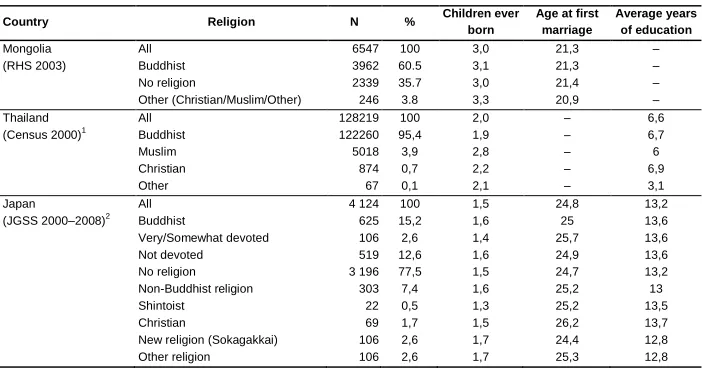
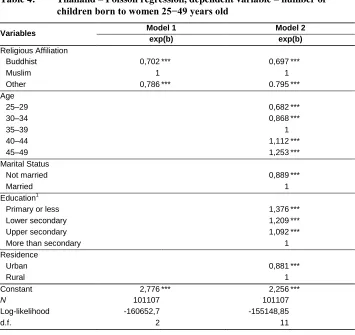
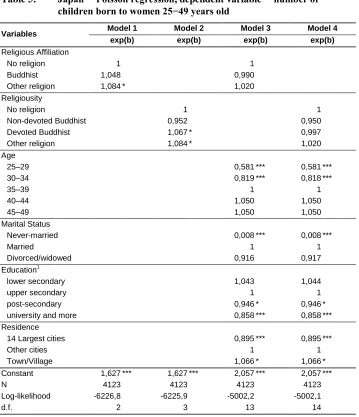
Likewise, these case studies represent Buddhism across very different economic development levels in 2010: Mongolia is a relatively poor country with a GDP per head of 2,227 USD; Thailand has an intermediate economic development level with a GDP per head of 9,187 USD; while Japan is one of the richest countries in the world with a GDP per head of 45,774 USD (IMF 2011). Some studies find that as a country becomes modernized with the modern state taking over religious institutions in providing basic services such as education, health care and housing, the importance of religion in social life declines (McCleary and Barro 2006; Norris and Inglehart 2004). This implies that the influence of religion on fertility may be minimal in Japan as compared to Thailand and Mongolia. Descriptive statistics on religious distributions, children ever born, age at first marriage and average years of education is provided in Table 2. Tables 3, 4 and 5 present the results from Poisson regression estimates of the number of children ever born in Mongolia, Thailand and Japan respectively. For Mongolia and Japan, “no religion” is used as a base category while for Thailand, “other religion” is used. Next, we discuss the statistical results for each country.
5.1 Mongolia
The Mongolian Census (National Statistical Office of Mongolia 2010) revealed that Buddhists constitute 56% of the population, while 36% are unaffiliated. Mongolia has experienced a very rapid decline in fertility in recent decades (Spoorenberg 2009), from a TFR of above 7.5 children per woman in 1970–1975 to a TFR of 2.08 in 2000–2005 and again an increase to a TFR of 2.37 in the 2005–2010 period (UNPD 2013). According to the latest census conducted in November 2010, the country counts 2.65 million inhabitants (National Statistical Office of Mongolia 2010).
could potentially behave differently from a reproductive point of view and bear more children in order to strengthen their position in Mongolian society (according to the minority status hypothesis) (Goldscheider 1971).
Table 2 reveals that Buddhists have slightly higher fertility than those with no religion, but lower fertility than those with other religions. Table 3 shows that after controlling for marital status, education, age, and residence in Model 2, those with Other religion have a significantly higher number of children than those with no religious affiliation. However, ceteris paribus, Buddhist women in Mongolia have similar fertility levels to non-religious women while exhibiting lower fertility than other religious groups.
Table 2: Descriptive Statistics for women age 25−49
Country Religion N % Children ever
born
Age at first marriage
Average years of education
Mongolia All 6547 100 3,0 21,3 –
(RHS 2003) Buddhist 3962 60.5 3,1 21,3 –
No religion 2339 35.7 3,0 21,4 –
Other (Christian/Muslim/Other) 246 3.8 3,3 20,9 –
Thailand All 128219 100 2,0 – 6,6
(Census 2000)1
Buddhist 122260 95,4 1,9 – 6,7
Muslim 5018 3,9 2,8 – 6
Christian 874 0,7 2,2 – 6,9
Other 67 0,1 2,1 – 3,1
Japan All 4 124 100 1,5 24,8 13,2
(JGSS 2000–2008)2
Buddhist 625 15,2 1,6 25 13,6
Very/Somewhat devoted 106 2,6 1,4 25,7 13,6
Not devoted 519 12,6 1,6 24,9 13,6
No religion 3 196 77,5 1,5 24,7 13,2
Non-Buddhist religion 303 7,4 1,6 25,2 13
Shintoist 22 0,5 1,3 25,2 13,5
Christian 69 1,7 1,5 26,2 13,7
New religion (Sokagakkai) 106 2,6 1,7 24,4 12,8
Other religion 106 2,6 1,7 25,3 12,8
Notes: 1
The 2000 Population and Housing Census of Thailand, Minnesota Population Center. Integrated Public Use Microdata Series, International [Machine-readable database]. Minneapolis: University of Minnesota, 2012.
2
Table 3: Mongolia – Poisson regression, dependent variable – number of children born to women 25−49 years old
Variables Model 1 Model 2
exp(b) exp(b)
Religious Affiliation
Buddhist 1,040 ** 1,003
Other religion 1,122 *** 1,097 ***
No Religion 1 1
Age
25–29 0,484 ***
30–34 0,746 ***
35–39 1
40–44 1,213 ***
45–49 1,488 ***
Marital status
Not married 0,745 ***
Married 1
Education
Primary or less 1,409 ***
Incomplete secondary 1,312 ***
Complete secondary 1,119 ***
More than secondary 1
Residence
Urban 0,822 ***
Rural 1
Constant 2,959 *** 2,526 ***
N 6547 6547
Log-likelihood -12995,3 -11267,6
d.f. 2 11
Note: * p<.1; ** p<.05; *** p<.01.
Source: 2003 Reproductive Health Surveys, National Statistical Office of Mongolia, UNFPA, and Ministry of Health (2004).
5.2 Thailand
planning policies implemented in 1971 as evident in contraceptive prevalence among married women of reproductive age, which had exceeded 70% by the 1990s (Knodel et al. 1999; NSO 1997; Nepomuceno 1991).
Even before the family planning campaign in the 1970s, the Buddhist majority had lower fertility rates than the Muslim minority (both Thai and particularly Malay speakers). A relatively common view during the 1960s among Muslims in southern Thailand was that family planning and contraception was a sin, and they should accept the number of children given to them (Knodel et al. 1999; Ling 1969). Traditional interpretations of Islam in the Malay-speaking areas of southern Thailand and neighboring Kelantan in Malaysia led to lowered contraceptive use (Leete 1996; Leete and Tan Boon 1993). For instance, data from DHS 1987 (when religion was recorded) show that the overall TFR was 3.57: Buddhists had a TFR of 3.43, while Muslims had a TFR of 5.29.
Trends in fertility for the largest religions in Thailand are presented in Figure 1. Buddhist women in Thailand tend to reduce their fertility from an earlier point in time and have lower fertility than Muslim or Christian women. However, we note that these religious groups also experienced a decline in fertility over time but at a slower rate than the national average.
Figure 1: Own-children estimates of fertility (3-year period) by religion, Thailand, 1976–2006
Sources: Our own calculations based on the 1990 and 2000 censuses in Thailand [Minnesota Population Center 2013] and 2005-06
MICS microdata.
0.0 0.5 1.0 1.5 2.0 2.5 3.0 3.5 4.0 4.5 5.0
1975 1980 1985 1990 1995 2000 2005 2010
C
h
ild
re
n
p
e
r
w
o
m
a
n
Buddhist - 2005-06 MICS Buddhist - 2000 Census
Buddhist - 1990 Census Muslim - 2005-06 MICS
Muslim - 2000 Census Muslim - 1990 Census
Christian - 2000 Census Christian - 1990 Census
Buddhist Muslim
Table 4: Thailand – Poisson regression, dependent variable – number of children born to women 25−49 years old
Variables Model 1 Model 2
exp(b) exp(b)
Religious Affiliation
Buddhist 0,702 *** 0,697 ***
Muslim 1 1
Other 0,786 *** 0.795 ***
Age 25–29 0,682 *** 30–34 0,868 *** 35–39 1 40–44 1,112 *** 45–49 1,253 *** Marital Status Not married 0,889 *** Married 1 Education1
Primary or less
1,376 *** Lower secondary 1,209 *** Upper secondary 1,092 *** More than secondary
1 Residence Urban 0,881 *** Rural 1
Constant 2,776 *** 2,256 ***
N 101107 101107
Log-likelihood -160652,7 -155148,85
d.f. 2 11
Note: * p<.1; ** p<.05; *** p<.01.
Source: Our own calculations based on the 2000 census in Thailand [Minnesota Population Center 2013].
5.3 Japan
predominance of non-affiliated individuals and Buddhist populations might, to a certain extent, contribute to low fertility in Japan.
Using the pooled Japanese General Social Surveys (JGSS), repeated cross-sectional social surveys for the years 2000−2008, we examine both the role of religious affiliation (which we also consider for Mongolia and Thailand) and a measure of religiosity for Buddhists. Respondents who answered that they follow a religion were further asked to identify how devoted they are to their religion given three possible answers: very devoted, devoted to a certain degree, and not very devoted. This question is used as a measurement of the degree of religiosity classified into devoted (“very devoted” and “devoted to a certain degree”) and non-devoted (“not very devoted”) groups. This allows us to investigate whether there is any difference between religious and less religious Buddhist followers.
Table 5: Japan ─ Poisson regression, dependent variable ─ number of children born to women 25−49 years old
Variables Model 1 Model 2 Model 3 Model 4
exp(b) exp(b) exp(b) exp(b)
Religious Affiliation
No religion 1
1
Buddhist 1,048
0,990
Other religion 1,084 * 1,020
Religiousity No religion 1 1 Non-devoted Buddhist 0,952 0,950 Devoted Buddhist 1,067 * 0,997 Other religion 1,084 * 1,020 Age 25–29
0,581 *** 0,581 ***
30–34
0,819 *** 0,818 ***
35–39
1 1
40–44
1,050 1,050
45–49
1,050 1,050
Marital Status
Never-married
0,008 *** 0,008 ***
Married
1 1
Divorced/widowed
0,916 0,917
Education1
lower secondary
1,043 1,044
upper secondary
1 1
post-secondary
0,946 * 0,946 *
university and more
0,858 *** 0,858 ***
Residence
14 Largest cities
0,895 *** 0,895 ***
Other cities
1 1
Town/Village
1,066 * 1,066 *
Constant 1,627 *** 1,627 *** 2,057 *** 2,057 ***
N 4123 4123 4123 4123
Log-likelihood -6226,8 -6225,9 -5002,2 -5002,1
d.f. 2 3 13 14
Notes: * p<.1; ** p<.05; *** p<.01.
1
Education is attended base. Educational levels under the Pre-WWII school system are converted to the current school system The levels of education correspond in the following; Lower secondary: junior high school. Upper secondary: high school. Post-secondary: vocational school/junior college. University and more: university and graduate school.
6. Discussion and conclusions
Our results suggest that Buddhist affiliation tends to be negatively or not associated with childbearing outcomes, controlling for observable socio-economic characteristics including education, residence, age and marital status. In spite of the highly diverse contexts under which the different types of Buddhism dominate, we do not have an example of Buddhist fertility being significantly higher than that of other religions except for Cambodia. Although the results vary between the highly diverse contextual and institutional settings we investigate, we find evidence that Buddhist affiliation or devotion is not generally related to elevated fertility across these very different cultural settings.
Generally, previous studies have found that those who have a religion tend to have higher fertility than the religiously unaffiliated. However, in the two countries in our study that have significant unaffiliated populations (Mongolia and Japan), Buddhist fertility is not higher than the fertility of the unaffiliated. The recent study of religious differences in fertility behaviour in Japan, Korea and Singapore reported a similar finding of no particular effect of being a Buddhist on the actual number of children (Kojima 2014). Furthermore, our results are also in contrast to earlier findings showing that greater religiosity is related to higher fertility. We found that more devout Buddhists in Japan do not appear to have higher fertility than less devout Buddhists. In models that control for demographic characteristics, these findings support our hypothesis that having a Buddhist religious faith does not lead to greater fertility.
The three countries under analysis differ not only in the religious strain of Buddhism, but also in the population shares that declare Buddhism as their religion. More than 93 % of the population in Thailand stated to be of Buddhist affiliation as compared to 55% in Mongolia and only 36% in Japan (Hackett et al. 2012). Whether one‟s religion has a minority status or not may potentially affect childbearing outcomes. Indeed, the higher levels of Muslim fertility in Thailand are consistent with the minority status hypothesis which postulates that the insecurities of minority group membership may increase fertility when a group prefers separation from the larger society and are committed to pronatalist norms (Knodel et al. 1999). On the other hand, despite having a minority status, the absence of pronatalist ideology in Buddhism in general does not influence the reproductive behaviors of Buddhist devotees in Japan.
and Finke 2000). Similarly, Muslims in Thailand perceive contraception as a sin and consider it is a duty to accept the number of children Allah gives (Knodel et al. 1999).
In contrast, Buddhism lacks unequivocal pronatal teachings and generally tends to provide little opposition to most forms of contraception. We find that Buddhist teachings do not require followers to have high fertility levels and are more ambivalent regarding procreation, contraception and abortion than the Abrahamic religions. Further, the fact that Buddhist practice often lack rigid formalities and concepts of taboo (Keown 2005) can help explain the absence of religious obligation on family formation and childbearing.
Buddhist religion and religious practice may represent a spiritual alternative to family formation rather than a precursor (Schak 2008). Hence, each religious group may change in response to socioeconomic development at a different pace, according to the interaction hypothesis proposed by Chamie (1981). For instance, in the case of Thailand, although family planning policies implemented in the 1970s contributed to overall fertility decline, the adoption of such programs was much slower among the Muslim community (Knodel et al. 1999).
Although a religious denomination may have teachings related to demographic behaviors, several factors are necessary for religion to influence fertility, such as means of communication, enforcement of compliance as well as a high degree of attachment within the religious community (McQuillan 2004). Along similar lines, the way Buddhism is practiced in the three countries studied may result in different levels of the influence of religion on childbearing. Our results suggest that the largest fertility difference between Buddhist followers and members of other religions is in Thailand. One explanation for smaller religious differences in Mongolia and Japan is possibly because the two countries are relatively more secularized than Thailand. The repression of religious practices under the communist regime in Mongolia until 1991 and modernization as well as the explicit separation between the state and religion in the Japanese constitution after World War II contribute to lower religiosity in the two countries. Thus, apart from the higher number of non-affiliated individuals in Japan and Mongolia compared to Thailand, members of religious groups may also be less religious. Fertility differentials by religion in the former two countries therefore are not as evident as in Thailand.
affiliation is contingent on individual practice. On the other hand, being a Muslim or Christian in Thailand requires more devotion as a means to distinguish oneself from the majority Buddhists, as reflected in the 2005−2008 World Values Survey and East-Asian Barometer, which shows that Muslims and Christians in Thailand consider themselves to be more religious and attend religious services more regularly than do Buddhists. Likewise, the practice of voluntary veiling among Muslim women is also a powerful symbol of identity and commitment to Islamic values (Marddent 2013). The greater devotion interacting with pronatalist ideology in Islam and Christianity thus have led to higher fertility among Muslims and Christians in Thailand.
Despite differences in the schools of Buddhism and the level of socioeconomic development and secularization, empirical results from the three countries under examination consistently show that Buddhists have slightly lower or insignificantly different fertility than other religions and are on par with those having no religious affiliation. While Buddhism is concentrated in Asian countries, there are a growing number of adherents in different parts of the world (including in western countries) partly due to migration and conversion (Baumann 1995). There is indeed some evidence suggesting that Buddhist fertility is relatively low outside of the Asian context. For instance, in Australia, adjusting for education and income, 40−44 year old Buddhist women have the lowest number of children ever born of any religious group, approximately half a child lower than the Christian majority (who have about 2.1 children) – and even 0.2 children less than those without religion (Australian Bureau of Statistics 2006). Similarly, the 2000 Swiss Census reports that the birth rate per woman is only 1.42 for Buddhists, slightly lower than the Swiss average of 1.43 (Blume 2009). Given below replacement level fertility in most European countries, Buddhism may have less influence on fertility behavior than in the Asian countries presented in this paper. This further raises an interesting question – would an increase in the adoption of Buddhist doctrine result in lower fertility and in which context?
7. Acknowledgements
References
Adhikari, R. (2010). Demographic, socio-economic, and cultural factors affecting fertility differentials in Nepal. BMC Pregnancy and Childbirth 10(1): 1–19.
doi:10.1186/1471-2393-10-19.
Attané, I. and Guilmoto, C. (2007). Watering the neighbour’s garden. Paris: Committee for International Cooperation in National Research in Demography.
Australian Bureau of Statistics (2006). Census of Population and Housing.
Baumann, M. (1995). Creating a European path to Nirvâna: Historical and contemporary developments of Buddhism in Europe. Journal of Contemporary Religion 10(1): 55–70. doi:10.1080/13537909508580726.
Blume, M. (2009). The reproductive benefits of religious affiliation. In: Voland, E. and Schiefenhövel, W. (eds.). The biological evolution of religious mind and behavior, the frontiers collection. Berlin/Heidelberg: Springer: 117–126.
doi:10.1007/978-3-642-00128-4_8.
Brown, G.K. (2008). Horizontal Inequalities and Separatism in Southeast Asia: A Comparative Perspective. In: Stewart, F. (ed.). Horizontal Inequalities and Conflict: Understanding Group Violence in Multiethnic Societies. Basingstoke: Palgrave: 252–284.
Burch, T.K. (1966). The fertility of North American Catholics: A comparative overview. Demography 3(1): 174–187. doi:10.2307/2060070.
Chamie, J. (1981). Religion and fertility: Arab Christian-Muslim differentials. Cambridge/New York: Cambridge University Press.
Childs, G., Goldstein, M.C., Jiao, B., and Beall, C.M. (2005). Tibetan fertility transitions. Population and Development Review 31(2): 337–349. doi:10.1111/j. 1728-4457.2005.00068.x.
Courbage, Y. and Todd, E. (2007). Le Rendez-vous des civilisations. Paris: Seuil/La République des Idées.
Demographic and Health Surveys (2013). Demographic and Health Surveys [Cambodia 2005, India 2005–6, Nepal 2006]. Rockville, MD: ICF International.
Falk, N.A. (1989). The Case of the Vanishing Nuns: The Fruits of Ambivalence in Ancient Indian Buddhism. In: Falk, N.A. and Gross, R.M. (eds.). Unspoken words: Women and religious lives. Belmont, CA: Wadsworth: 208–216.
Faure, B. (2003). The power of denial: Buddhism, purity, and gender. Princeton/Oxford: Princeton University Press.
Frejka, T. and Westoff, C.F. (2008). Religion, religiousness and fertility in the US and in Europe. Eur. J. Popul. Rev. Eur. Démographie 24(1): 5–31. doi:10.1007/s106 80-007-9121-y.
Gellner, D.N. (2001). Buddhism. In: Smelser, N.J. and Baltes, P.B. (ed.). International encyclopedia of the social & behavioral sciences. Oxford: Pergamon: 1378– 1386. doi:10.1016/B0-08-043076-7/04041-9.
Goldscheider, C. (1967). Fertility of the Jews. Demography 4(1): 196–209. doi:10.230 7/2060361.
Goldscheider, C. (1971). Population, modernization, and social structure. Boston: Little, Brown & Co.
Gombrich, R.F. (2006). Theravada Buddhism. A social history from ancient Benares to modern Colombo. New York: Routledge.
Gross, R.M. (1995). Buddhist resources for issues of population, consumption, and the environment. In: Coward, H. (ed.). Population, consumption and the environment. Religious and secular responses. Albany: State University of New York Press: 155–172.
Hackett, C., Grim, B., Stonawski, M., Skirbekk V., Potančoková, M., and Abel, G. (2012). The Global Religious Landscape. A Report on the Size and Distribution of the World’s Major Religious Groups as of 2010. Washington D.C.: Pew Research Center.
Hosaka, S. and Nagayasu, Y. (1993). Buddhism and Japanese economic ethics. In: Minus, P.M. (ed.) The Ethics of Business in a global economy. Dordrecht: Springer: 99–103. doi:10.1007/978-94-015-8165-3_9.
IMF (2011). Nominal GDP per capita. Washington D.C.: International Monetary Fund. Inoguchi, T. et al. (2006). AsiaBarometer Survey Data [computer file]. AsiaBarometer
Project. [http://www.asiabarometer.org/].
Johnson, T.M. and Ross, K.R. (2009). Atlas of Global Christianity 1910–2010. Edinburgh: Edinburgh University Press.
Jones, G., Straughan, P.T., and Chan, A. (2009). Ultra-low fertility in Pacific Asia. New York: Routledge.
Kabilsingh, C. (1998). Women in Buddhism: Questions and answers. Bangkok: Buddha Dharma Education Association Inc.
Karim, M. (2005). Islamic teachings on reproductive health. In: Jones, G. and Karim, M. (eds.). Islam, the state and population. London: Hurst and Co.: 40–55. Kelley, J. and De Graaf, N.D. (1997). National context, parental socialization, and
religious belief: Result from 15 nations. American Sociological Review 62(4): 639–659. doi:10.2307/2657431
Keown, D. (1998). Buddhism and abortion. Honolulu, HI: University of Hawaii Press. Keown, D. (2005). End of life: The Buddhist view. The Lancet 366(9489): 952–955.
doi:10.1016/S0140-6736(05)67323-0.
Kim, D. and Song, Y. (2005). Does religion matter? A study of regional variations in sex ratio at birth in Korea. Paper presented at the CEPED-CICRED-INED conference on Female Deficit in Asia: Trends and Perspectives, Singapore, December 5–7, 2005 http://www.cicred.org/Eng/Seminars/Details/Seminars/FD A/PAPERS/23_KIM.PDF.
Knodel, J.E., Chamratrithirong, A., and Debavalya, N. (1987). Thailand’s reproductive revolution: Rapid fertility decline in a third-world setting. Madison, WI: University of Wisconsin Press.
Knodel, J.E., Gray, R.S., Sriwatcharin, P., and Peracca, S. (1999). Religion and reproduction: Muslims in Buddhist Thailand. Population Studies 53(2): 149– 164. doi:10.1080/00324720308083.
Kojima, H. (2014). The effects of religion on fertility-related attitudes and behavior in Japan, South Korea and Singapore. Waseda Studies in Social Sciences 15(1): 1– 26.
Learman, L. (2005). Modernity, marriage, and religion: Buddhist Marriages in Taiwan. [Ph.D. Thesis]. Boston, MA: Graduate School of Arts and Sciences, Boston University.
Leete, R. and Tan Boon, A. (1993). Contrasting fertility trends among ethnic groups in Malaysia. In: Leete, R. and Alam, I. (eds.). The revolution in Asian fertility: Dimensions, Causes, and Implications. Oxford: Clarendon Press: 128–147. Lehrer, E.L. (1996). Religion as a determinant of marital fertility. Journal of Population
Economics 9(2): 173–196. doi:10.1007/s001480050013.
Lehrer, E.L. (2004). Religion as a determinant of economic and demographic behavior in the United States. Population and Development Review 30(4): 707–726. doi: 10.1111/j.1728-4457.2004.00038.x.
Ling, T.O. (1969). Buddhist factors in population growth and control: A survey based on Thailand and Ceylon. Population Studies 23(1): 53–60.
Marddent, A. (2013). Religious piety and Muslim women in Thailand. In: Schröter, S. (ed.). Gender and Islam in Southeast Asia: Women’s Rights Movements, Religious Resurgence and Local Traditions. Leiden: Brill: 241–265. doi:10.1163 /9789004242920_013.
McCleary, R.M. and Barro, R.J. (2006). Religion and political economy in an international panel. Journal for the Scientific Study of Religion 45(2): 149–175.
doi:10.1111/j.1468-5906.2006.00299.x.
McQuillan, K. (2004). When does religion influence fertility? Population and Development Review 30(1): 25–56. doi:10.1111/j.1728-4457.2004.00002.x. Minnesota Population Center (2013). Integrated Public Use Microdata Series,
International. [Machine-readable database]. Version 6.1. Minneapolis, MN: University of Minnesota.
Mole, R.L. (1973). Thai Values and Behavior Patterns. Rutland: C.E. Tuttle Co. Morgan, S.P., Stash, S., Smith, H.L., and Mason, K.O. (2002). Muslim and non-Muslim
differences in female autonomy and fertility: Evidence from four Asian countries. Population and Development Review 28(3): 515–537. doi:10.1111/j.1 728-4457.2002.00515.x.
National Statistical Office (NSO) (1997). Social Indicators. Bangkok: National Statistical Office.
National Statistical Office of Mongolia, UNFPA, and Ministry of Health (2004). Mongolia. Reproductive Health Survey 2003. National Report. Ulaanbaatar: NSO.
Nepomuceno T. (1991). The “anatomy” of Thailand‟s successful family planning program. IMCH Newsletter 18(189): 1.
Norris, P. and Inglehart, R. (2004). Sacred and Secular: Religion and Politics Worldwide. Cambridge: Cambridge University Press. doi:10.1017/CBO9780511 791017.
Perrett, R.W. (2000). Buddhism, abortion and the middle way. Asian Philosophy 10(2): 101–114. doi:10.1080/713650898.
Pew Forum on Religion and Public Life (2007). Muslim Americans: Middle class and mostly mainstream. Washington, D.C.: Pew Forum on Religion & Public Life and the Pew Research Center for the People & the Press.
Philipov, D. and Berghammer, C. (2007). Religion and fertility ideals, intentions and behaviour: A comparative study of European countries. Vienna Yearbook of Population Research 2007: 271–305. doi:10.1553/populationyearbook2007s271. Roudi-Fahimi, F. (2004). Islam and family planning. Washington, D.C.: Population
Reference Bureau.
Roudi-Fahimi, F., May, J.F., and Lynch, A.C. (2013). Demographic trends in Muslim countries. Washington, D.C.: Population Reference Bureau.
Sajoux, M. and Chahoua, S. (2012). Transition de la fécondité et développement au Maroc. Un lien complexe et spatialement différencié. Les Cahiers d’EMAM: 33– 62.
Schak, D.C. (2008). Gender and Buddhism in Taiwan. Hsuan Chuang Journal of Buddhist Studies 9: 145–174.
Schoonheim, M. and Hülsken, M. (2011). Religion and fertility at the extremes: The Netherlands and Taiwan, 1950–1985. The History of the Family 16(3): 267–277.
doi:10.1016/j.hisfam.2011.01.001.
Skirbekk, V., Kaufmann, E., and Goujon, A. (2010). Secularism, fundamentalism, or Catholicism? The religious composition of the United States to 2043. Journal for the Scientific Study of Religion 49(2): 293–310. doi:10.1111/j.1468-5906.201 0.01510.x.
Sponberg, A. (2005). Buddhism. In: Manning, C. and Zuckerman P. (eds.). Sex and religion. Toronto: Thomson Wadsworth: 41–59.
Spoorenberg, T. (2009). The impact of the political and economic transition on fertility and family formation in Mongolia. Asian Population Studies 5(2): 127–151.
doi:10.1080/17441730902992067.
Stacey, D. (2011). What Do Religions Say About Birth Control and Family Planning? About.com, July 18, 2011, http://contraception.about.com/od/additionalresource s/ss/religion.htm.
Stark, R. and Finke, R. (2000). Acts of faith: Explaining the human side of religion. Berkely, CA: University of California Press.
Suwanbubbha, P. (2003). The right to family planning, contraception and abortion in Thai Buddhism. In: Maguire, D.C. (ed.). Sacred rights: The case for contraception and abortion in world religions. New York: Oxford University Press: 145–165. doi:10.1093/acprof:oso/9780195160017.003.0007.
Tanioka, I., Maeda, Y., and Iwai, N. (2010). Japanese General Social Survey (JGSS), ICPSR34623-v1. Ann Arbor, MI: Inter-university Consortium for Political and Social Research.
Teachman, J.D. (2002). Stability across cohorts in divorce risk factors. Demography 39(2): 331–351. doi:10.1353/dem.2002.0019.
Thailand Census (2000). The 2000 Population and Housing Census. Bangkok: National Statistical Office in Thailand.
Thathong, K. (2012). A Spiritual Dimension and Environmental Education: Buddhism and Environmental Crisis. Paper presented at the 4th World Conference on Educational Sciences (WCES-2012), Barcelona, Spain, February 2–5 2012. TWA (Tibetan Women‟s Voice) (1995). An Interview with His Holiness the Dalai
Lama: July 20, 1995, private office Dharamsala. Dolma: The Voice of Tibetan Women:34–38.
Westoff, C.F. and Frejka, T. (2007). Religiousness and fertility among European Muslims. Population and Development Review 33(4): 785–809. doi:10.1111/j.17 28-4457.2007.00197.x.