in the population sciences published by the Max Planck Institute for Demographic Research Doberaner Strasse 114 · D-18057 Rostock · GERMANY www.demographic-research.org
DEMOGRAPHIC RESEARCH
VOLUME 4, ARTICLE 5, PAGES 133-162
PUBLISHED 8 MAY 2001
www.demographic-research.org/Volumes/Vol4/5/
DOI: 10.4054/DemRes.2001.4.5
The banquet of Aeolus:
A familistic interpretation of Italy's
lowest low fertility
Gianpiero Dalla Zuanna
1. Introduction 134
2. The familistic Italian way of life 138
3. Familism as an obstacle to leaving the parental home
144
4. From the late departure of the parental home to low fertility
147
5. Familism as the lubricating factor in the couples’ lowest low fertility
149
6. Final remarks 155
The banquet of Aeolus:
A familistic interpretation of Italy's lowest low fertility
1Gianpiero Dalla Zuanna 2
Abstract
During the last fifteen years in the Western countries, the higher is the proportion of people aged 20-30 living in the parental home, the lower is fertility. In this paper I suggest that the familistic structure of family and society can help in understanding both these demographic behaviours, looking at the Italian case. Nevertheless, these patterns could hold in the strong-family area as a whole, i.e. the Mediterranean Europe.
The familism refers to some social norms managing the relationships among members and generations within the nuclear family and kinship. Direct and indirect connections between familistic norms and marital and reproductive behaviour are described, using data from several sources for Italy during the new demographic transition. Finally, I argue that the triumph of the familistic society could be a pyrrhic victory, because the native Italian population risks being unable to reproduce itself.
1
A preliminary version of this paper was presented at the 2nd workshop on Lowest Low Fertility, held at the Max Planck Institute, Rostock, Germany in December 1999. I wish to thank all the participants for their suggestions and I also take the opportunity of thanking Maria Castiglioni, Paolo De Sandre, Massimo Livi Bacci, Letizia Mencarini and the four anonymous referees of Demographic Research for their useful comments.
2
1. Introduction
A number of authors have described how marital and reproductive behaviour in the Western World has changed over the last 30 years. By way of summarising this tale, the decline in fertility has been accompanied by the ageing of fertility and marriage patterns, increasing cohabitation and extramarital births, along with rising union dissolution and remarriage (or re-cohabitation). In Italy, late fertility and marriage are in line with Northern and Central European Countries (NCEC), whereas cohabitation, divorces and extramarital births are relatively few (see Table 1). Why have some changes diffused easily, whereas other kinds of “modern” behaviour are rare? And what is the cause of the “resultant” lowest low fertility rate?
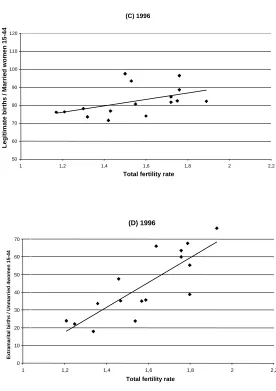
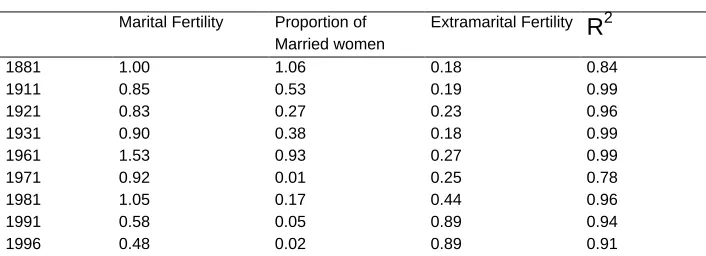
The low level of cohabitation and extramarital births should be underlined, as in Western Europe, during the 1990s, the more diffused extramarital births are, the higher the TFR is, with a striking change compared to the past, until the beginning of the 80s (see Figure 1 and Table 2). Empirical data show that in Italy the low cohabitation rate is strictly related to the late departure from the parental home, as the transition from parental home to living alone is rare (Billari et al., 1999b, 2000). Consequently, to understand Figure 1, the association between the late departure from the parental home and the lowest low fertility rate should be studied.
Table 1: Twelve indicators of marital and reproductive behaviour in eighteen Western Europe countries. 1996 (if available) or 1995. The rank of Italy for each indicator is in brackets.
NUPTIALITY FERTILITY
DIVORCES AND REMARRIAGES
Mean age at first marriage for women (Unmarried / women)
×
1,000,
age 35-44 Total first married. rate
×
100
(Extram. births /
unmar.) X
1,000, a. 15-44 (Legit. births / married)
×
1,000, a. 15-44 (Births / women)
×
1,000, age
15-19 (Births / women)
×
1,000, age
35-44 Mean age at first birth TFR of women born in 1955 TFR of the year (Div. or
separat. / mar.)
×
1,000, age 15-64 (Mar.>1° order / div. +
wid.)
×
1,000, a. 15-64
B 25,6 95,9 56 21,2 80,6 6,8 16,4 27,1 1,83 1,55 13,6 34,1
DK 29,7 195,2 67 53,2 82,4 7,5 39,5 27,5 1,84 1,75 14,2 37,4
G 26,6 109,1 57 19,2 73,5 9,8 17,7 28,3 1,67 1,32 10,5 34,1
GR 26,0 72,2 52 3,5 78,1 9,6 16,9 26,8 2,03 1,30 4,1 17,2
SP 27,1 95,5 58 9,5 76,1 5,9 23,4 28,5 1,90 1,17 4,2 11,8
F 27,4 158,4 54 45,5 81,6 7,0 25,3 27,9 2,13 1,72 11,7 21,5
IRE 27,9 123,0 59 29,4 96,5 13,0 44,3 27,4 2,67 1,88 0,0 4,0
I 26,8 (9) 106,7 (6) 60 (15) 7,7 (2) 76,3 (5) 5,1 (3) 22,3 (6) 27,8 (12) 1,78 (2) 1,21 (2) 2,7 (2) 9,4 (2)
L 26,5 93,3 58 24,3 96,4 7,1 28,4 27,5 1,69 1,76 9,5 24,1
NL 26,7 131,7 56 20,6 93,4 4,1 27,7 28,6 1,87 1,53 11,6 28,8
A 26,3 123,6 55 33,1 71,5 11,7 17,4 25,9 1,77 1,42 11,5 29,4
P 24,9 86,6 73 20,7 76,8 16,0 19,0 25,9 1,97 1,43 6,3 17,7
FIN 27,3 192,6 59 40,8 88,5 6,9 28,5 27,2 1,88 1,76 15,9 21,4
SW 28,9 255,0 44 51,5 74,0 5,5 26,1 26,8 2,03 1,60 16,5 19,5
UK 26,7 107,9 53 49,1 84,6 23,3 25,9 27,4 2,02 1,72 16,0 35,4
ICE 28,8 208,1 55 74,8 76,8 16,4 37,9 25,0 2,47 2,12 13,2 29,6
NO 27,7 153,9 58 61,7 82,2 9,8 28,2 26,5 2,05 1,89 13,7 27,4
CH 27,3 136,6 64 9,3 97,5 4,0 24,3 28,6 1,75 1,50 11,5 29,9
B: Belgium; DK: Denmark; G: Germany; GR: Greece; SP: Spain; F: France; IRE: Ireland; I: Italy; L: Luxembourg; NL: The Netherlands; A: Austria; P: Portugal; FIN: Finland; SW: Sweden; UK: United Kingdom; ICE: Iceland; NO: Norway; CH: Switzerland; AUS: Australia; HUN: Hungary.
Figure 1: Association between TFR, marital fertility and extramarital fertility. 1981 and 1996. 16 Western European countries (see table 1, excluding Ireland and Iceland)
(A) 1981
50 60 70 80 90 100 110 120
1 1,2 1,4 1,6 1,8 2 2,2
Total fertility rate
Legitimate births / Married women 15-44
(B) 1981
0 10 20 30 40 50 60 70
1 1,2 1,4 1,6 1,8 2 2,2
Total fertility rate
Figure 1: (Continued)
Source: Cantisani, Dalla Zuanna [1999].
(C) 1996
50 60 70 80 90 100 110 120
1 1,2 1,4 1,6 1,8 2 2,2
Total fertility rate
Legitimate births / Married women 15-44
(D) 1996
0 10 20 30 40 50 60 70
1 1,2 1,4 1,6 1,8 2 2,2
Total fertility rate
Table 2: Standardised β regression coefficients between total fertility and its three most proximate components (marital fertility, proportion of married women, extramarital fertility). 17 countries of Western Europe (*).
Marital Fertility Proportion of Married women
Extramarital Fertility
R
21881 1.00 1.06 0.18 0.84
1911 0.85 0.53 0.19 0.99
1921 0.83 0.27 0.23 0.96
1931 0.90 0.38 0.18 0.99
1961 1.53 0.93 0.27 0.99
1971 0.92 0.01 0.25 0.78
1981 1.05 0.17 0.44 0.96
1991 0.58 0.05 0.89 0.94
1996 0.48 0.02 0.89 0.91
(*) For the period 1881-1971 the source is Coale and Cotts Watkins [1986, pp. 78-152]. As indicators, If, Ig, Im, Ih, calculated for the Princeton project were used. France was excluded from the elaboration, being defined as an outlier due to its role as precursor in the fertility decline. Correlation values, particularly for the first two years, would have been largely determined by France if it had been included in the regression analysis. Two separate values were given for England-Wales and Scotland. For the final three years (which included France) the following indicators were used: TFR for total fertility, (legitimate births / married women) 15-44 for legitimate fertility, (unmarried women / women) 15-44 for the number of single women, (extramarital births / unmarried women)15-44 for extramarital fertility. As there is no large difference in the age structure of the total population and unmarried and married women in the 18 countries, it was not necessary to construct the Princeton indicators for the last two years.
Source: Cantisani, Dalla Zuanna [1999].
2. The familistic Italian way of life
In a recent paper Reher (1998) pointed out how the NCEC and Mediterranean countries are characterised by two different family systems: the weak and the strong family, respectively. In the weak-family area family ties (between parents and children, and among siblings) become less and less important during the teens and after the second decade of life. Consequently, children leave the parental home early, to work as servants (in the ancien régime) or to live alone, with friends or a partner (in recent years). Moreover, ageing persons are seldom assisted by their children during their last years. On the contrary, in the strong-family area family ties persist. Children leave the parental family only at marriage, or sons bring their wives into the parental home. When the neo-local rule is followed, children usually live near their parents after marriage, parents help their children during the chilrearing of grandchildren, and parents are assisted by their children during the last years of their lives.
social differences. In the Italian and Iberian regions, the strong-family system has dominated up until the present day. It is an ingrained anthropological feature, which has by no means waned, as shown also by Kuijsten (1996), when studying recent social and demographic behaviour.
Following in the footsteps of Reher, in a recent article Micheli (2000) underlines that in Italy as a whole the anthropological family structure is largely based on kinship, even if the rule of residence of the couple (patrilocal vs. neolocal), the diffusion of the stem-family, and the age at first marriage of both spouses show deep differences among counties. To use Micheli’s terminology, in Northern Italy the historical form of strong-family is the “Latin pattern”, based on the stem-strong-family and strong-family-farm (in the past), proximity of residence among relatives and the family-firm (currently). On the contrary, in the Southern regions the historical form of strong-family is the “Mediterranean pattern”, where the neolocal families are encapsulated in the family alliance (the Asabiyyah). In spite of these differences, Micheli, using empirical data, shows that kinship ties are more important and diffused than bonds with neighbours and friends, if all the Italian areas are compared with NCEC. Summing up, Reher’s classification of European families (strong vs. weak family) is reinforced by Micheli’s analysis, who places the variegated Italian context in a European framework.
The connection between family ties (strong vs. weak) and reproductive behaviour has not been developed by Reher. Nevertheless, as during the last 20 years in the strong-family area fertility has been the lowest world-wide, the social rules underpinning the strong-family system may be similar to those underlying the lowest low fertility. Consequently, a better definition of these could be useful.
In my opinion, much of this task has already been done by various anthropologists, sociologists, historians and demographers, who have concurred in describing the familistic way of life (Banfield, 1958; Aldmon and Verba, 1963; Balbo, 1976; Ginsborg, 1989, 1994a, 1998; Saraceno, 1994; Dalla Zuanna, 1995).
Following these authors, in a familistic oriented society, most people: - Consider their own utility and family utility as being one and the same thing; - Believe that every one else does too;
- Follow these two rules throughout their lives.
Further to this definition, familism is not a general attitude toward the “traditional family”, based on marriage and children, with the bread-winner father and the housewife, also found in demographic literature (Lesthaeghe and Meekers, 1986; Krishnan, 1990). As described in section five, familism and the traditional family are linked, but familism can persist even where traditional family-life declines.
This emphasis on familism in interpreting Italian society has not been readily accepted universally. Some authors radically criticise familism as being an explanation for certain characteristic features of Italian society (De Masi, 1976; Gribaudi, 1994). Familism is not considered as a cause, but rather as being the effect of poverty and underdevelopment (in the past) and of the incapacity of the State to guarantee impartial welfare and rights to its citizens (today). Moreover, it is stated that it is not possible to speak of “Italian families” without considering the differences between North and South, town and country, and social class (Gribaudi, 1994). In answer to these criticisms, it is difficult to fully subscribe to the viewpoint of those authors who overemphasise the importance of familism in Italian history and society (e.g. Altan, 1986). Nevertheless, abundant empirical evidence shows that currently in Italian society
– not only in its backward and archaic strata – the familistic viewpoint should be considered to better explain many kinds of social behaviour. Furthermore, Reher’s considerations on the historical roots and the persistence throughout the centuries of the strong-family system in Mediterranean Europe suggest that parents transmit the familistic way of life to their children, an “explanatory variable” rather than the consequence of other social processes.
The authors mentioned above have studied the influence of familism on several sectors of Italian life, implicitly assuming that the intimate structure of family ties orients various social organisations: political parties, trade unions, businesses, universities, criminal groups and so on. Many authors underline the strength of the family as an institution contrasting with others – church, government, the community,
etc. (e.g. Ginsborg, 1989, 1998). Moreover, in my opinion it is difficult to develop this macro-social perspective without considering the micro-level of familism, which is rooted in the psychological and anthropological rules described above.
This paper will examine the connection between familism and reproductive behaviour and some general data connected with Italian familism will be illustrated, comparing Italy with other Western countries. These general topics will be of relevance below, when the late departure from the parental home and lowest low fertility are considered.
are held in Italy. As the aforementioned authors found, familism and civic values cannot easily walk hand in hand.
Table 3: Percentage of people declaring that the most of their compatriots are “very” or “somewhat” trustworthy. Year 1986.
Italy GR P SP F IRL B UK NL G LUX DK
33 49 62 68 69 72 76 79 80 84 85 88
Source: Eurobarometro, Bollettino Doxa, XL, 22-23, Nov. 17th
[1986]. Data quoted by Inglehart [1990]. For the abbreviations of the countries, see the note of table 1.
Another important consequence of Italian familism – and the low esteem of civic values – is the gap between private wealth and the quality of public services (Saraceno, 1994). In Italy, public services are – generally speaking – at a low level, if per capita income is considered. Perhaps the most striking example is the housing policy, where tenure has been positively encouraged, nor can public housing policy be compared to the majority of the NCEC. Thus the anxiety of the part of Italians to become house owners, as can be seen in Table 4 for the period 1961-91, which has continued throughout the 90s, with no sign of a let-up. This hampers any decision on the part of young people to leave the parental home, cohabit and marry. Moreover, given these trends on the housing market it is not easy to change residence and to do so a thorough knowledge of the local area is needed to find a dwelling. Thus, many prospective house owners are actively encouraged to live near their family, although this is often more a question of choice, in keeping with the prevailing familism, rather than necessity (Table 5).
Table 4: Percentage of households owner of their houses.
Italy Other Europeans countries (1990-91)
1961 1971 1981 1991 GR SP F B UK NL G DK
46 51 59 68 76 78 54 54 67 45 39 54
Table 5: Residence of parents and children in some industrialised countries during the 1980s.
UK USA AUS G A HUN Italy
Proportion % of parents living with at least …
… an adult son 32 21 30 40 39 37 60
… an adult daughter 29 14 25 26 25 30 58
Proportion % of adult children not living with parents whose mother lives at a distance of…
… 15 minutes of less 32 27 24 38 37 43 57
… between 15 minutes and 1 hour
40 31 33 30 35 35 26
… between 1 and 5 hours 19 19 20 22 23 19 8
… 5 hours or more 9 23 23 9 4 4 4
Proportion % of adult people living near their mother (1 hour of distance or less) who see her every day
11 16 7 20 17 32 32
Source: Jowell et al. (eds.) [1989], quoted by Ginsborg [1994a]. For the abbreviations of the countries, see the note of table 1.
This could lead to the belief that welfare expenditure is low, which is simply not the case. The problem is that most welfare expenditure is directly transferred from the State to families, rather than to the public services. Moreover, most of these transfers go to the aged, financing pensions, whereas young people and couples with children are overlooked. This topic, which is very important in discouraging fertility, will be reconsidered below.
The Italian economy is also deeply steeped in familism. The production sector is characterised by thousands of small firms, whose founders are usually siblings or other relatives (see Table 6). Many years after the company's founding, owners and managers often continue to belong to the same family as the founder(s) (children, their spouses, nieces, nephews, grandchildren). This kind of organisation is not only typical of small firms: the Agnelli dynasty and the four Benetton brothers are but two examples of the success of this kind of model on broad industrial dimensions.
Table 6. Some data on dimension of firms. Some EU countries around 1995.
Italy SP F UK NL G SW
% industrial income produced by firms with fewer then 50 workers (1)
51 42 39 28 41 31 33
% industrial workers employed in firms with fewer then 50 workers (2)
64 63 50 43 42 41 43
Source: Eurostat Yearbook, 1997 (Italian version) p. 366. For the abbreviations of the countries, see the note of table 1.
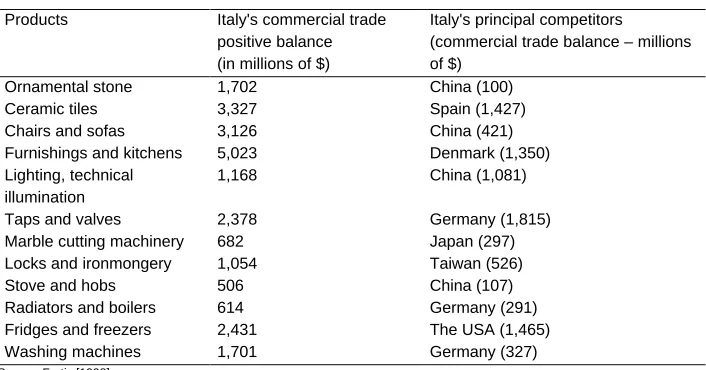
Table 7: The “house quality ” industrial sectors where the Italian trade balance was the best in the world. Year 1996
Products Italy's commercial trade
positive balance (in millions of $)
Italy's principal competitors
(commercial trade balance – millions of $)
Ornamental stone 1,702 China (100)
Ceramic tiles 3,327 Spain (1,427)
Chairs and sofas 3,126 China (421)
Furnishings and kitchens 5,023 Denmark (1,350)
Lighting, technical illumination
1,168 China (1,081)
Taps and valves 2,378 Germany (1,815)
Marble cutting machinery 682 Japan (297)
Locks and ironmongery 1,054 Taiwan (526)
Stove and hobs 506 China (107)
Radiators and boilers 614 Germany (291)
Fridges and freezers 2,431 The USA (1,465)
Washing machines 1,701 Germany (327)
Source: Fortis [1998].
accept a low status occupation. As will be seen parents find it hard to accept a “low status” child. Consequently, in many parts of unemployed Southern Italy, immigration from developing countries is high and continually growing.
3. Familism as an obstacle to leaving the parental home
Castiglioni and Dalla Zuanna (1994), in a previous analysis of the 1991 national survey, described the parental family as the golden cage of Italian youth. Later surveys in 1995 (Buzzi et al., 1997) and 1998 (IRP, 1999), the latter with a more demographic focus, showed that there was a trend in favour of greater autonomy but that this continued to be based within the family home (Table 8). Familistic parents do not encourage their children to leave, and young people react by placing their trust and affection in their parents and relatives (Table 9).
Table 8: Data on Italian people aged 15-24, interviewed in the 4 rounds of IARD survey.
1983 1987 1992 1995
Percentage of people living outside the parental family 6 6 5 4
Percentage of young workers living at parental home who give all their earnings to the parental family
23 15 9 5
Source: Buzzi et al. [1997].
Table 9: Mean score assigned to cohabiting relatives by Italian people aged 20-34 in 1998. Scale 1-10.
Father Mother Brothers Sisters Grandparents Other relatives
7.84 8.55 7.99 8.17 8.26 8.13
Source: IRP [1999].
an early departure from the family home and anyone who does so has to be strongly motivated(e.g. burdened by strict rules and limited freedom). Nonetheless, the golden cage is usually very comfortable and almost invisible.
Also directly connected with the late departure from the parental home is the parents’ major emotional investment in their children. In the aforementioned IRP survey, both adult children and parents stated that the main disadvantage in leaving the home was the emotional price paid, and as many as 60% of the parents interviewed said that the child's departure offered no advantage of any kind.
This co-operative adult family (I thank Rossella Palomba for this felicitous terminology) is based on a double exchange: both parties (parents and adult children) give and receive material and emotional goods: parents give more material goods and receive more affection, adult children give more affection and receive more material goods. For some authors, this material exchange, at the end of the life course, will be more balanced in favour of parents, if the pension system is considered (Cigno and Rosati, 1992). Nevertheless, it is less risky, for adult children, to stay on in the parental home, than to risk building a new family, where affective and material goods are re-contracted, on a daily basis, with their partners.
Some might say that this co-operative family of parents and adult children is the modern version of the court of Aeolus – described by Homer at the beginning of the 10th Book of the Odyssey – where the God of the winds gives his six daughters as wives to his six sons, and offers the six couples an eternal banquet (it is an extreme example of endogamy, and a good preventive measure against the Oedipus murder!). In Italy, few young people are as bold as Ulysses, leaving the banquet provided by Aeolus to face the open seas.
A familistic oriented society also discourages early departure from the parental family for a number of indirect motives, too. As suggested above, familism has contributed to the shortage of rental housing accessible to young people. Moreover, familism was an important brick in building the Italian welfare system, largely based on the transfer to old people rather than receipts from the public sector and the payment of unemployment benefit for all. Nevertheless, any material obstacle to leaving the parental home should not be over emphasised, as even the young employed with a good income or home owners usually prefer to remain until marriage (to the joy of their parents!).
above question defining and measuring this utility function. Looking at “the modern Western society”, Burch and Matthews define some explanatory hypotheses (i.e. the utility function), in order to explain the growing proportion of people living alone (or in a small household). Trying to fit Burch and Matthews’ hypotheses to the living arrangements of Italian young people, we discover that they do not refer to “the modern Western society”, but “the modern weak-family Western society”. The more striking example concerns the effect of the rising real income. For our authors: “We are on safe grounds in assuming that one reason so many people now live alone or in very small households is that they can afford to. They are able to forgo the economies of scale represented by larger households…”(p. 503). This could describe some aspects of the Italian situation, but is not useful in understanding why adult children stay in the parental home until their thirties. In Italy, the increasing income of familistic parents increases the amount of money available to their adult children. Empirical data show that during the last 20 years, the proportion of young people in employment living in the parental home, with their salary at their complete disposal, has substantially increased (return to table 8). At the same time, for those contributing to the household expenditures, the proportion of salary given to their parents has substantially dropped (Buzzi et al., 1997). This situation – that is strictly related to the familistic rules described above – increases the opportunity-cost of leaving the parental home. Hence, in a familistic oriented society, the rising of real income hampers – rather than favours – the early departure of children.
Another behavioural hypothesis described by Burch and Matthews concerns the rising demand for privacy: “With higher real income and a sense of security provided by an extensive welfare net, the individual turns inward and becomes more concerned with self-development and personal growth and experience. Recipes for such growth often emphasise the need for solitude and privacy" (p. 505). In Italy, the growing demand for privacy coming from adult children is often resolved in the parental home. Data show that during the last 20 years a growing proportion of adult children (both males and females) have a room of their own in the parental home (77% for people aged 25-34 in 1998), where they are often free to pursue a sexual relationship with their partner (57% for people aged 20-34 in 1998) – Buzzi et al., 1997; IRP, 1999.
4. From the late departure of the parental home to low fertility
Many authors have described the psychological and practical consequences of remaining in the parental home on several aspects of Italian social life and private behaviour – see chapter 3 of Ginsborg (1998) for a review. The direct and indirect consequences of the late departure from the parental home on fertility are stressed in the following section, which could help cast light on Figure 1.
The direct effect is not as important as it might seem. In Italy, as elsewhere, age at leaving the parental home is negatively associated with the quantum of fertility (Billari
et al., 1999a, 1999b). Nevertheless (Table 1), in 1996 in Italy the mean age of women having their first child is not particularly high: 27.8 years, as in the UK and France, where early departure from the parental home and cohabitation are widely diffused. In other words – looking at large populations – it is possible to have a late age at first child and a TFR not far from the replacement level, even if – looking at individual behaviour – the later the age at first child, the lower the probability of having other children.
Consequently, today, within a European perspective, the problem of Italian fertility is not its late beginning, but the low probability of having a third, second and – for the youngest cohorts – a first child.
The main direct effect on fertility is that the late departure from the parental home often results in the failure to marry and have children. The number of childless women has strikingly increased among cohorts born after 1955, particularly in Northern Italy. Table 10 is probably based on too low estimations of late fertility, and the proportion of those born after 1960 having at least one child will probably be higher. Nevertheless, childless Italian women born in the mid 1960s will surely top 20%: the proportion of childless women among cohorts born just ten years previously is going to be doubled. In this case, a delay of marriage often becomes permanent celibacy (De Sandre et al., 1997). This is an indication of something amiss, i.e. an unsatisfied desire, since throughout the 1980s and 1990s in all the surveys conducted very few young people expressed the wish not to marry or have children (see also Table 11).
Table 10: Percentage of Italian women without birth at the end of reproductive life by cohort*
1950 1955 1960 1961 1962 1963 1964 1965 1966
Italy 11 11 15 16 17 18 19 21 23
- North 10 13 18 19 21 22 24 25 27
- Centre 7 10 14 15 17 18 20 22 23
- South 15 13 12 13 14 14 15 17 18
Let us consider the indirect effects on fertility of a late departure from the parental home. First of all, men have no experience of housework, since they go directly from their mother’s arms to their wives, never having lived alone or with friends. Thus Italian husbands do not help out in the home, even if their wives are in full-time employment (Bimbi, La Mendola, 1999). The excessive burden for women can be considered as an important cause of Italy's lowest low fertility.
Another important indirect effect is less easily described and empirically supported. Staying at home until their thirties, young Italian people risk overemphasising each transition in psychological terms. Thanks to the cover offered by the parental family, they accept a job only if it is in line with their desires, and postpone marriage until the risk of losing amenities is low. In other words, during the age interval 20-30, when the enthusiasm for innovation should be higher, they fail to develop a taste for responsibility, almost indispensable to the transition to adulthood. Massimo Livi Bacci (1997) refers to this Italian situation as being la sindrome del ritardo – “the delay syndrome”. Young Italian people often become precociously fervent supporters of Malthus. Garelli (1984) said that this insecurity among young people in facing transition is the product of the general level of insecurity present in society. Micheli (1996) proposed that the inability of today's children in making choices is the direct product of their parents' insecurity. Golini (1997) supposed that the modernisation of Italy was too rapid to permit the growth of balanced relations between generations. All these hypotheses are interesting in putting together the pieces of the puzzle underlying the motivations for the late departure from the parental home and Italy's lowest low fertility, but they are not enough to explain the broad differences between Italy and the NCEC. To better understand the intricacies of the Italian context, the familistic paradigm should be taken into account.
A brief summary could be useful. Using data from several sources, the connection in Italy between familism, late leaving the parental home and fertility, has been described for the last 20 years.
Familism encourages late departure from the parental family… …directly, because:
(a) In the Italian familistic society, economic conditions at home are more favourable than living alone, with friends or a partner;
(b) Generally speaking, in Italy the affective bonds between parents and children, children and other members of the kin are very strong.
… indirectly, because:
(b) Familism was an important brick in building the Italian welfare system, based on private transfers to older people rather than the availability of unemployment benefit for all.
Late departure from the parental home negatively influences fertility… … directly, because:
(a) The higher the age at marriage or cohabitation, the shorter the time-interval available for childbearing;
(b) Often the delayed departure implies a definitive no to cohabitation, marriage and childbearing.
… indirectly, because:
(a) Young men do not learn to do housework, and thus in the Italian couple the working married (or cohabiting) woman has a double role (in the market and ménage);
(b) Staying on in the parental home until their thirties, young people forget how to risk, useful to tackle the prospect of childbearing (the “delay syndrome”).
Up to now, the interaction between familism, late departure from the parental home and low fertility has been described. The puzzle has to be completed by discussing the effect of familism on the reproductive behaviour of Italian couples.
5. Familism as the lubricating factor in the couples' lowest low
fertility
To explain the falling fertility rate in Western countries from 1970-2000, Lesthaeghe (1998, 1999) emphasised three compatible theories: (1) increased female autonomy and opportunity-costs, (2) the increase in relative economic deprivation, (3) changed cultural attitudes toward post-materialistic values. Let us examine if and how these interpretations can hold water in the familistic Italian society.
employment. Similar results are obtained using multilevel models – pooling the FFS data of several countries – the first level units being women or couples, the second level units being the countries (De Rose, Racioppi, 1999). To understand this “unusual” result, let us consider the fact that an Italian woman, who does not stop working after having children, must face at least four more “familistic” problems than NCEC mothers.
First of all – as described above – the Italian mother finds society organised as though the male-breadwinner family were dominant, since public child rearing services and nursery facilities are scarce. Secondly, she and her partner receive no State support to face the expenses incurred by a new child, since the family allowance paid to families with children is extremely low (Ditch et al., 1996). Let us only consider the fact that in 1994, 8 billion U.S. dollars were gathered as taxes to finance family allowances; only 2.5 billion were effectively re-distributed to families with children, whereas 5.5 billion were used to pay pensions (Saraceno, 1998, p. 104). Moreover – as described above – the woman is rarely helped by her partner in the ménage: the time spent working (at home and outside) is dramatically higher for a working Italian married woman than for an Italian married housewife (Bimbi, La Mendola, 1999). Last but not least, the Italian mother must face the anxiety of having very little time to spend with her child: she violates the well entrenched social norm – strictly connected with the familistic rules – that nothing is better for a child than to be with its mother. Consequently, two main familistic influences may be detected in Becker's behavioural chain theory.
Following a new-home economics’ viewpoint, the Italian familistic organisation of couple and society:
(1) Reduces the number of children to couples where both partners are earners, stressing the economic and psychological contrast between the woman’s employment and childbearing;
(2) Induces Italian mothers into stopping work whilst the children are growing up, which is why Italy is characterised by low female participation in the labour market, that also applies to the Northern regions where unemployment is practically unknown (Bettio, Villa, 1998). Moreover, half the Italian married FFS women aged 20-49 in 1996 were housewives at the time of the interview (Bernardi, 1999).
Social process (1) strengthens the negative association between female employment and fertility in Italian society. Thanks to social process (2), familism obstructs female employment: consequently, familism helps reduce both the Italian TFR and the proportion of Italian women inside the labour market.
process leads to competition between children and consumption, since high and rising consumption expectations can far better be satisfied by dual earner families (Easterlin, 1976). Italian FFS data seem to be consistent with these theoretical expectations (Di Giulio et al., 2000).
This result can be associated with the following familistic social processes: (1) As already described in the second section and in Table 7, Italians are strongly
oriented toward consumer goods connected with the quality of life in the home. These consumer expectations delay age at marriage, and emphasise the cost of a second or third child; the parents must take into account new high quality furniture and a new high quality house;
(2) When consumption aspirations rise, child value also increases, because familistic parents must compete with other familistic parents: adopting, at the same time, familistic and consumption oriented viewpoints, a child can be considered as being a luxury (De Santis, 1997). Puzzling over these considerations, material and immaterial investments made by familistic Italian parents in (what they consider to be) the quality of their children are rather high.
Three kinds of empirical data support these last statements. In Italy the cost of children is higher than in the NCEC, and this cost has been growing over the last few years (Ekart-Jaffé, 1994; De Santis, Righi, 1997). Moreover, ceteris paribus, children with fewer brothers and sisters have more possibilities of improving their own social class, thanks to better education (Casacchia, Dalla Zuanna, 1999), see figure 2. These results show that the strategy of reducing fertility has been a good familistic tool in Italy over the last 30 years, helping the social climb of few children or the only child.
The third empirical proof can be found in the survey data on the value of children. Table 11 illustrates the results of a survey conducted on two comparable samples, interviewed with the same questionnaire in Italy and in the Netherlands in 1989. The values assigned to children were clearly higher in Italy; from a familistic viewpoint, the interpretation of these results by Rossella Palomba are easily shared:
paradoxically, explain the low Italian birth-rate, since Italians invest a great deal of time, money, attention, and interest in their children and thus, instead of having several children, they prefer to have only the one child, who becomes the sole object of much care and attention (Palomba, 1995, page 186).
The last sentence of Palomba is precisely the microeconomists’ notion of substitution of quality for quantity, strongly emphasised in the Italian familistic context.
Figure 2: Fertility, education and social class. LISREL7 model with ordinal variables stratified by residence. Women aged 40-49 with at least one job during the life, interviewed at the beginning of 1996 during the Italian FFS.
- 0.219 ^
Fertility of parents Education of father
0.153 - 0.213 0.555
Fertility of daughter Education of daughter
- 0.185 North
- 0.320 South 0.716
First status* of daughter
North 0.360
South 0.488 0.330
Final status* of daughter
CHI 2 18= 7.02 p = 0.990 n = 1,040
^ All the coefficients are statistically significant (α<0.05).
* The first status is measured by a social score of the first job of the woman. The final status is measured by the higher social score between the job of woman or her partner.
Table 11: The values of having children in Italy and the Netherlands. Age group 20-44. Percentage who agrees with the statement.
Italy Netherlands
You cannot be really happy if you do not have children 57 7
Having children is your duty towards society 43 8
The closest relation you can have with anyone is with your own child
87 38
You can be perfectly satisfied with life if you have been a good mother or father
79 51
In our modern world the only place where you can feel completely happy is at home with your children
50 32
Source: Moors [1990].
The third theory has been formulated and re-adjusted by Lesthaeghe, van de Kaa and others (Lesthaeghe, Meekers, 1986; van de Kaa, 1988; Lesthaeghe, 1995). The basic idea is that new Western fertility and marital patterns cannot be interpreted without starting from changes in mentality. As data for Western countries show, cohort by cohort the orientation toward post-materialism increases, and this new pattern of values encourages cohabitation, low fertility and couple dissolution.
In Italy post-materialism is at a lower level than NCEC, even if new cohorts are fast making up for lost time (Lesthaeghe, Meekers, 1986; Inglehart, 1997; Ginsborg, 1998, pages 244-245). Moreover, the traditional indicator of secularisation (the weekly participation at mass), after a rapid decrease during the period 1950-81, remained substantially stable around 30-35% until the mid-1990s (Pisati, 2000). Generally speaking, religion has been gaining popularity over the last twenty years, particularly amongst the young (Table 12), even if many authors and data suggest that Italians have reverted towards an intimate and self-tailored Catholicism, which is less oriented by Church teaching (Cesareo et al., 1995).
Table 12: Answer to the question: “Is the religion important in your life?” Four rounds of the IARD survey. Italian people aged 15-24 *
1983 1987 1992 1996
Very much 7 9 10 12
Much 20 22 22 23
Enough 37 38 37 33
Few 24 23 19 22
No 11 8 10 8
I don’t know 1 0 2 2
Dealing with the empirical connection between fertility and post-materialism and secularisation indicators (the indicators of these two factors being strictly related – Clerici, 1999), the statistical “paradox” described above is found again. Among the more secularised and post-materialist Italian women and counties, fertility is later and lower (Clerici, 1999; De Sandre, Dalla Zuanna, 1999; Di Giulio et al., 2000; Dalla Zuanna, Righi, 1999). Nevertheless, assuming a European viewpoint (where countries are considered as statistical units, adopting both ecological and multilevel analyses), fertility is lower in the less secularised countries – De Rose, Racioppi, 1999.
The social processes underlying this “paradox” could be similar to the ones already seen whilst discussing Becker’s theory. The change of values toward individualism and secularisation could be obstructed by the underlying familistic mentality: consequently, in Italy both fertility and secularisation are low because they are both dropped by the Italian familistic way of life. The above sentences can be discussed in light of research conducted by some authors and their data.
Firstly, familism cannot cohabit with an excessive individualism, because it is a sort of familiar individualism and during the 1980s and 1990s, after the decline of the collective dreams of the 1960s, familistic values have celebrated their Italic triumph (Ginsborg, 1993, pp. 557-566; 1998, p. 533).
Summing up, two social processes are particularly relevant, to understand connections among familism, Catholicism and fertility in Italy:
(1) Catholic values are filtered by the familistic way of life. As the Catholic Church has emphasised some values easily compatible with familism in Italy, Catholicism has reinforced familism, and – partially – viceversa. This social pattern hampers secularisation;
(2) Some non-familistic Catholic values are less and less popular among Italians and their families. One of these is the non-familistic and unpopular Catholic value of a large number of children, strongly recommended by the Pope and Italian bishops, but practised only by a small minority of Italian couples, with a certain prevalence of those closest to the Catholic Church.
The consequent result is the “paradox” described above: the most traditional and Catholic Italian couples and counties are characterised by a higher fertility rate than the majority of secularised ones; but if Italy is compared with other European countries, a lower level of secularisation is associated with lower fertility.
6. Final remarks
The forces reducing fertility are not particularly different in Italy compared with the NCEC. But familism has interacted with them, emphasising the strength of the social processes, increasing the number of persons without children and depressing the fertility of the couple. Consequently, the persistence of familistic rules is useful in explaining the lowest low fertility in Italy during the last 20 years, compared to the NCEC weak-family area.
Should the social process described here effectively be at play, Italian fertility is unlikely to perceptibly increase without undermining the strong-family system. But the secular anthropologic structure of the strong family and kinship is not easily slackened. In this paper I have tried do show how – in the Italian context – this social-anthropologic system and the interconnected familistic norms hold, despite far-reaching economic, social and cultural change. Novelties have been assimilated into Italian society without loosening (and perhaps even enforcing) its basic familistic structure.
speaking – the weaker the ties between partners, the stronger the affective and material connections between adult children and their parents and kin.
References
Aldmon G., Verba S. (1963) The civic culture. Political attitudes and democracy in five nations, Princeton University Press, Princeton, USA.
Altan C.T. (1986) La nostra Italia, Feltrinelli, Milano. Balbo L. (1976) Stato di famiglia, Milano.
Banfield E. (1958) The moral basis of a backward society, Glencoe, USA.
Becker G. (1981) A treatise on the family, Harvard University Press, Cambridge, USA. Bernardi F. (1999) Donne fra famiglia e carriera, Franco Angeli, Milano.
Bettio F., Villa P. (1998) “A Mediterranean Perspective on the Break-Down of the Relationship Between Participation and Fertility”, Cambridge Journal of Economics, 22 (2).
Billari F.C., Manfredi P., Valentini A. (1999a) Becoming adult and its macro-demographic impact: Multistate stable population theory and an application to Italy, paper prepared for session J of the European Population Conference, The Hague, 30-8 – 3-9.
Billari F.C., Castiglioni M., Ongaro F. (1999b) L’uscita dei giovani dalla famiglia di origine, paper presented at the Conference “Le famiglie interrogano le politiche sociali”, Session titled “Politiche amichevoli nei confronti delle nascite”, Bologna, March 29-31.
Billari F.C., Castiglioni M., Castro Martin T., Michielin F., Ongaro F. (2000)
Household and union formation in a Mediterranean fashion: Italy and Spain, Flagship FFS Conference, Brussels, Belgium, 29-31 May.
Bimbi F., La Mendola S. (1999) Contratti di genere e modelli femminili e maschili della doppia presenza, in De Sandre P. et al. (eds.), 255-272.
Burch T., Matthews B. (1987) “Household formation in developed societies”,
Population and Development Review, 13, 3, 495-511.
Buzzi C., Cavalli A., de Lillo A. (1997) Giovani verso il Duemila, il Mulino, Bologna. Cantisani G., Dalla Zuanna G. (1999) “The new fertility transition in Europe. Have the
Casacchia O., Dalla Zuanna G. (1999) Trasmissione intergenerazionale di fecondità e interrelazioni con la mobilità sociale, in De Sandre P. et al. (eds.).
Castiglioni M., Dalla Zuanna G. (1994) “Innovation and tradition: reproductive and marital behaviour in Italy in the 1970s and 1980s”, European Journal of Population, 10, 107-141.
Castiglioni M., Dalla Zuanna G. (1995) “Some indications on reproductive behaviour of never married women in Italy”, Contribution of Italian scholars to the European Population Conference, 5-21, Rome, IRP-CNR.
Cesareo V., Cipriani R., Garelli F., Lanzetti C., Rovati G. (1995) La religiosità in Italia, Mondadori, Milano.
Cigno A., Rosati F.C. (1992) “The effect of financial markets and social security on saving and fertility behaviour in Italy”, Journal of Population Economics, 5, 3, 319-341.
Clerici R. (1999) “Pratica religiosa e scelte riproduttive”, in De Sandre P. et al. (eds.), 295-310.
Coale A., Cotts Watkins S. (editors, 1986) The decline of fertility in Europe, Princeton University Press, Princeton, NJ, USA.
Dalla Zuanna G. (1995) “Meglio soli. Famiglia e natalità in Italia”, Rivista del Mulino, XLIV, 357.
Dalla Zuanna G. Atoh M., Castiglioni M., Koshima K. (1998) “Late marriage among young people: the case of Italy and Japan”, Genus, LIV, 3-4, 187-232.
Dalla Zuanna G., Righi A. (1999) Nascere nelle cento Italie, ISTAT, Collana Argomenti, 18, Roma.
De Masi (editor, 1976) Le basi morali di una società arretrata, il Mulino, Bologna. De Rose A., Racioppi F. (1999) Describing and explaining differences in fertility
among the European countries: a multilevel approach, European Population Conference, Session A.2, The Hague, The Netherlands, September.
De Sandre I., Dalla Zuanna G. (1999) “Correnti socioculturali e comportamento riproduttivo”, in De Sandre P. et al. (eds.), 273-294.
De Sandre P., Pinnelli A., Santini A. (editors) (1999) Nuzialità e fecondità in trasformazione: percorsi e fattori del cambiamento, il Mulino, Bologna.
De Santis G. (1997) Economia e demografia, il Mulino, Bologna.
De Santis G., Righi A. (1997) “Il costo dei figli per le famiglie italiane”, Polis, XI, 1, 29-50.
Ditch J., Barnes H., Bradshaw J. (1996), A synthesis of national family policies 1995, European Observatory on National Family Policies, European Commission Social Policy Research Unit, York, UK.
Di Giulio P. , Lesthaeghe R., Moors H., Pinnelli A. (2000) “Fertility, tempo and quantum: an empirical test of major theories with data from four FFS countries”,
Démographie: analyse et synthèse, Actes du Séminaire de Roma – Napoli – Pozzuoli, vol. 2, 31-48, Materiali di studi e ricerche (numero speciale), Dipartimento di Scienze Demografiche, Roma, Italy.
Easterlin R. (1976) “The conflict between aspirations and resources”, Population and Development Review, 2, 3, 417-426.
Ekart-Jaffé O. (1994) “Chiffrer une évolution du cout de l’enfant?”, Population, 6, 1389-1418.
Fortis M. (1998) Il made in Italy, il Mulino, Bologna.
Garelli F. (1984) La generazione della vita quotidiana, il Mulino, Bologna.
Ginsborg P. (1989) Storia d’Italia dal dopoguerra a oggi, Einaudi, Torino. (This book – where family and familism are largely used in order to explain the Italian post-war history – should be translated in English in 2001).
Ginsborg P. (1994a) “Familismo” in Ginsborg P. (editor) Stato dell’Italia, il Saggiatore, Milano.
Ginsborg P. (1998) L’Italia del tempo presente, Einaudi, Torino. (This book – where family and familism are largely used in order to explain what has happened in Italy during the last 20 years – should be translated in English in 2001).
Golini A. (1997) Levels and trends of fertility in Italy. Are they desirable and/or sustainable?, Expert Group Meeting on “Below-replacement fertility”, organised by the Population Division of the Department of Economic and Social Affairs, United Nations, New York, 4-6 November, preliminarily version.
Hill D., Hill M. (1976) “Older children and splitting off”, in Duncan G., Morgan J. (eds.) Five thousand American families – Patterns of economic progress, Vol. IV, 117-154, Institute for Social Research, Ann Arbor, Michigan, USA.
Inglehart R. (1990) Culture shift in advanced industrial society, Princeton University Press, Princeton, USA.
Inglehart R. (1997) Modernisation and postmodernisation, Princeton University Press, Princeton, USA.
IRP - National Institute for Population Research (1999) Giovani che non lasciano il nido, IRP working paper, 1/99.
ISTAT (1998) La fecondità regionale nel 1995, Collana Informazioni, 97.
Jowell R., Withers Poon S., Brook L. (editors, 1989) British social attitudes, London. Krishnan V. (1990). “A causal approach to the study of fertility and familism”, Social
Biology, 37, 1-2, 59-68.
Kiujsten A. (1996) “Changing family patterns in Europe: a case of divergence?”,
European Journal of Population, 12, 2, 115-143.
Lesthaeghe R. (1995) “The second demographic transition: an interpretation”, in K. O. Mason, A. M. Jensen (editors), Gender and family changes in industrialised countries, 17-62, Clarendon Press, Oxford, UK.
Lesthaeghe R. (1998) “On theory development and applications to the study of family formation”, Population and Development Review, 24, 1, 1-14.
Lesthaeghe R. (1999) “Is low fertility a temporary phenomenon in the EU?” Population and Development Review, 25, 1.
Lesthaeghe R., Meekers D. (1986) “Value changes and the dimensions of familism in the European Community”, European Journal of Population, 2, 3-4, 225-68. Livi Bacci M. (1997) “Abbondanza e scarsità. Le popolazioni d’Italia e d’Europa al
passaggio del millennio”, il Mulino, XLVI, 374, 993-1009.
Micheli G. (1996) “New patterns of family formation in Italy. Which tools for which interpretations”, Genus, LII, 1-2, 15-52.
Moors H. (1990) Attitudes toward demographic trends and population policy acceptance: Italy and the Netherlands in a comparative perspective, IRP -Italian Institute for Population Research, Working Paper, 2, Rome, Italy.
Palomba R. (1995) “Italy: the invisible change”, in Palomba R., Moors H. (editors)
Population, family and welfare, 158-176, Clarendon Press, Oxford, UK.
Pinnelli A. (1992) Women Conditions, Low Fertility and Emerging Union Patterns in Europe, Seminar on Gender and Family Change in Industrialised Countries, Rome, Italy, 26-23 January.
Pisati M. (2000) “La frequenza alla messa festiva”, Polis, XIV, 1.
Reher D. (1998) “Family ties in Western Europe: persistent contrasts”, Population and Development Review, 24, 2, 203-234.
Rosina A. (1999) Un modello di mistura multi-episodio per l’analisi delle storie riproduttive, in De Sandre P. et al. (eds.), 569-588.
Saraceno C. (1994) “The ambivalent familism of Italian welfare state”, Social Politics, 1, 60-82.
Saraceno C. (1998) Mutamenti della famiglia e politiche sociali in Italia, il Mulino, Bologna.