Application of Group Technology in Complex Cluster Type
Organizational Systems
Slobodan Morača1,* - Miodrag Hadžistević1 - Igor Drstvenšek2 - Nikola Radaković 1 1 University of Novi Sad, Faculty of Technical Sciences, Serbia
2 University of Maribor, Faculty of Mechanical Engineering, Slovenia
The aim of this research was to contribute to the development of structural design procedures of complex - cluster type organizational systems. Industrial clusters can help companies to improve their own market positions, effectiveness, productivity and product quality. Organization of the production process in a company is an extremely complex process itself, and when it is transferred to the cluster level, the result is a complex task which is difficult to solve. For that purpose, this paper analyses the conditions and possibilities that would enable those structures to adapt to changes in the surroundings - flexibility and management adequacy of production and organizational structures - by lowering the degree of complexity.
For the time being, no simple models which would enable an increase of process effectiveness in complex organizational units like clusters have been developed. One of the possible solutions which would decrease the complexity of flows and increase process effectiveness within an industrial cluster is the application of Group approach.
©2010 Journal of Mechanical Engineering. All rights reserved.
Keywords: industrial clusters, group technology, planning, work cells, complexity, flexibility
0 INTRODUCTION
Modern concepts of increasing the effectiveness of production are based on the processes of automation, the application of modern materials and IT technology. They significantly reduce production costs, increase productivity and reduce the need for labour. However, despite the revolutionary application of modern technology, the end of the 20th century
and the beginning of the 21st century is further
characterized by increased mobility of investments and recession, which is visible in the most developed countries, where the modern technology is most applied. All that has resulted in a constant decrease of production, which directly caused a decrease of employment rate, an increase of company debt and reduced possibilities of investments in new development projects.
In a competitive environment success of an organization is a function of industry attractiveness, its relative position in the industry, and the activities (strategy) it undertakes to remain ahead of others ([1] and [2]). Mintzberg explained that strategy is an evolutionary and organic process which is unpredictable; [3] explained that core competence gives an
organization competitive capability and remains central to its strategy planning process. Small and medium organizations encounter different kinds of problems such as resource limitations (especially human and financial resources), and market information [4], they face competition within and between large organizations [5].
Analyses have showed that the reasons for these problems are not only the inability of companies or their production or service systems. Changes occur apart from how a company is capable to independently decrease its production costs or to increase the range of products. Changes often depend on other economic and non-economic entities, geo-political factors and changes on the global market.
market only if they associate with each other into systems which simulate a large enterprise, but maintain their flexibility.
Although this form of associating provides a lot of advantages, which will be mentioned in the Chapter 1, there are also many problems in functioning of complex systems. One of these problems is how to organize and manage such complex systems and establish effective production process? In chapters 2 and 3, we will describe a group approach as a possible solution.
1 CLUSTER AS A FORM FOR COMPANIES TO ASSOCIATE
Companies are constantly asked to improve performances in order to get the chance to maintain or to improve their own market positions and financial situation. Clusters have the possibility to develop their own specific mixture of competitive advantages which is created on the basis of locally-developed knowledge as a result of mutual relations, cultural heritage and local characteristics. This is evident in the focus on clusters as an important concept in understanding growth and in thinking about development policy [6].
The idea of localized economies of scale in geographic agglomerations has a long history in economics, going back to Adam Smith’s early observations of labour specialization and to [7] explanations of why companies continue to localize in the same areas. Clusters arise in the presence of Marshallian externalities, which signify that companies benefit from the production and innovation activities of neighbouring companies in the same and related industries. There is abundant evidence that such externalities exist and lead to industry-level agglomeration [8].
Development of clusters is an effective way to improve business operations and bring it to a higher level. Modern business is based on fast response, quality, flexibility, innovation, connections and building the critical mass of capital and production / service potential. This relatively new style of doing business requires a team approach on the local level - cluster approach. Clusters represent complex organizational systems that are flexible and can quickly be adjusted to oscillatory changes at the sale and purchase markets, generate employment,
help the diversification of economic activities and make a significant contribution to exports and trade. Clusters also play an important role in innovation and businesses where there is a need for application of modern technology. Thanks to their innovative flexibility, many of them become more productive and efficient than some large international corporations. In this process, emphasis should be put on creating a friendly business environment where the transformation of society towards a market economy shall take its place.
Cluster differs from other forms of associations within its geographical boundaries, involvement and utilization of funds, ways of exchange of products and partially finished products, information management - knowledge chains, and the importance of how they are connected. Clusters can be best understood and used as regional systems. According to Porter [9] they represent, "Geographic concentrations of mutually connected companies, specialized suppliers, service providers, companies from similar industries and institutions tied to them (i.e. universities, standardization agencies, trade unions), who compete, but also cooperate".
This paper focuses on the establishment of organizational and managerial mechanisms within a cluster, which will enable an increase of production processes' effectiveness to the level of a cluster as a whole. That is why one of more important segments is to determine the levels of specialization in companies – participants in a cluster, and what desirable levels of specialization for more effective business are in case of specialization or in other words, economic diversity. Research shows that traditional production sectors are inclined to do better business when densely concentrated in one geographical area. Contrary to this, newer, high-tech and service sectors are more comfortable with economic diversity environment.
other. Malizia and Feser [10] define economic diversity as "existence of multiple specializations". This means that is possible for local economies to be highly specialized in certain sectors and, at the same time, to have sound combination of economic activities. So we come to the concept of flexible specialization, which represents the possibility of companies to do what they do best, and cluster has the obligation to provide optimal utilization of capacities.
The establishment of organizational and managerial structures in complex organizational systems like cluster represents a big challenge because of diversity of clusters and characteristics of member companies. One of the possible models whose application shall enable the optimal use of the potentials of clusters is Group approach which is described in more details in Chapter 2.
2 THE GROUP APPROACH IN DESIGNING MATERIAL FLOWS
The concept of Group Technology [11] is based on the simplification and standardization
process, which originated at the beginning of 20th
century. It emerged as a single machine concept that was created to reduce setup times [12]. Group approach in the design flows of material in the production system based on the idea of group technology which, since the work of Mitrofanov [13], never stopped being up-to-date in scientific and expert circles.
This concept was further extended by collecting machine parts with similar requirements, completely processing them within a machine group or cell [14]. The ideas for Group approach came from the fact that there is similarity in objects which enter the production process of any company and that in real conditions there is a limited number of forms of these objects. In the core of Group technology set up by Mitrofanov is a unification of objects with similar characteristics into families.
Based on ideas of Group technology of Mitrofanov, as well as the results of the research made by Burbidge [11], the new approach in production was developed: Group approach to design of effective industrial structures.
Using this approach, based on a classification of objects within the production process, groups of geometrically and technologically similar objects are created – operational groups (families), which represent the basis for Group approach in the planning of production technology. However, matters have been taken further here, by merging individual operational groups which have mutually similar technologies (using the same work places) into larger groups. By assigning all the necessary work places into a created large group, we create a so called working unit (production cell, work cell), capable for the production of all objects.
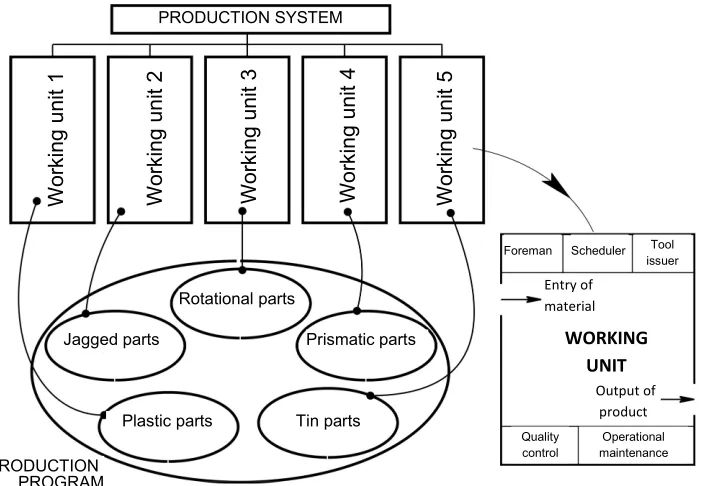
Working Unit has all the characteristics of Production Cell but besides its executive (production) independence it has to have an organizational and controlling independence too, which means its total responsibility for quantity, quality, and delivery terms of similar working objects, and also for organizing and managing of processes [15]. The final result is, as shown in Fig. 1 that the entire production program is divided in parts of the program - a group of objects, and the whole production system into independent operating units in which some parts
of the program are made. At the same time, each part of the production program consists of previously shaped operational groups of mutually very similar objects.
Apart from work places for production, as shown in Fig. 2, other resources join the composition of a working unit (technological preparation, operational preparation, distribution of materials and tools, process QA, operational maintenance), which gives independent (autonomous) unit – a part of production process which is fully capable to produce one separate component of production program. This approach in designing material flows in a production system provides a range of advantages, including the following most important ones:
significant simplification of material flows – with shorter transport paths,
simplified production management (each working unit is managed independently), production related problems, management,
quality control, maintenance, etc, are located in much smaller parts of the production processes – work units.
Fig. 2. Production system designed on the basis of Group approach
Work
ing
uni
t
1
Work
ing un
it
2
Work
in
g uni
t
3
Work
in
g uni
t 4
Work
ing un
it
5
PRODUCTION SYSTEM
Rotational parts
Jagged parts Prismatic parts
Plastic parts Tin parts
PRODUCTION PROGRAM
Foreman Scheduler Tool issuer
Quality control
Operational maintenance
Entry of material
Output of product
Presented Group approach in designing material flows has been applied in a large number of companies and described in details in [16] and [17], and the process of clustering and the formation of business units has been supported by a computer program system APOPS-08 [18].
The major advantages of Group technology have been reported in literature as reduction in setup time, reduction in throughput time, reduction in work-in-process inventories, and reduction in material handling costs, better quality and production control, increment in flexibility, etc., [19], [20] and [21].
3 ADVANTAGES OF THE APPLICATION OF GROUP APPROACH IN CLUSTER
ORGANIZATIONS
Productivity and productivity growth determine prosperity. Innovation is a key driver of productivity growth. Clustering supports both productivity and innovation. Porter's Diamond theory provides a useful concept that can help businesses, government and other institutions to explore improvements in the productivity environment. Various models and solutions have been extensively studied in literature. These models can be divided into the following categories:
Integration of production planning at the level of industrial clusters.
Integration of production planning at the level of companies within the industrial cluster. Integration of production planning and
distribution on the spot of procurement of raw materials, transport and distribution of semi or finished products to customers.
The aim of this paper is to present the application of the Group approach as a model of optimization of planning and programming production processes in complex organizational structures like clusters. The application of group technology in cluster produces savings and benefits in almost every area of the business: It combines tasks, equipment, gages, tooling
and schedules into larger groups of similar elements for similar solutions.
Purchasing can group similar parts and achieve quantity discounts. For non-standard purchased parts, grouping helps suppliers achieve savings and reduce price.
Accounting in industrial cluster is simpler in a group technology - costs are collected by cell and family rather than individual part.
Cluster production program can be diversified and composed of all products which are made by the member companies. Disparity in regional economic development is strongly influenced by the proportion of trade, local industries, resources and mix of organizations present in the cluster [22]. Participating companies can enter a cluster with only one part of their production program, and produce or distribute other products on their own, or in cooperation with companies which are not in their cluster. It is necessary to define basic products which are offered by a cluster, and adjustments of organizational and managerial cluster structures is done in regard to these products. Production program is further divided into structures and sub- structures, where individual requests towards cluster companies are defined for processing and assembling. Possibilities for process control and the shortening of production cycle depend on organization of a cluster.
Organization of the production process in a company is extremely complex process itself, and when we transfer it to the cluster level, we get a complex task which is difficult to solve. For the time being, there are no simple models developed which would enable an increase of process effectiveness in a complex organizational units like clusters. In that regard, this paper makes a pioneering attempt. One of the possible solutions which would decrease the complexity of flows and increase process effectiveness within a cluster is application of Group approach.
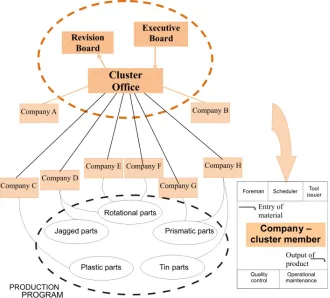
By applying a Group approach in complex cluster type organizational systems, the role of work units from the Fig. 2 is replaced by cluster member companies, as shown in Fig. 3. Previously, we stated that one of the significant characteristics of clusters is flexible specialization of companies for processing and assembling of structures and sub- structures from cluster production program. It enables the processing of structures and sub- structures with minimum costs and minimum time required.
Fig. 3. Production realization within a cluster in accordance with the Group approach
Application of the Group Technology on complex Cluster type organizational systems represents a new approach in creating effective production systems. Given approach is based on concepts of flexible specialization and Working Units with extended flexibility. Flexible specialization, as one of the basic advantages of Clusters, provides companies in Cluster to work on what they do best, for what they have trained labor force or technical-technological capacities, and still to have enough volume of work. Companies, Cluster members, considered from the aspect of flexible specialization represent Working Units of extended flexibility.
Having in mind that Companies participating in a Cluster can choose which part of the Cluster production program or production capacity they will be part of, then the same applies for branches of the Companies as well.
Application of the Group Technology covers many issues. On the basis of the Analyses of the methods applied in designing technological procedures and designing the organization of
work processes in Clusters on the territories of Serbia, Croatia, Slovenia and Italy, there have been determined the basic processes of Application of Group Approach on the level of an Industrial Cluster:
Harmonizing a common Cluster production program.
Classification of objects of work:
o Adjusting the Systems of Classifications of objects of work according to the increase of performances of technical-technological systems of Work Units with extended flexibility,
o Defining the Systems of Classifications of companies participating in Clusters and companies cooperating with a Cluster from the aspect of performances of technical-technological systems, organizational and managerial structures, o Defining correlations between the above
Adjusting organizational and managerial structures of Clusters and member companies which will provide both, a more efficient information flow amongst the companies in a Cluster and an increased quality in controlling working processes.
3.1 Harmonizing a Common Cluster Production Programe
Companies in a Cluster have to harmonize which products, assembles, subassemblies and parts are important on the Cluster level from the aspect of requests coming from the environment and from the aspect of companies participating in producing them. In that way, two basic goals are accomplished: directing activities towards fulfilling customer demands and creating the synergy effect amongst the companies participating in the production. Research carried out in the period 2007 to 2009 by the Center for Competitiveness and Cluster Development both individually and also participating in GIFIP1, and
UNIDO projects supporting development of the Cluster AC Serbia, demonstrate that without the existence of the above mentioned elements it is very difficult to accomplish effective functioning of Clusters.
1Bilateral cooperation programme Italy – Serbia :
Integrated Governance of productive companies in sectoral clusters (GIFIP)
3.2 Classification of Objects of Work
Production program of a Cluster can comprise a huge number of different elements - assembles, subassemblies or parts (Fig. 4a). These elements can differ in regard to shape, material, technical-technological specifics etc. Also, these elements are an integral part of different products which can be produced in different companies. For each of the individual elements produced in a Cluster, it is necessary to define the technological procedure starting from geometrical and technological characteristics of an element which, in case of a huge number of elements, requires a considerable waste of time. The Group approach has in its basis the procedure of grouping of objects according to their similarities. In order, from non-homogenous group of elements (Fig. 4a), to make a homogenous group of elements (Fig. 4b), it is necessary to have the existence of Unique System for Classification which is applied on the level of the whole Cluster. When the homogenous groups of elements are generated, then designing technological procedure for a Group is carried out.
a) b)
Finally designing individual technological procedures including utilizing the defined technological procedure for a Group as the starting point.
It is essential that due to similarities of elements in a Group, there are existing technological procedures covering the whole Group which reduces the waste of time in regard to individually defined technologies. Modification of an application of the Group approach in a Cluster also lies in the fact that the process of designing a Group technology is placed on the Cluster level - which significantly relieves resources of participating companies and decreasing the costs.
In practice, a series of more or less similar systems of classification have been developed. All developed systems provide gradual classification in terms of identifying classes, families and groups - types of parts with similar characteristics and specific measurement areas. Defining operational groups at the clusters level brings certain limitations in the implementation of classification systems. Classification system KS-IIS-08* developed for the needs of the industrial systems of geometrically shaped products, basically includes characteristics related to design operational groups in a relatively simple way. The structure of the system is schematically shown in Fig. 5.
Depending on the combination of technical-technological systems of companies, it is later chosen which company will process which group of selected parts including specific operations.
General characteristics of the above mentioned Classification system are the following:
classification label has 14 areas - features (1 to 14),
each feature has 10 fields (0 to 9), each field has a specific meaning.
Classification System KS-IIS-08*, shown in Fig. 5, represents the modification of the System which has been developed and utilized at the Faculty of Technical Sciences in many projects related to Application of Group Approaches for individual companies. Having in mind that homogenous groups of elements are created in regard to Working Units with extended flexibility – the degree of decomposition of Classification System is being kept on a lower level of details which simplifies the process of classification. It is also important to classify companies, or branches of companies, from the following aspects: type of industry, technical-technological potential, the degree of automation and organizational and managerial structures.
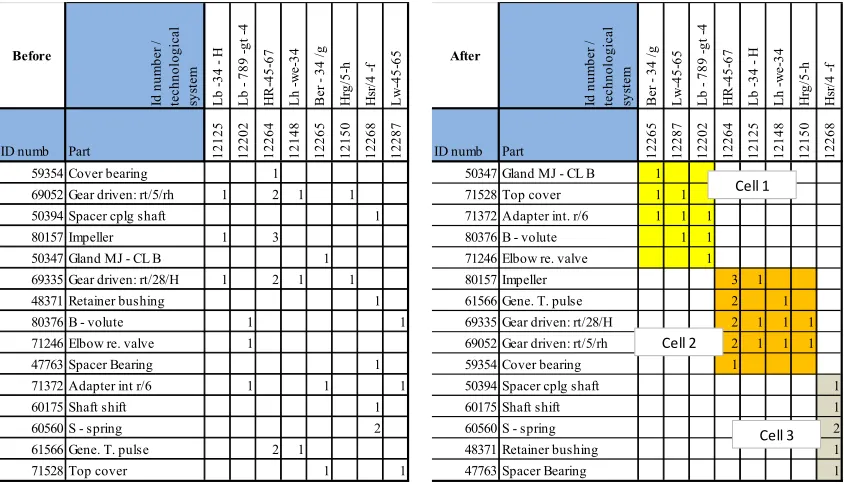
In order to reach the optimal choice of companies, in other words, the effective distribution of homogenous groups of objects of work amongst the companies, the following matrix shown in Fig. 6 is used. On its basis a comparison is done, comparing companies’ capabilities and technological requirements of a group of elements. In that way, the problem of participating companies having similar technical-technological potentials is being solved.
Before Id num be r / te ch nologi ca l sy st em Lb -3 4 H L b 789 -gt -4 HR -4 5-67 Lh -w e-34 B
er - 3
4 / g H rg/ 5-h Hs r/ 4 -f L w -45-65
ID numb Part 12125 12202 12264 14812 12265 12150 12268 12287
59354 Cover bearing 1
69052 Gear driven: rt/5/rh 1 2 1 1
50394 Spacer cplg shaft 1
80157 Impeller 1 3
50347 Gland MJ - CL B 1
69335 Gear driven: rt/28/H 1 2 1 1
48371 Retainer bushing 1
80376 B - volute 1 1
71246 Elbow re. valve 1
47763 Spacer Bearing 1
71372 Adapter int r/6 1 1 1
60175 Shaft shift 1
60560 S - spring 2
61566 Gene. T. pulse 2 1
71528 Top cover 1 1
After Id num be r / te ch nologi ca l sy st em B
er - 3
4 / g L w -45-65 L b 789 -gt -4 HR -4 5-67 Lb -3 4 H Lh -w e-34 H rg/ 5-h Hs r/ 4 -f
ID numb Part 12265 12287 12202 26412 12125 12148 12150 12268 50347 Gland MJ - CL B 1
71528 Top cover 1 1
71372 Adapter int. r/6 1 1 1
80376 B - volute 1 1
71246 Elbow re. valve 1
80157 Impeller 3 1
61566 Gene. T. pulse 2 1
69335 Gear driven: rt/28/H 2 1 1 1
69052 Gear driven: rt/5/rh 2 1 1 1
59354 Cover bearing 1
50394 Spacer cplg shaft 1
60175 Shaft shift 1
60560 S - spring 2
48371 Retainer bushing 1
47763 Spacer Bearing 1
Cell 1
Cell 2
Cell 3
Fig. 6. Uses a matrix of part numbers and machine numbers to group families
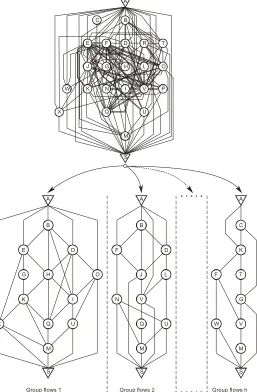
The result of the above mentioned activiti- es is demonstrated with decrease of system complexity (Fig. 7), creation of simplified and more effective information flows and creation of the basis for development of effective and efficient organizational and managerial structure of a Cluster. In Fig. 7, the expected result of the Application of Group Technology on the Cluster level is shown. Companies in the Cluster are marked with the characters of Alphabet, and flows of material and information are shown with the lines. Each group of products has its flow, which is defined on the Cluster level which enables easier control and consideration of possible critical points and possibilities for improvement. On the other hand, each innovation implies small changes in the layout of such arranged processing structures of Clusters.
The process of Adjusting organizational and managerial structures of Clusters and member companies is the next phase which shall provide utilization of established processing structures of Clusters.
4 PROGRAMMING AND PLANNING OF PRODUCTION IN CLUSTER
In order to achieve balanced utilizations of capacities, companies would have to submit their
production plans and engagement of their systems in advance, e.g. by utilizing IT technologies, and on the basis of these plans to make detailed plans at the cluster level. Any change of term-plan is recorded and must be available to all participating enterprises.
Many intersections in the system, diversity of procedures mutually connected with connections of different degrees of strength, courses and directions and a lot of feedback connections, hamper the process of managing to the great extent. Directed control procedures, in the case of artificial (man-made) systems, have basically mandatory character which provides designed system operations. However, in the case of natural systems, management procedures based on the homeostasis self-regulating principle, have a natural character and maintain a managed variable on the necessary level in the significantly narrower boundaries of tolerance fields and in significantly longer duration period.
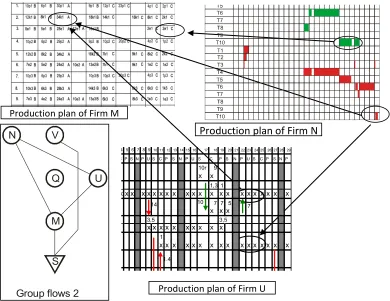
too. Only a full harmonization of working elements of the operational plans execution system - working processes – provides anticipated effects. Here is an illustration of what this concept means: We suppose that firms M, N, U are cooperating in the cluster. Firm M supplies (row materials and components) from firms N and U, and firm U supplies from firm N. If we want to apply a group approach, it is considered
that every firm has developed a management production system and that at the beginning of making an operating plan for the next period has a correct time schedule for all the processes in a firm. Plan of processes can be illustrated through matrix (firm M) or through Gantt chart (firms N and U). See Fig. 8. Deviations of the results of given phenomena leads also to deviations of designed effects.
A
A A A
S S S
C B
E
J
K W
X Q
M
S U F
G
N D
H
I R
L
V T
O
P
B B
D D
O
I
U U
E F
G
K N V
X
H J L F T
Q Q V
M M M
K C
G
W
Group flows 1 Group flows 2 Group flows h
Fig. 7. Simplified network of flows at the cluster level
The basic problems which condition the need for planning in the most of the production system are reduced to the following elements: maintenance of delivery deadlines,
control of the level of unfinished production,
minimization of waiting lines,
optimization of the sequence of inputs of orders in the working process,
elimination (minimization) of the time in the state of cancellation by providing integrated system support,
maintenance of a balanced relationship between the continuity of flow in the system and the cost of supplies (materials, participants, energy, money).
From the above mentioned, it is clear that data processing and information design about the system status in a specific cross-section, must be done continuously and in real-time in order to have the working process adjusted before entering the next cross-section of the system when needed. In this sense, there is no use to plan the status for the next day on the basis of the data from the previous week. Information about the status of the cross-section "i" must be the basis for planning the cross-section "i +1". The process must be carried out in real-time – therefore, at the end of
the operation that generates the status "i" it is necessary to design the status "i +1".
Knowing that with the hierarchy access there is practically no feedback connection between the system programming and system planning, the decisions made by system programming - operating plan (part of the production program stipulating the structure and the quantity that will be produced in the upcoming, accurately specified period of time) is not affecting decisions made in the planning stage, but is limiting them. Therefore, it becomes difficult to carry out the production plan taking into account the precise program for hierarchy systems.
It is necessary to make the integration of programming and planning systems for the sake of global optimization of processes in order to have industrial clusters functioning as one entity.
Production plan of Firm M
Production plan of Firm N
Production plan of Firm U
S
U
N V
Q
M
Group flows 2
4 5 6 7 8 910 11 12 13 14 15 16 17 18 19 20 21 22 23 24 25 26 27 28 29
C P S N P U S C P S N P U S C P S N P U S C P S N P
10r 9
x x
1,3 1
x x x x x x x x x x x x x x x x x x x x x x
7 7 5 x x x
3,5 3,5
x x x x x x x x x x
1
x x x x x x x x x x x x x x x x
14
1.4 10
7
The model of simultaneous planning and programming for more periods was suggested by Birewar and Grossmann [23], where programming decisions are built on the level of planning. It has been shown that planned profit increases significantly when planning and programming decisions are optimized simultaneously. The bad side of this approach is that the model of planning and monitoring is restricted to the specific category of simple problems because it requires an extremely large number of binary variables needed to solve the problems of integrated planning and programming.
5 CONCLUSIONS
Group technology adoption helps small organizations to acquire process competence and better process control. Investment in measurement and testing equipment leads to long term advantages. They can manufacture high precision products and get price advantage on these value added products as they grow through forward integration [24]. With this approach, a number of structural elements and a variety of relations between them are the basic parameters which define the complexity degree of organizational structure and simultaneously determine the complexity of cluster information flows. Therefore, the complexity degree of organizational structure determined upon those parameters enables a comparison of the designed structure variants using the quality defined as control adequacy. With process expertise they can also develop many new products and cater for the international market [25].
The system defined in this way enables high-performance production, and provides optimal use of capacities and great flexibility of the entire system. Such systems enable the production in small series with very low costs. Since there is a large number of small and medium-sized enterprises, any changes in processing, shaping or any changes of material are solved within a few enterprises either by replacement or purchase of a small number of machines or by including some companies with the required technology in the cluster. By doing so, a very fast reaction to any disorder or any changes is achieved. This means that the development processes are carried out
simultaneously because each company is assigned a task to develop a part of a product for which it is specialized. Thus, the development of shorter duration and an increased number of different combinations available for utilization is achieved.
6 REFERENCES
[1] Porter, M.E. (1979). How competitive forces shape strategy. Harvard Business Review, vol. 57, no. 2, p. 137-145.
[2] Porter, M.E. (1991). Towards a dynamic theory of strategy. Strategic Management Journal, vol. 12, p. 95-117.
[3] Hamel, G., Prahalad, C.K. (2002).
Competing for the Future. Tata McGraw-Hill Publishing Company Limited, New Delhi.
[4] Van Kirk, J.E., Noonan, K. (1982). Key factors in strategic planning. Journal of Small Business Management, p. 1-7.
[5] Besant, R. (2001). Nature of competition, firm behaviour, and performance. In: Morris, S., Besant, R., Das, K., Ramachandran, K., Koshy, A. (Eds.). The Growth and Transformation of Small Firms in India,
Oxford University Press, New Delhi.
[6] Porter, M. (1990). The Competitive Advantage of Nations, Free Press, New York.
[7] Marshall, A. (1925). Principles of economics, (8th ed.), Macmillan, London.
[8] Rosenthal, S.S., Strange, W.C. (2004).
Evidence on the nature and sources of agglomeration economies. Forthcoming in: Handbook of Urban and Regional Economics. Volume 4. Amsterdam.
[9] Porter, M.E. (1998). Clusters and the new economics of competition. Harvard Business Review, vol. 76, no. 6, p. 77-90.
[10] Malizia, E.E., Feser, E.J. (1999).
Understanding Local Economic Development. Center for Urban Policy Research, New Brunswick.
[11] Burbidge, J.L. (1978). The introduction of group technology. Heineman, London. [12] S. P. Mitrofanov, (1966) Scientific Principles
of Group Technology, English Translation Boston Spa: National Lending Library, London.
production. Mašinostroenie, Moscow. (In Russian)
[14] Burbidge, J.L. (1963). Production flow analysis. Journal of the Institution of Production Engineers, vol. 42, p. 742-752. [15] Maksimovic, R., Lalic, B. (2008) Flexibility
and Complexity of Effective Enterprises;
Strojniški vestnik - Journal of Mechanical Engineering, vol. 54, no. 11, p. 768-782. [16] Zelenovic, D.M., Tesic, Z.M. (1988). Period
batch control and group technology,
International Journal of Production Research, vol. 26, no.4, p. 539-552.
[17] Zelenovic, D., Cosic, I., Maksimovic, R., Radakovic, N. (1998). The IIS - Approach to Design of Effective Industrial Systems Structures. International Journal of Industrial Systems, vol. 1, no. 1, p. 5-16. [18] Zelenovic, D., Cosic, I., Sisarica, Z., Sormaz,
D., 1986: APOPS - Automated procedure for production systems design. FTN - Industrial Systems Institute, Novi Sad.
[19] Wemmerlov, U., Hyer, N.L. (1989). Cellular manufacturing in the U.S. industry: A survey ofusers. International Journal of Production Research, vol. 27, no. 9, p. 1511-1530. [20] Shankar, R., Vrat, P. (1999). Some design
issues in cellular manufacturing using the fuzzy programming approach. International Journal of Production Research, vol. 37, no. 11, p. 2545-2563.
[21] Olorunniwo, F., Udo, G. (2002). The impact of management and employees on cellular manuft. implementation. International Journal of Production Economics, vol. 76, no. 1, p. 27-38.
[22] Porter, M.E. (2003). The economic performance of regions. Regional Studies,
vol. 37, no. 6-7, p. 549-578.
[23] Birewar, D.B., Grossman, I.E. (1990). Simultaneous Synthesis, Sizing, and Scheduling of Multiproduct Batch Plants.
Ind. Eng. Chem. Res., vol. 29, p. 2242-2251.
[24] Murray, J.A. (1984). A concept of entrepreneurial strategy. Strategic Management Journal, vol. 5, p. 1-13.
[25] Prater, E., Ghosh, S. (2005). Current operational practices of U.S. small and medium-sized enterprises in Europe, Journal of Small Business Management vol. 43 no. 2, p. 155-169.
[26] Swann, P., Prevezer, M. (1996). A comparison of the dynamics of industrial clustering in computing and biotechnology.
Research Policy, vol. 25, p. 1139-1157. [27] Porter, M. (1998). Clusters versus industrial
policy. On Competition, HBS Press.
[28] Swamidass, P.M., Newell, W.T. (1987). Manufacturing strategy, environmental uncertainty and performance: a path analytic model. Management Science, vol. 33, p. 509-524.
[29] Boynton, A.C., Victor, B. (1991). Beyond Flexibility: Building and Managing the Dynamically Stable Organization. California Management Review, vol. 34, no. 1, p. 53-66.
[30] Broekhuizen, T.L.J., Alsem, K.J. (2002). Success Factors for Mass Customization: A Conceptual Model. Journal of Market-Focused Management, vol. 5, no. 4, p. 309-330.
[31] Hauser, D.P., de Weck, O.L. (2007). Flexibility in component manufacturing systems: evaluation framework and case study. Journal of Intelligent Manufacturing, vol. 18, no. 3, p. 421-432.
![Fig. 1. Working Unit (WU) – the basic changes in approaches for production structures designing a)Individual Approach to Flows Designing; b) Group Approach to Flows Designing [15]](https://thumb-us.123doks.com/thumbv2/123dok_us/8952630.1861998/3.539.128.409.380.638/approaches-production-structures-designing-individual-designing-approach-designing.webp)