Iranian journal of educational Sociology
(Interdisciplinary Journal of Education) Available online at: http://www.iase-idje.ir/
Volume 2, Number 1, March2019
Reliability, Validity, and Factor Structure of Teachers’ Success
Evaluation Questionnaire
Hamidreza Elhami1, Malek Mirhashemi 2, Hasan pasha Sharifi3 1. PhD Student, Department of Psychology, Roudehen Branch, Islamic Azad University, Roudehen, Iran.
2. Associate Professor, Department of Psychology, Roudehen Branch, Islamic Azad University, Roudehen, Iran. 3. Professor, Department of Psychology, Roudehen Branch, Islamic Azad University, Roudehen, Iran.
Article history:
Received date: 10 August 2018 Review date: 15 November 2018 Accepted date: 25 Aguste 2019
Abstract
Purpose: The purpose of this study was to design and test the structural model of the effects of life experiences, personality traits and thinking styles on the success of teachers with the mediation of job interests.
Methodology: In order to achieve this goal, 234 teachers were selected using a cluster sampling method among high school teachers in Bojnourd city as the sample of this study. At first, their success rate was assessed by managers and students through a researcher-made questionnaire. Then Sternberg-Wagner Stress Thinking Styles Questionnaire, Five Factor Questionnaire, Short Form Personality Traits, Job Awareness Questionnaire and Researcher-made Life-Exercise Questionnaire were completed by the teachers. At first, the descriptive characteristics of the data from the research sample were examined. In the next step, based on the path analysis method, the research model was extracted based on the relationships between the variables and finally, the fit of the extracted model with the experimental data was evaluated using the structural equation modeling method.
Findings: The results indicated that the personality traits of psychosis, extroversion and direct consistency, and personality trait of conscientiousness indirectly through external job interests, have a significant effect on the prediction of teachers' professional success. Also, Kurds of thinking styles, cognitive thinking, forms of thinking styles, group thinking, levels of thinking styles, holistic thinking, and the domains of thinking styles, external thinking, and the forms of thinking, thinking, and marital styles are also Both indirectly and indirectly through interpersonal and interpersonal interests, and the work of thinking styles, peer-to-peer, indirectly through external job interests, coefficients have a significant effect on the prediction of the professional success of teachers.
Conclusion: successful teachers include content knowledge, teaching skills, classroom management, communication skills and motivation, creativity development, interaction power.
Keywords:
Life experiences, thinking styles, personality traits, job interests, teachers' success
Please cite this article as: Elhami H, Mirhashemi M,pasha Sharifi H. (2019). Reliability, Validity, and Factor Structure of Teachers’ Success Evaluation Questionnaire. Iranian journal of educational Sociology. 2(1), 94-103.
Corresponding Author Email: [email protected]
1. Introduction
Earning success in various fields, including career, academic, economic, family and ... success has attracted scholars and scholars as an inherent desire for man in different periods. One of the key areas for success that can be effectively influenced by other areas is job success. Experts have studied the success of the work from different angles and dimensions presented a framework for categorizing how job succession operates, distinguishing between objective job success and mental success. Specifically, he defines objective success as being directly measured, proven, and impartially by a neutral third party. While mental success is only directly experienced by the individual himself involved in the job (Heslin, 2005).
Judge, Cable, Boudreau & Bretz (1994) define job success as positive psychological outcomes related to work and work experience. Their findings indicate that variables that lead to objective job success often vary greatly in terms of mental success variables. The categorization of the results of job success is also consistent with the distinction between objective and subjective job achievement that has been cited in most professional studies. Objective job success focuses on external criteria defined by an expert, peer, culture or community. Mental job success reflects a person's perception of job experience. Based on the success of the individual's job as a set of accomplished results in accordance with personal, professional or organizational contexts. In addition, he classifies five after professional results: (1) promotion: involves advancement in hierarchy, power, career, reputation, independence, entrepreneurship and control; (2) learning: in order to acquire the ability New skills and competencies, (3) physiological and biological aspects: security, purchasing power and labor, (4) psychological: satisfaction, belonging, self-esteem and self-esteem, and. (5) the quality of life and the balance of work and life (Rasdi, Garavan,and Ismail, 2011).
While the effect of the objective success on the mental experiences of their job success is clear, on the other hand, mental success experiences also affect the individual's objective achievement, so that mental success can increase self-esteem or increase the incentive for an attempt to reach to be targeted. In turn, these motivational effects lead to objective success over time (Abele & Spurk, 2009).
A meta-analysis categorizes job market prospects into four categories: human capital (work orientation, working hours, education levels, international experience, knowledge and political skills), organizational support (supervisor support and organizational resources), Socio-demographic status (age, sex, marital status), persistent individual differences (personality characteristics) (Ng, Eby, Sorensen & Feldman,2005). Karavardar (2014) in his research showed that professional commitment is a predictor of job success. In this study, she showed that job commitment also directly predicts a part of job success and also affects job satisfaction as a mediating variable on job success. Chen (2012) has also shown that training, personality and organizational support are three of the predictors of job success.
Differences in the type of occupation offer different definitions of job success and success criteria. Effective teaching and teaching features The successful and successful teacher is one of the topics that many studies and studies have done to identify and set clear and distinct criteria from different perspectives. Teachers have important responsibilities in enhancing the educational process. Their effectiveness and effectiveness are influenced by upgrading, supporting, job security, technology level, responsibility and, of course, a work plan that all is largely determined by the institutions, as well as by non-cognitive features such as age, gender, the family structure is ultimately affected by certain types of personality traits, attitudes and behavior, social values, qualifications, and other dimensions of personality (Ayan & Kocacik, 2010). Teachers' constructivist views are considered to be a specialist who do not directly meet the needs of students, but provides the conditions that students themselves recognize and meet their needs (Kadivar, 2006).
According to these theories, the teacher does not distribute knowledge, but serves as a guide, facilitator, and student helper alongside him and encourages him to question and formulate the hypotheses of his thoughts and achievements. While teachers' behavioristic perspectives seek to realize the content of the curriculum and try to develop the knowledge of the great ideas through the micro components of it. In this view, students take the role of the recipients of knowledge and information and the role of the teacher of this knowledge, according to the teacher's social learning theory, plays a role as a role model and forms the learning process (Saif, 2014).
In all perspectives, what is clearly seen is the presence of a full teacher, but with different roles, the degree and effectiveness of his change.Good teachers can students' thinking skills and foster the growth of her ease, as well as the class of the outcome, your lessons with high quality, to learn students to evaluate, themselves with the situation (Glover, 2006) A significant part of the research shows that student achievement is influenced by the relationships meaningful between teachers and students (Rust, 2014). While inappropriate or negative relationships can impede student performance and a sense of value in the classroom (Rust, 2014).
Walker (2008) For fifteen years through student surveys What did your own most effective and memorable teachers have? Twelve characteristics of teachers 'profiles are based on students' opinions. Accordingly, effective teachers have these features were: Preparation Time attend class, having a positive attitude about school and education, having high expectations for all students, creativity in teaching classes, fairness in dealing with students and grading them, showing a character accessible to all students, create a sense of belonging in the classroom, having a sense of humor and a serious lack of issues, respect for students' failure to make fun of them, gracious and heart failure grudge students and admit their mistakes .
Axelrod (2007) points out that the teacher's characteristics and effective instruction identified by the students are consistent with the studies of his historical memories and his collected biographies. Good teachers are recognized and remembered beyond time, place, discipline, and type of organization with seven features: accessibility, justice, open mindedness, mastery in teaching materials, enthusiasm, wit and inspiration. Marjorie, Bogner & Holmberg (2011) believe that in order to be effective and effective, it must be understood that the learner must be more than one passive recipient of knowledge, involved in the process of learning actively and through the teacher's attention. What is effective in teaching is the teacher modeling, which is shown through the teacher's personality, positive attitude and excellence, experience in education, talent, motivation, and general desire to learn learners.
Studies show that the wit, the fun of the classroom, and the mastery of content knowledge are the most important characteristics of a good teacher from the perspective of students (Santrock, 2008). Students challenge the characteristics of extremely effective teachers with rational expectations, sense of humor, enthusiasm, creativity, care, good explanation of complex subjects, flexible learning styles, accessibility, and interest in students., And organization (Malikow, 2006).
Moreno (2010) knows what makes an effective teacher a set of knowledge and professional skills: professional knowledge, professional skills. DeePa & Manhisha (2014) identified effective teaching factors for students as follows: classroom management style, performance appraisal of students, inspiration, teaching style, communication skills, and attitude. Delaney, Johnson, Johnson, and Terslan (2010) reported the characteristics of effective teacher-student attitudes as follows: Respect for students, informed and knowledgeable, accessible, attractive, verbal, disciplined, responsive, professional E and wit. Researchers in educational psychology have found that teachers who are capable of organizing and directing classroom activities are more effective than teachers who care about their disciplinary roles (Santrock, 2008). Dincer, Goksu, Takkac and Yazici (2013) categorized the main characteristics of English teachers in four categories, namely: socio-emotional skills, knowledge-based skills, subject knowledge and personality traits. Additionally, an effective teacher should have a combination of these four main attributes.
Shahmohammadi (2015) found that students 'perception of teacher's behavior and personality's ability to manage a class was more effective in examining students' viewpoints about teachers. Also, if teachers are mild, active and friendly, and at the same time serious and supportive of the students, they can be more effective teachers and these are more important than managing the class. At the same time, they emphasized the importance of teachers' knowledge compared to classroom management. The review of Suwanadee shows that from the perspective of successful student students, one has a good knowledge of the subject of teaching, providing difficult materials that can be readily available to students. Understand, eager to help students in and out of class, enter the class with good readiness and explain the content well (Mo'aphiyan and Pishghadam,2009).
Slavin (2008) in addition to intimacy, humor, planning, hard work, self-discipline, leadership, passion, love of learning and verbal ability, knowledge of the subject, dominate teaching skills, ability and importance to the people. He considers the necessities of a good teacher. Because of the particular complexity and individual differences of students, teachers must be flexible in their attitudes and strategies and in their applications. Effective teachers have a good command of the content of the course and the main skills they teach. They use higher education strategies based on targeting methods, educational planning and classroom management, and they know how to motivate. Communicating environmental influences Provides and maintains where learning is possible. In order to create this optimal learning environment, the teacher provides a set of strategies for establishing rules and agenda, grouping, monitoring, and timing of classroom activities and alternatives. It requires equal treatment. Effective science is a good strategy to help The learners to achieve their learning motivation. They know that when students can make choices based on their personal interests, they are more excited. Such teachers give them opportunities for creative and profound thinking about their projects (Santrock, 2008).
Mo'aphiyan and Pishghadam (2009) In the construction and validation of the questionnaire, the characteristics of successful teachers identified the characteristics of successful teachers as 12characteristics of successful teachers: educational ability, social relationships, attention to all, exam, commitment, learning facilitator, empowerment, facilitators Teaching, physical and emotional acceptance, empathy, class attendance, and teaching dynamics. It has been found that students at different levels of primary, secondary and higher education are able to measure the classroom environment and provide a reliable, reliable, reliable and ranking of the behavior, assessment and teacher attributes (Driscoll, Peterson, Crow & Larson, 1985; Khodadadi, 2015).
In summarizing the ideas and researches in the field of defining a successful teacher there is a very high level of participation. This suggests that beyond the subject of teaching, the length of teaching, the discipline, the time and place of teaching, and the individual differences (academic, age, gender, etc.), the characteristics of a successful teacher can be found in a set of components, including mastery The content of the course is a high academic and academic knowledge in the field of subject and subject, having content presentation skills or, in other words, the mastery of teaching and learning methods, the ability to manage and direct classroom, create classroom attractiveness, and the ability to motivate students to Learning and progress. Many attempts have been made to measure the success of teachers based on some of these indicators and other criteria that are less popular. But a tool that clearly and comprehensively does not provide all the criteria for sharing all the basics and research. Therefore, this research aims to build a tool that can measure and evaluate the teacher's success rate, especially during work and teaching, based on the viewpoint of students. The main objective of this study was to investigate the validity and validity of the teachers' success assessment questionnaire. In general, this research sought to answer the following questions: (1) Is there a sufficient internal consistency between the teachers' internal evaluation questionnaire? (2) Is the questionnaire to measure the success of teachers as a general saturation factor? (3) The sum of the questions of the teachers' success assessment questionnaire is saturated with a few significant factors?
2. Methodology
This research has been done with the aim of constructing, validity, validity, and factor structure of the questionnaire for measuring the success of teachers from the viewpoint of students. Based on theoretical foundations, the results of the research, the views of the experts and practitioners of education, were identified and extracted from the main characteristics and components of the success and popularity of teachers. Accordingly, a set of phrases that can be used to determine the success of teachers on the basis of these characteristics. The terms were developed by the experts. After summarizing and applying the initial opinions, the prototype of the questionnaire was prepared on the basis of the components and was identified and modified to assess the level of transparency and comprehensiveness of the terms in the two classes and ambiguities. The revised terms were reinstated by the experts and their factual validity was confirmed. Eventually, 43 questions were prepared for the introductory course. A questionnaire was used on a pilot sample and the results were analyzed for internal consistency estimation through Cronbach's alpha. Then the questions with lower coefficients were removed from the set of questions and the remaining questions included 23 questions in the final form.
The statistical population of this study included secondary school students in Bojnourd in the academic year of 2016-2017. To select the sample, by selecting a multi-stage cluster sampling, first 15 high schools were selected and, after reviewing the curriculum of each high school, the characteristics of all the teachers taught were extracted. Next, for each secretary, two classes were considered, so that for each teacher, two classes of students respond to the questionnaire questions. A total of 1404 students were selected as a sample. Following the necessary explanations and justification of the students and confidence in them in order to answer accurately and honestly, a questionnaire was provided to them and they were asked to comment on the questions raised in the questionnaire regarding the secretary listed in the questionnaire. In the Likert spectrum, five degrees out of a high (5) to very low (1). In total, students completed 304 questionnaires. To ensure that students respond to questions based on the correct knowledge of the teachers, the questionnaires were completed later in the school year (May), when the students arrived at a comprehensive understanding of the teachers.
Measurement Tool: The research instrument is a questionnaire consisting of 19 articles that are based on theoretical foundations, research findings, viewpoints of professors, educators and practitioners to assess the main characteristics and components of the success and popularity of teachers. In this questionnaire, the student is asked to indicate his or her opinion about the relevant teacher based on the Likert spectrum from very high to very low. In the questionnaire, the score of 5 is very high and the first is assigned very low.
3. Findings
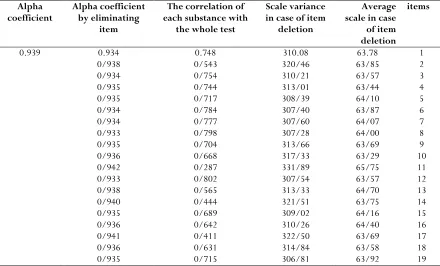
Given that the main objective of this study was to identify the success factors of teachers, in order to analyze the data and identify the major factors through the implementation of a questionnaire containing 19 questions, the method of estimating the internal consistency between females (Cronbach's alpha) and exploratory factor analysis through The analysis of the main components was used. In this study, in order to estimate the reliability of the material characteristics, the questionnaire, which requires one-time execution of the test, was used. In this method, the internal consistency of the test materials, ie the degree of interference of all questions in terms of measuring a common characteristic, was estimated by calculating the Cronbach's alpha coefficient. As shown in Table 1, the coefficient of validity (internal consistency) of teachers' achievement measurement questionnaire is equal to 0,939. The calculations of the Cronbach's alpha coefficient for the whole group and the correlation coefficient of each question with the total score with mean, variance and correlation in the removal of each question in the table are shown. It can be concluded that almost all questions are the same. Also, the questions almost have the same variance and
have a relatively similar situation. The range of correlations is between 0,287 (Article 11) and 79,88 (Article 8). At the same time, deleting any questions does not help much to increase the credit factor. At the end, the coefficient of validity for 19 of the 367 subjects is 0,939.
Table 1. Summary of statistical indicators related to estimating the coefficient of validity (internal consistency) of teachers'
items Average scale in case of item deletion Scale variance
in case of item deletion The correlation of
each substance with the whole test Alpha coefficient by eliminating item Alpha coefficient 1 63.78 310.08 0.748 0.934 0.939 2 85 / 63 46 / 320 543 / 0 938 / 0 3 57 / 63 21 / 310 754 / 0 934 / 0 4 44 / 63 01 / 313 744 / 0 935 / 0 5 10 / 64 39 / 308 717 / 0 935 / 0 6 87 / 63 40 / 307 784 / 0 934 / 0 7 07 / 64 60 / 307 777 / 0 934 / 0 8 00 / 64 28 / 307 798 / 0 933 / 0 9 69 / 63 66 / 313 704 / 0 935 / 0 10 9 2 / 63 33 / 317 668 / 0 936 / 0 11 75 / 65 89 / 331 287 / 0 942 / 0 12 57 / 63 54 / 307 802 / 0 933 / 0 13 70 / 64 33 / 313 565 / 0 938 / 0 14 75 / 63 51 / 321 444 / 0 940 / 0 15 16 / 64 02 / 309 689 / 0 935 / 0 16 40 / 64 26 / 310 642 / 0 936 / 0 17 69 / 63 50 / 322 411 / 0 941 / 0 18 58 / 63 84 / 314 631 / 0 936 / 0 19 92 / 63 81 / 306 715 / 0 935 / 0
In order to answer the question, is the questionnaire studied as a general saturation factor? The principal component analysis (PC) method was used. Based on this method, which is a descriptive-exploratory method, in this study Varimax rotation was used to determine the final answer and to identify the factors or factors that may be the basis of the materials of the questionnaire and also to determine its simple structure. The size of the KMO reflects the adequacy of the sampling and indicates that the correlation between the pair of variables cannot be determined by other variables, and in this situation the application of the operating model may not be appropriate. In this study, the amount of KMO is excellent (0,948).
Table 2. KMO Size and Bartlett Test
0 . 948
Kieser-Miller-Olkin Sampling Sufficiency Index
4394.706 X2
Bartlett's Curry Test
171 Degree of freedom
0.001 Sig
The table highlights the KMO (sampling adequacy) value of 0,948 and the significance level of the Bartlett Curve test is 0,001. Therefore, in addition to the adequacy of sampling, the implementation of factor analysis based on the correlation matrix of the study can also be justified.
Table 3. Primary Statistical Characteristics of the Questionnaire for Assessing the Teachers' Success by Main Components Analysis
items Special Initial Values
Total squared of extracted factor loads The sum of squares of rotated
factor loads total Variance Cumulativ total Variance Cumulativ total Variance Cumulative
percentage e percent percentage e percent percentage percent 1 529 / 9 154 / 50 154 / 50 529 / 9 154 / 50 154 / 50 884 / 5 967 / 30 967 / 30 2 447 / 1 616 / 7 770 / 57 447 / 1 616 / 7 770 / 57 158 / 4 886 / 21 853 / 52 3 141 / 1 006 / 6 776 / 63 141 / 1 006 / 6 776 / 63 075 / 2 923 / 10 776 / 3 6 4 863 / 0 545 / 4 320 / 68 5 683 / 0 595 / 3 915 / 71 6 630 / 0 314 / 3 229 / 75 7 546 / 0 873 / 2 102 / 78 8 519 / 0 733 / 2 835 / 80 9 481 / 0 530 / 2 365 / 83 10 474 / 0 495 / 2 860 / 85 11 427 / 0 245 / 2 105 / 88 12 396 / 0 082 / 2 187 / 90 13 366 / 0 925 / 1 112 / 92 14 349 / 0 838 / 1 950 / 93 15 285 / 0 499 / 1 449 / 95 16 260 / 0 369 / 1 818 / 96 17 238 / 0 250 / 1 068 / 98 18 196 / 0 031 / 1 100 / 99 19 171 / 0 900 / 0 00 / 100
As it is seen in Table 3, the special values are three factors larger than one, among which the value of the individual factor (9;529) has a significant difference with the value of the other factors. The second factor has a specific value of 1,447. These three factors justify a total of %776,36 of the total variance among the 19 items studied. Thus, if three factors are extracted from the set of questions, %30,698of the variance among the questions is explained by the first factor. However, paying attention to the specific values of the three factors, it is likely that a general factor dominates all material of the questionnaire. The extracted factors were transferred to the new axis by using the Varimax rotation until both the discovery of the general material of the questionnaire and the identification of a simple structure showing relatively clear main lines to reach the alternating paths. This rotating agent matrix is shown in Table 4 by main component analysis.
Table4. Rotational Matrix of Three Variables of Varimax Teachers' Successfulness Questionnaire
Items factors Factor 1 Factor 2 Factor 1 762 / 0 2 770 / 0 3 690 / 0 4 807 / 0 5 519 / 0 6 648 / 0 7 606 / 0 8 514 / 0 580 / 0 9 742 / 0 10 761 / 0 11 656 / 0 12 648 / 0 497 / 0 13 769 / 0 14 769 / 0 15 441 / 0 9 56 / 0 16 705 / 0 17 784 / 0
18 654
/ 0
19 536
/ 0 482
/ 0
The first factor is correlated with questions that are related to the teacher's success rate questionnaire with teaching skills and subject knowledge. Factor-bearing materials in this factor are 1, 2, 3, 4, 5,8, 9, 10, 11, 12, 18, and 19. The largest factor load is Article 4. The second factor is correlated with questions that are called communication skills teachers in measuring the success of the teachers. Factor load factors in this factor are6,7, 8, 11, 16, 15, 13, 12, 19 (Articles12, 19, 15, overlapping with the first factor), is the largest factor load belonging to Article 13. The third factor correlates with questions that are related to the ability to manage teachers in the success of the measure of success. Factor-bearing material in this factor is 14 and 17. The largest factor load is Article 17.
4. Discussion
Teacher as a determining factor in the process of teaching provides a range of responsibilities and activities in different dimensions and areas. The development of thinking, ease of growth, good class management, good presentation of the lesson and adaptive power are considered to be good teachers. Studies (Walker, 2008; Santrock,2008) have identified a fascinating and attractive environment in the classroom as one of the teachers' success criteria. Also, studies show that (Dincer, Goksu, Takkac and Yazici,2013; Moreno, 2010) students identified the ability to make subject knowledge and presentation skills as the teachers' success indicators. In his studies, Marjouri, Bohner and Holmberg (2011), Santrock (2008), Delaney,Johnson,Johnson,and Terslan (2010), Shahmohammadi (2015), in their studies, respect students and have a positive attitude towards students is necessary for the success of teachers. They are Emphasis on the active role of students in their dynamism and their creativity in many of the ideas and views of education, including constructivism, has been emphasized as a necessity for the full development of students (Saif, 2014). Walker (2008) Slavin (2006) and DeePa & Manhisha (2014) assessed the ability to manage class, motivation, justice, and ability to develop as indicators of successful teachers from the perspective of students.
The success of plans, programs and the realization of the goals of the education system is largely dependent on the performance of teachers. Accordingly, evaluating the effectiveness and success of teachers as a necessity has always been the focus of the attention of practitioners in the field of education. Various sources can be used in this assessment, including self-assessment of teachers, assessment by authorities and managers, by the parent, as well as by students. But what should be considered as an important and important issue is that teachers, classrooms and students mean each other; the greatest number of teachers attends classrooms and students. As a result, a large part of the academic performance and student developmental outcomes are affected by a variety of skills, abilities and abilities of teachers. However, one of the most trusted sources for assessing the teacher's success is the students' perspective about them. Evaluation of students' abilities and characteristics by students as an accepted method has attracted many researchers. Studies show: Students at different levels of study can provide reliable and stable resources for teachers' assessment.
Managers and administrators of the education system need to investigate and identify the strengths, weaknesses, and extent of realization of the goals of their field of activity. The assessment of all teachers' activities as an important part of this process is also inevitable in order to improve the level of efficiency. In
addition, teachers need to Getting accurate information and feedback are all about the effectiveness of the whole process of teaching and learning, in order to identify the strengths of the defeat, in order to promote the qualitative and quantitative development of self-management. This important need has been a reliable tool and useful information. Provide users with the right. In this research, based on theoretical foundations and studies of the studies, the most important indicators of successful teachers include content knowledge, teaching skills, classroom management, communication skills and motivation, creativity development, interaction power, creating attractiveness and vitality in the classroom, understanding needs and The characteristics of the students were extracted and a questionnaire based on these indicators was made up of 19 items. The results show that the coefficient of validity (internal consistency) of the Cronbach's alpha coefficient questionnaire for the whole group is equal to 0,939. The value of the coefficient of validity of this questionnaire is desirable. To determine that the sum of the terms of the teacher's success assessment questionnaire has been saturated with a number of significant factors, the specific values of the results showed that the special values of the three factors are greater than one, among which the specific value of the first factor (9,529) There is a significant difference between the second and third factors. Thus, if only 3 factors are extracted from the total of questions, about %31 of the variance of the questions among the questions is explained by the first factor. The results of the analysis of the extracted factors using varimax rotation showed that the first factor correlated with the questions that are related to the teacher's success rate questionnaire with teaching skills and subject knowledge. The biggest factor in Question 4 is (Do you think the teacher has sufficient control over the content of the course he teaches?). The second factor correlates with the questions that are related to communication skills in the questionnaire of teachers' success. The biggest factor in Question No.13 is the non-book material that is related to the subject in the classroom?). The third factor correlates with the questions that are related to the ability to manage teachers' success in the questionnaire(Does this teacher discriminate between students?
This research has been done to meet this need with the aim of constructing, validity, validity and factor structure of the questionnaire of assessing the success of teachers from students' point of view with great care in favorable psychological, temporal and spatial conditions on a wide range of samples, and from The psychometric properties are very favorable. The shortness of the questionnaire as a motivational factor for accountability, clarity and clarity of phrases according to the students' cognitive level, easy implementation, the ability to be implemented on girls and boys in different fields of secondary education, and also the ability to assess teachers Men and women in all areas of teaching are among the benefits of this questionnaire. As a result, it can be used by teachers and administrators, school administrators and teachers to achieve the goals of this questionnaire.
References
Abele Andrea E, Spurk D. (2009). How do objective and subjective career success interrelate over time? Journal of Occupational and Organizational Psychology, 82, 803–824.
Axelrod P. (2007 November 1). A history of good teaching: Student perspectives academic Matters. Presented in The David C. Smith Award lecture.
Ayan S, Kocacik F. (2010). The Relation between the Level of Job Satisfaction and Types of Personality in High School Teachers.
Australian Journal of Teacher Education, 35(1), 27-41.
Chen Yu. (2012). Career success and its predictors: Comparing between Canadian and Chinese. International Journal of Business and Management; 7: 14; 88-95.
Deepa S, Manisha S. (2014). An exploratory study of student perception of instructor traits in effective learning. Universal Journal of Management; 2(1): 1-8.
Delaney J, Johnson A, Johnson T, Treslan D. (2010). Students’ perceptions of effective teaching in tertiary education. St. John’s, NL: Distance Education and Learning Technologies.
Dincer A, Goksu A, Takkac A, Yazici M. (2013). Common characteristics of an effective English language teacher. The International Journal of Educational Researchers, 4(3): 1-8.
Driscoll A, Peterson K, Crow H, Larson B. (1985). Student reports for primary teacher evaluation. Educational Research Quarterly, 9(3): 43-50.
Glover A, Bruning H. (2006). Educational Psychology: Principles and Applications. (Ali naghi Kharazi translation). Tehran: Academic Publishing Center.
Heslin P A. (2005). Conceptualizing and evaluating career success. Journal of Organizational Behavior. 26(2), 113–136.
Judge T A, Cable D M, Boudreau J W, Bretz R D. (1994). An empirical investigation of the predictors of executive career success (CAHRS Working Paper #94-08). Ithaca, NY: Cornell University, School of Industrial and Labor Relations, Center for Advanced Human Resource Studies.
Kadivar P. (2006). Educational Psychology. Tehran: the side.
Karavardar G. (2014). Career Commitment, Subjective Career Success and Career Satisfaction in the Context of Hazelnut Processing Industry in Giresun/Turkey. International Journal of Business and Management, 9(6); 98-105.
Khodadadi E. (2015). Teacher effectiveness, educational grade and English achievement. Theory and Practice in Language Studies, 5(8), 1552-1562.
Malikow M. (2006). Effective teacher study. National Forum of Teacher Education Journal, 16(3): 1-9.
Mo'aphiyan F, Pishghadam R. (2009). Preparation and validation of the structure of the questionnaire of the characteristics of successful English language instructors. Foreign Languages Research, 54: 142-137.
Moreno R. (2010). Education psychology. New York: John Wiley & Sons.
Ng T W H, Eby L T, Sorensen K L, Feldman D C. (2005). Predictors of objective and subjective career success. A meta-analysis. Personnel Psychology, 58(2): 367-408.
Rasdi R M, Garavan T N, Ismail M. (2011) Understanding proactive behaviors and career success: Evidence from an emerging economy. Organizations and Markets in Emerging Economies, 2 (4): 53-71.
Rust A. (2014). Relationship between the emotional intelligence teachers and student academic achievement. PhD. dissertation in Education, College of Education, University of Kentucky
Saif A A. (2014). New psychology. Tehran: the era.
Santrock John W. (2008). Educational Psychology. (Translation by Shahede Saeedi, Mahshid Araghchi, Hossein Daneshfar). Tehran: Resa. (Date of publication in original language).
Schiering Marjorie S, Bogner D, Buli-Holmberg J. (2011). Teaching and learning: A model for academic and social cognition. Published by Rowman & Littlefield Education.
Shahmohammadi N. (2015). Competent teacher characters from student’s point of view. Procedia-Social and Behavioral Sciences, 205: 242–246.
Slavin Robert Y. (2008). Educational Psychology is a theory and practice. Eighth Edition (Yahya Seyyed Mohammadi translation). Tehran: Psycho.
Walker Robert J. (2008). Twelve characteristics of an effective teacher: A longitudinal, qualitative, quasi-research study of in-service and pre-in-service teacher’s opinions. Educational Horizon, 87(1): 61- 68.