IPA
International Journal of Psychology Vol. 10, No. 1, Winter & Spring 2016
PP. 144-178
Iranian Psychological
Association
The Direct and Indirect Relationships of
Emotional Intelligence with Mental Health and
Academic Performance with the Mediating Role
of Resiliency and Self-Efficacy in Medical
Students of Ahvaz Medical Sciences University
Leila Farhadi Motlaq, MA
Department of Educational Psychology
Shahid ChamranUniversity of Ahvaz
Nasser Behrozi, PhD*
Department of Educational Psychology
Shahid Chamran University of Ahvaz
Moosa Javdan, PhD
Department of Humanistic Sciences
Hormozgan University BandarAbass
Manijeh Shehni Yailagh, PhD
Department of Educational Psychology
Shahid Chamran University of Ahvaz
The purpose of the present study was to examine the direct and indirect relationship of emotional intelligence with mental health and academic performance through the mediating role of resiliency and self-efficacy. The population of this research consists of all the first-grade students of Medical Sciences in Jundi Shapur Medical University in 2012-2013 academic years. From this population, a sample consisting of 314 students were selected using stratified random sampling method. The research instruments were Emotional Intelligence Scale (EIS), Resilience Inventory (CD-RIS), General Self-efficacy Questionnaire (SA-GSEQ), and
health were significant. But, direct relationships of resiliency with academic performance, resiliency with mental health, emotional intelligence with academic performance and self-efficacy with academic performance were not significant. In addition, the results indicated that the indirect relationship of emotional intelligence with academic performance by the mediating role of resiliency and self-efficacy was not significant. But, the indirect relationship between emotional intelligence with mental health by the mediating role of resiliency and self-efficacy was significant.
Keywords: emotional intelligence, resiliency, self-efficacy, mental health, academic performance
Academic life is one of the most important proportions of an individual’s life which has much influence on other aspects of life. One of the basic problems in the academic life of the individuals and the educational system in every country is the academic drop and the decrease in academic performance level and the mental health of the students of the country. Different factors have effects on the academic performance and the mental health of the individuals. One of the factors having an effect on the mental health and the academic performance is emotional intelligence. During the recent fifteen years, the emotional intelligence has acquired great attention in the scientific research and has been paid deep attention in theoretical and experimental investigations (Freud Enthaler, Gabler Scherl, Rinder man, 2008; Zenasni & Lubart, 2008, 2009).
intelligence is a combination of inner-individual and inter-individual capacities which is useful for the people with high emotional intelligence. The emotional intelligence is an important factor in determining life successes and mental health because it influences the individual’s ability to effectively resist the pressures and environmental demands (Slaski & Cartwright, 2002). Also, according to other studies, emotional intelligence has had a positive correlation with mental health (Schott, Malouff, Thorsteinsson, Bhullar & Rook, 2007).
human’s adaptation to the needs and threats of his/her life. Connor (2006) has defined resilience as a way of measuring individual’s ability against stress-making factors and the factors that endanger his/her mental health.
Resilient people do not have a self-shattering behavior, are emotionally calm and have the ability to face sadness and undesirable situations (Letzring, Block & Funder, 2005). The researchers have investigated common features in resilient people as following: higher self-autonomy, independence, commitment to work, sympathy, Severences, good problem-solving abilities and enjoying desirable communication with peers (Keroger & Greene quoted in Issacson, 2002). Resilience is among the factors that can have an effect on mental health (Friborg, Barloug, Martinussen, Rosenvinge, Hjemdal, 2005; Tiangiang, Dajun & Jinliang, 2015). Most of the researchers have reported significant and negative relationships between resilience and psychological problems and are of the opinion that resilience can act as a mediator between mental health and many other variables. As resilience increases, the individual can resist and conquer the stress-making factors and also the factors that lead to many psychological problems (Agaibi & Wilson, 2005؛ Joseph, Williams & Yule, 1997؛ Connor, 2006; Besharat, 2007).
in the process of learning in a particular field. Also self-efficacy is a kind of personal judgment which determines the individual’s amount of attempt in achieving success in special academic fields such as mathematics, science and so on. Students with a great deal of self-efficacy are more likely to have academic progress than other learners (Pajares, 1996). Therefore, self-efficacy must be evaluated regarding the levels of the assignments in different activity fields and under particular conditions (Pajares & Schotte, 2001). People with high self-efficacy imagine themselves successful in doing challenging assignments; while people with low self-efficacy use lower-level thinking processes and imagine them unlucky in doing assignments. These differences of attitude and performance lead to differences in their imputes. Among factors under the influence of self-efficacy is psychological health. People having more powerful self-efficacy beliefs are more able to change their negative psychological states and this depends on their beliefs and attempts (Kim, 2002)
Direct hypothesis
1. There is a positive relationship between emotional intelligence and academic performance.
2. There is a positive relationship between self-efficacy and academic performance.
3. There is a positive relationship between resiliency and academic performance.
4. There is a positive relationship between emotional intelligence and mental health.
5. There is a positive relationship between self-efficacy and mental health.
7. There is a positive relationship between emotional intelligence and self-efficacy
8. There is a positive relationship between emotional intelligence and resiliency.
Indirect hypothesis
1. Emotional entelligence is related to academic performance through resiliency and self-efficacy.
2. Emotional entelligence is related to mental health through resiliency and self-efficacy.
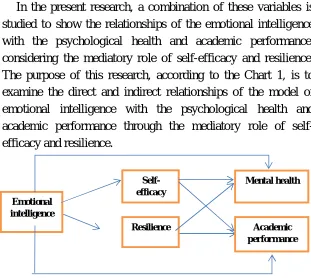
In the present research, a combination of these variables is studied to show the relationships of the emotional intelligence with the psychological health and academic performance, considering the mediatory role of self-efficacy and resilience. The purpose of this research, according to the Chart 1, is to examine the direct and indirect relationships of the model of emotional intelligence with the psychological health and academic performance through the mediatory role of self-efficacy and resilience.
Figure 1. The proposed research model of the variables
Emotional intelligence
Self-efficacy
Resilience
Mental health
Method
Emotional intelligence questionnaire (EIS). In this research Petrides and Furnham emotional intelligence scale (2000) that has been normalized by Marani (2003); quoted by Aliakbari Dehkordi (2007), consisting of the four factors of optimism, understanding one’s emotions and those of others, and evaluating and controlling the emotions and social skills, has been used. This scale has been made by making change on Schutt’ scale (1998) and using factor analysis method. This questionnaire consists of thirty articles and every article is graded from 1 to 7 (complete disagree to complete agree). Then, adding the given grades, the total number of the test is calculated which shows the emotional intelligence characteristics in 4 factors. The total grad of the test must be at least 30 and at most 210.In the present research, the reliability coefficient of the emotional intelligence scale has been achieved with the use of Cronbach Alpha 0.87 and split-half method 0.87 which means the suitable reliability and the acceptability of this questionnaire. in carrying out the affirmative factor analysis of the emotional intelligence questionnaire, all the articles had suitable factor loading but the articles 1,2,4,16,17 and twenty three questionnaires had a factor loading less than 0.30 which were deleted in the final analysis for the model test.
was achieved by Cronbach Alpha .85 and split-half .91 methods. These results show that the achieved coefficients have been satisfactory and also show the acceptable internal parallelism of the above questionnaire. In order to determine validity amount of this questionnaire, affirmative factor analysis was used. In carrying out the affirmative factor analysis in the resilience questionnaire, all the articles had suitable factor loading and only articles 3 and 20 of the questionnaire had a factor loading less than .30 which were deleted in the final analysis for the model test.
General self-efficacy questionnaire (GSEI. The general self-efficacy questionnaire was developed by Sherer and Adams (1983) and has 23 items, 17 out of which are about general self-efficacy and the other 6 are about self-self-efficacy experiences in social conditions. In the present research, a 17 item-questionnaire is used. Self-efficacy item-questionnaire measures the individual’s beliefs in his/her ability to conquer different conditions. This questionnaire has been arranged on the basis of the five-degree likert scale, in the form that the completely- disagree answer is graded one and the completely-agree answer is graded five. In the present research, the reliability coefficients of the self-efficacy scale was calculated by the use of Cronbach’s Alpha to be .87 and split-half to be .83, showing acceptable and suitable reliability for this questionnaire. In order to determine the validity value of this questionnaire, affirmative factor analysis method was used. In carrying out the affirmative factor analysis on the self-efficacy questionnaire, all the items had suitable factor loading but item 8, which was deleted for the model test.
questionnaire was developed in 1979 by Goldberg and Hiller and was translated and normalized by Palahang, et al. (1996). This questionnaire has four secondary scales each of which has seven items, namely: (A): physical symptoms (B) anxiety symptoms (C) social performance and (D) depression symptoms. This questionnaire consists of simple sentences about the psychological states of individuals, which are graded with the options of no (0), very few (1), few (2), many (3). In the present research, the reliability coefficient of the psychological health questionnaire was calculated by the use of Cronbach’s Alpha to be .89 and split-half to be 0.74, showing the suitable and acceptable reliability of the questionnaire. In order to determine the validity magnitude of this questionnaire, affirmative reduction method was used. In carrying out the affirmative factor analysis on the general health questionnaire all the items had suitable factor loadings.
This is a correlation research and of the type of path analysis. In this research the population is all the first grade students of general medical major at the Medical Sciences University of Jundi Shapoor Ahvaz studying in the academic year 2011-2012 and has passed at least thirty academic units. The sampling method is the stratified random in a way that in comparison with the number of students in each gender (boy and girl) and at first-grade medical major, a sample of 314 students (171 girls and 143 boys) have been selected randomly. In this research, the standard deviations and means, respectively are, emotional intelligence 19.84, 118.20, resilience 14.86, 55.70, self-efficacy 9.01, 56.92, academic performance 1.22, 15.78, and mental health 11.47, 25.03.
Data Analysis Method
the use of structural equation modeling (SEM. For the mediatory effects test in the suggested model and their significance, Bootstrap Macro (Preacher and Hayes method, 2008) was used. Determining fitting efficacy of the suggested model was performed by the use of several fitting indicators. In Table1, the explaining indicators including mean, standard deviation, the minimum and the maximum grades have been brought for the research variables.
Table 1
Mean, Standard Deviation, Minimum and Maximum Scores of Participants in the Study Variables
Variables Mean Standard deviation
Minimum grade
Maximum grade
Emotional
intelligence 118.20 19.84 54 159
Resilience 55.70 14.86 8 89
Self-efficacy 56.92 9.01 18 75
Academic
performance 15.78 1.22 12.50 18.80
Mental health 25.03 11.47 4 78
Table 2
Correlation Coefficients between the Variables
Variables 1 2 3 4 5
1. Emotional intelligence - .60∗∗ .72∗∗ -.46∗∗ .11∗
2. Self-efficacy - - .65∗∗ -.48∗∗ .13∗
3. Resilience - - - .45∗∗ .14∗
4. Mental health - - - - -.11∗ 5. Academic performance - - - -
**p<. 01 *p < . 05
As seen in Table 2, all the obtained correlation coefficients among the research variables are significant (levels of significance for all the coefficients are shown with asterisks in the Table). The correlation coefficients of emotional intelligence, self-efficacy, and resilience with mental health are, respectively, -.46, .48 and .45 which are all significant at the p .01 level and the correlation coefficients of emotional
intelligence, self-efficacy and resilience with academic performance are, respectively, .11, .13, .14 which are all significant at the p .05 levels. Figure 2 shows the coefficient
data. The results of the amended model paths are shown in Figure 3 and its fitting indicators are presented in Table 3.
Figure 2. Standardized Coefficients Proposed Direct and Indirect Relationships between EI and Psychological Health and Academic Performance, Self-Efficacy and Resilience with Mediation (Model 1).* Note: All the broken lines are none significant.
Figure 3. Modified Version of the Direct and Indirect Relationships between EI and Psychological Health and Academic Performance, Self-Efficacy and Resilience with Mediation (Model 2).
.064
Emotional intelligenc
e
Self-efficacy
Resilience
Mental health
Academic performance
-.280 .607
.728
-.0124
.003
.098
Emotional intelligence
Self-efficacy
Resilience
Mental health
Academic performance
-.320
.728
-.119 .456
Table 3
The Fit Indices of the Proposed Model and the Modified One
RMSEA NFI CFI TLI IFI AGFI GFI df 2 χ df χ2 Index .287 .902 .904 .520 .905 .555 .941 26.764 2 53.528 The proposed model (1) .041 .989 .996 .990 .996 .972 .993 1.522 4 6.090 The modified Model (2)
Table 5
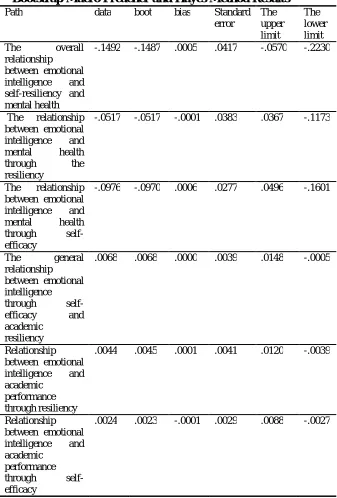
Bootstrap Macro Preacher and Hayes Method Results Path data boot bias Standard
error The upper limit The lower limit The overall
relationship between emotional intelligence and self-resiliency and mental health
-.1492 -.1487 .0005 .0417 -.0570 -.2230
The relationship between emotional intelligence and mental health through the resiliency
-.0517 -.0517 -.0001 .0383 .0367 -.1173
The relationship between emotional intelligence and mental health through self-efficacy
-.0976 -.0970 .0006 .0277 .0496 -.1601
The general relationship between emotional intelligence through self-efficacy and academic
resiliency
.0068 .0068 .0000 .0039 .0148 -.0005
Relationship between emotional intelligence and academic
performance through resiliency
.0044 .0045 .0001 .0041 .0120 -.0039
Relationship between emotional intelligence and academic
performance through self-efficacy
The contents of Table 5 show that among the indirect paths, only the up and down limit of the total indirect relationship of emotional intelligence on mental health excludes zero and this indicates the significance of the total indirect path and the rest of the paths became insignificant.
Discussion and Conclusions
on why resilience-promoting programs for every person must be defined (Masten & Poweel, 2003) according to the texture of the setting of any region (family school and society).
Thus, the resilience variable is influenced by many factors such as economic, cultural, social and personal differences. It seems that the existence of a category of these factors has caused the correlation between resilience and mental health of the students in this research fall down. The less the appropriate conditions and the accommodations, the more resilience and mental health decrease. Also, it must be noticed that the students of medical field have had a decrease in their psychological tenacity and have less resilience and mental health because of the abundance of their academic work and also the general exam at the end of the first grade period. Regarding the achieved result between emotional intelligence and self-efficacy there is a significant relationship which is in agreement with Talebinezhad & Banihashemi (2013), Adeoye & Emeke, (2010), Moira & Olivier, (2008). In justifying the relationship between emotional intelligence and self-efficacy, it must be said that because emotional intelligence includes a group of interconnected skills to exact understanding, evaluation and expressing emotions, producing emotions to ease the process of thinking, ability to understand the emotions and emotional knowledge and the ability to set the emotions in order to gain emotional and reasonable growth (Mayer & Salovey, 1997) and since self-efficacy also influences the way people think, how they face problems, emotional health, deciding, and dealing with environmental pressures, it has a positive relationship with self-efficacy and both have the ability to predict one another Rostami et al. (2010).
resilience and this is in line with the research of Trapp (2010), Garg and Rastogi (2009) and Jowker (2007). On a theoretical level, one can justify the mentioned achievement by analyzing emotional intelligence structure. Mayer & Salovey (1997) have considered four factors in their latest revision for emotional intelligence 1- ability to understand, evaluate and express the emotions, 2- emotional easing of thinking, 3- knowing, analyzing and using emotional knowledge, and 4– reasonable setting of emotions.
factors were presented separately, they promote each other's roles by interchanging with one another (Jowkar, 2007).
The indirect effect of emotional intelligence on academic performance, through the mediation of self-efficacy and resilience is not significant. In justifying this, we can say that students who lack needed skills like emotional intelligence, emotions controlling and administering resilience and the ways of encountering stress and happiness don’t acquire the ability to communicate with friends, professors and teaching environments. Because of the lack of experience in this regard, they negatively evaluate their abilities and self-efficacy sources and this can lead to a decrease in their self-esteem and falling down academically. It should be noted that in addition to socio-economic problems, the sensitivity of the field of study especially in the first few terms of academic years, is the effective factor in students’ stress.
effective in abating mental pressure and consequently causes the mental health of the individual. As Garg and Rastogi (2009) showed in their research students with high social and emotional intelligence have more resilience against stress and this is very effective in their personal and occupational success. The important and remarkable matter is that as social and emotional intelligence grows, in conjunction with more resilience against stress, depression decreases and muscular abilities increase which in return, has a good influence on thinking abilities of students on their growth and mental adaptation. Generally, it is hardly possible to prepare the desirable conditions for carrying out research. In this research too, the researcher faced some limitations, few of which are mentioned. This study is limited to the firsgrade medical college students of Ahvaz Medical Science University. So, generalizing the results to the students of other universities must be done with prudence. The only tool to collect data in this research was a self-report questionnaire. That is why we might face one-method bias in the acquired data. As path analysis method has been used to evaluate the suggested model’s fitting, cause and effect conclusion must be done with prudence.
Suggestions
indicators. Depending on the resultss of this research and by referring and using theatrical principles and research history of the subject, it can be recommended that resilience-based education be presented to students in the form of educational workshops. Also, it is recommended to the consultants and the psychologists to use resilience-based education in an individual and group setting as an efficient method to promote social adaptation.
Motivating and recommending to the parents to have realistic evaluation of their children’s abilities and so, reasonable expectations from their children to select the university major.
References
Adeoye, H., & Emeke, E. A. (2010). Emotional intelligence and self-efficacy as determinants of academic achievement in the English language among students in oyo stat enior secondary school. Ife PscyhologIA, 18(1), 206-216.s
Afrooz, GH., Arjmandnia, A., Taghizadeh, H., Ghasemzade, S., Asadi, R. (2013). The Comparison of Self-Efficacy Beliefs and Mental Health between gifted and normal students. Middle Eastern Journal of Disability Studies, 3, 27-38. Agaibi, C. E., & Wilson, J. P. (2005). Trauma, PTSD, and
resilience. A review of the literature.Trauma, 6(3), 195-216. Aliakbaridehkordi, M. (2007). Identifying and comparing nine-part combined groups of women gender categories having jobs in Ahvaz city and their husbands from a mental health, martial status faction and emotional intelligence point of view, Doctoral dissertation, faculty of psychology, Ahvaz, Chamran University.
468-482.
Austin, E. J., Farrelly, D., Black, K. & Moore, H. (2007). Emotional intelligence, Machiavellianism, and emotional manipulation. Personality and Individual Differences, 43, 173-179.
Besharat, M. A. (2004). The effects of emotional intelligence on the quality of social relationships. Journal of Psychological Studies, 1(2, 3), 25-38.
Besharat, M. A. (2007). Resiliency, vulnerability and mental health. Olume Pezeshki Journal, 6 (383), 373-383. [Persian]. Benard, B. (1991). Perceived self-efficacy in cognitive development and performance. Educational Psychology, 28, 117 – 148.
Bracckett, M. A., & Mayer, J. D. (2003). Convergent, discriminant, and incremental validity of competing measures of emotional intelligence. Personality and Social Bulletin, 29, 1147-1158.
Capa, Y., & Loadman, W. E. (2001). Self–Efficacy and Previous Testing Experiences as predictors of test – anxiety among college students. Eric Journal, 1.17-26.
Connor, K. M. (2006). Assessment of resilience in the aftermath of trauma. Journal of Clinical Psychiatry, 67(2), 46-9. Erabian, A., Khodapanahi, M. K., Heidari, M., & Sedghpour, B
(2004). Investigating the relationship between self-efficacy and mental health and academic success of the students. Journal Psychology, 360-371.
Extremera, N., & Fernandez-Berrocal, P. (2006). Emotional intelligence as predictor of mental, social and physical health in university students. Span J Psychol, 9(1), 45-51. Faraji, M., Sharififar, F., & Javadi, B. (20014). The relationship
Studies, 4(8), 948-952.
Freudenthaler, H. H., Neubauer, C. A., Gabler, P., Scherl, G. W., & Rindermann, H. (2008). Testing and validating the trait emotional intelligence questionnaire (TEIQue) in a German-speaking sample. PersIndividDif, 45(7), 673-678. Friborg, O., Barlaug, D., Martinussen, M., Rosenvinge, J. H., &
Hjemdal, O. (2005). Resilience in relation to personality and intelligence. International Journal of Methods in Psychiatric Research, 14, A(1), 29-42.
Garg, P., & Rastogi, R. (2009). Emotional intelligence and stress resiliency: A relationship study. International Journal of Educational Administration, 1, 1-16.
Golman, D. (1998). Emotional intelligence. Translated by Nasrin Parsa (1999), Roshd Publication.
Hampton, N. Z., & Mason, E. (2003). Learning disabilitis, gender, sources of efficacy, self-efficacy beliefs, and academic achievement in high school students. Journal of School Psychology, 41, 101-112.
Hsieh, M. O., & Shek, D. T. L. (2008). Personal and family correlates of resilience among adolescents living in single-parent households in Taiwan. Journal of Divorce, 49, 330-334.
Hudson, JR., W. (2007). The relationship between academic self-efficacy and aesilience to grades of students admitted under special criteria. (Unpublished dissertation). University of Phoenix.
Issacson, B. (2002). Characteristics and enhancement of resiliency in young people, A Research paper for Master of Science Degree with major in guidance and counseling, University of Wisconsin-Stout.
depression, anxiety, resiliency, daily stresses and mental health among Tehran University students. Procedia Social and Behavioral Sciences, 1515–1519.
Johnson, S. J., Batey, M., & Holdsworth, L. (2009). Personality and health, the mediating role of trait emotional intelligence and work locus of control. Manchester Business School, University of Manchester
Joseph, S., Williams, R., & Yule, W. (1997). Understanding post-traumatic stress: A psychology perspective on PTSD and treatment: West Indi: Wiley.
Jowkar, B. (2008). The mediating role of resilience in the relationship between general and emotional intelligence and life satisfaction. Contemporary psychology, 2, 3- 12.
Keshavarz, N., Amini, M., Mani, A., Nabeiei, P., Safari. Z., Jafari, M. (2014). A Study on the relationship of emotional intelligence and academic achievement in Students of Shiraz University of Medical Sciences. Journal Media, 5(3), 70-77. Kim, Y. M. (2002). Correlation of mental health problems with
psychological constructs in adolescents. International Journal of Nursing, 139-193.
Letzring, T. D., Block, J., & Funder, D. C. (2005). Ego control and ego resiliency: Generalization of self-report scale based on personality description from acquaintances, clinicians, and the self. Journal of Research in Personality, 29, 395-422.
Majidi, R. (2010). Investigating the cause relationship of general intelligence and emotional intelligence with academic performance with exam embarrassment mediation in first grade students of state high-schools of Borujerd, Master thesis, faculty of psychology, Ahvaz, Chamran University.
Excellent source of in-depth information on resiliency. Retrieved from: (http://resilnet.uiuc. Edu/library.htmL). Mayer, J. D., & Salovey, P. (1997). What is emotional
intelligence? In: Salovey P, Sluyter D. (editors). Emotional development and emotional intelligence: Educational implications. 1sted. New York: Basic Books, 3-31.
Mayer, J. D., Caruso, & Salovey, P. (2000). Emotional intelligence meets traditional standards for intelligence. Intelligence, 27 (4), 267-298.
Mirsamie, M., Ebrahimighavam, S. (2008). Investigating the relationship among self-efficacy social protection and exam embarrassment in mental health of boy and girl students of University of Alame Tabatabaee, Journal of Psychology and Educational Sciences, 91-74.
Mohamadi, M. (2005). Investigating effective factors on resilience in people prone to drug abuse. Doctoral dissertation, Institute of Welfare and Rehabilitation Sciences, Tehran, Welfare and Rehabilitation Sciences, Tehran.
Moira, M., & Olivier, L. (2008). Trait emotional intelligence and the cognitive appraisal of stressfull events: An exploratory study, Personality and Individual Differences, 44(7), 144-1453.
Nkosi, A. (2005). The influence of racial identity and resilience on the academic performance of African students attending predominantly white universities. (Unpublished dissertation). University Graduate Board.
Pajaras, F. (1996). Self–efficacy beliefs and mathematical problem solving of gifted students. Contemporary Educational Psychology, 21, 325 – 344.
Pajares, F., & Schunk, D. H. (2001). Self-Beliefs and school success: Self-efficacy, self-concept, and school achievement. In, R. Riding and S. Rayner (Eds).
Pakmehr, H., & Ja'fari-Sani, H. (2010). The relationship between students' self-efficacy beliefs and mental health in Mashhad University of Medical Sciences. Proceedings of the Nursing Students' National Conference, Iran University of Medical Sciences, 18-23.
Palahang, H., Nasr, M., Barahini, M. N., & Shahmohamadi, D. (1996). Investigating the epidemiology of mental disorders in kashan city. Iranian Journal of Psychiatry and Clinical Psychology, 4, 19-27.
Petrides, K. V., & Furnham, A. (2000). On the dimensional structure of emotion intelligence. Personality and Individual Differences, 29, 313-320.
Preacher, K. J., & Hayes, A. F. (2008). Asymptotic and resampling strategies for assessing and comparing indirect effects in multiple mediator models. Behavior Research Methods, 4, 879-891.
Rostami, R., Shahmohamadi, KH., Ghaedi, G. H., Besharat, M. A., Akbarizardkhane, S., & Nosratabadi, M. ( 2010). The relationship of self-efficacy with emotional intelligence and the understood social protection in Tehran University students. Journal of Medical Sciences of Gonabad, 3, 46-54. Safarinia, M., Bazyarimeimand, M. (2011). A comparison between social and emotional resilience in privileged regions students with non-privileged regions students. Journal of Innovative Education, 1, 107-124.
& Rooke, S. E. (2007). A meta-analytic investigation of relation between emotional intelligence and health. Personality and Individual Differences, 42, 921-933.
Schutt, N. S. (1998). Development and validation of a measure of emotional intelligence. Personality and Individual differences, 25, 167-177.
Sefatgol, F. K., & Lashkaripour, K. (2014). Mental health on nurses of Tamin Ejtemaee Hospital of Zahedan City. Journal of novel applied sciences, 3(12), 1375-1378.
Sevdalis, N., Petrides, K. V., & Harvey, N. (2007).Trait emotional intelligence and decision-related emotions. Personality and Individual Differences, (42), 1347-1358. Shabani, J., Hassan, S. A., Amad, A., & Maznahbaba. (2011).
Moderating effect of age on the link of emotional intelligence and mental health among high school students. International Education Studies, 4, 136-137.
Sherer, M., & Adams. C. H. (1983). Construct validation of the self-efficacy scale. Psychology Reports, 53, 899-902.
Slaski, M., & Cartwright, S. (2002). Health, performance and emotional intelligence: An exploratory study of retail managers. Stress and Health, 18, 63-68.
Talebinezhad, M., & Banihashemi, F. (2013). The Interaction of emotional intelligence and self-efficacy with EFL Learners’ Age and Gender. International Research Journal of Applied and Basic Sciences, 4(7), 1966-1971.
Tagharrobi, Z., Fakharian, E., Mirhoseini, F., Rasoulinejad, S. A., Akbari, H., & Ameli, H. (2010). Survey of educational drop-out indexes and its related factors in alumni of paramedical faculty of Kashan Medical University. Journal of Babol Unive Med. 76-89.
Personality and Individul Differences, 76, 18- 27
Trapp, C. S. (2010). The association among emottional intelligence, resilience, and academic performance of preservice teachers. (Unpublished dissertation). University of Phoenix.
Zenasni, F., & Lubart, T. I. (2009). Perception of emotion, alexithymia and creative potential. Personality and Individual Differences, 46(3), 353-358.
Zenasni, F., & Lubart, T. L. (2008). Emotion related-trait moderate the impact of emotional state on creative potential. Personality and Individual Differences, 29(3), 157-167.
IPA
International Journal of Psychology ناﺮﯾا ﻲﺳﺎﻨﺸﻧاور ﻦﻤﺠﻧا ﮫﻠﺠﻣ ... :ﻲﮔداﻮﻧﺎﺧمﺎﻧومﺎﻧ : كاﺮﺘﺷاﮫﺟووعﻮﻧ :ﯽﺘﺳاﻮﺧردیﺎھهرﺎﻤﺷ : ﻲﻜﯿﻧوﺮﺘﻜﻟا كاﺮﺘﺷا هرﺎﻤﺷﻚﺗ ٢٠٠٠٠ لﺎﯾر • ... : ﻞﯿﻤﯾا • يﺎﻀﻋا ﺗ ترﻮﺻ رد ﻦﻤﺠﻧا ﮫﺘﺳﻮﯿﭘ نﺎﮕﯾار ترﻮﺻ ﮫﺑ ﺖﯾﻮﻀﻋ ﺪﯾﺪﻤ .ددﺮﮔﯽﻣلﺎﺳرا كاﺮﺘﺷارد ﻧﻻﺎﺳ .ددﺮﮔﻲﻣﺰﯾراوﺮﺑاﺮﺑودقﻮﻓﻎﻟﺎﺒﻣﮫﯿﻠﻛﮫ كاﺮﺘﺷاﮫﺟو ﻲﻜﯿﻧوﺮﺘﻜﻟا ) (هرﺎﻤﺷ ﻚﺗ /ﮫﻧﻻﺎﺳ ﻲﻜﻧﺎﺑﺶﯿﻓﻲﻃ ... ﻎﻠﺒﻣﮫﺑ ... ﮫﺒﻌﺷ ... ﻚﻧﺎﺑ ... ﺦﯾرﺎﺗ ﮫﺑ ... هرﺎﻤﺷ ﮫﺑ ... يرﺎﺟبﺎﺴﺣ ٣۴٢٠۶٠۶۴١ ،ترﺎﺠﺗ ﻚﻧﺎﺑ ناﺮﯾاﻲﺳﺎﻨﺸﻧاور ﻦﻤﺠﻧا مﺎﻧ ﮫﺑ ﮫﺒﻌﺷ .ﺪﺷﺖﺧادﺮﭘناﺮﮭﺗردﻲﺘﺸﮭﺑﺪﯿﮭﺷهﺎﮕﺸﻧاد : ﺖﺴﭘ ﮫﻨﯾﺰھ ﺎﺑ ﻲﭘﺎﭼ ﮫﺨﺴﻧ كاﺮﺘﺷا هرﺎﻤﺷ ﺮھ ١۵٠٠٠٠ ) لﺎﯾر هدﺰﻧﺎﭘ راﺰھ (نﺎﻣﻮﺗ ... :ﺮﮭﺷ ... : نﺎﺘﺳا :ﻲﻧﺎﺸﻧ ... ... : نﺎﺑﺎﯿﺧ ...: ﻲﺘﺴﭘﺪﻛ ... : كﻼﭘ ... : ﻲﺘﺴﭘقوﺪﻨﺻ ... ... : سﺎﻤﺗﻦﻔﻠﺗ ءﺎﻀﻣا ﺮﮭﺗ :ﮫﻠﺠﻣﻲﻧﺎﺸﻧ آیاﺪﺘﺑا،ﺪﻧزنﺎﺧﻢﯾﺮﮐنﺎﺑﺎﯿﺧ،نا یﺰﮐﺮﻣنﺎﻤﺘﺧﺎﺳ،ﯽﻟﺎﻤﺷنﺎﺑ ﮫﻘﺒﻃ،ﯽﯾﺎﺒﻃﺎﺒﻃﮫﻣﻼﻋهﺎﮕﺸﻧاد قﺎﺗا،مود ٢٠٩ ناﺮﯾاﻲﺳﺎﻨﺸﻧاورﻦﻤﺠﻧا، :ﻦﻔﻠﺗ ٨١٠٣٢٢١۴ :ﺲﻜﻔﻠﺗ ، ٨١٠٣٢٢٠٠
Iranian Psychological Association, The Head quarters of Allameh Tabatabaii University, the edge of North Aban Ave.
Karimkhane-zand Ave., Tehran-Iran
Tel: +9821 81032214 Fax: +9821 81032200 Website:www.iranpa.org& www.ijpb.ir
Request for Subscription to Biannual IPA
International Journal of Psychology
The Journal of Iranian Psychological Association
First Name: ………. Family Name: ……….
Type and amount of Subscription:
• Single Issue: 20,000 Rials
• Email : ………..
• Paid members of IPA will get it free of charge
• Annual Subscription will be twice as much as the above amounts
Subscription dues rates (annual / single issue) amount of ………. was deposited in the checking account No. 342060641 of Tejarat Bank, University of Shahid Beheshti in Tehran, in the name of Iranian Psychological Association, according to the payslip No: ……… at: Bank name: ….….. Branch name: ………... Date: ……..…..
Subscriber's Address: Province / State ………. City ………. Country ……….. No. and Street ………
Postal / zip code ………. Post Box No. ………. Tel: ……… Subscriber's signature ……… Email : ………..
Journal Address:
Iranian Psychological Association, The Head quarters of Allameh Tabatabaii University, the edge of North Aban Ave. Karimkhane-zand Ave., Tehran-Iran
Tel: +9821 81032214 Fax: +9821 81032200 Website: www.iranpa.org & www.ijpb.ir