IPA
International Journal of Psychology Vol. 12, No. 1, Winter & Spring 2018
PP. 30-49
Iranian Psychological Association
Prediction of Cyber Bullying through
Components of Adversity Quotient
Ali Mehdad, PhD*
Department of Industrial and Organizational Psychology Islamic Azad University, Isfahan
(Khorasgan) Branch [email protected]
Arezoo Vali Nezhad, MA
Department of Industrial and Organizational Psychology Islamic Azad University, Isfahan
(Khorasgan) Branch
Monireh Sadat Hosseini, MA
Department of Industrial and Organizational Psychology Islamic Azad University, Isfahan (Khorasgan) Branch
The main purpose of this study was to predict cyber bullying (email and online) through the components of the adversity quotient (perceived control, origin and ownership, reach and endurance). The population in this study comprised all employees of a big public organization in Tehran in winter 2015 (1393). Among them, 271 persons were selected on the basis of convenience sampling method. Data were collected through the Adversity Quotient Profile (PEAK Learning Inc., 2008) and the Cyber Bullying Questionnaire (Savage, 2012), and analysed using Pearson correlation coefficient and multiple regression analysis. The results indicated significant negative relationships between all the components of the Adversity Quotient (perceived control, origin and ownership, reach and endurance) with Cyber Bullying (p<.05). Furthermore, the results of multiple regression analysis showed that the components of perceived control (F=48.2, P<.05) and reach (F=28.2, p<.01) could significantly predict cyber bullying.
Keywords: adversity quotient, cyber bullying, public sector
One of the organizational challenges in today’s world comprises the behaviours against organizational objectives, such as bullying, aggression, hostility, sabotage, theft, violence and
done directly (i.e. online threatening) or indirectly (i.e. spreading rumours online) (Chibbaro, 2007). In recent years, cyber bullying has been introduced as a new dimension of deviant behaviours (Bringué & Sabadá, 2011; Paul, Smith & Blumberg, 2012; Schenk & Fremouw, 2012; Smith, 2009; Vandebosch, Beirens, D’Haese, Wegge & Pabian, 2012; quoted by Del Rey, Elipe & Ortega-Ruiz, 2012). Therefore, Cyber bullying is a form of cyber aggression constantly carried out with purpose and enthusiasm through computers, mobile phones and other electronic devices (Hinduja & Patchin, 2010) to the detriment of a person or a group of persons, and reduces the power imbalance in interpersonal relationships (Dempsey, Sulkowski & Storch, 2011). In fact, in addition to the three abovementioned criteria of bullying (Olweus, 1991; quoted by Dwyer, 2012), cyber bullying is characterized by two other criteria: of anonymity and communication with a wide range of potential audiences (Nocentini, Calmaestra, Schultze-Krumbholz, Scheithauer, Ortega, et al. 2010; Spears, Slee, Owens & Johnson, 2009).
cause problems for people). However, the abilities of people to manage their daily problems differ; hence, people who cannot overcome their problems become easily distracted and retreat, whereas people who overcome their problems can manage their life and future. In this respect, the concept of Adversity Quotient (AQ) was introduced as a personality trait (Stoltz, 2000). AQ has been defined as the ways in which people respond to different kinds of hardship or react to the world around them (Stoltz & Weihenmayer, 2010; quoted by Cornista & Macasaet, 2013). It has also been defined as people’s ability to manage their everyday problems (Stoltz, 2000). AQ comprises four components: of perceived control (restraint), origin and ownership (accountability), reach, and endurance (stability) (Canivel, 2010). Perceived control means an individual’s perception of how much control s/he can exert over future events. Perceived control is determined by flexibility, health and tenacity (Stoltz, 2011). Origin and ownership indicate the extent to which an individual tries to improve the situation regardless of his/her official responsibilities. Origin and ownership are determined by accountability, responsibility, activity and enthusiasm (Stoltz, 2011). Reach—determined by stress tolerance and efforts to be collectively effective (Stoltz, 2011)— signifies the extent to which an individual understands and overcomes difficulties. Endurance (stability) deals with the amount of time an individual for which can tolerate difficult situations. Endurance is determined by hopefulness, optimism and perseverance (Stoltz, 2011).
cognitive-frustration (job obstacles) ultimately leads to CWBs (Cyber Bullying). One of these cognitive-personality characteristics is control over environmental events. Based on the conceptual literature of the adversity quotient, control over environmental events is higher in people with a higher adversity quotient. Therefore, it can be concluded that employees with a higher adversity quotient show less cyber bullying because of their belief/ability to be able to influence environmental events. Moreover, based on reciprocal determinism, individual differences (perceptions, beliefs and expectations), stressful environmental factors, and people’s behaviours are reciprocally related to each other (Motl, 2007). Therefore, thanks to individual differences (low self-awareness, low tolerance, too much expectation from the organization, and low control), people are affected by stressful environmental factors (conflicts with colleagues and supervisors, injustice, etc.), and consequently commit cyber bullying.
cyber bullying in the workplace or any official statistical analysis about cyber bullying facts are not available in Iran. Nevertheless, neither the financial nor psychological consequences of cyber bullying on the staff can be ignored. For this reason, this study aimed to introduce the phenomenon of cyber bullying to help researchers derive a better theoretical foundation for the conduct of future studies in the fields of deviant cyber behaviour or cyber criminology. Moreover, the findings of this study provided practical approaches to prevent deviant cyber behaviours in Iranian organizations by increasing the AQ of people. Therefore, the main purpose of the present study was to predict cyber bullying through the adversity quotient. It must be noted that this investigation was carried out for the first time in Iran; therefore, its findings could provide practical approaches for the development of the field of industrial-organizational psychology and practical objectives for Iranian organizational managers.
Method
Adversity Quotient (AQ)
To measure AQ, the 14-item Adversity Quotient Profile (AQP) (PEAK Learning Inc., 2008; quoted by Shariatmadari, 2011) was used. The AQP is answered and scored based on a five-point Likert scale ranging from 1 (not at all) to 5 (completely). Each item comprises four sub-items, each measuring one of the subscales of perceived control, origin and ownership, reach and endurance. Thus, the possible range of score for each subscale is 14 to 70. In the AQP, a higher score in each subscale indicates a higher tendency towards it. Cronbach’s alpha for the total questionnaire (.91) and its subscales (perceived control [.82], origin and ownership [.83], reach [.84] and endurance [.80]) have been reported by PEAK Learning Inc. (2008; quoted by Shariatmadari, 2011). In repeated independent studies done by the Educational Testing Services (ETS), the high reliability of the AQP and its subscales has been confirmed (quoted by Shariatmadari, 2011). Internal consistencies of the AQP subscales (perceived control (.727), origin and ownership (.723), reach (.760), and endurance (.781) have also been reported by PEAK Learning Inc. (2009; quoted by Shariatmadari, 2011). In the present study, the Cronbach’s alphas obtained for the subscales of perceived control, origin and ownership, reach and endurance were .77, .79, .77 and .75 respectively.
Cyber Bullying
in the current research by the use of the translate-back-translate method, and based on a six-scoring scale (never=1 to always=6). Savage (2012) used test retest reliability with a 10-day interval to test the reliability of this questionnaire and obtained Cronbach’s alpha .94 for t1(first time) and .86 for t2 (second time) and reported correlation coefficient of .88. He also reported Cronbach’s alpha for email bullying at .92, .95 and .96 and for online bullying at .93, 8 and .87. The results of the exploratory factor analysis on this questionnaire in the current study for online cyber bulling (KMO=.943, eigenvalue=9.657, variance explained=68.981 per cent) with 14 items showed all items pertaining to online cyber bulling, and the results of the exploratory factor analysis for email cyber bulling (KMO=.925, eigenvalue=6.246, variance explained=69.405 per cent) with nine items showed all items pertaining to email cyber bulling. In the current study, the Cronbach’s alpha obtained for email and online bullying were .97 and .94 respectively.
Method
Members of a sample group responded to the questionnaire at their workplaces over 20–25 minutes in the form of a self-report. Data analysis was performed using descriptive (means, SD and standard error) and inferential statistics. For the inferential analysis, Pearson’s correlation coefficient and stepwise regression analysis were used to examine the research hypothesis by the Statistical Package for Social Science (SPSS), Version 18.
Results
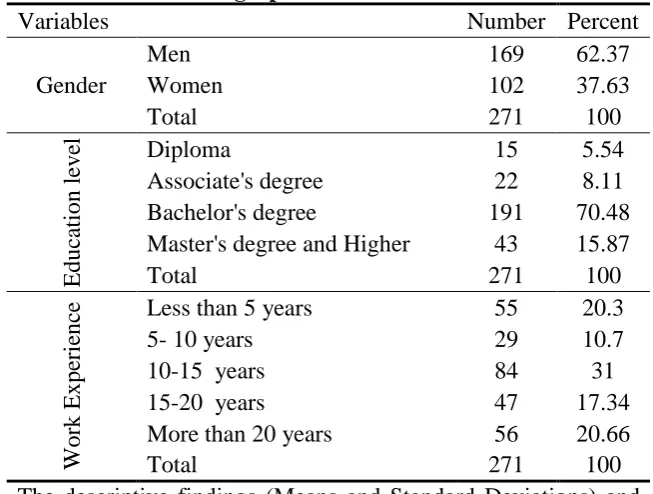
Table 1
Distribution of Demographic Variables
Variables Number Percent
Gender
Men 169 62.37
Women 102 37.63
Total 271 100
Educ
ati
on leve
l
Diploma 15 5.54
Associate's degree 22 8.11
Bachelor's degree 191 70.48
Master's degree and Higher 43 15.87
Total 271 100
W
or
k Expe
ri
enc
e Less than 5 years 55 20.3
5- 10 years 29 10.7
10-15 years 84 31
15-20 years 47 17.34
More than 20 years 56 20.66
Total 271 100
The descriptive findings (Means and Standard Deviations) and variables' correlation coefficients are presented in Table 2.
Table 2
Means, Standard Deviations and Correlation Coefficients between Variables 5 4 3 2 1 SD Mean Variables 1 .64 3.36 Control 1 .05 .63 3.04 Ownership 1 ** .56 .03 .59 3.04 Reach 1 .07 * .15 ** .36 .60 3.04 Endurance 1 ** .18 -** .40 -** .39 -* .15 -.75 1.45 Cyber-Bullying (E-mail and online)
The means of AQ components are shown in Table 2 (perceived control, 3.36; origin and ownership, 3.04; reach, 3.04; endurance, 3.04). Moreover, all AQ components (perceived control, origin and ownership, reach and endurance) were negatively related to cyber bullying (email and online).
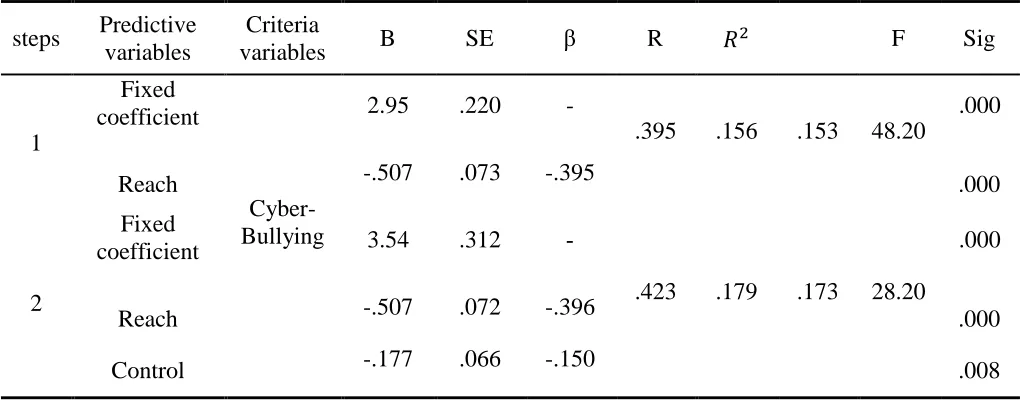
Table 3
Results of Stepwise Regression Analysis for Predicting Cyber Bullying through the Components of Adversity Quotient
steps Predictive variables
Criteria
variables B SE β R F Sig
1
Fixed coefficient
Cyber-Bullying
2.95 .220
-.395 .156 .153 48.20
.000
Reach -.507 .073 -.395 .000
2
Fixed
coefficient 3.54 .312
-.423 .179 .173 28.20
.000
Reach -.507 .072 -.396 .000
Discussion
Based on the results presented in Table 2 and Table 3, all AQ components of perceived control (p<.05), origin and ownership, reach and endurance (p<.01) were negatively related to cyber bullying (email and online). Moreover, a stepwise regression analysis showed that the AQ components of reach and perceived control could predict cyber bullying. This results are consistent with the findings of Major Global Technology (2005) and Hui Dai (2009), based on people with high AQ—who are less prone to commit cyber bullying—and Phoolka & Kaur (2012), based on people with high AQ—who quickly adapt themselves to new conditions and procedures, become less confused, and collaborate with their managers. Moreover, the results of this study were relatively consistent with the findings of other studies conducted: for example, Spector & Fox (2002), based on the relationship between negative affect and counterproductive work behaviours, Omar, Halim, Zainah, Farhadi, Nasir & Kairudin (2011), based on a negative relationship between stress and deviant behaviours, and Aftab & Javeed (2012), based on a negative relationship between stress and counterproductive work behaviours.
beats the odds, and finally how people stand in the face of problems and how they overcome them. People’s reactions to problematic situations can be predicted on the basis of their perceptions of how much they can influence the consequent events and the extent to which they understand difficult situations, and try to overcome or change them. Deviant behaviours like cyber bullying usually occur when an individual feels that others are treating him/her unfairly. According to a study conducted by Mitchel and Ambrose (2007), deviant behaviour such as cyber bullying occurs when an individual tends to retaliate against something: negative behaviour against negative behaviour. Thus, many people consider retaliation or payback as a good way of solving problems.
opportunities for development; therefore, they are less prone to commit cyber bullying.
According to the results, it is recommended that organizational managers consider AQ in the process of selection of their employees because people with high AQ are less affected by negative emotions in the face of environmental stressors (injustice, stress, etc.) and less prone to commit cyber bullying. It must be noted that this study was conducted among employees of a big public organization in Tehran; hence, the results cannot be generalized to other organizations without caution. In addition, this research statistical sample has been selected with the use of the convenience sampling method, which creates barriers for the generalization of results. Furthermore, this study was a correlational study; therefore, causal inferences cannot be made about its results. As a final point, it is necessary to mention that in this study, all variables were measured using the most valid tests; nonetheless, all limitations associated with self-report tests still apply to them.
References
Aftab, H., & Javeed, A. (2012). The Impact of Job stress on the Counterproductive Work Behavior (CWB): A Case Study from the Financial Spector of Pakistan. Journal of Contemporary Research in Business, 4, pp: 590-604.
Bennett, R. J., & Robinson, S. L. )2003(. The past, present, and future of workplace deviance research. In J Greenberg (Ed), Organizational behavior: The state of the science (2nd ed). Mahwah, New Jersey: Lawrence Erlbaum Associates.
Bringué, X., & Sabadá, C. (2011(. Menores y redes sociales. Madrid: Foro generaciones interactivas.
Bryce, J. (2008). Bridging the Digital Divide: Executive Summary. London: Orange and the cyberspace Research unit.
Canivel, L. D. )2010(. Principle Adversity Quotient: styles, performance and practice. MSc thesis, University of the Philippines Dili man.
Chibbaro, J. S. )2007(. School counselors and the cyberbully: Interventions and implications. Professional School Counseling 11(1), 65-68.
Cornista, G. A. L., & Macasaet, C. H. J. A. (2013(. Adversity Quotient and Achievement Motivation Of Selected Thired Year And Fourth Year Psychology Student Of De la salle lipa A.Y. Degree BSc, College of Education, Arts, and Sciences De La Salle Lipa.
Dalal, R. S. (2005(. A meta-analysis of the relationship between organizational citizenship behavior and counterproductive work behavior. Journal of Applied Psychology. 90(6), 1241-1255.
Del Rey, R., Elipe, P., & Ortega-Ruiz, R. (2012).Bullying and cyberbullying: Overlapping and predictive value of the co-occurrence. Psicothema, 24(4), pp. 608-613.
Del Valle, J. F., & Bravo, M. L. Y. A. (2007). Job stress and burnout in residential child care workers in Spain. Psicothema, 19(4), 610-615.
Dwyer, J. (2012). Traditional Vs Cyber-bullying: Associations with Cognitive Mechanisms and Interpersonal Variables in European and Asian Sample. Thesis BSc. Department of Psychology. DBS School of Arts.
Fox, S., Spector, P. E., & Rodopman, O. B. (2004). The Role of Control in Stressor-Emotion Theory of Counterproductive Work Behavior. Paper presented in symposium: Actionable Knowledge Gained from Theories of Workplace Deviance. Academy of management, New Orleans.
Fox, S., & Spector, P. E. (1999). A model of work frustration– aggression. Journal of organizational behavior, 20 (6), 915– 931.
Fox, S., & Spector, P. E. (Eds.). (2005). Counterproductive work behavior: Investigations of actors and targets. Washington, DC: American Psychological Association. Hui Dai, CH. (2009). A Study on the Employees' Adversity
Quotient, Job Stress and Role Performance in High Technology Industry: Perceived Organizational Support as a Moderator. Master's Thesis, Department Human Resource Management.
Hinduja, S., & Patchin, J. W. (2010). Bullying, cyber bullying, and suicide. Archives of Suicide Research. 14, 206-221. doi:10.1080/13811118.2010.494133
Lee, J. A. (2007). Organizational justice: A mediated model from individual well-being and social exchange theory perspectives, a dissertation for the degree of Doctor of Philosophy. TOURO University International.
Mitchell, M. L, & jolly, J. M. (2007). Research Design Explained (6thED). Thomson wads worth, USA.
Mount, M., Ilies, R., & Johnson, E. (2006). Relationship of personality traits and counterproductive work behaviors: The mediating effects of job satisfaction. Personnel Psychology, 59, 591-622.
Motl, R. (2007). Theoretical Models for Understanding Physical Activity Behavior among Children and Adolescents – Social Cognitive Theory and Self-Determination Theory. Journal of Teaching in Physical Education, 26, 350-357.
Nocentini, A., Calmaestra, J., Schultze-Krumbholz, A., Scheithauer, H., Ortega, R., & Menesini, E. (2010). Cyber bullying: labels, behaviours and definition in three European countries. Australian Journal of Guidance & Counselling, 20(2), 129-142.
Omar, F., Halim, F. M., Zainah, A. Z., Farhadi, H., Nasir, R., & Kairudin, R. (2011). Stress and job satisfaction as antecedents of workplace deviant behavior. World Applied Sciences Journal,12, pp: 45-51.
Patchin, J. W., & Hinduja, S. (2006). Bullies move beyond the schoolyard: A preliminary look at cyberbullying. Youth Violence & Juvenile Justice, 4, 148-169.
Paul, S., Smith, P. K., & Blumberg, H. H. (2012). Investigating legal aspects of cyberbullying. Psicothema, 24, 640-645. Phoolka, SH., & Kaur, N. (2012). Adversity Quotient: A new
paradigm to explore. International Journal of Contemporary Business Studies, 3(4), 67-78.
Savage, M. (2012). Developing a Measure of Cyberbullying Perpetration and Victimization. PhD thesis. Arizona State University.
Scheithauer, H., Hayer, T., Petermann, F., & Jugert, G. (2006). Physical, verbal, and relational forms of bullying among German students: Age trends, gender differences and correlates. Aggressive Behaviour, 32, 261-275.
Schenk, A. M., & Fremouw, W. J. (2012). Prevalence, psychological impact, and coping of cyberbully victims among college students. Journal of School Violence, 11(1), 21-37.
Shariatmadari, A. R. (2011). Standardization of adversity quotient testing and review of its relationship with job satisfaction among employees of the Islamic Republic Army. Master's thesis, Faculty of Education and Psychology, University of Isfahan (Esfahan).
Shoss, M. K. Eisenberger, R. Restubog, S. L. D., & Zagenczyk, T. J. (2013). Blaming the Organization for Abusive Supervision: The Roles of Perceived Organizational Support and Supervisor’s Organizational Embodiment. Journal of Applied Psychology, 98(1), 158-168.
Smith, P. K. (2009). Cyberbullying: Abusive relationships in cyberspace. Journal of Psychology, 217(4), 180–181.
Souza, R. (2006). A study of Adversity Quotient of Secondary School students in relation to school performance and school climate; unpublished M. Ed dissertation.
Spector, E. P., & Fox, S. (2002). An Emotion –Centered Model of Voluntary Work Behavior, Some Parallels between Counterproductive Work Behavior and Organizational Citizenship Behavior. Human Resource Management Review,12, 269-292.
Spector, P. E., Fox, S., Penney, L., Bruursema, K., Goh, A., & Kessler, S. (2006). The dimensionality of counter productivity: Are all counterproductive behaviors created equal? Journal of Vocational Behavior, 68(3), 446-460. Spector, P. E., Bauer, J. A., & Fox, S. (2010). Measurement
artifacts in the assessment of counterproductive work behavior and organizational citizenship behavior: Do we know what we think we know? Journal of Applied Psychology, 95(4), 781-790.
Spector, P. (2011). The relationship of personality to counterproductive work behavior (CWB): An integration of perspectives. Human Resource Management Review, 21, 342-352.
Stoltz, P. G. (2000). Adversity Quotient@Work: Make Everyday Challenges the Key to You. Success--Putting the Principles of AQ into Action, Harper Collins, New York.
Stoltz, P. G. (2011). AQ for you: The core of AQ. Retrieved November 1, 2011, from http://www.peaklearning.com/aq-you_basics.php
Tokunaga, R. S. (2010). Following you home from school: A critcal review and synthesis of research on cyberbullying victimization. Computers in Human Behavior, 26, 277-287. Vandebosch, H., Beirens, L., D’Haese, W., Wegge, D., &
Willard, N. (2007). Educator’s guide to cyberbullying and cyber threats. Retrieved November 1, 2007, from www.cyberbully.org/cyberbully/docs