University of New Orleans University of New Orleans
ScholarWorks@UNO
ScholarWorks@UNO
University of New Orleans Theses and
Dissertations Dissertations and Theses
8-7-2008
Distributed Support Vector Machine Learning
Distributed Support Vector Machine Learning
Kenneth C. Armond Jr. University of New Orleans
Follow this and additional works at: https://scholarworks.uno.edu/td
Recommended Citation Recommended Citation
Armond, Kenneth C. Jr., "Distributed Support Vector Machine Learning" (2008). University of New Orleans Theses and Dissertations. 711.
https://scholarworks.uno.edu/td/711
This Thesis is protected by copyright and/or related rights. It has been brought to you by ScholarWorks@UNO with permission from the rights-holder(s). You are free to use this Thesis in any way that is permitted by the copyright and related rights legislation that applies to your use. For other uses you need to obtain permission from the rights-holder(s) directly, unless additional rights are indicated by a Creative Commons license in the record and/or on the work itself.
Distributed Support Vector Machine Learning
A Thesis
Submitted to the Graduate Faculty of the University of New Orleans in partial fulfillment of the requirements for the degree of
Master of Science in
Computer Science Bioinformatics
by
Kenneth C. Armond Jr.
B.S. Texas A&M University, 2003
Acknowledgment
I would like to thank my advisor, Dr. Stephen Winters-Hilt. He has helped me
tremendously to understand the importance of academic research. He gave me the enthusiasm
needed to begin research in the field of Bioinformatics, which I previously did not know
anything about. I aspire to keep this enthusiasm in future endeavors, as he has after years of
research. His intelligence and accomplishments make him an excellent mentor yet he still knows
how to balance work and fun.
I would like to thank Sam Merat who was my student mentor and we worked together on
the early SVM Java code that eventually led to further work on the different chunking methods
described here. His knowledge was integral to helping me understand the SVM algorithm.
I would like to thank Carl Baribault who was always happy and willing to answer the many
questions I had. His collaboration on the Support Vector Reduction method was very helpful. I
have gained much insight on a variety of subjects from talking with him.
I would also like to think the other members of the Bioinformatics group for their help and
support.
Finally, I would like to express my deep gratitude to my wife, Stephanie, and my son,
Linus. Their encouragement and unconditional support have made getting this degree much
Table of Contents
List of Figures... iv
List of Tables ...v
List of Illustrations... vi
Abstract... vii
Chapter 1. Introduction...1
Chapter 2. Support Vector Machines ...3
2.1 Introduction...3
2.2 Applications of Support Vector Machines...3
2.3 Derivation of Binary SVM...5
2.4 SMO Parameters ...9
2.5 ‘Stabilization’ Kernels ...10
Chapter 3. Support Vector Reduction ...19
3.1 Methods...19
3.2 SVR Results...20
Chapter 4. SVM Chunking ...23
4.1 Previous SVM chunking methods ...25
4.2 Sequential Chunking (Linear Topology) ...28
4.3 Sequential Chunking Results ...28
4.4 Multi-threaded Chunking (Binary Tree Topology) ...30
4.5 Multi-threaded Chunking Results ...31
4.6 Multi-threaded Distributed Chunking...32
Chapter 5. Conclusion ...34
References...35
Appendix...36
A.1 Java code implementation of sequential chunking ...36
A.2 Java code implementation of multi-threaded chunking ...41
A.3 Java code implementation of multi-threaded distributed chunking ...47
A.4 Java code implementation of SMO SVM (non-chunked)...49
List of Figures
Figure 3.1 SMO Support Vector Reduction ...21
Figure 3.2 Multi-threaded Chunking Support Vector Reduction ...22
Figure 3.3 Sequential Chunking Support Vector Reduction ...23
Figure 4.1 Sequential Chunking % Parameters ...29
List of Tables
Table 2.1 Multi-threaded chunking, various datasets, Absdiff kernel...12
Table 2.2 Multi-threaded chunking, various datasets, Sentropic kernel...13
Table 2.3 Multi-threaded chunking, various datasets, Gaussian kernel ...13
Table 2.4 Sequential chunking, various datasets, Absdiff kernel ...14
Table 2.5 Sequential chunking, various datasets, Sentropic kernel...14
Table 2.6 Sequential chunking, various datasets, Gaussian kernel...15
Table 2.7 Sequential chunking, 9GC9CG_9AT9TA dataset, Absdiff kernel...15
Table 2.8 Sequential chunking, 9GC9CG_9AT9TA dataset, Sentropic kernel ...16
Table 2.9 Sequential chunking, 9GC9CG_9AT9TA dataset, Gaussian kernel ...16
Table 2.10 Multi-threaded chunking, 9GC9CG_9AT9TA dataset, Absdiff kernel ...17
Table 2.11 Multi-threaded chunking, 9GC9CG_9AT9TA dataset, Sentropic kernel ...17
Table 2.12 Multi-threaded chunking, 9GC9CG_9AT9TA dataset, Gaussian kernel ...18
List of Illustrations
Abstract
Support Vector Machines (SVMs) are used for a growing number of applications. A
fundamental constraint on SVM learning is the management of the training set. This is because
the order of computations goes as the square of the size of the training set. Typically, training
sets of 1000 (500 positives and 500 negatives, for example) can be managed on a PC without
hard-drive thrashing. Training sets of 10,000 however, simply cannot be managed with PC-based
resources. For this reason most SVM implementations must contend with some kind of chunking
process to train parts of the data at a time (10 chunks of 1000, for example, to learn the 10,000).
Sequential and multi-threaded chunking methods provide a way to run the SVM on large datasets
while retaining accuracy. The multi-threaded distributed SVM described in this thesis is
implemented using Java RMI, and has been developed to run on a network of
multi-core/multi-processor computers.
Keywords
Distributed
Parallel
SVM
Support Vector Machine
Machine Learning
SMO
Chapter 1. Introduction
SVMs are becoming more popular since researchers and engineers find it to be a better,
more robust replacement for older learning methods such as neural networks. Another attractive
aspect of SVMs is that they do not require much manual parameter manipulation which makes
their use much easier. Neural networks are a good example of an outdated learning method that
requires a decent amount of expertise in order to get the training parameters properly set for each
different dataset. Many areas of study such as text categorization, face recognition, handwriting
recognition, pedestrian detection, and DNA hairpin classification are increasingly using SVMs as
their main classification method.
The main problem with current day SVMs is that they cannot process large datasets in a
timely manner. This problem is compounded further when multiple SVM training rounds are
needed as with SVM clustering methods being developed by the Winters-Hilt Group (but not
discussed further here). Chunking the training set into smaller datasets provides a solution to this
problem. Sequential chunking runs the SVM on the first chunk and then sends the support
feature vectors (SVs) and sometimes some non-SVs to be added into the training data for the
next chunk. This continues until all chunks have been run. What is not as commonly discussed
are multi-threaded chunk processing methods. In part, this may be because of the many subtleties
that have been encountered in these efforts and this is a major focus of this thesis.
Multi-threaded chunking breaks the training dataset into smaller chunks to be trained separately. When
all chunks have been trained, SVs and sometimes some non-SVs are brought together and
re-chunked. This occurs until the dataset is small enough to be handled by the basic SVM. In order
to take advantage of multi-system networks, a multi-threaded distributed chunking method has
During research of this topic, observations have shown that not all support vectors are
needed in order to define an accurate hyperplane. To capitalize on this fact, a Support Vector
Reduction method has been developed to drop the weakest SVs. This method has not only
further advanced the stand-alone SVM but has significantly increased the effectiveness of the
chunking methods.
A plethora of results have been compiled to support the effectiveness of the discussed
methods which have been placed throughout the discussion. The Appendix contains the
Chapter 2. Support Vector Machines
2.1 Introduction
Support Vector Machines [10] (SVMs) are discriminators that use structural risk
minimization to find a decision hyperplane with a maximum margin between separate groupings
of feature vectors. SVMs are often used to classify binary and multi-class datasets. The
chunking algorithms discussed below concentrate on binary classification. The feature vectors
have been extracted from different blockade level frequencies, the emission probabilities, and
transition probabilities to arrive at probability vectors usually composed of 150 components [1].
When SVMs were created in 1995, a quadratic programming algorithm was used [5].
This was slow and only small datasets could be run with them. In 1998, Platt created Sequential
Minimal Optimization (SMO) which is an algorithm that uses minimal sets of Lagrange
multipliers (here two) to bypass having to use a quadratic algorithm [2]. The SMO SVM iterates
through the dataset comparing and updating the Lagrange multipliers (alphas) two at a time.
This simplification into smaller steps provides a significant increase in speed when compared to
the older quadratic algorithms. This new approach to SVMs has opened its use to a wide variety
of applications.
2.2 Applications of Support Vector Machines
Text categorization is used to classify documents into different predefined categories.
Some examples of documents are news articles, websites, and newsgroup postings. The feature
vectors are composed of the word stems of frequently used words within the document. Word
stems refer to the core of the word which ignores word additions such as “ing”, “ed”, and plural
endings. Also, common grammar words like “the”, “and”, and “is” are not counted as feature
document frequency (IDF), which is calculated from the frequency that words occur across all
documents in the training set, is used to scale the feature vectors for better performance. Since
feature spaces tend to be relatively large, information gain is often used to rank the feature
vectors to find the ones with the highest mutual information. SVMs have replaced methods such
as Naïve Bayes Classifiers, the Rocchio Algorithm, k-Nearest Neighbors, and Decision Tree
Classifiers for text categorization [11].
Face recognition can be used to determine if a human face exists in an image. This is
useful for human-computer interfaces, surveillance systems, and other automated processes that
require face detection. SVMs are excellent for this use since they can find details such as facial
expressions, mustaches, etc. even in varying light conditions. Feature vectors are created from
face/non-face pixels taken over several scales to perform the binary classification. Preprocessing
of the image is performed to get rid of data points that can later contribute to noise. First, the
image is scanned for pixels that are too close to call between face/non-face statuses. Next, an
illumination gradient correction is done to normalize the lighting thus accounting for bright
lights, glare, and shadows. Lastly, histogram equalization is done to distinguish between large
contrasts of brightness. Once the SVM is trained, it can be used against other images to classify
the location of faces. Some of the previous methods of face recognition were done using Neural
Networks, labeled graphs, and clustering and distribution-based modeling [12].
Handwritten digit recognition is another area of study that benefits from SVMs. This can
be used for a variety of applications. Attributed from the study by LeCun et al. [13], this could
be used to scan in address information for the U.S. Postal Service. The training data is generated
by taking each handwritten digit and putting it into a 20x20 pixel box. Each pixel contributes to
considered part of the written number. The majority white pixels are the unwritten region of the
box. The pixel data make up the polarized feature vectors which are using for training/testing.
Many other methods have been used to classify this type of data including Neural Networks,
Nearest Neighbor Classifiers, and variations of the LeNet Classifier [13].
SVMs are currently used to classify channel current data produced from nanopore
detectors. Strands of DNA hairpins are pulled into the channel via an applied potential. The
electrodes send pA electrical currents across the channel and the current fluctuations are
collected by a live data stream into a computer. This data is then sent through a Hidden Markov
Model (HMM) process to remove noise. The probabilities established by the HMM make up the
150 component feature vectors. The polarity comes from the two different molecules that are
being classified such as 9GC and 9CG. SVMs are useful for this area of study since the data is
often difficult to separate by previous methods such as Neural Networks. Several different
kernel spaces must be used in training in order to find the best one for the given type of dataset.
2.3 Derivation of Binary SVM [1]
Feature vectors are denoted by xik, where index i labels the feature vectors
(1 ≤ i ≤ M) and index k labels the N feature vector components (1 ≤ i ≤ N). For the binary SVM,
labeling of training data is done using label variable yi = ±1 (with sign according to whether the
training instance was from the positive or negative class). For hyperplane separability, elements
of the training set must satisfy the following conditions: wβxiβ - b ≥ +1 for i such that yi = +1,
and wβxiβ - b ≤ -1 for yi = -1, for some values of the coefficients w1,..., wN, and b (using the
convention of implied sum on repeated Greek indices). This can be written more concisely as:
yi(wβxiβ - b) - 1 ≥ 0. Data points that satisfy the equality in the above are known as "support
Once training is complete, discrimination is based solely on position relative to the
discriminating hyperplane: wβxiβ - b = 0. The boundary hyperplanes on the two classes of data
are separated by a distance 2/w, known as the "margin," where w2 = wβwβ. By increasing the
margin between the separated data as much as possible the optimal separating hyperplane is
obtained. In the usual SVM formulation, the goal to maximize w-1 is restated as the goal to
minimize w2. The Lagrangian variational formulation then selects an optimum defined at a
saddle point of
0
b)
w
w
(
2
w
w
b;
(w,
α
)
=
β β−
α
γy
γ β γβ−
−
α
L
where
=
∑
,γ γ
α
α
0α
γ ≥0 (1≤γ
≤ M)The saddle point is obtained by minimizing with respect to {w1,...,wN,b} and maximizing with
respect to {α1, ..., αM}. If yi(wβxiβ - b) - 1 ≥ 0, then maximization on αi is achieved for αi = 0. If
yi(wβxiβ - b) - 1 = 0, then there is no constraint on αi. If yi(wβxiβ - b) - 1 < 0, there is a constraint
violation, and αi→∞. If absolute separability is possible, the last case will eventually be
eliminated for all αi, otherwise it is natural to limit the size of αi by some constant upper bound,
i.e., max(αi) = C, for all i. This is equivalent to another set of inequality constraints with αi≤ C.
Introducing sets of Lagrange multipliers, ξγ and µγ(1 ≤γ≤ M), to achieve this, the Lagrangian
becomes: γ γ γ γβ β γ γ β β
α
ξ
α
ξ
µ
ξ
µ
ξ
α
)
=
−
y
−
+
+
+
C
−
L
[
(
w
x
b)
]
0 02
w
w
,
,
b;
(w,
where
=
∑
, andγ γ
ξ
ξ
0=
∑
γ γ
α
α
0α
γ ≥0 andξ
ξ≥
0
(
1
≤
γ
≤
M
)
simplifies to:
2 x y x y
(
α
)=α
0−α
δ δ δβα
γ γ γβL
with
0
≤
α
γ≤
C
(
1
≤
γ
≤
M
)
andα
γy
γ=
0
,where only the variations that maximize in terms of the αγ remain (known as the Wolfe
Transformation). In this form the computational task can be greatly simplified.
By introducing an expression for the discriminating hyperplane, fi = wβxiβ - b = αγyγxγβxiβ - b, the
variational solution for L(α) reduces to the following set of relations (known as the
Karush-Kuhn-Tucker, or KKT, relations):
(i) αi = 0 , yifi≥ 1
(ii) 0 < αi < C , yifi = 1
(iii) αi = C , yifi≤ 1
When the KKT relations are satisfied for all of the αγ (with αγyγ = 0 maintained) the solution is
achieved. The constraint αγyγ = 0 is satisfied for the initial choice of multipliers by setting the α's
associated with the positive training instances to 1/N(+) and the α's associated with the negatives
to 1/N(-), where N(+) is the number of positives and N(-) is the number of negatives. Once the
Wolfe transformation is performed it is apparent that the training data (support vectors in
particular, KKT class (ii) above) enter into the Lagrangian solely via the inner product xiβxjβ.
Likewise, the discriminator fi, and KKT relations, are also dependent on the data solely via the
xiβxjβ inner product.
Generalization of the SVM formulation to data-dependent inner products other than xiβxjβ
are possible and are usually formulated in terms of the family of symmetric positive definite
The SVM discriminators are trained by solving their KKT relations using the SMO
procedure of [8]. The method described here follows the description of [8] and begins by
selecting a pair of Lagrange multipliers, {α1,α2}, where at least one of the multipliers has a
violation of its associated KKT relations. For simplicity it is assumed in what follows that the
multipliers selected are those associated with the first and second feature vectors: {x1,x2}. The
SMO procedure then "freezes" variations in all but the two selected Lagrange multipliers,
permitting much of the computation to be circumvented by use of analytical reductions:
2 2 ) K 2 K K ( ; , ( ' ' ' ' ' ' ' 2 2 2 1 1 1 12 2 1 2 1 22 2 2 11 2 1 2 1 3 ' 2 1 y yy K U v y v y y y
L α α αβ≥ )=α +α − α +α + α α −α −α +αβ β −αβα β β
with β',γ' ≥ 3, and where Kij≡ K(xi, xj), and vi≡αβ'yβ'Kiβ' with β' ≥ 3. Due to the constraint αβyβ =
0, we have the relation: α1 + sα2 = -γ, where γ≡ y1αβ'yβ' with β' ≥ 3 and s ≡ y1y2. Substituting the
constraint to eliminate references to α1, and performing the variation on α2: ∂L (α2 ; αβ' ≥ 3)/∂α2 =
(1 - s) + ηα2 + sγ(K11 - K22) + sy1v1 – y2v2, where η≡ (2K12 - K11 - K22). Since vi can be rewritten
as vi = wβxiβ - α1y1Ki1 - α2y2Ki2, the variational maximum ∂L (α2 ; αβ'≥ 3)/∂α2 = 0 leads to the
following update rule:
η
α
α
2(( βx1β y1) ( βx2β y2)) 2 2 − − − −= old y w w
new
Once α2new is obtained, the constraint α2new≤ C must be re-verified in conjunction with the αβyβ =
0 constraint. If the L (α2;αβ' ≥ 3) maximization leads to a α2 new that grows too large, the new α2
must be "clipped" to the maximum value satisfying the constraints. For example, if y1≠ y2, then
increases in α2 are matched by increases in α1. So, depending on whether α2 or α1 is nearer its
maximum of C, we have max (α2) = argmin{α2 + (C - α2) ; α2 + (C - α1)}. Similar arguments
provide the following boundary conditions:
+1, max(α2) = argmin{C ; α2 + α1}, and min(α2) = argmax{0 ; α2 + α1 - C}.
In terms of the new α2new, clipped, clipped as indicated above if necessary, the new α1 becomes:
)
(
,2 2 1
1new
α
olds
α
oldα
newclippedα
=
+
where s ≡ y1y2 as before. After the new α1 and α2 values areobtained there still remains the task of obtaining the new b value. If the new α1 is not "clipped"
then the update must satisfy the non-boundary KKT relation: y1f(x1) = 1, i.e., fnew (x1) - y1 = 0.
By relating fnew to fold the following update on b is obtained:
12 2 ,
2 2 11 1 1
1 1 1
1
b
(
f
(
x
)
y
)
y
(
)
K
y
(
)
K
b
new=
−
new−
−
α
new−
α
old−
α
newclipped−
α
oldIf α1 is clipped but α2 is not, the above argument holds for the α2 multiplier and the new b is:
12 1 ,
1 1 22 2 2
2 2 2
2
b
(
f
(
x
)
y
)
y
(
)
K
y
(
)
K
b
new=
−
new−
−
α
new−
α
old−
α
newclipped−
α
oldIf both α1 and α2 values are clipped then any of the b values between b1new and b2new is
acceptable, and following the SMO convention, the new b is chosen to be:
2
2
1new new
new
b
b
b
=
+
Now that there is a more detailed understanding of the inner workings of the SVM, the
tuning parameters are discussed in the following section.
2.4 SMO Parameters
The SVM takes a set of parameters that are used to finely tune the classifier for different
types of datasets and for better performance. The C parameter is a constant value that serves as
the upper boundary on the Lagrange multipliers (alphas). The C value constrains the alpha from
potentially going to an infinite value. It trades off a wide margin with a few possible margin
failures [2].
The tolerance parameter is a margin of error put on the one (right hand side) when
the range .999 – 1.001 (for tolerance .001). The choice of tolerance influences the SVM
convergence.
The epsilon parameter is another margin of error used when checking the H and L
objective functions [2]. These functions are used on the alphas when η is negative which is
uncommon. The H and L functions [2] clip the new alpha to keep it within the bounds of 0 and
C. The value of η comes from a simple calculation using the values from the kernel matrix: η =
2K(x1,x2) - K(x2,x2) - K(x1,x1) [1].
The kernel matrix is produced from the specified kernel and the sigma constant
parameter. The matrix values are multiplied with the alphas in order to change the mapping of
the data points for easier classification. The choice of kernel determines the spatial mapping of
the data. Further details on a set of novel kernels are given in the next section.
2.5 ‘Stabilization’ Kernels
The kernel is probably the most important parameter to focus on when tuning the SVM.
There are a wide variety of kernels to choose from so one must find the best kernel that works
for the given type of dataset. The kernel is used to map the feature vectors into a
multi-dimensional space. The idea is to find the kernel that best maps the feature vectors in a way that
allows the hyperplane to find the optimal separation, thus the best decision.
For DNA hairpin feature vector datasets, our observations have shown the best kernels to
be the Gaussian, Absdiff, and Sentropic kernels. The Gaussian and Absdiff kernels are
regularized distances in the form of an exponential distance measure (d2(x,y)). The Gaussian
kernel (d2(x,y) = Σk(xk - yk)2) is common since it tends to produce good results when used with a
wide variety of datasets. The Absdiff (d2(x,y) = Σk(|xk - yk|)1/2) and Sentropic (D(x,y) = D(x||y) +
larger kernel space. The Sentropic kernel is based on a regularized information divergence
(D(x,y)) instead of a geometric distance. This can help produce to a more precise hyperplane.
Out of the three kernels mentioned above, Absdiff and Sentropic produce similar results when
considering the mean of the Sensitivity (SN) and Specificity (SP), which is used to measure
accuracy, and the size of the final chunk for the chunking methods. The choice of kernel makes
a difference in the size of the chunks, mainly the number of support vectors, which impacts the
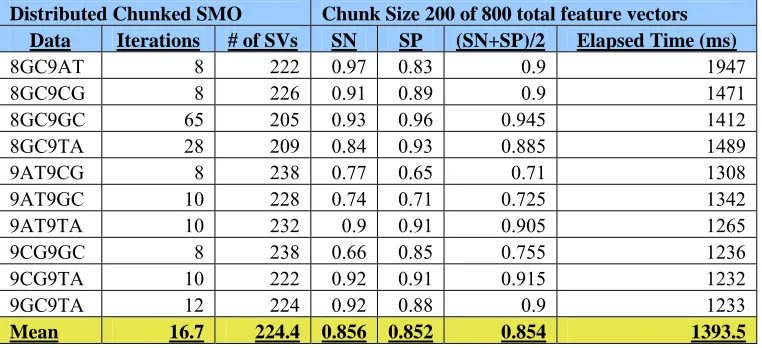
run time of the algorithm. The accuracy of Absdiff (0.854) and Sentropic (0.855) are nearly
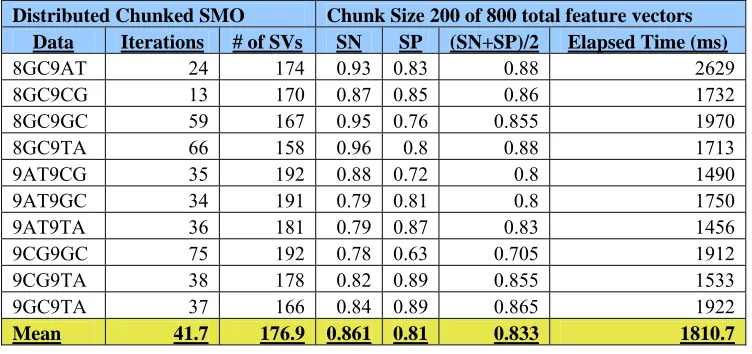
identical when using multi-threaded chunking (Tables 2.1 and 2.2). Gaussian is close behind
with accuracy 0.833 (Table 2.3). For the sequential chunking method, the same case with
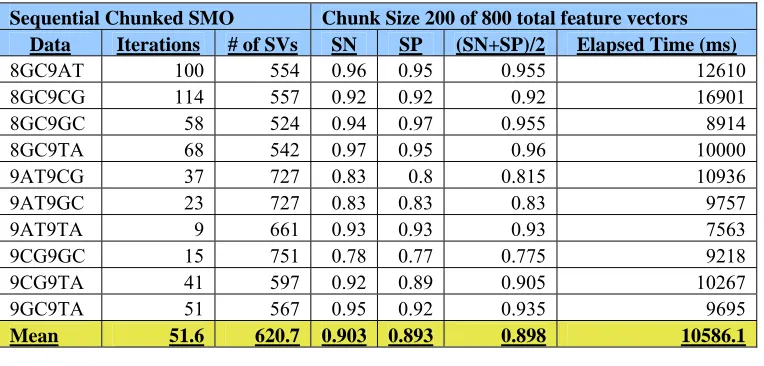
accuracy applies since Absdiff (0.898) and Sentropic (0.891) produce similar results (Tables 2.4
and 2.5). Once again, Gaussian is close behind with accuracy 0.864 (Table 2.6). In these data
runs, 30% of the support vector set was passed to the next set of chunks for the multi-threaded
chunking method and 100% of the support vector set was passed for the sequential chunking
method. These chunking parameters were chosen since they produced the best accuracy for the
given chunking method. This is analyzed in more depth later in section 4.
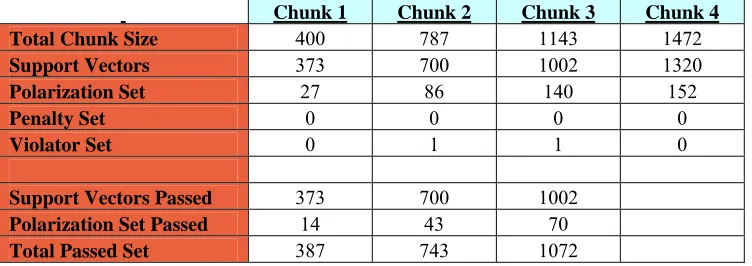
When focusing on the size of the final chunk, Absdiff (1472) and Sentropic (1481) are
once again similar for sequential chunking (Tables 2.7 and 2.8). Gaussian takes the lead with a
final chunk size of 1264 (Table 2.9). For the multi-threaded chunking method, Absdiff (791) and
Sentropic (787) once again fall behind Gaussian (690) for the final chunk size comparisons
(Tables 2.10, 2.11, and 2.12). For these data runs, 80% of the support vector set and 60% of the
polarization set were passed to the next set of chunks for the multi-threaded chunking method
and 100% of the support vector set and 50% of the polarization set were passed for the sequential
accuracy when compared to the parameters discussed above (30% for multi-threaded and 100%
for sequential) while passing a larger amount of feature vectors in order to properly test the
chunk size performance of each kernel.
After testing the three kernels, Absdiff was chosen as the best kernel for the DNA hairpin
datasets used here since it has high accuracy and also takes the least amount of iterations to
converge which contributes to it being the fastest for training these datasets. For multi-threaded
chunking, the mean of iterations is 16.7 and the elapsed time is 1393.5 milliseconds (Table 2.1).
For sequential chunking, the mean of iterations is 51.6 and the elapsed time is 10586.1
milliseconds (Table 2.4). After considering all of the above results, Absdiff was the chosen
kernel in all following data runs in sections 3 and 4.
Table 2.1
Multi-threaded chunking using different DNA hairpin datasets SVM Parameters: Absdiff kernel with sigma=.5, C = 10, Epsilon = .001, Tolerance = .001
Pass 30% of support vectors
This table shows the different multi-threaded chunking data runs performed on assortments of DNA hairpin pairs. The last line of the table presents the mean of the data runs to gauge the accuracy when using the Absdiff kernel.
Distributed Chunked SMO Chunk Size 200 of 800 total feature vectors Data Iterations # of SVs SN SP (SN+SP)/2 Elapsed Time (ms)
8GC9AT 8 222 0.97 0.83 0.9 1947
8GC9CG 8 226 0.91 0.89 0.9 1471
8GC9GC 65 205 0.93 0.96 0.945 1412
8GC9TA 28 209 0.84 0.93 0.885 1489
9AT9CG 8 238 0.77 0.65 0.71 1308
9AT9GC 10 228 0.74 0.71 0.725 1342
9AT9TA 10 232 0.9 0.91 0.905 1265
9CG9GC 8 238 0.66 0.85 0.755 1236
9CG9TA 10 222 0.92 0.91 0.915 1232
9GC9TA 12 224 0.92 0.88 0.9 1233
Table 2.2
Multi-threaded chunking using different DNA hairpin datasets SVM Parameters: Sentropic kernel with sigma=.5, C = 10, Epsilon = .001, Tolerance = .001
Pass 30% of support vectors
This table shows the different multi-threaded chunking data runs performed on assortments of DNA hairpin pairs. The last line of the table presents the mean of the data runs to gauge the accuracy when using the Sentropic kernel.
Distributed Chunked SMO Chunk Size 200 of 800 total feature vectors Data Iterations # of SVs SN SP (SN+SP)/2 Elapsed Time (ms)
8GC9AT 14 221 0.97 0.89 0.93 2667
8GC9CG 30 202 0.91 0.9 0.905 1993
8GC9GC 27 208 0.91 0.93 0.92 2003
8GC9TA 38 208 0.95 0.88 0.915 2017
9AT9CG 8 232 0.79 0.72 0.755 2531
9AT9GC 21 237 0.71 0.8 0.755 2121
9AT9TA 8 234 0.85 0.87 0.86 2318
9CG9GC 9 237 0.74 0.69 0.715 2132
9CG9TA 8 230 0.84 0.94 0.89 2003
9GC9TA 10 224 0.94 0.87 0.905 1945
Mean 17.3 223.3 0.86 0.849 0.855 2173
Table 2.3
Multi-threaded chunking using different DNA hairpin datasets SVM Parameters: Gaussian kernel with sigma=.05, C = 10, Epsilon = .001, Tolerance = .001
Pass 30% of support vectors
This table shows the different multi-threaded chunking data runs performed on assortments of DNA hairpin pairs. The last line of the table presents the mean of the data runs to gauge the accuracy when using the Gaussian kernel.
Distributed Chunked SMO Chunk Size 200 of 800 total feature vectors Data Iterations # of SVs SN SP (SN+SP)/2 Elapsed Time (ms)
8GC9AT 24 174 0.93 0.83 0.88 2629
8GC9CG 13 170 0.87 0.85 0.86 1732
8GC9GC 59 167 0.95 0.76 0.855 1970
8GC9TA 66 158 0.96 0.8 0.88 1713
9AT9CG 35 192 0.88 0.72 0.8 1490
9AT9GC 34 191 0.79 0.81 0.8 1750
9AT9TA 36 181 0.79 0.87 0.83 1456
9CG9GC 75 192 0.78 0.63 0.705 1912
9CG9TA 38 178 0.82 0.89 0.855 1533
9GC9TA 37 166 0.84 0.89 0.865 1922
Table 2.4
Sequential chunking using different DNA hairpin datasets SVM Parameters: Absdiff kernel with sigma=.5, C = 10, Epsilon = .001, Tolerance = .001
Pass 100% of support vectors
This table shows the different sequential chunking data runs performed on assortments of DNA hairpin pairs. The last line of the table presents the mean of the data runs to gauge the accuracy when using the Absdiff kernel.
Sequential Chunked SMO Chunk Size 200 of 800 total feature vectors Data Iterations # of SVs SN SP (SN+SP)/2 Elapsed Time (ms)
8GC9AT 100 554 0.96 0.95 0.955 12610
8GC9CG 114 557 0.92 0.92 0.92 16901
8GC9GC 58 524 0.94 0.97 0.955 8914
8GC9TA 68 542 0.97 0.95 0.96 10000
9AT9CG 37 727 0.83 0.8 0.815 10936
9AT9GC 23 727 0.83 0.83 0.83 9757
9AT9TA 9 661 0.93 0.93 0.93 7563
9CG9GC 15 751 0.78 0.77 0.775 9218
9CG9TA 41 597 0.92 0.89 0.905 10267
9GC9TA 51 567 0.95 0.92 0.935 9695
Mean 51.6 620.7 0.903 0.893 0.898 10586.1
Table 2.5
Sequential chunking using different DNA hairpin datasets SVM Parameters: Sentropic kernel with sigma=.5, C = 10, Epsilon = .001, Tolerance = .001
Pass 100% of support vectors
This table shows the different sequential chunking data runs performed on assortments of DNA hairpin pairs. The last line of the table presents the mean of the data runs to gauge the accuracy when using the Sentropic kernel.
Sequential Chunked SMO Chunk Size 200 of 800 total feature vectors Data Iterations # of SVs SN SP (SN+SP)/2 Elapsed Time (ms)
8GC9AT 52 570 0.96 0.95 0.955 14479
8GC9CG 78 545 0.93 0.93 0.93 16844
8GC9GC 22 525 0.92 0.95 0.935 10065
8GC9TA 130 550 0.97 0.95 0.96 18304
9AT9CG 32 722 0.83 0.82 0.825 15273
9AT9GC 44 734 0.81 0.82 0.815 15452
9AT9TA 39 693 0.9 0.9 0.9 14419
9CG9GC 33 747 0.75 0.79 0.77 14855
9CG9TA 73 616 0.89 0.91 0.9 16978
9GC9TA 54 597 0.91 0.93 0.92 14159
Table 2.6
Sequential chunking using different DNA hairpin datasets SVM Parameters: Gaussian kernel with sigma=.05, C = 10, Epsilon = .001, Tolerance = .001
Pass 100% of support vectors
This table shows the different sequential chunking data runs performed on assortments of DNA hairpin pairs. The last line of the table presents the mean of the data runs to gauge the accuracy when using the Gaussian kernel.
Sequential Chunked SMO Chunk Size 200 of 800 total feature vectors Data Iterations # of SVs SN SP (SN+SP)/2 Elapsed Time (ms)
8GC9AT 97 434 0.93 0.88 0.905 14978
8GC9CG 83 395 0.88 0.85 0.865 15653
8GC9GC 134 396 0.94 0.88 0.91 17783
8GC9TA 114 396 0.96 0.82 0.89 15988
9AT9CG 62 503 0.79 0.82 0.805 20789
9AT9GC 89 488 0.81 0.85 0.83 20833
9AT9TA 111 477 0.91 0.89 0.9 18057
9CG9GC 60 523 0.91 0.54 0.725 20233
9CG9TA 78 436 0.88 0.9 0.89 17910
9GC9TA 89 409 0.9 0.94 0.92 12422
Mean 91.7 445.7 0.891 0.84 0.864 17464.6
Table 2.7
Dataset = 9GC9CG_9AT9TA (1600 feature vectors) SVM Parameters: Absdiff kernel with sigma=.5, C = 10, Epsilon = .001, Tolerance = .001
Pass 100% of support vectors and 50% of polarization set Final Chunk Performance: {SN, SP} = {.87, .84}
This table shows the sequential chunking method focusing on the chunk sizes during the data run. The Absdiff kernel chunk performance is represented here. The breakdown of each feature vector set is displayed to show how the percentage parameters are used to pass portions of each set to the next chunk.
Chunk 1 Chunk 2 Chunk 3 Chunk 4
Total Chunk Size 400 787 1143 1472 Support Vectors 373 700 1002 1320 Polarization Set 27 86 140 152
Penalty Set 0 0 0 0
Violator Set 0 1 1 0
Table 2.8
Dataset = 9GC9CG_9AT9TA (1600 feature vectors) SVM Parameters: Sentropic kernel with sigma=.5, C = 10, Epsilon = .001, Tolerance = .001
Pass 100% of support vectors and 50% of polarization set Final Chunk Performance: {SN, SP} = {.875, .82}
This table shows the sequential chunking method focusing on the chunk sizes during the data run. The Sentropic kernel chunk performance is represented here. The breakdown of each feature vector set is displayed to show how the percentage parameters are used to pass portions of each set to the next chunk.
Chunk 1 Chunk 2 Chunk 3 Chunk 4
Total Chunk Size 400 792 1150 1481 Support Vectors 383 707 1011 1320 Polarization Set 17 85 139 160
Penalty Set 0 0 0 0
Violator Set 0 0 0 1
Support Vectors Passed 383 707 1011 Polarization Set Passed 9 43 70 Total Passed Set 392 750 1081
Table 2.9
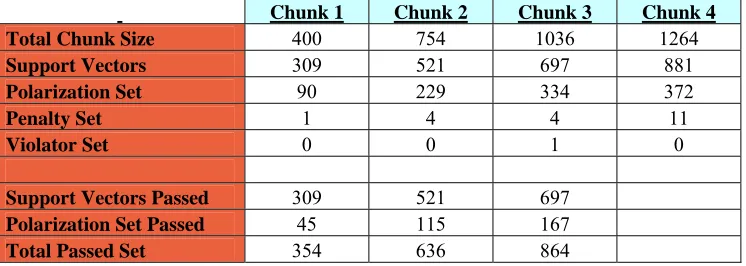
Dataset = 9GC9CG_9AT9TA (1600 feature vectors)
SVM Parameters: Gaussian kernel with sigma=.05, C = 10, Epsilon = .001, Tolerance = .001
Pass 100% of support vectors and 50% of polarization set Final Chunk Performance: {SN, SP} = {.715, .85}
This table shows the sequential chunking method focusing on the chunk sizes during the data run. The Gaussian kernel chunk performance is represented here. The breakdown of each feature vector set is displayed to show how the percentage parameters are used to pass portions of each set to the next chunk.
Chunk 1 Chunk 2 Chunk 3 Chunk 4
Total Chunk Size 400 754 1036 1264 Support Vectors 309 521 697 881 Polarization Set 90 229 334 372
Penalty Set 1 4 4 11
Violator Set 0 0 1 0
Table 2.10
Dataset = 9GC9CG_9AT9TA (1600 feature vectors) SVM Parameters: Absdiff kernel with sigma=.5, C = 10, Epsilon = .001, Tolerance = .001
Pass 80% of support vectors and 60% of polarization set Final Chunk Performance: {SN, SP} = {.855, .795}
This table shows the multi-threaded chunking method focusing on the chunk sizes during the data run. The Absdiff kernel chunk performance is represented here. The breakdown of each feature vector set is displayed to show how the percentage parameters are used to pass portions of each set to the next set of chunks.
C1 C2 C3 C4 C5 C6 C7 C8 C9 C10 Total Chunk Size 400 400 400 400 423 423 425 504 504 791 Support Vectors 373 377 378 388 402 402 403 466 460 699 Polarization Set 27 23 22 12 21 21 22 38 43 92 Penalty Set 0 0 0 0 0 0 0 0 0 0 Violator Set 0 0 0 0 0 0 0 0 1 0 Support Vectors Passed 1218 - - - 968 - - 742 - - Polarization Set Passed 53 - - - 40 - - 49 - - Total Passed Set 1271 - - - 1008 - - 791 - -
Table 2.11
Dataset = 9GC9CG_9AT9TA (1600 feature vectors) SVM Parameters: Sentropic kernel with sigma=.5, C = 10, Epsilon = .001, Tolerance = .001
Pass 80% of support vectors and 60% of polarization set Final Chunk Performance: {SN, SP} = {.845, .755}
This table shows the multi-threaded chunking method focusing on the chunk sizes during the data run. The Sentropic kernel chunk performance is represented here. The
breakdown of each feature vector set is displayed to show how the percentage parameters are used to pass portions of each set to the next set of chunks.
Table 2.12
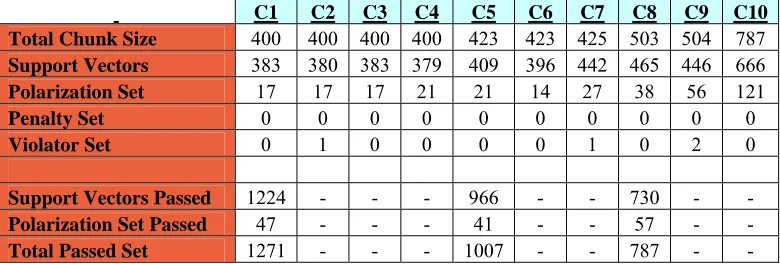
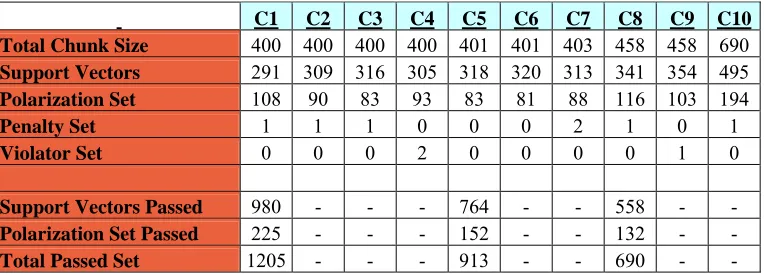
Dataset = 9GC9CG_9AT9TA (1600 feature vectors)
SVM Parameters: Gaussian kernel with sigma=.05, C = 10, Epsilon = .001, Tolerance = .001
Pass 80% of support vectors and 60% of polarization set Final Chunk Performance: {SN, SP} = {.85, .83}
This table shows the multi-threaded chunking method focusing on the chunk sizes during the data run. The Gaussian kernel chunk performance is represented here. The breakdown of each feature vector set is displayed to show how the percentage
parameters are used to pass portions of each set to the next set of chunks.
C1 C2 C3 C4 C5 C6 C7 C8 C9 C10 Total Chunk Size 400 400 400 400 401 401 403 458 458 690 Support Vectors 291 309 316 305 318 320 313 341 354 495 Polarization Set 108 90 83 93 83 81 88 116 103 194 Penalty Set 1 1 1 0 0 0 2 1 0 1 Violator Set 0 0 0 2 0 0 0 0 1 0 Support Vectors Passed 980 - - - 764 - - 558 - - Polarization Set Passed 225 - - - 152 - - 132 - - Total Passed Set 1205 - - - 913 - - 690 - -
Chapter 3. Support Vector Reduction
3.1 Methods
Support Vector Reduction (SVR) is a process that is run right after the SVM learning step
is complete. Instead of going on to testing data against the training results to get accuracy, we
further reduce the support vector set. One way to do this is to coerce some alphas to zero which
means they would now fall into the polarization set and further away from the hyperplane.
Converting the smaller alphas to zeros makes the most sense since a larger alpha indicates that
the data point is stronger towards its grouping (polarized sign). This is done using a user-defined
alpha cut off value. All alpha values that are under the cut off are pushed to zero. It is not
entirely trivial since certain mathematical constraints must be met. The constraint that must be
met for this method is the linear equality constraint [2]:
0
1
=
∑
= N
i i i
y
α
Therefore, the alpha values not meeting the cutoff cannot just be forced to zero unless the
value is retained somewhere else in the set. This is done by first sorting the alpha values of the
support vectors. Then for each alpha that does not meet the cut off value, the small left over
value is added to the largest alpha of the same polarity. Since the list is sorted it can loop
through and evenly distribute the left over values through the larger alphas starting with the
largest. The reduction process can cut the support vector count down without significantly
affecting the accuracy. Other observations have shown that the easier the dataset to classify, the
3.2 SVR Results
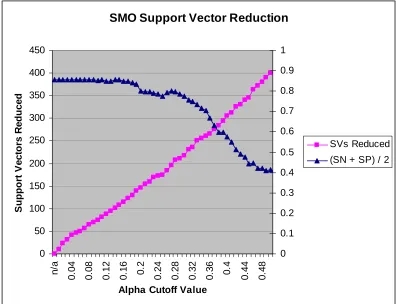
Figure 3.1 shows the results of the SVR method on the non-chunking SMO SVM. For
this dataset, 0.19 seems like the best cut off value to use for future data runs since it retains the
accuracy while reducing the support vectors. As shown in Figure 3.1, the total run time
decreases as support vectors are reduced. This is due to a decrease in testing time since there are
not as many support vectors to test against. For the 9GC9CG_9AT9TA dataset, 140 support
vectors (10.5% of total) were dropped without affecting the accuracy.
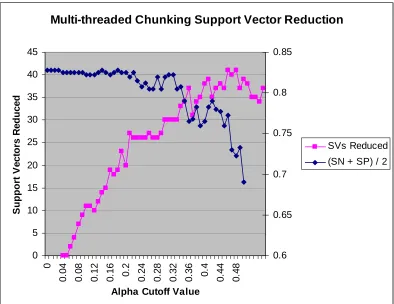
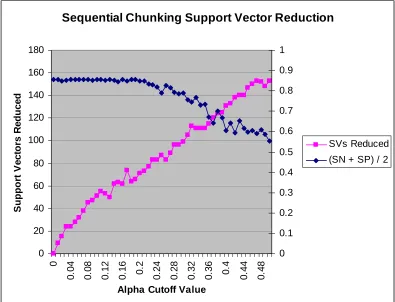
Data runs using sequential (Figure 3.3) and multi-threaded (Figure 3.2) chunking
methods with SVR show similar results. The chunking results tend to be a bit choppier since the
SVM algorithm makes some approximations thus the hyperplane will not be exactly the same for
every data run and this behavior is amplified in the chunking methods. Nonetheless, the trend
lines show that using the SVR method definitely cuts down on support vectors and decreases
testing time. For sequential chunking (Figure 3.3), an alpha cut-off value of 0.25 caused 87
support vectors (7.2%) to be dropped without affecting accuracy. For multi-threaded chunking
(Figure 3.2), an alpha cut-off value of 0.22 dropped 26 support vectors (6.2%) while retaining
Figure 3.1
SMO (non-chunking) Support Vector Reduction Dataset: 9GC9CG_9AT9TA (1600 feature vectors) SVM Parameters: Absdiff kernel with sigma=.5, C = 10, Epsilon = .001, Tolerance = .001
This graph shows the rate of support vectors reduced as the alpha cutoff value is increased. The alpha cutoff value 0.19 is chosen as the best since it is the last value before accuracy begins to degrade. This chosen value reduces 140 support vectors.
SMO Support Vector Reduction
0 50 100 150 200 250 300 350 400 450 n/ a 0. 0 4 0. 0 8 0. 1 2 0. 1 6 0. 2 0. 2 4 0. 2 8 0. 3 2 0. 3 6 0. 4 0. 4 4 0. 4 8
Alpha Cutoff Value
Figure 3.2
Multi-threaded Chunking Support Vector Reduction
Dataset: 9GC9CG_9AT9TA (1600 feature vectors), Starting chunk size=400 SVM Parameters: Absdiff kernel with sigma=.5, C = 10,
Epsilon = .001, Tolerance = .001 Passing 30% of Support Vectors
This graph shows the rate of support vectors reduced as the alpha cutoff value is increased. The alpha cutoff value 0.22 is chosen as the best since it is the last value before accuracy begins to degrade. This chosen value reduces 26 support vectors.
Multi-threaded Chunking Support Vector Reduction
0 5 10 15 20 25 30 35 40 45 0 0. 0 4 0. 0 8 0. 1 2 0. 1 6 0. 2 0. 2 4 0. 2 8 0. 3 2 0. 3 6 0. 4 0. 4 4 0. 4 8
Alpha Cutoff Value
Figure 3.3
Sequential Chunking Support Vector Reduction
Dataset: 9GC9CG_9AT9TA (1600 feature vectors), Starting chunk size=400 SVM Parameters: Absdiff kernel with sigma=.5, C = 10,
Epsilon = .001, Tolerance = .001 Passing 100% of Support Vectors
This graph shows the rate of support vectors reduced as the alpha cutoff value is increased. The alpha cutoff value 0.25 is chosen as the best since it is the last value before accuracy begins to degrade. This chosen value reduces 87 support vectors.
Sequential Chunking Support Vector Reduction
0 20 40 60 80 100 120 140 160 180 0 0. 0 4 0. 0 8 0. 1 2 0. 1 6 0. 2 0. 2 4 0. 2 8 0. 3 2 0. 3 6 0. 4 0. 4 4 0. 4 8
Alpha Cutoff Value
Chapter 4. SVM Chunking
SVM chunking provides an alternative method to running a typical SVM (SMO) on a
dataset by instead breaking up the training data and running the SVM on smaller chunks of data.
In the chunking process, feature vectors associated with strong data points are retained from
chunk to chunk, while weak data points are discarded. Chunking becomes a necessity when
classifying large datasets. In this context, a large dataset refers to one that has over 5,000
features vectors where each vector has 150 components. Since the order of computations
increases by the square of the size of the training set, most PCs would not have enough memory
to support a kernel matrix of 10,000 or more training instances.
Initially, the training data is shuffled then broken into chunks. The number and size of the
chunks depends on the size of the dataset to be trained. In the Java implementation of this
algorithm, the user specifies the size of each chunk and the chunks are broken up accordingly. If
the chunks don't divide evenly, which is the case most of the time, the few remaining feature
vectors are added to the last chunk. When training on the chunk is complete, the resulting
trained feature vectors each fit into a separate set. If the SVM classifies well, the largest set
consists of the support feature vectors. The KKT violators make up another set. KKT violators
refer to feature vectors that violate one of the KKT relations. The violator set is usually zero at
the end of the training process, unless some minimal number of violators is allowed upon
learning completion. The polarization set consists of the feature vectors that have been classified
as a positive or negative one. These are feature vectors that pass the KKT relations and have an
alpha coefficient equal to zero. The penalty set consists of the feature vectors which pass the
KKT relations and have alpha coefficients equal to C (the max value). These sets give the user a
converging to a better solution, on the next chunk run, several support feature vectors and
sometimes some of the polarization set are passed to the next chunk(s). The percentages of each
feature vector set depend on which kernel is used and the dataset.
There are different methods of extracting the feature vectors from the different sets. The
specified percentages of feature vectors are pseudo-randomly chosen from each of the sets
except for one. The support feature vectors extraction method differs since it extracts the feature
vectors that have the best scores. Each score represents the distance of the feature vector from
the hyperplane. It makes sense to choose feature vectors whose scores are closer to the
hyperplane in order to pass a tighter hyperplane on to the next chunk(s). Passing a more precise
hyperplane should speed up the next SVM run.
4.1 Previous SVM chunking methods
Zanghirati and Zanni [6] developed the variable projection method (VPM) for training
SVMs in parallel. This method is based off of Joachim's SVM light decomposition techniques
[7] which delve further into the inner workings of the SMO algorithm [2]. First, the feature
vector indices are divided into two categories, the free and fixed sets based upon their alphas
(Langrange Multipliers). The free set represents the KKT violators which need to be further
optimized while the fixed set is the alphas that already fulfill the KKT equations. An alpha
variable from each set is used to solve each quadratic sub problem in order to optimize the free
set alphas until convergence. Though this sounds similar to Platt's SMO [2], Joachim performs
some additional tricks to cut down on the number of iterations needed to converge [7]. VPM
provides a parallel solution to computing the kernel matrix which is the most memory intensive
part of the SVM. The kernel calculations are spread among several processing elements and the
elements. Since the rows are duplicated, they must be synchronized after each local
computation. VPM is implemented using standard C and MPI communication routines.
Hans Peter Graf et al. [9] developed the Cascade SVM to parallelize SVMs. This method
begins by breaking the large dataset into chunks. The SVM is run on each separate chunk in the
first layer. When the SVMs have all converged, new chunks are created from the resulting
support vectors from the pairs of first layer chunks which make up the second layer of chunks.
This occurs until a final chunk is reached. The final set of support vectors is then fed back into
each first layer chunk. If further optimization is possible and needed, the entire process is rerun
until the global optimum is met. If the global optimum is not needed due to decent initial
training results, the process can be halted after one run of the network of chunks. Allowing the
Cascading SVM to continue running will eventually produce the global optimum. This method
seems intuitive but after testing, we have found that passing 100% of support vectors down to the
next set of chunks without also passing some non support vectors or using the SVR method does
not work properly with the DNA hairpin data used here. The data run never finishes, in fact,
since it cannot further reduce the support vectors to converge to the final chunk. This weakness
of the method, not apparent at first sight or mentioned in [9], may be understood if the SVs from
different chunks are sufficiently different and training on SVs from individual chunks are
As shown in the illustration, the actual margins for each chunk (between the two green
lines) are not recognized since another significant margin exists. The SVM continually works on
trying to fit the hyperplane between the intercalating chunk margin (between the red dashed
lines) and never finishes running.
Illustration 4.1
100% SV Passing for multi-threaded chunking without SVR
+ + + + + +
+
- - - -
+
- -
The chunking methods presented here have some similarities to the Cascade SVM. As
discussed above, the large dataset is broken into smaller chunks and the SVM is run on each
separate chunk. Instead of bringing the results of paired chunks together, all chunk results are
chunk is calculated which gives the trained result. Since SVM parameters vary for different
datasets, the user has the option to tune the percentage of support vectors and non support
vectors to pass to the next set of chunks. Additionally, passed support vectors are chosen wisely
to produce a tighter hyperplane to better distinguish the polarization sets. Another aspect not
covered in the Cascade method is the SVR method. This method runs as part of the core SVM
learning task on each chunk. It uses a user-defined alpha cutoff value for further tuning and can
significantly reduce the number of support vectors passed to the next set of chunks. These
additional steps reduce the size of the chunks thus making the algorithm run faster without loss
of accuracy. Details of these steps are discussed in more depth in chapter 3.
4.2 Sequential Chunking (Linear Topology)
Sequential chunking is one form of chunking which is not multi-threaded. This method
runs the SVM on the first chunk, and then sends the support feature vectors (SVs) and sometimes
non-SVs to be added onto the training data for the next chunk. This continues until the final
chunk has been run. When using sequential chunking, feature vector passing can be difficult
since passing too many features on to the next chunk can result in large datasets in the later
chunks in the process. Support feature vectors are the most valuable to pass to the next chunk
since they define the hyperplane.
4.3 Sequential Chunking Results
For the DNA hairpin datasets used here, results have shown that the ideal chunking
parameter for sequential chunking is 100% of the support vector set. This produced the best
accuracy (0.855) within stable conditions (Figure 4.1). Illustration 4.2 displays a sample run and
the size of each chunk as the algorithm progresses through the chunks. Table 2.7 shows the
Illustration 4.2 Linear Topology Chunk Progression
Training Training Training Final
Chunk 1 Chunk 2 Chunk 3 Chunk
400 features 787 features 1143 features 1472 features
Figure 4.1
Dataset = 9GC9CG_9AT9TA (1600 feature vectors)
SVM Parameters: Absdiff kernel with sigma=.5, C = 10, Epsilon = .001, Tolerance = .001 This shows the trend for sequential chunking when using different support vector and
polarization set percentage parameters. Every variation of multiples of ten up to 100 was used for each of the two sets. For example, when the SV % parameter was 10, the polarization set % parameter would vary from 0 to 100 in multiples of ten. For most of the data run, especially the more stable part at 100 % SVs, the variation of the polarization set did not seem to have much effect on the outcome.
Sequential Chunking % Parameters
0.74 0.76 0.78 0.8 0.82 0.84 0.86 0.88
10 10 10 20 20 30 30 40 40 50 50 60 60 60 70 70 80 80 90 90 100 100
Support Vector % Passed
(S
N
+
S
P
)/
2
4.4 Multi-threaded Chunking (Binary Tree Topology)
The multi-threaded chunking method simultaneously runs the chunks using multiple
threads. Once all of the threaded chunks are finished training, the chunk results are collected
into an array. The same user defined percentages of feature vector sets are used here except this
time those percentages of feature vectors are extracted from each chunk. All of the chosen
feature vectors to be passed are stored together then re-chunked if the current data set is large
enough to be chunked again. Re-chunking occurs when the data set is greater than or equal to
twice the specified chunk size. If this is not the case, the final chunk is run alone to get the final
result. The main use of the multi-threaded chunking method is with a single computer with
multiple processors/cores.
Observations have shown that sending 100% of the support vectors to the next chunk
generally causes the chunking to run continuously without ever ending with a result. At least, on
these challenging datasets, this is an expected behavior since passing all support vector data to
the next chunk level would just be re-chunking the same support vectors that were already done
the first time. Some data must be dropped to converge to the final chunk whether it is through
the chunking parameters or the SVR method. Dropping too much data can affect the final
accuracy while retaining too much data increases training time. Therefore the chunking
4.5 Multi-threaded Chunking Results
The best accuracy result (0.83) within stable conditions for multi-threaded chunking were
obtained using 30% of the support vectors set as shown in Figure 4.3. Illustration 4.3 displays a
sample multi-threaded chunking run and the size of each chunk as the algorithm progresses
through the sets of chunks.
Illustration 4.3 Binary Tree Topology Chunk Progression
The numbers in each chunk represent the number of feature vectors (fv).
Training Training Training Training
Chunk 1 Chunk 2 Chunk 3 Chunk 4
400 fv 400 fv 400 fv 400 fv
Training Chunk 5
520 fv
Training Chunk 6
512 fv
Final Chunk 7
743 fv Specified fv passed to
the next chunks
Specified fv passed to the last chunk
Figure 4.2
Dataset = 9GC9CG_9AT9TA (1600 feature vectors)
SVM Parameters: Absdiff kernel with sigma=.5, C = 10, Epsilon = .001, Tolerance = .001 This shows the trend for multi-threaded chunking when using different support vector and polarization set percentage parameters. Every variation of multiples of ten up to 100 was used for each of the two sets. For example, when the SV % parameter was 10, the polarization set % parameter would vary from 0 to 100 in multiples of ten. For most of the data run, especially the more stable part at 30 % SVs, the variation of the polarization set did not have much effect on the outcome.
Multi-threaded Chunking % Parameters
0.72 0.74 0.76 0.78 0.8 0.82 0.84 0.86
10 10 10 20 20 30 30 40 40 50 50 60 60 60 70 70 80 80 90 90 100 100
Support Vector % Passed
(S
N
+
S
P
)/
2
(SN+SP)/2
4.6 Multi-threaded Distributed Chunking
Multi-threaded distributed chunking is a multi-server/multi-CPU (core) approach to the
previous multi-threaded chunking method. Java RMI is used to handle the remote calls between
the client and servers. The client program runs multi-threaded remote calls to a user specified set
When the client program runs, a chunk is passed to each available processor/core in the network
until all or as many as possible are training simultaneously. As the chunks finish, the results are
passed back to the client. Each “chunk level” may take multiple batches depending on the chunk
size and amount of processors/cores available. The final chunk is largest so the client program
should be processed on the machine with the most computing power. This not only speeds up
the final chunk but allowing larger chunks should produce better final results. The main benefit
of this method is a significant decrease in run time for large datasets. As shown below in Table
4.1, multi-threaded distributed chunking performs well when it comes to run time. Network
overhead causes it to be slightly slower than the non-remote multi-threaded chunking method.
With extremely large datasets (i.e. 60,000 feature vectors), the Remote method would be faster.
Table 4.1
Dataset = 9GC9CG_9AT9TA (1600 feature vectors)
SVM Parameters: Absdiff kernel with sigma=.5, C = 10, Epsilon = .001, Tolerance = .001 For chunking methods: Pass 90% of support vectors,
Starting chunk size = 400, maxChunks = 2
For SV Reduction methods: Alpha cut off value = .15
This table shows the overall performance of the different SVM methods. The distributed chunking had three identical networked machines (see Appendix for details).
SVM Method Sensitivity Specificity (SN + SP) / 2
Total Time (ms)
SMO (non-chunked) 0.87 0.84 0.86 47708
Sequential Chunking 0.84 0.86 0.85 27515
Multi-threaded Chunking 0.88 0.78 0.83 7855
SMO (non-chunked) with SV
Reduction 0.91 0.81 0.86 43662
Sequential Chunking with SV
Reduction 0.90 0.82 0.86 18479
Multi-threaded Chunking with SV
Reduction 0.85 0.83 0.84 5232
Multi-threaded Distributed Chunking
Chapter 5. Conclusion
Support Vector Machines are extremely useful for classifying data and therefore
dominating over other methods in a variety of fields and applications. Since the main weakness
of SVMs is the long training time when running large datasets, it is only natural that one would
develop multi-threaded distributed methods especially since many typical computers today have
multiple cores/processors, each with a continuously growing capacity for RAM.
An overall comparison of the SVM methods explained here can be found in Table 4.1
(above). Sequential chunking has the benefit of holding onto accuracy when compared to
running the straight SVM (SMO) but the run times can be higher since the method does not run
in parallel. Though this performance hit is significantly countered when using the SVR method.
Another benefit of sequential chunking is that it helps cut down on high memory usage for the
kernel matrix build which can make the difference since the straight SVM may bog down from
hard drive thrashing if the machine does not have enough memory. The only negative aspect is
that chunk size can still eventually grow too much for extremely large datasets so the chunking
percentage parameters must be adjusted accordingly.
Multi-threaded chunking has a significant run time performance increase which is further
improved when employing the SVR method. The multi-threaded aspect allows training of
extremely large datasets which may not be possible using sequential chunking. Additionally,
using the multi-threaded distributed method allows users to add several more machines to make
the algorithm train even faster. This aspect makes the size of the dataset no longer a concern for
SVM training, which opens up the practical use of SVM methods to more applications than
References
[1] Winters-Hilt, S., Yelunder, A., McChesney, C., and Landry, M., “Support Vector Machine Implementations for Classification & Clustering”, BMC Bioinformatics, (2006).
[2] Platt, J.C., “Sequential Minimal Optimization: A Fast Algorithm for Training Support Vector Machines”, Microsoft Research, Technical Report MSR-TR-98-14, (1998).
[3] Osuna, E., Freund, R., and Girosi, F., “An Improved Training Algorithm for Support Vector Machines”, Proc. IEEE NNSP ’97, (1997).
[4] Vapnik, V., Estimation of Dependencies Based on Empirical Data, Springer-Verlag, (1982).
[5] Cortes, C., Vapnik, V., “Support Vector Networks”, Machine Learning, 20:273-297, (1995).
[6] Zanghirati, G., Zanni L., “A parallel solver for large quadratic programs in training support vector machines”, Parallel Computing, Vol. 29, pp.535-551, 2003.
[7] Joachims, T., Making large-scale SVM learning practical, in: B. Sch€lkopf, C.J.C. Burges, A. Smola (Eds.), Advances in Kernel Methods––Support Vector Learning, MIT Press, Cambridge, MA, 1998.
[8] Platt, J.C., Fast training of support vector machines using sequential minimal optimization, in: B. Sch€lkopf, C. Burges, A. Smola (Eds.), Advances in Kernel Methods––Support Vector Learning, MIT Press, Cambridge, MA, 1998.
[9] Graf, H.P., Cosatto, E., Bottou, L., Durdanovic, I., Vapnik, V., Parallel Support Vector Machines: The Cascade SVM, in proceedings NIPS, 2004
[10] Vapnik, V., The Nature of Statistical Learning Theory, Springer-Verlag, New York, 1995.
[11] Joachims, T., "Text Categorization with Support Vector Machines", LS VIII Technical Report, No. 23, University of Dortmund, (1997).
[12] Osuna, E., Freund, R., Girosi, F., "Training Support Vector Machines: An Application to Face Detection," Proc. Computer Vision and Pattern Recognition ’97, 130-136, (1997).
[13] LeCun, Y., Jackel, L. D., Bottou, L., Cortes, C., Denker, J. S., Drucker, H., Guyon, I., Muller, U. A., Sackinger, E., Simard, P. and Vapnik, V., "Learning Algorithms for
Classification: A Comparison on Handwritten Digit Recognition," Neural Networks: The Statistical Mechanics Perspective, Oh, J. H., Kwon, C. and Cho, S. (Ed.), World Scientific,
Appendix
Note 1: All data sets used in this paper were recorded in the Winters-Hilt Children’s Hospital
laboratory using a nanophore detector. This raw data was then fed through a Hidden Markov
Model which produced the feature vectors.
Note 2: All data runs (except for Table 4.1) were done on a (PC) machine with Debian Linux
containing dual AMD Athlon MP 2400 (2 ghz.) processors with 2 gigabytes of RAM.
Note 3: The Table 4.1 data runs were done using three Sun machines with Ubuntu Linux each
containing a quad processor, dual core AMD Opteron 280 (1 ghz.) processor with 8 gigabytes of
RAM.
A.1 Java code implementation of sequential chunking method
SequentialChunksSVM.java
package edu.uno.cs.bioinformatics.svm.chunking;
import cern.colt.list.IntArrayList;
import edu.uno.cs.bioinformatics.data.ModelParameters; import edu.uno.cs.bioinformatics.data.TrainingData; import edu.uno.cs.bioinformatics.svm.SVMModel; /**
* The SequentialChunkTrial breaks up the training data and runs the SVM on the chunks.
* The chunks are trained in sequence in order to pass support features to the next chunk.
*/
public class SequentialChunksSVM extends AbstractChunksSVM {
static final long serialVersionUID = 25123L;
private ChunkParameters chunkPar; private TrainingData trainingData; private ModelParameters param; private SVMModel model;
private ChunkResult chunkRes; private SVMchunkLearner svmEngine; private SVMchunkLearner newEngine;
/**
* The feature vector indices that are */
private IntArrayList penaltySet = new IntArrayList();
*/
private IntArrayList polarizationSet = new IntArrayList();
/**
* The feature vector indices that are KKT violators. */
private IntArrayList kktViolators = new IntArrayList();
/**
* The support feature vector indices. */
private IntArrayList svList = new IntArrayList();
/**
* Save the first chunk to use for testing in order to verify the integrity of the chunking process.
*/
protected TrainingData firstChunk;
/**
* Constructs a new sequential chunk trial with the given SVMLearner, TrainingData, and Parameters.
* @param maxSize the maximum size of each chunk
* @param trainingData the feature vectors and labels to train on * @param param the user defined parameters object
*/
public SequentialChunksSVM(SVMchunkLearner svmEngine, ChunkParameters chunkPar, TrainingData trainingData, ModelParameters param) {
this.svmEngine = svmEngine; this.chunkPar = chunkPar;
this.trainingData = trainingData; this.param = param;
} /**
* Default Constructor */
public SequentialChunksSVM() {}
/**
* The runSeqChunkedSVM method runs the SVM chunks sequentially. * @return the results model
*/
public SVMModel runSeqChunkedSVM() {
int featsCount = trainingData.getLabels().size();
int chunkCount = (int)Math.ceil((featsCount*1.)/(chunkPar.chunkSize*1.)); TrainingData[] data = makeDataChunks(chunkCount);
this.firstChunk = data[0];
String resCapture = "Chunk Number\tChunk Size"; int chunkTally = 0;
//traverse through the chunks for (int i=0; i<chunkCount; i++) {