Copyright © 2015 (U. Hasebrink, K. B. Jensen, H. v.d. Bulck, S. Hölig & P. Maeseele). Licensed under the Creative Commons Attribution Non-commercial No Derivatives (by-nc-nd). Available at http://ijoc.org.
Changing Patterns of Media Use Across Cultures:
A Challenge for Longitudinal Research
UWE HASEBRINK
Hans Bredow Institute for Media Research University of Hamburg, Germany
KLAUS BRUHN JENSEN
University of Copenhagen, Denmark
HILDE VAN DEN BULCK
University of Antwerp, Belgium
SASCHA HÖLIG
Hans Bredow Institute for Media Research University of Hamburg, Germany
PIETER MAESEELE
University of Antwerp, Belgium
This article places the 2013 European audience survey in the wider historical context of the ongoing societal appropriation of digital media. To better understand longitudinal changes in the patterns of media use, the article compares the technological, industrial, and cultural factors that, together, shape the observable patterns of media use. Because Internet diffusion does not occur at exactly the same time in all countries, comparisons of audiences across the nine countries of the survey can be interpreted in terms of changes over time. The article, further, reports longitudinal evidence from Belgium, Denmark, and Germany, which sheds additional light on current changes at the country level. Building on these findings, the article finally addresses key challenges for future longitudinal research on media use across cultures.
Keywords: Internet, diffusion of innovations, media audiences, media repertoires, longitudinal research
Uwe Hasebrink: [email protected] Klaus Bruhn Jensen: [email protected]
Introduction
One of the core objectives of recent studies of media use in digital media environments has been to analyze and understand the degree and scope of ongoing changes, both in audience practices and in their wider societal and cultural consequences (e.g., Bjur et al., 2014; Couldry, Livingstone, & Markham, 2007; Jensen & Helles, 2011; Napoli, 2011). Against this background, the European project on audiences across media, reported in the present special issue, set out to provide a basis for long-term research on media audiences in Europe and beyond. Looking at populations of online users in 2013, it describes usage patterns of “old” and “new” media in general, and in particular how people combine the communicative options that are available to them and thus create their own individual media repertoires (Hasebrink & Domeyer, 2012). This final article of the issue looks ahead, addressing the question of how these patterns of media use may change within ongoing technical, societal, and cultural developments. It is structured by the following set of subquestions:
From a theoretical point of view, what are the core factors of change that might shape observable patterns of media use, and which have to be considered by longitudinal research? We discuss these factors and develop hypotheses on which kinds of changes in media usage they may initiate.
To what extent do the findings of our cross-sectional survey allow for conclusions regarding long-term developments in media environments? Changes in, for instance, Internet penetration, do not occur at exactly the same time in all countries, so that some countries represent “pioneers” while others might be regarded as “lagging behind.” Thus, comparisons of audiences across countries can be interpreted in terms of changes over time. Accordingly, we analyze project data to identify differences between countries that witnessed either early or late Internet diffusion.
What kind of longitudinal changes in media use have been observed in different cultural contexts? We present findings from Belgium, Denmark, and Germany that shed some light on changes at the country level and discuss similarities and differences.
Building on findings and reflections regarding these three questions, we finally address key challenges for future longitudinal research on media use across cultures.
Factors of Change: Technologies, Societies, and Cultures
Figure 1. Factors of change within the process of societal appropriation of digital media.
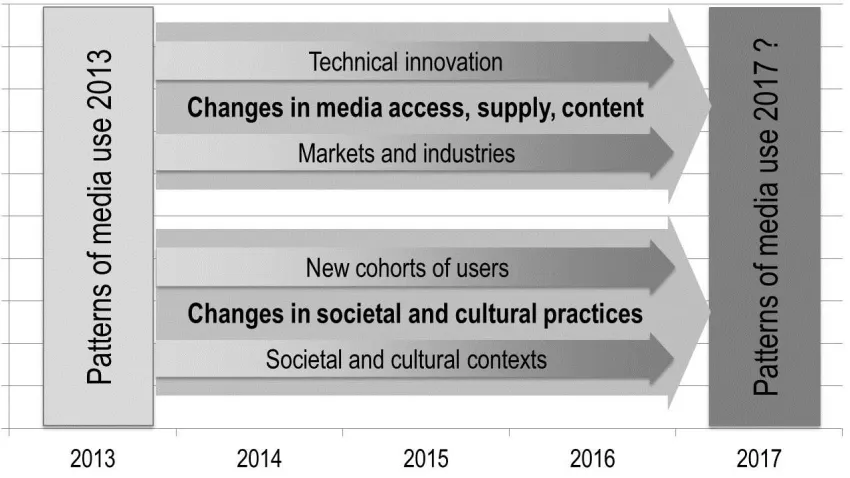
As shown in Figure 1, changing patterns of media use have to be investigated against the background of two comprehensive contextual factors: changes in media access, supply, and content and changes in societal and cultural practices.
Changes in Media Access, Media Supply, and Media Content
The most relevant drivers of this first process of changes in media access are technical innovation on the one hand and market developments and industry strategies on the other hand; these two are obviously closely interwoven. Together they determine “what is available for media use.”
media-related activities. These developments were captured by Jenkins’ (2004) suggestion that digitization is a continuing process, and that the end is not in sight.
The technological focus that is common in accounts of the changing uses of media in the digital media environment has a number of limitations. First, the concept of convergence tends to exaggerate seemingly stable and strict divides between predigital media. This ignores a complex set of intermedial and intertextual relationships among print media, film, and broadcasting throughout the 20th century (see, e.g., Herkman, 2012). Second, common notions of convergence involve an oversimplification of the complexity of the relationship between technological change and media use in different social and cultural contexts (for an overview, see Storsul & Stuedahl, 2007). Much research and debate has been based on a discourse of technological determinism—the idea that technologies and the new forms of communication that they enable may, in themselves, change humans and societies. As noted in the critical review by Storsul and Stuedahl (2007), this has been the dominant paradigm in much work, not just on technologies and policies, but also on ICT diffusion and evolving patterns of media use.
This presumed relationship between technological change and media use seems to be confirmed by data on the uptake of new technologies by media users, as can be illustrated by the example of Belgium. Here, the northern, Dutch-speaking region of Flanders has witnessed an exponential growth in digital television: Starting modestly in 2005, by 2012, three-quarters of all Flemish television households had access to digital television services, an increase of 20% compared to 2011. These households generated 68 million video-on-demand requests in 2011, as compared to 1 million in 2009, and by 2011, 10% of all audiovisual viewing in Flanders was time-shift viewing (ADSL & Breedband, 2012; CIM, 2013).
Changes in Societal and Cultural Practices
Changes in societal and cultural practices, in the structure of everyday life and in people’s interests and needs, refer to the media users’ side of broader developments. The main drivers here are new cohorts of media users (which refers to differences between consecutive cohorts or generations of media users) and changing societal and cultural contexts (which emphasizes the ways in which the societal and cultural evaluation of digital media is changing—for example, in the form of pressures to stay connected and to be present on social networking platforms). Again, these two factors are obviously interwoven; together they result in changing societal and cultural practices.
From a broadly social-constructivist (Berger & Luckmann, 1966) or structurational (Giddens, 1984) perspective, the evolution of patterns of media use is the result not just of what technologies do to people, but also of what individuals, groups, and societies (want to) do with technologies. In this perspective, the relevance and meaning of media and ICTs are continuously negotiated and molded by social actors, in and through their social interactions. Changes in media uses and audience practices must be understood in the context of other societal changes that promote certain technologies and uses rather than others. The rise of more assertive, hedonistic consumers may have privileged qualities of interactivity and choice and, thus, the success of “pull” rather than “push” media, user-generated content, and a bricolage of media input rather than linear media use (Galperin, 2004; see also d’Haenens & Brink, 2001; Lawson-Borders, 2006). As such, shifting technologies, institutions, and uses of media contribute to the socialization of new cohorts of media users, consumers, and citizens with shifting interests and preferences, who represent one more factor in a changing media environment. This leads to new social practices that can be regarded as up to date and appropriate. Thus, by 2017, patterns of media use will have to be interpreted against a background of social practices and meanings that is different than four years earlier. A new survey in 2017 would be based on new cohorts of media users whose (media) socialization will be different from that of the respondents in the 2013 survey.
In addition, given the fact that the diffusion process of the Internet is still going on, a new survey that would keep the definition of the relevant population (people 18 years and older who use the Internet) would be based on a different online population. Although this effect is small in those countries that had already reached almost full online coverage in 2013, it will be substantial for those countries where the first survey was based on a sample that represents only about 50% of the population. Inasmuch as the diffusion process is stratified by social position (DiMaggio & Hargittai, 2001), the composition of the new sample would be quite different from the first sample.
Following these general considerations on the particular challenges of doing longitudinal research, we now turn to empirical evidence and search for specific changes in patterns of media use. Within the limits of this article, we cannot provide a comprehensive overview of national and international findings; instead we focus on three indicators that illustrate our considerations regarding longitudinal changes:
The absolute and relative use of digital media, particularly the Internet: In many debates over the last several years, it has been taken for granted that the amount of Internet use will continue to increase in absolute as well as in relative terms compared to the overall media use (e.g., DiMaggio & Hargittai, 2001).
The relationship between digital media and legacy media within people’s media repertoires: An issue of major concern has been to what extent digital media compete with other media and thus tend to replace them (e.g., Gaskins & Jerit, 2012).
The differentiation of distinct user types: Much effort has been invested in research on emerging patterns of use that characterize highly specific and distinct user groups, which thus might undermine the socially integrative function of mediated communication (e.g., Tewksbury, 2005).
[image:6.612.119.498.388.587.2]A Longitudinal Perspective on Cross-Sectional Survey Data
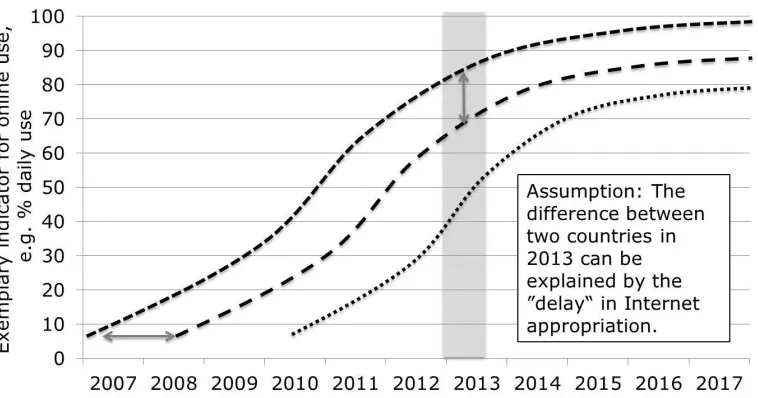
We start from the following empirical assumption: Countries differ with regard to the point in time when the process of the societal appropriation of online communication began. Thus, cross-sectional data as provided by the present European audience survey in 2013 can be used to analyze the process of appropriation. Figure 2 illustrates the general argument: The curves schematically represent the introduction of the Internet in three countries. The country represented by the green curve started earlier than the other countries. The assumption is that empirical differences between the countries, as observed in the 2013 survey, are explained, in part, by this difference in Internet diffusion.
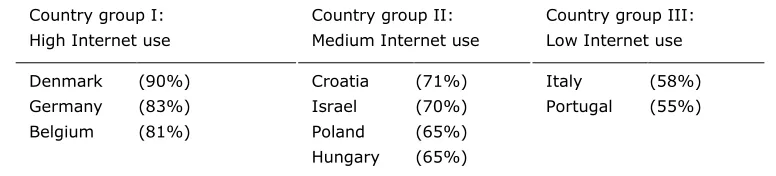
[image:7.612.111.499.417.505.2]To further operationalize this approach we need an indicator for the degree of societal appropriation of online communication. The participating countries were grouped in terms of the percentage of the population who had access to the Internet in 2012 (see Table 1). It is a well-known problem of comparative research that even “simple” indicators such as the percentage of people who use the Internet are complicated to measure, and that international statistics differ quite substantially in this regard. In the present case, we chose the figures provided by Internet World Stats (2014) for 2012; these data include all countries involved in this survey. (For the case of Belgium, it has to be emphasized that the percentage shown in Table 1 refers to Belgium as a whole, while the data of the European audience survey as well as some findings presented below refer to Flanders only. Given the fact that online diffusion in Flanders is higher than in the French-speaking part of Belgium, the classification of Belgium in Group I is clearly valid.)
Table 1. Classification of Participating Countries According to the Percentage of Populations With Access to the Internet in 2012.
Country group I: High Internet use
Country group II: Medium Internet use
Country group III: Low Internet use Denmark Germany Belgium (90%) (83%) (81%) Croatia Israel Poland Hungary (71%) (70%) (65%) (65%) Italy Portugal (58%) (55%)
Note. From Internet World Stats (2014).
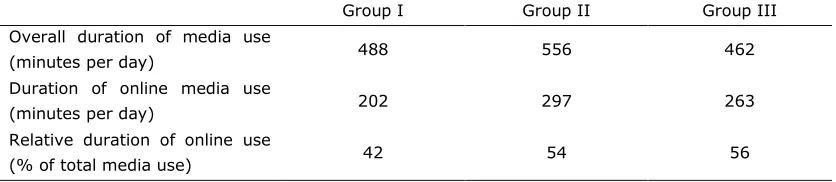
Table 2 shows substantial differences between the three groups of countries in terms of the overall duration of media use, with Group II being characterized by the highest duration of more than nine hours per day on average. The second row indicates that the three countries in Group I represent the lowest duration of online media use. Hence, the relative duration of online media use is substantially lower in these countries than in the two other groups. At first sight, this finding might be counterintuitive: Recent public as well as academic debates seem to expect that the relative position of online communication will continue to increase as the process of Internet appropriation proceeds. At second sight, though, the factors of change discussed above might explain this finding: The population of our study, for all countries, was the part of the population with access to the Internet. Thus, while the findings from Denmark represent more than 90% of the entire Danish population, the findings from Portugal represent only about half of the population, and it may be assumed that this part of the Portuguese population is younger and has a stronger interest in online communication than the average population.
Table 2. Absolute and Relative Duration of Media Use Per Country Group.
Group I Group II Group III
Overall duration of media use
(minutes per day) 488 556 462
Duration of online media use
(minutes per day) 202 297 263
Relative duration of online use
(% of total media use) 42 54 56
A further analysis of the age of respondents supports this argument: The average age of respondents in Belgium, Denmark, and Germany is 44 years—substantially older than the respondents in the two other groups, with an average age of 37 years. Thus, the observed difference between the countries can be attributed to differences in the composition of the online population rather than to an actual increase in the relative duration of online media use in those countries with the highest Internet diffusion.
media, the effect of early enthusiasm and curiosity about these new media fades away, and the relative duration of online media use decreases.
Figure 3. Online media use as percent of overall media use.
As a second empirical approach to the longitudinal analysis of comparative data, we next examine correlations between individual media. The underlying question is to what extent different media may be concordant (as indicated by a positive correlation between the duration of use of two media) or competitive (as indicated by a negative correlation). Correlational analyses were conducted for each pair of 24 media types that had been covered in the European audience survey. One finding is almost no significant negative correlations between any of these pairs of media. This suggests a “the more, the more” rule of media use: Some groups will use all media more intensively than others. That finding constitutes an empirical argument against any claim that the use of one medium occurs at the expense of another medium.
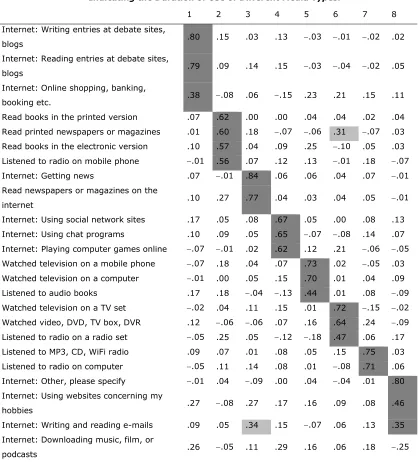
Table 3. Rotated Matrix of Factor Loadings of 24 Variables, Indicating the Duration of Use of Different Media Types.
1 2 3 4 5 6 7 8
Internet: Writing entries at debate sites,
blogs .80 .15 .03 .13 .03 .01 .02 .02
Internet: Reading entries at debate sites,
blogs .79 .09 .14 .15 .03 .04 .02 .05
Internet: Online shopping, banking,
booking etc. .38 .08 .06 .15 .23 .21 .15 .11
Read books in the printed version .07 .62 .00 .00 .04 .04 .02 .04 Read printed newspapers or magazines .01 .60 .18 .07 .06 .31 .07 .03 Read books in the electronic version .10 .57 .04 .09 .25 .10 .05 .03 Listened to radio on mobile phone .01 .56 .07 .12 .13 .01 .18 .07 Internet: Getting news .07 .01 .84 .06 .06 .04 .07 .01 Read newspapers or magazines on the
internet .10 .27 .77 .04 .03 .04 .05 .01
Internet: Using social network sites .17 .05 .08 .67 .05 .00 .08 .13 Internet: Using chat programs .10 .09 .05 .65 .07 .08 .14 .07 Internet: Playing computer games online .07 .01 .02 .62 .12 .21 .06 .05 Watched television on a mobile phone .07 .18 .04 .07 .73 .02 .05 .03 Watched television on a computer .01 .00 .05 .15 .70 .01 .04 .09 Listened to audio books .17 .18 .04 .13 .44 .01 .08 .09 Watched television on a TV set .02 .04 .11 .15 .01 .72 .15 .02 Watched video, DVD, TV box, DVR .12 .06 .06 .07 .16 .64 .24 .09 Listened to radio on a radio set .05 .25 .05 .12 .18 .47 .06 .17 Listened to MP3, CD, WiFi radio .09 .07 .01 .08 .05 .15 .75 .03 Listened to radio on computer .05 .11 .14 .08 .01 .08 .71 .06 Internet: Other, please specify .01 .04 .09 .00 .04 .04 .01 .80 Internet: Using websites concerning my
hobbies .27 .08 .27 .17 .16 .09 .08 .46
Internet: Writing and reading e-mails .09 .05 .34 .15 .07 .06 .13 .35 Internet: Downloading music, film, or
podcasts .26 .05 .11 .29 .16 .06 .18 .25
The main findings of the factor analysis are, on the one hand, that certain general “modes” of media use are central: Key factors are defined by watching audiovisual media (factors 5 and 6), by reading (factor 2), by listening (factor 7), or by interpersonal communication (factor 4). On the other hand, concrete devices do matter: Traditional TV viewing (factor 6) and TV viewing via computer or mobile (factor 5) are separated in the analysis, as are newspapers (factor 2) and online newspapers (factor 3). A third relevant aspect is content: Music (factor 7) and news (factor 3) are used across different devices.
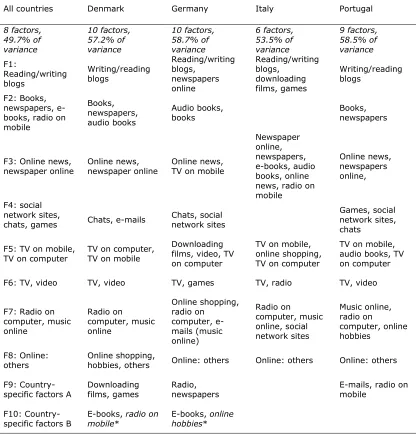
Regarding long-term changes in the uses of individual media, it can be anticipated that, with an ongoing appropriation of the Internet, the use of online media will become increasingly differentiated. Whereas in the early phases of Internet use, the main distinction of media users might be between online and off-line communication, later phases might be characterized by the development of various preferences for particular online services in combination with off-line media (Simons, 2013). To better understand international differences in the structures underlying variations in the duration of media use, we conducted a similar factor analysis for four selected countries, two belonging to Group I (Denmark and Germany) and two belonging to Group II (Italy and Portugal).
Table 4 attributes the national factor solutions, as far as possible, to the eight factors of the previous overall analysis, presented in
Table 3. A first observation is that the factor structure of the two countries representing an advanced phase of Internet appropriation is more differentiated. The factor solutions for both countries have 10 factors (compared to 6 and 9 for Italy and Portugal), but this higher number of factors does not lead to a higher level of explained variance. Particularly in the case of Italy, some factors are defined by quite a broad range of online activities, which indicates a lower degree of differentiation within the online environment. Beyond these differences, there are also many similarities between the factor solutions for the four countries.
The present longitudinal analysis of findings from a comparative survey leads to two hypotheses regarding long-term changes in online media use. First, a continuous increase in the relative duration of online use cannot be observed; on the contrary, the tendency is that the relative duration of online media use in “advanced” countries is lower than in other countries. Second, a prolonged process of societal appropriation of online media is associated with more differentiated patterns of online activities.
Table 4. Factor Analyses for Four Selected Countries.
All countries Denmark Germany Italy Portugal
8 factors, 49.7% of variance 10 factors, 57.2% of variance 10 factors, 58.7% of variance 6 factors, 53.5% of variance 9 factors, 58.5% of variance F1: Reading/writing blogs Writing/reading blogs Reading/writing blogs, newspapers online Reading/writing blogs, downloading films, games Writing/reading blogs F2: Books, newspapers, e-books, radio on mobile
Books, newspapers, audio books
Audio books,
books Books, newspapers
F3: Online news,
newspaper online Online news, newspaper online Online news, TV on mobile
Newspaper online, newspapers, e-books, audio books, online news, radio on mobile Online news, newspapers online, F4: social network sites,
chats, games Chats, e-mails Chats, social network sites
Games, social network sites, chats
F5: TV on mobile,
TV on computer TV on computer, TV on mobile
Downloading films, video, TV on computer
TV on mobile, online shopping, TV on computer
TV on mobile, audio books, TV on computer
F6: TV, video TV, video TV, games TV, radio TV, video
F7: Radio on computer, music online Radio on computer, music online Online shopping, radio on computer, e-mails (music online) Radio on computer, music online, social network sites Music online, radio on computer, online hobbies F8: Online:
others Online shopping, hobbies, others Online: others Online: others Online: others F9:
Country-specific factors A Downloading films, games Radio, newspapers E-mails, radio on mobile F10:
Country-specific factors B E-books, radio on mobile* E-books, online hobbies*
Longitudinal Findings at the National Level
The Contexts of Longitudinal Research in Denmark, Flanders, and Germany
“Measuring the information society” (International Telecommunication Union, 2012) is a concern in all countries around the world, including the three countries that we use here as exemplars. Media companies, advertising agencies, governments, and other stakeholders will initiate repeated large-scale surveys to gain empirical evidence about ongoing changes in the patterns of media use. However, even if many of these studies aim at assessing more or less the same phenomena, the concrete approaches and methods are often quite different; and so are the findings. The following reflections on selected findings from Denmark, Flanders, and Germany are not based on strictly comparable studies, but rather consider several complementary approaches to procuring more substantial evidence about longitudinal changes in the patterns of media use in the future. Indeed, the paucity of such studies was a central motivation for the comparative study of European media audiences, and it equally motivates the following suggestions for further research.
The design of the nine-country comparative study of media use in Europe derives from research originally conducted in Denmark, for which data were collected in 2008 (Jensen & Helles, 2011). Refocusing attention on processes of communication rather than on media as either texts or institutions, that first study found that “one-to-one and one-to-many forms of communication remain dominant” (p. 528), even if many-to-many forms of communication through social and other digital media were making inroads into the media environment as a whole. The Danish study also called for “sustained empirical research” (p. 529) about a rapidly changing media environment in order to identify and interpret the shifting flows of communication between and across different media, through comparative analyses of different demographic and cultural segments as well as in a longitudinal perspective. The European study represents an important empirical step in this regard, including a replication of the original set of analyses in a culturally comparative perspective (Nimrod, Adoni, & Nossek, this issue), which found significant support for the continued centrality of what used to be known as “mass communication” and “mass media” in (the present stage of) the digital media environment.
In the case of Denmark, 2014 witnessed the launch of a new and more comprehensive documentation of various aspects of the national media environment, including patterns of use across different types of media and technological platforms. Hosted by the Danish Ministry of Culture as a web-based resource (Kulturstyrelsen, 2014), the reporting covers technological, demographic, as well as economic-industrial aspects of media use and media change. As part of this reporting, one study replicated key questions from both the 2008 Danish study and the 2013 European study (Jensen & Helles, 2014).
For Germany, several longitudinal studies cover current trends in media use—in particular the ARD/ZDF Online Survey (since 1997; see van Eimeren & Frees, 2014), which is an annual report about audience research for TV, radio, and print media, as well as the famous long-term study “Massenkommunikation” (mass communication), organized by the public broadcasters in Germany (since 1964; see Reitze & Ridder, 2011).
The Development of Online Media Use
[image:14.612.143.471.394.597.2]With regard to the first indicator noted above—the absolute and relative amount of online communication—the ARD/ZDF Online Survey measures the duration of online media use among those Germans who actually use the Internet (van Eimeren & Frees, 2014). Figure 4 illustrates that this indicator was quite stable between 2009 and 2012, with slightly more than two hours of online media use per day. In 2013, however, the study noted a striking increase of more than 30 minutes above the level of 2012; in 2014 this high level recurs. Thus, with regard to longitudinal changes, the findings hold a complex message: There is no constant and linear increase in the duration of online media use; there are, instead, stable phases, followed by fast changes. In the present case, the substantial increase from 2012 to 2013 might be explained, in part, by the fact that many online media users started to use mobile devices to access the Internet. The gray curve in Figure 4 shows a sharp increase in who goes online during transportation. This supports the assumption, outlined in Figure 1, that changes in the availability of technical devices—in this case, mobile media such as smart phones and tablets—at least begin to explain changes in the patterns of media use.
Figure 4. Online media use in Germany 2009–2014: Total use (in minutes per day) and use during transportation (in %).
The role of technical innovations for mobile communication is supported by Flemish findings. The Digimeter studies have documented that Internet penetration rose from 78% in 2009 to a saturation point of over 90% in 2012–2013, further characterizing off-line Flemings as typically older than 60 years, retired, and with low education. Most interesting is the soaring success of mobile media in Flanders: Between 2010 and 2013, the penetration rate of smart phones (from 24% to 48%), tablets (from 2% to 41%), and mobile data subscriptions (from 15% to 40%) rose at a rapid pace. As a result, Flanders could be characterized in 2013 as a country of multiscreen households, with about one in four triple-screen households, one in four quadruple-screen households, and one in six quintuple-screen households.
This picture of online mobile communication is complicated, however, by findings from Denmark, which otherwise is close to Germany and Flanders on various social as well as technological parameters. The 2014 study of media use in Denmark found that, in a representative sample of the population, only 6% watched television on mobiles, and only 4% listened to radio on mobiles, as measured not by diffusion or access, but by use “the day before” (Jensen & Helles, 2014). Once again, different methods and measurement make it difficult to compare across societies and cultures, and thus to infer and assess the nature of ongoing changes.
“Old” and “New” Media
As for the second indicator of changing patterns of media use—the relationship between different media—the high number of multiscreen households in Flanders might explain a sharp decline in linear television use from 71% in 2012 to 56% in 2013. By 2013, more than half of the respondents relied on a computer, tablet, or smart phone for watching television. So, while traditional one-to-many communication remains important, the devices through which this communication takes place may be changing. A similar proportion of respondents would surf the Internet while watching television. Furthermore, websites outpaced newspapers as sources of news for the first time in 2013, although national television and radio still trumped both of these sources. Also by 2013, the vast majority of respondents had made use of over-the-top communication, such as Skype or streaming music, films, or series. Nonetheless, e-mail, information-seeking, and use of social network sites remained the most frequent online activities.
Figure 5. Duration of use of audiovisual media in Germany (in minutes per day).
Base is total population age 14 and older; for television AGF/GfK people meter panel; for radio Media Analyse; for Internet ARD/ZDF Online Survey (van Eimeren & Frees, 2014, p. 392).
The stability of these aggregated findings is surprising. In the process of appropriating the Internet, media users seem to extend their time budgets for mediated communication. But does this finding hold at the individual level of analysis? A negative correlation between the time spent on using two different media (e.g., television and Internet) would suggest a tension between them: One medium is used at the expense of the other, and few people will combine heavy use of both. A positive correlation, on the other hand, would indicate that the two media likely can be combined within individuals’ media repertoires. As already mentioned, the findings from the European audience survey (see Table 3) point to such a “the more, the more” rule. This, however, might be a consequence of large national samples including diverse social contexts and lifestyles and, thus, distinct patterns of media use. The next question is whether the same rule holds for more homogeneous groups of users.
hold up. Notably, within the group of adolescents, the correlation between online media use and television viewing is close to zero (r = .02), and for newspapers there is a moderate and highly significant positive correlation (r = .22). In other words, the more young people use the Internet, the more they read newspapers—which clearly goes against the received understanding. An important general lesson of these findings is to always consider the role of demographic and other contextual variables. In the present case, the media correlation for the total sample can be explained by social factors: Older respondents watch a lot of television and are less likely to use the Internet than younger respondents.
User Types
In stressing the social and cultural contexts of media use, we finally reach the question of which distinctive user types can be seen to emerge within the process of appropriating the Internet in different national settings. In Denmark, the 2014 report of the recent comprehensive national study constructed profiles of Danish media users. Familiar from both academic and commercial research on the relationship between media use and broader lifestyles (Bourdieu, 1984; Inglehart, Basanez, & Moreno, 1998), such typologies begin to capture aspects of the general process of societal appropriation: Typologies of media use serve as indicators of how individuals, groups, and entire societies recombine the available means of communication in a particular social and cultural context, which is subject to change along with the institutions, technologies, and practices constituting it.
The 2014 study (Jensen & Helles, 2014) identified three main types of media users in the Danish population through a latent class analysis (Agresti, 2002): traditionalists, mainstreamers, and pluralists. Whereas traditionalists will center their media use on the traditional mass media—television, radio, and newspapers—mainstreamers perform more specific selections and combinations of both “new” and “old” media, including online newspapers. Pluralists, in turn, represent a group of early adopters of new media of communication, who engage, for example, in significantly more online communication such as streaming television and streaming music. Interestingly, pluralists are a comparatively small group (8% of the population). In comparison, mainstreamers (47%) and traditionalists (45%) together account for more than 90% of media users in the case of Denmark.
Not surprisingly, age matters in this typology. There is an overrepresentation of older respondents among the traditionalists, and an overrepresentation of younger respondents among the mainstreamers. However, there is no statistically significant relationship between age and the pluralist profile. Like the findings from the nine-country comparative study, then, the Danish follow-up study one year later served to question the common perception of young media users as a distinctively digital media generation. Instead, these studies suggest a gradual process of societal appropriation in which new media and communicative practices are added to and aligned with existing media and practices. People come of age with, and are socialized into using, historically shifting configurations of media.
refer to these as “mediaphobics” (30%) and “traditional media users” (28%) (2009); “zapping, functional media consumers” (31%) and “avid, classical media users” (23%) (2011); and “instrumental media users” (28%) and “traditional media fans” (23%) (2013). Apart from television use, these predominant profiles are characterized by low levels of media use; a reliance on classic media such as linear television, radio, and newspapers; traditional cell phone use; and use of computers and the Internet primarily for professional reasons. Other groups are termed “onliners” (23%), “mobile fun seekers” (13%), and “digital omnivores” (6%) (2009); “new media freaks” (19%), “professional multitaskers” (16%), and “digital analphabets” (11%) (2011); and “digital gentlemen” (17%), “online media masters” (14%), and “media innovators” (19%) (2013). Except for the digital analphabets (2011), these other profiles all represent specific combinations of online and off-line media, often at the same time, with a considerable interest in new products and services, either for professional reasons or as components of leisure. Whereas there is an overrepresentation of older respondents among the majority groups who depend least on media, younger respondents are overrepresented among the groups combining online and off-line media. By 2013, these latter types of media profiles had come to account for half of Flemish media users.
In Germany, as in Flanders and Denmark, typologies of media use have been proposed, focusing mainly on the difference between legacy media and online media, and on differentiating between traditional or innovative patterns of use. One specific approach (Oehmichen, 2007; Oehmichen & Ridder, 2003) was based on survey data from 1998, which informed the first version of the German MedienNutzerTypologie (Typology of Media Users). The approach defined nine user types with reference to a broad set of determinants of media use: leisure activities, leisure-related values, aims in life, tastes regarding styles of music, interests in particular topics, fashion, newspaper use, and so on. Importantly, this typology is not based on actual patterns of media use, but on general orientations regarding culture and lifestyle. Nevertheless, these patterns have a clear bearing on media use, and the typology provided a powerful instrument for predicting concrete use patterns for television, radio, and the Internet. In 2006, a second version of the typology was published, based on a slightly adapted instrument of 10 types (Hartmann & Höhne, 2007). A comparison between the nine types of 1998 and the 10 types of 2006 suggests a number of longitudinal changes (Oehmichen, 2007): The 2006 follow-up study found types corresponding to most of the 1998 types, indicating a high degree of stability in the basic patterns of cultural orientation. At the same time, the types were found to become gradually more distinct, so that their explanatory power in predicting the use of certain media increased. This distinctiveness and differentiation applied to all generations: Whereas the 1998 typology included just one type of young users, the 2006 typology revealed two “young types.” Overall, keeping in mind that the two typologies cover the central phase of the diffusion of the Internet in Germany (from 10% of the population in 1998 to 60% in 2006), it might be surprising that the second typology did not find any user type that was characterized by a particular affinity to the Internet.
Conclusions
In converging media environments, it no longer seems appropriate to focus on the development of single media and their social uses. Given rapid and substantial changes in contemporary media environments around the world, the research question at hand is how the uses of different media are interrelated and how they may be changing as people integrate new means of communication into their everyday lives. It is a question that requires longitudinal research monitoring developments over time; it also requires an approach recognizing that, amid global technical innovations and institutional strategies, the social contexts and cultural traditions of individual countries substantially shape the appropriation of each new medium. Thus, to guard against technological determinism, further cross-cultural research on changing patterns of media use is key. The comparative European project presented in this special issue began to address this task and set out to describe audiences across media, to compare patterns of media use across countries, and, thus, to provide a baseline for future longitudinal studies of media use.
The present article has discussed the particular challenges of doing longitudinal research. Departing from the 2013 survey, future comparative studies will have to take into account not only continued technical innovations but the shifting strategies of media industries and the established societal and cultural practices of users. In methodological terms, we noted that, because the diffusion of technical innovations does not take place at the same time in all countries, findings from the 2013 European survey could throw light on various longitudinal aspects of how people appropriate online media in different national contexts. Furthermore, we presented other findings from national longitudinal studies that have tracked developments in the relative importance of online and off-line media use, the changing relationship between legacy and digital media, and the emergence and transformation of distinctive user types. Still, it is remarkable that, even in instances with such strong social and cultural affinities— Denmark, Flanders, and Germany—research is not yet in a position to deliver either dedicated comparative frameworks of analysis or genuinely longitudinal empirical findings.
This article and the comparative European project have reemphasized the point that the societal appropriation of digital media is no linear process. Across countries, their diffusion is far from synchronous; even within countries, there are phases of relative stability alternating with phases of rapid change. Such phases of change are often associated with the introduction of new devices or services. Nevertheless, in all nine countries examined here, “old” media still constitute an integral part of most users’ media repertoires. Moreover, additional studies have pointed to substantial differences between user types within and across countries—distinctive patterns of media use—which, further, can be seen to emerge from equally distinctive social and cultural contexts. Rather than tracking the diffusion of new devices and services, comparative audience researchers are, or should be, in the business of studying long-term, tectonic changes.
comparing media use across countries and cultures as well as time. The time is right to move beyond Europe and to initiate more audience studies that are cross-continental as well as cross-cultural, comparing media use in, for example, the United States, Europe, and China to better understand the geographically and culturally situated audiences of the global, digital media environment.
References
ADSL & Breedband. (2012, March 5). Aantal klanten groeit bij belgacom; omzet en winst daalde [Number of customers for Belgacom increases: Turnover and profit decline]. Retrieved from
http://www.adsl-breedband.be/actualiteiten/aantal-klanten-groeit-bij-belgacom-omzet-winst-daalde
Agresti, A. (2002). Categorical data analysis (2nd ed.). Hoboken, NJ: Wiley.
Berger, P. L., & Luckmann, T. (1966). The social construction of reality: A treatise in the sociology of knowledge. London, UK: Penguin.
Bjur, J., Schrøder, K. C., Hasebrink, U., Courtois, C., Adoni, H., & Nossek, H. (2014). Cross-media use— Unfolding complexities in contemporary audiencehood. In N. Carpentier, K. C. Schrøder, & L. Hallett (Eds.), Audience transformations: Shifting audience positions in late modernity (pp. 15– 29). New York, NY: Routledge.
Bourdieu, P. (1984). Distinction. Cambridge, MA: Harvard University Press.
Christensen, J. F., & Maskell, P. (Eds.). (2003). The industrial dynamics of the new digital economy. London, UK: Edward Elgar.
CIM (Centrum voor Informatie over de Media/Centre for Information on Media). (2013). Viewing figures for Flanders (delayed viewing—all day: 4+ & guests).CIM TV (01/01/09–31/08/13). Retrieved from http://www.cim.be/media/Televisie/Openbare%20resultaten
Couldry, N., Livingstone, S., & Markham, T. (2007). Media consumption and public engagement. Basingstoke, UK: Palgrave Macmillan.
d’Haenens, L., & Brink, S. (2001). Digital convergence: The development of a new media market in Europe. In L. d’Haenens & F. Saeys (Eds.), Western broadcasting at the dawn of the 21st century (pp. 125–145). Berlin, Germany: Mouton de Gruyter.
Doyle, G. (2002). Media ownership: The economics and politics of convergence and concentration in the UK and European media. London, UK: SAGE Publications.
Galperin, H. (2004). New television, old politics: The transition to digital TV in the United States and Britain. Cambridge, UK: Cambridge University Press.
Gaskins, B., & Jerit, J. (2012). Internet news: Is it a replacement for traditional media outlets? International Journal for Press/Politics, 17(2), 190–213. doi:10.1177/1940161211434640
Giddens, A. (1984). The constitution of society: Outline of the theory of structuration. Cambridge, UK: Polity Press.
Hartmann, P. H., & Höhne, I. (2007). MNT 2.0—Zur Weiterentwicklung der MedienNutzerTypologie [Toward a further development of media users typology]. Veränderungen gegenüber der MNT 98 [Changes compared to the MNT 98]. Media Perspektiven, 5, 235–241.
Hasebrink, U., & Domeyer, H. (2012). Media repertoires as patterns of behaviour and as meaningful practices: A multimethod approach to media use in converging media environments. Participations, 9(2), 757–783. Retrieved from
http://www.participations.org/Volume%209/Issue%202/40%20Hasebrink%20Domeyer.pdf
Herkman, J. (2012). Introduction: Intermediality as a theory and methodology. In J. Herkman, T. Hujanen, & P. Oinonen (Eds.), Intermediality and media change (pp. 10–27). Tampere, Finland: Tampere University Press.
Humphreys, P. (1996). Mass media and media policy in Western Europe. Manchester, UK: Manchester University Press.
Inglehart, R., Basanez, M., & Moreno, A. (1998). Human values and beliefs: A cross-cultural sourcebook. Ann Arbor, MI: University of Michigan Press.
International Telecommunication Union. (2012). Measuring the information society 2012. Geneva, Switzerland: Author.
Internet World Stats. (2014). Usage and population statistics. Retrieved from www.internetworldstats.com
Jenkins, H. (2004). The cultural logic of media convergence. International Journal of Cultural Studies, 7, 33–43. doi:10.1177/1367877904040603
Jensen, K. B., & Helles, R. (2011). The Internet as a cultural forum: Implications for research. New Media & Society, 13(4), 517–533. doi:10.1177/1461444810373531
Jensen, K. B., & Helles, R. (2014). Danskernes mediebrug 2014: Hverdag og demokrati [Media use in Denmark 2014: Everyday life and democracy]. Copenhagen, Denmark: Kulturstyrelsen.
Kulturstyrelsen. (2014). Mediernes udvikling: Resumé 2014 [Media development: Summary 2014]. Retrieved from http://www.kulturstyrelsen.dk/mediernes-udvikling-2014
Lawson-Borders, G. (2006). Media organizations and convergence. Case studies of media convergence pioneers. Mahwah, NJ: Lawrence Erlbaum.
Lotz, A. D. (Ed.) (2009). Beyond prime time: Television programming in the post-network era. New York, NY: Routledge.
Ludes, P. (Ed.) (2009). Convergence and fragmentation: Media technology and the information society. Bristol, UK: Intellect.
McQuail, D., & Siune, K. (Eds.). (1998). Media policy: Convergence, concentration and commerce. London, UK: SAGE Publications.
Mittell, J. (2011). TiVoing childhood: Time-shifting a generation’s concept of television. In M. Kackman, M. Binfield, M. T. Payne, A. Perlman, & B. Sebok (Eds.), Flow TV: Television in the age of media convergence (pp. 46–54). New York, NY: Routledge.
Murdock, G. (1990). Redrawing the map of the communication industries: Concentration and ownership in the era of privatisation. In M. Ferguson (Ed.), Public communication: The new imperatives (pp. 1–15). London, UK: SAGE Publications.
Napoli, P. M. (2011). Audience evolution: New technologies and the transformation of media audiences. New York, NY: Columbia University Press.
Noam, E. M. (2009). Media ownership and concentration in America. New York, NY: Oxford University Press.
Oehmichen, E. (2007). Die neue MedienNutzerTypologie MNT 2.0. Veränderungen und Charakteristika der Nutzertypen [The new typology of media users MNT 2.0. Changes and characteristics of the user types]. Media Perspektiven, 5, 226–234. Retrieved from
http://www.media-perspektiven.de/fileadmin/user_upload/media-perspektiven/pdf/2007/05-2007_Oehmichen.pdf
Reitze, H., & Ridder, C.-M. (Eds.). (2011). Massenkommunikation VIII: Eine Langzeitstudie zur Mediennutzung und Medienbewertung 1964 – 2010 [Mass Communication VIII: A longitudinal study on media use and media evaluation 1964–2010]. Baden-Baden, Germany: Nomos.
Rogers, E. (2003). Diffusion of innovation (5th ed.). New York, NY: Free Press.
Simons, N. (2013). Watching TV fiction in the age of digitization: A study into the viewing practices of engaged TV fiction viewers, International Journal of Digital Television, 4(2), 177–191. doi:10.1386/jdtv.4.2.177_1
Storsul, T., & Stuedahl, D. (Eds.). (2007). Ambivalence towards convergence: Digitalization and media change. Gothenburg, Sweden: Nordicom.
Tewksbury, D. (2005). The seeds of audience fragmentation: Specialization in the use of online news sites, Journal of Broadcasting and Electronic Media, 49, 332–348.
doi:10.1207/s15506878jobem4903_5
Van den Bulck, H., & Donders, K. (2014). Pitfalls and obstacles of media policy making in an age of digital convergence: The Flemish signal integrity case. Journal of Information Policy, 4, 444-462. doi:10.1177/0267323113509362
Van Eimeren, B., & Frees, B. (2014). 79 Prozent der Deutschen online—Zuwachs bei mobiler
Internetnutzung und Bewegtbild. Ergebnisse der ARD/ZDF-Onlinestudie 2014 [79 percent of Germans online. Growth in mobile Internet usage and moving images. Results of the ARD/ZDF-Online study 2014]. Media Perspektiven, 7–8, 378–396. Retrieved from http://www.media-