Sztandera Paulina. The influence of body posture parameters on selected parameters of the dynamic foot analysis. Journal of
Education, Health and Sport. 2018;8(9):1282-1292 eISNN 2391-8306. DOI http://dx.doi.org/10.5281/zenodo.1432868
http://ojs.ukw.edu.pl/index.php/johs/article/view/6067
The journal has had 7 points in Ministry of Science and Higher Education parametric evaluation. Part B item 1223 (26/01/2017). 1223 Journal of Education, Health and Sport eISSN 2391-8306 7
© The Authors 2018;
This article is published with open access at Licensee Open Journal Systems of Kazimierz Wielki University in Bydgoszcz, Poland
Open Access. This article is distributed under the terms of the Creative Commons Attribution Noncommercial License which permits any noncommercial use, distribution, and reproduction in any medium, provided the original author (s) and source are credited. This is an open access article licensed under the terms of the Creative Commons Attribution Non commercial license Share alike.
(http://creativecommons.org/licenses/by-nc-sa/4.0/) which permits unrestricted, non commercial use, distribution and reproduction in any medium, provided the work is properly cited.
The authors declare that there is no conflict of interests regarding the publication of this paper.
Received: 22.08.2018. Revised: 28.08.2018. Accepted: 21.09.2018.
The influence of body posture parameters on selected parameters of the dynamic foot analysis
Paulina Sztandera, [email protected], orcid.org/0000-0002-1848-562X
Doctoral Studies, Faculty of Medicine and Health Science, Jan Kochanowski University, Kielce, Poland
Abstract
Introduction and purpose of work. The correct body posture and its evaluation in children of all ages is of great importance. Special attention should be paid to two critical periods, when the posture may deteriorate significantly. Monitoring the body posture makes it possible to detect any abnormalities at an early stage that may subsequently lead to other health problems. The aim of the paper was to analize the connections between the body posture parameters and the selected parameters of the dynamic foot examination.
Material and methods. 106 children at the age of 10-15 years old from schools located in the Świętokrzyskie Voivodeship took part in the study. The posture of children assessed with the use of the Diers system is analyzed using a three-dimensional light-optical system. The next stage of the research was to conduct the dynamic foot analysis on the FreeMed platform.
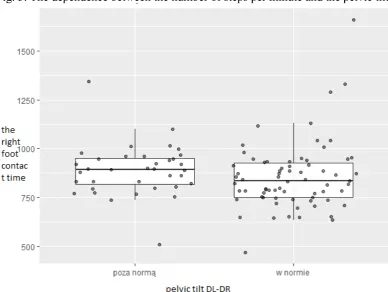
Results. No dependence between the majority of the studied body posture parameters and the parameters of the dynamic analysis was found. A statistically significant dependence was observed between: the right foot surface and the pelvic tilt, the right foot surface and the rotation surface, the number of steps per minute and the pelvic tilt, the contact time of the right foot surface and the pelvic tilt. When the pelvic tilt was standard, the authors observed a smaller surface while loading the right foot, a greater number of steps, and a shorter right foot contact time. The standard surface rotation affected the larger foot surface in the dynamic analysis.
Conclusion. The study needs to be continued and extended in order to verify if there are any dependencies between the body posture parameters and the selected parameters of the dynamic analysis of the foot and gait pressure in children.
Introduction
The correct body posture and its evaluation in children of all ages is of great importance. Special attention should be paid to two critical periods, when the posture may deteriorate significantly. Monitoring the body posture makes it possible to detect any abnormalities at an early stage that may subsequently lead to other health problems [1, 2, 3]. The data regarding the occurrence of body posture defects among children and adolescents differs and estimates up to 50-60% of children [4, 5, 6, 7]. Health prophylaxis regardingthe correct body posture should be implemented not only by qualified physiotherapists, but also at school or home, so in the daily environment of children [4, 6, 8, 9]. The authors also deal with factors contributing to the development of incorrect body posture, i.e.: too little physical activity, obesity, socio-economic status, lifestyle, sex, age and many others [5, 10, 11, 12].
Purpose of work
The aim of the paper was to analize the connections between the body posture parameters and the selected parameters of the dynamic foot examination.
Material and methods
The consent to conduct this study was obtained from the Bioethics Committee located at the Jan Kochanowski University in Kielce. 106 children at the age of 10-15 years old from schools located in the Świętokrzyskie Voivodeship took part in the study. The including criterion was the consent given by parents or legal guardians to conduct the study and the lack of current orthopedic problems related to the motor system, i.e. fractures or dislocations. No consent granted by parents or legal guardians of children to conduct the examination and current orthopedic problems related to the motor system, i.e. fractures or dislocations constituited the excluding criterion. The children were tested using the Diers device and the FreeMed platform.
The posture of children assessed with the use of the Diers system is analyzed using a three-dimensional light-optical system. A naked patient faces backwards the device, which consists of a camera and a projector. Measuring lines are emitted through the projector and a three-dimensional image is transmitted to the computer. The software analyzes the obtained data and gives a full picture of the posture. The next stage of the research was to conduct the dynamic foot analysis on the FreeMed platform. The children wore sport clothes without shoes for the examination. After the examination, the patient was asked to walk on the platform. The examination of children was conducted in the Posturology Laboratory at the Faculty of Medicine and Health Science.
MS Office Excel and statistical program R.3.3.1 were used to analyze the research.Basic measures of descriptive statistics were calculated for all parameters, i.e. arithmetic averages, standard deviation, minimum and maximum for the entire group. While studying thedependencies between the variables,non-parametric tests were applied: the Mann-Whitney-Wilcoxon U test and the Wilcoxon test for pairs of observations. The result when the level of significance amounted to p<0.05 was considered as statistically significant. The dependencies between the selected parameters of the dynamic foot analysiswere examined, i.e. maximum foot load, average foot load, feet load surface cm2, ground contact time, steps
VPDM (rms) [mm], kyphosis angle ICT-ITL (max.) [°], and lordosis angle ITL-ILS (max.) [°].
Results
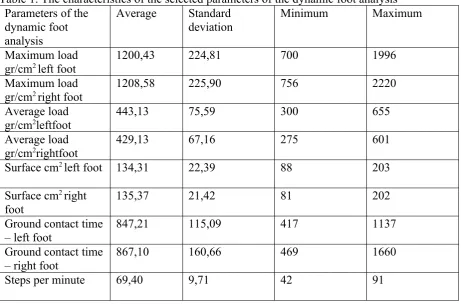
[image:3.595.72.535.176.480.2]Tables 1 and 2 contain the information regarding the characteristics of the selected body posture parameters and the dynamic foot analysis.
Table 1. The characteristics of the selected parameters of the dynamic foot analysis Parameters of the
dynamic foot analysis
Average Standard deviation
Minimum Maximum
Maximum load gr/cm2 left foot
1200,43 224,81 700 1996
Maximum load gr/cm2 right foot
1208,58 225,90 756 2220
Average load
gr/cm2leftfoot 443,13 75,59 300 655
Average load
gr/cm2rightfoot 429,13 67,16 275 601
Surface cm2 left foot 134,31 22,39 88 203
Surface cm2 right
foot
135,37 21,42 81 202
Ground contact time – left foot
847,21 115,09 417 1137
Ground contact time – right foot
867,10 160,66 469 1660
[image:3.595.73.536.496.660.2]Steps per minute 69,40 9,71 42 91
Table 2. The characteristics of the selected parameters assessing the body posture of children The parameters
assessing the body posture
Average Standard deviation
Minimum Maximum
Surface rotation
(rms) [°] 3,80 1,62 1 10
Lateral deviation VPDM (rms) [mm]
3,54 1,74 1 9
Kyphosis angle ICT-ITL (max) [°]
47 6,22 35 66
Lordosis angle ITL-ILS (max) [°]
40,26 8,5 10 66
Table 3. The analysis of the dependencies between the maximum foot load and the body posture parameters.
Right foot Maximum load gr/cm2 Left foot
Stan dard
Non-stand ard
Z p Standa
rd Non-stand ard Z p 1184 ,9 1247 ,6
0,978 0,33 Deviation from the vertical VP-DM [mm] 1197,2 1205, 8 -0,101 0,92 1228 ,9 1169 ,0
-1,174 0,24 Pelvic tilt DL-DR [mm] 1217,9 1166, 4 -0,801 0,42 1233 ,7 1182 ,5
-0,847 0,40 Pelvic torsion DL-DR [°] 1224,0 1176, 0
-0,521 0,60
1251
,8 1171,4 -1,223 0,22 Surface rotation (rms) [°] 1235,0 1170,7 -1,239 0,22 1208
,7 1208,2 0,489 0,62 Lateral deviation VPDM (rms) [mm] 1221,3 1139,4 -1,577 0,11 1210
,1
1205 ,0
-0,260 0,79 Kyphosis angle ICT-ITL (maks.) [°] 1205,9 1187, 3 -0,809 0,42 1222 ,3 1170 ,4
-0,899 0,37 Lordosis angle ITL-ILS (maks.) [°]
1209,6 1175, 0
-0,394 0,69
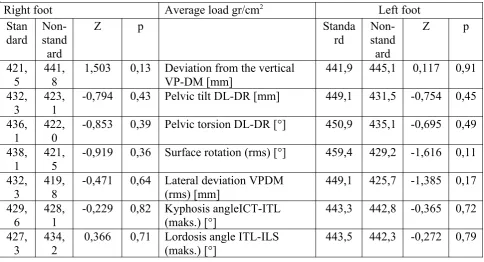
Table 4.The analysis of the dependencies between the average foot load and the body posture parameters.
Right foot Average load gr/cm2 Left foot
Stan dard
Non-stand ard
Z p Standa
rd Non-stand ard Z p 421, 5 441, 8
1,503 0,13 Deviation from the vertical VP-DM [mm]
441,9 445,1 0,117 0,91
432, 3
423, 1
-0,794 0,43 Pelvic tilt DL-DR [mm] 449,1 431,5 -0,754 0,45
436, 1
422, 0
-0,853 0,39 Pelvic torsion DL-DR [°] 450,9 435,1 -0,695 0,49
438,
1 421,5 -0,919 0,36 Surface rotation (rms) [°] 459,4 429,2 -1,616 0,11 432,
3 419,8 -0,471 0,64 Lateral deviation VPDM (rms) [mm] 449,1 425,7 -1,385 0,17 429,
6
428, 1
-0,229 0,82 Kyphosis angleICT-ITL (maks.) [°]
443,3 442,8 -0,365 0,72
427, 3
434, 2
0,366 0,71 Lordosis angle ITL-ILS (maks.) [°]
[image:4.595.73.558.407.669.2]Table5. The analysis of the dependencies between the feet surface and the body posture parameters.
Right foot Surface cm2 Left foot
Stan
dard stand Non-ard
Z p Standa
rd Non-stand ard
Z p
135,
0 136,1 0,606 0,54 Deviation from the vertical VP-DM [mm] 132,4 137,5 1,294 0,20 131,
3 143,2 2,299 0,02 Pelvic tilt DL-DR [mm] 131,0 140,8 1,962 0,05 136,
8
133, 9
-0,724 0,47 Pelvic torsion DL-DR [°] 135,6 133,0 -0,496 0,62
139, 6
131, 7
-2,257 0,02 Surface rotation (rms) [°] 138,4 130,8 -1,813 0,07
136, 6
131, 8
-1,041 0,30 Lateral deviation VPDM (rms) [mm]
135,0 132,2 -0,656 0,51
135, 6
134, 8
-0,205 0,84 Kyphosis angleICT-ITL (maks.) [°]
134,0 135,1 0,108 0,91
137, 3
130, 0
-1,272 0,20 Lordosis angle ITL-ILS (maks.) [°]
136,5 128,4 -1,832 0,07
Table6. The analysis of the dependencies between the foot contact time and the body posture parameters.
Right foot Ground contact time Left foot
Stan dard
Non-stand ard
Z p Standa
rd Non-stand ard Z p 864, 7 871, 2
0,209 0,83 Deviation from the vertical VP-DM [mm]
835,4 866,7 1,300 0,19
855, 5
889, 7
2,038 0,04 Pelvic tilt DL-DR [mm] 836,3 868,4 1,538 0,12
851, 0
883, 9
1,321 0,19 Pelvic torsion DL-DR [°] 834,7 860,2 1,194 0,23
860, 6
872, 7
-0,551 0,58 Surface rotation (rms) [°] 849,3 845,4 -0,447 0,66
877,
2 837,6 -0,406 0,68 Lateral deviation VPDM (rms) [mm] 846,1 850,3 0,522 0,60 868,
1 864,8 -0,674 0,50 Kyphosis angleICT-ITL (maks.) [°] 850,8 838,5 -0,233 0,82 873,
2
850, 2
-0,365 0,71 Lordosis angle ITL-ILS (maks.) [°]
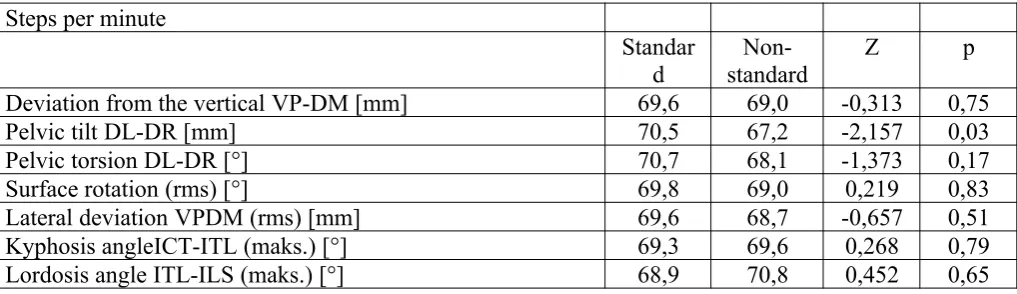
Table 7. The analysis of the dependencies between the steps per minute and the body posture parameters.
Steps per minute
Standar d
Non-standard
Z p
Deviation from the vertical VP-DM [mm] 69,6 69,0 -0,313 0,75
Pelvic tilt DL-DR [mm] 70,5 67,2 -2,157 0,03
Pelvic torsion DL-DR [°] 70,7 68,1 -1,373 0,17
Surface rotation (rms) [°] 69,8 69,0 0,219 0,83
Lateral deviation VPDM (rms) [mm] 69,6 68,7 -0,657 0,51
Kyphosis angleICT-ITL (maks.) [°] 69,3 69,6 0,268 0,79
Lordosis angle ITL-ILS (maks.) [°] 68,9 70,8 0,452 0,65
Table 8 compares the parameters of the dynamic foot analysis with the division into the right and the left foot. The dependence between the average load of the right and the left foot, and the foot contact time is noticable.
Table 8. The comparison of parameters for both feet- the Wilcoxon test for pairs of observations (WilcoxonSigned-Rank Test)
The comparison of feet – the Wilcoxon test for pairs of observations (Wilcoxon Signed-Rank Test)
left right Z p
Maximum load gr/cm2– the dynamic
examination
1200.4(SD=224.8 )
1208.6(SD=225.9 )
-0,5768391
0,5 6 Average load gr/cm2– the
dynamicexamination
443.1(SD=75.6) 429.1(SD=67.2) 2,6303907 0,0 1 Surface cm2- the dynamicexamination 134.3(SD=22.4) 135.4(SD=21.4)
-0,7256938 0,4
7
Groundcontacttime 847.2(SD=115.1) 867.1(SD=160.7)
-2,3341206 0,0
2
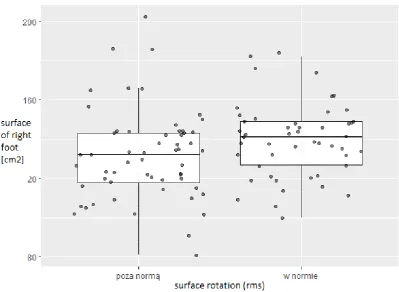
Fig. 1. The dependence between the right foot surface and the pelvic tilt
[image:7.595.75.475.340.632.2]Fig. 3. The dependence between the number of steps per minute and the pelvic tilt
Fig. 4. The dependence between the right foot contact time and the pelvic tilt
Discussion
[image:8.595.75.464.357.649.2]length and low energy consumption [14], but also provide proper conditions for shaping the body posture.
The majority of authors concentrate their dynamic analysis using pedobarographic patterns on analysing loads of particular foot zones in people with various problems. Articles refer the most frequently to the foot load of people with excessive body mass or feet irregularities [15, 16, 17, 18, 19]. Therefore, the authors have made an attempt to investigate the influence of body posture parameters on selected parameters of the dynamic foot analysis which are related to the gait.
Jaszczur et al. [20]in her research of people aged 22-27 did not notice any statistically significant differences between the maximum foot load, the ground contact time, and thus, found that the gait of the respondents was symmetrical. In this paper, the parameters such as the maximum load and the foot surface in the loading phase while differentiating the averages for both feet, showed no statistically significant differences, however, statistically significant differences were found while analyzing the following parameters, i.e.: the ground contact time, and the average foot load. The right lower limb came into longer contact with the ground, while the average load was higher for the left lower limb.
The number of steps per minute changes with age, and according to the standards [21] the number in the examined age group should fall between 100-162 steps per minute. On average the number amounted to 69 steps in the study group – while the results fall between 42-91 steps.
The authors here of were seeking the dependencies between the selected parameters of the dynamic foot analysis and the gait, and the body posture.
This paper attempted to assess how variable body posture parameters will affect the selected parameters of the foot load, as well as the number of steps per minute and the ground contact time. It was assumed that as the posture symmetry changes, the above-mentioned parameters should change as well. No dependence between the majority of the studied body posture parameters and the parameters of the dynamic analysis was found. A statistically significant dependence was observedbetween: the right foot surface and the pelvic tilt, the right foot surface and the rotation surface, the number of steps per minute and the pelvic tilt, the contact time of the right foot surface and the pelvic tilt. When the pelvic tilt was standard, the authors observed a smaller surface while loading the right foot, a greater number of steps, and a shorter right foot contact time. The standard surface rotation affected the larger foot surface in the dynamic analysis.
The authors emphasized the need to broaden the study regarding the foot load and increase the number of respondents, as well as suggestedan attempt to divide the test and the control group. In their opinion, the test group should comprise of people with posturalproblems.
Conclusion
References:
1. Kasperczyk T. Wady postawy ciała. Kasper. Kraków; 2002.
2. Proszkowiec M, Słonka K, Hyla-Klekot L. Kształtowanie sie postawy ciała w II krytycznym okresie posturogenezy z uwzględnieniem stopnia dojrzałości płciowej badanych. Fizjoterapia. 2011; 19(1): 10-19.
3. Hagner W, Bąk D, Hagneer-Deengowska M. Changes in body posture in children between the 10th and 13th years of age. Pol. Ann. Med. 2011; 18(10: 76-81.
4. Górecki A, Kiwerski j, Kowalski IM, Marczyński W, Nowotny J, Rybicka M, Jarosz U, Suwalska M, Szelachowska-Kluza W. Profilaktyka wad postawy u dzieci i młodzieży w środowisku nauczania i wychowania – rekomendacje ekspertów. Pol. Ann. Med. 2009; 16(1):168-177.
5. Wawrzyniak A, Tomaszewski M, Mews J, Jung A, Kalicki B. Wady postawy u dzieci i młodzieży jako jeden z głównych problemów w rozwoju psychosomatycznym. Pediatr Med. Rodz. 2017; 13(1): 72-78.
6. Jehle C, Kuhnis J. Postural assessment of primary school children in Lichtenstein: a longitudinal study 2008-2010. Sportmedizin und Sporttraumatologie. 2001; 59(3): 133-135.
7. Mitova S. Frequency and prevalence of postural disorders and spinal deformities in children of primary school age. Research in Kinesiology. 2015; 43(1): 21-24.
8. Eivazi Gh M, Alilou A, Ghafurinia , Fereydounnia S.Prevalence of faulty posture in children and youth from rural region in Iran. Biomedical Human Kinetics. 2012; 4: 121-126.
9. Lizak D, Czarny W, Niewczas M. The problem od postural defects in children and adolescents and the role of school teachers and counselors in their prevention. Scientific Review of Physical Culture. 2014; 4(4): 11-18.
10. Latalski M, Bylina J, Fatyga M, Repko M, Filipowic M, Jarosz MJ, Borowicz KB, Matuszewski Ł, Trzpis T. Risk factors of postural defects in children at school age. Annals of Agricultural and Enviromental Medicine. 2013; 20(3): 583-587.
11. Łubkowska W, Mroczek B. Assessment of body posture of boys aged 7-15 in relation to the body mass index – BMI. Journal of Education, Health and Sport. 2017; 7(3): 371-380.
12. Maciałczyk-Paprocka K, Krzyżaniak A, Kotwicki T, Sowińska A, Stawińska-Witoszyńska B, Krzywińska-Wiewiorowska M, Przybylski J. Występowanie błędów w postawu ciała u uczniów poznańskich szkół podstawowych. Problemy Higieny i Epidemiologii 2012; 93: 309-314.
13. Bohannon RW. Number of Pedometer-Assessed Steps Taken Per Day by Adults: A Descriptive Meta-Analysis. PhysicalTherapy. 2007; 87(12):
14. Śliwiński Z, Sieroń A (red). Wielka fizjoterapia Tom 1. Elsevier Urban&Partner. Wrocław 2014.
15. Yan S, Wang Y, Ruoyi L, Zhang L, Chen W, Yang L. The effects of foot type on the foot morphology and plantar pressure distributions of obese children. Leather and Footwear Journal. 2017; 17(4): 227-234.
16. Mueller S, Carlsohn A, Mueller J, Baur H, Mayer F. Influence of obesity foot loading characteristics in gait for children aged 1 to 12 years. Plose ONE. 2016; 11(2): e0149924.
18. Filippin NT, Barbosa VLP, S acco ICN, Lobo Da Costa PH. Effects of obesity on plantar pressure distributions in children. RevistaBrasileira de Fisioterapia. 2007; 11(6): 495-501.
19. Chang HW, Chieh HF, Lin ChJ, Su FCh, Tsai MJ. The relationship between Foot Arch Volumes and Dynamic Plantar Pressure during Midstance of Walking in Preschool Children. Plos One. 2014; 9(4): e94535.
20. Jaszczur I, Koprowski P, Wrzosek Z. Próba stworzenia kryteriów oceny funkcji chodu z wykorzystaniem platform PDM-S. Acta Bio-Optica et Informatica Medica Inżynieria Biomedyczna. 2013; 19(1): 24-31.