Bendíková Elena, Görner Karol, Paugshová Božena. Exercise programme for schoolgirl with poor posture. 2016;6(13):54-64. eISSN 2391-8306.
DOI http://dx.doi.org/10.5281/zenodo.232974
http://ojs.ukw.edu.pl/index.php/johs/article/view/4151
The journal has had 7 points in Ministry of Science and Higher Education parametric evaluation. Part B item 754 (09.12.2016). 754 Journal of Education, Health and Sport eISSN 2391-8306 7
© The Author (s) 2016;
This article is published with open access at Licensee Open Journal Systems of Kazimierz Wielki University in Bydgoszcz, Poland
Open Access. This article is distributed under the terms of the Creative Commons Attribution Noncommercial License which permits any noncommercial use, distribution, and reproduction in any medium, provided the original author(s) and source are credited. This is an open access article licensed under the terms of the Creative Commons Attribution Non Commercial License (http://creativecommons.org/licenses/by-nc/4.0/) which permits unrestricted, non commercial use, distribution and reproduction in any medium, provided the work is properly cited. This is an open access article licensed under the terms of the Creative Commons Attribution Non Commercial License (http://creativecommons.org/licenses/by-nc/4.0/) which permits unrestricted, non commercial
use, distribution and reproduction in any medium, provided the work is properly cited. The authors declare that there is no conflict of interests regarding the publication of this paper.
Received: 05.12.2016. Revised 20.12.2016. Accepted: 31.12.2016.
Exercise programme for schoolgirl with poor posture
Elena Bendíková, Karol Görner, Božena Paugshová
,
Department of Physical Education and Sports, Faculty of Arts, Matej Bel University,
Banská Bystrica, Slovakia
Corresponding author:
Doc. PaedDr. Elena Bendíková, PhD.
Matej Bel University, Faculty of Arts
Department of Physical Education and Sports
974 01 Banská Bystrica, Tajovského 40, Slovakia
Phone: 00421 48 446 7556, E-mail: [email protected]
Abstract
positive impact of the applied exercise programme on overall posture as well as its individual components. The partial output is part of the: VEGA 1/0376/14.
Key words: motion program, posture, health, schoolgirl
Introduction
Contemporary sedentary lifestyle of children and adolescents (Bendíková, 2014; Novotná, Slováková, 2016) leads to an increasing number of lifestyle diseases, which undoubtedly include also functional disorders of the musculoskeletal system, poor posture and muscle imbalance. Functional disorders of the musculoskeletal system in children and adolescents are the subject of studies conducted not only by Slovak authors (Adamčák et al., 2011; Kanásová et al., 2015), but also by foreign scientists (Chen et al., 1998; Kopecký, 2004; Kabátová et al., 2012; Lemos et al., 2012; Łubkowska, Tarnowski, 2012; Yoo, 2013; Żukowska et al., 2014). At present, the high occurrence of poor posture among school population is largely caused by lack of physical activity (Bendíková, Kostencka, 2013). In addition to other important functions, good posture is a condition of optimal work of internal organ systems (especially the respiratory and cardiovascular ones).
Coordination between postural and phasic muscles results in body posture that presents a relatively proper arrangement of individual body segments in a sitting and standing position, while walking or doing other movements that these segments participate in (Čermák et al., 2005):
head posture,
spine (axial body organ),
position of pelvis and posture of lower limbs, posture of foot arch and information inputs.
One of the most important movement mechanisms is anti-gravity – postural mechanism, e. i. keeping the upright position. In this regard, it is necessary to point to the optimal spine mobility, which is considered to be one of the basic conditions of good body posture.
The spine needs to be perceived as a compact organ that performs several functions: it is a support that enables upright posture,
it participates in creation of movement,
disorders are more common also in young age due to insufficient support of the spine. Their symptoms in the first phase are functional postural disorders and poor (improper) posture is, in fact, a disorder of the system postural function, which results in changes in body shape caused by shortening or weakening of some muscle groups and unphysiological curvature of the spine (Vojtaššák, 2000).
Symptoms of functional disorders of the musculoskeletal system affect three interconnected systems (Kolář, 2001):
a) in the area of muscle functions it is muscle imbalance,
b) in the area of central regulation they are disorders of movement stereotypes, c) in joints the symptoms are limited joint mobility or hypermobility.
The most common symptom of the spine functional disorder is pain (Łubkowska et al., 2016). It is a subjective feeling ranging from mild discomfort to strong unpleasant sensation (Hart et al, 1995; Thurzová, 2003). Therefore, intensity of experience of pain does not always correspond with how serious the spine disorder is (Buran, 2002). Buran (2002), Véle (2006) and other authors consider muscle imbalance as the main reason of chronic pains in the musculoskeletal system and the spine disorders. Muscle imbalance has a negative impact on posture, movement stereotypes and muscle coordination. What is more, it increases susceptibility to injuries and changes or limits joint mobility.
Muscle imbalance and the spine disorders lead to changes in mobility and function of the musculoskeletal system as well as static and dynamic disorders. They also result in unphysiological loading of individual parts of joints that changes their functions and can subsequently lead to premature degenerative changes. Insufficient primary prevention leads to vertebrogenic diseases in adulthood, which (Buran, 2002):
are the main cause of sickness absence among people after the age of 45 years, are the fifth or the sixth most common reason for hospitalization,
60 - 90 % of the population suffered or suffer from vertebrogenic diseases and problems, 70 % of the Slovak patients in rehabilitation facilities have problems with their spine,
which is a serious economic problem. Aim
The study aims to broaden the knowledge on how exercise programmes applied in physical and sport education classes can affect the postural stereotype of pupils.
Materials and methods
average age of whom was 13.3 years. The pupils attend one elementary school in the town of Liptovský Mikuláš (Table 1).
Table 1 Characteristics EG (n = 9) and CG (n = 9)
Group n Decimal
age
Body
height (cm)
Body
weight (kg)
BMI
A Group (EG) 9 ±13.6 163.9 45.1 21.9
B Group (CG) 9 ±13.3 163.6 46.6 22.1
Legend: BMI – Body mass index, EG – experimental group, CG - control group
The study was conducted in the school year 2014/2015 in 3 stages. In September 2014, the pupils underwent an initial medical examination the purpose of which was medical diagnosis focused on selected determinants of the musculoskeletal system. The examination was based on the standardized method for physical education practice developed by Thomas – Klein and modified by Mayer (Labudová, Vajcziková, 2009). The above-mentioned method uses the following classification of body posture: I. Perfect, II. Good, III. Poor and IV. Bad. Each posture quality level has 5 postural components and is given marks from 1 to 4.
I. Head and neck posture II. Chest (shape)
III. Abdomen and pelvic tilt IV. Spine curvature
V. Front posture (assessment of posture of shoulders – shoulder girdle) Classification of postures:
I. Perfect posture ...5 points II. Good (almost perfect) posture ...6 – 10 points III. Poor posture ...11 – 15 points IV. Bad posture ...16 – 20 points
Posture of lower limbs was assessed on the basis of the distance between inner sides of knee joints (varus deformities) and the distance between inner sides of ankles in a standing position (valgus deformities).
The qualitative and quantitative traits were processed by means of the clinical case study (Vojtaššák, 2000), including application of the logical analysis and synthesis theoretical methods, induction and deduction, comparison and generalization as well as arithmetic mean (x), extent of variation (Rmax – min), standard deviation (s) and median (m). The statistical
significance of the difference in monitored indicators (posture and individual segments) between initial and continuous and initial and final assessments was determined by means of the nonparametric test for dependent monitoring, Wilcoxon signed-rank test (Wtest p < 0.01; p
< 0.05). We used the Wilcoxon-Mann–Whitney test (MWWtest p < 0.01; p < 0.05) to verify the
agreement of the level of two independent groups. Research results and discussion
Following the partial aim and assignments, we present the part of results that require further and more exact monitoring and processing. The presented results cannot be generalized. They need to be perceived as orientation and source data that can be used to organise the syllabi for physical and sport education with regard to health status of pupils and aims of this school subject.
Table 2 Classification of posture in the EG members EG (n = 9) and CG members (n = 9)
Evaluation/
sex
Initial
I.
Perfect
posture
up to 5 points
II.
Good
posture
6 – 10 points
III.
Poor
posture
11 – 15 points
IV.
Bad
posture
16 – 20 points
EG 11.1 % (n=1) 22.2 % (n=2) 55.6 % (n=5) 11.1 % (n=1)
CG 11.1 % (n=1) 22.2 % (n=2) 55.6 % (n=5) 11.1 % (n=1)
Legend: p < 0.01, ES – experimental group, CG – control group
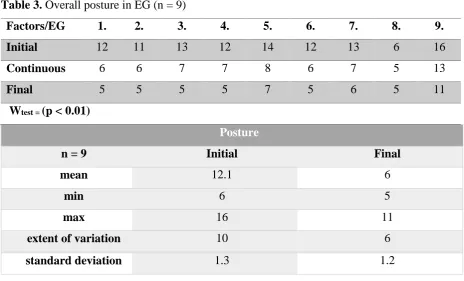
Continuous evaluation showed that the exercise programme had a positive impact on overall posture, including individual segments, in all members of the experimental group (Table 3).
Table 3. Overall posture in EG (n = 9)
Posture
n = 9 Initial Final
mean 12.1 6
min 6 5
max 16 11
extent of variation 10 6
standard deviation 1.3 1.2
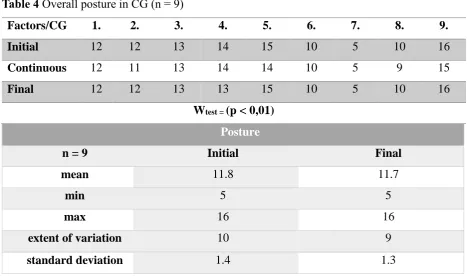
There were no significant (Wtest =p >0.05) changes between the initial, continuous and
final assessment of overall posture and its individual segments in the control group. The members of this group attended physical education classes, which were organised in accordance with the education programme (Table 4).
Factors/EG 1. 2. 3. 4. 5. 6. 7. 8. 9.
Initial 12 11 13 12 14 12 13 6 16
Continuous 6 6 7 7 8 6 7 5 13
Final 5 5 5 5 7 5 6 5 11
Table 4 Overall posture in CG (n = 9)
Factors/CG 1. 2. 3. 4. 5. 6. 7. 8. 9.
Initial 12 12 13 14 15 10 5 10 16
Continuous 12 11 13 14 14 10 5 9 15
Final 12 12 13 13 15 10 5 10 16
Wtest = (p < 0,01)
Posture
n = 9 Initial Final
mean 11.8 11.7
min 5 5
max 16 16
extent of variation 10 9
standard deviation 1.4 1.3
There were significant (MWWtest p < 0.01) changes in posture and its individual segments
in both groups between the initial and final assessment. We also measured significant (MWWtest
p < 0.01) changes in both groups between the initial and continuous evaluation of overall body posture.
The assessment results of individual postural segments were as follows.
The final evaluation of the head and neck posture (I.) in the EG showed that there was a significant difference (Wtest = p < 0.01) between the initial evaluation, when only one pupil was
given mark 1, and the final assessment, when seven pupils were given mark 1.
The initial assessment of the chest region (II.) in the EG showed that only one girl, who had a symmetrical and well arched chest and used the intercostal region for breathing, was given mark 1 while most of the pupils belonged to the third quality level. The positive thing was that none of the pupils belonged to the fourth quality level (IV.). There was a significant difference (Wtest = p < 0.01) between the initial and final evaluation, concerning especially mark 2, which
Another area of evaluation was the abdomen and pelvic tilt (III.). There were significant (Wtest = p < 0.01) changes between the initial and final assessment. There was an improvement
(Wtest = p < 0.05) after the final evaluation in all the pupils. What is more, the improvement was
significant (Wtest = p < 0.05) also after the continuous evaluation. In this regard, it is necessary
to point out that good posture depends also on proper curve of the spine and appropriate pelvic tilt. Improper posture and extension of pelvic tilt results in weakening of rectus abdominis muscles and shortening of the iliopsoas muscle, which can lead to other functional disorders affecting individual postural segments.
Physiological and natural curve of the spine in sagittal and lateral plane is important in health, economic and aesthetic terms. The initial evaluation of the spine curve (IV.) showed that all the pupils had apparently rounded back and forward head posture as compensation. Even the continuous evaluation proved a positive impact of the exercise programme, where changes were significant (Wtest = p < 0.05). There was also a significant difference (Wtest = p <
0.01) between the initial and final assessment of the whole EG.
As regards the front posture (V.), we saw the highest percentage and significance (Wtest =
p < 0.01) in marks 1 and 2 after the final evaluation.
The initial assessment showed that 8 pupils had prominent shoulder blades and shoulders that were pulled forward, which are typical symptoms of the rounded back (Labudová, Vajciková, 2009). It is necessary to point out that initially such symptoms are connected with only a functional disorder that can later develop into a structural disorder. Therefore, it is important to align and strengthen the spine by active muscle activity before it matures (approximately up to 12 or 13 years of age). This muscle activity includes preventive exercises focused on individual segments that contribute to good posture. The main reason of prominent shoulder blades is weakening of the shoulder blade and rhomboid muscles, which are drawn by relatively stronger pectoral muscles (Bendíková, Stacho, 2010). After the final evaluation of forward posture we found out symmetry and relaxed shoulders that were at the same height. Furthermore, the results showed that 6 pupils did not have prominent shoulder and 3 girls had only slight deviations.
There were no significant changes between the initial and final evaluation of lower limbs because the pupils did not have valgus or varus deformities of lower limbs. What is more, they did not have any deformities of their soles, which were properly curved.
Conclusion
The presented empirical study helps to broaden the knowledge of applying the exercise programme in physical and sport education, with focus on monitored determinants of the musculoskeletal system. The study proved the positive effect of the programme (p<0.01), with the significant difference (p<0.01) between the experimental group and the control group. Our results show that adequate physical activities can influence the factors influencing the body posture and support proper development and growth in pupils. The partial output is part of the: VEGA 1/0376/14.
References
1. ADAMĆÁK, Š., BARTÍK, P. & KOZAŇÁKOVÁ, A. (2011). Úroveň posturálnych a
fázických svalov žiakov na 2.stupni základných škôl. Banská Bystrica : UMB FHV KTVŠ, 173p.
2. BENDÍKOVÁ, E. & STACHO, K. (2010). Vplyv kompenzačných cvičení na rozvoj pohyblivosti chrbtice u žiakov II. stupňa ZŠ. Studia kinantropologica. České Budějovice :
Jihočeská univerzita, 11(1), 35–41.
3. BENDÍKOVÁ, E. & KOSTENCKA, A. (2013). Exercise Routine as a Conditions of Early School Age Pupil’s Health. Oficyna Wydawnicza Mirosław Wrocławski and Wydział Kultury Fizycznej, Zdrowia i Turystyki UKW, Bydgoszcz : Poland, 2013.
4. BENDÍKOVÁ, E. (2014). Lifestyle, physical and sports education and health benefits of physical activity. In European researcher : international multidisciplinary journal. - Sochi : Academic publishing house Researcher, 2014. - ISSN 2219-8229. - Vol. 69, no. 2-2 (2014), pp. 343-348.
5. BURAN, I. (2002). Vertebrogénne algické syndrómy. Bratislava : S+S, 2002. 6. ČERMÁK, J. et al. (2005). Záda mně už nebolí. 4. vydanie, Praha : Vasut, 2005.
7. HART L, G., DEYO, R. A. & CHERKIN, D. C. (1995). Physician office visits for low back pain: Frequency, fysical evaluation and treatment patterns from a USA national survey. In Spine, 1995; 20, p. 11–19.
8. CHEN, P. Q., WANG, J. L., TSUANG, Y. H., LIAO, T. L., HUANG, P. I., & HANG, Y.S. (1998). The postural stability control and gait pattern of idiopathic scoliosis adolescents.
Clin. Biomech., 13(1), 52-58.
9. KABÁTOVÁ, H.; KOPECKÝ, M., STRNISKOVÁ, D. & TOMANOVÁ J. (2012). Těžké školní aktovky jako další možný faktor ovlivňující výskyt vadného držení těla. In Hygiena.
10. KANÁSOVÁ, J. et al. (2015). Developmentalchanges of functional disorders of motor system of pupils and possibilities of their remedy. Sport Science, 8(2), 88‐92.
11. KOLÁŘ, P. (2001). Systematizace svalových dysbalancí z pohledu vývojové kineziologie. Rehab. Fyz. Lek., 2001, roč. 8, č. 4, p. 152–164.
12. KOPECKÝ, M. (2004). Posture Assessment in Children of the School Age Group (7-15 Years of Age) in the Olomouc Region. In Acta Universitatis Palackianae Olomucensis Gymnica. Olomouc : UP, 2004, vol. 34, No. 2, p. 19-29.
13. LABUDOVÁ, J. & VAJCZIKOVÁ, S. (2009). Športová činnosť pri poruchách orgánov
opory a pohybu. Bratislava : SZ RTVŠ, 88 s.
14. LEMOS, A. T., SANTOS, F. R., & GAYA, A. C. A. (2012). Lumbar hyperlordosis in children and adolescents at a privative school in southern Brazil: occurrence and associated factors. Cadernos De Saúde Pública, 28(4), 781–788.
15. ŁUBKOWSKA, W., POŁEĆ, J., SZARK-ECKARDT, M. & ŻUKOWSKA, H. (2016). Subjective assessment of kinesitherapy as an element of comprehensive rehabilitation process of subjects with lower spine pain. Journal of Education, Health and Sport, 6(2), 255-266. DOI http://dx.doi.org/10.5281/zenodo.46656
16. ŁUBKOWSKA, W. & TARNOWSKI, M. (2012). Za mało ruchu nie pomaga – za dużo szkodzi?” – porównanie kryterium poglądu. Aktywność Ruchowa Ludzi w Różnym Wieku. 2012; No. 16, p. 91-102.
17. MEDEKOVÁ, H. & BEKÖ, R. (2009). Funkčné svalové poruchy a držanie tela detí z hľadiska pohybovej aktivity po prvom roku. ZŠ. Pohybová aktivita a jej súvislosti s
vybranými ukazovateľmi somatického, funkčného a motorického rozvoja. Zborník prác VEGA 1/4508/07. FTVŠ UK v Bratislave. Bratislava : ICM Agency, p. 56-63.
18. NOVOTNÁ, B. & SLOVÁKOVÁ, N. (2016). The current problem of school children - lack of physical activity. In European Journal of Contemporary Education: international bilingual scientific Journal . Sochi, Russia -2016. online, vol. 105, no. 4 (2016), pp. 231-238.
19. THURZOVÁ, E. (2003). Bolesť pohybového aparátu u mladých športovcov. In TV a Šport, Bratislava, roč. XIII., č.1, p. 31 –34.
20. TISOVSKÝ, P., DEČO P., REHÁK, L., KOKAVEC, M., NOVOROLSKÝ, K., HORVÁTH, J. & MAKAI, F. (2004). Prevalencia asymetrii trupu u detí vo veku 8 – 14 rokov v Bratislave. In Lek. obzor, 53, 9, p. 341 – 343.
21. VÉLE F. (2006). Kineziológie, Přehled kineziológie a patokineziológie pro diagnostiku
22. VOJTAŠŠÁK, J. (2000). Ortopédia. Bratislava : SNP, 2000.
23. ŻUKOWSKA H, SZARK-ECKARDT M, MUSZKIETA R & IERMAKOVA T. (2014). Characteristics of body posture in the sagittal plane and fitness of first-form pupils from rural areas. In Pedagogics, psychology, medical-biological problems of physical training and sports. 2014; (7), p. 50-60.