www.ann-geophys.net/27/601/2009/
© Author(s) 2009. This work is distributed under the Creative Commons Attribution 3.0 License.
Annales
Geophysicae
Mirror structures above and below the linear instability threshold:
Cluster observations, fluid model and hybrid simulations
V. G´enot1, E. Budnik2, P. Hellinger3, T. Passot4, G. Belmont5, P. M. Tr´avn´ıˇcek3, P.-L. Sulem4, E. Lucek6, and I. Dandouras1
1CESR, Universit´e de Toulouse (UPS) & CNRS (UMR5187), Toulouse, France 2Noveltis, 2 Avenue de l’Europe, 31520 Ramonville Saint-Agne, France
3Institute of Atmospheric Physics and Astronomical Institute, AS CR, Prague, Czech Republic 4CNRS, Observatoire de la Cˆote d’Azur, Nice, France
5CETP-CNRS, V´elizy, France
6Space and Atmospheric Physics Group, Blackett Laboratory, Imperial College, London, UK
Received: 23 May 2008 – Revised: 26 November 2008 – Accepted: 7 January 2009 – Published: 6 February 2009
Abstract. Using 5 years of Cluster data, we present a de-tailed statistical analysis of magnetic fluctuations associated with mirror structures in the magnetosheath. We especially focus on the shape of these fluctuations which, in addition to quasi-sinusoidal forms, also display deep holes and high peaks. The occurrence frequency and the most probable location of the various types of structures is discussed, to-gether with their relation to local plasma parameters. While these properties have previously been correlated to theβ of the plasma, we emphasize here the influence of the distance to the linear mirror instability threshold. This enables us to interpret the observations of mirror structures in a stable plasma in terms of bistability and subcritical bifurcation. The data analysis is supplemented by the prediction of a quasi-static anisotropic MHD model and hybrid numerical simula-tions in an expanding box aimed at mimicking the magne-tosheath plasma. This leads us to suggest a scenario for the formation and evolution of mirror structures.
Keywords. Magnetospheric physics (Magnetosheath; Plasma waves and instabilities) – Space plasma physics (Waves and instabilities)
1 Introduction
In a magnetized plasma, mirror modes and mirror structures are slowly evolving states, in which the magnetic fluctuations are compressible and in approximate pressure balance,
lead-Correspondence to: V. G´enot
ing to anti-correlated magnetic and plasma pressure (density) fluctuations. They are non-propagating in the rest frame of the plasma, when the later is homogeneous, but a drift ve-locity can result for example from variations of the ambiant field. They differ from the slow MHD modes and structures by the fact that the quasi-equilibrium is mainly based on the temperature anisotropy and not on a slow propagation. The time evolution of the linear mode can correspond either to an increase or to a decrease of the fluctuation magnitude (i.e. to instability or damping), depending on the value of the zero order anisotropy with respect to a threshold value, for which the temperature perpendicular to the ambiant magnetic field is larger than the parallel one. The nonlinear structures may be due to the nonlinear evolution of the instability, but the lin-ear threshold value has anyway a pivotal role in the physics. To avoid any confusion, the terminology adopted in relation with mirror mode physics must be specified. In the follow-ing and in agreement with the common use of the literature, we shall use the terms “mode” and “wave” in relation with the solution of the linearized kinetic equations in the low-frequency regime. We shall call “mirror structures” what we consider to be the nonlinear extension of the linear mirror mode. The object of the present paper is to investigate how these structures look like and how they form.
to be far from being sinusoidal and are rather displayed as trains of large-amplitude holes or peaks, and in some in-stances solitary structures. The morphology of mirror struc-tures is in fact a long standing issue. Magnetic depressions (holes) or enhancements (peaks) were observed in temper-ature anisotropic, high β magnetosheath plasmas of a va-riety of celestial bodies which provide a natural location for mirror instability. Trains of magnetic holes and peaks were observed by Voyager 1 in the heliosheath and inter-preted as mirror structures (Burlaga et al., 2006, 2007; G´enot, 2008). Liu et al. (2006) (see also references therein) ob-served mirror modes ahead of interplanetary coronal mass ejections (ICME) preceded by shocks. Magnetic fluctuations mostly appear as large holes in regions where the plasma is marginally unstable with respect to the linear instabil-ity. These observations exhibit the presence of a plasma depletion layer (PDL) resembling those of planetary mag-netosheaths. For Saturn, Voyager observations made on the dayside were reported by Bavassano Cattaneo et al. (1998). The authors track the evolution of mirror structures from a quasi-perpendicular bow shock to the magnetopause. The observed structures evolve from quasi-sinusoidal waves to non-periodic structures, consisting of both magnetic peaks and holes, and, finally, to holes in the PDL close to the mag-netopause. For Jupiter, spiky structures were reported for the first time by Erd¨os and Balogh (1996). A more recent and thorough survey of all the Jovian magnetometer data (Joy et al., 2006) shows that 33% of the observed structures are ei-ther holes or peaks, with peaks primarily observed on the day side in the highβplasma of the middle magnetosheath, and holes mostly in lowβ plasma near the magnetopause and on the flanks. In the Earth context, observations of mir-ror structures are available since the early measurements by Explorer 12 (Kaufmann et al., 1970); Leckband et al. (1995) using AMPTE-UKS termed the observed peaks “monolithic” structures. Equator-S observations of peaks and holes have been reported by Lucek et al. (1999) but the spatial distribu-tion of these structures was not investigated further and no information on the plasma parameters are available for this spacecraft. Later on, when studying kinetic aspects of the mirror mode, G´enot et al. (2001) listed a number of mirror mode events observed by AMPTE-UKS & IRM and some of them were tagged “spiky up” and “spiky down” by con-trast with the more sinusoidal ones. However, in this case also, it was difficult to draw any conclusion on the occurrence conditions, as the plasma data were scarce in these intervals, except for the 21 September 1984 13:13–13:36 IRM event which exhibits very deep magnetic holes (δB/B'0.6) in a mirror stable region, a peculiarity which will be addressed in the following.
For the solar wind, Winterhalter et al. (1994) made a sur-vey of magnetic holes observed by Ulysses and examined their possible relationship with mirror instability. They found that holes tend to occur in the interaction regions where fast streams overtake the ambient solar wind and the plasma is
marginally stable. Using the same detection criterion on a larger set of data from Ulysses, Helios 1 & 2 and Voyager 2, Sperveslage et al. (2000) reinterpreted magnetic holes as a combination of both mirror modes and solitons. Mirror mode dynamics is indeed not the only theory proposed to account for the observed magnetic peaks and holes. For instance Stasiewicz (2004a,b) (see also references therein) interpreted Cluster observations in term of trains of slow magnetosonic solitons, which are nonlinear wave solutions of Hall-MHD equations, an approach initiated by Baumg¨artel et al. (1997) and Baumg¨artel (1999).
Several models in connection with observations have been proposed (Joy et al., 2006; T´atrallyay and Erd¨os, 2002) to explain the evolution of mirror modes from the bow shock to the magnetopause, whereas computational (Pantellini, 1998; Baumg¨artel et al., 2003) or theoretical (Kivelson and South-wood, 1996) works investigated how these structures could be formed. In the context of Jupiter’s magnetosheath, Joy et al. (2006) follow this last model and synthesize the pic-ture by noting that magnetic peaks could be the signapic-ture of nonlinear saturation of mirror modes; hole structures are also observed and interpreted as collapsing structures in a plasma near the linear mirror threshold, a phase termed stochas-tic decay as individual structures are supposed to decay at different rates. A relation between the shape of the struc-tures and the local plasma parameters is suggested: peaks are mostly observed in highβ regions, and holes in low β regions in agreement with the model by Pantellini (1998). In the model of Kivelson and Southwood (1996), the return to marginal stability is made possible by the formation of mag-netic fluctuations with slight compressions and large depres-sions, which would favor peaks.
The formation mechanism for both magnetic peaks and holes, and in particular their relation with the mirror insta-bility, is however not fully understood. Insight was given by observations by Erd¨os and Balogh (1996) in which the signature of a bistable behavior between region of high and low magnetic field was evidenced. To account for this ob-servation, Baumg¨artel (2001) constructed a fluid model with a double polytropic closure equation which revealed that magnetic holes can survive mirror stable plasma conditions, while peaks cannot. This is a signature of a bistability phe-nomenon which is related to the existence of a sub-critical bifurcation. In this paper, we rely on this concept to ana-lyze mirror structures in the Earth magnetosheath with Clus-ter data. Through the use of both magnetic field and plasma data, we develop discriminating methods to identify mirror events among magnetosheath passes and to assign them a shape related to the skewness of the magnetic field distri-bution.
particles-in-cell simulations of the Vlasov-Maxwell equa-tions, developed to investigate the effect of a slow expan-sion on a magnetosheath-like plasma and low frequency tur-bulence (Tr´avn´ıcek et al., 2007). This approach enables us to present a dynamical perspective on the mirror mode evo-lution and in particular to point out peak-to-hole transition, together with the phenomenon of bistability. We also rely on the theoretical work of Passot et al. (2006) to provide a basis to the bistability phenomenon. More recent theoretical works aimed to understand mirror mode dynamics include Borgogno et al. (2007); Kuznetsov et al. (2007a,b); Califano et al. (2008).
The paper is organized as follows. Section 2 presents the data selection and the way magnetosheath passes are identi-fied. The methods we employ to characterize mirror struc-tures are discussed in Sect. 3 and tested in Sect. 4 on a case study. Section 5 presents statistics on the structure locations and discusses correlations with in-situ parameters. Obser-vational results are compared with numerical and theoretical models in Sect. 6. Our main results are summarized in the Conclusion.
2 Data and magnetosheath model
2.1 Data
Five years (1 February 2001 to 31 December 2005) of the Cluster mission are considered. Cluster 1 magnetic field (FGM, Balogh et al., 2001) and on-board calculated ion mo-ments (from the HIA experiment on the CIS instrument, R`eme et al., 2001) data are used at 4 s resolution. Based on the same dataset a statistical analysis of mirror mode occur-rence (localisation, fluctuation amplitude) has recently been published by G´enot et al. (2009). The results compare fa-vorably with those of a study based on ten years of ISEE data (Verigin et al., 2006). Cluster orbital configuration is ideally designed to study the magnetosheath whose various regions are correctly sampled in our analysis, with a majority of events close to the magnetopause. A web-based version of the statistical analysis tool developed at CDPP (the French Plasma Physics Data Centre) and used in this study is avail-able at the URL: cdpp-amda.cesr.fr. Access is granted upon request (mail to [email protected]).
2.2 Magnetosheath identification
The first step of our analysis is to determine whether Cluster is located in the magnetosheath. Data are analyzed by 5 min window: a delay procedure is applied to obtain associated solar wind and IMF parameters from ACE. Shock and mag-netopause models, as described by Verigin et al. (2006) and Shue et al. (1997) respectively, are computed dynamically from these parameters in order to locate Cluster as “inside” or “outside” the magnetosheath.
2.3 Fractional distance in the magnetosheath
We will make use of the fractional distance F = r−rMP
rBS−rMP
(1) introduced by Verigin et al. (2006) to normalize event posi-tions in the magnetosheath. Here,ris the Cluster geocentric distance,rMP the geocentric distance to the magnetopause
(which is a function of the zenith angle, the solar wind ram pressure and IMFBz) andrBSthe geocentric distance to the
bow shock (which is a function of the zenith and clock gles, the upstream Alfv´en and Mach numbers and the an-gle between the solar wind velocity and IMF vectors). As a consequenceF=0 at the magnetopause andF=1 at the bow shock.
3 Mirror mode characterization
Identification of mirror mode events has been a long standing issue. Both slow mode and mirror modes indeed display anti-correlated magnetic and density fluctuations. Moreover, both mirror and ion cyclotron modes develop in the presence of temperature anisotropy (T⊥>Tk). It has nevertheless been predicted by Gary et al. (1993) and observed by Anderson et al. (1994) that due to the presence of heavier ions (mainly helium) in the magnetosheath, mirror instability dominates forβ>1, which is the most common situation. This condition is confirmed by recent simulations by Tr´avn´ıcek et al. (2007) (βk≥0.35).
Various methods have been developed to discriminate be-tween the various low-frequency modes and isolate mirror modes. They include transport ratio (Song et al., 1994; Den-ton et al., 1995), minimum variance analysis (T´atrallyay and Erd¨os, 2005), 2- and 4-spacecraft methods (Chisham et al., 1999; G´enot et al., 2001; Balikhin et al., 2003; Horbury et al., 2004), 90◦B/Vzphase difference (Lin et al., 1998). A
com-prehensive review of these approaches is given in Schwartz et al. (1996).
3.1 Identification of mirror-like structures
Magnetic field variations associated with mirror modes are almost linearly polarized in the direction of the ambient field. They may be of large amplitude (a few 10%). From these characteristics, a criterion has been established which fol-lows closely those used by T´atrallyay and Erd¨os (2005); Soucek et al. (2008); G´enot et al. (2009); it requires two con-ditions:
– to prescribe relatively large amplitude, the variance of the field must be larger than 10%.
In order to perform a statistical survey over 5 years of data, we use relatively low resolution data (4 s), which limits the lower sampled mirror event size to 8 s. From a 2 month sur-vey with high resolution Cluster data, Soucek et al. (2008) found that mirror events were distributed as a bell-shaped distribution with 98% of events falling into the 4s-24s inter-val and with a mean of 12 s. This shows that our data set is undersampled, as it misses events in the 4 to 8 s length. This corresponds to the structures with a smaller spatial scale (of the order of 10 local Larmor radii) even though flow velocity and field geometry do affect the observed temporal scales. The way the scale of events affects the statistics still remains to be studied with higher resolution data.
The above criterion is applied to all 5 min magnetosheath intervals selected in Sect. 2.1. The mean magnetic field is calculated on 10 min window, and the Minimum Variance Analysis (MVA) (Sonnerup and Cahill, 1967) is performed on 5 min windows. The sensitivity of the results was tested against the variation of these time windows and revealed no major difference. At this stage, we do not make any restric-tion on the values of plasma parameters, as we are interested in mirror-like structures appearing above as well as below the linear mirror instability threshold given by Eq. (2). No constraint has been imposed on the eigenvaluesλresulting from the MVA. Indeed, as noted by G´enot et al. (2001), mir-ror modes are more frequently observed with an elliptic po-larization than with the linear popo-larization predicted by the linear theory for plane waves. We checked that restraining our data set to linearly polarized events (for instance with the condition: λint/λmax≤0.2 and λmin/λint≥0.3) does not
significantly alter the conclusions. Note that T´atrallyay and Erd¨os (2005) supplement their criterion with a condition on the symmetry of the structures which essentially selects mag-netic depressions. Therefore, only “dip” or “hole” mirror structures are discussed in that paper. Automatic detection of data patterns is a difficult task and it is possible that com-pressional structures other than mirror modes (e.g. quasi-perpendicular shocks) may be retained by our algorithm. It is however difficult to evaluate the proportion of such misin-terpreted events.
3.2 Mirror condition
The general form of the threshold condition for the mirror in-stability in a plasma composed of electrons, protons and al-pha particules (He2+) with bi-Maxwellian distribution func-tions and evaluated in the low-frequency,long-wavelength limit of the Vlasov-Maxwell equations reads (Stix, 1962; Hall, 1979; Hellinger, 2007)
X
s=p,α,e
βs⊥
Ts⊥ Tsk
−1
>1+ X
s=p,α,e
nsqs
Ts⊥ Tsk
!2
2 X
s=p,α,e
(nsqs)2
βsk
(2)
wheren,qandT are the density, the charge and the temper-ature, respectively andβ=2µ0nkT /B2. Subscripts⊥ and kstands for the directions with respect to the ambient mag-netic fieldB, ande,pandαfor electrons, protons and alpha respectively. In the case of cold electrons, the previous con-dition reduces to
βp⊥ T
p⊥ Tpk
−1
+βα⊥ T
α⊥ Tαk
−1
>1, (3)
In the detector used in this study (HIA, see Sect. 2) ions are binned according to their energy per charge ratio. Therefore proton and alpha particles are generally mixed and moments are averages over these populations (we use the subscripti for ions). In order to characterize the plasma with respect to the mirror instability, we thus define the mirror parameter by CM =βi⊥
T
i⊥ Tik
−1
. (4)
CM−1 is then the distance to threshold. From Eq. (3), the
conditionCM<1 (CM>1) corresponds to mirror stable
(un-stable) plasma, whileCM=1 refers to marginal stability, for
which the linear growth rate is zero.
Although ion species are not separately discriminated we evaluated the error introduced by computing averaged ion moments rather than individual ones. With the typical val-uesTαk/Tpk=4,nα/np=0.04 and an alpha anisotropy equal
to the proton one we obtain∼6% overestimation of theCM
value. This figure increases up to 10% for large alpha to pro-ton anisotropy and/or density ratios. Such an overestimation is however still within the overall measurement uncertainties. As mentioned at the beginning of this section, previous equations apply for bi-Maxwellian plasmas only. Linear the-ory of the mirror instability with arbitrary distribution func-tions has been considered in Shapiro and Shevchenko (1964); Pokhotelov et al. (2002); Hellinger (2007); Califano et al. (2008). In particular, simulations by Califano et al. (2008) show that near threshold initially Gaussian distributions are flattened by quasi-linear effects for small velocities, which requires the use of the full criterion
−mp
pB
Z v4 ⊥ 4
∂f ∂v2kd
3v−β⊥−1>0 (5)
wherefis the distribution function,pBis the magnetic
pres-sure andmpthe proton mass.
3.3 Peaks and holes identification
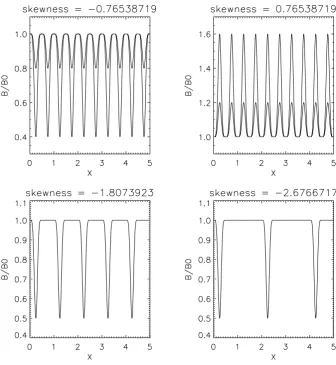
Fig. 1. Skewnesses of composite peak and hole structures obtained by varying the fluctuation amplitudes (top panels) and the number of structures on a given interval (bottom panels). Abscissae are arbitrary.
for symmetrical shapes of magnetic depressions. Joy et al. (2006) proposed a statistical method based on the determina-tion of the background magnetic field level. For our analy-sis, we consider the list of 5 min magnetosheath intervals in which mirror-like structures were detected by the algorithm steps described earlier; we then compute the skewness (i.e. the normalized third moment) of the distribution of the mag-netic fluctuations (δB=B−<B>, where the average is taken on a 10 min window). A positive (negative) value reflects a distribution skewed towards higher (smaller) values, which corresponds to an interval dominated by peaks (holes). A vanishing or small value corresponds to sinusoidal-like (sym-metric) fluctuations or alternatively to an interval composed of peaks and holes equally distributed. The latter regime is usually associated with transition periods. The method was proved to be efficient by showing it correctly captures peak-or hole-filled intervals identified by visual inspection.
Simultaneously to our analysis, an alternative and some-what more refined algorithm based on the peakness of the distribution was developed and used by Soucek et al. (2008),
The peakness is defined as the skewness of the time series representing the total wavelet content, between two chosen scales, of the original magnetic field fluctuations. In a way similarly to that of our method, negative (positive) peakness of a given interval corresponds to magnetic holes (peaks).
Figure 1 shows changes in the skewness value when fluc-tuations are varied. Top panels show that varying the am-plitudeδB/B0while preserving the same underlying shape
does not affect the skewness whose sign is simply reversed when fluctuations are changed from holes (left,B0−|δB|) to
peaks (right, B0+|δB|). On the bottom panels, the shape
0 5 10 15 20 25 30
Magnetic Field CL 1
Magnitude, nT
0.0 0.2 0.4 0.6 0.8 1.0
Fractional Distance 0 = MP
1 = BS
-2.0 -1.5 -1.0 -0.5 0.0 0.5 1.0
Skewness
02:26 02:36 02:46 02:56 03:06 03:16 03:26 03:36 03:46 03:56 0.0
0.5 1.0 1.5 2.0 2.5
CM
[image:6.595.131.466.62.402.2]March 15, 2001
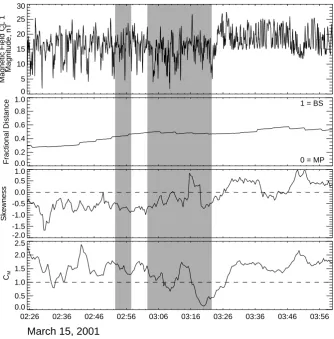
Fig. 2. Observations of mirror structures by Cluster 1 on 15 March 2001. From top to bottom: magnetic field amplitude, fractional distance F, skewness of magnetic fluctuations and mirror parameterCM. The grey color codes windows of 5 min when mirror structures are not
detected by the algorithm based on magnetic fluctuations.
4 Case study: 15 March 2001
In order to validate the above algorithm, we present in Fig. 2 observations which satisfy the mirror conditions on the mag-netic field fluctuations and exhibit, during the course of a few hours, both holes and peaks, separated by a sharp transition. It appears that this transition is due to an abrupt change in the direction of the IMF, associated with a variation in the solar wind velocity. Data are from the Cluster and ACE satellites on 15 March 2001 from 02:23 to 04:00 (as recorded by Clus-ter), during which the conditions expressed above for mirror mode selection are almost totally fulfilled in each 5 min sub-interval (grey color refers to the time sub-intervals where they are not). The solar wind data are averaged on a 20-min win-dow and the time delay between ACE and Cluster is about 3500 s until 03:10 and then steadily increases to 3700 s at 04:00. Cluster is mainly moving along the+Xgse direction
from [10.0, 1.2, 9.0]RE to [12.9, 0.2, 8.6]RE, away from
the magnetopause and towards the bow shock. Cluster satel-lites are separated by about 0.1RE and ACE is positioned at
[226.6,−37.6, 1.3]RE. From visual inspection of the
vari-ations of the magnetic field amplitude, one identifies a first interval consisting mainly of holes followed by a second in-terval of peaks. A sharp transition occurs at 03:24. We detail below these two sequences.
4.1 Holes: 02:25–03:24
(CM>1), except for a short period when the deep hole is
ob-served. We shall come back to this apparent peculiarity in the course of the discussion.
4.2 Peaks: 03:24–04:00
In the second interval Cluster 1 observes mirror structures located in the middle magnetosheath (0.45<F <0.55). They are mostly shaped as peaks during two intervals (during the first one, the skewness is close to 0.5, while in the second one, it ranges between 0.5 and 1), separated by a mixed struc-tures interval (skewness close to−0.15). The plasma is mir-ror unstable withCM>1.5 in most of the interval.
The sharp transition between the two ranges, observed at 03:24, is due to IMF turning and decelerating solar wind. Indeed, ACE data shifted accordingly (not shown) exhibit a rotation in the magnetic field (from 30◦to 70◦for(B\x, By)
and from 0◦to 50◦for(B\x, Bz)) and a sharp decrease in the
solar wind velocity from 390 km/s to 370 km/s, exactly at this time. The transition between the two magnetosheath regions is therefore a spatial effect related to a fast change in the up-stream solar wind forcing, resulting in the reconfiguration of associated shocks and local conditions of the magnetosheath.
5 Statistical analysis
Based on the methods described above for determining mag-netosheath intervals, 5647 linearly polarized compressive mirror structures were isolated and classified as “holes” (44%) or “peaks” (30%) depending on the skewness sign when|skewness|>0.2, or “either” (26%) otherwise. “Either” means that the structures in the interval are either sinus-like or a mixture of holes and peaks. This somewhat arbitrary cri-terion was chosen from visual inspection. The question then arises of the statistics on hole/peak distributions, in relation with in-situ parameters.
5.1 Relation with the plasmaβ
In Fig. 3, the skewness is plotted as a function of βk. For moderate βk, observations are gathered toward nega-tive skewness, whereas largeβk(≥4) conditions favor pos-itive skewness. This pospos-itive correlation gives a vanishing skewness forβk'3.5, in agreement with other observational studies (Erd¨os and Balogh, 1996; Bavassano Cattaneo et al., 1998; Joy et al., 2006; Soucek et al., 2008).
As temperature anisotropy is anti-correlated with βk (Anderson et al., 1994; Gary and Lee, 1994; Fuselier et al., 1994), we expect and indeed observe (not shown) that smaller anisotropy conditions favor peaks. The anti-correlation in our data set is such that
T⊥ Tk =1+
a
[image:7.595.310.547.60.309.2]βkb (6)
Fig. 3. Skewness as a function ofβkfor all mirror events detected
in the period 1 February 2001–31 December 2005.
witha=0.47 andb=0.56 in rather good agreement with the values ofa=0.83 andb=0.58 found for example by Fuselier et al. (1994) (forβk>1). This formal relation conveys the idea that the magnetosheath plasma remains in a marginal stable state with respect to the mirror instability and in a lesser measure with the ion cyclotron instability,as numeri-cally demonstrated by Hellinger et al. (2003) and Tr´avn´ıcek et al. (2007).
5.2 Location
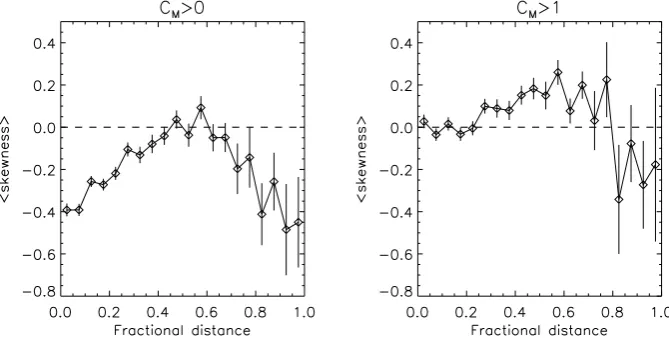
To localize events in the magnetosheath, we use the fractional distance F defined in Eq. (1). Let us first consider struc-tures in a mirror unstable plasma (CM>1). On the right of
Fig. 4, the average skewness is represented in eachF-bin and shows that peaks are mostly observed in the middle magne-tosheath (F >0.3). Statistics close to the bow shock are poor and therefore negative values close to the shock are neither significant nor meaningful. A more detailed analysis (not shown) revealed that peaks are observed closer to the shock for increasing zenith angle; no dawn/dusk asymmetry is ob-served. Interestingly, if we now include mirror structures in unstable conditions (CM>0, left of Fig. 4), the average
Fig. 4. Average skewness as a function of the fractional distanceF forCM>0 (left) andCM>1 (right). The error bars are proportional to
σ/ √
Nwhereσ is the standard deviation andNis the number of mirror events in each1F=0.05 bin (Nmin=17 andNmax=709 forCM>0
andNmin=7 andNmax=301 forCM>1).
showed that mirror structures are present everywhere in the (Jupiter) magnetosheath with peaks appearing preferentially in the middle sheath and holes close to the magnetopause at least for the day side magnetosheath data which represent most of our dataset. Further down the flank their observa-tions suggest that holes fill the whole magnetosheath. Fi-nally, the hole/peak localization in the magnetosheath is con-sistent with theβ spatial distribution (β decreases from the shock towards the magnetopause) and its dependence on the skewness discussed in the previous section.
5.3 Influence of the distance to threshold
Authors of similar observational studies (Erd¨os and Balogh, 1996; Joy et al., 2006) have emphasized the dependence of the mirror structure shape on the value of beta. However the way the mirror fluctuations evolve in a plasma is closely re-lated to the distance to the mirror instability threshold. We show in the following that although this parameter corre-sponds to a linear threshold, it is also relevant to order data in the nonlinear regime for which mirror structures develop. This parameter is therefore a crucial variable for the physics of mirror mode dynamics. This also explains why this pa-rameter is pivotal in all modeling approaches, be they analyt-ical or computational, as discussed in the next section.
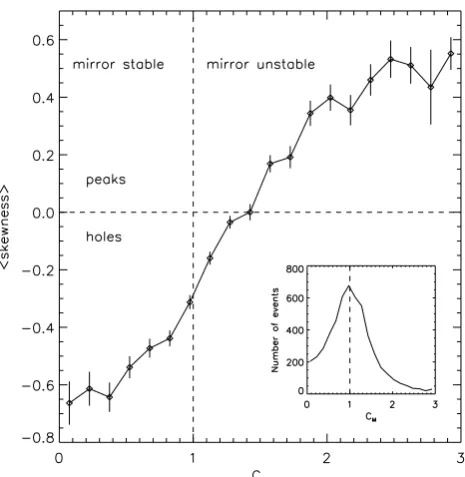
On Fig. 5, all events have been binned in intervals of the mirror parameter CM (Eq. 4). For each bin, the average
skewness is computed as well as error bars. Transitions be-tween peak/hole (skewness=0) and mirror stable/unstable (CM=1) have been over-plotted as dash lines. The insert
shows that statistical significance is better (i.e. the number of observed events maximises) aroundCM=1 which expresses
the tendency of the magnetosheath plasma to be mostly ob-served in a marginally stable state with respect to the mirror
instability (see for instance the observations reported in An-derson et al., 1994).
Inspection of this figure indicates that for increasing values ofCM, mirror magnetic fluctuations associated with
unsta-ble plasma conditions are shaped mostly as holes just above threshold, and as peaks far from it (the skewness increases up to 0.6). There is a transitional regime for which the skewness is close to zero (it vanishes forCM'1.4) and which
corre-sponds to sinusoidal variations or to a mixed regime of holes and peaks. All shapes of magnetic fluctuations may there-fore be encountered under unstable plasma conditions. The striking observation comes from the stable plasma condition domain (CM<1). In this parameter range, very distinct
mag-netic hole structures are observed. The skewness varies from
−0.3 to−0.7, decreasing on average further off from thresh-old. It has to be stressed that this represents a general aver-aged trend, and some observations fall out the strict picture described above, as illustrated by error bars. These results are consistent with those of Soucek et al. (2008) where a similar positive correlation peakness-distance to threshold is described.
simulations of the Vlasov-Maxwell equations (Califano et al., 2008). Recently observations in the Earth magnetosheath with Cluster (Soucek et al., 2008; this study) have initiated an important theoretical effort to understand bistability, i.e. how mirror structures can survive in mirror stable conditions (Passot et al., 2006; Borgogno et al., 2007; Kuznetsov et al., 2007a; Califano et al., 2008). We shall come back to this issue in the next section devoted to comparison with models. Note that, in binning the mirror parameterCM to display
the average skewness in Fig. 5, the electron temperature ef-fect is neglected. Taking this efef-fect into account would lead to replace CM by CMe=CM−12
T⊥
Tk−1 2
1 βe+
1 βk
(see Eq. 2). In-cluding the electron temperature term diminishesCMby∼1,
5, 11, 13% forβe=0.1,1,10,100, respectively; this can be
viewed as a small correction, comparable to the observational uncertainties and similar to the effect regarding ion measure-ments discussed in Sect. 3.2. Another effect concerns the electron anisotropy (in the magnetosheathT⊥e/Tke&1 Gary
et al. (2005); Masood and Schwartz (2008)). Both effects tend to reduce the mirror parameter (and then shift the curve of Fig. 5 to the left), but are not significant for our present discussion.
5.4 Observations
To illustrate the findings of the previous section, we chose two typical intervals displaying holes and peaks in their re-spective “natural environment”. Mirror modes have been detected by our algorithm from the magnetic fluctuations throughout these intervals.
On 17 June 2002 (Fig. 6), holes are observed relatively close to the magnetopause (0.12<F <0.19) withδB/Bup to 0.8. The skewness varies from−0.15 down to−1.7 with the lower values corresponding to isolated depressions (at 15:17 for instance). The plasma is mostly mirror stable with two short excursions in mirror unstable conditions for whichCM
remains below 1.2. This is consistent with the fact that the peak/hole transition is seen forCM'1.5 i.e. holes exist in
stable conditions as well as in slightly unstable ones (close to threshold).
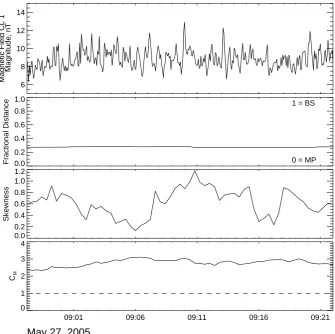
On 27 May 2005 (Fig. 7), peaks are observed close to the middle magnetosheath (F'0.3) with relatively small enhancements δB/B'0.3. The skewness is quite vari-able whereas the plasma conditions remains highly mirror-unstable with 2.2<CM<3.1. By analogy with the simulation
results which are presented in the next section, this obser-vation may correspond to the saturated phase of the mirror instability with well developed peaks far from threshold.
6 Discussion: comparison with theory and simulations
Our final aim is to compare magnetosheath observations of mirror structures with theoretical models and numerical
sim-Fig. 5. Average skewness as a function of the mirror parameterCM.
The vertical dashed line delineates the mirror threshold. The hor-izontal dashed line delineates the region of predominance of holes (below) from the one of peaks (above). The error bars are pro-portional toσ/
√
N whereσ is the standard deviation andNis the number of mirror events in each1CM=0.15 bin (Nmin=20 and Nmax=675). The insert shows the distribution of mirror events as a function ofCM: the peak is observed for marginally stable
condi-tions with respect to the mirror instability (CM'1).
ulations. For both these approaches, the key control parame-ter is the distance to the instability threshold.
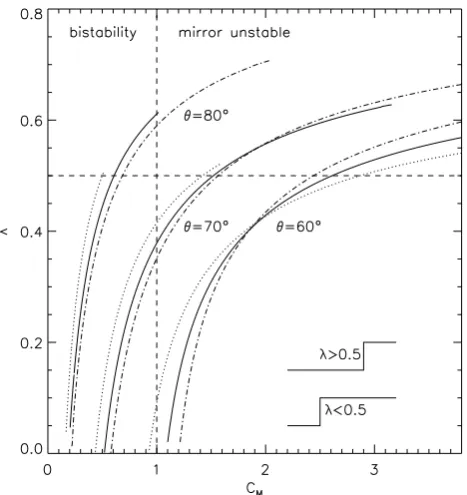
Recently, a simple hydrodynamic description of pressure balanced magnetic structures has been proposed (Passot et al., 2006), based on anisotropic MHD equations supple-mented by an equation of state suitable for the quasi-static regime. A similar equation of state has been kinetically de-rived by Constantinescu (2002). This model is able to ac-curately reproduce the mirror instability threshold. By min-imizing the potential energy under the constraint of particle conservation and frozen-in magnetic field, stable solutions were obtained, in the form of magnetic holes at moderateβ, or peaks whenβis larger, provided the angleθkBbetween the
[image:9.595.311.544.59.298.2]0 5 10 15 20 25
Magnetic Field CL 1
Magnitude, nT
0.0 0.2 0.4 0.6 0.8 1.0
Fractional Distance 0 = MP
1 = BS
-2.0 -1.5 -1.0 -0.5 0.0
Skewness
15:06 15:11 15:16 15:21 15:26 15:31 15:36
0.0 0.2 0.4 0.6 0.8 1.0 1.2
CM
[image:10.595.130.468.62.396.2]June 17, 2002
Fig. 6. Observations of magnetic holes by Cluster 1 on 17 June 2002 (same panels as in Fig. 1).
and Passot et al., 2006, for details on how it is computed). For λ<0.5 the solution is hole-like whereas forλ>0.5 the solu-tion is peak-like. On Fig. 8, for threeθkBangles,λis plotted
as a function ofCM, calculated by varying the anisotropy for
fixedβk. Qualitatively, the variations ofλwithCM depend
very slightly onβk, except for the domain of validity of the solutions which is more restricted for smallerβk (see Pas-sot et al., 2006, for detail on this issue). The model is able to reproduce the general behavior revealed by the observa-tions: for a large angle (for instance 70◦), hole solutions are obtained in the bistability region (CM<1) and slightly above
threshold, whereas at large distance from threshold, magnetic peaks are obtained. For larger angles, solutions in mirror un-stable plasmas are obtained only for large enough beta (βk=8 at 80◦) whereas for angles smaller than∼60◦solutions exist only in unstable plasmas.
Although a MHD description appears to be sufficient to obtain a valid instability threshold and to reproduce the bista-bility phenomenon, retaining kinetic effects such as Landau damping and finite Larmor radius corrections is mandatory to determine the linear growth rate as well as to investigate the nonlinear development of the mirror instability. This
has been achieved in further developments of the present Landau-fluid model (Passot and Sulem, 2006; Borgogno et al., 2007). A dynamical model for nonlinear mirror modes near threshold has also been recently proposed by Kuznetsov et al. (2007a) using a reductive perturbative expansion of the Vlasov-Maxwell equations. In this model, the saturation mechanism is due to local variations of the ion Larmor radius which are supplemented phenomenologically, leading to the bistability phenomenon and also the variation of the skew-ness with the distance to threshold. It differs from previous models for which the saturation is provided by the cooling of a population of trapped ions (Kivelson and Southwood, 1996; Pantellini, 1998).
6 8 10 12 14
Magnetic Field CL 1
Magnitude, nT
0.0 0.2 0.4 0.6 0.8 1.0
Fractional Distance 0 = MP
1 = BS
0.0 0.2 0.4 0.6 0.8 1.0 1.2
Skewness
09:01 09:06 09:11 09:16 09:21
0 1 2 3 4
CM
[image:11.595.132.468.62.396.2]May 27, 2005
Fig. 7. Observations of magnetic peaks by Cluster 1 on 27 May 2005 (same panels as in Fig. 1).
one and neglects global inhomogeneities/heat fluxes (physi-cal lengths increase linearly with time). In this way, it pro-vides a self-consistent mean to study the dynamical proper-ties of waves driven by the magnetosheath plasma.
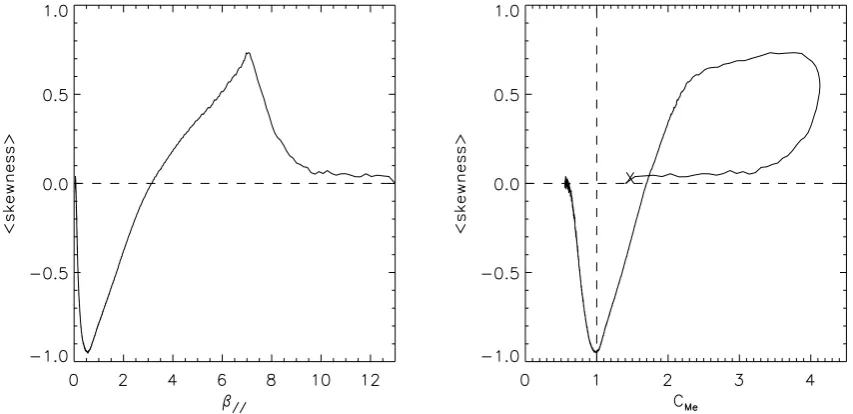
The simulation discussed hereafter is described in Tr´avn´ıcek et al. (2007); we focus here on different quantities. Figure 9 displays the evolution of the system, in the plane (skewness,CMe), where the skewness is evaluated from the
magnetic fluctuations in the parallel direction. Initial con-ditions correspond to an homogeneous plasma only weakly unstable with respect to the mirror and proton cyclotron in-stabilities:T⊥/Tk=1.1 andβk=13 (CMe=1.4, indicated by a
cross on the right panel of Figure 9). The duration of the sim-ulation is 36 000−p1which corresponds to 36 characteristic expansion times (pis the initial proton gyrofrequency). As
expansion proceeds, the anisotropy increases together with mirror mode fluctuations which remain mainly sinusoidal (with thus an almost vanishing skewness) untilCMe'3. The
distance to threshold increases and mirror oscillations grow in amplitude and start shaping as peaks, up to the point where the instability saturates (βk=7,CMe'3.8). Enhanced wave
particle interactions induce proton isotropization which
lim-its the anisotropy growth due to expansion. The system grad-ually reaches a marginally stable state. However, due to the expansion, β continues to decrease, which further reduces the distance to threshold. This effect is supplemented by a gradual damping of the saturated peaks and by the formation of deeper and more isolated holes (the peak/hole transition is achieved atβk'3.1,CMe'1.7), until the mirror threshold
CMe=1 is reached. From the analysis of Fig. 2a in Tr´avn´ıcek
et al. (2007), the transition from positive to negative skew-ness corresponds to a saturation of the mirror fluctuations. This transition is consistent with the observations of Fig. 3. WhenCM is decreased further, hole structures are damped
but still survive below threshold. This behavior is also in agreement with the bistability phenomenon described earlier. An interesting feature is that in HEB simulations, mirror fluctuations are seen forθkB'70◦(see Fig. 2b in Tr´avn´ıcek et
al., 2007) while the (CM, skewness) curve in the fluid model
(Fig. 8) compares favorably to both observation and simula-tion curves for this angle. Within the three approaches the peak-hole transition is observed forCM=1.7 in the
simu-lation (see Fig. 9),CM=1.5 in the model (see Fig. 8), and
Fig. 8. Shape factor (λ) of the solutions of Passot et al. (2006)’s fluid model, as a function of the mirror parameterCM. As shows
the insert in the lower right corner,λ<0.5 corresponds to “hole” so-lutions andλ>0.5 corresponds to “peak” solutions. The bistability region is in the range 0<CM<1. The different curves correspond to
the validity domain of the solutions of the model for threeθkB and
threeβkvalues: 2 (dotted line), 4 (solid line), and 8 (dash-dotted
line). For given angle andβkvalues the solutions of the model live
in a range of temperature anisotropy, i.e in a range ofCM values.
over allθkB values is implicit). The three approaches thus
suggest thatCM'1.5 is a significant threshold for the
tran-sition between hole and peak mirror structures. The value in excess to 1 originates from the fact that hole structures ex-ist in a large domain of plasma conditions (not too far from threshold tough), while peaks dwell only in mirror unstable plasmas.
Califano et al. (2008) also performed simulations of the Vlasov-Maxwell equations in an extended computational do-main, in the case of an homogeneous plasma. They show that it is possible to obtain hole structures similar to those obtained in the HEB model when the system is initially far from threshold. In the same paper, the persistence of large amplitude magnetic holes below threshold is observed and interpreted as as the signature of bistability.
Concerning the formation of magnetic peaks, conclusions similar to ours were proposed by Baumg¨artel et al. (2003), based on hybrid simulations of the saturation of the mirror instability. This contrasts with the predictions of the theo-retical models of Kivelson and Southwood (1996) and Pan-tellini (1998). Baumg¨artel et al. (2003) suggests that this di-vergence might be attributed to the fact that these models as-sume the conservation of the magnetic moment for protons,
a condition which may be violated at the scale of the mirror structures.
Finally, all three approaches share a common feature: in absolute term, extreme negative skewness values are larger than positive ones. As described in Sect. 3.3 and showed in Fig. 1, these larger values do not mean holes are deeper than peaks are high, but that holes appear in a more isolated manner than peaks. Indeed, in contrast with peaks, holes can exist in mirror stable plasma, which means they do not need particular conditions to survive.
7 Conclusion
In this paper, we used a statistical analysis of five years of Cluster data, supplemented by a fluid model and hybrid sim-ulations to describe different morphological aspects of mirror structures. We use the skewness of the magnetic field fluc-tuations over 5 min windows to characterize these shapes, as negative (positive) skewness is associated with hole (peak) structures. We show that these different shapes can be related to different stages of the mirror mode dynamics which, in our analysis, is tracked by the mirror parameterCM=β⊥(TT⊥k−1)
which is equal to 1 at threshold. These approaches favor-ably compare regarding the existence of a bistability phe-nomenon, associated with a subcritical bifurcation: mirror structures in the form of magnetic holes exist below the linear threshold. This bistability phenomenon may also explain ob-servational signatures of mirror modes in a large wavenum-ber regime where the growth rate is negative (Sahraoui et al., 2006). As shown by numerical simulations, the nonlin-ear saturation of the mirror instability leads in contrast to the formations of magnetic peaks.
In most previous analyses, the shape of the mirror struc-tures was related to the value of the plasmaβ. We here show that the distance to threshold is a more relevant controlling parameter because of its direct link to the mirror mode dy-namics. The skewness of mirror fluctuations are indeed cor-related withCM: deep holes, due to the bistability process,
are observed for mirror stable conditions (CM<1), sinusoidal
mirror modes and moderate holes and peaks are encountered near thresholdCM'1.5, whereas large peaks, are obtained
far from thresholdCM&2. Because they are present in
Fig. 9. Results of the HEB simulation code. On the left panel the skewness of parallel magnetic fluctuations as a function of protonβkis
displayed. The time evolves from highβkvalues to lower ones whereas the anisotropy increases, both processes being due to the forced
expansion of the plasma box modeled in the code. The transition from positive to negative skewness occurs forβk'3.1. On the right panel
the skewness is plotted as a function ofCMe(βe=1) and the starting point of the simulation is referenced by the cross.
evolution from the shock (largeβ, moderate anisotropy) to the magnetopause (smallβ, large anisotropy).
From the combined views of observations and models we can propose the following scenario for the evolution of mir-ror structures. Large peak structures grow out from mod-erately unstable plasma (typically observed behind the bow shock), reaching saturation at sufficiently large distance from threshold (in the middle magnetosheath depending on the convection time), and, asβ is further decreased closer to the magnetopause, the plasma turns to be mirror stable, which is accompanied by a decay of the peaks to the profit of hole structures which can survive these conditions. Close to the magnetopause, trains of magnetic holes with very small val-ues of the magnetic field amplitude can modify the reconnec-tion rate. Further down the magnetosheath flanks, the analy-sis of Soucek et al. (2008) showed that mostly magnetic holes are observed even at larger magnetopause distance, due to a gradual decrease in temperature anisotropy.
On the observational point of view, a challenge is posed by recent theoretical works Califano et al. (2008) which pre-dict, near threshold, a flattening of the distribution functions at small parallel velocities (corresponding to resonant parti-cles). Precise measurements at small energies are then re-quired to capture this effect due to a diffusion in velocity space. Another interesting development that multi-spacecraft observations can achieve, would be to observe the same structure in different stages of evolution in order to study the mirror dynamics, as in the numerical simulations.
Acknowledgements. This work was performed in the frame of the International Space Science Institute meetings of Team 80 “The ef-fect of ULF turbulence and flow chaotisation on plasma energy and mass transfer at the magnetopause”. V.G. thanks the CDPP team members for their efforts in developing the analysis tools used in this study. P.H. and P.T. acknowledge the Czech grants GAAV IAA300420702 and IAA300420602. The hybrid simulation has been performed on Amalka supercomputing facility at IAP, ASCR. Topical Editor I. A. Daglis thanks two anonymous referees for their help in evaluating this paper.
References
Anderson, B. J., Fuselier, S. A., Gary, S. P., and Denton, R. E.: Magnetic spectral signatures in the Earths magnetosheath and plasma depletion layer, J. Geophys. Res., 99(A4), 5877–5892, doi:10.1029/93JA02827, 1994.
Balikhin, M. A., Pokhotelov, O. A., Walker, S. N., Amata, E., An-dre, M., Dunlop, M., and Alleyne, H. S. C. K.: Minimum vari-ance free wave identification: Application to Cluster electric field data in the magnetosheath, Geophys. Res. Lett., 30(10), 1508, doi:10.1029/2003GL016918, 2003.
Balogh, A., Carr, C. M., Acu˜na, M. H., et al.: The Cluster Magnetic Field Investigation: overview of in-flight performance and initial results, Ann. Geophys., 19, 1207–1217, 2001,
http://www.ann-geophys.net/19/1207/2001/.
Baumg¨artel, K., Dubinin, E., Sauer, K., and Story, T. R.: Solar wind magnetic holes: signature of slow mode type MHD solitons?, Adv. Space Res., 20, 69–74, 1997.
Baumg¨artel, K.: Fluid approach to mirror mode structures, Planet. Space. Sci., 49, 1239–1247, 2001.
Baumg¨artel K., Sauer, K., and Dubinin, E.: Towards understand-ing magnetic holes: Hybrid simulations, Geophys. Res. Lett., 30(14), 1761, doi:10.1029/2003GL017373, 2003.
Bavassano Cattaneo, M. B., Basile, C., Moreno, G., and Richard-son, J. D.: Evolution of mirror structures in the magnetosheath of Saturn from the bow shock to the magnetopause, J. Geophys. Res., 103, 11961–11972, 1998.
Borgogno, D., Passot, T., and Sulem, P. L.: Magnetic holes in plas-mas close to the mirror instability, Nonlin. Processes Geophys., 14, 373–383, 2007,
http://www.nonlin-processes-geophys.net/14/373/2007/. Burlaga, L. F., Ness, N. F., and Ac˜una, M. H.: Trains of magnetic
holes and magnetic humps in the heliosheath, Geophys. Res. Lett., 33, L21106, doi:10.1029/2006GL027276, 2006.
Burlaga, L. F., Ness, N. F., and Acuna, M. H.: Linear magnetic holes in a unipolar region of the heliosheath observed by Voyager 1, J. Geophys. Res., 112, A07106, doi:10.1029/2007JA012292, 2007.
Califano, F., Hellinger, P., Kuznetsov, E., Passot, T., Sulem, P. L., and Travnicek, P.: Nonlinear mirror mode dynamics: simulations and modeling, J. Geophys. Res., 113, A08219 doi:10.1029/2007JA012898, 2008.
Chisham, G., Schwartz, S. J., Balikhin, M. A., and Dunlop, M. W.: AMPTE observations of mirror mode waves in the magne-tosheath: Wavevector determination, J. Geophys. Res., 104(A1), 437–448, doi:10.1029/1998JA900044, 1999.
Constantinescu, O. D.: Self-consistent model for mirror structures, J. Atmos. Terr. Phys., 64, 645–649, 2002
Denton, R. E., Gary, S. P., Anderson, B. J., LaBelle, J. W., and Lessard, M.: Low-frequency fluctuations in the magnetosheath near the magnetopause, J. Geophys. Res., 100(A4), 5665–5680, doi:10.1029/94JA03024, 1995.
Erd¨os, G. and Balogh, A.: Statistical properties of mirror mode structures observed by Ulysses in the magnetosheath of Jupiter, J. Geophys. Res., 101, 1–12, 1996.
Fazakerley, A. N. and Southwood, D. J.: Mirror instability in the magnetosheath, Adv. Space Res., 14(7), 65–68, 1994.
Fuselier, S. A., Anderson, B. J., Gary, S. P., and Denton, R. E.: Inverse correlations between the ion temperature anisotropy and plasma beta in the Earths quasi-parallel magnetosheath, J. Geo-phys. Res., 99, 14931–14936, doi:10.1029/94JA00865, 1994. Gary, S. P. and Lee, M. A.: The ion cyclotron anisotropy
in-stability and the inverse correlation between proton anisotropy and proton beta, J. Geophys. Res., 99(A6), 11297–11302, doi:10.1029/94JA00253, 1994.
Gary, S. P., Fuselier, S. A., and Anderson, B. J.: Ion anisotropy in-stabilities in the magnetosheath, J. Geophys. Res., 98(A2), 1481– 1488, doi:10.1029/92JA01844, 1993.
Gary, S. P., Lavraud, B., Thomsen, M. F., Lefebvre, B., and Schwartz, S. J.: Electron anisotropy constraint in the magne-tosheath: Cluster observations, Geophys. Res. Lett., 32, L13109, doi:10.1029/2005GL023234, 2005.
G´enot, V., Schwartz, S. J., Mazelle, C., Balikhin, M., Dunlop, M., and Bauer, T. M.: Kinetic study of the mirror mode, J. Geophys. Res., 106(A10), 21611–21622, doi:10.1029/2000JA000457, 2001.
G´enot, V.: Mirror and firehose instabilities in the heliosheath, The
Astrophys. J., 687, L119–L122, 2008.
G´enot, V., Budnik, E., Jacquey, C., Dandouras, I., and Lucek, E.: Mirror modes observed with Cluster in the Earth’s magne-tosheath : statistical study and IMF/solar wind dependence, Adv. Geosci., in press, 2009.
Hall, A. N.: Finite ion Larmor radius modifications to the firehose and mirror instabilities, J. Plasma Phys., 21, 431–443, 1979. Hellinger P., Tr´avn´ıˇcek, P., Mangeney, A., and Grappin,
R.: Hybrid simulations of the magnetosheath compression: Marginal stability path, Geophys. Res. Lett., 30(18), 1959, doi:10.1029/2003GL017855, 2003.
Hellinger P. and Tr´avn´ıˇcek, P.: Magnetosheath compression: Role of characteristic compression time, alpha particle abundance, and alpha/proton relative velocity, J. Geophys. Res., 110, A04210, doi:10.1029/2004JA010687, 2005.
Hellinger P.: Comment on the linear mirror instability near the threshold, Phys. Plasmas, 14, 8, 2007.
Horbury, T. S., Lucek, E. A., Balogh, A., Dandouras, I., and R`eme, H.: Motion and orientation of magnetic field dips and peaks in the terrestrial magnetosheath, J. Geophys. Res., 109, 9209, doi:10.1029/2003JA010237, 2004.
Joy, S. P., Kivelson, M. G., Walker, R. J., Khurana, K. K., Rus-sell, C. T., and Paterson, W. R.: Mirror mode structures in the Jovian magnetosheath, J. Geophys. Res., 111, A12212, doi:10.1029/2006JA011985, 2006.
Kaufmann, R. L., Horng, J.-T., and Wolfe, A.: Large-amplitude hydromagnetic waves in the inner magnetosheath, J. Geophys. Res., 75(25), 4666–4676, 1970.
Kivelson, M. and Southwood, D.: Mirror instability II: The mech-anism of non-linear saturation, J. Geophys. Res., 101, 17365– 17371, 1996.
Kuznetsov, E. A., Passot, T., and Sulem, P. L.: Dynamical model for nonlinear mirror modes near threshold, Phys. Rev. Lett., 98(23), 235003, 2007a.
Kuznetsov, E. A., Passot, T., and Sulem, P. L.: Nonlinear theory of mirror instability near threshold, Pis’ma v ZhETF, 86, 725–730, JETP Lett., 86, 637–642, 2007b.
Leckband, J. A., Burgess, D., Pantellini, F. G. E., and Schwartz, S. J.: Ion distributions associated with mirror waves in the Earth’s magnetosheath, Adv. Space Res., 15(8–9), 345–348, 1995. Lin, C.-H., Chao, J. K., Lee, L. C., Wu, D. J., Li, Y., Wu, B. H., and
Song, P.: Identification of mirror waves by the phase difference between perturbed magnetic field and plasmas, J. Geophys. Res., 103(A4), 6621–6632, doi:10.1029/97JA03474, 1998.
Liu, Y., Richardson, J. D., Belcher, J. W., Kasper, J. C., and Skoug, R. M.: Plasma depletion and mirror waves ahead of interplan-etary coronal mass ejections, J. Geophys. Res., 111, A09108, doi:10.1029/2006JA011723, 2006.
Lucek, E. A., Dunlop, M. W., Balogh, A., Cargill, P., Baumjohann, W., Georgescu, E., Haerendel, G., and Fornacon, G.-H.: Identi-fication of magnetosheath mirror modes in Equator-S magnetic field data, Ann. Geophys., 17, 1560–1573, 1999,
http://www.ann-geophys.net/17/1560/1999/.
Lucek, E. A., Dunlop, M. W., Horbury, T. S., Balogh, A., Brown, P., Cargill, P., Carr, C., Fornac¸on, K.-H., Georgescu, E., and Oddy, T.: Cluster magnetic field observations in the magnetosheath: four-point measurements of mirror structures, Ann. Geophys., 19, 1421–1428, 2001,
Masood, W. and Schwartz, S. J.: Observations of the development of electron temperature anisotropies in Earths magnetosheath, J. Geophys. Res., 113, A01216, doi:10.1029/2007JA012715, 2008. Pantellini, F. G. E.: A model of the formation of stable non-propagating magnetic structures in the solar wind based on the nonlinear mirror instability, J. Geophys. Res., 103, 4789–4798, 1998.
Passot T. and Sulem, P. L.: A fluid model with finite Larmor ra-dius effects for mirror mode dynamics, J. Geophys. Res., 111, A04203, doi:10.1029/2005JA011425, 2006.
Passot T., Ruban, V., and Sulem, P. L.: Fluid description of trains of stationary mirror structures in a magnetized plasma, Phys. Plas-mas, 13, 102310–102310-10, 2006.
Pokhotelov, O. A., Treumann, R. A., Sagdeev, R. Z., Ba-likhin, M. A., Onishchenko, O. G., Pavlenko, V. P., and Sandberg, I.: Linear theory of the mirror instability in non-Maxwellian space plasmas, J. Geophys. Res., 107(A10), 1312, doi:10.1029/2001JA009125, 2002.
R`eme, H., Aoustin, C., Bosqued, J. M., et al.: First multispacecraft ion measurements in and near the Earths magnetosphere with the identical Cluster ion spectrometry (CIS) experiment, Ann. Geo-phys., 19, 1303–1354, 2001,
http://www.ann-geophys.net/19/1303/2001/.
Sahraoui, F., Belmont, G., Rezeau, L., Cornilleau-Wehrlin, N., Pin-con, J. L., and Balogh, A.: Anisotropic turbulent spectra in the terrestrial magnetosheath as seen by the cluster spacecraft, Phys. Rev. Lett.,96(7), 075002, 2006.
Schwartz, S. J., Burgess, D., and Moses, J. J.: Low-frequency waves in the Earth’s magnetosheath: present status, Ann. Geophys., 14, 1134–1150, 1996,
http://www.ann-geophys.net/14/1134/1996/.
Shapiro, V. D. and Shevchenko, V. I.: Quasilinear theory of insta-bility of a plasma with an anisotropic ion velocity distribution, Sov. Phys. JETP 18, Engl. Transl., 1109–1116, 1964.
Shue, J.-H., Chao, J. K., Fu, H. C., Russell, C. T., Song, P., Khurana, K. K., and Singer, H. J.: A new functional form to study the solar wind control of the magnetopause size and shape, J. Geophys. Res., 102(5), 9497–9512, 1997.
Song, P., Russell, C. T., and Gary, S. P.: Identification of low-frequency fluctuations in the terrestrial magnetosheath, J. Geo-phys. Res., 99(A4), 6011–6026, doi:10.1029/93JA03300, 1994. Sonnerup, B. U. O., and Cahill Jr., L. J.: Magnetopause structure
and attitude from Explorer 12 observations, J. Geophys. Res., 72, 171–183, 1967.
Soucek J., Lucek, E., and Dandouras, I.: Properties of magne-tosheath mirror modes observed by Cluster and their response to changes in plasma parameters, J. Geophys. Res., 113, A04203, doi:10.1029/2007JA012649, 2008.
Sperveslage, K., Neubauer, F. M., Baumg¨artel, K., and Ness, N. F.: Magnetic holes in the solar wind between 0.3 AU and 17 AU, Nonlin. Processes Geophys., 7, 191–200, 2000,
http://www.nonlin-processes-geophys.net/7/191/2000/.
Stasiewicz, K.: Reinterpretation of mirror modes as trains of slow magnetosonic solitons, Geophys. Res. Lett., 31(21), L21804, doi:10.1029/2004GL021282, 2004a.
Stasiewicz, K.: Theory and observations of slow-mode solitons in space plasmas, Phys. Rev. Lett., 93(12), 125004, 2004b. Stix, T. H.: The theory of plasma waves, McGraw-Hill, New York,
1962.
T´atrallyay, M. and Erd¨os, G.: The evolution of mirror mode fluc-tuations in the terrestrial magnetosheath, Planet. Space Sci., 50, 593–599, 2002.
T´atrallyay, M. and Erd¨os, G.: Statistical investigation of mirror type magnetic field depressions observed by ISEE-1, Planet. Space Sci., 53, 33–40, 2005.
Tr´avn´ıcek, P., Hellinger, P., Taylor, M. G. G. T., Escoubet, C. P., Dandouras, I., and Lucek, E.: Magnetosheath plasma expan-sion : hybrid simulations, Geophys. Res. Lett., 34(15), L15104, doi:10.1029/2007GL029728, 2007.
Verigin, M. I., T´atrallyay, M., Erd¨os, G., and Kotova, G. A.: Magnetosheath-Interplanetary medium reference frame: Appli-cation for a statistical study of mirror type waves in the terrestrial plasma environment, Adv. Space Res., 37, 515–521, 2006. Walker, S. N., Balikhin, M. A., and Dunlop, M.: Mirror structures
in the magnetosheath: 3D structures on plane waves, Adv. Space Res., 30, 2745–2750, 2002.