19 *Corresponding author
Email address: [email protected]
Designing and manufacturing a novel tool in the incremental sheet
metal forming process and its effects on the process parameters
E. Haghani, A. Gheysarian and M. Honarpisheh*
Faculty of Mechanical Engineering, University of Kashan, Kashan, Iran
Article info: Abstract
One of the methods for making prototypes is incremental forming process. In this method, the forming tool performs a pre-programmed movement by the CNC machine and runs the desired path. This modernization process is used in the automotive, aerospace, military, medical and other industries. One of the most influential parameters in this process is the forming tool. This parameter is effective in forming forces, surface roughness, sheet formability and thickness distribution. In this study, the forming tool was investigated and rotating geometry tool was compared with a rigid tool. Also, the effects of step down, feed rate and spindle speed on the forming force, surface roughness and thickness distribution were investigated by comparing the mentioned forming tools. The results indicate that the forming forces, sheet surface quality and thickness changes increase with increasing step down and feed rate. Using the rotary tools improves the forming forces, surface roughness and thickness distribution rather than the non-rotating tool.
Received: 24/11/2018 Accepted: 25/02/2019 Online: 25/02/2019
Keywords:
Incremental forming, Rotary tool,
Thickness variation, Forming force.
1. Introduction
Nowadays, the production of components with high plasticity and elasticity is one of the most important items in the production of industrial parts. For this reason, it is important to examine the conditions of forming and to improve these conditions to optimize the operation. In this process, the tool moves on the sheet in a predefined path and begins to shape it. This process involves two methods. The simplest method of incremental sheet forming (ISF) process is single-point incremental forming (SPIF), which uses only one forming tool to form components and the other method is
20
set forth that magnesium has low formability at room temperature. Increasing the temperature up to 300 °C increases the formability of the magnesium sheet. Manco et al. [6] investigated the effects of tool diameter, vertical pitch, thickness and wall angle on the minimum thickness in the incremental forming by controlling and changing the design. Provided equations shown that tool diameter has a significant influence on the minimum thickness and minimum thickness increased with increasing the vertical pitch. Mirnia et al. [7] investigated the effect of tool diameter and vertical step on the thicknesses changes in a truncated cone. They reported that the elasticity increases and thickness decreases by increasing the tool diameter, and that increasing the vertical step to a specific amount improves the thinning. They analyzed the surface roughness of the formed parts by incremental forming [8]. Frattini et al. [9] investigated the effect of some mechanical properties of materials on the formability and compared both traditional and incremental forming. They reported that the strain hardening is the main parameter on the formability. Iseki et al. [10] provided an approximate analysis to examine the formability, forming forces and strain distribution. This analysis was performed by using deformation plane strain model and forming limit diagram. Iseki et al. [11] developed a gradual multi-stage forming machine by using spherical and cylindrical roller to form the vertical wall surfaces of thin rectangular panels. Due to local plastic deformation in the area around the tool, the formability increases [12]. Attanasio et al. [13] tried to optimize the tool path in a positive incremental forming process with the aim of providing an empirical assessment of the instrument's path. Young et al. [14] investigated the effect of input parameters on the wall thickness variations in single-point incremental forming process. Hussain et al. [15] investigated the effect of input parameters on the formability of pure titanium sheet by using incremental sheet metal forming. Vertical step and the diameter of the tool were the parameters examined in their study. The results showed that by increasing step down, the formability decreases linearly and that by increasing the diameter of the tool and feed
rate, it is reduced. Hamilton et al. [16] investigated the effects of feed rate on the thicknesses distribution in the incremental sheet metal forming. Tests were completed on the Al3003 sheet with a maximum feed of 8890 mm/min. It was observed that this parameter does not have a significant effect on the thicknesses distribution. Kurra et al. [17] used the NSGA-II as a multi-objective optimization to investigate the effect of process parameters on the roughness and time using Design expert software and RSM method. Wenke Bao et al. [18] investigated the formability of AZ31B alloy and evaluated the influence of electropulse-assisted incremental forming (EAIF) on this parameter.
21 type part in incremental sheet metal forming.
The goal was increasing the flexibility and maximum part size and reducing both the need of post- processing operations and material waste. The study finished with manufacturing some more elaborate geometries, testing and validating the tunnel incremental forming concept to be used in freeform parts. Incremental forming process of explosive-welded multilayer is one of the attractive fields used in recent years. Sakhtemanian et al. [25] evaluated the effects of input parameters such as layer arrangement in the incremental forming process of low-carbon steel/CP-titanium bimetals. An experimental study on the process parameters of incremental forming of explosively-welded Al/Cu bimetal was performed by Gheysarian et al. [26]. Honarpisheh et al. [27] used response surface methodology to optimize the single point incremental forming of Al- 1050/Cu bimetal sheet. Honarpisheh et al. [28] evaluated the effects of process parameters in the incremental forming process of Al/Cu bimetals, numerically and experimentally. Honarpisheh et al. [29] evaluated the effects of input parameters on the outputs in the hot incremental forming of Ti. In their study, the heat is localized to the contact point of the sheet by the electric current. Honarpisheh and Gheysarian. [30] optimized and investigated the effect of the initial parameters on the incremental forming process. Sakhtemanian et al. [31] Examined the effects of ultrasonic vibration as one input parameter on the incremental forming process of bimetal sheet. Sakhtemanian et al. [32] Investigated the mechanical and geometrical properties of St/CP-titanium bimetal sheet during the single point incremental forming process.
There are many studies in the field of process parameters and formability of metal sheet by incremental forming until now.
This article evaluated the effect of rotary forming tool on incremental sheet metal forming process.
2. Principle and equipment of the experimental setup
The rotary and non-rotary forming tools, sheet, holder, CNC milling machine and KISTLER
9257B dynamometer were used for this process (Fig. 1). The sensor of KISTLER 9257B dynamometer is located under the mold and on the CNC milling plate to measure the forming force. Then the sheet is clamped on the mold and the tool starts to execute the predefined motion. This tool moves through the CNC machine on a predetermined path and starts to form the used sheet. The dimensions of the samples were 160×160×2 mm. The tool motion is controlled numerically in the incremental forming process. CAD software is used to provide the required geometry and then the CAD file entered to the CAM software (POWERMILL). Finally, G-codes were obtained from the generated tool path to the CAM software and transferred to the CNC machine.
2.1. Material and tools
2. 1. 1. Tools
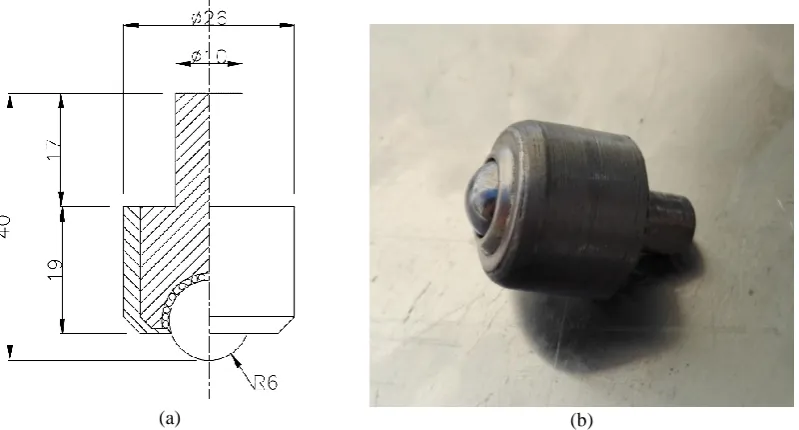
A lot of studies have been done with the use of stripping tools on the incremental forming process. In the current study, some tools with rotating geometry are used. The rotary tool reduces the friction between the tool and the sheet. Therefore, the surface conditions and the formability of the sheet improve. For this purpose, the geometry of the tool is drawn up in a design software 9 See Fig. 2). In this geometry, the balloon can be rotated freely in any direction. In the rotary tool, the ball can be freely moved by contacting the sheet in any direction but in the usual tool, the sheet was formed by the rotation of the tool that cuts some of the materials from the surface (Fig. 3). Also, the direction of the tool and ball rotation on the sheet are effective in this category.
2. 1. 2. Materials
22
Fig. 1. The used equipment in this study.
(a) (b)
Fig. 2. The design of the new tool (a) the design model for the tool (b) the produced tool.
Mold
CNC milling
Metal sheets
23 (a)
(b)
Fig. 3. Forming by any tool and closing method of rotary tool in the CNC (a) rotary tool (b) non- rotary tool.
Table 1. Used parameters.
Input parameters Level
1 Level 2 Level 3 Level 4
Tool model old new
Spindle speed (N) 100 300 600 1000
Feed rate (F) 400 600 800
Step down (dz) 0.25 0.5 0.75
2.3. Design of experiment of the process parameters
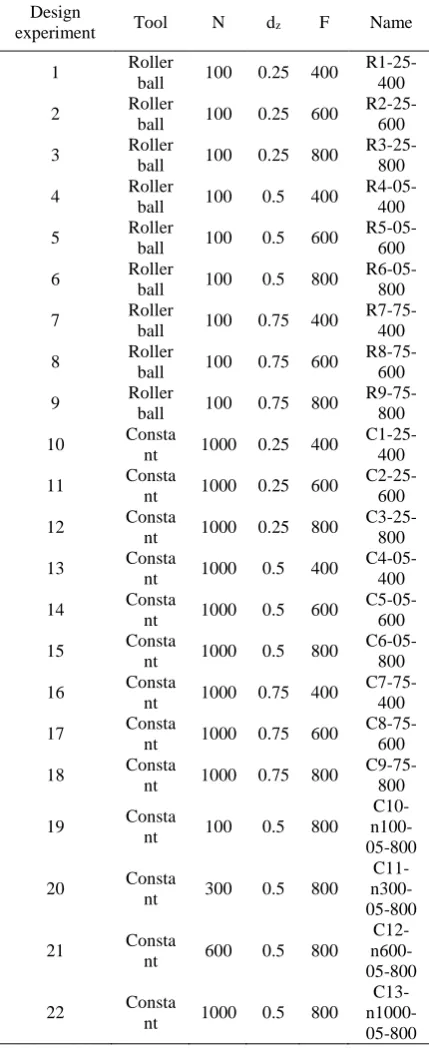
At the beginning of each process, an appropriate design of experiment (DoE) is carried out on the process parameters. In this test, the vertical step, spindle speed, type of tool and feed rate were selected as input parameters. For the parameters of vertical step, as well as feed rate, 3 values were considered and in the fixed instrument (old tool) for checking the spindle speed, 4 speeds were considered and compared to the two instruments (Table 1). According to the design of the experiments, there are 21 different states that should be performed in this process (Table 2).
2.2. Designing the parts
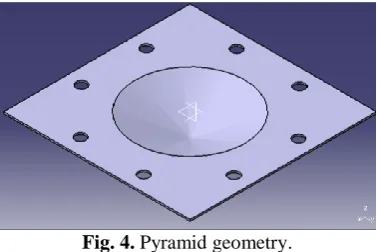
In this study, the pyramid geometry (Fig. 4) was developed in incremental forming process. The tool path (G codes) was extracted from CAD model by POWER MILL software and transferred to the controller of CNC machine by
CIMCO software. In this table, R is a sign of rotating tool, C is an indication of the old tool, n is the spindle speed and tests 19 to 22 are used to determine the effect of spindle speed on the results.
Table. 2. Design experiments. Design
experiment Tool N dz F Name
1 Roller
ball 100 0.25 400
R1-25-400
2 Roller
ball 100 0.25 600
R2-25-600
3 Roller
ball 100 0.25 800
R3-25-800
4 Roller
ball 100 0.5 400
R4-05-400
5 Roller
ball 100 0.5 600
R5-05-600
6 Roller
ball 100 0.5 800
R6-05-800
7 Roller
ball 100 0.75 400
R7-75-400
8 Roller
ball 100 0.75 600
R8-75-600
9 Roller
ball 100 0.75 800
R9-75-800
10 Consta
nt 1000 0.25 400
C1-25-400
11 Consta
nt 1000 0.25 600
C2-25-600
12 Consta
nt 1000 0.25 800
C3-25-800
13 Consta
nt 1000 0.5 400
C4-05-400
14 Consta
nt 1000 0.5 600
C5-05-600
15 Consta
nt 1000 0.5 800
C6-05-800
16 Consta
nt 1000 0.75 400
C7-75-400
17 Consta
nt 1000 0.75 600
C8-75-600
18 Consta
nt 1000 0.75 800
C9-75-800
19 Consta
nt 100 0.5 800
C10- n100-05-800
20 Consta
nt 300 0.5 800
C11- n300-05-800
21 Consta
nt 600 0.5 800
C12- n600-05-800
22 Consta
nt 1000 0.5 800
24
Fig. 4. Pyramid geometry.
3. Performing tests and measuring the output parameters
In this study, the experiments were conducted to investigate the effect of input parameters on forming force, surface roughness and thickness distribution as output parameters. Experiments were conducted to obtain the lowest forming forces, less surface roughness and lowest thickness variations; and the results were presented. Fig. 5 shows the forming process and a formed sample.
4. Results and discussion
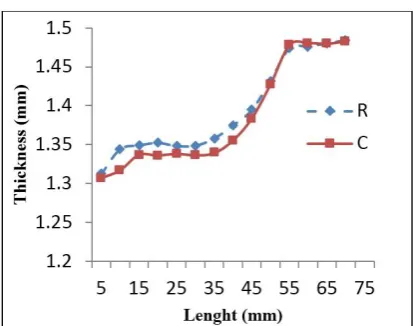
In this study, the effect of step down, feed rate, spindle speed and type of tool on the forming forces, thickness distribution and surface roughness have been investigated. To measure the surface roughness, the roughness device traverses the path from B to C and for measuring the thickness distribution, the CMM1 device (Poly CMM sky model) traverses the path from A to C and provides the results (Fig. 6).
4.1. Effect of vertical step, feed rate and spindle speed on the forming forces
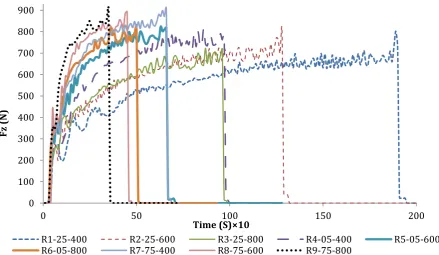
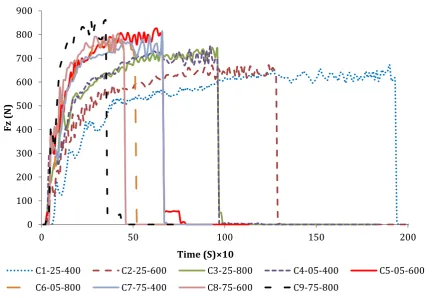
The results of investigating the effect of feed rate and vertical step on the forming forces for two model tools used in this study are presented in Figs. 7 and 8. The results indicate that increasing vertical steps and feed rate increased the forming forces and the effect of the vertical step is much higher than that of the feed rate. Mirnia and Mollaei [7] referred to the same issue and stated
1 Coordinate measuring machine
that as the vertical step increased, the forces of formation would increase.
(a)
(b)
Fig. 5. (a) Formed sheets (b) forming process.
25 This is due to the increase in the volume of the
material being shaped and also the increase in the strain rate in the desired sheet. In fact, with the increase of the vertical step and the feed rate, a larger amount of material is changed and the strain increases and with increasing the stress, the forming forces increase. . Spindle speed does not have a significant effect on the forming forces in the incremental forming. On the other hand, due to increasing the temperature at the contact point, the forming forces decreases by increasing the spindle speed. By using the new tool, the spindle speed has no effect on the process because the ball is in the contact with sheet and it can rotate freely in any direction. Also the results show that in rotary geometry tools, shaping forces are reduced due to friction reduced between the tool and the sheet and this provides better conditions for the forming process.
According to former studies, the spindle speed does not have a significant effect on incremental forming, but for comparing these two tools with each other, two tests should be selected with the
same conditions in each case. A review of the experiments showed that tests R6 and C10 have the same conditions for comparing these two tools. The results of this comparison indicate that forming forces reduced by using the rotary tool (Fig. 9).
4.2. Effects of input parameters on surface roughness and the comparison of the effects of the tools
In this process, the lubricant is used to improve the performance of the tests. The oil color, after testing with two tools, is visible in Fig. 10. As shown in the figure, the oil has a common color in the rotary tool because the ball can be freely moved by contacting the sheet in any direction but in the usual tool,
the sheet was
formed by the rotation of the tool that cuts some
of the materials from the surface and causes the color of the oil to darken. The direction of the tool and ball rotation on the sheet are effective in this category.Fig. 7. Effect of feed rate and step down on the forming forces by rotational tool. 0
100 200 300 400 500 600 700 800 900
0 50 100 150 200
Fz (N)
Time (S)×10
R1-25-400 R2-25-600 R3-25-800 R4-05-400 R5-05-600
26
Fig. 8. Effect of feed rate and step down on the forming forces by Non-rotating tool.
Fig. 9. Forming force diagram for rotational and non-rotational tools.
Also, less friction in the tool with rotating geometry can improve the surface smoothness. The results of the measurements of surface roughness by two parameters Ra and Rz for two instruments under test conditions are shown in Fig. 11. The results of the current study are in good agreement with the results gained by Honarpisheh [30].
As it has been stated, the surface quality of the rotary tool is better than non- rotary tool. A
distinct difference between the values in the above graph illustrates this issue.
4.3. Effects of input parameters on the thickness distribution in the two type of the tools
The results of examining the thickness distribution in the rotary and non- rotary tools are depicted in Fig. 12. According to the figure, rotary tool has less changes in the thickness distribution in comparison with non- rotary tool. The non- rotary tool cuts some of the materials from the surface of the sheet. So, the maximum thickness distribution happens in case of using non-rotary tool. Of course, the high friction in the non-rotating tool can also lead to inappropriate conditions in the thickness distribution. The results presented in references [11], [14] and [30] show a good agreement with the results outlined in this paper about thickness distribution. The results obtained in these studies suggest that increasing the vertical step increases the maximum thickness variation.
0 100 200 300 400 500 600 700 800 900
0 50 100 150 200
Fz (N)
Time (S)×10
C1-25-400 C2-25-600 C3-25-800 C4-05-400 C5-05-600
27
Fig. 10. The color of the used oil for two tools.
Fig. 11. The results of surface roughness.
28
5. Conclusions
In this study the effect of spindle speed, step down, feed rate and design of forming tool on the forming forces, surface roughness and thickness distribution during the incremental sheet metal forming have been investigated. The followings are results derived from this research:
-Forming force increased by increasing step down and feed rate. Spindle speed had no significant effect on this parameter.
- In the same conditions, forming force decreased by using rotary tool due to less friction in this model of the tool.
- Surface roughness increased by increasing the vertical step and feed rate. Spindle speed had no significant effect on this parameter.
- The non-rotary tool destroyed surface roughness by cutting some of the materials from the surface of the sheet.
- Maximum thickness changes increased with increasing the vertical step and feed rate due to increased strain.
- The thickness distribution in the rotary tool has a better trend than the non-rotary tool.
References
[1] J. Jeswiet, F. Micari, G. Hirt, A. Bramley,
Joost Duflou, and J. Allwood. "Asymmetric single point incremental forming of sheet
metal." CIRP Annals-Manufacturing
Technology, Vol. 54, No. 2, pp. 88-114 (2005).
[2] J. Jeswiet, E. Hagan, and A. Szekeres. "Forming parameters for incremental forming of aluminium alloy sheet metal."
Proceedings of the Institution of Mechanical Engineers, Part B: Journal of Engineering Manufacture, Vol. 216, No. 10, pp. 1367-1371, (2002).
[3] M. B. Silva, Pedro Teixeira, Ana Reis, and P. A. F. Martins. "On the formability of hole-flanging by incremental sheet forming." Proceedings of the Institution of Mechanical Engineers, Part L: Journal of Materials Design and Applications, Vol. 227, No. 2, pp. 91-99, (2013).
[4] L. Montanari, V. A. Cristino, M. B. Silva, and P. A. F. Martins. "On the relative
performance of hole-flanging by incremental sheet forming and conventional press-working." Proceedings of the Institution of Mechanical Engineers, Part L: Journal of Materials Design and Applications, Vol. 228, No. 4, pp. 312-322, (2014).
[5] G. Ambrogio, L. Filice, and G. L. Manco.
"Warm incremental forming of magnesium
alloy AZ31." CIRP Annals-Manufacturing
Technology, Vol. 57, No. 1 pp. 257-260, (2008).
[6] G. L. Manco, and G. Ambrogio. "Influence of thickness on formability in
6082-T6." International Journal of Material
Forming Vol. 3, No. 1 pp. 983-986 (2010). [7] M. J. Mirnia, B. Mollaei Dariani, H.
Vanhove, and J. R. Duflou. "An
investigation into thickness distribution in single point incremental forming using sequential limit analysis." International Journal of Material Forming, Vol. 7, No. 4, pp. 469-477, (2014).
[8] E. Hagan, and J. Jeswiet. "Analysis of
surface roughness for parts formed by computer numerical controlled incremental forming." Proceedings of the Institution of Mechanical Engineers, Part B: Journal of Engineering Manufacture, Vol. 218, No. 10, pp. 1307-1312 (2004).
[9] L. Fratini, G. Ambrogio, R. Di Lorenzo, L.
Filice, and F. Micari. "Influence of mechanical properties of the sheet material on formability in single point incremental
forming." CIRP Annals-Manufacturing
Technology, Vol. 53, No. 1 pp. 207-210, (2004).
[10] Hideo, Iseki, "An approximate deformation
analysis and FEM analysis for the incremental bulging of sheet metal using a spherical roller." Journal of Materials Processing Technology, Vol. 111, No. 1, pp. 150-154, (2001).
29 [12] L. Filice, L. Fratini, and F. Micari.
"Analysis of material formability in
incremental forming." CIRP
annals-Manufacturing technology, Vol. 51, No. 1, pp. 199-202, (2002).
[13] A. Attanasio, E. Ceretti, and C. Giardini. "Optimization of tool path in two points
incremental forming." Journal of
Materials Processing Technology, Vol. 177, No. 1, pp. 409-412, (2006).
[14] D. Young, and J. Jeswiet. "Wall thickness variations in single-point incremental forming." Proceedings of the Institution of Mechanical Engineers, Part B: Journal of Engineering Manufacture, Vol. 218, No. 11, pp. 1453-1459 (2004).
[15] G. Hussain, L. Gao, and Z. Y. Zhang. "Formability evaluation of a pure titanium sheet in the cold incremental forming process." The International Journal of
Advanced Manufacturing
Technology, Vol. 37, No. 9-10, pp. 920-926, (2008).
[16] K. Hamilton, and J. Jeswiet. "Single point incremental forming at high feed rates and rotational speeds: Surface and structural
consequences." CIRP
Annals-Manufacturing Technology, Vol. 59, No. 1, pp. 311-314, (2010).
[17] Suresh, Kurra, Regalla, Srinivasaprakash,
and Amit Kumar Gupta. "Parametric study and multi-objective optimization in single-point incremental forming of extra deep drawing steel sheets." Proceedings of the Institution of Mechanical
Engineers, Part B: Journal of
Engineering Manufacture, Vol. 230, No. 5, pp. 825-837, (2016).
[18] Wenke, Bao, Xingrong Chu, Shuxia Lin,
and Jun Gao. "Experimental investigation on formability and microstructure of AZ31B alloy in electropulse-assisted
incremental forming." Materials &
Design, Vol. 87, pp. 632-639, (2015).
[19] Kurra, Suresh and Srinivasa Prakash
Regalla. "Analysis of formability in single point incremental forming using finite element simulations." Procedia Materials Science, Vol. 6, pp. 430-435, (2014).
[20] R. Senthil, and A. Gnanavelbabu.
"Numerical analysis on formability of AZ61A magnesium alloy by incremental forming." Procedia Engineering, Vol. 97, pp. 1975-1982, (2014).
[21] V. Mugendiran, and A. Gnanavelbabu. "Comparison of FLD and thickness distribution on AA5052 aluminium alloy formed parts by incremental forming process." Procedia Engineering, Vol. 97 pp. 1983-1990, (2014).
[22] McAnulty, Tegan, Jack Jeswiet, and
Matthew Doolan. "Formability in single point incremental forming: A comparative analysis of the state of the art.", CIRP Journal of Manufacturing Science and Technology, Vol. 16, pp. 43-54, (2017). [23] EH. Uheida, G. A. Oosthuizen, and D.
Dimitrov, "Investigating the Impact of Tool Velocity on the Process Conditions in Incremental Forming of Titanium Sheets", Procedia Manufacturing Vol. 7, pp. 345-350, (2016).
[24] D. Afonso, R. Alves de Sousa, and R. Torcato, "Incremental Forming of Tunnel Type Parts", Procedia Engineering, Vol. 183, pp. 137-142, (2017).
[25] MR. Sakhtemanian, M. Honarpisheh, and
S. Amini, "Numerical and experimental study on the layer arrangement in the incremental forming process of
explosive-welded low-carbon steel/CP-titanium
bimetal sheet", The International Journal of Advanced Manufacturing Technology,
Vol. 95, No. 9-12, pp. 3781-3796, (2018). [26] M. Honarpisheh, and A. Gheysarian, "An Experimental Study on the process parameters of Incremental Forming of Explosively-Welded Al/Cu Bimetals",
Journal of Computational & Applied
Research in Mechanical
Engineering, Vol. 7, No. 1, pp. 73-83, (2017).
[27] M. Honarpisheh, M. Mohammadi
30
Technology, Vol. 96, No. 9-12, pp. 3069-3080, (2018).
[28] M. Honarpisheh, M. Keimasi, and I. Alinaghian, “Numerical and experimental study on incremental forming process of Al/Cu bimetals: influence of process
parameters on the forming force,
dimensional accuracy and thickness
variations", Journal of Mechanics of
Materials and Structures Vol. 13, pp. 35-51, (2018).
[29] M. Honarpisheh, M. J. Abdolhoseini, and S. Amini, "Experimental and numerical investigation of the hot incremental forming of Ti-6Al-4V sheet using electrical current", The International Journal of Advanced Manufacturing Technology, Vol. 83, No. 9-12 pp. 2027-2037, (2016).
[30] A. Gheysarian, and M. Honarpisheh, "Process Parameters Optimization of the Explosive-Welded Al/Cu Bimetal in the
Incremental Sheet Metal Forming
Process." Iranian Journal of Science and Technology, Transactions of Mechanical Engineering: pp. 1-12, (2018).
[31] M. R. Sakhtemanian, M. Honarpisheh,
and S. Amini. "A novel material modeling technique in the single-point incremental forming assisted by the ultrasonic
vibration of low carbon
steel/commercially pure titanium bimetal
sheet." The International Journal of
Advanced Manufacturing Technology,
Vol. 102, No. 1-4, pp. 473-486, (2019). [32] M. R. Sakhtemanian, S. Amini, and M.
Honarpisheh. "Simulation and
investigation of mechanical and
geometrical properties of St/CP-titanium bimetal sheet during the single point
incremental forming process." Iranian
Journal of Materials Forming, Vol. 5, No. 1, pp. 1-18, (2018).
How to cite this paper:
E. Haghani, A. Gheysarian and M. Honarpisheh, “Designing and manufacturing a novel tool in the incremental sheet metal forming process and its effects on the process parameters