2014; 3(4): 125-129
Published online July 30, 2014 (http://www.sciencepublishinggroup.com/j/acm) doi: 10.11648/j.acm.20140304.13
ISSN: 2328-5605 (Print); ISSN: 2328-5613 (Online)
Modelling the migratory population dynamics of the
Serengeti ecosystem
Janeth James Ngana
1, Livingstone Serwadda Luboobi
2, Dmitry Kuznetsov
11Nelson Mandela African Institution of Science and Technology (NM-AIST), Arusha, Tanzania 2Department of Mathematics, Makerere University, Kampala, Uganda
Email address:
[email protected] (J. J. Ngana), [email protected] (L. S. Luboobi), [email protected] (D. Kuznetsov)
To cite this article:
Janeth James Ngana, Livingstone Serwadda Luboobi, Dmitry Kuznetsov. Modelling the Migratory Population Dynamics of the Serengeti Ecosystem.Applied and Computational Mathematics. Vol. 3, No. 4, 2014, pp. 125-129. doi: 10.11648/j.acm.20140304.13
Abstract:
Many ecological studies have tried to explain the animal migrations, but none has embarked on modeling the Great Migration and its impact on the migratory animals’ population dynamics, in combination with food and the impact of predation. In this paper, we present a mathematical model of the four dynamic Ordinary Differential Equations of Grass, Herbivores, Lions and Crocodiles. Using secondary data covering ten years 1996-2006 we estimated the parameters in the model. The grass forage grew periodically, the herbivores population grew, the predation rate of lions grew and so did its population. But the crocodiles’ population grew less. The study has shown that there was no extinction and migration continued. Herbivores population grew provided that there was enough food.Keywords:
Great Migration, Grass, Herbivores, Lions, Crocodiles, Predation, Prey, Serengeti, Masai Mara1. Introduction
The Great Migration, is one of the “Seven New Wonders of the World”. There is nowhere else in the world where there is such a movement of animals as immense as the wildebeests (Connochaetes taurinus), zebras (Equus burchelli) and Thomson’s gazelle (Gazella thomsoni), migrating from Serengeti National Park in Tanzania to Masai Mara National Reserve in Kenya and back. Over two million animals migrate from the Serengeti to the greener pastures of the Maasai Mara. The lions, hyenas, leopards, cheetahs, crocodiles and lesser predators await the annual coming of the migration for predation.
The wildebeest (Connochaetes taurinus) migration in the Serengeti/ Mara ecosystem of Tanzania and Kenya represents an iconic example of ungulate migration and constitutes one of the most thoroughly documented animal migrations in one of the most intensively studied ecosystems on Earth (Pennycuick [7]; Maddock [4]; Fryxell et al [1]; Mduma et al. [5]; Wilmshurst et al. [10]; Wolanski and Gereta [11]; Sinclair [9]; Musiega and Kazadi [6]).
The migration is driven by a marked, highly seasonal rainfall gradient, increasing from South East to North West, coupled with strong differences in soil fertility and plant
nutritional content between the grassland and savanna habitats (Maddock [4] ; Holdo et al. [3]; Holdo et al. [2]).
2. Statement of the Problem
the regulation of wildebeest populations by directly incorporating food supply into our model (Stratton [8]). Thus, the study aims at covering that gap and develops a mathematical model for the impact of migration.
3. Main Objective
To develop a population dynamics model that will reflect the Migration impact on the Serengeti Ecosystem.
3.1. Model Formulation
dG
dt = k cos θt G − αHG dH
dt = ηGH + γH − ωLH − βCH − + 1
− dL
dt = −ϕL + υHL
"#
"$= −εC + δHC.
The emigration rate, which is the migration from Tanzania to Kenya is: and immigration rate, that is the migration from Kenya to Tanzania is:
'1 − (.
3.2. The variables and Parameters
* = Grass + =Herbivores , = Lions - = Crocodiles
. = the rainfall constant
/ = the efficiency rate of herbivores predation on grass 0 = the angle in radians
1 = the interaction rate of grass prey on herbivores 2 = the intrinsic logistic rate
3 = the efficiency rate of lion predation on herbivores 4 = the efficiency rate of crocodile predation on herbivores
5 = the natural death rate of lions in the absence of prey 6 = the efficiency rate of lion in the presence of herbivores
7 = the natural death rate of crocodile in the absence of prey
8 = the efficiency rate of the crocodile in the presence of herbivores
= the emigration effect rate for migratory movement from Tanzania to Kenya
= the immigration effect rate for migratory movement from Kenya to Tanzania
These migration rates can be justified as follows: On the Tanzanian side, if limits are applied then as * + ⟶ 0, that’s during the dry season in Tanzania * ;< = >? <@ABB , then the animals emigrate from Tanzania to Kenya at the rate .When * + ⟶∞, that’s
during the raining season in Tanzania * ;< = >? ℎEF , then the animals immigrate to Tanzania from Kenya at the rate .
4. The Equilibrium Points
The following were the four equilibrium points:
1.
2.
3.
4.
4.1. The Jacobian Matrices for the Model
4.2. The Eigenvalues of the Model
These were the three eigenvalues among four: Eigenvalues (J1);
Conclusion: For stability of the first equilibrium point, we must have:
2 < 0, 25 − 6 < 0, 27 − 8 < 0, 2. cos 0H > / Eigenvalues(J3);
Conclusion: For stability of the third equilibrium point, we must have:
8 > 0 58 + 67 > 0, 7/ − 8. cos 0H > 0,
7 > 0
8 + J K8K+ 4 7K8 − 427M<
0,.− 8 + J K8K+ 4 7K8 − 427M> 0
Eigenvalues(J4);
Conclusion: For stability of the fourth equilibrium point, then:
6 > 0
58 − 67 < 0, 5/ − 6.Ncos 0H > 0,
5 > 0
6 + J K6K+ 4 5K6 − 425M< 0,
− 6 + J K6K+ 4 5K6 − 425M> 0.
5. The Results of Simulation Analysis of
the Model with Migration
The simplified model has thirteen parameters. The following graphs show how the data fitted the model, for Grass, Herbivores, Lions and Crocodiles against time.
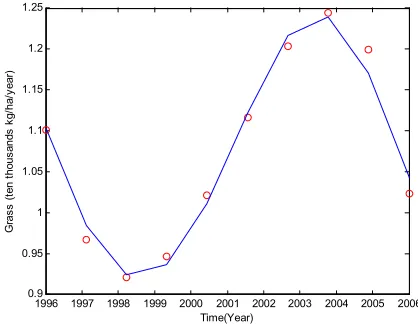
Figure 5.5(a). The graph above represents the best fitting of data for grass.
Discussion: The data is best fitting with the model. The grass grew periodically. It dropped from 1.1 in 1996 to 0.925 units of volume in 1998. Probably there was less rainfall. It then shot up to 1.25 volume units in 2003, and started to drop again to approximately 1.04 units in 2006.
1996 1997 1998 1999 2000 2001 2002 2003 2004 2005 2006 0.9
0.95 1 1.05 1.1 1.15 1.2 1.25
Time(Year)
G
ra
s
s
(
te
n
t
h
o
u
s
a
n
d
s
k
g
/h
a
/y
e
a
Figure 5.5(b). The graph above represents the best fitting of data for Herbivores population.
Discussion: The data is best fitting with the model. The herbivores population was 1,550,000 in 1996 and dropped to approximately to 1,510,000 in 1999. Relating with the grass graph above, this was around the same period that the grass had dropped drastically in growing. But after that the population started growing up drastically again. It was around the same time that the grass volume also grew up at large.
Figure 5.5(c). The graph above represents the best fitting of data for the Lions Population.
Discussion: The data does NOT well best fit with the model. This could be due to the reason that the data given
was too minimal. And so the interpolated values were misleading, and hence not estimating the model properly.
Figure 5.5(d). The graph above represents the best fitting of data for the Crocodiles.
Discussion: The data slightly best fits with the model. The graph approximately shows that the crocodile population was declining. The reason could be that maybe they don’t fetch enough food. It can also be observed that it is very difficult for them to fetch the herbivores when crossing Masai-River to Kenya, and when back to Tanzania. A big reason to why their population is declining.
Conclusion: The migratory herbivores population dynamics has fortunately shown to be increasing, while the predators’ population happened to decrease. There was no sign of extinction happening within the ten years, thus from 1996-2006. The population dropped around the year 2000 probably due to drought. The grass appeared to be periodically growing depending of rainfall seasoning. It is tremendously urgent for the concerned authorities to continue to control and maintain the sustainability of the existence of wildlife conservation despite some of the natural hazards which are uncontrollable. This will not only be vigilant economically for our generation, but for our future generation as well.
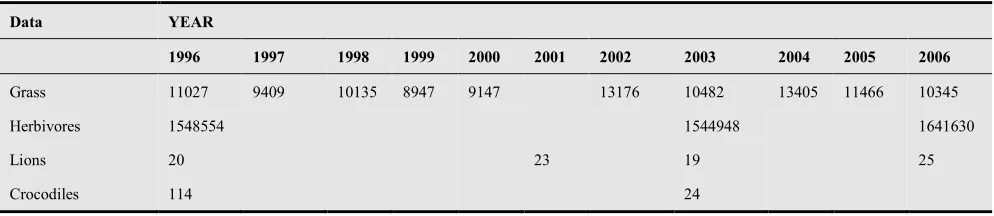
The following table below consist of the secondary data that was used in the simulation process for the year 1996-2006.
Table 1. Data on Grass, Herbivores, Lions and Crocodiles for the years: 1996-2006
Data YEAR
1996 1997 1998 1999 2000 2001 2002 2003 2004 2005 2006
Grass 11027 9409 10135 8947 9147 13176 10482 13405 11466 10345
Herbivores 1548554 1544948 1641630
Lions 20 23 19 25
Crocodiles 114 24
Source: Tanzania Wildlife Research Institute (TAWIRI)
1996 1997 1998 1999 2000 2001 2002 2003 2004 2005 2006 150 155 160 165 Time(Year) H e rb iv o re s P o p u la ti o n s ( te n t h o u s a n d s )
19961 1997 1998 1999 2000 2001 2002 2003 2004 2005 2006 1.5 2 2.5 3 3.5 4 4.5 5 5.5x 10
-3 Time(Year) L io n P o p u la ti o n s ( te n t h o u s a n d s )
References
[1] Fryxell, J. M., Greever, J., and Sinclair, A. R. E. (1988). Causes and consequences of migration in large herbivores. Trends in Ecology and Evolution 3: 237-241.
[2] Holdo, R. M., Holt, R. D., Sinclair, A. R., Godley, B. J., & Thirgood, S. (2011). Migration impacts on communities and ecosystems: empirical evidence and theoretical insights. Animal Migration: A Synthesis, 131-143.
[3] Holdo, R. M., Holt, R. D., and Fryxell, J.M. (2009). Opposing rainfall and pant nutritional grsdients best explain the wildebeest migration in the Serengeti. The American Naturalist, 173 (4), 431-445.
[4] Maddock, L., Sinclair, A. R. E and Norton-Griffiths, M. (1979). The Migration and Grazzing succession in Serengeti: Dynamics of an Ecosystem. 104-29. Chicago: University of Chicago Press.
[5] Mduma S.A.R, Sinclair A.R.E. AND Hiborn, R. (1999). Food regulates the Serengeti Wildbeest: a 40-year record. Journal of Animal Ecology, 68, 1101-1122
[6] Musiega, D. E., and Kazadi, S.N. (2004). Simulating the East African Wildebeest Migration Patterns using GIS and remote sensing. African Journal of Ecology, 42 (4), 355-362. [7] Pennycuick, C.J. (1975). On the running of gnu
(Connochaetes taurinus) and other animals. Journal of Experimental Biology. 63, p.775-799.
[8] Stratton, D. (2010). Wildebeest in Serengeti: limits to exponential growth. University of Chicago Press.
[9] Sinclair, A. R. E, Arcese, P. (1995). Serengeti II: Dynamics, management and conservation of an ecosystem. University of Chicago Press, Chicago.
[10] Wilmhurst, J. F. Fryxell, J. M., Fram, B.P., Sinclair, A. R. E., Henschel, C. P. (1999). Spatial Distribution of Serengeti Wildebeest in relation to Resources. Can. J. Zool.77, 1223-1232.