V
OLUMEN
O.
8
(2018),
I
SSUEN
O.
08
(A
UGUST)
ISSN
2231-5756
A Monthly Double-Blind Peer Reviewed (Refereed/Juried) Open Access International e-Journal - Included in the International Serial Directories
Indexed & Listed at:
Ulrich's Periodicals Directory ©, ProQuest, U.S.A., EBSCO Publishing, U.S.A., Cabell’s Directories of Publishing Opportunities, U.S.A., Google Scholar, Indian Citation Index (ICI), J-Gage, India [link of the same is duly available at Inflibnet of University Grants Commission (U.G.C.)],
Index Copernicus Publishers Panel, Poland with IC Value of 5.09 (2012) & number of libraries all around the world.
V
OLUMEN
O.
8
(2018),
I
SSUEN
O.
08
(A
UGUST)
ISSN
2231-5756
INTERNATIONAL JOURNAL OF RESEARCH IN COMMERCE, IT & MANAGEMENT
CONTENTS
Sr.
No.
TITLE & NAME OF THE AUTHOR (S)
Page
No.
1
.
EFFECTS OF SOCRATIC AND CONVENTIONAL LECTURE TEACHING METHODS
ON ACADEMIC PERFORMANCE OF SECONDARY SCHOOL STUDENTS IN
FINANCIAL ACCOUNTING IN ADAMAWA STATE, NIGERIA
Dr. TITUS AMODU UMORU & BABANGIDA HARUNA
1
2
.
HUMAN RESOURCE MANAGEMENT PRACTICES & WORK LIFE BALANCE:
WOMEN INFORMATION TECHNOLOGY PROFESSIONALS
SARITA VAIDYA, Dr. PRASHANT GUPTA & Dr. JYOTI SHARMA
6
3
.
EVALUATION OF EMPLOYEES’ PERFORMANCE USING DATA ENVELOPMENT
ANALYSIS AS A TOOL: A PILOT STUDY OF HR EXECUTIVES OF THDCIL
ASHUTOSH KUMAR ANAND & Dr. V.P.GANGWAR
11
4
.
DIGITAL INDIA – A CRITICAL REVIEW
Dr. NARINDER TANWAR
16
5
.
A STUDY ON CUSTOMERS ATTITUDE TOWARDS SOCIAL MEDIA
NETWORKING
S. CHITRA & M. BHUVANESWARI
20
6
.
ASSESSMENT OF EMOTIONAL INTELLIGENCE AND ITS IMPACT ON
LEADERSHIP STYLE OF LEATHER ENTREPRENEURS AND EXECUTIVES
A. NIYAZ AHMED
28
V
OLUMEN
O.
8
(2018),
I
SSUEN
O.
08
(A
UGUST)
ISSN
2231-5756
INTERNATIONAL JOURNAL OF RESEARCH IN COMMERCE, IT & MANAGEMENT
CHIEF PATRON
Prof. (Dr.) K. K. AGGARWAL
Chairman, Malaviya National Institute of Technology, Jaipur
(An institute of National Importance & fully funded by Ministry of Human Resource Development, Government of India)
Chancellor, K. R. Mangalam University, Gurgaon
Chancellor, Lingaya’s University, Faridabad
Founder Vice-Chancellor (1998-2008), Guru Gobind Singh Indraprastha University, Delhi
Ex. Pro Vice-Chancellor, Guru Jambheshwar University, Hisar
FOUNDER PATRON
Late Sh. RAM BHAJAN AGGARWAL
Former State Minister for Home & Tourism, Government of Haryana
Former Vice-President, Dadri Education Society, Charkhi Dadri
Former President, Chinar Syntex Ltd. (Textile Mills), Bhiwani
CO-ORDINATOR
Dr. BHAVET
Former Faculty, Shree Ram Institute of Engineering & Technology, Urjani
ADVISOR
Prof. S. L. MAHANDRU
Principal (Retd.), Maharaja Agrasen College, Jagadhri
EDITOR
Dr. PARVEEN KUMAR
Professor, Department of Computer Science, NIMS University, Jaipur
CO-EDITOR
Dr. A. SASI KUMAR
Professor, Vels Institute of Science, Technology & Advanced Studies (Deemed to be University), Pallavaram
EDITORIAL ADVISORY BOARD
Dr. S. P. TIWARI
Head, Department of Economics & Rural Development, Dr. Ram Manohar Lohia Avadh University, Faizabad
Dr. CHRISTIAN EHIOBUCHE
Professor of Global Business/Management, Larry L Luing School of Business, Berkeley College, USA
Dr. SIKANDER KUMAR
Chairman, Department of Economics, Himachal Pradesh University, Shimla, Himachal Pradesh
Dr. JOSÉ G. VARGAS-HERNÁNDEZ
Research Professor, University Center for Economic & Managerial Sciences, University of Guadalajara,
Guadala-jara, Mexico
Dr. M. N. SHARMA
Chairman, M.B.A., Haryana College of Technology & Management, Kaithal
Dr. TEGUH WIDODO
Dean, Faculty of Applied Science, Telkom University, Bandung Technoplex, Jl. Telekomunikasi, Indonesia
Dr. M. S. SENAM RAJU
Professor, School of Management Studies, I.G.N.O.U., New Delhi
Dr. A SAJEEVAN RAO
Professor & Director, Accurate Institute of Advanced Management, Greater Noida
Dr. D. S. CHAUBEY
Professor & Dean (Research & Studies), Uttaranchal University, Dehradun
Dr. CLIFFORD OBIYO OFURUM
V
OLUMEN
O.
8
(2018),
I
SSUEN
O.
08
(A
UGUST)
ISSN
2231-5756
INTERNATIONAL JOURNAL OF RESEARCH IN COMMERCE, IT & MANAGEMENT
Dr. KAUP MOHAMED
Dean & Managing Director, London American City College/ICBEST, United Arab Emirates
Dr. VIRENDRA KUMAR SHRIVASTAVA
Director, Asia Pacific Institute of Information Technology, Panipat
SUNIL KUMAR KARWASRA
Principal, Aakash College of Education, ChanderKalan, Tohana, Fatehabad
Dr. MIKE AMUHAYA IRAVO
Principal, Jomo Kenyatta University of Agriculture & Tech., Westlands Campus, Nairobi-Kenya
Dr. SYED TABASSUM SULTANA
Principal, Matrusri Institute of Post Graduate Studies, Hyderabad
Dr. BOYINA RUPINI
Director, School of ITS, Indira Gandhi National Open University, New Delhi
Dr. NEPOMUCENO TIU
Chief Librarian & Professor, Lyceum of the Philippines University, Laguna, Philippines
Dr. SANJIV MITTAL
Professor & Dean, University School of Management Studies, GGS Indraprastha University, Delhi
Dr. RAJENDER GUPTA
Convener, Board of Studies in Economics, University of Jammu, Jammu
Dr. SHIB SHANKAR ROY
Professor, Department of Marketing, University of Rajshahi, Rajshahi, Bangladesh
Dr. ANIL K. SAINI
Professor, Guru Gobind Singh Indraprastha University, Delhi
Dr. SRINIVAS MADISHETTI
Professor, School of Business, Mzumbe University, Tanzania
Dr. NAWAB ALI KHAN
Professor & Dean, Faculty of Commerce, Aligarh Muslim University, Aligarh, U.P.
MUDENDA COLLINS
Head, Operations & Supply Chain, School of Business, The Copperbelt University, Zambia
Dr. EGWAKHE A. JOHNSON
Professor & Director, Babcock Centre for Executive Development, Babcock University, Nigeria
Dr. A. SURYANARAYANA
Professor, Department of Business Management, Osmania University, Hyderabad
P. SARVAHARANA
Asst. Registrar, Indian Institute of Technology (IIT), Madras
Dr. MURAT DARÇIN
Associate Dean, Gendarmerie and Coast Guard Academy, Ankara, Turkey
Dr. ABHAY BANSAL
Head, Department of Information Technology, Amity School of Engg. & Tech., Amity University, Noida
Dr. YOUNOS VAKIL ALROAIA
Head of International Center, DOS in Management, Semnan Branch, Islamic Azad University, Semnan, Iran
WILLIAM NKOMO
Asst. Head of the Department, Faculty of Computing, Botho University, Francistown, Botswana
Dr. JAYASHREE SHANTARAM PATIL (DAKE)
Faculty in Economics, KPB Hinduja College of Commerce, Mumbai
SHASHI KHURANA
Associate Professor, S. M. S. Khalsa Lubana Girls College, Barara, Ambala
Dr. SEOW TA WEEA
Associate Professor, Universiti Tun Hussein Onn Malaysia, Parit Raja, Malaysia
Dr. OKAN VELI ŞAFAKLI
Professor & Dean, European University of Lefke, Lefke, Cyprus
Dr. MOHENDER KUMAR GUPTA
V
OLUMEN
O.
8
(2018),
I
SSUEN
O.
08
(A
UGUST)
ISSN
2231-5756
INTERNATIONAL JOURNAL OF RESEARCH IN COMMERCE, IT & MANAGEMENT
Dr. BORIS MILOVIC
Associate Professor, Faculty of Sport, Union Nikola Tesla University, Belgrade, Serbia
Dr. LALIT KUMAR
Faculty, Haryana Institute of Public Administration, Gurugram
Dr. MOHAMMAD TALHA
Associate Professor, Department of Accounting & MIS, College of Industrial Management, King Fahd University
of Petroleum & Minerals, Dhahran, Saudi Arabia
Dr. V. SELVAM
Associate Professor, SSL, VIT University, Vellore
Dr. IQBAL THONSE HAWALDAR
Associate Professor, College of Business Administration, Kingdom University, Bahrain
Dr. PARDEEP AHLAWAT
Associate Professor, Institute of Management Studies & Research, Maharshi Dayanand University, Rohtak
Dr. ALEXANDER MOSESOV
Associate Professor, Kazakh-British Technical University (KBTU), Almaty, Kazakhstan
Dr. ASHOK KUMAR CHAUHAN
Reader, Department of Economics, Kurukshetra University, Kurukshetra
Dr. BHAVET
Former Faculty, Shree Ram Institute of Engineering & Technology, Urjani
YU-BING WANG
Faculty, department of Marketing, Feng Chia University, Taichung, Taiwan
SURJEET SINGH
Faculty, Department of Computer Science, G. M. N. (P.G.) College, Ambala Cantt.
Dr. MELAKE TEWOLDE TECLEGHIORGIS
Faculty, College of Business & Economics, Department of Economics, Asmara, Eritrea
Dr. RAJESH MODI
Faculty, Yanbu Industrial College, Kingdom of Saudi Arabia
Dr. SAMBHAVNA
Faculty, I.I.T.M., Delhi
Dr. THAMPOE MANAGALESWARAN
Faculty, Vavuniya Campus, University of Jaffna, Sri Lanka
Dr. SHIVAKUMAR DEENE
Faculty, Dept. of Commerce, School of Business Studies, Central University of Karnataka, Gulbarga
SURAJ GAUDEL
BBA Program Coordinator, LA GRANDEE International College, Simalchaur - 8, Pokhara, Nepal
FORMER TECHNICAL ADVISOR
AMITA
FINANCIAL ADVISORS
DICKEN GOYAL
Advocate & Tax Adviser, Panchkula
NEENA
Investment Consultant, Chambaghat, Solan, Himachal Pradesh
LEGAL ADVISORS
JITENDER S. CHAHAL
Advocate, Punjab & Haryana High Court, Chandigarh U.T.
CHANDER BHUSHAN SHARMA
Advocate & Consultant, District Courts, Yamunanagar at Jagadhri
SUPERINTENDENT
V
OLUMEN
O.
8
(2018),
I
SSUEN
O.
08
(A
UGUST)
ISSN
2231-5756
INTERNATIONAL JOURNAL OF RESEARCH IN COMMERCE, IT & MANAGEMENT
CALL FOR MANUSCRIPTS
We invite unpublished novel, original, empirical and high quality research work pertaining to the recent developments & practices in the areas of Com-puter Science & Applications; Commerce; Business; Finance; Marketing; Human Resource Management; General Management; Banking; Economics; Tourism Administration & Management; Education; Law; Library & Information Science; Defence & Strategic Studies; Electronic Science; Corporate Gov-ernance; Industrial Relations; and emerging paradigms in allied subjects like Accounting; Accounting Information Systems; Accounting Theory & Practice; Auditing; Behavioral Accounting; Behavioral Economics; Corporate Finance; Cost Accounting; Econometrics; Economic Development; Economic History; Financial Institutions & Markets; Financial Services; Fiscal Policy; Government & Non Profit Accounting; Industrial Organization; International Economics & Trade; International Finance; Macro Economics; Micro Economics; Rural Economics; Co-operation; Demography: Development Planning; Development Studies; Applied Economics; Development Economics; Business Economics; Monetary Policy; Public Policy Economics; Real Estate; Regional Economics; Political Science; Continuing Education; Labour Welfare; Philosophy; Psychology; Sociology; Tax Accounting; Advertising & Promotion Management; Management Information Systems (MIS); Business Law; Public Responsibility & Ethics; Communication; Direct Marketing; E-Commerce; Global Business; Health Care Administration; Labour Relations & Human Resource Management; Marketing Research; Marketing Theory & Applications; Non-Profit Or-ganizations; Office Administration/Management; Operations Research/Statistics; Organizational Behavior & Theory; Organizational Development; Pro-duction/Operations; International Relations; Human Rights & Duties; Public Administration; Population Studies; Purchasing/Materials Management; Re-tailing; Sales/Selling; Services; Small Business Entrepreneurship; Strategic Management Policy; Technology/Innovation; Tourism & Hospitality; Transpor-tation Distribution; Algorithms; Artificial Intelligence; Compilers & Translation; Computer Aided Design (CAD); Computer Aided Manufacturing; Computer Graphics; Computer Organization & Architecture; Database Structures & Systems; Discrete Structures; Internet; Management Information Systems; Mod-eling & Simulation; Neural Systems/Neural Networks; Numerical Analysis/Scientific Computing; Object Oriented Programming; Operating Systems; Pro-gramming Languages; Robotics; Symbolic & Formal Logic; Web Design and emerging paradigms in allied subjects.
Anybody can submit the soft copy of unpublished novel; original; empirical and high quality research work/manuscript anytime in M.S. Word format after preparing the same as per our GUIDELINES FOR SUBMISSION; at our email address i.e. [email protected] or online by clicking the link online submission as given on our website (FOR ONLINE SUBMISSION, CLICK HERE).
GUIDELINES FOR SUBMISSION OF MANUSCRIPT
1. COVERING LETTER FOR SUBMISSION:
DATED: _____________
THE EDITOR
IJRCM
Subject: SUBMISSION OF MANUSCRIPT IN THE AREA OF______________________________________________________________.
(e.g. Finance/Mkt./HRM/General Mgt./Engineering/Economics/Computer/IT/ Education/Psychology/Law/Math/other, please specify)
DEAR SIR/MADAM
Please find my submission of manuscript titled ‘___________________________________________’ for likely publication in one of your journals.
I hereby affirm that the contents of this manuscript are original. Furthermore, it has neither been published anywhere in any language fully or partly, nor it is under review for publication elsewhere.
I affirm that all the co-authors of this manuscript have seen the submitted version of the manuscript and have agreed to inclusion of their names as co-authors.
Also, if my/our manuscript is accepted, I agree to comply with the formalities as given on the website of the journal. The Journal has discretion to publish our contribution in any of its journals.
NAME OF CORRESPONDING AUTHOR :
Designation/Post* :
Institution/College/University with full address & Pin Code :
Residential address with Pin Code :
Mobile Number (s) with country ISD code :
Is WhatsApp or Viber active on your above noted Mobile Number (Yes/No) :
Landline Number (s) with country ISD code :
E-mail Address :
Alternate E-mail Address :
Nationality :
* i.e. Alumnus (Male Alumni), Alumna (Female Alumni), Student, Research Scholar (M. Phil), Research Scholar (Ph. D.), JRF, Research Assistant, Assistant
Lecturer, Lecturer, Senior Lecturer, Junior Assistant Professor, Assistant Professor, Senior Assistant Professor, Co-ordinator, Reader, Associate
Profes-sor, ProfesProfes-sor, Head, Vice-Principal, Dy. Director, Principal, Director, Dean, President, Vice Chancellor, Industry Designation etc. The qualification of
V
OLUMEN
O.
8
(2018),
I
SSUEN
O.
08
(A
UGUST)
ISSN
2231-5756
INTERNATIONAL JOURNAL OF RESEARCH IN COMMERCE, IT & MANAGEMENT
NOTES:
a) The whole manuscript has to be in ONE MS WORD FILE only, which will start from the covering letter, inside the manuscript. pdf. version is liable to be rejected without any consideration.
b) The sender is required to mention the following in the SUBJECT COLUMNof the mail:
New Manuscript for Review in the area of (e.g. Finance/Marketing/HRM/General Mgt./Engineering/Economics/Computer/IT/ Education/Psychology/Law/Math/other, please specify)
c) There is no need to give any text in the body of the mail, except the cases where the author wishes to give any specific message
w.r.t. to the manuscript.
d) The total size of the file containing the manuscript is expected to be below 1000 KB.
e) Only the Abstract will not be considered for review and the author is required to submit the complete manuscript in the first instance.
f) The journal gives acknowledgement w.r.t. the receipt of every email within twenty-four hours and in case of non-receipt of acknowledgment from the journal, w.r.t. the submission of the manuscript, within two days of its submission, the corresponding author is required to demand for the same by sending a separate mail to the journal.
g) The author (s) name or details should not appear anywhere on the body of the manuscript, except on the covering letter and the cover page of the manuscript, in the manner as mentioned in the guidelines.
2. MANUSCRIPT TITLE: The title of the paper should be typed in bold letters, centeredand fully capitalised.
3. AUTHOR NAME (S) & AFFILIATIONS: Author (s) name, designation, affiliation (s), address, mobile/landline number (s), and email/al-ternate email address should be given underneath the title.
4. ACKNOWLEDGMENTS: Acknowledgements can be given to reviewers, guides, funding institutions, etc., if any.
5. ABSTRACT: Abstract should be in fully Italic printing, ranging between 150 to 300 words. The abstract must be informative and eluci-dating the background, aims, methods, results & conclusion in a SINGLE PARA. Abbreviations must be mentioned in full.
6. KEYWORDS: Abstract must be followed by a list of keywords, subject to the maximum of five. These should be arranged in alphabetic order separated by commas and full stop at the end. All words of the keywords, including the first one should be in small letters, except special words e.g. name of the Countries, abbreviations etc.
7. JEL CODE: Provide the appropriate Journal of Economic Literature Classification System code (s). JEL codes are available at www.aea-web.org/econlit/jelCodes.php. However, mentioning of JEL Code is not mandatory.
8. MANUSCRIPT: Manuscript must be in BRITISH ENGLISH prepared on a standard A4 size PORTRAIT SETTING PAPER. It should be free
from any errors i.e. grammatical, spelling or punctuation. It must be thoroughly edited at your end.
9. HEADINGS: All the headings must be bold-faced, aligned left and fully capitalised. Leave a blank line before each heading.
10. SUB-HEADINGS: All the sub-headings must be bold-faced, aligned left and fully capitalised.
11. MAIN TEXT:
THE MAIN TEXT SHOULD FOLLOW THE FOLLOWING SEQUENCE:
INTRODUCTION REVIEW OF LITERATURE
NEED/IMPORTANCE OF THE STUDY STATEMENT OF THE PROBLEM OBJECTIVES
HYPOTHESIS (ES)
RESEARCH METHODOLOGY RESULTS & DISCUSSION
FINDINGS
RECOMMENDATIONS/SUGGESTIONS
CONCLUSIONS LIMITATIONS
SCOPE FOR FURTHER RESEARCH
REFERENCES
APPENDIX/ANNEXURE
V
OLUMEN
O.
8
(2018),
I
SSUEN
O.
08
(A
UGUST)
ISSN
2231-5756
INTERNATIONAL JOURNAL OF RESEARCH IN COMMERCE, IT & MANAGEMENT
12. FIGURES & TABLES: These should be simple, crystal CLEAR, centered, separately numbered & self-explained, and the titles must be above the table/figure. Sources of data should be mentioned below the table/figure. It should be ensured that the tables/figures are
referred to from the main text.
13. EQUATIONS/FORMULAE: These should be consecutively numbered in parenthesis, left aligned with equation/formulae number placed at the right. The equation editor provided with standard versions of Microsoft Word may be utilised. If any other equation editor is utilised, author must confirm that these equations may be viewed and edited in versions of Microsoft Office that does not have the editor.
14. ACRONYMS: These should not be used in the abstract. The use of acronyms is elsewhere is acceptable. Acronyms should be defined on its first use in each section e.g. Reserve Bank of India (RBI). Acronyms should be redefined on first use in subsequent sections.
15. REFERENCES: The list of all references should be alphabetically arranged. The author (s) should mention only the actually utilised references in the preparation of manuscript and they may follow Harvard Style of Referencing. Also check to ensure that everything that you are including in the reference section is duly cited in the paper. The author (s) are supposed to follow the references as per the following:
•
All works cited in the text (including sources for tables and figures) should be listed alphabetically.•
Use (ed.) for one editor, and (ed.s) for multiple editors.•
When listing two or more works by one author, use --- (20xx), such as after Kohl (1997), use --- (2001), etc., in chronologically ascending order.•
Indicate (opening and closing) page numbers for articles in journals and for chapters in books.•
The title of books and journals should be in italic printing. Double quotation marks are used for titles of journal articles, book chapters, dissertations, reports, working papers, unpublished material, etc.•
For titles in a language other than English, provide an English translation in parenthesis.•
Headers, footers, endnotes and footnotes should not be used in the document. However, you can mention short notes to elucidate some specific point, which may be placed in number orders before the references.PLEASE USE THE FOLLOWING FOR STYLE AND PUNCTUATION IN REFERENCES:
BOOKS
•
Bowersox, Donald J., Closs, David J., (1996), "Logistical Management." Tata McGraw, Hill, New Delhi.•
Hunker, H.L. and A.J. Wright (1963), "Factors of Industrial Location in Ohio" Ohio State University, Nigeria.CONTRIBUTIONS TO BOOKS
•
Sharma T., Kwatra, G. (2008) Effectiveness of Social Advertising: A Study of Selected Campaigns, Corporate Social Responsibility, Edited by David Crowther & Nicholas Capaldi, Ashgate Research Companion to Corporate Social Responsibility, Chapter 15, pp 287-303.JOURNAL AND OTHER ARTICLES
•
Schemenner, R.W., Huber, J.C. and Cook, R.L. (1987), "Geographic Differences and the Location of New Manufacturing Facilities," Jour-nal of Urban Economics, Vol. 21, No. 1, pp. 83-104.CONFERENCE PAPERS
•
Garg, Sambhav (2011): "Business Ethics" Paper presented at the Annual International Conference for the All India Management Asso-ciation, New Delhi, India, 19–23UNPUBLISHED DISSERTATIONS
•
Kumar S. (2011): "Customer Value: A Comparative Study of Rural and Urban Customers," Thesis, Kurukshetra University, Kurukshetra.ONLINE RESOURCES
•
Always indicate the date that the source was accessed, as online resources are frequently updated or removed.WEBSITES
V
OLUMEN
O.
8
(2018),
I
SSUEN
O.
08
(A
UGUST)
ISSN
2231-5756
INTERNATIONAL JOURNAL OF RESEARCH IN COMMERCE, IT & MANAGEMENT
EVALUATION OF EMPLOYEES’ PERFORMANCE USING DATA ENVELOPMENT ANALYSIS AS A TOOL: A PILOT
STUDY OF HR EXECUTIVES OF THDCIL
ASHUTOSH KUMAR ANAND
MANAGER (PERSONNEL)
THDC INDIA LIMITED
RISHIKESH
Dr. V.P.GANGWAR
PROFESSOR
NORTH INDIA INSTITUTE OF TECHNOLOGY
NEKPUR
ABSTRACT
Global Competition has created a challenge for companies to either perform or perish. Therefore, Performance has become the litmus test for survival for any organization. It is generally said what cannot be measured cannot be managed. In order to manage and measure the performance of the employees companies use several types of methods, one being Performance Appraisal Method. Performance appraisal has been recognized as a strategic tool for improving organizational effectiveness. The success of any organization is dependent on how well the performance of every employee is effectively appraised, managed and measured. Performance Management System is therefore important process from the perspective of business alignment.Employee performance appraisal systems, which are well designed and properly used, are essential for the effective functioning of the organization. Due to some disadvantages of traditional methods, a need has been felt to develop new evaluation procedures. The main contribution of this paper is to apply a multidimensional approach, represented by the method of Data Envel-opment Analysis (DEA) to measure the performance and efficiency of employees in association with the data accumulated from PARs.
KEYWORDS
performance appraisal, data envelopment analysis, performance analysis and THDCIL.
JEL CODE
M12INTRODUCTION
erformance Management is both a strategic and an integrated approach to delivering successful results in organizations by improving the performance and developing the capabilities of teams and individuals.
Today, so many organizations face the problem of satisfying their workers, despite the fact that they are given incentives. This happens because most of these organisations are unable to manage & measure the performance of their employees appropriately.
Performance Appraisal System is widely used as one of the key methods for measuring and managing the performance efficiency of its employees and at the same time identify the star and weak performers for rewarding and working on those who are lagging behind. Therefore, great efforts have been spent in developing most objective and effective system by the performance can be evaluated.
The success or failure of performance appraisal in an organization depends upon the philosophy on which it is established. There have been efforts to devise transparent and efficient Performance Measurement System and lot has been achieved in this area but still there are issues. Appraisal systems have also become more results-oriented, which means that appraisals are more focused on a process of establishing benchmarks, setting individual objectives, measuring perfor-mance, and then judging success based on the goals, standards and accomplishments. PMS has become a very important process from the perspective of business alignment.
Appraisal systems have helped in measuring the efficiency and performance levels of employees and the data has been used in incentivizing performance as well as devising training needs and other developmental planning of employees. High-performing employees contribute superior performance, giving the companies they work for a competitive advantage and their extra effort differentiates great organizations from merely good ones. An effective system should encourage collaboration, teamwork, and communication. It's crucial for businesses to have systems in place to identify, recognize, reward, and retain their top performers to achieve sustainable growth.
Business Organizations establish robust and attractive appraisal systems are to help motivate their employees to strive hard to be recognized and rewarded. Once the employees are motivated, their performance reflects on productivity. Employees strive hard by pooling together skills, knowledge and efforts to achieve maximum output.
Performance Appraisal (PA) is an important management tool to assess employees’ efficiency in the workplace, and may be defined (Pearce & Porter 1986), as a structured formal interaction between a subordinate and supervisor that usually takes the form of a periodic interview (annual or semi- annual) to evaluate the work performance. Performance Appraisal is intended to engage, and align individual and group effort to continually improve overall organizational mission ac-complishment (Grubb 2007). It provides a basis for identifying acac-complishments (Grubb 2007) and at the same time it provides a basis for identifying and correcting disparities in performance.
However, no system is perfect and there is a room for improvement in all system, Performance Appraisal is one among them. Although, in past years Performance Appraisal System has acted as an instrument to measure, manage and improve the efficiency of employees. But there are inherent limitations of the system. There are several errors that managers make while making performance appraisals. Several authors have pointed out several shortcomings of existing performance appraisal systems. Owing to personal biases of the assessor and are often influenced more heavily by personality than by performance.
In the highly competitive business world, remaining productive and innovative is tantamount to success. Corporations are increasingly utilizing performance ap-praisals to ensure that all employees are working at optimal capacity while staying focused on overall business objectives. Several tools are available to help streamline the appraisal process, making it less burdensome for both supervisors and their direct reports. Today’s, owing to technological advancements several tools and software’s are being used to measure and manage the performance and efficiency of employees. Data Envelopment Analysis (DEA) a computer based tool is also one such tool being used now-a-days to eliminate the shortcomings of PAR system.
Data envelopment analysis (DEA) is a nonparametric method in operations research and economics for the estimation of production frontiers. It is used to
em-pirically measure productive efficiency of decision making units (or DMUs). Although DEA has a strong link to production theory in economics, the tool is also used for benchmarking in operations management, where a set of measures is selected to benchmark the performance of manufacturing and service operations. DEA identifies a "frontier" which are characterized as an extreme point method that assumes that if a firm can produce a certain level of output utilizing specific input levels, another firm of equal scale should be capable of doing the same.
V
OLUMEN
O.
8
(2018),
I
SSUEN
O.
08
(A
UGUST)
ISSN
2231-5756
INTERNATIONAL JOURNAL OF RESEARCH IN COMMERCE, IT & MANAGEMENT
In this study Data Envelopment Analysis (DEA) has been used to evaluate the performance of executives in Corporate HR department of THDCIL and the use of DEA to improve methods of measuring employees’ efficiency of executives of different sub departments of Corporate HR department of THDCIL.
OBJECTIVES
1. Evaluate and rank the employees based on their performance using the DEA in HR department of THDCIL.
2. Determine the peer for each underperforming employee.
3. Scope for using DEA as a tool for measuring performance.
4. Formulate recommendations and suggestions to the management, which should lead to enhancing employee efficiency using DEA.
REVIEW OF LITERATURE
Working towards common goals often employees get so caught up in our daily work routine that we forget about our purpose in an organization. Individual performance drives organizational performance. It is important to ensure everyone understands the organization's vision and goals, and how their work fits in to the organization, and how they contribute to our mission accomplishment. Doing this increases engagement and improves our program delivery.
Performance appraisal is an important step in the organization's HRM system and influences employee performance and then organizational performance. There-fore, devising Performance Appraisal System for efficiently managing the performance of employees is important. If there is no measure to performance, there will be no sign of feedback and continuous improvement.
Well designed and properly used appraisal systems are essential for effective functioning of organizations (Slusher 1975). A well devised Performance Appraisal System can tightly link strategy (mission, vision and values) with daily performance. Many companies pay close attention to the hard science of performance measurement, particularly the financial and operational sides, while successful companies play equal attention to the art, which is the softer aspect of selecting and applying performance measures (Singh & Finn 2003).
An effective PA programme should do more than set salary and promotion decisions on past performance. It should aid in the development of a performance improvement plan that utilizes coaching from the department supervisor or manager to increase skills development.
PRODUCTIVITY AND EFFICIENCY
Although, we often use the term productivity and efficiency. It is efficiency that leads to productivity and at the same time an increased productivity means that there is increased efficiency.
According to a classic definition (see e.g. Vincent 1968) productivity is the ratio between an output and the factors that made it possible. In the same way, Lovell
(1993) defines the productivity of a production unit as the ratio of its output to its input. This ratio is easy to compute if the unit uses a single input to produce a
single output. On the contrary, if the production unit uses several inputs to produce several outputs, then the inputs and outputs have to be aggregated so that productivity remains the ratio of two scalars.
Similar, but not equal, is the concept of efficiency. Even though, in the efficiency literature many authors do not make any difference between productivity and efficiency. For instance, Sengupta (1995) and Cooper, Seiford and Tone (2000) define both productivity and efficiency as the ratio between output and input. Instead of defining the efficiency as the ratio between outputs and inputs, we can describe it as a distance between the quantity of input and output, and the quantity of input and output in an industry Efficiency and productivity, anyway, are two cooperating concepts.
PROFILE OF THDC INDIA LIMITED
Tehri Hydro Development Corporation India Limited (THDCIL) is a Joint Venture of Government of India and Government of Uttar Pradesh. The Equity is shared in the ratio of 75:25 between GoI and GoUP. The Company was incorporated in July’ 88 to develop, operate & maintain the 2400 MW Tehri Hydro Power Complex and other hydro projects. The Company has an authorised share capital of INR 4000 cr. THDCIL is a Mini Ratna Category-I and Schedule ‘A’ CPSE.
Its greatest strength is highly skilled and committed workforce of 2000 employees. Every employee is given an equal opportunity to develop himself/herself and grow in his/her career. Continuous training and retraining, career planning, a positive work culture and participative style of management - all these have engen-dered development of a committed and motivated workforce setting new benchmarks in terms of productivity, quality and responsiveness
PERFORMANCE MANAGEMENT SYSTEM IN THDCIL
The world is a global village today where boundaries have diminished and due to liberalization of economy worldwide including India there has been tremendous change in the business scenario. Utmost utilization and effective management of human resource in era of competition is crucial and one of the tools to manage and motivate employees today is performance Appraisal System which has now been transformed to Performance management System.
The historic service culture was based on the principle of equality and experience and people in the same job with the same experience as well as same qualifica-tions expected and got the same pay and had around the same prospects of promotion. By providing many years of service, one gained experience and showed loyalty and commitment as well as learned the corporate culture. Reward and their seniority were based on number of years of service and if people were in the same job they were paid equally, irrespective of performance.
To be competitive and to even retain market-share in the local economy, companies have to look beyond Indian shores and offer products and services of global quality and prices. This requires benchmarking of practices, standards of performance and efficiency in line with the worldwide competition. The performance management has importance wherein companies have to monitor their performance factors affecting them on a proactive and hands-on basis (Rao, A Srinivasa, 2007).
THDC India Limited is a Schedule “A” Mini Ratna Central Public Sector Undertaking under Ministry of Power. Erstwhile the name of the Company was Tehri Hydro Development Corporation. The company was earlier into Hydro power generation but in the past few years it has diversified into Thermal, Solar, Wind power as well.
The company has a stable financial performance earning profits and is known for its best HR policies and practices and also bagged several awards for it including SCOPE Meritorious Award for Best HR Practices. In the past few years company has revisited and modified several HR policies to synchronize them with the trends of time and industry standard. It has formulated and implemented several new policies and issued several guidelines one such improvement is in the field of managing performance of employees through Performance Management System.
Earlier the system of Annual Confidential report was closed system where the report was prepared by senior in confidential manner. The concerned employee who was rated by his senior was not informed of his rating and thus he was not given chance to know and improve upon.
V
OLUMEN
O.
8
(2018),
I
SSUEN
O.
08
(A
UGUST)
ISSN
2231-5756
INTERNATIONAL JOURNAL OF RESEARCH IN COMMERCE, IT & MANAGEMENT
However, the new Performance Management System was introduced in THDCIL during the year 2006-2008. This new system of appraisal was a shift from the old system of annual appraisal method. The new Performance Appraisal System introduced in THDCIL started with setting of targets/key result areas(KRA) in conso-nance with the business objectives of the Organization. The system gradually modified and several improvements were made with introduction of Balance Score Card for executives of Sr. Manager and above.
DEA (DATA ENVELOPMENT ANALYSIS) @THDCIL
Data envelopment analysis (DEA) is a linear programming based technique for measuring the relative performance of organisational units where the presence of multiple inputs and outputs makes comparisons difficult.
DEA defines the relative efficiency for each decision making unit (DMU) (bank, department etc.) by comparing the DMU’s inputs and outputs to other DMUs data in the same “cultural or working” environment. The outcomes of a DEA includes:
(i) A piecewise linear empirical envelopment frontier surface of the best practice internal benchmark, consisting of DMUs exhibiting the highest attainable
outputs for their given level of inputs;
(ii) An efficiency metric (score) to represent the maximal performance measure for each DMU measured by its distance to the efficient frontier surface;
(iii) Efficient projections onto the efficient frontier to project improvement with an identification of a reference set of efficient units which consists of the “close“
efficient DMUs to suggest internal benchmarks to guide inefficient units; a ranking of units from best (highest score) to worst (lowest score). There are mainly two types of DEA models: constant returns-to-scale (CRS, or CCR) model and introduced the variable returns-to-scale (VRS or BCC) model. The VRS model is one of the extensions of the CRS model where the efficient frontiers set is represented by a convex curve passing through all efficient DMUs.
There is an increasing concern with measuring and comparing the efficiency of organizational units such as industries, schools, hospitals, shops, bank branches and similar instances where there is a relatively homogeneous set of units.
The usual measure of efficiency, i.e.:
is often inadequate due to the existence of multiple inputs and outputs related to different resources, activities and environmental factors. This problem can be illustrated for different departments of HR which are indulged in customer and employee delivery in an organization. In this case the inputs for an efficiency measure are taken to be the time taken in processing the different requests of fellow employees by number of employees in each department and the recurrent costs mainly in the form of wages, as these HR employees are resources supporting the people in line function and operation. Time taken and number of tasks processed is an input to an efficiency measure as an efficient department will attempt to give a good service at minimum time, saving on capital and resulting in satisfaction of employees.
The outputs correspond to activities of the department are measured by the number of issues representing failure of processing of such requests of fellow em-ployees, number of grievance raised due to non-processing of such requests in time.
With two inputs and three outputs the difficulty of comparing the efficiency of department becomes apparent. Some statements concerning the relative efficiency of department can be made, for example comparing two sub departments of HR viz. Establishment and Welfare. These both have the same number of employees handling the tasks and the same costs but Welfare department has activity levels which are all as great or greater than those of Establishment department However the majority of comparisons are difficult to make
A formula for relative efficiency incorporating multiple inputs and outputs is introduced now, and the DEA model which allows relative efficiency measures to be determined is developed.
The main objective of this paper is to verify the possibility of using efficiency evaluation methodology Data Envelopment Analysis to measure performance of executives in the E2 to E5 grade of sub departments of HR at Corporate Office. The secondary purpose of this work is to examine the impact of ranking method used for finalizing Performance Appraisal Report on the calculated PMR score depicting the efficiency score of employees, using various statistical techniques. Let us have n mutually compared decision making units (DMU) producing outputs yrj (r = 12,..., s), using inputs xij (i = 1, 2,..., m). If we use output-oriented model DEA with constant returns to scale for evaluation of decision making unit DMU0, then we are solving the following linear programming task:
Objective function:
φ∗o = max φo
n
Subject to: xijλj Xio i=1,2,…
J=1 n
- φ yro+ yrjλj 0 r =1, 2,….,s J=1
λj 0 j = 1,2,…,n
where:
xij is i input of j employee; yrjis r output of j employee;
xio is i input of evaluated employee; yrois r output of evaluated employee; λj is intensity variable of j employee;
φo is the coefficient of expansion of output, the technical efficiency score of the evaluated employee.
The result of thus formulated linear programming task is technical efficiency score φo of evaluated decision making unit, in this case, the executive, which is
defined as the ability to achieve maximum outputs at a given level of inputs. This measurement indicates how many times level of outputs has to be proportionally
increased, maintaining the unchanged level of inputs, for executive to be technically efficient. If φo equals one and a variable λj is equal one for rated executive
and zero for all other executives, the executive is technically efficient. Otherwise, if the technical efficiency measurement φo is greater than 1, the executive is not
technically efficient in comparison with others and must increase outputs while level of inputs remains the same. If executive is rated inefficient, non-zero
varia-bles λj points to the elements of referential set. Convex combination of outputs and inputs of efficient employees’ reference set with coefficients λj indicates so
called target values, i.e. values of inputs and outputs of a virtual efficient reference employee on the frontier. Model assumes constant returns to scale, which means the proportional change in outputs due to the change of inputs. Therefore, if the inputs increase by 1%, outputs also increase by 1%.
Five input and Five output variables have been used in the work. Inputs were overall work atmosphere, salary (average salary including incentives as stated in employees’ questionnaire), career progression opportunities, working condition and working time (ordinary scale of 1 - really poor and 10 - definitely suitable) and benefits (list of benefits provided by employer).
Performance Appraisal Report is also considered as the system used to evaluate employees’ performance apart from other factors like production / generation figures in case of THDCIL being a power generating Company. Performance Appraisal Report which consists of Key Result Areas(the task or assignment that the employee has to perform in mutual consultation and agreement with reporting officer within designated time). PAR also consists of list of Competencies and Potential traits which employee exhibits at workplace and is rated by his superior. Since, career progression /promotion is determined though Performance Ap-praisal Reports but several other output factors have impact of employees efficiency and therefore, four other factors have been selected that have positive effect on it - work motivation, job satisfaction and commitment to the organization, Likelihood to stay with the company & Job Security.
V
OLUMEN
O.
8
(2018),
I
SSUEN
O.
08
(A
UGUST)
ISSN
2231-5756
INTERNATIONAL JOURNAL OF RESEARCH IN COMMERCE, IT & MANAGEMENT
Score (MPS) of individual respondents have been calculated. (Hackman and Oldham (1976). 15 statements has been taken from the job satisfaction research
by Brayfield and Rothe (1951) and the last 15 ascertained commitments to the organization, according to research of Mowday, Steers and Porter (1979) and03 statements has been taken from likelihood to stay with the company, 02 statements has been taken from Job Security.
TABLE 1: INPUTS AND OUTPUTS OF THE MODEL Inputs Outputs
Salary Work motivation
Overall work atmosphere Organization Commitment
Work condition and working time Likelihood to stay with the company
Benefits Job Satisfaction
Career Progression Job Security & Retention
In order to test the validity of the hypotheses on the impact of demographic factors (age, gender, length of service, level of education, employment status and number of previous jobs) on the technical efficiency score of employees, the non-parametric tests of compliance of mean values to test validity of the hypotheses on the impact of demographic factors (age, gender, length of service, level of education, employment status and number of previous jobs) on the technical effi-ciency score of employees. Kruskal-Wallis test and Wilcoxon-Mann-Whitney two sample test was used.
The Kruskal-Wallis H test (sometimes also called the "one-way ANOVA on ranks") is a rank-based nonparametric test that can be used to determine if there are statistically significant differences between two or more groups of an independent variable on a continuous or ordinal dependent variable.
The Mann Whitney U test, sometimes called the Mann Whitney Wilcoxon Test or the Wilcoxon Rank Sum Test, is used to test whether two samples are likely to derive from the same population (i.e., that the two populations have the same shape).
RESULTS AND DISCUSSION
THDC India Limited is engaged in power generation formerly it was only into Hydro Power generation but now it has diversified into Thermal, Wind and Solar Power generation. Like other companies THDCIL banks on its employees, its policies to gain competitive advantage against its competitors. Therefore, maintaining and making efforts to derive utmost performance from employees is must. HR executives serve an important role in catering to the day to day requirements of line managers/function and carrying out several crucial activities.
The DEA method for employee performance was used in Corporate HR department of THDCIL, where the number of Executives in the grade of E2 to E5 posted in different departments of Corporate HR is 25. The different wings of HR department are generally headed by executives in the rank of E7 (DGM). There are 03 DGMs and at least 03 -05 executives in the rank of E2 to E5 report to them functionally. All these 25 employees underwent a PA within a framework of DEA that provided data for this study. The DGMs are not included for PA. The Performance Appraisal Report is same for executives in the rank of E2 to E5.
Corporate Office is the main office of the company; the Board level Directors have their offices at corporate Office. The policies, procedures of the company are framed here. The Office has manpower of approx. 800 employees and the HR department caters to these 800 employees. HR department at Corporate Office has five wings: Policy and Promotions Department, Establishment Department, Employee Relation and recruitment, Employee Welfare Department and Administra-tion Department.
The major functions of these wings relates to framing of HR policies, carrying out annual appraisals, doing promotions based of Annual Appraisal Reports, dealing with several day to day functions of HR department viz. Pay roll, Attendance, Employee Advances, Loans, Leave Management, Recruitment, Employee Relations, carrying out various employee welfare measures and office administration, Vehicle, Guest house Management etc.
The efficiency of HR department with regard to effective customer (employees are internal customers) service delivery has wide ramifications and satisfaction of employees. Therefore, it is required that Executives posted in HR department work with utmost efficiency, sincerity and dedication.
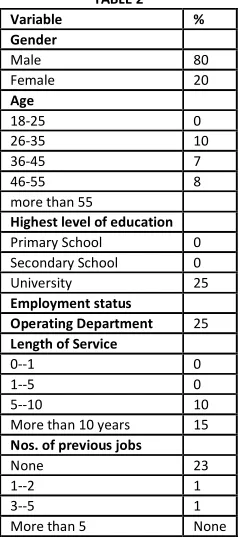
Questionnaire was used to collect information from these executives. The first part of questionnaire examined demographic characteristics of respondents. Fur-ther, the age, gender, employment status, highest level of education, length of service and number of previous jobs were also examined. The resulting statistics are presented in table 2:
TABLE 2 Variable % Gender
Male 80
Female 20
Age
18-25 0
26-35 10
36-45 7
46-55 8
more than 55
Highest level of education
Primary School 0
Secondary School 0
University 25
Employment status
Operating Department 25
Length of Service
0--1 0
1--5 0
5--10 10
More than 10 years 15
Nos. of previous jobs
None 23
1--2 1
3--5 1
More than 5 None
The technical efficiency scores of individual employees were calculated by applying Data Envelopment Analysis model.
V
OLUMEN
O.
8
(2018),
I
SSUEN
O.
08
(A
UGUST)
ISSN
2231-5756
INTERNATIONAL JOURNAL OF RESEARCH IN COMMERCE, IT & MANAGEMENT
almost 85% of the best employee’s performance. Worst employee had technical efficiency score of 2.08, which was only 36% of the employees with the maximum efficiency.
Time that employee spent in the company had a statistically significant impact on his efficiency measure. The longer employee worked in the company, the better his performance (efficiency score) was. Employees have built a relationship with organization over the years; they are more committed, willing to make greater effort than is expected of them. After 10 years of working, however, there has been deterioration in performance, which may be connected with reduced motiva-tion to work after long years spent in the same company. The company should therefore try to motivate such employees, whether with new work tasks or greater
independence. Results are presented in table 3.
TABLE 3
Length of service Mean St.Dev. Min Max Mode Median
0-1 year 0 0,000 0 0 0
1-5 years 0 0,000 1 0 0 0
5-10 years 1,131 0,208 1 1,43 1 1,035
more than 10 years 1,117 0,164 1 1,02 1 1,21
The impact of other demographic characteristics was not statistically significant. The efficiency score has detoriated in average with increasing age, men were on average slightly more efficient than women. Educated workers were slightly more efficient than employees with lower level of educational attainment. An inter-esting finding was that while the executives in Policy, Welfare department were more motivated, happier and more committed than their colleagues in Establish-ment & Administration departEstablish-ment, however technical efficiency did not differ significantly between these groups of employees. So, from the overall perspective, both groups were equally efficient. There was no significant difference among workers with different numbers of previous employment.
CONCLUSION
The objective of this paper was to apply the method of Data Envelopment Analysis in assessing employee performance and using the PAR (Performance Appraisal Report) variables and scores.
Furthermore, it was discovered that the length of service has statistically positive impact on employee performance. This increases their commitment to the organization and they are willing to do more. The performance of the employees who have worked for the company for more than 15 years, were slightly low probably due to reduced work motivation. That is why the management of the organization should motivate them more and reinforce motivation through different HR interventions.
Because of distinct advantages of DEA method over traditional systems of employee performance evaluation it may be recommended that DEA method may be applied in future in THDCIL in conjunction with Performance Management System to better measure efficiency of employees and gain competitive advantage against its sectoral rivals.
REFERENCES
1. Alexouda, G. (2005). A user-friendly marketing decision support system for the product line design using evolutionary algorithms. Decision Support System,
38(4), 495-509.
2. Banker, R. D., Charnes, A., & Cooper, W. W. (1984). Some models for estimating technical and scale inefficiencies in data envelopment analysis. Management
Science, 30(9), 1078-1092.
3. Becker, B. E., Huselid, M. A., & Ulrich, D. (2001). The HR scorecard, linking people, strategy, and performance. Harvard Business School Press: Boston.
4. Cooper, W.W. - Ruiz, J.l. - Sirvent, I. 2009. Selecting Non-zero Weights to Evaluate Effectiveness of Basketball Players with DEA. In European Journal of
Operational Research, vol. 195, 2009, 563-574.
5. Favore, C. and Pappi L., (1995), Technical efficiency and scale efficiency in the Italian banking sector: a non-parametric approach Applied Economics, 27:
349-366
6. Ramanathan, R., 2003. An Introduction to Data Envelopment Analysis: A Tool for Performance Measurement. New Delhi: Sage Publications India Private Ltd.,
2003.
7. Ruiz, J.L. - Pastor, J.T. 2011. Assessing Professional Tennis Players Using Data Envelopment Analysis (DEA). In Journal of Sports Economics, 2011.
8. Sueyoshi, T. - Ohnishi, K. - Kinase, Y. 1999. A Benchmark Approach for Baseball Evaluation. In European Journal of Operational Research, vol. 115, 1999,