New Walsh-Like Non-Linear Phase Orthogonal Codes for
Direct Sequence CDMA Communication
Mr. Abhinav V. Deshpande
Internal Full Time Ph. D. Research Scholar, School of Electronics Engineering (SENSE),Vellore Institute of Technology (VIT), Vellore [email protected]
Abstract —Walsh codes and Gold codes have been used as a spread spectrum codes in Code Division Multiple Access (CDMA) communication because of their ease of generation than the efficiency of these codes. The drawbacks of these codes are that they are limited in number and in their lengths. In this research paper, we relaxed the linear phase requirements of the Walsh code and the new sets of Walsh-like non-linear phase binary orthogonal user codes (transforms) are obtained for the asynchronous and the synchronous spread spectrum multi user communication. We designed the simulink model and performed the algorithm by using MATLAB R 2011 a version in order to obtain this newly proposed Walsh-like code set for the multiuser spread spectrum communication. We compared their performance with the existing codes like the Gold code and the Walsh code families. Our comparisons include their time domain properties like the autocorrelation and the cross correlation along with the bit error rate (BER) performances in the additive white Gaussian noise (AWGN) for the synchronous and asynchronous DS-CDMA communication. We proved that the proposed binary user code family outperforms the Walsh codes significantly and they match in the performance with the popular, nearly orthogonal Gold codes closely for the asynchronous multi user communication in the additive white Gaussian noise (AWGN) channels. We present in this research paper that there are a good number of such desirable code sets which are available in the binary sample space with different transform sizes. These new binary sets with a good performance and flexible code lengths might help us to improve the spread spectrum multiplexing capabilities of future wire line and the wireless CDMA communication systems.
Keywords— Additive White Gaussian Noise (AWGN) Channel; Code Division Multiple Access (CDMA); Gold Sequences; Orthogonal Binary Codes; Walsh Sequences.
1.
Introduction
The binary Walsh codes have been well studied in the literature over the last few decades and found their many popular applications including the multi user wireless communication. The Walsh codes are perfectly orthogonal binary block codes that found their use in many popular applications including the synchronous multi user communication. But they perform poorly for the case of the asynchronous multi user communication due to the poor cross correlation value in between the codes. Therefore, the near orthogonal and non-linear phase Gold codes are the preferred user codes in the asynchronous direct sequence code division multiple access (DS-CDMA) communication standards [3]. The simplicity of their generation and fixed power feature along with the orthogonality property make them a good choice for the synchronous multi user communication. On the other hand, the near orthogonal Gold codes and their extensions are shown to perform superior to the Walsh codes for the asynchronous multi user communication due to their good auto correlation and the cross-correlation properties [5]. All of these binary sequences which are proposed in the literature belong to the binary sample space. Our main focus in this research paper is on the binary valued orthogonal carrier sequences that are spread in the time and the frequency domains. Therefore, they are called as the
spread spectrum user codes in the DS-CDMA communication system.
1.1 Walsh-Hadamard Transform
The Walsh Hadamard Transform (WHT), is defined with its built-in scalability which is given as follows H1 = 1/√2 [1 1 1 -1 ] Eqn. (1) H2N = 1/√2 [HN HN HN -HN]= HN * HN] Eqn. (2) The higher length of the Walsh Code sets are iteratively
generated from the lower length of the Walsh Code sets by using the Kronecker product [1]. These sequences are utilized in the current wireless communication standards such as the IS-95, CDMA 2000, WCDMA as the binary user codes or the multi carrier units [9]. The WHT codes are employed for the downlink (the cell tower to the mobile units) and the Gold Codes are used for the uplink (from the mobile units to the cell tower) communication as a binary carrier.
1.2 Properties of Walsh Hadamard Transform
1.2.1 Property 1
applications where the DC component of a signal is significant in many signal types.
1.2.2 Property 2
The WHT basis functions are the linear phase sequences.
1.2.3 Property 3
The Walsh set has a unique number of zero crossings in the time domain. In a typical NN size WHT matrix, the row indices (I = 0, 1, 2… N- 1) also indicates the numbers of the zero crossings of the corresponding row sequence.
1.2.4 Property 4
Except the DC sequence, the remaining sequences in a Walsh set have a zero mean values. The block transforms have been used for source coding applications where the orthogonality, which is having the DC basis function, and the linear phase features are important requirements for a good performance.
2.
Walsh-Like Transform
The linear phase response is an inherent feature of the orthogonal Walsh sequences, but the spread spectrum CDMA communication does not have such requirement. In addition, the Walsh sets have restricted not to include more than one sequence with the same number of time domain zero crossings. In this research paper, we propose a new, Walsh like binary orthogonal transform with a non-linear phase basis sequence. For that purpose, we relaxed the linear phase property to enlarge the search region within a binary sample space which is having the orthogonal codes with better correlation properties than the Walsh family. We also relaxed the strict condition of having the basis sequences with a unique number of time domain zero crossings in the set. In addition, any of these new sets does not have a DC basis sequence. We performed the brute force searches in the binary sample space in order to obtain some of these new orthogonal sets. The binary sample space for an n-length orthogonal code sets which is generated through a brute force search consists of (2n – 1) integer numbers.
2.1 Brute Force Search Method for a New Walsh-Like Transform Bases
The first basis function in the orthogonal code set is selected by representing an integer number in the sample space as the n-length binary code with the elements [0,1]. Furthermore, [0,1] elements of this binary code are mapped into [-1,1] respectively, in order to generate an n-length spreading code. Select the next basis function by checking
the orthogonality with the first basis function. Repeat the process n – 1 time in order to obtain a complete N×N orthogonal code set. With this search process, a number of orthogonal code sets are formed with the first basis sequence as the common basis sequence for the different orthogonal code sets. By choosing a different integer as the first basis sequence of the set, a number of unique orthogonal sets can be formed. Finally, select the orthogonal code sets that have a minimum cross correlation values among all the pairs of the codes as a performance metric for further analysis [6]. A number of nonlinear phase (Walsh-like) orthogonal code sets are obtained for the lengths that are the multiples of 4 (8, 12, 16, 20…).
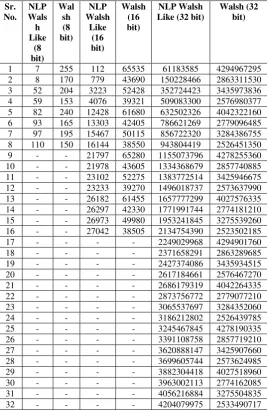
Table 1: Decimal Values of 8, 16, 32 Bits Non-Linear Phase Walsh-Like and Walsh Codes
Sr. No. NLP Wals h Like (8 bit) Wal sh (8 bit) NLP Walsh Like (16 bit) Walsh (16 bit) NLP Walsh Like (32 bit)
Walsh (32 bit)
1 7 255 112 65535 61183585 4294967295 2 8 170 779 43690 150228466 2863311530 3 52 204 3223 52428 352724423 3435973836 4 59 153 4076 39321 509083300 2576980377 5 82 240 12428 61680 632502326 4042322160 6 93 165 13303 42405 786621269 2779096485 7 97 195 15467 50115 856722320 3284386755 8 110 150 16144 38550 943804419 2526451350 9 - - 21797 65280 1155073796 4278255360 10 - - 21978 43605 1334368679 2857740885 11 - - 23102 52275 1383772514 3425946675 12 - - 23233 39270 1496018737 2573637990 13 - - 26182 61455 1657777299 4027576335 14 - - 26297 42330 1771991744 2774181210 15 - - 26973 49980 1953241845 3275539260 16 - - 27042 38505 2134754390 2523502185 17 - - - - 2249029968 4294901760 18 - - - - 2371658291 2863289685 19 - - - - 2427374086 3435934515 20 - - - - 2617184661 2576467270 21 - - - - 2686179319 4042264335 22 - - - - 2873756772 2779077210 23 - - - - 3065537697 3284352060 24 - - - - 3186212802 2526439785 25 - - - - 3245467845 4278190335 26 - - - - 3391108758 2857719210 27 - - - - 3620888147 3425907660 28 - - - - 3699605744 2573624985 29 - - - - 3882304418 4027518960 30 - - - - 3963002113 2774162085 31 - - - - 4056216884 3275504835 32 - - - - 4204079975 2533490717
of the binary sequence samples are replaced by 0 valued bits for this representation. In Section 3, we present the performance of the proposed Walsh-like binary, non-linear phase orthogonal codes. We compared their performance with the popular codes such as the Gold and the Walsh families.
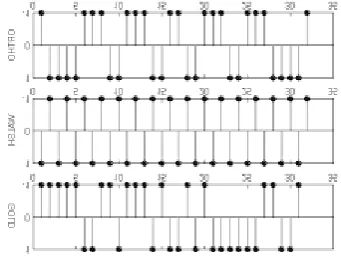
Fig. 1: Typical length Walsh Code, a typical 32-length Proposed Walsh-like (NPOT) Code along with a
typical 31-length Gold Code
This comparison includes their time domain properties like the auto (intra code) and the cross (inter code) correlations, and the Bit Error Rate (BER) performances for the asynchronous multi carrier communication scenarios in the Additive White Gaussian Noise (AWGN). It is shown that the proposed Walsh-like non-linear phase binary orthogonal transform significantly outperforms the Walsh codes, and provides a performance as compared to the Gold codes in an AWGN channels for all performance metrics and the communication scenarios which are considered in this research paper. It is shown that all the code families which were tested tend to perform well as compared with all the channel types when the number of users in the channel is increased.
3.
Performance Comparisons
3.1 Time Frequency and Correlation Properties
A typical 32-bit orthogonal Walsh code, a typical 32 length proposed Walsh-like code, and a 31 length Gold code are displayed in Figure 1. The magnitude and the phase functions of these codes are also shown in Figure 2 (a) and (b) respectively. Note that the sample sequence of the proposed orthogonal codes has more evenly spread frequency spectrum as compared to the sample Walsh code of the same length. Additionally, the proposed Walsh-like and the Gold sequences have a non-linear phase functions while the Walsh sequences are the linear phase functions. For the direct sequence spread spectrum applications, we require a unique coding of different user signals that occupy the same transmission bandwidth in multi access system and the synchronization for the WCDMA system
where there is no global timing [9]. In order to achieve these objectives, the coding sequences require special correlation properties which are referred to as the auto correlation and the cross correlation. The auto correlation and the cross-correlation sequences for the typical codes of three families are being displayed in Figure 3 (a) and Figure 3 (b) respectively. The cross-correlation sequences in between an arbitrary pair of the codes [for a two-user case with the codes xi (n) and xj(n) which are defined as follows:
Rxx(m) = ∑n xi (n) xj (n + m) Eqn. (3)
It is observed from the figure that the Gold and the proposed non-linear phase Walsh-like orthogonal codes have a similar auto correlation (intra code correlation) and cross correlation (inter code correlation) sequences while the sample Walsh pair has worse correlation properties than the others [2,3,4,5,6].
3.2 AWGN Channel Performance
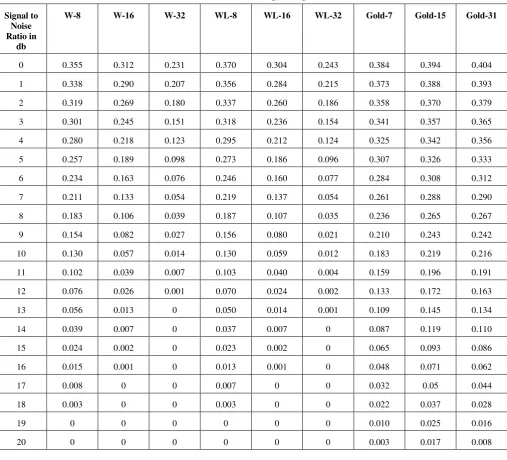
BER curves for the 32-bit Walsh and Walsh-like and 31-bit Gold codes. It is observed from these curves and the table that the proposed non-linear phase Walsh-like orthogonal
code family outperforms the Walsh codes significantly, and its performance closely matches with the Gold codes.
Table 2: BER Values for different Codes for given Signal to Noise Ratio Values
Signal to Noise Ratio in
db
W-8 W-16 W-32 WL-8 WL-16 WL-32 Gold-7 Gold-15 Gold-31
0 0.355 0.312 0.231 0.370 0.304 0.243 0.384 0.394 0.404
1 0.338 0.290 0.207 0.356 0.284 0.215 0.373 0.388 0.393
2 0.319 0.269 0.180 0.337 0.260 0.186 0.358 0.370 0.379
3 0.301 0.245 0.151 0.318 0.236 0.154 0.341 0.357 0.365
4 0.280 0.218 0.123 0.295 0.212 0.124 0.325 0.342 0.356
5 0.257 0.189 0.098 0.273 0.186 0.096 0.307 0.326 0.333
6 0.234 0.163 0.076 0.246 0.160 0.077 0.284 0.308 0.312
7 0.211 0.133 0.054 0.219 0.137 0.054 0.261 0.288 0.290
8 0.183 0.106 0.039 0.187 0.107 0.035 0.236 0.265 0.267
9 0.154 0.082 0.027 0.156 0.080 0.021 0.210 0.243 0.242
10 0.130 0.057 0.014 0.130 0.059 0.012 0.183 0.219 0.216
11 0.102 0.039 0.007 0.103 0.040 0.004 0.159 0.196 0.191
12 0.076 0.026 0.001 0.070 0.024 0.002 0.133 0.172 0.163
13 0.056 0.013 0 0.050 0.014 0.001 0.109 0.145 0.134
14 0.039 0.007 0 0.037 0.007 0 0.087 0.119 0.110
15 0.024 0.002 0 0.023 0.002 0 0.065 0.093 0.086
16 0.015 0.001 0 0.013 0.001 0 0.048 0.071 0.062
17 0.008 0 0 0.007 0 0 0.032 0.05 0.044
18 0.003 0 0 0.003 0 0 0.022 0.037 0.028
19 0 0 0 0 0 0 0.010 0.025 0.016
20 0 0 0 0 0 0 0.003 0.017 0.008
4. Conclusion
In this research paper, we presented that the Walsh codes utilize only a small sub set of the orthogonal binary sample space due to their intrinsic restrictions such as the linear phase zero mean and unique zero crossings. But this is not the requirement of the spread spectrum CDMA communication (we need only the property of orthogonality). The growing demand for the orthogonal, fixed power binary user codes require us to design additional orthogonal codes to be employed in the
the Gold codes might be improved in their next generations by employing these new code sets and others. Additionally, by having a rich library of the binary code sets, with flexible lengths and good performance, will offer further efficiencies and additional information about the security options in the user code level for the wireless communication and the sensor networks.
References
[1] J. L. Walsh, “A Closed Set of Normal Orthogonal Functions”, Amer J. Math, Volume 55, pp. 05-24, 1923.
[2] T. Lang and X. H. Chang, “Comparison of Correlation Parameters of Binary Codes for DS/CDMA Systems”, in the Proceedings of the ICCS, November 1994, pp. 1059-1063.
[3] D. Gerakoulis and S. Ghassemzadeh, “Extended Orthogonal Code Designs with Applications in CDMA”, in the Proceedings of IEEE 6th International Symposium on Spread Spectrum Techniques and
Applications, September 2000, pp. 657-661.
[4] T. K. Woo, “Orthogonal Code Design for Quasi-Synchronous CDMA”, Electronics Letters, Volume 36, No. 19, pp. 1632-1633, September 2000.
[5] C. C. Chen, K. Yao and E. Biglieri, “Optimal Spread Spectrum Sequences Constructed from Gold Codes”, in the Proceedings of the IEEE Globecom, December 2000, pp. 867-871.
[6] A. N. Akansu, “New Binary Codes and their Comparative Bit Performances”, New Jersey Institute of Technology, New York, NJ [online], available: http://www.web.njit.edu/ali/newcodes.html [7] R. Poluri and A. N. Akansu, “New Orthogonal Binary Use Codes for
Multi User Spread Spectrum Communication”, in the Proceedings of the EUSIPCO, Antalya, Turkey, September 2005, Volume 1, pp. 02-04.
[8] John G. Prokis, “Digital Communication”, Tata Mac Graw Hill, 2001.