ISSN 0975-928X
http://sites.google.com/site/ejplantbreeding 629
Research Article
Identifying stable Bt cotton genotypes with superior fibre quality parameters
for irrigated situations
Rajakumar., Nidagundi J. M.*., Kuchanur P.K And Konda C. R.
All India Co-ordinated Cotton Improvement Project, Agricultural Research Station, Adoni Road, Siruguppa – 583 121, Dist. Bellary, Karnataka
*Email: [email protected]
(Received: 01 Nov 2011; Accepted: 29 Feb 2012)
Abstract:
Twenty two Bt cotton hybrids were evaluated for seed cotton yield and fibre quality parameters over three environments viz., Agricultural Research Station, Siruguppa 1), Main Agricultural Research Station, Raichur (E-2) and Agricultural Research Station, Bheemarayanagudi (E-3), during Kharif 2010-11. The seed cotton yield ranged from 1478 to 2203 kg/ha among the Bt cotton hybrids. Pooled data of seed cotton yield revealed that two hybrids viz., MRC 7347 BG II (2203 kg/ha) and ACH 177-2 BG II (2054 kg/ha) recorded numerically superior seed cotton yield over the check, MRC-7351 BG-II (2053 kg/ha). The data on 2.5 per cent span length ranged from 29.2 mm to 33.6 mm, while the fibre strength of the hybrids ranged from 21.7 g/tex to 23.9 g/tex. Fibre fineness or micronaire value ranged from 3.9 to 4.6 µg/inch. None of the hybrids were found to be stable across all the test environments indicating the need to undertake extensive testing of Bt cotton hybrids for recommending region specific hybrids possessing high yielding potential coupled with desirable fibre quality parameters.
Key words: Bt cotton, seed cotton yield, span length, micronaire, fibre strength.
Introduction
Cotton (Gossypium spp.), popularly known as the ‘King of natural fibres, is a global leading fibre crop. India ranks first in global scenario with an acreage of about 20 % of the total world cotton area, but with respect to production, it is ranked second, next only to China. The cotton production increased from 17.9 million bales in 1996-1997 to 29.0 million bales during 2008-2009 (Anonymous, 2009). With fibre quality parameters gaining greater prominence especially the fibre strength with matching staple length, there is a need to identify Bt hybrids which are stable with respect to not only seed cotton yield, but also acceptable fibre strength. Fibre quality can be attributed by set of measurable properties that affect the spinning performance of fibre. Among them, fibre strength, fibre length and fibre fineness are the primary quality parameters that influence the textile processing (Palve, 2009). Therefore the present study was initiated to identify stable and high yielding potential Bt cotton hybrids with desirable fibre properties.
Material and methods
Twenty two Bt cotton hybrids including two checks were grown in a randomized block design with three replications during Kharif 2010 at Agricultural Research Station, Siruguppa (E–1), Main
Agricultural Research Station, Raichur (E-2) and Agricultural Research Station, Bheemarayanagudi (E-3). The net plot consisted of six rows of six meter length. A spacing of 60 and 90 cms within and between the rows respectively was maintained. Recommended dose of fertilizers and need based plant protection measures were carried out for management of sucking pests to ensure a near perfect expression of the genotypes. Seed cotton yield on net plot basis was recorded. First picking of the kapas
was taken from all the test entries and the lint was subjected to fibre quality testing at Central Institute for Research on Cotton Technology, (CIRCOT), Mumbai. Stability analysis was carried out as per standard statistical procedures given by Eberhart and Russell (1966).
Results and discussion
http://sites.google.com/site/ejplantbreeding 630 presented in Tables 2 and 3. All the characters viz.,
seed cotton yield (1478 to 2203 kg/ha), lint yield (496 to 738 kg/ha), ginning out-turn (32.9 to 36.9%), 2.5 % span length (29.2 to 33.6 mm), micronaire (3.9 to 4.6 µg/inch) and fibre strength (21.7 to 23.9 g/tex) exhibited wide variability.
Seed cotton and lint yield: For seed cotton yield and lint yield, the mean and two stability parameters, viz.,
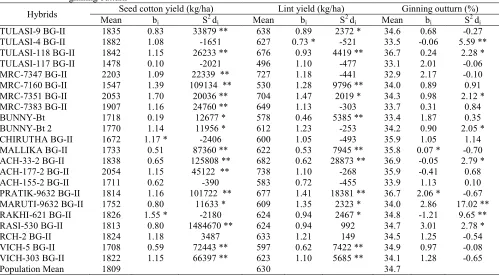
regression coefficient (bi) and deviation from regression (S2di) revealed significant variation among Bt cotton hybrids ranging from 1478 to 2203 kg/ha and 496 to 738 kg/ha respectively (Table 2). One of the test hybrids (MRC-7347 BG-II) out yielded the best check. For seed cotton yield, hybrids Tulasi-4BG-II, RCH-2 BG-II, ACH-155-2 BG-II and Tulasi-177-2 BG-II (Fig. 1 a and b) were found to be stable for seed cotton yield while the hybrids ACH-177-2 BG-II and MRC-7347 BG-II were found to be stable for lint yield as seen from their regression (bi) values which were nearer to unity and with least deviation from regression values (S2di).
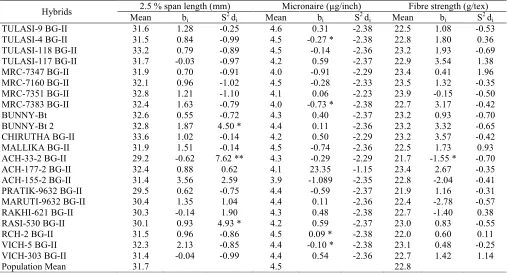
Fibre quality parameters: The span length ranged from 29.2 to 33.6 mm (Table 3) among the Bt cotton hybrids. The hybrid, Chirutha BG-II, (33.6 mm) followed by Tulasi-118 BG-II (33.2 mm) and MRC-7351 BG-II (32.8 mm) recorded higher 2.5 per cent span length compared to checks. And these hybrids exhibited regression (bi) values of near or equal to one and non significant (S2di) values, suggesting that these hybrids were stable for this particular trait.
Micronaire value ranged from fine (3.9 µg/inch) to medium course (4.6 µg/inch). ACH-155-2 BG-II followed by Tulasi-9 BG-II recorded fine and medium micronaire values respectively. Seventeen of the test hybrids recorded higher micronaire values compared to both the checks, MRC-7351 BG-II and ACH-155-2 BG-II, thereby exhibiting coarseness of the fibres.
Fibre strength of the Bt cotton hybrids ranged from 21.7 to 23.9 g/tex. The hybrid MRC-7351 BG-II (23.9 g/tex) recorded the highest fibre strength followed by MRC-7160 BG-II (23.5 g/tex) and Bunny Bt (23.2 g/tex). None of the hybrids recorded higher fibre strength over check MRC-7351 BG-II. Among all the Bt cotton hybrids, Tulasi-9 BG-II,MRC-7160 BG-II, MRC-7347 BG-II, Bunny Bt, Rasi-530 BG-II, and VICH-5BG-II had fibre strength (>22 g/tex) and regression (bi) values near to unity and non significant (S2di) values (Fig 2 a and b), thereby indicating that these hybrids were stable for this particular trait.
In conclusion, the hybrid MRC-7347 BG-II was found to be the best hybrid with respect to both seed cotton yield and fibre strength, exhibiting near better stability for these two important traits. The study further revealed that none of the hybrids were stable for all characters studied. So Multi-seasonal and multi-location testing of these hybrids is required for recommending suitable hybrids for cultivation for different agro-ecological situations.
References
Anonymous, 2009. Annual report of All India Co-ordinated Cotton Improvement Project. Central Institute of Cotton Research, Regional Station, Coimbatore. pp. A-5. Eberhart, S.A. and Russell, W.A. 1966. Stability
parameters for comparing varieties. Crop Sci. , 6: 36-40.
Nizam, J. R., Shroff, V. N., Patel, V. G. and Dabholkar, A. R. 1988. Phenotypic stability of single and three way cross hybrids of cotton with respect to their yield and yield components. J. Indian Soc. Cotton Improv.,
13: 118-123
Palve, S. M. 2009. Heterosis and combining ability for fibre properties in upland cotton. Indian J. Agric. Sci., 79:732-34.
Shinde, Y. M., Thombre, M. V. and Patel, F. 1987. Relationship between genetic make up and phenotypic stability in cotton (G. hirsutum
L.). Indian J. Genet., 47: 189-194.
ISSN 0975-928X
http://sites.google.com/site/ejplantbreeding
631 Table 1. Pooled ANOVA for stability of seed cotton yield, its component characters and fibre
quality parameters in Bt cotton hybrids
Source of variations d. f. Mean sum of squares
Seed cotton yield (kg/ha)
Lint yield (kg/ha)
Ginning outturn
(%)
2.5 % span length
(mm)
Micronaire (µg/inch)
Fibre strength
(g/tex)
Rep within Env. 6 2106 761 1.09 0.56 2.64 ** 2.75 **
Varieties 21 75505 9997 * 4.24 3.98 * 2.05 ** 0.86
Env.+ (Var.* Env.) 44 208110 ** 31008 ** 6.97 * 1.90 2.22 ** 0.62
Environments 2 3664942 ** 582610 ** 60.11 ** 14.27 ** 1.91 ** 1.63
Var.* Env. 42 43498 4737 4.44 1.31 2.24 ** 0.57
Environments (Lin.) 1 7329883 ** 1165381 ** 120.22 ** 28.54 ** 3.83 ** 3.26 *
Var.* Env.(Lin.) 21 40907 4395 6.00 * 0.99 4.38 ** 0.47
Pooled Deviation 22 43995 ** 4848 ** 2.75 ** 1.55 0.09 0.65
Pooled Error 126 2428 518 0.67 1.03 2.37 0.60
Total 65 165268 24219 6.09 2.58 2.16 0.70
Table 2 . Estimates of stability parameters for individual genotypes with respect to seed cotton yield, lint yield and ginning outturn
Hybrids Seed cotton yield (kg/ha) Lint yield (kg/ha) Ginning outturn (%)
Mean bi S2 di Mean bi S2 di Mean bi S2 di
TULASI-9 BG-II 1835 0.83 33879 ** 638 0.89 2372 * 34.6 0.68 -0.27
TULASI-4 BG-II 1882 1.08 -1651 627 0.73 * -521 33.5 -0.06 5.59 **
TULASI-118 BG-II 1842 1.15 26233 ** 676 0.93 4419 ** 36.7 0.24 2.28 *
TULASI-117 BG-II 1478 0.10 -2021 496 1.10 -477 33.1 2.01 -0.06
MRC-7347 BG-II 2203 1.09 22339 ** 727 1.18 -441 32.9 2.17 -0.10
MRC-7160 BG-II 1547 1.39 109134 ** 530 1.28 9796 ** 34.0 0.89 0.91
MRC-7351 BG-II 2053 1.70 20036 ** 704 1.47 2019 * 34.3 0.98 2.12 *
MRC-7383 BG-II 1907 1.16 24760 ** 649 1.13 -303 33.7 0.31 0.84
BUNNY-Bt 1718 0.19 12677 * 578 0.46 5385 ** 33.4 1.87 0.35
BUNNY-Bt 2 1770 1.14 11956 * 612 1.23 -253 34.2 0.90 2.05 *
CHIRUTHA BG-II 1672 1.17 * -2406 600 1.05 -493 35.9 1.05 1.14
MALLIKA BG-II 1733 0.51 87360 ** 622 0.53 7945 ** 35.8 0.07 * -0.70
ACH-33-2 BG-II 1838 0.65 125808 ** 682 0.62 28873 ** 36.9 -0.05 2.79 *
ACH-177-2 BG-II 2054 1.15 45122 ** 738 1.10 -268 35.9 -0.41 0.68
ACH-155-2 BG-II 1711 0.62 -390 583 0.72 -455 33.9 1.13 0.10
PRATIK-9632 BG-II 1814 1.16 101722 ** 677 1.41 18381 ** 36.7 2.06 * -0.67
MARUTI-9632 BG-II 1752 0.80 11633 * 609 1.35 2323 * 34.0 2.86 17.02 **
RAKHI-621 BG-II 1826 1.55 * -2180 624 0.94 2467 * 34.8 -1.21 9.65 **
RASI-530 BG-II 1813 0.80 1484670 ** 624 0.94 992 34.7 3.01 2.78 *
RCH-2 BG-II 1824 1.18 3487 633 1.21 149 34.5 1.25 -0.54
VICH-5 BG-II 1708 0.59 72443 ** 597 0.62 7422 ** 34.9 0.97 -0.08
VICH-303 BG-II 1822 1.15 66397 ** 623 1.10 5685 ** 34.1 1.28 -0.65
http://sites.google.com/site/ejplantbreeding
632 Table 3. Estimates of stability parameters for individual genotypes with respect to 2.5 % span length, micronaire
and fibre strength
Hybrids 2.5 % span length (mm) Micronaire (µg/inch) Fibre strength (g/tex)
Mean bi S2 di Mean bi S2 di Mean bi S2 di
TULASI-9 BG-II 31.6 1.28 -0.25 4.6 0.31 -2.38 22.5 1.08 -0.53
TULASI-4 BG-II 31.5 0.84 -0.99 4.5 -0.27 * -2.38 22.8 1.80 0.36
TULASI-118 BG-II 33.2 0.79 -0.89 4.5 -0.14 -2.36 23.2 1.93 -0.69
TULASI-117 BG-II 31.7 -0.03 -0.97 4.2 0.59 -2.37 22.9 3.54 1.38
MRC-7347 BG-II 31.9 0.70 -0.91 4.0 -0.91 -2.29 23.4 0.41 1.96
MRC-7160 BG-II 32.1 0.96 -1.02 4.5 -0.28 -2.33 23.5 1.32 -0.35
MRC-7351 BG-II 32.8 1.21 -1.10 4.1 0.06 -2.23 23.9 -0.15 -0.50
MRC-7383 BG-II 32.4 1.63 -0.79 4.0 -0.73 * -2.38 22.7 3.17 -0.42
BUNNY-Bt 32.6 0.55 -0.72 4.3 0.40 -2.37 23.2 0.93 -0.70
BUNNY-Bt 2 32.8 1.87 4.50 * 4.4 0.11 -2.36 23.2 3.32 -0.65
CHIRUTHA BG-II 33.6 1.02 -0.14 4.2 0.50 -2.29 23.2 3.57 -0.42
MALLIKA BG-II 31.9 1.51 -0.14 4.5 -0.74 -2.36 22.5 1.73 0.93
ACH-33-2 BG-II 29.2 -0.62 7.62 ** 4.3 -0.29 -2.29 21.7 -1.55 * -0.70
ACH-177-2 BG-II 32.4 0.88 0.62 4.1 23.35 -1.15 23.4 2.67 -0.35
ACH-155-2 BG-II 31.4 3.56 2.59 3.9 -1.089 -2.35 22.8 -2.04 -0.41
PRATIK-9632 BG-II 29.5 0.62 -0.75 4.4 -0.59 -2.37 21.9 1.16 -0.31
MARUTI-9632 BG-II 30.4 1.35 1.04 4.4 0.11 -2.36 22.4 -2.78 -0.57
RAKHI-621 BG-II 30.3 -0.14 1.90 4.3 0.48 -2.38 22.7 -1.40 0.38
RASI-530 BG-II 30.1 0.93 4.93 * 4.2 0.59 -2.37 23.0 0.83 -0.55
RCH-2 BG-II 31.5 0.96 -0.86 4.5 0.09 * -2.38 22.0 0.60 0.11
VICH-5 BG-II 32.3 2.13 -0.85 4.4 -0.10 * -2.38 23.1 0.48 -0.25
VICH-303 BG-II 31.4 -0.04 -0.99 4.4 0.54 -2.36 22.7 1.42 1.14
Population Mean 31.7 4.5 22.8
Fig. 1a. Mean and regression coefficient (bi) of Bt cotton hybrids for seed cotton yield (kg/ha)
Legend Hybrids
A/1 TULASI-9 BG-II B/2 TULASI-4 BG-II C/3 TULASI-118 BG-II D/4 TULASI-117 BG-II E/5 MRC-7347 BG-II F/6 MRC-7160 BG-II G/7 MRC-7351 BG-II H/8 MRC-7383 BG-II
ISSN 0975-928X
http://sites.google.com/site/ejplantbreeding
633 Fig. 1b. Regression coefficient (bi), deviation from regression (S2di) and mean of Bt cotton hybrids for seed
cotton yield (kg/ha)
Fig 2a.Mean and regression coefficient (bi) of Bt cotton hybrids for fibre strength (g/tex)
Fig. 2b. Regression coefficient (bi), deviation from regression (S2di) and mean of Bt cotton hybrids for fibre strength (g/tex)
Legend Hybrids
A/1 TULASI-9 BG-II B/2 TULASI-4 BG-II C/3 TULASI-118 BG-II D/4 TULASI-117 BG-II E/5 MRC-7347 BG-II F/6 MRC-7160 BG-II G/7 MRC-7351 BG-II H/8 MRC-7383 BG-II