ISSN 1392-2785 ENGINEERING ECONOMICS. 2007. No 5 (55) WORK HUMANISM
Human Resource Training Evaluation
Vilmantė Kumpikaitė
Kauno tachnologijos universitetas K. Donelaičio g. 73, LT-44029, Kaunas
This paper draws on prior research on human re-source training evaluation, including its models, criteria, tangible and intangible benefits of training and return on investment.
Human resource management (HRM) is the recogni-tion of the importance of an organizarecogni-tion’s workforce as vital human resources contributing to the goals of the organization, and the utilization of several functions and activities to ensure that they are used effectively and fairly for the benefit of the individual, the organization, and society. Today human resource management has a unique and timely opportunity to improve productivity. Increasingly, however, improving productivity does not mean just increasing output. In addition, evaluation en-sures that programs are accountable and are meeting the particular needs of employees in a cost-effective manner. This is especially important today, as organizations at-tempt to cut costs and improve quality in their firms. Without evaluation, it is very difficult to show that train-ing was the reason for any improvements. Human re-source training may safeguard productivity as well as supporting it, insulating firms from skills shortages by preparing employees for current and future jobs.
Evaluation involves identifying the appropriate out-comes to measure. The outout-comes used in evaluating training programs include trainees’ satisfaction with the training program, learning of knowledge or skills, use of knowledge and skills on the job, and results such as sales, productivity, or accident prevention. Evaluation may also involve comparing the costs of training to the benefits received (return on investment). Outcomes used in train-ing evaluation help to determine the degree to which the program resulted in both learning and transfer of train-ing.
Training evaluation provides a way to understand the investments that training produces and provides informa-tion needed to improve training. If the company receives an inadequate return on ist investment in training, the company will likely reduce its investment in training or look for training providers outside the company who can provide training experiences that improve performance, productivity, customer satisfaction, or whatever other outcomes the company is interested in achieving. Train-ing evaluation provides the data needed to demonstrate that training does provide benefits to the company.
This paper is organized as follows. First the pur-pose of human resource training evaluation is shown. Next, analysis of human resource training evaluation models is provided. Third, human resource training’s evaluation process is shown. Fourth and fifth, evaluating
of human resource training costs and returns of invest-ments are discussed. Sixth hard and soft data in training evaluation is described. Later, costs of training in Lithuanian companies are demonstrated. Finally, conclu-sions of this paper are given.
Keywords: Human resource training, human resource training evaluation, human resource training costs, returns on investment.
Introduction
During the last decade, the Human Resources (HR) function experienced drastic change in its role, status and influence (De Cieri and Kramar, 2005; Grugulis, 2006 et al). Several factors, such as theoretical developments, societal and workforce demographic changes, increasing importance of management strategy, and decline in trade union pressure and economic influences contributed to the rise of HRM as an organizational function (Roger and Wright, 1998; Yeung and Berman, 1997).
HRM recognises the importance of people in relation to financial and physical resources. Since human resource represents a significant cost to organization, the effec-tiveness of function can influence the overall success or failure of organization. Indeed, some organizations have failed because of ineffective HR policies.
Today human resource management has a unique and timely opportunity to improve productivity. Increasingly, however, improving productivity does not mean just in-creasing output. In addition, evaluation ensures that pro-grams are accountable and are meeting the particular needs of employees in a cost-effective manner. This is especially important today, as organizations attempt to cut costs and improve quality in their firms. Without evaluation, it is very difficult to show that training was the reason for any improvements. Human resource train-ing may safeguard productivity as well as supporttrain-ing it, insulating firms from skills shortages by preparing em-ployees for current and future jobs.
Human resource evaluation problems are researched in the world by Kirkpatrick (1994), Kraiger, Ford and Salas (1993), Holton (1996), Phillips (1996) and others. Kumpikaite (2005; 2007) and Sakalas (1996) study this very important but quite new field in Lithuania.
with performance management programs to 232 compa-nies without programs. The compacompa-nies with these pro-grams posted higher profits, better cash flows, stronger stock market performance and higher stock values. These results show us the importance of human resource train-ing evaluation importance and necessity. While most companies recognize the importance of evaluation, few actually evaluate their training programs.
When evaluating the HR function it is important to examine how companies enable the workforce to develop its full potential. In doing so, it is important to ask com-panies to describe their approach and proof of positive results in five categories:
1. HR planning and management. 2. Employee involvement.
3. Employee training and development. 4. Employee performance and recognition. 5. Employee well-being and satisfaction.
In this paper we will pay attention to one of these components – human resource training and development evaluation aspects.
The purpose of this study is to explore human re-source training and return on Investment of training proc-ess.
Methods of the research - analysis and synthesis of scientific literature, logical analysis and empirical re-search covering 12 organizations of Lithuania.
The purpose of Human Resource Training
Evaluation
Training and development has positive impact on the individual, the organization and the nation (Smith, 1992). Human resource evaluation is defined as “systematic collection of descriptive and judgmental information nec-essary to make effective training decisions related to the selection, adoption, value, and modification of various instructional activities” (DeSimone et al, 2003). This definition makes several important points:
First, when conducting an evaluation, both de-scriptive and judgmental information may be col-lected. And these both are needed in human re-source development (HRD) evaluation. Some of the judgments are made by those involved in the program, and others are made by those not in-volved in the program.
Second, evaluation also involves the systematic collection of information according to a predeter-mined plan or method to ensure that the informa-tion is appropriate and useful.
Finally, evaluation is conducted to help managers, employees, and HRD professionals make informed decisions about particular programs and methods. For example, if part or a program is ineffective, it may need to be changed or discarded. Or, if a cer-tain program valuable, it may be replicated in other parts of the organization.
Evaluation begins with a clear identification of the purpose or results expected from the training programs. By focusing on the purpose and results evaluators are
guides to the reasons that the training program has been developed and the changes and improvements in learner performance that should result from training. It would be expected that training programs are based on important organizational goals and improvement efforts. However, that connection must be directly guiding training efforts if training results are to be linked to organizational meas-ures (Burrow and Berardinelli, 2003).
Evaluation can serve a number of purposes within the organization. According to Philips (1983), evaluation can help to do the following:
Determine whether a program is accomplishing its objectives.
Identify the strengths and weaknesses of HRD programs.
Determine the cost-benefit ratio of an HRD pro-gram.
Decide who should participate in future HRD pro-grams.
Identify which participants benefited the most or least from the program.
Reinforce major points to be made to the partici-pants.
Gather data to assist in marketing future programs. Determine if the program was appropriate. Establish a database to assist management in
mak-ing decisions.
Human Resource Training Evaluation Models
A model of evaluation outlines the criteria for and focuses of the evaluation effort. Because an HRD pro-gram can be examined from a number of perspectives, it is important to specify which perspectives will be consid-ered.Table 1 lists nine frameworks of HRD evaluation that have been suggested by DeSimone et al (2003). By far, the most widely used evaluation approach to date has been the framework laid out by Kirkpatrick (1994) (De-Simone et al, 2003; Elwood 1996).
In the human resource department it is expedient to try to be efficient and productive while designing and delivering quality products and services.
Many HR programs are designed to improve produc-tivity or performance. Training, compensation, motiva-tion programs, employee relamotiva-tions practices, and organi-zation development usually focus on performance im-provement. A combined strategy must coordinate all the elements of human resource management.
One of the goals of translating the effects of training and HRD programs into monetary terms is to make clear that the programs are investments and as such will lead to payoffs for the organization in the future. Although many managers and supervisors pay lip service to this idea, they often see HRD and other HR interventions primarily as costs – exemplified by the fact that HR programs are often the first programs to be cut when financial and eco-nomic pressures force the organization to reduce its ex-penses.
Table 1
Human resource training evaluation models/frameworks (DeSimone et al, 2003)
Model/ Framework Training evaluation criteria
1. Kirkpatrick (1994) Four levels: Reaction, Learn-ing, Job Behaviour, and Re-sults
2. CIPP (Galvin, 1993) Four levels: Context, Input, Process, and Product
3. CIRO (Warr et al., 1970) Context, Input, Reaction, and Outcome
4. Brinkerhoff (1987)
Six stages: Goal Setting, Program Design, Program Implementation, Immediate Outcomes, Intermediate or Usage Outcomes, and Im-pacts and Worth
5. Systems approach (Bush-nell, 1990)
Four sets of activities: Inputs, Process, Outputs, and Out-comes
6. Kraiger, Ford and Salas (1993)
A classification scheme that specifies three categories of learning outcomes (cognitive, skill – based, affective) sug-gested by the literature and proposes evaluation measures appropriate for each category of outcomes
7. Kaufman and Keller (1994)
Five levels: Enabling and Reaction, Acquisition, Appli-cation, Organizational Out-puts, and Societal Outcomes
8. Holton (1996)
Identifies five categories of variables and the relation-ships among them: Secondary Influences, Motivation ments, Environmental Ele-ments, Outcomes, Ability/ Enabling Elements
9. Phillips (1996)
Five levels: Reaction and Planned Action, Learning, Applied Learning on the Job, Business Results, Return on Investment
It has been always argued that HR programs are dif-ficult to assess in financial terms, but the evaluation of training costs and utility analysis are two practical op-tions to help the HRD professional determine the finan-cial impact of various programs.
The Evaluation Process
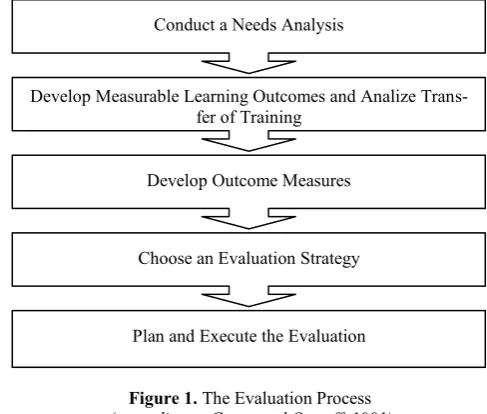
Training evaluation involves scrutinizing the program both before and after the program is completed. Figure 1 emphasizes that training evaluation be considered by managers and trainers before training has actually oc-curred.
The evaluation process should begin with determin-ing traindetermin-ing needs. Needs assessment helps identify what knowledge, skills, behaviour, or other learned capabilities are needed. Once the learned capabilities are identified, the next step in the process is to identify specific, meas-urable training objectives to guide the program. The more specific and measurable these objectives are, the easier it is to identify relevant outcomes for the evaluation. Analysis of the work environment to determine transfer of training is also useful for determining how training content will be used on the job. Based on the learning objectives and analysis of transfer of training, outcome measures are designed to assess the extent to which learn-ing and transfer have occurred. Once the outcomes are identified, the next step is to determine an evaluation strategy. Factors such as expertise, how quickly the in-formation is needed, change potential, and the organiza-tional culture should be considered in choosing a design. Planning and executing the evaluation involves preview-ing the program (formative evaluation) as well as collect-ing traincollect-ing outcomes accordcollect-ing to the evaluation design. The results of the evaluation are used to modify, market, or gain additional support for the program. Finally is the examination of each aspect of the evaluation process, starting with the development of outcome measures.
Figure 1. The Evaluation Process
(according to Grove and Ostroff, 1991)
Evaluation of human resource training costs is dis-cussed in the next chapter.
Evaluation of Human Resource Training Costs
Evaluation of training costs compares the costs in-curred in conducting and HRD program to the benefits received by the organization, and can involve two catego-ries of activities: benefit evaluation and cost-effectiveness evaluation. Cost-benefit analysis involvesConduct a Needs Analysis
Develop Measurable Learning Outcomes and Analize Trans-fer of Training
Develop Outcome Measures
Choose an Evaluation Strategy
comparing the monetary costs of training to the benefits received in non-monetary terms, like improvements in attitudes, safety, and health. Cost-effectiveness analysis focuses on the financial benefits accrued from training, such as increases in quality and profits, and reduction in waste and processing time. (DeSimone et al, 2003).
Modern financial methods (Usry, Hammer, Matz, 1988; Williams, 1994; Ganske, 1996) require very high work input, which is unjustifiable with respect of expedi-ency. The model of cost effectiveness offered by Cullen et al. (1978), can be very helpful in evaluating the costs of training. This model distinguishes between structured and unstructured training, and it lists possible training costs (e.g., the cost of developing the training, materials, time, and production losses) and benefits (improvements in time to reach job competency, job performance, and work attitudes).
Robinson and Robinson (1989) have developed a similar model, dividing training costs into five categories: direct costs, indirect costs, developments costs, overhead costs, and compensation for participants. Direct costs include salaries and benefits for all employees involved in training, including trainees, instructors, consultants, and employees who design the program; program mate-rial and suppliers; equipment or classroom rentals or pur-chases; and travel costs. Indirect costs are not related di-rectly to the design, development, or delivery of the train-ing program. They include general office supplies, facili-ties, equipment, and related expenses; travel and ex-penses not directly billed to one program; training de-partment management and staff salaries not related to any one program; and administrative and staff support sala-ries (Noe, 2005). All these training costs are then com-pared to benefits as measured by improvements in opera-tional indicators, such as job performance, quality, and work attitudes. Benefits are the value that the company gains from the training program.
The Return of Investment
Return of investment (ROI) refers to comparing the training’s monetary benefits with the cost of training. Training costs can be direct and indirect. Direct costs include salaries and benefits for all employees involved in training, including trainees, instructors, consultants, and employees who design the program material and sup-plies; equipment or classroom rentals or purchases; and travel costs. Indirect costs are not related directly to the design, development, or delivery of the training program. They include general office supplies, facilities, equip-ment, and related expenses; travel and expenses not di-rectly billed to one program; training department man-agement and staff salaries not related to any one program; and administrative and staff support salaries. Benefits are the value that the company gains from the training pro-gram.
Therefore the general strategy for evaluating training costs is to measure cost and benefit indicators in monetary terms and then compare them. For example the return on investment (ROI) is calculated using the program benefits and costs, where the benefit/cost ratio is the program bene-fits divided by the cost (Chmielievski and Phillips, 2002;
DeSimone et al, 2003). In formula form (1), it is:
ROI = Program Benefits/Program Costs (1)
The return-on-investment uses the net benefits di-vided by program costs. The net benefits are the program benefits minus the costs. In formula from (2), the ROI becomes:
ROI (%) =Net Program Benefits / Program costs x 10 (2)
This is the same basic formula used in evaluating other investment where the ROI is traditionally reported as earnings divided by investment.
Usually the greater the ratio of results to costs shows the greater the benefit the organization received by con-ducting the training program. Many people think that training of any sort will benefit the company. This as-sumption is just not true (Blanchard and Thacker, 2004). If ratio is less then 100 percent, than the program costs more than it returns to the organization. Such programs either need to be modified or dropped. When a training program is developed without using the training process, disaster usually follows. Such a program is likely to be unrelated to the needs of the company employees being trained, or both. When training is not designed to address a specific performance improvement opportunity, em-ployees tend to discount its relevance and few changes will be seen in their performance. Likewise, companies quickly tire of training that cannot demonstrate its incre-mental value over its cost.
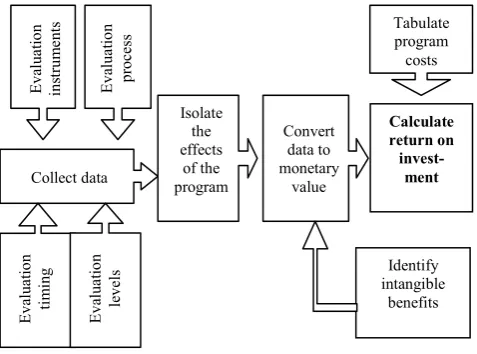
Therefore it should be noted here that the ROI from some programs can be quite high. For example, in many training scenarios, the ROI can be quite large, frequently more than 100 percent, while the ROI value for personnel systems may be lower. Positive benefits that cannot be quantified are referred to as intangible benefits. At times there may be some noneconomic or legally mandated reason to continue a certain training program; even here, however, if the ROI for this program is negative, some rethinking or reworking of the program is likely in order. (Chmielievski and Phillips, 2002; DeSimone et al, 2003). Figure 2 provides ROI process model according to Chmielewski and Phillips (2002).
Figure 2. ROI Process Model
(according to Chmielewski and Phillips, 2002) Calculate return on
invest-ment
Identify intangible
benefits
Ev
al
ua
tio
n
pr
oc
ess
Collect data
Ev
al
ua
tio
n
ti
m
in
g
Ev
al
ua
tio
n
le
ve
ls
Isolate the effects
of the program
Convert data to monetary
value
Tabulate program costs
Ev
al
ua
tio
n
in
st
ru
m
en
ROI analysis is not appropriate for all training pro-grams. Training programs best suited for ROI analysis have clearly identified outcomes, are not a one-time events, are highly visible in the company, are strategi-cally focused, and have effects that can be isolated (Worthen, 2001). For training programs that focus on soft outcomes (e.g., attitudes, interpersonal skills), it may be more difficult to estimate the value.
Hard and Soft Data in Training Evaluation
Traditionally, business people talk about two types of data: hard and soft. Hard data deal with objective, quanti-fiable factors. Soft data deal with subjective, qualitative factors. Businesses tend to values hard data because they are less equivocal. In contrast, soft data can mean about what anyone wants them to mean.Table 2
Strategies to Convert Data to Monetary Values in ROI Evaluation
Unit of Data Type of Conversion
Output data
Data is converted to profit contribu-tion or cost savings.
Output increases are converted to monetary value based on their contri-bution to profit or cost reduction.
Quality data The cost of quality is calculated and quality improvements are directly converted to cost savings.
Time data
For programs where employee time is saved, wages and benefits are used for the value of time;
Since many programs focus on im-proving the time required to complete projects, processes, or daily activities, the value of time is important to con-sider.
Organizational cost data
Historical costs and current records are used when available for a specific variable.
Organizational cost data are utilized to establish the specific value of an im-provement.
Estimate of value
When available, internal and external experts may be used to estimate a value for an improvement.
The credibility of the estimate hinges on the expertise and reputation of the individual.
Estimate of costs
External databases are sometimes available to estimate the value or cost of data items.
Government, industry, and research databases can provide important in-formation for these values.
All hard data such as output, quality, and time are easily converted. Chmielewski and Phillips (2002) pro-vide strategies to convert data to monetary values in a ROI evaluation (Table 2). It is noted, that it is not very
difficult to analyse HR training works, but their perform-ance results, efficiency are expressed more heavily. It is quite difficult to assess them by quantitative indicators (time minutes, quantity units). HR training undoubtedly influences general financial results, however its effect is more expressed not through economic but through social efficiency, in which two main measures are distin-guished: work focus and focus on the relations with other people (Hentze, Kammel, Lindert 1997; Witte 1995).
The conversion of soft data is attempted for each data item. However, if the process used for conversion is too subjective or inaccurate, and the resulting values lose credibility in the process, the data are listed as an intangi-ble benefit with the appropriate explanation. Human re-source has no choice but to also emphasize hard data.
Other data items are identified which are not con-verted to monetary values. These intangible benefits in-clude items, such as increased job satisfaction, increased organizational commitment, improved teamwork, im-proved customer service, reduced complaints, and re-duced conflicts. During data analysis, every attempt is trying to convert all data to monetary values.
For some programs, intangible, nonmonetary benefits are extremely valuable, often carrying as much influence as the hard data items. This is particularly true in the government system, which for years was not responsible for accountability. Now, the old way of doing business has been replaced by accountability. Thus, although in-tangible benefits may be extremely important, it is often difficult to use only intangible benefits as justification for a program. Since intangible benefits are subjective, they are often jeopardized by different interpretations. In these cases, ROI analysis provides objective data that is far more impenetrable to criticism.
Through the two focuses the fluctuations defined by individual factors are expressed. This precludes evaluat-ing of benefit created by HR trainevaluat-ing. In addition the re-form going in the world and the country changes values priorities, forms and distributes new orientations, forms new needs and new possibilities for their meeting, this even more impede reliable forecast of the expected activ-ity results, and this in its turn affects evaluation of HR development (Kumpikaite, Sakalas, 2005).
Traditional and modern financial methods of effi-ciency evaluation are difficult applicable in the field of HR training evaluation to evaluate soft data, they require very high labour costs, which are unjustifiable with re-spect of expediency. They can be used as an auxiliary dimension, when evaluating HR maintenance of training results etc. It is stated that financial methods, therefore the most attention should be paid to the soft data and qualitative evaluation methods.
spent for one person per year in analyzed companies is 432 Lt. Average for training time for one person is 13 days per year in researched companies. The minimum time is 5 days and the maximum time is even 62 days for the person. The company spending the most time for training is the centre of training so it explains such big difference in time. Total situation tells us that in different organizations attention to training is different and ex-penses and time for training are very different too.
0 200 400 600 800 1000 1200 1400 1600 1800 2000
1 2 3 4 5 6 7 8 9 10 11 12 Companies
Lt
0 10 20 30 40 50 60 70
D
a
y
s
Money for training for one person, Lt/year
Days of training for one person per year
Figure 3. Expenses for Training in Lithuanian Companies
Table 3 gives us information about the size of com-panies, investment for training for one person in Litas per year and percent of training costs in total organizational costs. 3 of 12 organizations do not calculate (or only did not provide such information) costs of training in total organizational costs. And other organizations spend from 0.01 to 10 percent for training of all costs.
Table 3
Costs of Training in Lithuanian Organizations
Number of employees in
organization
Money for training for one person,
Lt/year
Percent of training costs in
total costs
10 1000 0.01
12 100 1
15 480 0.1
16 300 10
60 148.46 0.21
79 327.2 0.4
92 120 0.1
103 60 There is no calculation
240 100 5
300 300 There is no calculation
1300 2000 There is no calculation
3801 253 0.17
Week correlation (0.17) dependence was set between the size of organization and amount of money spending for training. Thus bigger organizations spend a little bit much money for training than small companies. Also week negative dependence (- 0.178) was defined between the number of employees in organization and percent of training costs in total costs. Percent of costs in total or-ganizational costs are less in companies which spend more money for one person for training (correlation is - 0.186). Such small research is insufficient to describe full picture of training costs and links between different com-ponents in Lithuania. To research this dependence more companies of different size should be explored. Accord-ing to this research we can say that situation of trainAccord-ing and its costs in different organizations are different. In order to see more detailed picture more research should be provided. Depending on kind of activity, efficiency, size and profitability of organizations should be analyzed and only then we could know actual situation of training costs in Lithuanian organizations.
Conclusions
Human resource evaluation provides information used to determine training effectiveness. Training as-sessment can be done by evaluating training costs using cost-benefit or cost-effectiveness analysis or by translat-ing a trained employee’s productivity into monetary terms through utility analysis.
Evaluation also involves choosing the appropriate de-sign to maximize the confidence that can be placed in the results. The design is based on a careful analysis of how to minimize threats to internal and external validity as well as the purpose, expertise, and other company and training characteristics. The types of designs used for evaluation vary on the basis of whether they include pre-training and post-pre-training measures of outcomes and training and a comparison group.
Human resource training benefits can be tangible and intangible getting from hard and soft data. Financial methods in the field of the human resource training evaluation are difficult applicable to soft data and there-fore much more attention should be paid to qualitative evaluation methods.
The important point is that ROI calculations can be developed reliably and accurately for almost any type of HR program. To do so, the ROI process must be ap-proached with careful planning, methodological proce-dures, as well as logical and practical analyses.
References
1. Baldwin, T.T. Transfer of training: A review and directions for future research / T.T Baldwin, J.K.Ford // Personnel Psychology, 1998, Vol. 41, p. 63-100.
2. Bernardin, H. Human Resource Management: An Experiential Approach / H.Bernardin, J.Russel. New York: McGraw-Hill, 1993. 3. Burrow, J. Systematic performance improvement – refining the
space between learning and results / J.Burrow, P.Berardinelli // Journal of Workplace Learning, 2003, Vol.15 (1), p. 6-13. 4. Chmielewski, T.L. Measuring Return-on-Investment in
Govern-ment: Issues and Procedures.Public / T.L.Chmielewski, J.J.Phillps // Personnel Management, 2002, Vol. 31 (2), p. 255-237.
investment / J.G.Cullen, S.A.Swazin, G.R.Sisson, R.A.Swanson // Training and Development Journal, 1978, Vol. 32 (1), p.24-29. 6. De Ciery, H. Human resource management is Australia. Strategy
people performance / H.De Ciery, R.Kramar. New York: McGraw-Hill, 2005.
7. DeSimone, R.L. Human resource development / R.L.DeSimone, J.M.Werner, D.M.Harris. Mason, South Western, 2003.
8. Effective People Management Helps the Bottom Line // Personnel Journal, 1994, December, p.17.
9. Elwood, F.H. The Flawed Four-Level Evaluation Model // Human Resource Development Quarterly, 1996, Vol. 7, p.5-19.
10. Grove, D.A. Program Evaluation (Ed. K.N.Wexley) / D.A.Grove, C.Ostroff, // Developing Human Resources, Washington: DC: Bu-reau of National Affairs, 1991, p.5-185.
11. Grugulis, I. Skills, Training and human resource development. A Critical Text. Palgrave Macmillan, 2007.
12. Hentze, J. Personalführungslehre: Grundlagen, Funktionen und Modelle der Führung / J. Hentze, A.Kammel, K.Lindert, 3 Aufl. Bern. Stuttgart, Wien: Haupt, 1997.
13. Kumpikaitė, V. Human resource development evaluation: practical aspect // Ekonomika ir vadyba, 2007, p.592-599.
14. Kumpikaitė, V. The model of human resource development system focused on consistency of the organisation and its employee’s de-velopment interests / V.Kumpikaitė, A.Sakalas // International Human Resource Management: Making a Difference in a World of Differences. Proceedings of the International Human Resource Management Conference, Australia, Brisbane, 2005, p. 1-26. 15. Noe, R.A. Employee training and development (third ed.). New
York: McGraw-Hill., 2005.
16. Phillips, J.J. Handbook of training evaluation and measurement methods. Houston: Gulf Publishing, 1983.
17. Phillips, J.J. How much is the Training? Training and Develop-ment, 1996, April, p. 20-24.
18. Rogers, E.W. and Wright, P.M. Measuring organizational perfor-mance in strategic human resource management: Problems, pros-pects, and performance information markets / E.W.Rogers, P.M.Wright // Human resource Management Review, 1998, Vol. 8 (3), p.311-331.
19. Robinson, D.G. Training and impact / D.G.Robinson, J.Robinson // Training and Development Journal, 1989, Vol. 43 (8), p.39. 20. Sakalas, A. Personalo ugdymo kiekybiniai ir kokybiniai aspektai.
Monografija. Kaunas: Technologija, 1996.
21. Shelton, S. and Alliger, G. Who’s Afraid of Level 4 Evaluation? / S.Shelton, G.Alliger // Training and Development. 1993, June, p.43-47.
22. Smith, A. Training and development in Australia. Australia: But-terworths, 1992.
23. Yeung, A.K. and Berman, B. Adding value though human re-sources: Reorienting human resource measurement to drive busi-ness performance / A.K.Yeung, B.Berman // Human Recourse Management, 1997, Vol. 36, p.321-335.
24. Usry, M.F. Cost Accounting. Planning and control (9th ed.) / M.F.Usry, L.H.Hammer, A.Matz. South-Western Publishing Co. 1988.
25. Williams, A. Enterprise Cultures in the Global Economy // Em-ployee Relations, 1994, Vol.16 (7), p.5-17.
26. Witte, E., Effizienz der Führung. Handwörterbuch der Führung / E.Witte, A.Kieser, G. Reber, R.Wunderer, 2 Aufl. Stuttgart, 1995.
27. Worthen, D. Measuring the ROI of Traning // CIO, 2001, p.128-136.
Vilmantė Kumpikaitė
Ţmonių išteklių mokymo vertinimas
Santrauka
Pastarąjį dešimtmetį ţmonių išteklių vadyba ir jos funkcijos pa-tyrė drastiškų pokyčių organizacijoje, keičiančioje savo statusą ir rolę (De Cieri ir Kramar, 2005; Grugulis, 2006 ir kt.). Ţmonių išteklių valdymas yra gyvybiškai svarbus veiksnys, siekiant organizacijos tikslų ir naudojant juos efektyviai siekiant naudos kiekvienam
indivi-dui, organizacijai ir visuomenei. Šiandien ţmonių išteklių vadyba turi unikalią ir laiku suteiktą galimybę parodyti savo produktyvumą ir naudą.
Vertinant ţmonių išteklių funkciją svarbu ištirti, kaip organiza-cijos įgalina išugdyti kuo didesnį savo darbuotojų potencialą. Tai atliekant labai svarbu, kad organizacijos aprašytų savo siūlymus ir teigiamus rezultatus penkiose kategorijose:
Ţmonių išteklių planavimas ir valdymas,
Darbuotojų įtraukimas,
Darbuotojų mokymas ir ugdymas,
Darbuotojų darbo atlikimas ir pripaţinimas,
Darbuotojų pasitenkinimas.
Šiame straipsnyje autorė nagrinėja vieną iš šių penkių kompo-nentų – ţmonių išteklių mokymo ir ugdymo – vertinimo aspektus.
Šio straipsnio tikslas – apibūdinti ţmonių išteklių mokymo ver-tinimą ir šio proceso investicijų grąţą. praktinius aspektus.
Tyrimo metodai – mokslinės literatūros analizė ir sintezė, lo-ginė analizė, empirinis tyrimas 12-oje Lietuvos organizacijų.
Ţmonių išteklių vertinimu, organizacijoje galima siekti keleto tiks-lų. Pasak Phillips (1983) vertinimas gali padėti atlikti šiuos darbus:
Nustatyti, ar mokymo programos pasiekia savo tikslus.
Nustatyti mokymo programų silpnąsias ir stipriąsias savybes.
Nustatyti mokymo programų kaštų – naudos santykį.
Nuspręsti, kas turėtų dalyvauti ateities ţmonių išteklių mo-kymo programose.
Įvertinti, kuris dalyvis patyrė didţiausią ar maţiausią moky-mo programoky-mos naudą.
Uţtvirtinti pagrindinius momentus programos dalyviams.
Surinkti duomenis, reikalingus ateities programoms paruošti.
Nustatyti, ar mokymo programa buvo tinkama.
Sukurti duomenų bazę, padėsiančią sprendimų priėmimo procese.
Ţmonių išteklių mokymas – vienas iš strateginių organizacijos uţdavinių siekiant sukurti sistemą, kuri ugdytų darbuotojų sugebėji-mus, atsiţvelgus į įmonės reikalavimus ir darbuotojų tikslus. Darbuo-tojui turi būti sudaromos galimybės vystyti kompetencijas, sugebėji-mą prisitaikyti prie pokyčių, lavinti įgūdţius, patirtį, taisyti daromas klaidas. Ši sritis plačiai pasaulyje tyrinėta tokių mokslininkų kaip Kirkpatrick (1994), Kraiger, Ford ir Salas (1993), Holton (1996), Phillips (1996) ir kitų. Nors Lietuvoje šios srities studijos, nors labai aktualios, tačiau vis dar tebėra ganėtinai naujos. Jas labiausiai išplė-tojo Kumpikaitė (2005; 2007) ir Sakalas (1996).
Ţmonių išteklių mokymo programas labiausiai įprasta vertinti lyginant programos suteiktą naudą su programos kaštais. Daugelis ţmonių mano, kad bet koks mokymas organizacijai naudingas, tačiau tai ne visada tiesa. Kuo programos naudos ir kaštų santykis didesnis uţ vienetą, tuo projekto nauda didesnė. Jei šis santykis maţesnis, tai rodo, kad programa buvo nenaudinga, ir ją verta modifikuoti arba jos atsisakyti. Be to, paţymėtina, kad tradiciškai vertinti atrenkami dvi e-jų rūšių duomenys: vadinamieji „kietieji“ ir „minkštieji“. „Kietieji“ duomenys (pavyzdţiui, produkcijos kiekis, kokybė, laikas, kaina) siejami su objektyviais, kiekybiniais faktoriais, o „minkštieji“ (pa-vyzdţiui, darbo įpročiai, darbo klimatas, jausmai/nuostatos, nauji įgūdţiai, paaukštinimas, iniciatyva) siejami su subjektyviais, kokybi-niais veikskokybi-niais. Verslas mėgsta tikslumą ir pinigus, tad ir vertinant ţmonių išteklių ugdymą siekiama kuo daugiau piniginių išraiškų. Taigi gautiesiems rezultatams stengiamasi kuo greičiau suteikti pin i-ginę išraišką. Paprasčiau pinigine išraiška paversti „kietuosius“ nei „minkštuosius“ duomenis, tačiau ir „minkštuosius“ duomenis sten-giamasi pateikti pinigine išraiška.
Šiame straipsnyje autorė apibūdina ţmonių išteklių ugdymo ver-tinimo aktualumą, ţmonių išteklių ugdymo verver-tinimo metodus pagal Kirkpatrick (1994), Galvin (1993), Warr et al. (1970), Holton (1996), Phillips (1996) ir kt.; apţvelgia gautų ţmonių išteklių mo-kymo programų vertinimo kiekybinių ir kokybinių duomenų perve-dimą į piniginę išraišką, diskutuoja apie apčiuopiamą ir neapčiuopia-mą ţmonių išteklių mokymo programų naudą.
tiksliau, vertinimo kaštai gali gerokai viršyti jų teikiamą naudą. Tad šio straipsnio autorės nuomone, nors piniginius rezultatus paprasčiau suprasti, tačiau ţmonių išteklių mokyme daugiau dėmesio turėtų būti skirta neapčiuopiamiems, kokybiniams rezultatams vertinti, naudo-jant kokybinius ţmonių išteklių mokymo vertinimo metodus.
Atlikus empirinį tyrimą 12-oje Lietuvos organizacijų, vertinant personalo ugdymo sistemą, nustatyta, kad vienam darbuotojui ugdyti išlaidos šiose organizacijose svyruoja nuo 100 iki 2000 Lt per metus. Vidutinės išlaidos vienam darbuotojui tirtose įmonėse – 432 Lt. Vi-dutiniškai 13 dienų per metus buvo skirta kiekvieno darbuotojo mo-kymuisi. Maţiausiai mokymuisi buvo skirtos 5 dienos, maksimali trukmė – net 62 dienos. Daugiausiai skyrusi mokymuisi dienų organi-zacija buvo mokymo centras, o tai ir paaiškina tokį išskirtinį dėmesį mokymuisi. Mokymo kaštų procento bendruose organizacijos kaštu o-se nenurodė net 3 įmonės, teigdamos, kad jos to neatlieka. Tad kaštai, skirti mokymui bendrose organizacijos išlaidose, sudaro nuo 0,01 iki 10 procentų skirtingose organizacijose. Tyrimo duomenys parodė, kad mokymo ir tam skiriamų lėšų situacija skirtingose organizacijose labai skiriasi. Siekiant nustatyti tikslesnę situaciją, reikėtų atlikti didesnės apimties tyrimą, vertinant organizacijas pagal dydį, veiklos pobūdį, pelningumą ir net gal būt pagal geografinę padėtį. Tik tada galima būtų kalbėti apie priklausomybių tarp atskirų ţmonių išteklių mokymo programų vertinimo kriterijų egzistavimą ar šių priklauso-mybių nebuvimą.
Apibendrinant galima sakyti, kad:
Ţmonių išteklių vertinimas teikia informacijos, reikalingos mokymo programų efektyvumui nustatyti. Mokymo vertini-mas gali būti atliktas naudojantis kaštų – naudingumo ar kaš-tų – efektyvumo analize. Tai taip pat gali būti daroma paver-čiant darbuotojų produktyvumą pinigine išraiška, remiantis naudingumo analize.
Vertinimas apima tinkamų priemonių, norint maksimizuoti re-zultatų patikimumą, pasirinkimą. Šis projektavimas turi būti paremtas nuoseklia analize, įvertinant būdus, kaip galima būtų minimizuoti grėsmes vidiniam ir išoriniam patikimumui per tikslą, kompetencijas, mokymo priemonių charakteristikas.
Ţmonių išteklių mokymo nauda gali būti apčiuopiama ir ne-apčiuopiama, gaunama iš „kietųjų“ ir „minkštųjų“ duomenų. Finansiniai metodai ţmonių išteklių mokymo vertinime dėl turimų „minkštųjų“ duomenų yra sunkiai pritaikomi, todėl daugiau dėmesio turėtų būti skiriama kokybiniams, o ne kie-kybiniams metodams.
Svarbu paminėti, kad investicijų grąţos apskaičiavimas gali būti patikimai ir tiksliai taikomas daugmaţ visoms ţmonių išteklių mokymo programoms vertinti. Todėl investicijų grą-ţos procesas turi remtis rūpestingu planavimu, metodologi-nėmis procedūromis bei logine ir praktine analize.
Raktaţodţiai: žmonių išteklių mokymas, žmonių išteklių mokymo vertinimas, mokymo kaštai, investicijų grąža.
The article has been reviewed.