Roubides, P. (2004). Computational differential equations: A pilot project. AACE Journal, 12(2), 218-235.
COMPUTATIONAL DIFFERENTIAL EQUATIONS: A PILOT PROJECT
PASCAL ROUBIDES Georgia Institute of Technology
Miami, FL USA [email protected]
The following article presents a proposal for the redesign of a traditional course in Differential Equations at Middle Georgia College. The redesign of the course involves a new approach to teaching traditional concepts: one where the understand-ing of the physical aspects of each problem takes precedence over the actual mechanics of solving the problem, hence, integrating the physics and mathematics of the subject matter. Furthermore, a computational component of the course is developed and implemented. Thus, the use of technology be-comes an integral part of the course, with the aim to enhance the student’s comprehension of the concepts presented, as well as introduce them to a more “real-world” or “industry” approach to solving problems. Preliminary results indicate a positive reaction by the students to using technology in this course, as well as higher performance over the same course taught in a traditional manner.
Mathematics and science have a long and close relationship that is of crucial and growing importance for both. Mathematics is an intrinsic component of science (National Research Council, 1996), part of its universal language and indispensable source of intellectual tools. Reciprocally, science inspires and stimulates mathematics, posing new questions, challenging current ways of thinking and promoting new ways of understanding, and ultimately conditioning the value system of mathematics.
Fields such as physics or engineering for instance that have always been mathematical are becoming even more so. Sciences that have not been heavily mathematical in the past, for example, biology, physiology, and
medicine, are moving from description and taxonomy to analysis and explanation; many of their problems involve systems that are only partially understood and are therefore inherently uncertain, demanding exploration with new mathematical tools. Outside the traditional spheres of science and engineering, mathematics is being called upon to analyze and solve a widening array of problems in communication, finance, manufacturing, and business (Ockendon, 1995). Progress in science, in all its branches, requires close involvement and strengthening of the mathematical enterprise; new science and new mathematics go hand in hand (American Association for the Advancement of Science, 1993).
Many departments of mathematics and engineering in the University System of Georgia and other states around the country are now striving to be at the forefront of utilizing information technologies to improve under-graduate instruction with separate programs in each of their units. Plans are underway to work on multidisciplinary courseware and curriculum modules that integrate calculus instruction with physics and engineering in a man-ner that involves coordinated intellectual development of the instructional content and pedagogies, in-depth assessment, and an integrated instruc-tional technology plan. The ultimate goal is to improve student learning and motivation in lower division (freshman/sophomore) as well as in upper division (junior/senior) math and science courses by connecting the abstract material in the traditional curriculum to design and analysis problems whose solutions are realized through computer-based animations, simulations and interactive multimedia design cases.
220
Association for the Advancement of Computing In Education, 12(2) NECESSITY FOR REDESIGN
Math 2209, Differential Equations, has been a traditional sophomore or junior level course with the scope of introducing the subject of differen-tial equations to undergraduate students in mathematics and engineering, as well as to students of other disciplines interested in the mathematical representation of our world. For students majoring in mathematics and most engineering majors, Math 2209 is part of the required coursework, and is strongly suggested for all engineering and science majors. Differ-ential Equations is based on differDiffer-ential calculus, hence, it is required that students taking this course will have successfully completed two semesters of Calculus and, in most institutions, a semester of Linear Algebra. Topics covered in the course include some theory of linear and nonlinear differen-tial equations, inidifferen-tial and boundary values problems, systems of differendifferen-tial equations, and various analytic and numerical methods of solutions for each particular category of mathematical models discussed.
During the past decade, it has become increasingly clear that the course as listed in the catalog and as taught by mathematics faculty in the past may not be fully serving the needs of our students and future scientists and engineers.
The need for course redesign is in part motivated by the type of students enrolled in this course and also by nationwide trends in applied science edu-cation, requirements in graduate science programs, and in current research trends in the industry. For example, such topics as the Cauchy-Kowaleski theorem (Friedman, 1961) are less central to mainstream differential equa-tions research these days than elementary topics in nonlinear differential equations, such as, perhaps, similarity solutions. Moreover, many of the stu-dents now taking this course are interested in applied and interdisciplinary programs of study that may involve an integrated computational mathemat-ics component. These observations are supported by a recent study by the National Science Foundation (NSF, 1998) according to which:
example is the computational design of Boeing airplanes, which re-quires engineers well trained in computational mathematics. (Report of the Assessment Panel for the International Assessment of the U.S. Math & Sciences, pp. 51-54)
Furthermore, to address the ambitious goal of a more technologically literate society in general, mathematics and science standards documents include the use of technology as a common goal. The National Council of Teachers of Mathematics Technology Principle (NCTM, 2000) states:
Technology is essential in teaching and learning mathematics; it in-fluences the mathematics that is taught, and enhances students’ learn-ing… Technology offers teachers options for adapting instruction to meet the needs of all students’ learning styles, provides opportunities for students to have ownership of their learning, and creates avenues for students to explore mathematics more deeply… (Principles and Standards for School Mathematics, chap. 2)
Looking at the statistics of students that enroll in this course at Middle Georgia College, we see that among all students enrolled in Math 2209 since 1990, more than 90% were pursuing engineering majors with the rest majoring in mathematics, physics, or other applied science fields. This figure shows that the instruction of Math 2209 needs to not only present new mathematical concepts, but also associate these new concepts directly to the nature of the students’ fields of study and furthermore improve their understanding and need for mastery of the subject matter. To better serve this large number of students, some of which may soon be the next compu-tational engineers and scientists at Boeing, Lockheed, or other big corpora-tions, we need to reconsider our approach to teaching courses with such broad applications and significance as differential equations.
PROJECT DESCRIPTION
The proposed redesign of Math 2209 is quite simple in its concept, as well as in its implementation. It consists of two components, which are described in detail next.
The first component closely resembles the current course structure in that the subject matter remains mainly the same. Nevertheless, there is a very significant difference: rather than presenting the subject matter from a pure-ly mathematical perspective, where one is merepure-ly interested in obtaining analytic or numerical solutions to a particular mathematical equation, the main focus is shifted toward the mathematical modeling of actual physical phenomena, where one first uses mathematics to model a certain phenom-enon based on the laws of physics, and where the solution is interpreted in terms of its actual physical meaning. Thus, the students’ understanding of the mathematics will be intertwined with their understanding of the phys-ics of the problem. As an example, consider the following one-dimensional fourth order nonhomogeneous differential equation:
, with (1)
subject to the following constraints:
; . (2)
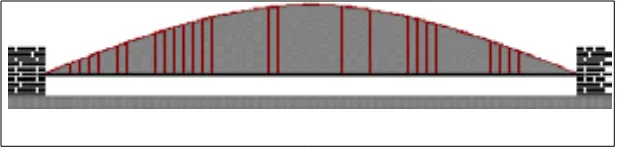
other words, the beam considered is clamped on both ends (as if built in a solid wall). A physical depiction of the loaded beam is shown in Figure 1. Certainly, students (and future scientists or engineers) would appreci-ate knowing exactly what they are working on and what the mathematical solutions they obtain represent!
Figure 1. Elastic beam subject to transverse loading
The second component is a technology infusion that has inalienable rights to an applied course such as this (Ferzola, 1994). Since differential equa-tions represent mathematical models of physical phenomena, the simula-tion of such must naturally be the next step. Classroom examples and demonstrations, take-home assignments, and intensive sessions or study group problems will be designed so that solutions can be observed visually through simulations and animations that illustrate the power of analysis and simulation to verify and visualize physical systems. These will be coupled with “order of magnitude” analyses so that students can estimate whether their answers are reasonable. It is the hope of the author that some of these problems may even lead to more in-depth multimedia modules, which would demonstrate how mathematical and physical principles are applied to create physical artifacts and engineering designs (Campbell, 2000). The main aggregate of these can be made possible through the use of computer algebra software (Abell & Braselton, 1993, 1994; Akritas & Bavel, 1998; Coombes, Hunt, Lipsman, Osborn, & Stuck, 1997, 1998; Ferzola, 1994, 1996; Lawson, 1998; Matthews, 1991), such as Maple, Mathematica, and/or other software packages or high level programming languages. Us-ing Maple for example, one can obtain a symbolic equation representUs-ing the deflection of the loaded beam problem given by equations (1) and (2) which is:
224
Association for the Advancement of Computing In Education, 12(2)
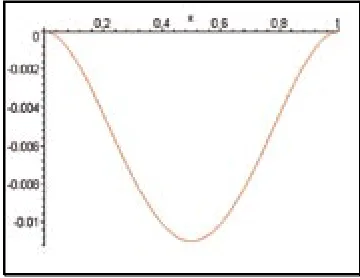
Figure 2. Beam deflection for the model given by equations (1), (2)
The fact that the loading function, as given by the right-hand side of equa-tion (1), is symmetric about the mid-point of the beam, leads one to expect that the deflection of the beam will be maximum at that point. Hence, our physical intuition is also verified by computer visualization. Moreover, once the nature of the solution is realized, students can quickly obtain and visualize solutions based on a wide variety of loading functions and/or with different constraints. An added advantage is the ability to easily create ani-mations based on previous solutions, simulating the response of the elastic beam under various or changing conditions. Hence, a more realistic under-standing of the problem and its solution can be attained. This interactivity is claimed to play a key role in achieving effectiveness in learning (Cezikturk, Kahveci, & Cirik, 2000).
OBJECTIVES
Massachusetts Institute of Technology Rose-Hulman Institute of Technology University of Massachusetts -Lowell Tennessee Technological University California Polytechnic University Middle Tennessee State University Georgia Institute of Technology University of South Carolina Columbus State University University of South Florida Arizona State University University of Pennsylvania Texas A&M University University of Kentucky Villanova University University of Delaware US Naval Academy University of Georgia
One major novelty in this course will be, from a student perspective, that the close relationship between mathematics and other applied sciences will become apparent through the continuous association of mathemati-cal models covered throughout the course with their physimathemati-cal origins. Hence, students will learn exactly why there is a need to explore solutions to various equations that would otherwise appear to be of only academic significance. Armed with knowledge of the physical substance and the theoretical background to attack any given problem, students will enhance their understanding of achieved solutions by visualization through computer simulation (Ferzola, 1994, 1996). The objective in this stage is not merely to display a solution graphically but to use computers as an aid to obtain the solution itself. In this fashion, students will be exposed not only to the theo-retical analysis of a given problem but also to the numerical analysis and the benefits that such analysis brings to the field of applied science. Moreover, students will acquire knowledge and experience in using the chosen com-puter software package and/or programming language in scientific program-ming and visualization of applied problems. This added skill could perhaps play an important role in the marketability of graduating students.
226
Association for the Advancement of Computing In Education, 12(2) And since most of the students attempting Math 2209 at Middle Georgia College are majoring in engineering, graduates of the redesigned Math 2209 will be amply prepared to take on such demanding courses in physical un-derstanding as Engineering Dynamics, Mechanics of Solids, Fluid Mechan-ics, and Thermodynamics.
Finally, it is hoped that this project will develop instruments for measuring the effectiveness of technology-enhanced mathematics courses and relating this effectiveness to differences among students. In this way, Math 2209 will provide a head start for similar projects in other mathematics courses and will serve as a basis for further change at the institution toward a fully developed technology-enhanced curriculum.
PROJECT REPLICABILITY
It is expected that the revised Math 2209 may not be replicable in its entire-ty immediately. The reason for this is that it may take two to three semesters to resolve difficulties associated with the exact time requirements for all the additional material that needs to be covered in the same time allotted for the current course. Nevertheless, this is common to all new courses attempted, especially those in the physical sciences that take their infant steps into the world of technology. An increase of the credit hours assigned to the course from three to four may also be an acceptable option.
The real advantage of the new course is the development of a computational infrastructure, a model on which other mathematics and science courses can be developed. Moreover, future enhancements or versions of this course and other courses developed based on this model can easily implement the exist-ing computational module and at the same time will also have an estimate of the initial time requirements for the implementation of this component. Thus, this course will serve as a pioneer project whose outcomes will assist in reaching decisions regarding future development, restructure, or redesign of other mathematics and science courses.
STUDENT EVALUATION
mid-term and final exams, and daily homework assignments. In most cases, that implies being able to provide a mathematically correct solution to the problems assigned. Though it is necessary for students in any course to demonstrate the knowledge of the subject matter, an assessment designed to measure student knowledge of specific procedures, as has been the case in the traditional course, should only partially determine a student’s grade. Inferring that this assessment sufficiently measures the student’s ability to perform scientific tasks would be a mistake; instead, measuring the stu-dent’s understanding of these principles would require observing the student applying that scientific knowledge in a laboratory-like setting, as the new course proposes.
Based on this premise, the scope of the redesigned course will be shifted toward assessing the students’ ability to provide a correct physical expla-nation of the solution of the problems assigned, in addition to obtaining a mathematically sound answer. Hence, memorizing a particular sequence of steps or procedure to attain a mathematical solution would not be deemed as important as acquiring an understanding of what the solution means in physical terms, as well as why and how the particular procedure employed leads to a solution that is sound, both mathematically and physically. Furthermore, the redesigned course requires additional evaluation pro-cedures that include computer assignments, independent and/or group projects, class presentations of these and/or written reports, and perhaps a final computer project and/or presentation in lieu of or in addition to the tra-ditional final examination. The actual assessment procedures chosen depend on time constraints and on the instructor’s personal preferences.
228
Association for the Advancement of Computing In Education, 12(2) the results obtained or written report, will act as a measurement of the level of understanding of the problem faced with, and the clarity and accuracy of the communication to other “experts” in the field.
As previously suggested, a multitude of different skills that are essential to a well-rounded education are being sought for in the students’ development through this course.
PROJECT EVALUATION
The assessment of the benefits of incorporating technology in the traditional Differential Equations course can be made by the following procedures: 1. As a first method of assessment, a comparison of student performance
with the performance of students in a traditional class can be made. This will provide the instructor with a general idea of the success of the project. However, this immediate comparison can not sufficiently mea-sure the effectiveness of integrating technology into the course since a direct correlation between performance of different populations require that observations be made over a long period of time.
2. The main goal of this project is the improvement of students’ under-standing of the material and their ability in working with mathematical concepts. Hence, a student opinion survey can serve as a measure of the students’ personal feelings regarding the effectiveness of using tech-nology in learning. This way, the students will be directly involved in measuring the success of the project.
3. Measuring the knowledge gained by the students statistically can only provide us with a partial measure of the benefits gained. Other signifi-cant factors, such as improvement in critical thinking, collaboration and communication skills, pursuit of student involvement in technology outside the classroom, and retention and application of learned qualities in other aspects of life cannot be directly measured.
5. Last, but not least, the annual faculty evaluation may be used to com-pare faculty performance in a technology enhanced course to perfor-mance in traditional courses, thus providing an additional measure of the effect of the particular instructional technology employed, this time on the faculty rather than the students.
PRELIMINARY RESULTS
The project was proposed and accepted for development through an institu-tional Technology Development Grant and implemented in four sections of Math 2209 over a period of one academic year. In its initial phase, less than 70% of the computational module was used because of time constraints. Re-sults of the variables being measured are still being gathered and interpreted as of this writing. Some preliminary results, which appear to be positive, are presented next.
230
Association for the Advancement of Computing In Education, 12(2)
Figure 3. Student age distribution
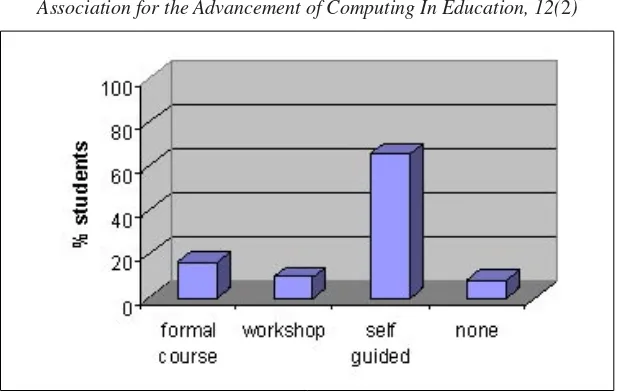
Figure 5. Prior technology training or experience
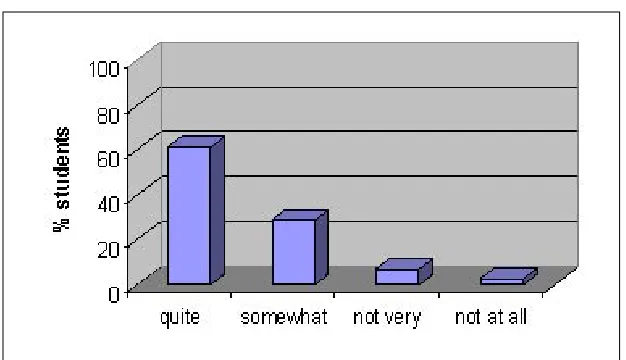
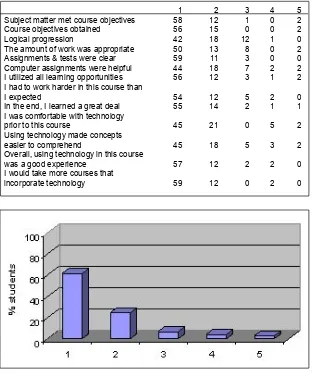
Students’ attitudes toward the course were evaluated by student opinion sur-veys. Table 1 shows various questions asked through one such survey and the corresponding student responses. The overall opinion of the students seems to be positive toward using technology as can be seen graphically in Figures 6 and 7. The results gathered show an overwhelming acceptance of having a technology component in Math 2209 by the students, nevertheless, as shown from their survey responses, most had to work harder than they anticipated to accomplish the course objectives. Figure 6 shows that approx-imately 80% of the students agree that using technology in the course made concepts easier to understand, while Figure 7 shows that almost all students in the course, regardless of grade achieved, agree that using technology in the course was a good experience.
232
Association for the Advancement of Computing In Education, 12(2) Table 1
Course Evaluation Tabulation (1 is strongly agree - 5 is strongly disagree)
1 2 3 4 5
Subject matter met course objectives 58 12 1 0 2
Course objectives obtained 56 15 0 0 2
Logical progression 42 18 12 1 0
The amount of work was appropriate 50 13 8 0 2
Assignments & tests were clear 59 11 3 0 0
Computer assignments were helpful 44 18 7 2 2
I utilized all learning opportunities 56 12 3 1 2
I had to work harder in this course than
I expected 54 12 5 2 0
In the end, I learned a great deal 55 14 2 1 1
I was comfortable with technology
prior to this course 45 21 0 5 2
Using technology made concepts
easier to comprehend 45 18 5 3 2
Overall, using technology in this course
was a good experience 57 12 2 2 0
I would take more courses that
incorporate technology 59 12 0 2 0
Figure 7. Overall, using technology in this course was a good experience (1 is strongly agree - 5 is strongly disagree)
234
Association for the Advancement of Computing In Education, 12(2)
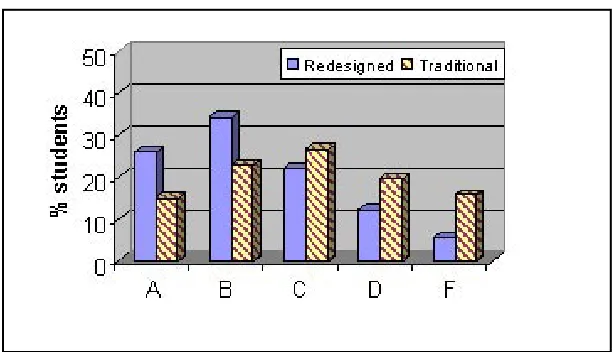
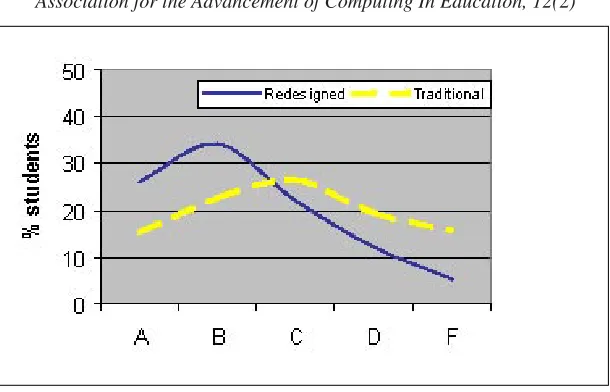
Figure 9. Student grade performance comparison
CONCLUSION
In this article, a pilot project was presented regarding the redesign of a traditional Differential Equations course at Middle Georgia College. This redesign includes a more physical approach to teaching the subject matter, hence, integrating the physics and mathematics of topics discussed, and the development and implementation of a computational component in a laboratory-like setting through which better understanding of the concepts presented is sought. Student performance evaluations encompass a variety of skills beyond subject matter knowledge, such as comprehension, commu-nication, and collaboration. Preliminary results show that students’ attitudes toward using technology in this course are positive and that their perfor-mance compares favorably to peer perforperfor-mance in the traditional course. Further study of data collected throughout the year is currently under way.
References
Abell, M., & Braselton, J. (1994). Differential equations with Maple. Orlando, FL: Academic Press.
Akritas, A., & Bavel, Z. (1998). Teaching great ideas of mathematics with math-ematica. Mathematica in Education and Research, 7(4), 5-14.
American Association for the Advancement of Science (AAAS) (1993). Bench-marks of science literacy: Project 2061. New York: Oxford University Press.
Campbell, S. (2000). Computer assisted synthesis of visual and symbolic mean-ing in mathematics education. Proceedmean-ings of International Conference on Mathematics/Science Education and Technology, 1, 101-105.
Cezikturk, O., Kahveci, M., & Cirik, G. (2000). Interactivity in mathematics and science education. Proceedings of International Conference on Mathemat-ics/ Science Education and Technology, 1, 106-111.
Coombes, K.R., Hunt, B.R., Lipsman, R.L., Osborn, J.E., & Stuck, G.J. (1997). Differential equations with maple. New York: John Wiley & Sons.
Coombes, K.R., Hunt, B.R., Lipsman, R.L., Osborn, J.E., & Stuck, G.J. (1998). Differential equations with Mathematica. New York: John Wiley & Sons. Ferzola, A.P. (1994). Using a computer algebra system to enhance a traditional
undergraduate course in ordinary differential equations. Primus IV, 4, 383-395. Ferzola, A.P. (1996). Differential equations and the computer: Using maple as a
resource for mathematical information. Proceedings of the 5th Conference
on the Teaching of Mathematics, Baltimore, MD. New York: John Wiley & Sons. Friedman, A. (1961). A new proof and generalizations of the Cauchy-Kowaleski
theorem. Transactions of the American Mathematical Society, 98, 1-20. Lawson, D. (1998). Differential equations using maple. Presented at the 2nd
An-nual Symposium in Technology for Mathematical Learning. London: Impe-rial College.
Maple [Computer software]. [Online]. Available: http://www.maplesoft.com. Mathematica [Computer software]. [Online]. Available: http://www.wolfram.com. Mathews, J. (1991). Solving differential equations with computer algebra
sys-tems software. Journal of Computers in Mathematics and Science Teaching 1, 79-86.
National Council of Teachers of Mathematics (NCTM) (2000). Principles and standards for school mathematics. Reston, VA. [Online]. Available: http:// standards.nctm.org
National Research Council (NRC) (1996). National science education standards. Washington, DC: National Academy Press.
National Science Foundation (NSF) (1998). Report of the assessment panel for the international assessment of the U.S. Math & Sciences. Arlington, VA. Ockendon, J.R. (1995). The moving interface between mathematics and industry.
In K. Kirchgassner (Ed.), O. Mahrenholtz, & R. Mennicken, Proceedings of ICIAM-95. New York: John Wiley & Sons.
Timoshenko, S. (1970). Theory of elasticity. New York: McGraw-Hill.