R E S E A R C H
Open Access
The potential of computerised analysis of
bowel sounds for diagnosis of
gastrointestinal conditions: a systematic
review
Andrisha-Jade Inderjeeth
1,2, K. Mary Webberley
2*, Josephine Muir
2and Barry J. Marshall
1,2Abstract
Background:Gastrointestinal (GI) conditions are highly prevalent, and their standard diagnostic tests are costly and carry risks. There is a need for new, cost-effective, non-invasive tests. Our main objective was to assess the potential for use of bowel sounds computerised analysis in the diagnosis of GI conditions.
Methods:The systematic review followed the PRISMA requirements. Searches were made of four databases
(PubMed, MEDLINE, Embase, and IEEE Xplore) and the references of included papers. Studies of all types were included. The titles and abstracts were screened by one author. Full articles were reviewed and data collected by two authors independently. A third reviewer decided on inclusion in the event of disagreement. Bias and applicability were assessed via a QUADAS tool adapted to accommodate studies of multiple types.
Results:Two thousand eight hundred eighty-four studies were retrieved; however, only 14 studies were
included. Most of these simply assessed associations between a bowel sound feature and a condition. Four studies also included assessments of diagnostic accuracy. We found many significant associations between a bowel sound feature and a GI condition. Receiver operating characteristic curve analyses revealed high sensitivity and specificity for an irritable bowel syndrome test, and a high negative predictive value for a test for post-operative ileus. Assessment of methodological quality identified weaknesses in all studies. We particularly noted a high risk of bias in patient selection. Because of the limited number of trials included and the variety in conditions, technology, and statistics, we were unable to conduct pooled analyses.
Conclusions: Due to concerns over quality and small sample sizes, we cannot yet recommend an existing
BSCA diagnostic test without additional studies. However, the preliminary results found in the included studies and the technological advances described in excluded studies indicate excellent future potential. Research combining sophistical clinical and engineering skills is likely to be fruitful.
Systematic review registration: The review protocol (review ID number 42016054028) was developed by
three authors (AI, KMW, and JM) and was published in the PROSPERO International prospective register of
systematic reviews. It can be accessed from https://www.crd.york.ac.uk/PROSPERO/.
Keywords: Bowel sound, Borborygmi, Diagnostics, Systematic review, Gastrointestinal medicine, Non-invasive
tests, Research quality assessment methodology post-operative ileus
* Correspondence:[email protected]
2The Marshall Centre for Infectious Diseases Research and Training, School of
Biomedical Sciences, QEII Medical Site, The University of Western Australia, Perth, Western Australia, Australia
Full list of author information is available at the end of the article
© The Author(s). 2018Open AccessThis article is distributed under the terms of the Creative Commons Attribution 4.0
International License (http://creativecommons.org/licenses/by/4.0/), which permits unrestricted use, distribution, and
Background
Gastrointestinal (GI) disease and disorders are significant causes of morbidity worldwide. For example, inflamma-tory bowel diseases lead to around 100,000 hospital ad-missions annually in the USA [1], whilst irritable bowel syndrome (IBS) is the second most common cause of work absenteeism [2] and accounts for up to 50% of gastroenterology outpatient clinic time [3].
Accurate diagnosis of GI pathology typically requires a gastroenterology review (prolonging waiting lists) prior to invasive procedures such as endoscopies, biopsies, and manometry. Indeed, the gold standard for positive diagno-sis of chronic GI diseases is often endoscopy with biopsy of tissue for analysis. Unfortunately, patients with func-tional gastrointestinal disorders such as IBS typically also endure invasive endoscopies to diagnose these conditions by means of exclusion of more sinister pathologies [4].
However, endoscopies carry a small risk of gastrointes-tinal perforation—requiring emergency surgery and car-rying high mortality rates [5]. Other risks associated with endoscopy such as bleeding, infection, and anaes-thetic complications, whilst rare, can be life threatening. In addition to these risks, the costs to the patient in-clude physical discomfort, psychological distress, and time off-work.
The cost of unnecessary endoscopies to health care systems also cannot be underestimated; associated the-atre time and adequate nursing and medical staffing are all expensive. By avoiding unnecessary‘normal’ endosco-pies, reallocation of staffing, resources, and funding would allow better provision of urgent care to the pa-tients with life-threatening conditions such as malig-nancy or GI bleeding.
Similarly, certain GI conditions such as bowel obstruc-tions or post-operative ileus are often investigated with
abdominal imaging involving radiation exposure with as-sociated risks.
Clearly, there is a significant need for cost-effective, non-invasive diagnostic tests for GI diseases that avoid unnecessary patient risk and place less strain on the health care system.
Auscultation of bowel sounds is a traditional tech-nique pioneered by Cannon in the early twentieth cen-tury [6] and widely taught to training doctors, despite limited clinical value and relevance due to inaccuracy and variability in interpretation [7–9].
Technological advancement in the twenty-first cen-tury has brought a new era to the practice of medi-cine, minimising human error and variation in the interpretation of data. Increases in computer process-ing power and improvement in data analysis brprocess-ing the potential for practice-altering research into bowel sounds analysis for evaluating GI motility. Can the new technology outperform clinicians in analysing the myriad of sounds emanating from the GI tract?The first objective of this study was to evaluate if bowel sound computational analysis (BSCA) is currently useful as a tool in GI condition diagnosis. Table 1 provides the study inclusion criteria in terms of population, index test, reference test, and diagnosis (PIRD) for this review question.
Given the limited publications, heterogeneity of stud-ies, and paucity of proper diagnostic test accuracy (DTA) studies, our secondary objective was to assess if BSCA is likely to be useful in the future given the rate of technological advancement. Hence, we also assessed if bowel sound computational analysis revealed signature patterns or variation associated with gastrointestinal conditions. Again Table 1 provides included study char-acteristics in terms of population, index test, comparator,
Table 1Eligibility criteria: general inclusion criteria and those shaped by the PIRD and PICO components
All studies Inclusion criteria
Publication details English, abstract, original study, peer-reviewed article, or conference proceeding, any year.
Human subjects any age, but not foetal. Any setting.
DTA studies Inclusion criteria Preliminary
(non-DTA) studies
Inclusion criteria
Population Patients with a diagnosis or subjective symptoms of a GI condition (pathological or functional).
Population Patients with a diagnosis or subjective symptoms of a GI condition (pathological or‘functional’) and healthy controls. Some studies had groups for multiple
conditions.
Index test Computerised analysis of bowel sounds Index test Computerised analysis of bowel sounds
Reference test Standard method used for diagnosis Comparator(s) Healthy controls or different target condition groups diagnosed by standard methods
Diagnosis Confirmed or excluded diagnosis of GI condition(s) Outcome Results of statistical analysis testing for heterogeneity or associations between bowel sound feature and condition(s)
and outcome (PICO terms). We hypothesise that, using modern techniques of noise-removal and sound analysis, computerised analysis of bowel sounds has the potential to be a non-invasive technique to aid in the screening and diagnosis of gastrointestinal conditions.
Methods Aim
The aim of this review was to assess the potential for use of bowel sounds computerised analysis in the diagnosis of GI conditions. We looked at the value of specific tests in the clinical setting, as well as the potential of the general approach. Reporting followed PRISMA guidelines. The completed checklist is provided as Additional file1. Eligibility criteria
We included studies of any type and in any setting where BSCA was used as a tool for identification or characterisation of GI conditions (clinical trials of de-vices; diagnostic test accuracy studies, both single gate or case-control; studies with retrospective diagnosis from the data; and preliminary observational studies with tests for associations between bowel sound char-acteristics and GI conditions or heterogeneity across groups). This reflects the full breadth of studies found along the development pathway of a diagnostic test from proof-of-concept through to widespread clinical use. We included original studies (not reviews) on human subjects, published in a peer-reviewed journal in English. The publication had to have an abstract, to allow the first stage of our search protocol and as an indicator of the depth of the study. We included conference proceedings from the search of engineer-ing journals, given these are typically both compre-hensive and peer-reviewed. The participants could be any age, excluding studies with foetal subjects.
Other inclusion criteria were shaped by the PIRD terms for the DTA studies (which we defined as any study that produced accuracy measures, such as sensitiv-ity, specificity) and PICOS terms for the simpler prelim-inary studies (see Table 1). Our analysis included no limitations on year of publication and inclusion criteria were broad, so as to identify a comprehensive list of relevant studies.
Information sources
Searches were made of electronic databases with the last search made on 7 April 2017. We also searched for additional studies by reading the references of each included paper.
Electronic searches
After a preliminary review of PubMed for existing pub-lished terminology, our search strategy was developed in
consultation with an Information Specialist from the University of Western Australia, as well as several team members on the project including both clinicians and engineers. Searches were made of four major databases: PubMed, MEDLINE, IEEE Xplore, and Embase. Search terms broadly related to the three key features required by studies to address the review aims: anatomical site in question (e.g. bowel), measure of sound (e.g. ausculta-tion/telemetry), and technology used for analysis (e.g. computational analysis).
The electronic search strategy for Embase, PubMed, and Medline was:
((bowel or stomach or gut or gastrointestinal or abdominal or intestinal or intestine or bowel-sound or bowels) and (sounds or sound or noise or noises or borborygmus or borborygmi or bowel-sound or bowel-sounds) and (telemetry or biosensor or acous-tic or microphone or analysis or enterotachogram or pattern analysis or wavelets or wavelet or motility analysis or neural networks or neural network or computerised auscultation or electronic stethoscope or computer analysis or computerized analysis or computerised analysis or computerized phonoentero-graphy or computerized phonoenterophonoentero-graphy or com-puterised auscultation or computerized auscultation or enterotachogram or wavelet-based or monitoring or pattern analysis or auscultation or phonogram)). Limits for Embase were human, English, and journal articles. Limits for MEDLINE were human, English, journal articles, and abstracts, and for PubMed, limits were English and human and limits.
IEEE allows less search terms than the previous data-bases; hence, the following terms were used:
bowel sound* or abdom* vibration* and signal processing.
Selection process
All articles were initially screened by one reviewer (AI) and excluded based on title and then screened and ex-cluded based on abstract (AI). In the event of uncertainty of inclusion at either of these points, a second reviewer (KMW) aided with review of both title and abstract and a consensus decision. Two independent reviewers assessed the remaining full articles for review eligibility with regard to pre-determined inclusion and exclusion criteria as out-lined in Table1(AI and KMW). Articles were included if a consensus decision was reached by both reviewers (AI and KMW) with study data inputted onto independent spreadsheets prior to quality assessments. In the event of disagreement, the decision was made by a third reviewer (BJM), after discussion.
Data collection process and data items
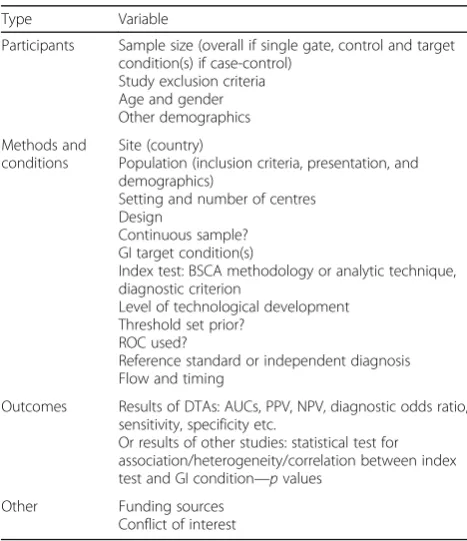
using three studies. Discrepancies were identified and re-solved through discussion. For each study that passed initial screening, reviewed data was collected on the eli-gibility criteria (see Table 1) and an eligibility decision documented. In addition, data was sought and recorded for the variables in Table2for all included studies.
Risk of bias in individual studies
The breadth of studies included made use of a standard quality assessment tool problematic. Hence, bias was assessed at the study level using a modified tool. The QUADAS-2 tool for Quality Assessment for Diagnostic Accuracy Studies was heavily modified (by KMW) with in-put from three validated checklists used in the quality as-sessment of a range of study designs for intervention studies: those of Downs and Black [10], Cho and Bero [11], and Moga et al. [12]. The tool was piloted and amended by two independent reviewers (AI and KMW). The resultant tool covered selection bias, performance bias, attrition bias, and reporting bias, as well as compet-ing interests. Across the domains, some questions were retained or added that were applicable to all type of stud-ies, e.g. domain 1: patient selection included‘Did the study avoid inappropriate exclusions’ (from QUADAS-2) and ‘Were the characteristics of the cohorts clearly described’ (derived from Downs and Black [10]). Consideration of the checklists, especially Cho and Bero [11] and Moga et
al. [12], prompted us to add additional questions on statis-tics and competing interests (see domains 5 and 6).
Elsewhere in the tool, pairs of signalling questions, one question for the DTA studies and one for the preliminary studies testing for associations or differ-ences across groups (see Additional file 2), were used that each addressed the same aspect of bias. For ex-ample, the first signalling question for a DTA study was ‘Was a case-control (two-gate) design avoided?’ (derived from QUADAS 2), whilst for a preliminary study, it was replaced with ‘Were the control sub-jects/cohorts appropriate (similar population to those with the GI condition, matched or random)?’ (derived from Cho and Bero [11]).
Given the simpler preliminary or proof-of-concept studies tend to intrinsically have a higher rate of bias due to a case-control design, the question set used was noted and the results are presented separately below.
Some studies included two components: a test for an association and a subsequent ROC analysis. These were assessed twice, with the appropriate questions for the different parts of the studies.
Quality assessments of all included studies were per-formed by two independent reviewers (AI and KMW). In the event of disagreement after discussion to reach a con-sensus, a decision was made by a third reviewer (BJM).
Results Study selection
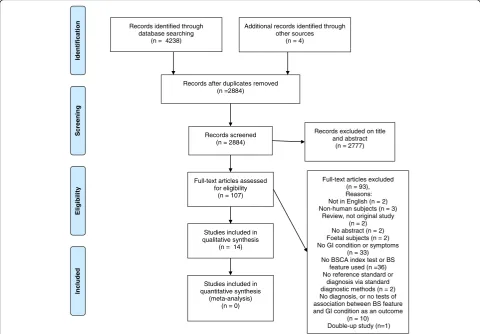
We retrieved studies using the search protocol specified in our protocol. The database searches uncovered the following numbers of studies: Embase, 1421; IEEE, 288; Medline, 753; and PubMed, 1776. After discarding dupli-cates, 2880 studies remained. An additional four studies were uncovered by reading the references. One reviewer discarded 2770 papers after reviewing the titles and/or abstracts. One hundred and seven studies were excluded following assessment of the full text by two independent reviewers making consensus decisions. One paper was included after discussion with a third reviewer. Many studies retrieved from the medical databases searches were excluded due to a lack of computational analysis of bowel sounds. In parallel, many studies retrieved from the IEEE search were discarded due to a lack of clinical investigation, i.e. no GI diagnosis offered or no compari-son with healthy controls. Several papers with the most sophisticated technology and pattern recognition ana-lysis were excluded for simply outlining methods for identifying bowel sounds, or because the authors mim-icked gastrointestinal conditions through the administra-tion of drugs. Thus, ultimately only 14 studies were included in this review. The study selection process is detailed in Fig.1.
Table 2Data collection variables for included studies
Type Variable
Participants Sample size (overall if single gate, control and target condition(s) if case-control)
Study exclusion criteria Age and gender Other demographics
Methods and conditions
Site (country)
Population (inclusion criteria, presentation, and demographics)
Setting and number of centres Design
Continuous sample? GI target condition(s)
Index test: BSCA methodology or analytic technique, diagnostic criterion
Level of technological development Threshold set prior?
ROC used?
Reference standard or independent diagnosis Flow and timing
Outcomes Results of DTAs: AUCs, PPV, NPV, diagnostic odds ratio, sensitivity, specificity etc.
Or results of other studies: statistical test for association/heterogeneity/correlation between index test and GI condition—pvalues
Other Funding sources
Study characteristics and results
A summary of the 14 included studies is given in Table3. The studies cover a variety of target conditions, index tests, and study type.
The majority of studies were preliminary in nature, i.e. case control (multi-gate or two-gate studies) to test for an association between a bowel sound feature or features and a target condition. Thus, they typically examined the potential usefulness of bowel sound analysis in diag-nosis rather than true measures of diagnostic accuracy. Four studies involved ROC analysis to determine test cut-off points and provided data on sensitivity and speci-ficity. In three cases, this was derived from multi-gate data [13, 14, 23]. The fourth study had a prospective, blinded, cross-sectional (single-gate) design, undertaken at multiple centres, and we would expect that this gives a better indication of accuracy in the clinical setting in which the test will be applied [24].
In two studies, the diagnostic outcome was continuous rather than discrete [20,21]. Here, the authors assessed the degree of correlation between a continuous variable (colon transit time) calculated by standard methods and values es-timated from models derived from bowel sound features.
These two studies employed relatively sophisticated acoustic signal processing and modelling techniques. However, typically most studies involved only rudimentary bowel sound analysis techniques, and this is reflected in the simplicity of the analytical techniques employed. The duration of bowel sound recordings used was generally short, but ranged from 16 to 1 h. In addition, in most studies, the level of computational analysis was relatively low: simple signal processing rather than advanced pattern recognition. In only one case was there an attempt at localization of the bowel sounds.
Risk of bias and concerns about applicability within studies
Consensus decisions between two reviewers were reached for all sub-sections of the modified QUADAS tool for all ar-ticles included. The majority of studies were preliminary studies with case-control design, which typically are poorer in quality due to limited challenge bias and spectrum effects [27, 28]. These are grouped separately in Fig. 2. Generally, there was a high risk of bias in both the included DTA and preliminary studies.
Records identified through database searching
(n = 4238)
Scr
e
ening
Included
Eligibility
n
oi
t
a
ci
fi
t
n
e
dI
Additional records identified through other sources
(n = 4)
Records after duplicates removed (n =2884)
Records screened (n = 2884)
Records excluded on title and abstract
(n = 2777)
Full-text articles assessed for eligibility
(n = 107)
Full-text articles excluded (n = 93), Reasons: Not in English (n = 2) Non-human subjects (n = 3)
Review, not original study (n = 2)
No abstract (n = 2) Foetal subjects (n = 2) No GI condition or symptoms
(n = 33) No BSCA index test or BS
feature used (n =36) No reference standard or
diagnosis via standard diagnostic methods (n = 2) No diagnosis, or no tests of association between BS feature and GI condition as an outcome
(n = 10) Double-up study (n=1) Studies included in
qualitative synthesis (n = 14)
Studies included in quantitative synthesis
(meta-analysis) (n = 0)
Domain 1, patient selection, frequently gave rise to a high risk of bias because of a lack of information regarding study participant characteristics and inclusion/exclusion criteria. Three of the DTA studies had a case-control design. In addition, sample sizes were typically small which may have negatively impacted the reliability of results. For example, Kaneshiro et al.’s study [24] was well designed (blinded, prospective, longitudinal, single-gate (cohort) study across multiple centres, featuring a consecutive sample of pa-tients), but it had only a small sample size of 28 partici-pants, only nine of whom developed post-operative ileus.
There were no concerns about the applicability of the index test in any of the studies. However, we determined that it could have given rise to bias in over half of the preliminary studies and all the DTA studies. In all these, the bowel sound analysis was objective or, less fre-quently, was conducted blind [24] or prior [26]. How-ever, in all cases, we determined that the index test could still have given rise to bias because the bowel sound feature or threshold was not pre-specified [13–16,
18, 19, 21, 23, 24]. Tests of association or correlation
between the target condition and a range of different features were made to find one of interest, or the cut-off threshold was determined as part of the study.
an unclear risk of bias in the further three studies, where we could not determine if the diagnosis was made with-out knowledge of the bowel sound analysis or not [17,
19, 23]. This problem was rectified in the second study with the AGIS system [24] where there were different teams undertaking clinical assessment and bowel sound analysis.
In all but one case, there was no cause for concern about the applicability of the reference standard to the review question. There was concern that the target con-dition in the study by Liatsos et al. [26] small volume as-cites as defined by the reference standard (without knowledge of patient comorbidities) is not solely a GI condition. Indeed, this was the one paper where the de-cision on inclusion in the review had to be made by the third reviewer (BJM).
Flow and timing were poorly described in two studies by Craine et al. of bowel sounds analysis in relation to IBS and other conditions [13,15], leading to an unclear risk of bias. In a third study by the same group [14], not only was the interval between index test and reference standard test unclear, but it also appears that a mix of different methods was used to diagnose Crohn’s disease. Similarly, in four other studies [17–19, 26], there was a variation in the reference standard used for subjects. In Tomomasa’s study [22], perhaps for ethical reasons, the healthy infant controls did not undergo a standard test to assess the rate of gastric emptying, and this intro-duced a risk of bias to the study.
Not all data was included in the analysis for two stud-ies. In Ching and Tan’s study [18] of intestinal obstruc-tion patients, six recordings were of poor quality and so were not included in the analysis, whilst the results from an IBS patient were not mentioned in the results section of the Hadjileontiadis et al. paper, which was also un-clear on the relative timing of the reference standard and index tests.
The overall quality of statistics and reporting was dis-appointing for several studies. Problems related to statis-tics were found for two of Craine et al.’s studies [13,15]. We determined that some of the statistics used in their 2002 study [15] were not appropriate. They looked for heterogeneity in sound to sound interval between groups, but since the non-ulcer dyspepsia groups were split based on this, the approach was circular. We were unable to determine if some of the statistics reported in an earlier Craine et al. paper [13] were appropriate since the test used was not detailed leading us to give them an unclear risk of bias in this domain.
The paper by Hadjileontiadis et al. [16] had quite so-phisticated analysis but was still deemed to be at risk of bias due to statistics or reporting bias. Nopvalues were provided, simply scatter plots and the IBS data was missing.
Four other studies had missing test outcomes [17, 21,
25]. Exact p values were missing in the two papers on delayed gastric emptying [20, 21], and one on acute ab-domen [19].
The statistics on heterogeneity across groups for the first component of the first paper on the AGIS system [23] were considered to add bias, since the small sample sizes meant that non-parametric tests would have been more appropriate. This was rectified in their second paper, which detailed a similar method of bowel sound analysis for post-operative ileus diagnosis [24].
The DTA studies were all considered to have a high risk of statistical bias since the statistics provided on measures of accuracy were all derived from the same data from which the cut-off thresholds were determined, rather than from independent cases.
The pattern observed in risk of bias in relation to competing interests largely reflects the date of publica-tion of the studies. Absence of informapublica-tion about com-peting interests and/or funding led to us record high risk in this domain for the earlier publications. However, we believe this was largely because many journals have only recently required statements in these areas.
Results of individual studies
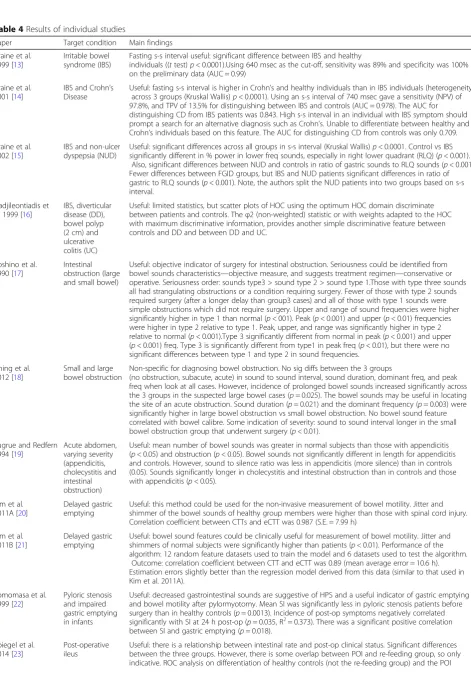
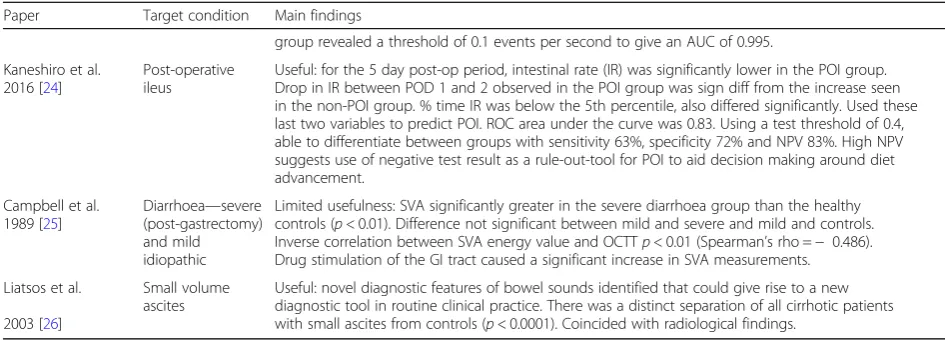
The results of all included studies are included in Table4.
Synthesis of results
The heterogeneity in index tests and target conditions precluded statistical meta-analysis. However, we are able to present a narrative describing the study results orga-nised by target condition and bowel sound analysis approach.
Irritable bowel syndrome
Table 4Results of individual studies
Paper Target condition Main findings
Craine et al. 1999 [13]
Irritable bowel syndrome (IBS)
Fasting s-s interval useful: significant difference between IBS and healthy
individuals ((ttest)p< 0.0001).Using 640 msec as the cut-off, sensitivity was 89% and specificity was 100% on the preliminary data (AUC = 0.99)
Craine et al. 2001 [14]
IBS and Crohn’s Disease
Useful: fasting s-s interval is higher in Crohn’s and healthy individuals than in IBS individuals (heterogeneity across 3 groups (Kruskal Wallis)p< 0.0001). Using an s-s interval of 740 msec gave a sensitivity (NPV) of 97.8%, and TPV of 13.5% for distinguishing between IBS and controls (AUC = 0.978). The AUC for distinguishing CD from IBS patients was 0.843. High s-s interval in an individual with IBS symptom should prompt a search for an alternative diagnosis such as Crohn’s. Unable to differentiate between healthy and Crohn’s individuals based on this feature. The AUC for distinguishing CD from controls was only 0.709.
Craine et al. 2002 [15]
IBS and non-ulcer dyspepsia (NUD)
Useful: significant differences across all groups in s-s interval (Kruskal Wallis)p< 0.0001. Control vs IBS significantly different in % power in lower freq sounds, especially in right lower quadrant (RLQ) (p< 0.001).
Also, significant differences between NUD and controls in ratio of gastric sounds to RLQ sounds (p< 0.001). Fewer differences between FGID groups, but IBS and NUD patients significant differences in ratio of gastric to RLQ sounds (p< 0.001). Note, the authors split the NUD patients into two groups based on s-s interval.
Hadjileontiadis et al. 1999 [16]
IBS, diverticular disease (DD), bowel polyp (2 cm) and ulcerative colitis (UC)
Useful: limited statistics, but scatter plots of HOC using the optimum HOC domain discriminate between patients and controls. Theφ2 (non-weighted) statistic or with weights adapted to the HOC with maximum discriminative information, provides another simple discriminative feature between controls and DD and between DD and UC.
Yoshino et al. 1990 [17]
Intestinal obstruction (large and small bowel)
Useful: objective indicator of surgery for intestinal obstruction. Seriousness could be identified from bowel sounds characteristics—objective measure, and suggests treatment regimen—conservative or operative. Seriousness order: sounds type3 > sound type 2 > sound type 1.Those with type three sounds all had strangulating obstructions or a condition requiring surgery. Fewer of those with type 2 sounds required surgery (after a longer delay than group3 cases) and all of those with type 1 sounds were simple obstructions which did not require surgery. Upper and range of sound frequencies were higher significantly higher in type 1 than normal (p< 001). Peak (p< 0.001) and upper (p< 0.01) frequencies were higher in type 2 relative to type 1. Peak, upper, and range was significantly higher in type 2 relative to normal (p< 0.001).Type 3 significantly different from normal in peak (p< 0.001) and upper (p< 0.001) freq. Type 3 is significantly different from type1 in peak freq (p< 0.01), but there were no significant differences between type 1 and type 2 in sound frequencies.
Ching et al. 2012 [18]
Small and large bowel obstruction
Non-specific for diagnosing bowel obstruction. No sig diffs between the 3 groups
(no obstruction, subacute, acute) in sound to sound interval, sound duration, dominant freq, and peak freq when look at all cases. However, incidence of prolonged bowel sounds increased significantly across the 3 groups in the suspected large bowel cases (p= 0.025). The bowel sounds may be useful in locating the site of an acute obstruction. Sound duration (p= 0.021) and the dominant frequency (p= 0.003) were significantly higher in large bowel obstruction vs small bowel obstruction. No bowel sound feature correlated with bowel calibre. Some indication of severity: sound to sound interval longer in the small bowel obstruction group that underwent surgery (p< 0.01).
Sugrue and Redfern 1994 [19]
Acute abdomen, varying severity (appendicitis, cholecystitis and intestinal obstruction)
Useful: mean number of bowel sounds was greater in normal subjects than those with appendicitis (p< 0.05) and obstruction (p< 0.05). Bowel sounds not significantly different in length for appendicitis and controls. However, sound to silence ratio was less in appendicitis (more silence) than in controls (0.05). Sounds significantly longer in cholecystitis and intestinal obstruction than in controls and those with appendicitis (p< 0.05).
Kim et al. 2011A [20]
Delayed gastric emptying
Useful: this method could be used for the non-invasive measurement of bowel motility. Jitter and shimmer of the bowel sounds of healthy group members were higher than those with spinal cord injury. Correlation coefficient between CTTs and eCTT was 0.987 (S.E. = 7.99 h)
Kim et al. 2011B [21]
Delayed gastric emptying
Useful: bowel sound features could be clinically useful for measurement of bowel motility. Jitter and shimmers of normal subjects were significantly higher than patients (p< 0.01). Performance of the algorithm: 12 random feature datasets used to train the model and 6 datasets used to test the algorithm.
Outcome: correlation coefficient between CTT and eCTT was 0.89 (mean average error = 10.6 h). Estimation errors slightly better than the regression model derived from this data (similar to that used in Kim et al. 2011A).
Tomomasa et al. 1999 [22]
Pyloric stenosis and impaired gastric emptying in infants
Useful: decreased gastrointestinal sounds are suggestive of HPS and a useful indicator of gastric emptying and bowel motility after pylormyotomy. Mean SI was significantly less in pyloric stenosis patients before surgery than in healthy controls (p= 0.0013). Incidence of post-op symptoms negatively correlated significantly with SI at 24 h post-op (p= 0.035, R2= 0.373). There was a significant positive correlation
between SI and gastric emptying (p= 0.018).
Spiegel et al. 2014 [23]
Post-operative ileus
Inflammatory bowel disease
As mentioned, Craine et al. found that the s-s interval was higher in Crohn’s individuals than healthy subjects, but they were unable to reliably differentiate between the two based on this feature [14]. They still concluded that their technology could be useful in differential diag-nosis, since high s-s interval in an individual with IBS symptoms should prompt a search for an alternative diagnosis to IBS, such as Crohn’s.
Hadjileontiadis et al. [16] processed bowel sounds based on higher-order crossings. Their statistics were limited, but scatter plots allowed discrimination between patients with ulcerative colitis, diverticular disease, a large bowel polyp, and healthy controls.
Intestinal obstruction
Yoshino et al. [17] used spectral analysis of bowel sounds to categorise sounds into three groups based on frequency characteristics. The groups corresponded to the severity of intestinal obstruction.
Ching and Tan [18] found mixed results. Their study examined four bowel sound features from six short re-cordings each made from patients with suspected bowel obstruction. The features were non-specific for diagnos-ing bowel obstruction. There were no significant differ-ences when they looked at all cases. However, when they examined the large bowel obstruction cases alone, inci-dence of prolonged bowel sounds increased significantly from 4% with no obstruction to 11% with subacute ob-struction, and 17% with acute obstruction. The authors also found that one feature provided indication of sever-ity in small bowel obstruction cases. They also con-cluded that bowel sounds may be useful in locating the obstruction site; two features varied significantly be-tween large and small bowel obstruction cases.
Intestinal obstruction was one of a range of causes of acute abdomen considered by Sugrue and Redfern [19]. Different sound features allowed differentiation between
the different causes, although their findings suggest that analysis of multiple features would be needed for full dif-ferential diagnosis. They found that the mean number of bowel sounds was significantly less in subjects with ob-struction and appendicitis than in normal subjects. In addition, sounds were significantly longer in cholecystitis and intestinal obstruction than in controls and those with appendicitis.
Appendicitis
Sugrue and Redfern [19] also found that the fasting sound to silence ratio was less in appendicitis cases than in controls, although bowel sounds were not signifi-cantly different in length.
Delayed gastric emptying and reduced bowel motility
More sophisticated processing and modelling techniques have proven useful in measurement of bowel motility and characterisation of delayed gastric emptying. Two studies were undertaken by Kim et al. [20,21] on largely the same data set, with extraction of jitter and shimmer features from bowel sounds recorded from three chan-nels. The subjects were male patients with spinal cord injury and delayed gastric emptying and healthy con-trols. Both the jitters and shimmers of the normal sub-jects were higher than those of the patients, and their colon transit times (CTT) were lower (p< 0.01). The first study [20] employed regression modelling based on stepwise selection methods to select the optimal nine features with which to model CTT. The correlation co-efficient, coefficient of determination (R2), standard error (SE), and the absolute differences between the CTTs and eCTTs were 0.987, 0.974, 7.99, and 3.5 ± 3.3 h. The average absolute error on the cross-validation test was 7.3 ± 2.4 h. The same team undertook quantitative esti-mation of the CTT using an artificial neural network model of acoustic features, on the same data plus two additional patients, with slightly improved results [21].
Table 4Results of individual studies(Continued)
Paper Target condition Main findings
group revealed a threshold of 0.1 events per second to give an AUC of 0.995.
Kaneshiro et al. 2016 [24]
Post-operative ileus
Useful: for the 5 day post-op period, intestinal rate (IR) was significantly lower in the POI group. Drop in IR between POD 1 and 2 observed in the POI group was sign diff from the increase seen in the non-POI group. % time IR was below the 5th percentile, also differed significantly. Used these last two variables to predict POI. ROC area under the curve was 0.83. Using a test threshold of 0.4, able to differentiate between groups with sensitivity 63%, specificity 72% and NPV 83%. High NPV suggests use of negative test result as a rule-out-tool for POI to aid decision making around diet advancement.
Campbell et al. 1989 [25]
Diarrhoea—severe (post-gastrectomy) and mild idiopathic
Limited usefulness: SVA significantly greater in the severe diarrhoea group than the healthy controls (p< 0.01). Difference not significant between mild and severe and mild and controls. Inverse correlation between SVA energy value and OCTTp< 0.01 (Spearman’s rho =− 0.486). Drug stimulation of the GI tract caused a significant increase in SVA measurements.
Liatsos et al.
2003 [26]
Small volume ascites
They obtained 18 jitter and shimmer features of colonic sounds. The top six features (correlation coefficient with measured CTT was 0.65 or above) were used for the in-put vector for the artificial neural network (ANN). The ANN model gave correlation coefficient, MAE, and RMSE between the CTTs and eCTTs of 0.89, 10.6, and 14.6 h respectively. The ANN model had the same cor-relation coefficient but smaller error than a regression model derived from the expanded data.
The authors concluded that the algorithm had good potential as a tool for the continuous and non-invasive monitoring of bowel motility, instead of, complementary to conventional radiography.
Pyloric stenosis and impaired gastric emptying in infants
Tomomasa et al. [22] found analysis of bowel sounds potentially useful as an indicator of gastric emptying and bowel motility for paediatric patients. They observed de-creased gastrointestinal sounds (using the sum of the amplitude of sound signals as the sound index) in in-fants with hypertrophic pyloric stenosis before surgery (4.6 ± 1.0 mV per minute) compared to healthy controls (31.7 ± 8.4 mV per minute). They also found a significant negative correlation between incidence of post-operative symptoms and the sound index at 24 h post-op, and a significant positive correlation between the sound index and gastric emptying.
Post-operative ileus
The most comprehensive analysis of a BSCA approach comes from two studies of the acoustic gastrointestinal surveillance biosensor (AGIS) system used to determine post-operative clinical status. Spiegel et al. [23] investi-gated the relationship between AGIS-derived ‘intestinal rate’and the healthy fed state versus two post-operative states: post-operative ileus (POI) and toleration of feed-ing. It is unclear from their description whether the in-testinal rate refers to propulsive events occurring during the active phase of the migrating motor complex or other events. However, the authors did find significant differences between the three groups in the index.
ROC analysis was conducted on the preliminary data to assess differentiation between healthy controls and the POI group. A threshold of 0.1 events per second gave an AUC of 0.995. ROC analysis of the more clinic-ally useful differentiation between patients experiencing POI and toleration of refeeding was not undertaken. Motility rates were significantly higher in fed versus POI patients (p= 0.017). However, the fact that there was overlap in the motility rate between the POI and feeding group indicated that the index could possibly be only in-dicative of status.
The group’s second study of patients recovering from colorectal surgery had a blinded, single-gate, longitudinal,
prospective, multi-centre design and was more enlighten-ing as well as beenlighten-ing well-designed to reduce bias [24]. Using ROC analysis, the authors identified an algorithm that maximised predictive discrimination between POI and non-POI groups. The algorithm encompassed two metrics derived from the intestinal rate. The authors emphasised the high negative predictive value (NPV) be-cause this meant that the AGIS system could offer confi-dence to hospital staff that POI is unlikely and that diet advancement would be safe. They found that a test thresh-old of 0.4 provided an NPV of 83%, sensitivity of 63%, and specificity of 72%. The study was only an interim report on the first 28 subjects of a 100 subject clinical trial, but it appears that the AGIS system will prove useful in both prognosis and diagnosis in the post-operative setting.
Other conditions
Liatsos et al. [26] found that filtered and denoised bowel sounds subjected to higher order crossings (HOC) analysis could prove useful in diagnosis of small volume ascites. This is a similar approach to that used by Hadjileontiadis et al. [16] (see above). Scatter-plots of third-order zero crossings reflected distinct differences in the sound transmission path for cirrhotic patients with small ascites and healthy controls and allowed separation of the two (p< 0.0001). A single gate study is now needed to confirm these findings.
Campbell et al.’s [25] study of surface vibration analysis (SVA) included comparison of two groups of patients: one with severe (post-gastrectomy) diarrhoea and the other with mild idiopathic diarrhoea. The SVA values were also compared to oral caecal transfer time. The authors found evidence of limited usefulness for the approach: SVA values were significantly greater in the severe diarrhoea group than in the healthy controls, but the differences were not significant between other groups.
Discussion
Implications and usefulness
Gastrointestinal disorders are a common cause of mor-bidity worldwide. There is a need for non-invasive, simple, diagnostic tests to reduce the demand for gastro-enterology referrals and for investigations such as endos-copy and imaging with their associated risks. Our aim was to assess the potential for BSCA to meet this need.
Our review had several strengths. We conducted a highly comprehensive search of both the medical and engineering literature, without limiting study design type or GI condition to gain a full understanding of the ap-plicability of BSCA. To allow quality assessment of the breadth of studies uncovered, we developed a novel quality assessment tool with parallel question sets for DTA and other study types.
many with highly significant results. Four of the studies also incorporated preliminary studies of diagnostic ac-curacy. These DTA studies provide only a moderate level of evidence to support the idea that bowel sound ana-lysis is currently useful as a tool in GI diagnosis. How-ever, together all the studies provide excellent evidence that many GI conditions are characterised by specific bowel sound features. Hence, there is strong evidence of the potential for future use of BSCA in diagnosis of GI disease and disorders.
The main diagnostic benefits or strongest associations between a bowel sound feature and condition were dem-onstrated in papers examining a single GI condition (e.g. IBS [13], ascites [26]) or where there was estimation of a single variable such as colon transit time [21]. However, it is important to note that the vast majority of these studies were case-control in design which can lead to in-flated accuracy measures (see below).
Interestingly, the data also seems clearest where the target condition is associated with motility, e.g. hypomo-tility in post-operative ileus [24], disordered motility in IBS [13], delayed gastric emptying in adults [21] and in-fants [22], or prediction of colon transit time.
Whilst clinical applicability increases with two gate studies utilising control patients with conditions caus-ing similar symptoms, incorporatcaus-ing multiple patholo-gies and variables appeared to make BSCA less reliable, or at least more difficult. In these cases, it necessitated study of multiple features, or recordings from multiple sites. For example, multiple features are needed to differentiate between causes of acute abdo-men [19] and results were mixed in studies of bowel obstruction [17, 18]. The latter is perhaps surprising since traditionally, auscultation has been used in diag-nosis of bowel obstruction with an expectation that this condition results in distinctive higher pitched sounds with a tinkling quality (Talley and O'Connor [29]).
The clearest and most reliable evidence for the util-ity of BSCA comes from tests of the AGIS system in diagnosis of post-operative ileus. Sensitivity and speci-ficity were not overly impressive, but there is promise of a high negative predictive value, which is key in the clinical setting [23, 24]. The NPV varies with the prevalence of the target condition. However, given this study was undertaken in the setting in which the test will be used, we can be hopeful about the applic-ability of the results. The latest published study [24] is based on a small sample size; the full results from the clinical trial are needed to have full confidence in its utility. However, it appears that the AGIS system will prove useful in both prognosis and diagnosis in the post-operative setting. Certainly, it is likely that the system will provide useful additional information for the clinician to use in decision-making, even if it
is not used as a stand-alone test. This work is par-ticularly exciting because it also demonstrates that monitoring is possible with long-term recordings and real-time feedback.
Evidence from more rudimentary DTA-type studies suggested that BSCA may be useful in the diagnosis of IBS and in the differentiation between functional gastro-intestinal disorders [13,15]. In particular, it appears that study of the s-s interval could be used in IBS diagnosis. However, BSCA with technology at the level of included studies is unlikely to remove the need for endoscopy and imaging, especially given BSCA alone was not effective in differentiation between IBS and IBD.
Future potential
Several studies were excluded from our review for rea-sons including a lack of GI disease, non-English full text, or no abstract [30–53]. Although of less value than in-cluded papers, some exin-cluded papers add information to help us assess the feasibility of the overall approach and are worthy of discussion.
Some provide information specifically about the clin-ical possibilities for BSCA. Three studies were excluded because only their abstracts were in English; however, they appear to add weight to the argument for utility of BSCA in diagnosis of post-operative ileus [31–33].
Two short letters were excluded from the review, due to lack of abstract, but have some relevance to understanding of the utility of Craine et al.’s tech-nology in the diagnosis of IBS and IBD [34, 35]. Yuki et al. [34] using the Enterotach technology found no significant effect on s-s interval in response to administration of pro-kinetic drugs or a stimulant laxative to mimic bowel disease. The authors suggested that the short recording time may not be long enough to detect alterations in the bowel sounds. In response, Craine and Silva [35] suggested that the effects of drugs on bowel sounds may not be easily predicted. They suggested that the decreased s-s interval reflects disordered motility ra-ther than increased motility and sited unpublished data showing that both diarrhoea-dominant and constipation-dominant IBS patients have markedly increased fasting rates of sound production. Yuki et al. [34] were also unable to differentiate between in-flammatory bowel disease patients and normal con-trols using the Enterotach analysis system.
index for gastroduodenal sounds (sum of the amplitude) in diabetic patients after food intake when compared to controls. Similarly, Goto et al. [37] studied bowel sounds in patients with sepsis and found a feature that nega-tively correlated with interleukin-6 blood concentration. Ozawa et al. [38] found reduced bowel sounds in Parkin-son’s disease and multiple system atrophy patients. These studies hint at the breadth of conditions BSCA could be applicable to in the future. Logic would also suggest that pathology affecting the gut lumen (e.g. lu-minal masses, stricturing disease, or diverticular disease) could also be diagnosed via BSCA, which could provide an alternative screening test for colorectal malignancy.-Other studies excluded were those utilising drug admin-istration as a mimic of GI disease. Tomomasa et al. [39] and Emoto et al. [30] delivered drugs known to affect bowel motility, e.g. cisapride, scopolamine, and mosa-pride, allowing the authors to document changes in bowel sounds in the post-prandial state. These studies prompt us to think it is possible that BSCA may also be useful in development of an objective monitoring tool to assess the effects of GI treatments or GI symptoms as patients undergo management. In addition, BSCA could be used as a tool to test for side effects on the GI tract of a whole range of medications.
Some excluded studies simply demonstrate that bowel sounds can be extracted from the wealth of sounds em-anating from the abdomen and surrounding environ-ment, processed, and analysed [40, 41]. These are vital first steps in the use of BSCA for diagnosis. Many of these papers were more recent and indicate advance-ment of technology and more sophisticated analysis, which may provide powerful results if ever applied to a clinical setting [40, 42–46]. They certainly throw into stark relief the very simple analysis on short recordings undertaken in the older studies, such those by Craine’s group [13].
We note that increased computer processing power has allowed use of longer recordings [40], which could be use-ful in the long-term monitoring of conditions, use of data from multiple sensors [46,47], and real-time analysis [48]. The more recent studies also utilise signal processing techniques that are much more sophisticated [44,45,50– 53]. In addition, we see exciting pattern recognition and machine learning techniques being employed [30, 46]. This approach is likely vital when needing to utilise large amounts of data, e.g. from longer recordings, multiple sensors, or multiple features.
Limitations
Perhaps the most significant limitation on this review is the heterogeneity between studies preventing formal statistical analysis. For example, no two DTA studies employed exactly the same BSCA methodology with the
same cut-off point being tested for a given target condi-tion. Similarly, no two heterogeneity studies employed the same statistics to allow comparison.
Diversity of bias assessments for different articles war-ranted use of a heavily modified QUADAS tool. Whilst this adapted tool is not validated, it did include ques-tions derived from QUADAS-2 and other checklists that have been validated. It would not have been possible to adequately assess these studies using a single existing validated tool because of the vast heterogeneity of in-cluded studies. Note, we still presented the results of the preliminary and DTA studies separately to highlight the general difference in quality.
We searched both the medical and engineering litera-ture in order to undertake a comprehensive search but decided to only include peer-reviewed studies to ensure the reliability of studies. Hence, we did not search clin-ical trials registers. We gained advice on our search strategy but did not use the Peer Review of Electronic Search Strategies checklist and, due to limited human resources, only included studies in English.
Our screening strategy was limited in that only a sin-gle reviewer undertook initial screening, although in the event of uncertainty, a second person was involved.
A major limitation of the included studies them-selves was that the majority were dated and only employed older techniques of analysis and recording of sound data. Other limitations of the included stud-ies were revealed by the quality assessment process: small sample size, poor specification of reference standard used, and weak statistical analysis including preliminary tests for association. We are aware that we have recorded a high risk of bias for the majority of studies, which diminishes our confidence in the potential for BSCA usefulness. In part, this reflects the study design. Many were tests of association or case-control in design allowing comparison between two groups: healthy controls and individuals with well-developed disease status. Whilst this type of pre-liminary study is extremely useful to screen whether a diagnostic test is worth developing, it can lead to an overestimate of the likely sensitivity and specificity of the test when used in the clinical setting. Use of healthy controls leads to inflated estimates of specifi-city, since few will have other diagnoses that could generate false positives. Similarly, inclusion of individ-uals with advanced disease will generate fewer false negatives and hence increase estimates of sensitivity. It was refreshing to review the paper from Kaneshiro et al. with a more sophisticated single-gate (cohort) design and consecutive sampling.
pre-specified criterion, were assessed as being at high risk of bias [16,20,21]. Nevertheless, we are aware that in some cases, it was necessary to use multiple features to enable differential diagnoses through BSCA, and hence, there this proved a very effective approach.
Generally, there is a significant need for improved study design: including more cross-sectional (single-gate) DTA studies in the appropriate clinical setting. With time, mul-tiple well-designed studies are necessary to allow for meta-analysis and greater confidence in our conclusions.
Recommendations
Whilst hopeful about future prospects, we cannot yet recommend any BSCA-based diagnostic test to clini-cians. The majority of included studies gave signifi-cant results, but only tested prototype technology and were simple preliminary case-control studies to test for association, or correlation studies. Where technol-ogy is closer to market and study design was more advanced [24], we still found problems in study qual-ity, especially related to small sample sizes and pa-tient selection. As mentioned above, replication of high-quality studies and larger sample sizes are neces-sary. Hopefully, this is likely to be addressed, for the AGIS system at least, in the next few years.
Generally, we found that researchers have much work to do to before BSCA can be applied in clinical practice. However, there is a great opportunity for gastroenterolo-gists to work with engineers and software developers to provide access to patients in the correct setting and in-form on good trial design. Together such collaborations should be able to provide clinically relevant high quality data, and possibly real progress in GI diagnostics.
Conclusions
With increasing rates of endoscopy and CT scan requests, the potential for damage and associated risks is also in-creasing in gastroenterology patients. Computerised ana-lysis of bowel sounds shows promise not only as a diagnostic tool but also as a tool for prognosis of GI disor-ders. There is a need for further DTA studies examining a standardised approach to recording bowel sounds for computerised analysis and proper statistical evaluation with the powers of modern technology. Similar advances in diagnostic tests of other areas of medicine are starting to reap benefits, although these largely involve image ana-lysis rather than audio (e.g., in detection of retinal disease [54]). It appears that differential diagnosis is a more in-tractable problem and more complex approaches are needed for conditions not directly linked to motility. How-ever, the associations recognised in studies included in this review reveal that BSCA may be a powerful tool in the diagnosis of a number of gastrointestinal conditions, once the technology is fully developed.
Additional files
Additional file 1:Modified QUADAS-2 tool: risk of bias and applicability judgments. (DOC 96 kb)
Additional file 2:Completed PRISMA checklist. (DOC 63 kb)
Abbreviations
AGIS:Acoustic gastrointestinal surveillance biosensor; ANN: Artificial neural network; AUC: Area under the curve; BSCA: Bowel sound computational analysis; CT: Computed tomography; CTT: Colon transit time; DD: Diverticular disease; eCTT: Estimated colon transit time; freq: Frequency;
GI: Gastrointestinal; HOC: Higher order crossings; IBS: Irritable bowel syndrome; NPV: Negative predictive value; NUD: Non-ulcer dyspepsia; OCTT: Oral to caecal transit time; PICO: Population, index test, reference test, diagnosis; PIRD: Population, index test, comparator, outcome; POI: Post-operative ileus; PPV: Positive predictive value; PRISMA: Preferred Reporting Items for Systematic Reviews and Meta-Analyses; QUADAS: Quality Assessment of Diagnostic Accuracy Studies; RLQ: Right lower quadrant; ROC: Receiver operating characteristic; S.E.: Standard error; s-s: Sound-to-sound; SVA: Surface vibration analysis; UC: Ulcerative colitis; WTST-NST: Wavelet transform-based stationary–nonstationary
Acknowledgements
This study was supported by funding from the McCusker Charitable Foundation. We received statistical advice from Dr. Alethea Rea from the UWA Centre for Applied Statistics. Dr. Gary Allwood and Mr. Xuhao Du from The Marshall Centre and Assoc/Prof Adam Osseiran from Edith Cowan University advised on search terms, engineering technology level for inclusion decisions, and characterisation of included studies. Kylie Black provided advice on database searches and Endnote.
Funding
This study was supported by funding from the McCusker Charitable Foundation. The foundation had no role in the design of the study or collection, analysis, and interpretation of the data or in writing the manuscript.
Availability of data and materials
The datasets generated and/or analysed during the current study are available from the corresponding author on reasonable request.
Authors’contributions
All authors provided intellectual input, played a role in writing the manuscript, and approved the final draft. AI and KMW were involved in the protocol development, search, and selection of studies as well as data collection, quality assessment of included studies, and the synthesis of results. JM was involved in the protocol development. BJM was involved in the selection of studies and quality assessment.
Ethics approval and consent to participate Not applicable.
Consent for publication Not applicable.
Competing interests
Three authors (BJM, JM, KMW) have received funding to research novel methods of IBS diagnosis.
Publisher’s Note
Springer Nature remains neutral with regard to jurisdictional claims in published maps and institutional affiliations.
Author details 1
North Metropolitan Health Service, Sir Charles Gairdner Hospital, Nedlands, Western Australia, Australia.2The Marshall Centre for Infectious Diseases
Received: 6 November 2017 Accepted: 30 July 2018
References
1. Peery AF, Crockett SD, Barritt AS, Dellon ES, Eluri S, Gangarosa LM, et al. Burden of gastrointestinal, liver, and pancreatic diseases in the United States. Gastroenterology. 2015;149:1731–41. e1733
2. Schuster MM. Diagnostic evaluation of the irritable bowel syndrome. Gastroenterol Clin N Am. 1991;20:269–78.
3. Canavan C, West J, Card T. The epidemiology of irritable bowel syndrome. Clin Epidemiol. 2014;6:71–80.
4. Spiegel BM, Farid M, Esrailian E, Talley J, Chang L. Is irritable bowel syndrome a diagnosis of exclusion?: a survey of primary care providers, gastroenterologists, and IBS experts. Am J Gastroenterol. 2010;105:848–58. 5. Chirica M, Champault A, Dray X, Sulpice L, Munoz-Bongrand N, Sarfati E,
et al. Esophageal perforations. J Visc Surg. 2010;147:e117–28.
6. Cannon WB. Auscultation of the rhythmic sounds produced by the stomach and intestines. Am J Physiol. 1905;14:339–53.
7. Felder S, Margel D, Murrell Z, Fleshner P. Usefulness of bowel sound auscultation: a prospective evaluation. J Surg Educ. 2014;71(5):768–73. 8. Breum BM, Rud B, Kirkegaard T, Nordentoft T. Accuracy of abdominal
auscultation for bowel obstruction. World J Gastroenterol. 2015;21:10018–24. 9. Gu Y, Lim HJ, Moser MAJ. How useful are bowel sounds in assessing the
abdomen? Dig Surg. 2010;27(5):422–6.
10. Downs SH, Black N. The feasibility of creating a checklist for the assessment of the methodological quality both of randomised and non-randomised studies of health care interventions. J Epidemiol Community Health. 1998;52:377–84. 11. Cho MK, Bero LA. Instruments for assessing the quality of drug studies
published in the medical literature. JAMA. 1994;272:101–4. 12. Moga C, Guo B, Schopflocher D, Harstall C. Development of a quality
appraisal tool for case series studies using a modified Delphi technique. Edmonton: Institute of Health Economics; 2012.http://www.ihe.ca/ advanced-search/development-of-a-quality-appraisal-tool-for-case-series-studies-using-a-modified-delphi-technique.
13. Craine BL, Silpa M, O'Toole CJ. Computerized auscultation applied to irritable bowel syndrome. Dig Dis Sci. 1999;44:1887–92.
14. Craine BL, Silpa ML, O'Toole CJ. Enterotachogram analysis to distinguish irritable bowel syndrome from Crohn’s disease. Dig Dis Sci. 2001;46:1974–9. 15. Craine BL, Silpa ML, O'Toole CJ. Two-dimensional positional mapping of
gastrointestinal sounds in control and functional bowel syndrome patients. Dig Dis Sci. 2002;47:1290–6.
16. Hadjileontiadis LJ, Kontakos TP, Liatsos CN, Mavrogiannis CC, Rokkas TA, Panas SM. Enhancement of the diagnostic character of bowel sounds using higher-order crossings, vol. 1022; 1999. p. 1027.
17. Yoshino H, Abe Y, Yoshino T, Ohsato K. Clinical application of spectral analysis of bowel sounds in intestinal obstruction. Dis Colon Rectum. 1990;33:753–7. 18. Ching SS, Tan YK. Spectral analysis of bowel sounds in intestinal obstruction
using an electronic stethoscope. World J Gastroenterol. 2012;18:4585–92. 19. Sugrue M, Redfern M. Computerized phonoenterography: the clinical
investigation of a new system. J Clin Gastroenterol. 1994;18:139–44. 20. Kim KS, Seo JH, Ryu SH, Kim MH, Song CG. Estimation algorithm of the
bowel motility based on regression analysis of the jitter and shimmer of bowel sounds. Comput Methods Prog Biomed. 2011;104:426–34. 21. Kim KS, Seo JH, Song CG. Non-invasive algorithm for bowel motility
estimation using a back-propagation neural network model of bowel sounds. Biomed Eng Online. 2011;https://doi.org/10.1186/1475-925X-10-69. 22. Tomomasa T, Takahashi A, Nako Y, Kaneko H, Tabata M, Tsuchida Y, et al.
Analysis of gastrointestinal sounds in infants with pyloric stenosis before and after pyloromyotomy. Pediatrics. 1999;104:e60.
23. Spiegel BM, Kaneshiro M, Russell MM, Lin A, Patel A, Tashjian VC, et al. Validation of an acoustic gastrointestinal surveillance biosensor for postoperative ileus. J Gastrointest Surg. 2014;18:1795–803.
24. Kaneshiro M, Kaiser W, Pourmorady J, Fleshner P, Russell M, Zaghiyan K, et al. Postoperative gastrointestinal telemetry with an acoustic biosensor predicts ileus vs. uneventful GI recovery. J Gastrointest Surg. 2016;20:132–9. 25. Campbell FC, Storey BE, Cullen PT, Cuschieri A. Surface vibration
analysis (SVA): a new non-invasive monitor of gastrointestinal activity. Gut. 1989;30:39–45.
26. Liatsos C, Hadjileontiadis LJ, Mavrogiannis C, Patch D, Panas SM, Burroughs AK. Bowel sounds analysis: a novel noninvasive method for diagnosis of small-volume ascites. Dig Dis Sci. 2003;48:1630–6.
27. Rutjes AW, Reitsma JB, Vandenbroucke JP, Glas AS, Bossuyt PM. Case-control and two-gate designs in diagnostic accuracy studies. Clin Chem. 2005;51(8): 1335–41.
28. Colli A, Fraquelli M, Casazza G, Conte D, Nikolova D, Duca P, et al. The architecture of diagnostic research: from bench to bedside--research guidelines using liver stiffness as an example. Hepatology. 2014;60(1):408–18. 29. Talley NJ, O'Connor S. Clinical examination: a systematic guide to physical
diagnosis. Chatswood: Elsevier Australia; 2009.
30. Emoto T, Shono K, Abeyratne UR, Okahisa T, Yano H, Akutagawa M, et al. ARMA-based spectral bandwidth for evaluation of bowel motility by the analysis of bowel sounds. Physiol Meas. 2013;34:925–36.
31. Türk E, ÖztaşAS, Deniz Ü, Canpolat M, Kazanır S, et al. Wireless bioacoustic sensor system for automatic detection of bowel sounds. Proceedings of the 19th National Biomedical Engineering Meeting (BIYOMUT). 2015 (no pagination).
32. Ulusar UD, Canpolat M, Yaprak M, Kazanir S, Ogunc G. Real-time monitoring for recovery of gastrointestinal tract motility detection after abdominal surgery. Proceedings of the 7th International Conference on Application of Information and Communication Technologies. 2013 (no pagination).
33. ÖztaşAS, Türk E, Uluşar ÜD, Canpolat M, Yaprak M, Öğünç G, et al. Bioacoustic sensor system for automatic detection of bowel sounds; Proceedings of the 2015 Medical Technologies National Conference (TIPTEKNO). 2015 (no pagination).
34. Yuki M, Adachi K, Fujishiro H, Uchida Y, Miyaoka Y, Yoshino N, et al. Is a computerized bowel sound auscultation system useful for the detection of increased bowel motility? Am J Gastroenterol. 2002;97:1846–8.
35. Craine BL, Silpa ML. Use of a computerized GI sound analysis system. Am J Gastroenterol. 2003;98:944.
36. Yamaguchi K, Yamaguchi T, Odaka T, Saisho H. Evaluation of gastrointestinal motility by computerized analysis of abdominal auscultation findings. J Gastroenterol Hepatol. 2006;21:510–4.
37. Goto J, Matsuda K, Harii N, Moriguchi T, Yanagisawa M, Sakata O, et al. Usefulness of a real-time bowel sound analysis system in patients with severe sepsis (pilot study). J Artif Organs. 2015;18:86–91.
38. Ozawa T, Saji E, Yajima R, Onodera O, Nishizawa M. Reduced bowel sounds in Parkinson’s disease and multiple system atrophy patients. Clin Auton Res. 2001;21:181–4.
39. Tomomasa T, Morikawa A, Sandler RH, Mansy HA, Koneko H, Masahiko T, et al. Gastrointestinal sounds and migrating motor complex in fasted humans. Am J Gastroenterol. 1999;94:374–81.
40. Dimoulas C, Kalliris G, Papanikolaou G, Kalampakas A. Long-term signal detection, segmentation and summarization using wavelets and fractal dimension: a bioacoustics application in gastrointestinal-motility monitoring. Comput Biol Med. 2007;37:438–62.
41. Ranta R, Louis-Dorr V, Heinrich C, Wolf D, Guillemin F. Digestive activity evaluation by multichannel abdominal sounds analysis. IEEE Trans Biomed Eng. 2010;57:1507–19.
42. Dimoulas C, Kalliris G, Papanikolaou G, Kalampakas A. Novel wavelet domain Wiener filtering de-noising techniques: application to bowel sounds captured by means of abdominal surface vibrations. Biomed Signal Process Control. 2006;1(3):177–218.
43. Emoto T, Aabeyratne UR, Gojima Y, Nanba K, Sogabe M, Okahisa T, et al. Evaluation of human bowel motility using non-contact microphones. Biomed Phys Eng Express. 2016;2:045012.
44. Hadjileontiadis LJ. Wavelet-based enhancement of lung and bowel sounds using fractal dimension thresholding--part I: methodology. IEEE Trans Biomed Eng. 2015;52:1143–8.
45. Hadjileontiadis LJ. Wavelet-based enhancement of lung and bowel sounds using fractal dimension thresholding--part II: application results. IEEE Trans Biomed Eng. 2005;52:1050–64.
46. Yin Y, Yang W, Jiang H, Wang Z. Bowel sound based digestion state recognition using artificial neural network. Proceedings of the 2015 IEEE Biomedical Circuits and Systems Conference (BioCAS); 2015. p. 1–4. 47. Ranta R, Louis-Dorr V, Heinrich C, Wolf D, Guillemin F. Towards an acoustic
map of abdominal activity. Proceedings of the 25th Annual International Conference of the IEEE Engineering in Medicine and Biology Society (IEEE Cat. No.03CH37439), vol. 2763; 2003. p. 2769–72.
49. Tsai CF, Wu TJ, Chao YM. Labview based bowel-sounds monitoring system in realtime; 2011 Proceedings of the International Conference on Machine Learning and Cybernetics; 2011. p. 1815–8.
50. Hadjileontiadis LJ, Liatsos CN, Mavrogiannis CC, Rokkas TA, Panas SM. Enhancement of bowel sounds by wavelet-based filtering. IEEE Trans Biomed Eng. 2000;47:876–86.
51. Zhou L, Sun Y, Hua S, Li Z, Hao D, Yonghe H. Identification of bowel sound signal with spectral entropy method. Proceedings of the 2015 12th IEEE International Conference on Electronic Measurement & Instruments (ICEMI); 2015. p. 798–802.
52. Sheu MJ, Lin PY, Chen JY, Lee CC, Lin BS. Higher-order-statistics-based fractal dimension for noisy bowel sound detection. IEEE Signal Process Lett. 2015;22:789–93.
53. Yin Y, Jiang H, Yang W, Wang Z. Intestinal motility assessment based on Legendre fitting of logarithmic bowel sound spectrum. Electron Lett. 2016; 52:1364–6.