The Thirty-Third AAAI Conference on Artificial Intelligence (AAAI-19)
A Better Algorithm for Societal Tradeoffs
Hanrui Zhang
Computer Science DepartmentDuke University Durham, NC 27705 [email protected]
Yu Cheng
Computer Science Department Duke University Durham, NC 27705 [email protected]
Vincent Conitzer
Computer Science DepartmentDuke University Durham, NC 27705 [email protected]
Abstract
In the societal tradeoffs problem, each agent perceives cer-tain quantitative tradeoffs between pairs of activities, and the goal is to aggregate these tradeoffs across agents. This is a problem in social choice; specifically, it is a type of quanti-tative judgment aggregation problem. A natural rule for this problem was axiomatized by Conitzer et al. [AAAI 2016]; they also provided several algorithms for computing the out-comes of this rule. In this paper, we present a significantly improved algorithm and evaluate it experimentally. Our algo-rithm is based on a tight connection to minimum-cost flow that we exhibit. We also show that our algorithm cannot be improved without breakthroughs on min-cost flow.
1
Introduction
In social choice, we take as input the preferences or opinions of multiple agents and seek to aggregate them. This is a key problem in multiagent systems, which has given rise to the computationalsocial choice research community (Brandt et al. 2015). The paradigmatic setting in social choice is that of voting, where each agentranksa set of alternatives. How-ever, a ranking of alternatives is not always a natural rep-resentation of the preferences or opinions that must be ag-gregated. For example, in a multi-issue setting (Lang and Xia 2015), there are exponentially many alternatives, mak-ing it infeasible to rank them all. Injudgment aggregation (in its standard form) (Endriss 2015), agents provide true-or-false judgments on various propositions, and we must ag-gregate these into judgments that are logically consistent. AI researchers regularly deal with questions of how to represent the world, so it is not surprising that these problems are re-ceiving special attention from the AI/MAS community. And indeed, entirely new problems in social choice are arising from work done in this community.
One such problem is the societal tradeoffs prob-lem(Conitzer, Brill, and Freeman 2015). In it, each agent quantitatively compares pairs of activities. For example, one agent may judge that using one liter of gasoline is as bad as generating 2 bags of landfill trash; another may judge that that number should be 3 instead of 2. One pos-sible area of application for this framework is in automated
Copyright c2019, Association for the Advancement of Artificial Intelligence (www.aaai.org). All rights reserved.
moral decision making, where an AI system has to choose a course of action based on data that it has about human judg-ments in similar scenarios (see, e.g., Conitzer et al. (2017)). This problem has already been considered in the specific contexts of self-driving vehicles making life-or-death deci-sions (Noothigattu et al. 2018) and kidney exchange algo-rithms prioritizing certain patients over others (Freedman et al. 2018). To fit this into the framework considered in this paper, it may be that one human subject appears to value (say) the life of a 20-year old at 1.5 times the life of a 50-year old, and another appears to use a ratio of 1.1. We then need to find an aggregate ratio.1
When only two activities are being compared, using the median judgment as our aggregate satisfies many nice prop-erties. Things become more complex when more than two activities are compared. As observed by Conitzer, Brill, and Freeman (2015), taking the median on each pair separately can result ininconsistenttradeoffs. For example, the result-ing aggregate tradeoffs may be that (one unit of) gasoline is 2 times as bad as trash, trash is 4 times as bad as defor-estation, and gasoline is 2 times as bad as deforestation; but
2·4 = 86= 2(Figure 1).
Conitzer et al. [2016] take consistency as a hard constraint and specify some axioms that a rule should satisfy. Some-what unusually2for a social choice context, instead of lead-ing to impossibility, the axioms uniquely pin down a slead-ingle rule. This rule involves first taking the logarithm of each tradeoff value. Hence, the consistency constraint changes from a multiplicative one (a·b = c) to an additive one (loga+ logb= logc), and the problem can be thought of as follows. Each activity is to be assigned a number (its qual-ity), and the agents express for pairs of activities what they consider to be the idealdifferencein quality between these two activities. Then, aggregate qualities are chosen so that the sum of the distances between the aggregate differences and the ideal differences expressed by the voters is mini-mized.
Conitzer et al. [2016] show that this problem can be
for-1
In these contexts, the word “activities” is not very appropriate to refer to the different types of people, but we will stick with this word for the sake of consistency with prior literature.
2
gasoline trash deforestation
2(1)
8(3) 4(2)
gasoline trash
deforestation
0.5(−1)
2(1) 4(2)
gasoline trash deforestation
2(1)
0.5(−1) 0.25(−2)
gasoline trash deforestation
2(1)
2(1) 4(2)
Figure 1: An example where taking pairwise medians yields an inconsistent outcome. The three figures on the left are the votes, and the right figure shows the (inconsistent) aggregate outcome. The numbers on edges show the multiplicative tradeoff factors perceived by different agents, and the numbers in parentheses are obtained by taking the logarithm with base 2, representing the additive tradeoff values—to be interpreted as ideal differences in quality. In the remainder of the paper we will focus only on the numbers obtained after taking the logarithm, which are easier to work with; these can then be exponentiated to return to the original interpretation.
mulated as a linear program, and also give a hill-climbing heuristic that does not necessarily find an optimal solution. In this paper, we show that the computational problem is in fact closely related to minimum-cost circulation. Based on this insight, we provide a significantly improved (and, bar-ring breakthroughs on min-cost circulation, best possible) algorithm for the problem and evaluate it experimentally.
2
Preliminaries
We first present the societal tradeoffs problem, which is the problem of determining the aggregate tradeoffs according to the rule defined by Conitzer et al. [2016]. Without loss of generality and for presentational simplicity, we focus on the additive model (i.e., we assume that logarithms have already been taken). Also, we assume that each agent (voter) only votes on one pair of activities; this is also w.l.o.g., because a voter voting on multiple pairs can equivalently be split up into multiple voters voting on one edge each.
Definition 1(Societal Tradeoffs). Given a setV ofn activ-ities and a setEof mvoters, each voter submits a vote of the form(ai, bi, ci, wi). Voteri believes the difference be-tween activitiesai, bi∈V should beci ≥0, and each voter is associated with a weightwi ≥0. The Societal Tradeoffs Problem asks us to compute potentialsx ∈ RV, such that the total lossL(V, E, x)is minimized:
L(V, E, x) = X
(ai,bi,ci,wi)∈E
wi|xai−xbi−ci|.
Throughout this paper, we will usenfor the number of vertices (activities) andmfor the number of edges (votes).
3
The Algorithm
We identify close connections between Societal Tradeoffs and classic combinatorial problems. Based on these, we give an algorithm for Societal Tradeoffs that is best possible given what is currently known about these classic problems.
3.1
Formulating the Problem as a Linear
Program
Conitzer et al. (2016) showed how to formulate Societal Tradeoffs as a linear program (LP). In this subsection, we present an equivalent but slightly different linear program that makes it easier to take the dual.
Recall that the problem asks to setxvfor everyv ∈V to minimizeL(V, E, x). For any positive integert, we denote the set{1,2, . . . , t}by[t]. We can then formulate the prob-lem as the following LP, where`+i being positive means that we deviate from the valueciin one direction, and`−i being positive means we deviate in the other direction.
Linear Program 1.
minimize P
i∈[m]wi(` +
i +`
−
i )
subject to `+i ≥xai−xbi−ci ∀i∈[m] `−i ≥ci+xbi−xai ∀i∈[m] `+i ≥0, `−i ≥0 ∀i∈[m]
While we can solve this LP directly in polynomial time, for larger instances with thousands of activities, we want an algorithm faster than generic LP solvers.
3.2
Equivalence to Max-Cost Circulation
Consider the dual of Linear Program 1:
Linear Program 2.
maximize P
i∈[m]ci(fi−−f
+
i )
subject to 0≤fi+≤wi, 0≤fi−≤wi ∀i∈[m] P
i:ai=v(f −
i −f
+
i ) = P
i:bi=v(f −
i −f
+
i ) ∀v∈V
Observe that for anyi,fi+andfi−only appear in the form
fi−−fi+. Letfi=fi−−f
+
i . We obtain the following LP: Linear Program 3.
maximize P
i∈[m]cifi subject to P
i:ai=vfi=
P
i:bi=vfi ∀v∈V
−wi≤fi≤wi ∀i∈[m]
Definition 2(Undirected Max-Cost Circulation).Given ver-ticesV = [n]and edgesE={(ai, bi, ci, wi)}mi=1, the
Undi-rected Max-Cost Circulation problem seeks a flowf ∈Rm
that satisfies
(1) Flow conservation:P
i:ai=vfi=
P
i:bi=vfi,∀v, and
(2) Capacity constraints: for anyi∈[m],|fi| ≤wi,
such that the total cost of the flow, P
i∈[m]cifi, is maxi-mized.
x1= 0 x2= 1
x3=−1
1
−1
1 3
1
−1 2
2
−2
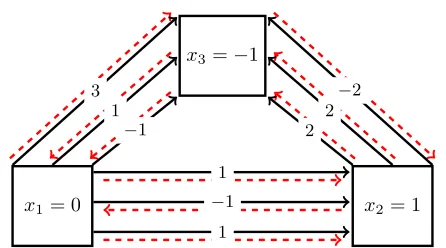
Figure 2: Illustration of the primal and dual LPs based on activities and votes in Figure 1. All votes/edges have unit weight/capacity. The cost of the edges (theci) are the val-ues submitted by the three voters in Figure 1 (after taking
log2). Optimal potentials (the xv) are associated with the activities; the differences between these values necessarily constitute a solution that is consistent, unlike the one at the right of Figure 1. Specifically, the bottom-edge comparison between gasoline and trash becomes−1instead of the1in parentheses at the right of Figure 1 (and the other aggregate differences are the same as in that figure). The flows on the edges from the dual LP (thefi) are always1and their direc-tions are indicated by the red/dashed arrows; note that the flows form a circulation. These flows are obtained by solv-ing the dual LP. The total cost of these flows is12, which is equal to the loss of the primal solution, which proves both to be optimal by weak LP duality.
Strong duality immediately gives the following theorem.
Theorem 1. FixV = [n],E = {(ai, bi, ci, wi)}mi=1. The
following problems have the same optimal objective value:
(1) Societal Tradeoffs with activitiesV and votesE. (2) Max-Cost Circulation with verticesV and edgesE.
3.3
Translation between Primal/Dual Solutions
Theorem 1 implies that, in order to find thevalueof an opti-mal solution to the Societal Tradeoffs problem, it suffices to solve Max-Cost Circulation. Nevertheless, we are generally not so much interested in this value, but rather in the solu-tion itself. While some LP algorithms solve for primal and dual solutions simultaneously, our goal is to avoid the use of general LP algorithms. We next show that there are more ef-ficient ways to translate optimal solutions between Societal Tradeoffs (primal) and Max-Cost Circulation (dual).
Algorithm 1:Translation from an Undirected Max-Cost Circulation optimum to a Societal Tradeoffs optimum.
Input :A circulation{fi}that maximizes the total cost on graph(V, E).
Output:Potentialsxthat minimize the loss of Societal Tradeoffs with activitiesV and votesE. LetS= (V,∅)be an empty system of difference
constraints with variablesx∈RV.
fori∈[m]do iffi >−withen
Add constraintxai−xbi ≤ciintoS.
iffi < withen
Add constraintxai−xbi ≥ciintoS.
SolveSby running Single-Source Shortest Path from an arbitrary vertex inV, and return the distance labels
x.
From dual optima to primal optima. Algorithm 1 com-putes an optimal primal solution by solving a system of dif-ference constraints. The difdif-ference constraints come from the complementary slackness conditions of LP 2—for dual constraints that are not tight (which correspond to unsatu-rated edges), we require the corresponding primal variables (i.e.,`+i or`−i for edgei) to be0.
Theorem 2. Given an optimal solution to Undirected Max-Cost Circulation, Algorithm 1 runs in time
O(m+n+TSSSP(n, m, W)),
and returns an optimal solution of the corresponding Soci-etal Tradeoffs instance.TSSSP(n, m, W)is the time required
to solve Single-Source Shortest Path with negative weights (SSSP) on a graph withnvertices,medges, and maximum absolute distanceW.
Proof. The time complexity follows from Algorithm 1 and fact that systems of difference constraints can be efficiently solved using SSSP oracles (Pratt 1977; Aspvall and Shiloach 1979). We focus on the correctness of the algorithm.
First observe thatS in Algorithm 1 is feasible, because no negative cycle exists in the graph representation of S. Otherwise, flowing backward along the cycle increases the total cost of the circulation, contradicting the optimality of
f.
Next we show that the loss incurred by xis exactly the cost off. The optimality ofxthen follows from weak du-ality. For i ∈ [m] where |fi| < wi, the corresponding loss wi|xai −xbi −ci| in the primal LP is zero, because
Algorithm 1 added both constraints xai −xbi ≤ ci and xai −xbi ≥ ci. Therefore, if we consider votes E
0 =
{(ai, bi, ci, w0i)}wherew0i = |fi|, the total loss ofxonE andE0are the same.
We then decomposef into sum of flows around directed cycles. For a cycleC= (uC
1, . . . , uCl(C))of lengthl(C)with
flowfC >0, letdC
Algorithm 2:Translation from a Societal Tradeoffs op-timum to an Undirected Max-Cost Circulation opop-timum.
Input :Potentialsxthat minimize the`1-loss of Societal Tradeoffs with activitiesV and votes
E.
Output:A circulation{fi}that maximizes the total cost on graph(V, E).
Letfi←0for alli∈[m].fori∈[m]do ifxai−xbi−ci<0then
fi←wi.
ifxai−xbi−ci>0then fi← −wi.
LetV0←V ∪ {s, t},(E0, Es, Et)←(∅,∅,∅). forv∈V do
dv=Pi:bi=vfi−Pi:ai=vfi. ifdv>0then
Es←Es∪ {(s, v, dv)} ifdv<0then
Et←Et∪ {(v, t,−dv)}
fori∈[m]do
ifxai−xbi−ci= 0then
E0←E0∪ {(ai, bi, wi),(bi, ai, wi)}.
Compute a maximums-tflowf0on
G0= (V0, E0∪Es∪Et). Returnf +f0|E0.
fCP
id C
i . Note that we consider the edges in the direction of the flow, and we always have
xuC
i −xuCi+1−d C
i =±(xa−xb−c).
Moreover, the fact thatfC >0means there are constraints of formxuC
i −xuCi+1≥d C
i inS. Therefore,
cost(f) =X
C
fC X
i∈[l(C)] dCi
=X
C
fC X
i∈[l(C)]
dCi −xuC
i +xuCi+1
=X
C
fCX
i
xuCi −xuCi+1−d C i = X
e=(a,b,c,w0)∈E0
X
C:e∈C
fC|xa−xb−c|
= X
(a,b,c,w0)∈E0
w0|xa−xb−c|
=L(V, E0, x) =L(V, E, x).
From primal optima to dual optima. For completeness, we show that we can also efficiently translate primal (So-cietal Tradeoffs) optima to dual (Max-Cost Circulation) optima. Algorithm 2 first constructs a partial flow based on votes/edges with non-zero primal costs, and then tries
to balance the surplus at each activity/vertex using only votes/edges with0primal costs.
Theorem 3. Given any optimum of a Societal Tradeoffs in-stance, Algorithm 2 runs in
O(m+n+TMaxFlow(n, m, U))
time and returns an optimum of the corresponding Undi-rected Max-Cost Circulation instance. TMaxFlow(n, m, U)
is the time complexity of Undirected s-t Max-Flow on a graph withnvertices,medges, and maximal capacityU.
Proof. The time complexity follows from the description of Algorithm 2. We focus on the correctness of the algorithm.
We first show that Algorithm 2 does output a circulation. In the first step, we assign a positive saturating flowfi =wi to an edge(ai, bi, ci, wi)ifxai−xbi−ci<0, and a negative
saturating flowfi=−wiifxai−xbi−ci>0. The surplus
of each vertexvis
dv= X
i:bi=v fi−
X
i:ai=v fi.
The algorithm then tries to route the remaining surpluses on the edges
E0={(ai, bi, ci, wi)|xai−xbi−ci= 0},
which have not been assigned any flow. This attempt suc-ceeds if the max flowf0 on graphG0 saturates every edge
froms(and every edge tot). We now show this always hap-pens whenxis optimal.
Suppose the flow computed is not saturating. That is, there exists a cutCwhose size is smaller thanP
v∈V:dv>0dv. Let S, T ⊂V be the vertices on thes-side andt-side ofC. Let
∆ = E0∩C be the edges/votes betweenS andT with0
primal cost. The cutCincludes edges in∆, as well as edges fromStotandstoT. From the assumption on the size of
C, we know that
X
(ai,bi,ci,wi)∈∆
wi− X
v∈S:dv<0
dv+ X
v∈T:dv>0
dv< X
v∈V:dv>0
dv.
Rearranging the terms gives
D:=X
v∈S
dv−
X
(ai,bi,ci,wi)∈∆ wi>0.
Note that by the construction offin the beginning,
dv=
X
i:ai=v,xai−xbi−ci>0 wi−
X
i:ai=v,xai−xbi−ci<0 wi
+ X
i:bi=v,xai−xbi−ci<0 wi−
X
i:bi=v,xai−xbi−ci>0 wi.
−P
v∈Sdv. On the other hand, changingxvin any way in-creases the loss on zero edges acrossC, and the total rate of this part is simply the total weight of zero edges across
C, namelyP
(ai,bi,ci,wi)∈∆wi. The sum of the two parts is
exactlyD.
Finally, we show that the cost of the constructed circula-tion is equal to the loss in the Societal Tradeoffs instance. For any unsaturated edgei ∈ E (i.e.|fi +fi0| < wi), the corresponding primal cost is0 (i.e.,xai −xbi −ci = 0).
Hence, settingwi0 =|fi+fi0|for these edges does not affect the primal or the dual cost. LetE0 be the edges after this transformation. A similar cycle-decomposition argument to that in the proof of Theorem 2 yields
cost(f) =L(V, E0, x) =L(V, E, x).
The optimality follows from weak duality.
3.4
Implications on the Time Complexity of
Societal Tradeoffs
A solid connection between Societal Tradeoffs and classic combinatorial problems has been established in the forego-ing sections. Based on this connection, we give a signifi-cantly improved algorithm for Societal Tradeoffs, and prove that improving our algorithm would give a faster algorithm for Min-Cost Circulation.
First, we review the state of the art for Min-Cost Circu-lation and Single-Source Shortest Path (SSSP) algorithms. Maximum Flow, Shortest Path, and other related graph prob-lems are core combinatorial optimization probprob-lems that have been studied extensively (see, e.g., (Edmonds and Karp 1972; Gabow and Tarjan 1989; Madry 2013; Cohen et al. 2017) and the references therein).
In this section, we will use n for the number of ver-tices (activities),mfor the number of edges (votes),U for the maximum capacity, andW for the maximum absolute value of the cost (for Min-Cost Circulation) or distance (for SSSP).
Lemma 1 ((Gabow and Tarjan 1989)). There is an algo-rithm for Min-Cost Circulation and SSSP which runs in time
O(m1.5log(nW)).
Lemma 2((Cohen et al. 2017)). For unit-capacity graphs, there is an algorithm for Min-Cost Circulation and SSSP which runs in timeOe(m10/7logW).3
We can now state our main results. Theorem 4 follows immediately from Theorem 2 and Lemmas 1 and 2. Theorem 4(Better Algorithms for Societal Tradeoffs). So-cietal Tradeoffs can be solved in time O(m1.5log(nW)),
whereW is the maximum difference suggested by the vot-ers. If all voters have the same weight, then Societal Trade-offs can be solved in timeOe(m10/7logW).
We further show (in Theorem 5) that the above algorithm cannot be significantly improved without giving faster Min-Cost Circulation algorithms. More specifically, any algo-rithm whose dependency on m has a smaller exponent is considered significantly faster. We first show that directed
3
We useOe(f(n))as a shorthand forO(f(n) logO(1)f(n)).
and undirected Min-Cost Circulations are essentially equiv-alent.
Lemma 3(Folklore). Directed Min-Cost Circulation withn
vertices,medges and maximum absolute costW can be re-duced to Undirected Min-Cost Circulation with parameters
(n+ 1,3m, nW). The reduction takesO(m+n)time.
Proof. We construct an Undirected Min-Cost instanceG0= (V∪ {v0}, E0)which preserves the solution to any Directed
Min-Cost Circulation instanceG= (V, E). Without loss of generality, we assume each capacitywi is an even integer. Otherwise, we first multiply all capacities by2, which does not change the nature of the instance. For each (directed) edge(ai, bi, ci, wi) ∈ E, we add 3 (undirected) edges into
E0:
• (ai, v0,−nW, wi/2),
• (v0, bi,−nW, wi/2), and
• (ai, bi, ci, wi/2).
Note that in any minimum cost circulation ofG0, all edges with cost−nW must be saturated. In other words, the opti-mum is a combination of two parts:
(1) a circulation consisting of wi/2 units of flow along directed cycles (bi, ai, v0), one for each edge
(ai, bi, ci, wi)∈E; and
(2) a Min-Cost Circulation on the residual graph. Observe that the residual graph is exactlyG.
Thus, a Min-Cost Circulation ofGcan be recovered from a Min-Cost Circulation ofG0, by subtracting the first part of the flow. This can be done inO(m+n)time.
Theorem 5 is a direct corollary of Theorem 1 and Lemma 3.
Theorem 5(Improvement Gives Faster Flow Algorithms). LetU denote the maximum weight of any voter (and max-imum capacity), and letW denote the maximum difference between activities (and maximum absolute cost).
LetTMCCdenote the time it takes to compute a circulation
that minimizes the total cost.
TMCC(n, m, U, W)
≤TSocietalTradeoffs(n+ 1,3m, U, nW) +TMaxFlow(n+ 1,3m, U) +O(m+n).
In other words, if one can solve Societal Tradeoffs signif-icantly faster, then either (1) there is a faster algorithm that computes a Min-Cost Circulation, or (2) Min-Cost Circula-tion is no harder than Max-Flow. Either result would be a breakthrough on the computation of min-cost flow.
4
Limitations of Hill-climbing
local improvements are possible. Conitzer et al. (2016) ob-served that hill-climbing can get stuck at local optima. We give a simple example where hill-climbing gets stuck. In ad-dition, we show that even when the algorithm converges to optimality, sometimes this can take a very long time.
Hill-climbing can get stuck in a local optimum. Con-sider an example with6 activities, and one complete vote (or equivalently, a vote for each pair of activities with unit weight). Fori ∈ {1,2,3}, the difference between xi and
xi+3should be1, and the difference between any other pair
should be0. The optimal solution is to assign every activity the same value, say0, with total loss3.
Consider an initial value configuration (1,1,1,0,0,0). This is a local optimum for hill-climbing with loss6, since changing the value of any single vertex cannot reduce the total loss. To see this, consider activity 1. At this local opti-mum, its differences to activitiesx2,x3, andx4 align with
the vote, so 3 out of the 5 remaining activities preferx1to stay the same. Similar arguments hold for other activities.
Hill-climbing can take arbitrarily long to terminate. Consider the same example except that the voter now thinks the value of activity1should beεhigher than that of activ-ity2. Again, we start from(1,1,1,0,0,0). First we movex2
to1−ε, because this improves the comparison withx1,x4,
andx6(but moving it any further would hurt the comparison withx1). Then, we movex3to1−εbecause this improves the comparison tox2,x4, andx5. After that, we movex1to
1−εto improve the comparison tox3,x5, andx6. Now we are back to a similar configuration to where we started, i.e.,
(1−ε,1−ε,1−ε,0,0,0). Following this pattern, it takes
Ω(1/ε)time for hill-climbing to terminate. For arbitrarily smallε, this time can be arbitrarily large.
5
Experiments
All experiments were done on a laptop computer with 8GB of memory and a 2.6 GHz Intel Core i5 CPU. Results are obtained by averaging over 10 runs with different seeds.
5.1
Experimental Setup
For empirical evaluation, we implemented our algorithm based on the network simplex algorithm from LEMON (an open-source library of graph algorithms). We evaluate our flow-based algorithm against
1. an LP solver based on the GNU Linear Programming Kit (GLPK),
2. an LP solver based on CPLEX, which is generally consid-ered one of the best general-purpose LP solvers, and
3. a hill-climbing heuristic.
(1) and (3) were studied experimentally by Conitzer et al. (2016). We generate input using 4 different distributions:
1. Uniform. For each voter and each pair of activities(u, v), we draw a numberx∈[−1,1]uniformly at random, and let the voter’s tradeoff betweenuandvbex.
2. Spanning. For each voter, we sample a random spanning tree of the activities. For each edge(u, v)of the spanning tree, we draw the voter’s tradeoffxuniformly at random from[−1,1]. We then fill in the voter’s tradeoff between other pairs of activities by consistency.
3. Noise. We first draw a potential for each activitypvfrom
[−10,10]uniformly at random. For each voteriand each pair of activities(u, v), let the voter’s tradeoff betweenu
andvbepu−pv+xiuv, wherex i
uv ∈ [−1,1]is drawn independently uniformly at random.
4. Random-graph-uniform. For each voter, we draw exactly one pair of activities(u, v)and a numberxfrom[−1,1]
uniformly at random. We then let the voter’s tradeoff be-tweenuandvbex.
The first three distributions generate instances where each voter expresses a preference on every pair of activities (i.e., the voting graph is a clique). The spanning tree distribution generates consistent votes; the others generally do not.4
5.2
Results and Evaluation
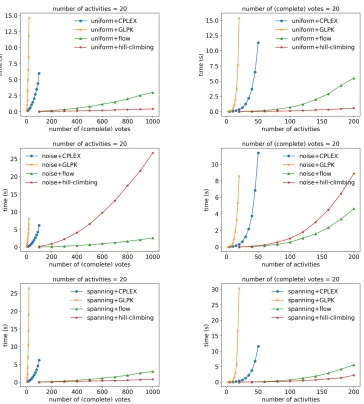
As can be seen from Figure 3, GLPK is consistently slow, particularly on instances from the spanning distribution. CPLEX is faster than GLPK, but still significantly slower than the other two methods.
Hill-climbing works reasonably well as a heuristic al-gorithm. As Table 1 shows, its accuracy improves as the voting graph becomes denser. In particular, the solutions hill-climbing generates are usually indistinguishable from the optimal solution when voters give complete votes (i.e., tradeoffs between all pairs of activities).
In terms of runtime, hill-climbing beats our flow-based algorithm on the uniform and spanning distributions. How-ever, its runtime is worse under the noise model, when there is an underlying ground truth. During our experiments, we sometimes observe instances on which hill-climbing takes significantly more time than the flow-based algorithm. In contrast, the flow-based algorithm shows remarkable robust-ness regardless of the distribution of the input.
In general, our flow-based algorithm is robustly fast with a strong upper bound on running time, and is guaranteed to produce an optimal solution. In contrast, the formerly stud-ied algorithms have notable flaws: LP-based methods (i.e., GLPK and CPLEX) produce optimal solutions but almost never terminate on our large instances, and hill-climbing, at the cost of producing suboptimal solutions, is not too much faster and its runtime is extremely sensitive to the structure of the input. These factors make our flow-based algorithm preferable both in theory and in practice.5
6
Discussion
Our algorithm for societal tradeoffs scales much better than the previously known linear programming approach. Given
4
We consider inconsistent votes here in order be consistent with prior experimental practice on this topic (Conitzer et al. 2016).
5
Figure 3: Runtime of the 3 algorithms on inputs from different distributions. The left 3 figures plot the growth of running times when the number of votes grows, and the right 3 figures show the running times when the number of activities grows.
Number of edges 100 200 300 400 500
Approximation ratio 2.04 1.20 1.06 1.04 1.02
Table 1: Approximation ratio of hill-climbing vs. density of the voting graph (random-graph-uniform distribution with 100 nodes).
the tight connection to min-cost circulation that we have ex-hibited, it appears that there is little left to be done to im-prove this algorithm as far as exact approaches go. Even when comparing to the previously known heuristic hill-climbing approach, our algorithm is sometimes significantly faster in experiments—and of course it comes with the ben-efits of exactness and provable running time guarantees.
The faster algorithm will allow us to scale to much larger sets of activities. In some contexts, this will be
7
Acknowledgements
We are thankful for support from NSF under awards IIS-1814056 and IIS-1527434. Yu Cheng is also supported in part by NSF grants 1527084, 1535972, CCF-1637397, CCF-1704656, IIS-1447554, and NSF CAREER Award CCF-1750140. We also thank anonymous reviewers for helpful comments.
References
Aspvall, B., and Shiloach, Y. 1979. A polynomial time al-gorithm for solving systems of linear inequalities with two variables per inequality. InFoundations of Computer Sci-ence, 1979., 20th Annual Symposium on, 205–217. IEEE.
Brandt, F.; Conitzer, V.; Endriss, U.; Lang, J.; and Procaccia, A. D. 2015. Handbook of Computational Social Choice. Cambridge University Press.
Cohen, M. B.; Madry, A.; Sankowski, P.; and Vladu, A. 2017. Negative-weight shortest paths and unit capacity min-imum cost flow in ˜o (m 10/7 log w) time. InProceedings of the Twenty-Eighth Annual ACM-SIAM Symposium on Dis-crete Algorithms, 752–771. Society for Industrial and Ap-plied Mathematics.
Conitzer, V.; Freeman, R.; Brill, M.; and Li, Y. 2016. Rules for choosing societal tradeoffs. In Thirtieth AAAI Confer-ence on Artificial IntelligConfer-ence.
Conitzer, V.; Sinnott-Armstrong, W.; Borg, J. S.; Deng, Y.; and Kramer, M. 2017. Moral decision making frameworks for artificial intelligence. In Proceedings of the Thirty-First AAAI Conference on Artificial Intelligence, 4831– 4835. Blue Sky track.
Conitzer, V.; Brill, M.; and Freeman, R. 2015. Crowdsourc-ing societal tradeoffs. InProceedings of the Fourteenth In-ternational Conference on Autonomous Agents and Multi-Agent Systems (AAMAS), 1213–1217. Blue Sky Ideas track. Edmonds, J., and Karp, R. M. 1972. Theoretical improve-ments in algorithmic efficiency for network flow problems. Journal of the ACM (JACM)19(2):248–264.
Endriss, U. 2015. Judgment aggregation. In Brandt, F.; Conitzer, V.; Endriss, U.; Lang, J.; and Procaccia, A. D., eds., Handbook of Computational Social Choice. Cam-bridge University Press. chapter 17.
Freedman, R.; Borg, J. S.; Sinnott-Armstrong, W.; Dicker-son, J. P.; and Conitzer, V. 2018. Adapting a kidney ex-change algorithm to align with human values. In Proceed-ings of the Thirty-Second AAAI Conference on Artificial In-telligence.
Gabow, H. N., and Tarjan, R. E. 1989. Faster scaling algo-rithms for network problems. SIAM Journal on Computing 18(5):1013–1036.
Lang, J., and Xia, L. 2015. Voting in combinatorial do-mains. In Brandt, F.; Conitzer, V.; Endriss, U.; Lang, J.; and Procaccia, A. D., eds.,Handbook of Computational Social Choice. Cambridge University Press. chapter 9.
Madry, A. 2013. Navigating central path with electrical flows: From flows to matchings, and back. InFoundations
of Computer Science (FOCS), 2013 IEEE 54th Annual Sym-posium on, 253–262. IEEE.
Noothigattu, R.; Gaikwad, S. N. S.; Awad, E.; D’Souza, S.; Rahwan, I.; Ravikumar, P.; and Procaccia, A. D. 2018. A voting-based system for ethical decision making. In Pro-ceedings of the Thirty-Second AAAI Conference on Artificial Intelligence.
Pratt, V. 1977. Two easy theories whose combination is hard. Technical report, Technical report, Massachusetts In-stitute of Technology.