R E S E A R C H
Open Access
Classification of heterogeneous text data for
robust domain-specific language modeling
Ján Staš
*, Jozef Juhár and Daniel Hládek
Abstract
The robustness ofn-gram language models depends on the quality of text data on which they have been trained. The text corpora collected from various resources such as web pages or electronic documents are characterized by many possible topics. In order to build efficient and robust domain-specific language models, it is necessary to separate domain-oriented segments from the large amount of text data, and the remaining out-of-domain data can be used only for updating of existing in-domainn-gram probability estimates. In this paper, we describe the process of classification of heterogeneous text data into two classes, to the in-domain and out-of-domain data, mainly used for language modeling in the task-oriented speech recognition from judicial domain. The proposed algorithm for text classification is based on detection of theme in short text segments based on the most frequent key phrases. In the next step, each text segment is represented in vector space model as a feature vector with term weighting. For classification of these text segments to the in-domain and out-of domain area, document similarity with automatic thresholding are used. The experimental results of modeling the Slovak language and adaptation to the judicial domain show significant improvement in the model perplexity and increasing the performance of the Slovak transcription and dictation system.
Keywords: Document similarity; Language modeling; Speech recognition; Term weighting; Text classification; Topic detection
1 Introduction
With an increasing amount of the text data gathered from various web pages or electronic documents and growing need for more accurate and robust models of the Slovak language [1], a question of how to classify the text data according to their content arises even more than expected. This question is getting on importance with using hetero-geneous text corpora, in which we do not have any knowl-edge about the document boundaries. In the case of the
task-oriented speech recognitionanddomain-specific lan-guage modeling [2], these heterogeneous text data bring many ambiguities caused by the overestimating suchn -gram probabilities that are typically unrelated with the area of speech recognition into the process of the train-ing language models. Therefore, we were looktrain-ing for a way of classification of the text data into predefined domains
*Correspondence: [email protected]
Department of Electronics and Multimedia Communications, Technical University of Košice, Park Komenského 13, 041 20 Košice, Slovakia
as good way as possible and adjustment of the parame-ters of language modeling for effective large vocabulary continuous speech recognition(LVCSR).
There are two ways existing for assigning text data into domains; using text classification or document clustering with topic detection. The difference between them is that thetext classificationis based on assigning the text data
into two or more predefined classes, whereas document
clusteringtries to group similar documents into a number of classes and find some relationship between them. The similarity of two documents represented by their feature vectors is usually based on computing cosine of the angle between them [3]. After clustering, the topic detection for every cluster of documents is needed [4]. Unlike cluster-ing, the classification is supervised learning technique and requires the training data for classifying new documents. Considering fact that we need to group text documents only into two classes, we focused our research on the text classification techniques.
A growing number of statistical methods have been applied to the problem of text classification in recent
years, including naïve Bayes classifier and probabilis-tic language models [5,6], similarity-based approaches using k-nearest neighbor classifier [5,7], decision trees
and neural networks [8], support vector machines [5,9], or semi-supervised clustering [10]. When large amount of documents is used, these algorithms usually suffer from a very high computational complexity. Moreover, for correct estimation of parameters of these classifica-tion algorithms, a training corpus is needed. Therefore, we proposed an algorithm based on computing simi-larity between two documents and decision, which one will appertain to the domain and one which will not, using a threshold value calculated automatically on a development data set. This simple and effective algo-rithm classifies short text segments (such as paragraphs) from heterogeneous text corpora gathered from vari-ous resources to the in-domain and out-of-domain data. Classified text data are then used in statistical language modeling for enhancing its quality and robustness in the task-oriented speech recognition.
The rest of this paper is organized as follows. Section 2 starts with a short overview about the source data used either for text classification, training acoustic and lan-guage models, and testing the Slovak LVCSR system. Our proposed approach for text classification based on the key phrase identification, term weighting, measur-ing similarity between two documents, and automatic thresholding is introduced in the Section 3. Section 4 presents the speech recognition setup used for evaluat-ing language models trained on classified text corpora. The experimental results with adapted models of the Slo-vak language into the selected domain are discussed in the Section 5. Finally, Section 6 summarizes the contri-bution of our work and concludes this article with future directions.
2 Source data
2.1 Acoustic database
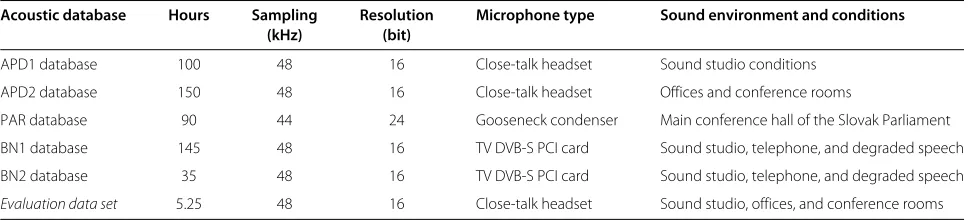
For testing language models using speech recognition sys-tem, the Slovak acoustic database was created, on which acoustic models have been trained. Speech database con-sists of three subsets (see the Table 1):
• The first part is characterized by gender-balanced speakers, contains 250 h of speech recordings obtained from 250 speakers together and consists of two parts: APD1 and APD2 databases. The APD1 database includes 100 h of readings of real adjustments from the court with personal data changed, recorded in sound studio conditions. The APD2 database consists of 150 h of read phonetically rich sentences, web texts, newspaper articles, short phrases, and spelled items, recorded in conference rooms using table and close-talk headset
microphones [2].
• The second PAR database includes 90 h of 90% male and 10% female speech recordings realized in the main conference hall of the Slovak Parliament using conference gooseneck condenser microphones [11].
• The mixture of Broadcast news (BN) databases consists of 145 h of speech recordings acquired from main and morning TV shows and 35 h from
broadcast news and TV and radio shows, together realized with TV DVB-S PCI card [12].
All speech recordings were downsampled to kHz 16-bit PCM mono format for training and testing. The whole acoustic database was manually annotated by our team of trained annotators using the Transcriber tool [12], double checked, and corrected.
2.2 Text corpora
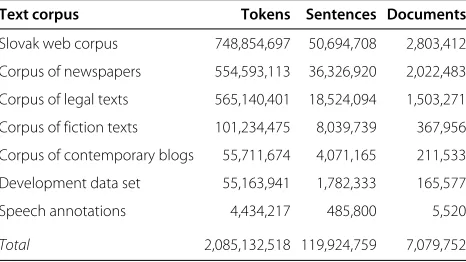
The main part of text corpora used for text classification and statistical language modeling was created by using our proposedsystem for gathering text datafrom various web pages and electronic resources written in Slovak lan-guage [1]. From the retrieved text data, there was a large amount of numerals, symbols, or grammatically incorrect words filtered out and the rest of the data were normal-ized into their pronounced form by additional process-ing, such as word tokenization, sentence segmentation, numerals transcription, and abbreviations expanding. The processed text corpora were later divided into smaller domain-specific subcorpora ready for the training lan-guage models. Contemporary text corpora consists of following subsets:
Table 1 Acoustic database description
Acoustic database Hours Sampling Resolution Microphone type Sound environment and conditions
(kHz) (bit)
APD1 database 100 48 16 Close-talk headset Sound studio conditions
APD2 database 150 48 16 Close-talk headset Offices and conference rooms
PAR database 90 44 24 Gooseneck condenser Main conference hall of the Slovak Parliament
BN1 database 145 48 16 TV DVB-S PCI card Sound studio, telephone, and degraded speech
BN2 database 35 48 16 TV DVB-S PCI card Sound studio, telephone, and degraded speech
• Slovak web corpus was collected by crawling whole web pages from various Slovak domains saved with information about date, title, URL, extracted text, and HTML source code.
• Corpus of newspapers is a collection of articles that have been gathered from the most popular online news portals, magazines, and journals in the Slovak Republic. This corpus was extended by a large amount of newspaper articles downloaded via RSS channels and collection of manually corrected speech transcriptions of four main TV broadcast news and five radio shows.
• Corpus of legal texts (judicial corpus) was obtained from the Ministry of Justice of the Slovak Republic in order to develop the automatic dictation system for their internal purpose [2].
• Corpus of fiction texts was created from1, 625
electronic books and other stories freely available on the Internet written in Slovak language.
• Corpus of contemporary blogs consists of
web-extracted blog texts from main news portals in the Slovak Republic saved without contribution’s comments.
• Development data set (held-out data) was created from 10% randomly selected sentences from (in-domain) corpus of legal texts that were not used in the process of training language models.
• Speech annotations (transcriptions) of data obtained from acoustic database are a special portion of the text corpus. Transcriptions also contain a large amount of filled pauses and additional disfluent speech events together with useful text. We have discovered that filled pauses have a positive effect on the quality of language modeling, both for dictated or spontaneous speech. Therefore, we decided to include these speech transcriptions into the process of language modeling.
The complete statistics on the total number of tokens and sentences for particular text subcorpus are summa-rized in the Table 2.
Table 2 Statistics on the text corpora
Text corpus Tokens Sentences Documents
Slovak web corpus 748,854,697 50,694,708 2,803,412
Corpus of newspapers 554,593,113 36,326,920 2,022,483
Corpus of legal texts 565,140,401 18,524,094 1,503,271
Corpus of fiction texts 101,234,475 8,039,739 367,956
Corpus of contemporary blogs 55,711,674 4,071,165 211,533
Development data set 55,163,941 1,782,333 165,577
Speech annotations 4,434,217 485,800 5,520
Total 2,085,132,518 119,924,759 7,079,752
Moreover, each text corpus was annotated using our proposedSlovak morphological classifier[13] based on a hidden Markov model (HMM) together with suffix-based word clustering function and restricted bymanually mor-phologically annotated lexicon of words. The HMM has been trained on trigram statistics generated from mor-phologically annotated corpus together with the lexicon delivered by the Slovak National Corpus [14]. Note that the morphologically annotated corpus were then used in the process of extraction of key phrases from development data set of the proposed algorithm for classification of heterogeneous text data.
3 Proposed text classification approach
As it was mentioned before, we proposed an effective approach for classification of heterogeneous text corpora into the two data sets, the in-domain and out-of-domain data, to increase the robustness of domain-oriented sta-tistical language modeling in the Slovak LVCSR system. Our algorithm is based on identifying key phrases with their occurrences in short text segments. Each text docu-ment is represented as a vector of key phrases in a vector space (a key phrase/document matrix). For reducing the influence of frequent key phrases in documents, term weighting was applied. The next step includes measuring the similarity between reference and examined document to determine the closeness between them. Based on the automatic thresholding, the algorithm then decides which text document belongs or does not belong to the exam-ined domain (in our case to the judicial one). The block scheme of the proposed text classification approach is depicted in Figure 1.
In the following sections, the proposed text classifica-tion approach is described in more detail.
3.1 Key phrase extraction
Figure 1The block scheme of the proposed approach for text classification.
background on how the set of morpho-syntactic patterns were created can be found in [15].
3.2 Text segmentation
In general, text data gathered from the Internet are char-acterized by a large variety of domains or topics that are contained in the web articles, from which the text corpus is composed. Moreover, in case of large-scale text docu-ments, they may also contain more than one theme within. As it was mentioned earlier, this problem is gaining on importance when using heterogeneous text corpora, in which we have no knowledge about the document bound-aries. Therefore, the next step in the text classification process includes segmentation of the used text corpora into the small segments (paragraphs) with at least 300 words. This value was determined empirically from the
Table 3 Morpho-syntactic patterns
Type Characterization Scheme
2-gram Adjective + noun AS
Numeral + noun NS
Noun + noun SS
Abbreviation + noun WS
3-gram Adjective + adjective + noun AAS
Adjective + noun + noun ASS
Adverb + adjective + noun DAS
Numeral + adjective + noun NAS
Noun + adjective + noun SAS
Noun + preposition + noun SES
Noun + numeral + noun SNS
4-gram Noun + preposition + adjective + noun SEAS
Noun + preposition + noun + noun SESS
Noun + noun + conjunction + noun SSOS
statistical observation and expresses the average number of words contained in one paragraph of a web-based arti-cle. By application of segmentation rules, we obtained a total of 6, 908, 655 short (300+ words) text segments -documents - entering to the process of text classification. The statistics on the number of documents after text seg-mentation for particular subcorpus are resumed in the Table 2.
3.3 Key phrase identification
In the next step, the key phrases were used in comput-ing the frequency of their occurrence in examined text segments of 300+ words. The key phrase identification process is similar to any topic detection approach. How-ever, in this process we have not considered removal of stop-words, because key phrases extracted using pro-posed morpho-syntactic patterns contained such part-of-speech classes as prepositions or conjunctions (see the Table 3). Also lemmatization (or stemming) is very time-consuming and would cause high memory requirements, therefore it has not been introduced into this process of text classification. Note that text segments that did not contain any key phrases were automatically classified as out-of-domain data.
3.4 Vector space modeling
One of the simplest way how to represent the occurrence of terms (key words or key phrases) in any text document is to use avector space model(VSM). In eachith docu-ment,d¯iis represented as a feature vector of the termstj
that appear in this document as follows [5]:
¯
di=(ti,1,ti,2,. . .,ti,N). (1)
Section 3.2), we have received the matrix with 5, 210 columns and 6, 908, 655 rows. However, the main disad-vantage of such representation is a very high dimension of this matrix and sparsity of values in the vector space, resulting in very high requirements on its storage.
3.5 Term weighting
As it was mentioned earlier, term weighting was applied as a feature selection algorithm for reducing the influence of frequently occurring terms in a collection of documents. In this research, we have tested three different weighting schema: (a) tf-idf, (b) Okapi BM25, and (c) Ltu factors.
The conventional term weighting came from the com-puting frequency of a term in a document using theterm frequency and the frequency in the collection of docu-ments in which the term appears, which is expressed as the document frequency. A number of term weighting schemes based on these two frequency functions exist such as idf - inverse document frequency, expressed by the negative reciprocal value of the document frequency; ridf -residualidf, defined as the difference between actual idf and logarithm of idf predicted by Poisson distribution in a term distribution model; tf-idf and tf-ridf that com-bines term frequency and document frequency into one algorithm, which can be scaledlogarithmicallyor normal-ized byaugmentedversion [5]. Moreover, term weighting does not have to be performed on the entire collection of documents. It can be calculated on a small training corpus and used in clustering dynamic data streams using tf-icf weighting [16].
Based on the previous research [17] focused on a com-parative study of term weighting schemes, we observed that standard tf-idf achieved the best results in clustering of the Slovak text documents obtained from Wikipedia. Therefore, we used this weighting scheme in the proposed classification too.
The tf-idf is a standard term weighting scheme used in information retrieval or data mining and combines term frequency and inverse document frequency together. The importance of tf-idf increases proportionally to the occur-rence of a word in the document and is offset by the frequency of the word in the collection of documents according to formula [5]
wi,j=tfi,j×idfi=
fi,j
kfk,j ×
log N
dfi
, (2)
where fi,j is the number of occurrence of a termti in a
document dj and sum in the denominator of tfi,j
com-ponent expresses the number of occurrences of all terms
ti indj. Then, N is the total number of documents, and
the denominator of idfi component expresses the total
number of documents in a collection that ti occurs in
well-known as document frequency dfi.
Contemporary term weighting schemes take into account additional factors such asmaximum of term fre-quencymax(tfi,j)in a document,length of a documentdli,
oraverage document lengthdlavg in a collection of
docu-ments. Between these, we can fit a simpleautomated text classification(ATC), which uses the idf as the term impor-tance factor and Euclidean vector length as the document length normalization factor, either Okapi BM25 or Ltu scoring [18] that were used in our experiments.
The Okapi BM25 score is defined as a bag-of-words retrieval function that ranks a collection of documents regardless of the inter-relationship between the terms within a document [5]. It is based on computing BM25-tf score and idf component derived from the binary inde-pendence model that is well-known from the probabilistic theory in the information retrieval [19]:
wi,j=BM25 − tfi,j × idf∗i =
tfi,j
0.5+1.5× dli
dlavg +tfi,j
× logN−dfi+0.5 dfi+0.5
,
(3)
where tfi,jmeans term frequency,N is a total number of
documents in the collection, dfi presents the document
frequency, dlidocument length and dlavgthe average doc-ument length for the collection. In addition, we can put the Okapi BM25 scoring into the tf-idf scheme, which was presented in [20].
In Ltu term weighting scheme, L factor expresses the
logarithm of the term frequency, t factor theinverse docu-ment frequency, and u thelength normalizationfactor as follows [21]:
wi,j=L×t×u=(log tfi,j+1)×log
N
dfi×
1 0.8+0.2× dli
dlavg .
(4)
As we can see from these equations, both the Okapi BM25 and Ltu scores are only a certain variation of the conventional tf-idf weighting.
The problem of data sparsity and high dimension of VSM after term weighting can be efficiently eliminated usinglatent semantic analysis/indexing (LSA/LSI) or its
3.6 Document similarity measurement
The next step involves measuring similarity of two docu-ments. In this approach, we measured the document simi-larity between reference and examined texts, not between all documents in a collection, commonly used in the tasks oriented on the document clustering. The reference text contained weighted form of all key phrases which occurred in a development data set. Both reference and examined text documents were represented by the vector of 5, 210 key phrases weighted according to the selected weighting scheme, described in the Section 3.5, so they could be compared.
By empirical study of numerous similarity measures described in [23], we have chosen three different mea-sures: (a) Bhattacharyya coefficient, (b) Jaccard correla-tion index, and (c) Jensen-Shannon divergence, satisfying the conditions of non-negativity, symmetricity, triangle inequality, andidentity, when distance is equal to 0.
For clustering phonemes in the process of training acoustic models, the Bhattacharyya coefficient is often used. In general, it can be used as a classification criterion in many other tasks oriented on clustering in information theory. Therefore, we used this coefficient as one classi-fication criterion. Bhattacharyya coefficient comes from thesum of geometric meansbetween two probability den-sity functions and specifies the separability of two classes
xandyas follows:
dBha= −ln
N
i=1
√x
iyi. (5)
On the contrary,Jaccard correlation indexis defined as aharmonic meanbetween two probability density func-tions and expresses a scalar sum of two vectors. It comes from equation on computing cosine similarity [5], nor-malized by absolute deviation of two distributionsxandy
according to the formula
dJac=
N
i=1(xi+yi)2 N
i=1x2i + N
i=1y2i − N
i=1xiyi
. (6)
Jensen-Shannon divergencecomes from the principle of uncertainty. It is often used in information theory and natural language processing as a special case ofrelative entropy approachsimilar to the averaged Kullback-Leibler divergence, satisfying the condition of symmetry in the entire range of values. For two probability density func-tionsxandy, it is computed as
dJS=
1 2
N
i=1
xiln
2xi
xi+yi
+1
2 N
i=1
yiln
2yi
xi+yi
. (7)
3.7 Automatic thresholding
The last step in the classification process is to correctly adjust the threshold that determines which documents
will appertain to the in-domain and which to the out-of-domain area. In general, this value is usually deter-mined empirically from long-term observation or can be adjusted automatically based on a set of statistic val-ues derived from development data. There are many algorithms for automatic thresholding. A comprehensive study about those can be found in [24].
We used themedian(centroid) of a sequence of
coef-ficients derived from a set of values determining the similarity of two documents as a method of automatic thresholding (see the Section 3.6). The threshold value was calculated on a development data set and its acqui-sition shares the same process with classification of the text data described in the previous sections. This means that the development data were divided into short text segments consisting of at least 300 words, represented by VSM through the key phrases, and weighted, and each document was compared with the reference text (weighted list of key phrases) using one of the presented similarity measure. Using this process, we get a list of the coefficients (one coefficient for each document in devel-opment data set) expressing distance to the target domain. This list was sorted and the median value was selected as a threshold.
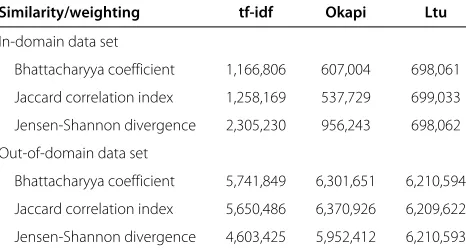
In the Table 4, we can find the statistics of the number of in-domain and out-of-domain documents after apply-ing the proposed classification approach to the segmented text corpora for different term weighting scheme and distance measure used in the step of measuring similar-ity between the reference and examined documents with automatic thresholding.
The performance between in-domain and out-of-domain language models is summarized in the Table 5. Model perplexity evaluated on a development data set was used for testing the quality of the language models. Its calculation will be introduced in the next section.
4 Speech recognition setup
4.1 Decoding
For evaluation of the quality of language modeling after text classification and performance of the Slovak LVCSR,
Table 4 The number of documents after text classification
Similarity/weighting tf-idf Okapi Ltu
In-domain data set
Bhattacharyya coefficient 1,166,806 607,004 698,061
Jaccard correlation index 1,258,169 537,729 699,033
Jensen-Shannon divergence 2,305,230 956,243 698,062
Out-of-domain data set
Bhattacharyya coefficient 5,741,849 6,301,651 6,210,594
Jaccard correlation index 5,650,486 6,370,926 6,209,622
Table 5 Model perplexity for particular language models computed on development data
Similarity/weighting tf-idf Okapi Ltu
In-domain data set
Bhattacharyya coefficient 14.1223 15.7542 17.2876
Jaccard correlation index 14.0815 14.8402 17.2872
Jensen-Shannon divergence 15.0343 15.4863 17.2878
Out-of-domain data set
Bhattacharyya coefficient 90.6770 25.7417 183.670
Jaccard correlation index 75.0398 20.7094 162.901
Jensen-Shannon divergence 99.8450 24.3595 187.167
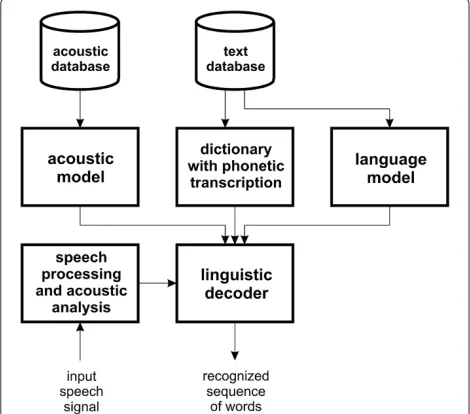
we configured a speech recognition setup based on Julius, an open-source continuous speech recognition engine [25]. Julius usestwo-level Viterbi search algorithm, when input speech is processed in the forward search with bigram model, and the final backward search is performed again using the result obtained from the first search to narrow the search space with reverse language model of the highest order (in our case with trigram model). Pro-posed speech recognition setup is depicted in the Figure 2.
4.2 Acoustic modeling
The speech recognition setup involves a set oftriphone context-dependent acoustic modelsbased on HMMs. All models have been generated from feature vectors contain-ing 39 mel-frequency cepstral (MFC) coefficients, where each of four states had been modeled by 32 Gaussian mixtures. Acoustic models have been trained on four databases of annotated speech recordings, described in the Section 2.1, using HTK Toolkit. The training set also involves model of silence, short pause, and additional
Figure 2The Slovak LVCSR system.
noise events. Rare triphones have been modeled by the
effective triphone mapping algorithm[11].
4.3 Language modeling
The experimental results have been performed taking an
advantage of trigram models created using the SRI LM
Toolkit [26], restricted by the vocabulary size of 325, 555
unique words and smoothed by theWitten-Bell back-off
algorithm. All models have been trained on the processed text corpora size of about 2 billion of tokens in 120 million of sentences (see the Table 2) and divided into two parts, to the in-domain and out-of-domain data, after text clas-sification (see the Table 4). Particular models trained on in-domain and out-of-domain data were combined with a model trained on the small portion of text data obtained from speech transcriptions (see the Table 2). Finally, the resulting trigram model was composed from three inde-pendent models andadapted to the judicial domainusing
linear interpolationwith computing interpolation weights by our proposed algorithm based on theminimization of perplexityon a development data set. The complete pro-cess of building the Slovak language models is depicted on the Figure 3 and described in [1].
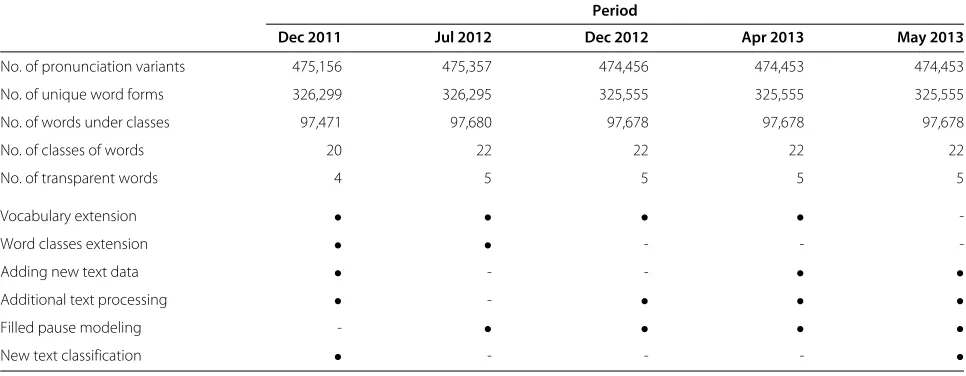
In this article we have compared the contribution of changes performed in the vocabulary, also using better text preprocessing steps, adding new text data, or intro-ducing new principles into the Slovak language modeling during the recent time periods. These contributions and differences between language models are summarized in the Table 6.
During this period, the named entities such as people names, surnames, and geographical items were assigned into the word classes in recognition dictionary. The vocabulary has been continually updated with the new words, checked, and corrected. We have introduced filled pauses into the language modeling as transparent words and model some geographically named entities as multi-words. We have also tested a number of methods for lan-guage model adaptation to the ted domain and algorithms for text classification and clustering.
4.4 Evaluation
For evaluation of the Slovak language models after text classification, three standard measures have been used.
Accuracy(Acc) andCorrectness(Corr) are the standard extrinsic measures for evaluating the performance of the
LVCSR system. IfN is the total number of words in an
evaluation data set (reference),S,I, andDreflect the total number of substituted, inserted, and deleted words in rec-ognized hypothesis, respectively, andH=N−(S+D)is the total number of words in hypothesis, then
Acc= H−I
N and Corr=
H
Figure 3The block scheme of the process of building the Slovak language models.
For intrinsic evaluation of the quality of language mod-eling, the model perplexity has been used.Model perplex-ity(PPL) is defined as the reciprocal value of the weighted (geometric) probability assigned by the language model to each word in the test set and is related to cross-entropy
H(W)by the equation
PPL=2H(W)= √n 1
P(W), (9)
whereP(W)is the probability of sequence ofnwords in a language model.
The evaluation data set used for testing the perfor-mance of the LVCSR system and the quality of the Slovak language modeling after text classification were repre-sented by randomly selected segments from the APD databases (see the Section 2.1, Table 1) containing 1, 950 male and 1, 476 female speech utterances with total length of about 5.25 h. These speech segments were not used in the training of acoustic models and contain 41, 868 words in 3, 426 sentences and short phrases. We have decided to include also short phrases in the test set because people make pauses in real conditions not only on the sentence
boundaries, but also on phrase boundaries, usually before conjunctions.
5 Experimental results
The experiments have been oriented on the evaluation of the model perplexity and performance of the Slovak LVCSR system on the evaluation (test) data after text clas-sification and statistical modeling of the Slovak language from judicial domain. The selection of this domain was intentional concerning our research oriented on develop-ment of the Slovak automatic dictation and transcription system for the Ministry of Justice of the Slovak Republic in recent years [2]. The same approach for text clas-sification and statistical language modeling can be also used for several other domains, in the task of broad-cast news transcription, meeting speech recognition, etc.
As it was mentioned in the Section 3, the statistics on the numbers of in-domain and out-of-domain documents after text classification regarding the used term weighting scheme in combination with selected similarity measure are resumed in the Table 4.
Table 6 Differences in the text processing and language modeling during the recent time periods
Period
Dec 2011 Jul 2012 Dec 2012 Apr 2013 May 2013
No. of pronunciation variants 475,156 475,357 474,456 474,453 474,453
No. of unique word forms 326,299 326,295 325,555 325,555 325,555
No. of words under classes 97,471 97,680 97,678 97,678 97,678
No. of classes of words 20 22 22 22 22
No. of transparent words 4 5 5 5 5
Vocabulary extension • • • •
-Word classes extension • • - -
-Adding new text data • - - • •
Additional text processing • - • • •
Filled pause modeling - • • • •
New text classification • - - - •
Table 7 Language model perplexity and performance of Slovak LVCSR system with different acoustic models
APD1+APD2 250 h APD1+APD2 250 h APD1+APD2 APD1+APD2
Text (table mic.) (close-talk mic.) +PAR 340 h +PAR+BN 520 h
PPL classification sp. adapt.: no sp. adapt.: no sp. adapt.: no sp. adapt.: no eval. set: gender-bal. eval. set: gender-bal. eval. set: gender-bal. eval. set: gender-bal.
Weighting Similarity Acc % Corr % Acc % Corr % Acc % Corr % Acc % Corr %
40.4302 Reference language model 91.84 93.08 93.61 94.51 94.36 95.13 94.06 94.89
36.0428 tf-idf Bhattacharyya 92.44 93.64 93.99 94.85 94.70 95.46 94.36 95.13
35.9444 Jaccard index 92.46 93.65 93.97 94.85 94.72 95.47 94.37 95.16
38.1756 Jensen-Shannon 92.23 93.39 93.78 94.70 94.50 95.25 94.21 94.99
38.1289 Okapi Bhattacharyya 92.17 93.34 93.77 94.65 94.61 95.34 94.27 95.02
39.9782 Jaccard index 92.10 93.31 93.60 94.54 94.48 95.21 94.11 94.89
39.2267 Jensen-Shannon 92.27 93.42 93.77 94.67 94.61 95.36 94.18 94.95
40.1325 Ltu Bhattacharyya 91.86 93.12 93.57 94.51 94.42 95.16 94.05 94.87
40.1439 Jaccard index 91.87 93.12 93.56 94.50 94.40 95.16 94.04 94.87
40.1319 Jensen-Shannon 91.87 93.12 93.57 94.51 94.42 95.16 94.05 94.87
As we can see from this results, we achieved the best class separation of in-domain and out-of-domain data in combination of Okapi BM25 weighting with similar-ity based on computing Jaccard correlation index. Using this combination, we yielded the in-domain data with the best possible concentration of key phrases in it. On the contrary, the worst separation of classes was observed when using tf-idf weighting and Jensen-Shannon diver-gence. Although this combination gives the largest num-ber of text documents in the in-domain corpus, it has a much weaker concentration of key phrases in it. If we review the Ltu weighting, similar results of class
separation were noticed for any similarity measure we have chosen. It would be interesting to discover the over-lap between classes for the same term weighting and different distance/similarity measure. Their intersection or union could produce more interesting results in the future.
However, if we look at the performance between in-domain and out-of-in-domain language models using per-plexity evaluated on development data summarized in the Table 5, the text classification using tf-idf weighting with measuring similarity based on computing Jaccard correla-tion index or Bhattacharyya coefficient predetermines the
Table 8 Language model perplexity and performance of the Slovak LVCSR system with gender-dependent acoustic models
APD1+APD2 APD1+APD2 APD1+APD2 APD1+APD2
Text +PAR 340 h +PAR 340 h +PAR 340 h +PAR 340 h
PPL classification sp. adapt.: female sp. adapt.: male sp. adapt.: female sp. adapt.: male eval. set: gender-bal. eval. set: gender-bal. eval. set: female sp. eval. set: male sp.
Weighting Similarity Acc % Corr % Acc % Corr % Acc % Corr % Acc % Corr %
40.4302 Reference language model 90.15 91.68 92.72 93.80 95.72 96.48 94.10 94.87
36.0428 tf-idf Bhattacharyya 91.23 92.50 93.23 94.18 95.97 96.68 94.34 95.06
35.9444 Jaccard index 91.26 92.55 93.24 94.22 95.98 96.68 94.73 95.11
38.1756 Jensen-Shannon 90.71 92.10 92.92 93.94 95.81 96.54 94.23 94.94
38.1289 Okapi Bhattacharyya 90.95 92.23 93.03 94.01 95.88 96.59 94.25 94.96
39.9782 Jaccard index 90.59 91.99 92.82 93.84 95.81 96.53 94.17 94.90
39.2267 Jensen-Shannon 90.93 92.27 93.00 93.97 95.94 96.65 94.17 94.89
40.1325 Ltu Bhattacharyya 90.19 91.70 92.72 93.78 95.73 96.49 94.10 94.85
40.1439 Jaccard index 90.18 91.70 92.73 93.78 95.76 96.51 94.11 94.86
Table 9 Model perplexity and performance of Slovak LVCSR system with different language and acoustic models
APD1+APD2 250 h APD1+APD2 250 h APD1+APD2 APD1+APD2
Language (table mic.) (close-talk mic.) +PAR 340 h +PAR+BN 520 h
PPL model sp. adapt.: no sp. adapt.: no sp. adapt.: no sp. adapt.: no
(period) eval. set: gender-bal. eval. set: gender-bal. eval. set: gender-bal. eval. set: gender-bal.
Acc % Corr % Acc % Corr % Acc % Corr % Acc % Corr %
44.9254 Dec. 2011 91.89 93.09 93.44 94.39 94.21 94.98 93.90 94.68
38.9688 Jul. 2012 92.33 93.55 93.78 94.69 94.46 95.26 94.30 95.11
40.2543 Dec. 2012 92.47 93.66 93.86 94.77 94.65 95.43 94.38 95.19
44.3262 Apr. 2013 92.35 93.56 93.76 94.69 94.53 95.33 94.30 95.12
35.9444 May 2013 92.46 93.65 93.97 94.85 94.72 95.47 94.37 95.16
optimal combination in terms of the quality the text seg-ments used only for in-domain language modeling. Using Ltu factor, we observed significant degradation in the per-plexity of language models trained not only on in-domain, but also on out-of-domain text data for each selected sim-ilarity measure. This is probably caused by inappropriate setting of a threshold in the last step of the proposed algorithm.
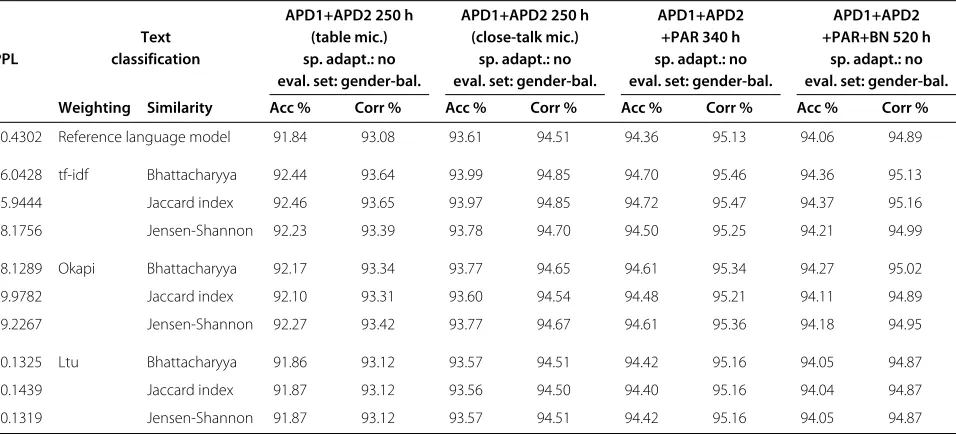
As regards the overall results performed on the ran-domly selected speech utterances from judicial domain, the first part of the experiments presented in the Tables 7 and 8 were oriented on the computing of model perplexity and performance of the Slovak LVCSR system after lan-guage modeling trained on classified text corpora using proposed approach.
The first table summarizes the performance of the
Slovak language modeling using acoustic models
trained on different speech databases, described in the Section 2.1. The results have shown that increasing the amount of acoustic data that were close to the examined domain with similar recording environment improved the recognition accuracy. On the other hand, the BN database degraded the results because the recording environment was quite different to the evaluation data selected from the APD databases.
The second table presents the quality of language mod-eling using gender-dependent acoustic models (optimized
to male and female speech) trained on the APD1, APD2 and PAR databases, giving the best results in previous experiment.
In the first two columns of the Table 8, the experi-mental results with acoustic models adapted to the male and female gender of speaker evaluated on the whole test data set are presented. The next two columns show the performance of language models in combination of gender-dependent acoustic models evaluated on the test speech utterances per gender.
As we can see from these results, gender-dependent acoustic modeling can significantly improve the recogni-tion accuracy. If we look at the language model perplexity, we have achieved significant reduction about 11% rel-atively in comparison with the reference model trained on unclassified text corpora, if we applied combination of tf-idf weighting with similarity based on Jaccard cor-relation index in the text classification process. Similar results were obtained in the accuracy and correctness evaluated by the LVCSR system. Slightly worse results were noticed when using the Okapi BM25 and Ltu weight-ing in combination with one of the selected similarity measure. However, we can say that the proposed text clas-sification approach had a significant impact on the overall robustness of the Slovak language modeling.
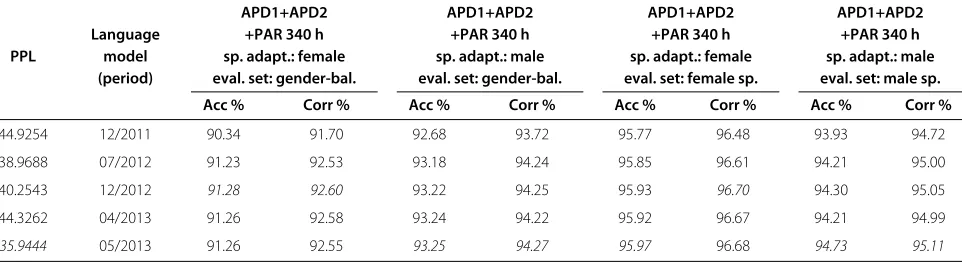
The second part of the experiments presented in the Tables 9 and 10 show the progress of acoustic and
Table 10 Model perplexity and performance of the Slovak LVCSR system with different language and gender-dependent acoustic models
APD1+APD2 APD1+APD2 APD1+APD2 APD1+APD2
Language +PAR 340 h +PAR 340 h +PAR 340 h +PAR 340 h
PPL model sp. adapt.: female sp. adapt.: male sp. adapt.: female sp. adapt.: male (period) eval. set: gender-bal. eval. set: gender-bal. eval. set: female sp. eval. set: male sp.
Acc % Corr % Acc % Corr % Acc % Corr % Acc % Corr %
44.9254 12/2011 90.34 91.70 92.68 93.72 95.77 96.48 93.93 94.72
38.9688 07/2012 91.23 92.53 93.18 94.24 95.85 96.61 94.21 95.00
40.2543 12/2012 91.28 92.60 93.22 94.25 95.93 96.70 94.30 95.05
44.3262 04/2013 91.26 92.58 93.24 94.22 95.92 96.67 94.21 94.99
language modeling in development of the Slovak tran-scription and dictation system from the judicial domain, observed during the recent time periods.
With increasing amount of acoustic and linguistic data from the judicial domain, using gender-dependent acous-tic modeling and speaker adaptation based on max-imum likelihood linear regression (MLLR) as well as much better text preprocessing and classification for robust domain-specific language modeling, we achieved the speech recognition accuracy nearly 95% with a sig-nificant decrease in language model perplexity. Besides the better text processing and classification of training data, this result was achieved either by introducing classes of names, surnames, and other named entities into the recognition dictionary; representation of geographically named entities and technical terms by multiword expres-sions; by modeling of filled pauses in a language; or by effective adaptation of language models to the ted domain (see the Table 6).
In the future, we want to build also a new evaluation data set containing different acoustic environments to compare the performance of the Slovak LVCSR system for mixed end-user environments.
6 Conclusions
This paper proposed an algorithm for classification of heterogeneous text corpora to the in-domain and out-of-domain data with the aim of increasing robustness and quality of the statistical language modeling in task-oriented continuous speech recognition. By combining straightforward and effective methods used for text classi-fication and document clustering based on topic detection with key phrases in short text segments, term weighting, measuring similarity between documents and automatic thresholding, we have achieved significant improvement in the quality of modeling of the Slovak language and per-formance of the Slovak automatic transcription and dicta-tion system. The proposed algorithm can also be used in classification of heterogeneous text corpora into the other domains depending on the used development data.
Further research should be also focused on a better key phrase extraction in fully unsupervised manner with-out using morphologically annotated corpora or applica-tion of dimensionality reducapplica-tion based on singular value decomposition and using latent semantic indexing or principal component analysis for better representation of text documents in the vector space despite of very high time and memory requirements of this process. Based on the initial tests with document clustering using the latent Dirichlet allocation, our proposed classification approach gives the similar results in the model perplexity as well as the recognition accuracy of the Slovak LVCSR system.
Besides the better text preprocessing and classifica-tion of the training data, the robustness and quality of
modeling of the Slovak language can be enhanced by addition of large amount of text data from transcripts of real speech recordings, introducing modeling of disflu-ent speech in a language, or by adaptation of language models to a specific user, group of users, or conversation, depending on the speech recognition task in which they will be used, for example, broadcast news transcription or meeting speech recognition.
Competing interests
The authors declare that they have no competing interests.
Acknowledgements
The research presented in this paper was partially supported by the Ministry of Education, Science, Research and Sport of the Slovak Republic under the research projects MS SR 3928/2010-11 (20%) and VEGA 1/0386/12 (30%) and the Research and Development Operational Program funded by the ERDF under the project ITMS-26220220141 (50%).
Received: 20 November 2013 Accepted: 26 March 2014 Published: 15 April 2014
References
1. J Juhár, J Staš, D Hládek, inNew Technologies - Trends, Innovations and Research, ed. by C Volosencu. Recent progress in development language model for Slovak large vocabulary continuous speech recognition (InTech Open Access, Rijeka, 2012), pp. 261–276
2. Rusko M, J Juhár, M Trnka, Staš J, S Darjaa, D Hládek, R Sabo, M Pleva, Ritomský M, Ondáš S, inProceedings of the 6th Language and Technology Conference on HLT. Recent advances in the Slovak dictation system for the judicial domain (Pozna ´n, LTC, 2013), pp. 555–560
3. A Huang, inProceedings of the 6th New Zealand Computer Science Research Student Conference. Similarity measures for text document clustering (Christchurch, NZCSRSC, 2008), pp. 49–56
4. L Yue, S Xiao, X Lv, T Wang, inProceedings of 2011 International Conference on Mechatronic Science, Electric Engineering and Computer. Topic detection based on keyword (Jilin, MEC, 2011), pp. 464–467
5. CD Manning, P Raghavan, H Schütze,Introduction to Information Retrieval. (Cambridge University Press, Cambridge, 2009)
6. F Peng, D Schuurmans, S Wang, Augmenting naïve Bayes classifiers with statistical language models. Inf. Retr.7(3–4), 317–345 (2004)
7. S Tan, An effective refinement strategy for KNN text classifier. Expert Syst. Appl.30(2), 290–298 (2006)
8. N Remeikis, I Skuˇcas, Melninkaité V, Text categorization using neural networks initialized with decision trees. Informatica.15(4), 551–564 (2004) 9. T Joachims, inProceedings of the 10th European Conference on ML. Text
categorization with support vector machines: learning with many relevant features (Chemnitz, ECML, 1998), pp. 137–142
10. W Zhang, T Yoshida, X Tang, inProceedings of the 2nd International Conference on Business Intelligence and Financial Engineering. Text classification using semi-supervised clustering (Beijing, BIFE, 2009), pp. 197–200
11. S Darjaa, M Cer ˇnak, M Trnka, M Rusko, inProceeding of INTERSPEECH 2011. Effective triphone mapping for acoustic modeling in speech recognition (Florence, INTERSPEECH, 2011), pp. 1717–1720
12. M Pleva, J Juhár, Building of broadcast news database for evaluation of the automated subtitling service. Communications.15(2A), 124–128 (2013) 13. D Hládek, Staš J, J Juhár, Dagger, inProceedings of the 54th International
Symposium ELMAR 2012. the Slovak morphological classifier (Zadar, ELMAR, 2012), pp. 195–198
14. R Garabík, inProceedings of the 1st Workshop on Intelligent and Knowledge Oriented Technologies. Slovak morphology analyzer based on Levenshtein edit operations (Bratislava, WIKT, 2006), pp. 2–5
15. Staš J, D Hládek, J Juhár, M Ološtiak, inProceedings of the 7th International Conference on Natural Language Processing, Corpus Linguistics and E-learning. Automatic extraction of multiword units from Slovak text corpora (Bratislava, SLOVKO, 2013), pp. 228–237
16. JW Reed, Y Jiao, TE Potok, BA Klump, MT Elmore, AR Hurson, TF-ICF, in
Applications. a new term weighting scheme for clustering dynamic data sets (ICMLA Orlando, 2006), pp. 258–263
17. Zlacký D, Staš J, J Juhár, A ˇCižmár,Term weighting schemes for Slovak text document clustering. (J. Electr. Electron. Eng, ed.), vol. 6, (2013), pp. 163–166 18. R Jin, C Falusos, AG Hauptmann, inProceedings of the 24th Annual
International ACM Conference on Research and Development in Information Retrieval. Meta-scoring: automatically evaluating term weighting schemes in IR without precision-recall (New Orleans, USA, SIGIR ACM, New York, 2001), pp. 83–89
19. SE Robertson, S Walker, S Jones, MM Hancock-Beaulieu, M Gatford, in
Proceedings of the 3rd Text Retrieval Conference. Okapi at TREC-3 (Gaithersburg, TREC-3, 1996), pp. 109–126
20. JS Whissell, Clarke ChLA, Improving document clustering using Okapi BM25 feature weighting. Inf. Retr.14(5), 466–487 (2011)
21. A Singhal, inProceedings of the 6th Text Retrieval Conference. AT&T at TREC-6 (Gaithersburg, TREC-6, 1998), pp. 215–226
22. S Lee, J Song, Y Kim, An empirical comparison of four text mining methods. J. Comp. Inf. Sys.51(1), 1–10 (2010)
23. SH Cha, Comprehensive survey on distance/similarity measures between probability density functions. Intl. J. Math. Model. Methods Appl. Sci.1(4), 300–307 (2007)
24. PL Rosin, Edges: saliency measures and automatic thresholding. Technical Note No. I.95.58: Institute for Remote Sensing Applications (1995) 25. A Lee, T Kawahara, inem Proceedings of the 2009 Asia-Pacific Signal and
Information Processing Association Annual Summit and Conference. Recent development of open-source speech recognition engine Julius (Sapporo, APSIPA ASC, 2009), pp. 131–137
26. A Stolcke, J Zheng, W Wang, V Abrash, inProceedings of IEEE Automatic Speech Recognition and Understanding Workshop. SRILM at sixteen: update and outlook (Waikoloa, ASRU, 2011), p. 5 pages
doi:10.1186/1687-4722-2014-14
Cite this article as:Stašet al.:Classification of heterogeneous text data
for robust domain-specific language modeling.EURASIP Journal on Audio, Speech, and Music Processing20142014:14.
Submit your manuscript to a
journal and benefi t from:
7Convenient online submission 7Rigorous peer review
7Immediate publication on acceptance 7Open access: articles freely available online 7High visibility within the fi eld
7Retaining the copyright to your article